- Base Value(2025): 5.9 Bn
- Estimated Value(2025): 5.9 Bn
- Forecast Value (2035): 8.9 Bn
- CAGR (2025 - 2035): 4.2%
Grease Market Forecast and Outlook 2025 to 2035
The global grease market is projected to reach USD 8.9 billion by 2035, recording an absolute increase of USD 3.0 billion over the forecast period. The market is valued at USD 5.9 billion in 2025 and is set to rise at a CAGR of 4.2% during the assessment period.
The overall market size is expected to grow by approximately 1.5 times during the same period, supported by increasing industrialization and expanding manufacturing capacity across emerging economies worldwide, driving demand for reliable lubrication solutions and increasing investments in advanced grease formulations with enhanced performance characteristics across automotive, construction, and heavy equipment applications globally.
Quick Stats for Grease Market
- Grease Market Value (2025): USD 5.9 billion
- Grease Market Forecast Value (2035): USD 8.9 billion
- Grease Market Forecast CAGR: 4.2%
- Leading Form in Grease Market: Mineral (57.2%)
- Key Growth Regions in Grease Market: Asia Pacific, North America, and Europe
- Top Players in Grease Market: Shell, Chevron, BP, ExxonMobil, TotalEnergies, Fuchs Petrolub, SKF, Idemitsu Kosan, Sinopec, PetroChina
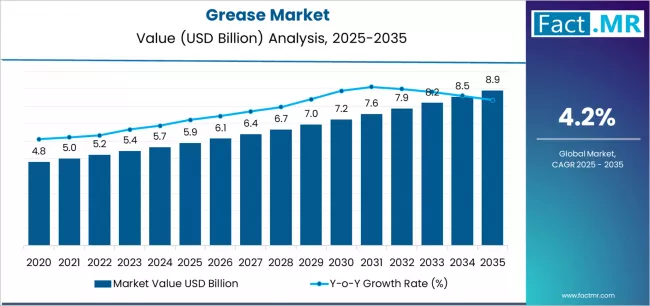
Grease Market Market Value Analysis | Source: Fact.MR
Industrial operations face mounting pressure to extend equipment lifecycles while minimizing maintenance downtime and reducing total cost of ownership, with modern grease products providing documented operational benefits including superior extreme pressure protection, enhanced water resistance, and extended relubrication intervals compared to conventional lubricants alone.
Rising adoption of condition-based maintenance strategies and expanding integration with predictive maintenance programs enabling optimized lubrication practices create substantial opportunities for manufacturers and industrial distributors. However, raw material price volatility and increasing competition from alternative lubrication technologies may pose obstacles to traditional market growth patterns.
The mineral grease segment dominates market activity, driven by cost-effectiveness and proven performance across diverse industrial applications including automotive bearings and general-purpose machinery lubrication worldwide. Industries increasingly recognize the operational benefits of mineral-based formulations, with typical product offerings providing reliable protection and consistent performance at accessible price points through established distribution networks.
The manufacturing application segment demonstrates robust growth potential, supported by rising global manufacturing output and comprehensive equipment maintenance programs integrating systematic lubrication protocols in production environments. Manufacturing emerges as the dominant application sector, reflecting extensive grease consumption for machinery maintenance and operational reliability optimization in industrial facilities. India represents the fastest-growing market, driven by rapid infrastructure development and expanding manufacturing capacity supporting increased lubricant consumption.
Regional dynamics show India maintaining the fastest growth trajectory, supported by extensive infrastructure investments and government initiatives promoting domestic manufacturing across industrial sectors. China demonstrates strong growth potential driven by continuous industrial expansion and modernization of manufacturing capabilities requiring advanced lubrication solutions, while USA emphasizes equipment reliability and maintenance optimization for operational excellence.
Germany leads European growth through automotive manufacturing leadership and precision engineering requirements, followed by Japan supported by advanced manufacturing technologies and quality-focused maintenance practices. The competitive landscape features moderate concentration with Shell maintaining market leadership position at 17.1% market share, while established players including Chevron, BP, ExxonMobil, and TotalEnergies compete through comprehensive product portfolios and technical service capabilities across diverse industrial applications.
Grease Market Year-over-Year Forecast 2025 to 2035
Between 2025 and 2029, the grease market is projected to expand from USD 5.9 billion to USD 6.9 billion, resulting in a value increase of USD 1.0 billion, which represents 33.3% of the total forecast growth for the period. This phase of development will be shaped by rising demand for high-performance grease formulations addressing extreme operating conditions, product innovation in synthetic and bio-based grease technologies with enhanced environmental profiles and extended service life, as well as expanding adoption in renewable energy applications and electric vehicle components. Companies are establishing competitive positions through investment in additive technology development, advanced testing capabilities, and strategic market expansion across automotive aftermarket, industrial distribution, and original equipment manufacturer channels.
From 2029 to 2035, the market is forecast to grow from USD 6.9 billion to USD 8.9 billion, adding another USD 2.0 billion, which constitutes 66.7% of the overall expansion. This period is expected to be characterized by the expansion of specialized applications, including food-grade formulations for processing equipment and high-temperature greases for renewable energy installations tailored for specific operational requirements, strategic collaborations between grease manufacturers and equipment producers, and an enhanced focus on sustainability initiatives and circular economy principles. The growing emphasis on predictive maintenance technologies and rising adoption of condition monitoring systems will drive demand for premium grease products with extended performance capabilities across diverse industrial sectors.
Grease Market Key Takeaways
| Metric | Value |
|---|---|
| Market Value (2025) | USD 5.9 billion |
| Market Forecast Value (2035) | USD 8.9 billion |
| Forecast CAGR (2025-2035) | 4.2% |
Source: Fact.MR analysis. Updated Dec 2, 2025
Why is the Grease Market Growing?
The grease market grows by enabling industrial operations and automotive applications to maintain equipment reliability and extend component lifecycles while reducing friction-related wear and preventing premature failure without frequent relubrication requirements and excessive maintenance interventions.
Industrial facilities face mounting pressure to maximize equipment uptime and minimize unplanned maintenance costs while operating in demanding conditions, with modern grease formulations typically providing superior protection including extreme pressure capabilities, water washout resistance, and thermal stability compared to basic lubricants alone, making advanced grease essential for comprehensive equipment maintenance.
The manufacturing industry's need for reliable lubrication solutions and cost-effective maintenance programs creates demand for specialized grease products that can provide long-lasting protection, reduce maintenance frequency, and support operational efficiency without compromising equipment performance or safety standards.
Equipment manufacturer specifications and performance requirements drive adoption in automotive environments, industrial machinery applications, and heavy equipment operations, where lubrication quality has direct impact on component longevity and operational reliability.
The increasing complexity of modern machinery and equipment, incorporating higher operating speeds and loads across manufacturing and transportation sectors, creates expanding grease consumption supporting advanced protection requirements.
Rising awareness about total cost of ownership and lifecycle management enables informed lubrication decisions and adoption of premium grease formulations. However, alternative lubrication technologies and increasing electrification of automotive systems may limit traditional grease consumption patterns among certain application segments with different lubrication requirements.
Segmental Analysis
The market is segmented by form, application, and region. By form, the market is divided into mineral, synthetic, and bio-based. Based on application, the market is categorized into manufacturing, construction, metal & mining, power generation, food processing, agriculture, and other applications. Regionally, the market is divided into Asia Pacific, Europe, North America, Latin America, and Middle East & Africa.
By Form, Which Segment Accounts for the Dominant Market Share?
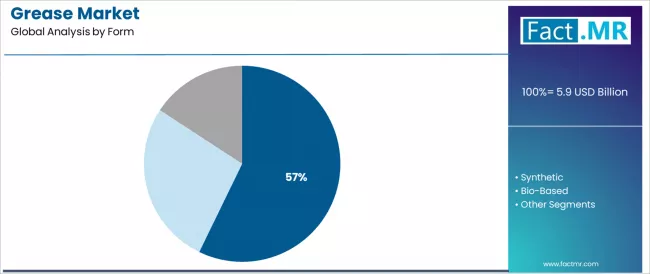
Grease Market Analysis By Form | Source: Fact.MR
The mineral grease segment represents the dominant force in the grease market, capturing 57.2% of the total market share in 2025. This established product category encompasses solutions featuring petroleum-derived base oils and proven additive technologies, including advanced formulations combining lithium complex thickeners and extreme pressure additives that enable reliable performance and cost-effective lubrication across automotive bearings, industrial machinery, and general-purpose maintenance applications worldwide.
The mineral segment's market leadership stems from its superior cost-performance balance, with solutions capable of addressing mainstream lubrication requirements including bearing protection, chassis lubrication, and general equipment maintenance while maintaining accessible pricing and widespread availability across distribution networks.
Synthetic grease maintains a substantial market share in the 28-32% range, serving high-performance applications requiring exceptional thermal stability, extended service intervals, and operation in extreme environments including aerospace bearings, electric motor applications, and high-temperature industrial equipment.
Synthetic grease offers superior oxidation resistance for demanding operational conditions while providing sufficient performance to justify premium pricing. The synthetic segment demonstrates strong growth potential, driven by expanding requirements for extended lubrication intervals and increasing emphasis on energy efficiency optimization.
Within the form category, bio-based grease demonstrates growing adoption, driven by environmental regulations and sustainability initiatives promoting biodegradable lubricants for environmentally sensitive applications. This sub-segment benefits from regulatory compliance requirements and consumer preference for sustainable products.
Key performance advantages driving the mineral segment include:
- Cost-effective formulations with proven performance characteristics enabling widespread adoption across price-sensitive applications without compromising basic protection requirements
- Established manufacturing infrastructure allowing efficient production and consistent quality while maintaining competitive pricing structures
- Broad application compatibility enabling use in diverse equipment types and operating conditions while maintaining reliable performance
- Extensive distribution networks providing optimal product availability and technical support across automotive and industrial market segments
By Application, Which Segment Accounts for the Largest Market Share?
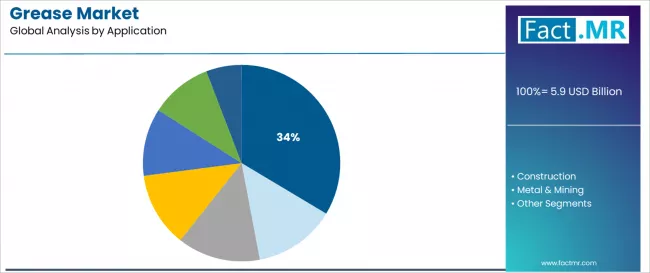
Grease Market Analysis By Application | Source: Fact.MR
Manufacturing dominates the grease application landscape with a 33.6% market share in 2025, reflecting the critical role of effective lubrication in supporting production equipment reliability and operational efficiency across industrial manufacturing facilities worldwide. The manufacturing segment's market leadership is reinforced by extensive machinery populations, continuous operating requirements, and comprehensive preventive maintenance programs that depend on systematic lubrication practices.
Within this segment, bearing lubrication represents the primary grease consumption category, driven by universal bearing applications across rotating equipment and material handling systems. This sub-segment benefits from established maintenance protocols and high relubrication frequencies supporting consistent grease demand.
The construction application segment represents an important category with robust growth potential, demonstrating strong expansion through specialized requirements for heavy equipment lubrication and operation in contaminated environments. This segment benefits from infrastructure development initiatives and construction equipment fleet expansion.
The metal & mining segment maintains significant presence through extreme-duty applications requiring superior protection capabilities, while power generation applications address critical rotating equipment in turbines and generators. Food processing applications serve specialized needs for food-grade lubricants meeting regulatory requirements.
Key market dynamics supporting application segment growth include:
- Manufacturing segment expansion driven by global production growth and equipment modernization, requiring comprehensive lubrication programs and preventive maintenance protocols
- Construction category growth trends requiring heavy-duty formulations and contamination resistance for earthmoving equipment
- Integration of condition monitoring systems enabling optimized relubrication intervals and predictive maintenance approaches
- Growing emphasis on application-specific formulations driving specialized product development for targeted equipment requirements
What are the Drivers, Restraints, and Key Trends of the Grease Market?
The market is driven by three concrete demand factors tied to industrial operational outcomes. First, rising global manufacturing output and expanding industrial capacity create increasing equipment populations requiring systematic lubrication maintenance, with grease consumption representing an essential operational requirement for machinery reliability in production environments, requiring widespread product availability. Second, growing emphasis on equipment lifecycle management and total cost of ownership optimization drives facility adoption and maintenance program implementation, with premium grease formulations demonstrating significant benefits in extended component life, reduced maintenance frequency, and improved operational reliability through enhanced protection by 2030. Third, increasing infrastructure development and construction activity enable more extensive heavy equipment deployment that drives grease consumption while supporting economic development and urbanization initiatives.
Market restraints include raw material price volatility and base oil supply fluctuations that can challenge profit margins and pricing stability, particularly in commodity-grade products where competitive pricing pressures limit ability to pass through cost increases and margin compression proves inevitable. Automotive electrification trends and reduced lubrication requirements in electric vehicle drivetrains pose another significant obstacle, as traditional automotive grease consumption depends on conventional powertrains and mechanical systems, potentially affecting long-term volume growth in transportation sectors. Competition from automatic lubrication systems and centralized lubrication solutions create additional challenges for traditional manual greasing practices, demanding product differentiation and value-added services.
Key trends indicate accelerated synthetic grease adoption in developed markets, particularly North America and Europe, where end-users demonstrate willingness to invest in premium formulations offering extended service intervals, enhanced performance characteristics, and improved environmental profiles. Sustainability trends toward bio-based and biodegradable grease formulations with renewable content and reduced environmental impact enable regulatory compliance and corporate sustainability objectives. However, the market thesis could face disruption if significant advances in solid lubricant technologies or major shifts in equipment design approaches reduce reliance on traditional grease-based lubrication strategies.
Analysis of the Grease Market by Key Countries
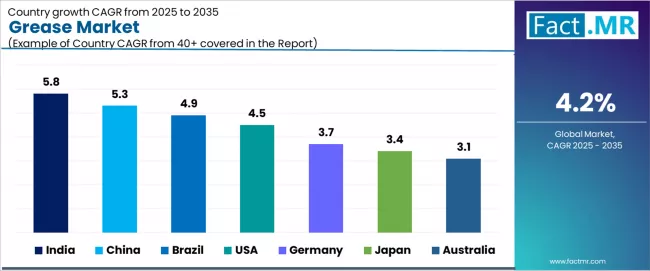
Grease Market Cagr Analysis By Country | Source: Fact.MR
| Country | CAGR (2025-2035) |
|---|---|
| India | 5.8% |
| China | 5.3% |
| Brazil | 4.9% |
| USA | 4.5% |
| Germany | 3.7% |
| Japan | 3.4% |
| Australia | 3.1% |
Source: Fact.MR analysis. Updated Dec 2, 2025
The global grease market is expanding steadily, with India leading at a 5.8% CAGR through 2035, driven by robust infrastructure development, expanding manufacturing sector, and rising automotive production supporting increased lubricant consumption. China follows at 5.3%, supported by continuous industrial expansion, construction activity growth, and extensive machinery populations. USA records 4.5%, reflecting a mature landscape with steady replacement demand and emphasis on premium product adoption.
Germany advances at 3.7%, leveraging automotive manufacturing excellence and industrial equipment sophistication. Japan posts 3.4%, focusing on high-performance formulations and precision maintenance practices, while Brazil grows steadily at 4.9%, emphasizing agricultural mechanization and mining sector expansion. Australia demonstrates 3.1% growth, anchored by mining operations and agricultural equipment populations.
How is India Leading Global Market Expansion?
India demonstrates the strongest growth potential in the grease market with a CAGR of 5.8% through 2035. The country's leadership position stems from rapid infrastructure development, expanding manufacturing capacity under government initiatives, and increasing automotive production driving comprehensive lubricant demand across industrial and transportation sectors.
Growth is concentrated in major industrial regions and manufacturing hubs, including Gujarat, Maharashtra, Tamil Nadu, and Karnataka, where facilities are increasingly consuming grease for equipment maintenance and operational reliability beyond traditional lubrication approaches.
Distribution channels through automotive parts distributors, industrial suppliers, and retail outlets expand product accessibility across urban centers and industrial zones. The country's growing emphasis on domestic manufacturing and infrastructure modernization provides strong momentum for industrial lubricant consumption, including comprehensive adoption across construction equipment and agricultural machinery seeking reliable performance.
Key market factors:
- Manufacturing facilities concentrated in industrial corridors and special economic zones with extensive machinery populations
- Distribution expansion through automotive aftermarket networks and industrial supply chains enabling widespread availability
- Comprehensive infrastructure development programs, including road construction and urban development projects with proven equipment deployment
- Local manufacturing presence featuring international brands and domestic suppliers offering competitively priced products
Why is China Emerging as a High-Growth Market?
In major industrial regions including Jiangsu, Shandong, Guangdong, and Zhejiang, the consumption of grease products is accelerating across manufacturing facilities, driven by continuous industrial production growth and increasing emphasis on equipment maintenance programs. The market demonstrates strong growth momentum with a CAGR of 5.3% through 2035, linked to comprehensive manufacturing sector expansion trends and increasing adoption of systematic maintenance practices.
Chinese facilities are implementing advanced grease formulations integrated with preventive maintenance protocols to enhance equipment reliability while meeting growing expectations in production efficiency. The country's expanding construction sector and infrastructure investment create ongoing demand for heavy-duty grease formulations, while increasing emphasis on equipment modernization drives adoption of premium synthetic products.
Key development areas:
- Heavy industry and manufacturing operations leading grease consumption with emphasis on machinery protection and reliability
- Distribution expansion through both traditional wholesale networks and emerging e-commerce platforms
- Technology integration enabling grease applicator systems and automated lubrication equipment
- Growing preference for domestic brands addressing cost requirements alongside international products offering advanced formulations
What drives USA’s Market Resilience?
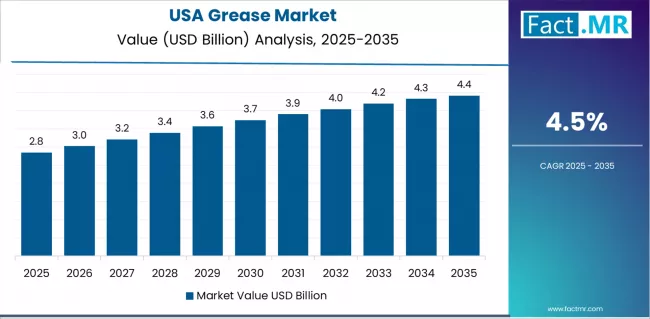
Grease Market Country Value Analysis | Source: Fact.MR
USA’s market expansion is driven by diverse consumption patterns, including premium synthetic grease in performance-conscious applications and reliable mineral-based products across mainstream maintenance segments. The country demonstrates steady growth potential with a CAGR of 4.5% through 2035, supported by continuous product innovation from established lubricant manufacturers and specialized grease producers.
American facilities face implementation challenges related to sustainability requirements and environmental regulations, necessitating reformulation efforts and performance validation strategies. However, established maintenance practices and comprehensive equipment populations create stable baseline demand for grease products, particularly among industrial facilities and automotive service providers where reliable lubrication drives primary purchasing decisions.
Market characteristics:
- Industrial manufacturing and automotive aftermarket segments showing robust demand with substantial annual consumption across maintenance applications
- Regional preferences varying between synthetic product emphasis in aerospace and automotive sectors and cost-effective formulations in general industrial markets
- Future projections indicate continued premiumization with emphasis on extended service intervals and enhanced performance characteristics
- Growing emphasis on bio-based formulations and sustainability credentials supporting environmental compliance objectives
How does Germany Demonstrate Automotive Excellence Leadership?
The market in Germany leads in high-performance grease adoption based on integration with automotive manufacturing excellence and precision engineering requirements for enhanced component protection and reliability. The country shows strong potential with a CAGR of 3.7% through 2035, driven by automotive sector leadership and advanced manufacturing sophistication in major industrial regions, including Baden-Württemberg, Bavaria, North Rhine-Westphalia, and Lower Saxony.
German facilities are adopting premium grease formulations through original equipment manufacturer specifications and comprehensive quality standards for complete equipment protection, particularly in export-oriented automotive production and precision machinery manufacturing demanding rigorous performance credentials. Distribution channels through automotive parts networks and industrial distributors expand coverage across manufacturing clusters and service centers.
Leading market segments:
- Automotive manufacturing facilities in major production centers implementing OEM-specified grease formulations
- Industrial equipment manufacturers achieving high adoption rates of specialized high-performance products
- Strategic collaborations between grease manufacturers and equipment producers expanding application development
- Focus on long-life formulations and extended service intervals addressing maintenance optimization requirements
What Positions Japan for Quality and Performance Leadership?
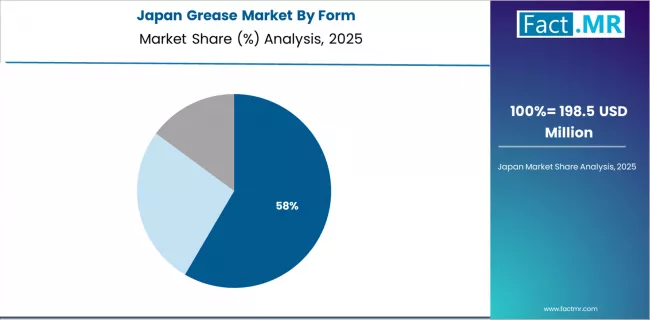
Grease Market Japan Market Share Analysis By Form | Source: Fact.MR
In Tokyo, Osaka, Nagoya, and other major industrial centers, facilities are implementing advanced grease solutions through precision maintenance protocols and comprehensive quality management systems, with documented case studies showing substantial equipment life improvements through systematic lubrication programs and premium product selection.
The market shows steady growth potential with a CAGR of 3.4% through 2035, linked to ongoing manufacturing sector sophistication, advanced maintenance practices, and emerging technology integration initiatives in major regions. Facilities are adopting high-performance grease formulations with precise application protocols to enhance equipment longevity while maintaining standards demanded by quality-focused manufacturing environments. The country's established automotive and electronics manufacturing sectors create ongoing opportunities for specialized grease applications that differentiate through technical performance and application support.
Market development factors:
- Precision manufacturing facilities leading adoption of high-quality grease formulations across Japan
- Quality-driven maintenance programs providing growth opportunities in automotive and electronics sectors
- Strategic partnerships between lubricant suppliers and equipment manufacturers expanding technical collaboration
- Emphasis on application engineering and technical service support addressing performance optimization requirements
How does Brazil Show Agricultural and Mining Sector Growth?
Brazil's grease market demonstrates substantial consumption focused on agricultural mechanization and mining operations, with documented integration of heavy-duty grease formulations achieving reliable equipment protection in demanding operational environments across agribusiness and extractive industries.
The country maintains solid growth momentum with a CAGR of 4.9% through 2035, driven by agricultural sector expansion and mining industry presence emphasizing equipment reliability methodologies that align with operational continuity requirements applied to Brazilian industrial operations.
Major agricultural regions, including Mato Grosso, Paraná, Rio Grande do Sul, and Goiás, showcase extensive grease consumption where farm equipment maintenance integrates seamlessly with seasonal agricultural cycles and comprehensive machinery management programs.
Key market characteristics:
- Agricultural and mining equipment populations driving demand for heavy-duty grease formulations
- Seasonal demand patterns enabling distribution planning aligned with planting and harvest cycles
- Technology adoption including automatic lubrication systems in modern agricultural equipment
- Focus on contamination resistance and water washout protection addressing operational environment challenges
What Characterizes Australia's Mining and Agriculture Focus?
In major mining regions including Western Australia, Queensland, and New South Wales, the consumption of grease products is substantial across mining operations and agricultural applications, driven by extensive equipment populations and demanding operational conditions. The market demonstrates steady growth potential with a CAGR of 3.1% through 2035, linked to ongoing mining sector activity and agricultural production supporting rural equipment populations.
Australian operations are implementing reliable grease formulations capable of performing in harsh environmental conditions to enhance equipment availability while meeting operational expectations in remote locations. The country's established mining industry and agricultural sector create ongoing demand for heavy-duty grease products, while increasing emphasis on operational efficiency drives adoption of premium formulations.
Key development areas:
- Mining operations leading grease consumption with emphasis on extreme-duty protection and reliability
- Distribution networks serving remote locations through regional wholesalers and equipment dealers
- Heavy-duty formulations supporting large earthmoving equipment and haul trucks in mining applications
- Integration of bulk lubrication systems enabling efficient regreasing programs in large equipment fleets
Europe Market Split by Country
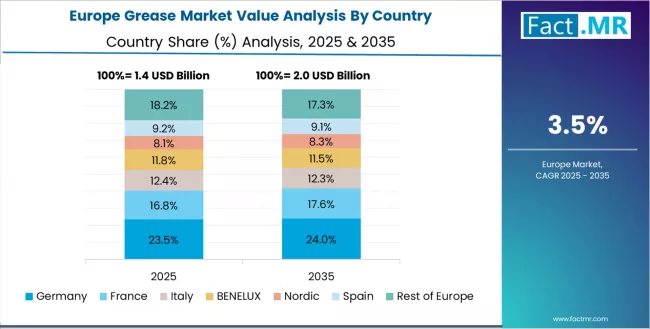
Grease Market Europe Country Market Share Analysis, 2025 & 2035 | Source: Fact.MR
The grease market in Europe is projected to grow from USD 1.4 billion in 2025 to USD 2.0 billion by 2035, registering a CAGR of 3.6% over the forecast period. Germany is expected to maintain its leadership position with a 31.8% market share in 2025, adjusting to 31.2% by 2035, supported by its extensive automotive manufacturing base, advanced industrial machinery populations, and comprehensive maintenance standards serving major European industrial sectors.
France follows with a 19.5% share in 2025, projected to reach 19.8% by 2035, driven by comprehensive aerospace manufacturing presence and agricultural equipment populations in major agricultural regions implementing systematic maintenance protocols. UK holds a 16.7% share in 2025, expected to maintain 16.9% by 2035 through ongoing development of manufacturing sector and construction equipment applications.
Italy commands a 14.2% share, while Spain accounts for 10.8% in 2025. The rest of Europe region is anticipated to gain momentum, expanding its collective share from 6.9% to 7.4% by 2035, attributed to increasing grease consumption in Nordic manufacturing facilities and emerging Eastern European industrial operations implementing modern maintenance practices.
Competitive Landscape of the Grease Market
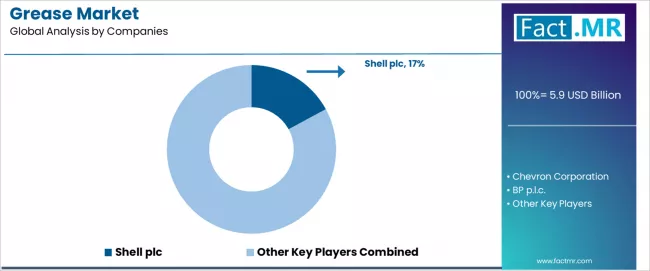
Grease Market Analysis By Company | Source: Fact.MR
The grease market features approximately 25-35 meaningful players with moderate concentration, where the top three companies control roughly 35-45% of global market share through established brand recognition, extensive distribution networks, and comprehensive product portfolios. Competition centers on technical performance, application support, and distribution reach rather than pricing competition alone.
Market leaders include Shell plc., maintaining a 17.1% market share, Chevron, and BP, which maintain competitive advantages through comprehensive grease product lines, proven formulation expertise, and deep relationships with automotive and industrial customers, creating high brand loyalty among users seeking reliable lubrication solutions. These companies leverage global distribution infrastructure and ongoing research and development investments to defend market positions while expanding into specialty applications including food-grade and environmentally acceptable formulations.
Challengers encompass established energy companies including ExxonMobil, TotalEnergies, and Fuchs Petrolub, which compete through strong regional presence and technical service capabilities supporting customer applications. Specialty lubricant manufacturers, including SKF, Idemitsu Kosan, and regional producers Sinopec and PetroChina, focus on specific market segments or geographic regions, offering differentiated capabilities in bearing grease formulations, automotive applications, and cost-competitive products.
Emerging regional brands and private label manufacturers create competitive pressure through aggressive pricing strategies and localized distribution advantages, particularly in high-growth markets including India and China, where domestic production capabilities provide cost advantages and market access.
Market dynamics favor companies that combine technical credibility with extensive distribution reach that addresses diverse customer requirements from original equipment manufacturers through aftermarket service providers. Strategic emphasis on application engineering support, technical training programs, and sustainability initiatives enables differentiation in increasingly performance-driven grease market segments across developed and emerging markets.
Global Grease Market — Stakeholder Contribution Framework
Grease represents a critical lubrication product that enables industrial operations and automotive applications to maintain equipment reliability and extend component lifecycles while reducing friction-related wear and preventing premature failure without frequent relubrication requirements and excessive maintenance interventions, typically providing superior protection including extreme pressure capabilities, water washout resistance, and thermal stability compared to basic lubricants alone while ensuring improved equipment uptime and comprehensive maintenance outcomes.
With the market projected to grow from USD 5.9 billion in 2025 to USD 8.9 billion by 2035 at a 4.2% CAGR, these products offer compelling advantages for manufacturing applications, mineral-based formulations, and diverse equipment populations seeking cost-effective lubrication solutions. Scaling market development and sustainable growth requires coordinated action across product innovation, industry standards, lubricant manufacturers, equipment producers, and end-user education initiatives.
How Could Governments Spur Local Development and Adoption?
- Industrial Development Programs: Include lubrication best practices in manufacturing competitiveness initiatives, providing targeted support for maintenance excellence programs in small and medium enterprises and supporting technical training through development grants and vocational programs.
- Tax Policy & Investment Support: Implement favorable tax treatment for domestic lubricant manufacturing, provide incentives for companies investing in sustainable formulation technologies and bio-based product development, and establish import duty structures that encourage local production over imports.
- Standards & Quality Framework Development: Create quality standards for grease products across industrial applications, establish performance testing protocols and specification guidelines for consumer protection, and develop harmonization initiatives that facilitate cross-border trade.
- Environmental & Safety Regulations: Fund initiatives promoting biodegradable formulations and environmentally acceptable lubricants, invest in waste oil management infrastructure supporting circular economy principles, and establish clear guidelines for food-grade and incidental food contact applications.
- Research & Innovation Support: Establish public-private partnerships for advanced lubricant research, support collaborative development investigating new additive technologies and base oil alternatives, and create regulatory frameworks that encourage sustainable product innovation.
How Could Industry Bodies Support Market Development?
- Technical Standards & Specifications: Define standardized performance classifications for grease products across application categories, establish universal testing methodologies and quality benchmarks, and create specification frameworks that equipment manufacturers and end-users can reference.
- Market Education & Best Practices: Lead initiatives demonstrating proper grease selection, emphasizing application-appropriate product matching, relubrication interval optimization, and realistic performance expectations compared to inadequate lubrication approaches.
- Quality Assurance Programs: Develop guidelines for manufacturing excellence, quality control procedures, and performance validation testing, ensuring product reliability across production and distribution operations.
- Professional Development: Run certification programs for maintenance technicians, lubrication specialists, and industrial engineers on optimizing grease applications, contamination control strategies, and systematic maintenance approaches in diverse equipment populations.
How Could Manufacturers and Technology Players Strengthen the Ecosystem?
- Advanced Product Development: Develop next-generation grease formulations with enhanced extreme pressure protection, superior water resistance, and extended service capabilities that improve equipment protection while reducing maintenance frequency and total cost of ownership.
- Application Engineering Support: Provide comprehensive technical assistance, lubrication surveys, and application-specific recommendations that help customers optimize product selection and maintenance practices.
- Sustainability Initiatives: Offer environmentally responsible formulations including bio-based products, reduced toxicity formulations, and biodegradable options that support corporate sustainability objectives and regulatory compliance.
- Research & Development Networks: Build comprehensive R&D capabilities, collaborative testing programs, and field trial partnerships that ensure grease products maintain high performance standards and meet evolving application requirements.
How Could Equipment Manufacturers and Distributors Navigate the Market?
- Lubrication Specification Development: Incorporate optimized grease specifications into equipment designs, with particular focus on extended service intervals, compatibility requirements, and application-specific characteristics for comprehensive equipment protection.
- Distribution Excellence: Establish efficient supply chain networks addressing product availability, technical support capabilities, and customer service through optimized logistics frameworks and inventory management systems.
- Technical Training Programs: Implement comprehensive education initiatives addressing proper grease application techniques, storage and handling procedures, and contamination prevention through structured training programs and certification courses.
- Customer Support Services: Develop application engineering capabilities addressing lubrication audits, used grease analysis, and continuous improvement programs that enable customers to maximize equipment reliability and maintenance efficiency.
How Could Investors and Financial Enablers Unlock Value?
- Sustainability Investment: Provide growth capital for established companies like Shell, Chevron, and specialty manufacturers to fund bio-based product development and sustainable formulation initiatives supporting environmental objectives.
- Innovation Financing: Back companies developing advanced additive technologies, solid lubricant alternatives, and next-generation base oil solutions that enhance performance capabilities and environmental profiles.
- Market Expansion Funding: Finance distribution network expansion strategies for lubricant manufacturers establishing operations in high-growth regions including India and China, supporting localization initiatives that address market-specific requirements.
- Consolidation Support: Enable strategic acquisitions that combine manufacturing capacity with distribution reach, creating comprehensive solution providers with enhanced competitive positioning and market coverage.
Key Players in the Grease Market
- Shell plc
- Chevron Corporation
- BP p.l.c.
- Exxon Mobil Corporation
- TotalEnergies SE
- FUCHS Petrolub SE
- SKF Group
- Idemitsu Kosan Co., Ltd.
- China Petrochemical Corporation (Sinopec)
- PetroChina Company Limited
Segmentation
Scope of the Report
| Items | Values |
|---|---|
| Quantitative Units | USD 5.9 Billion |
| Form | Mineral, Synthetic, Bio-Based |
| Application | Manufacturing, Construction, Metal & Mining, Power Generation, Food Processing, Agriculture, Other Applications |
| Regions Covered | Asia Pacific, Europe, North America, Latin America, Middle East & Africa |
| Country Covered | India, China, Brazil, USA, Germany, Japan, Australia, and 40+ countries |
| Key Companies Profiled | Shell, Chevron, BP, ExxonMobil, TotalEnergies, Fuchs Petrolub, SKF, Idemitsu Kosan, Sinopec, PetroChina |
| Additional Attributes | Dollar sales by form and application categories, regional consumption trends across Asia Pacific, Europe, and North America, competitive landscape with lubricant manufacturers and distribution companies, product specifications and performance requirements, compatibility with equipment manufacturer recommendations and maintenance protocols, innovations in synthetic formulations and bio-based technologies, and development of specialized applications with enhanced performance characteristics and extended service capabilities. |
Source: Fact.MR analysis. Updated Dec 2, 2025
Grease Market by Segments
-
Form :
- Mineral
- Synthetic
- Bio-Based
-
Application :
- Manufacturing
- Construction
- Metal & Mining
- Power Generation
- Food Processing
- Agriculture
- Other Applications
-
Region :
- Asia Pacific
- China
- Japan
- South Korea
- India
- Australia
- Thailand
- Rest of Asia Pacific
- Europe
- Germany
- UK
- France
- Italy
- Spain
- Denmark
- Sweden
- Norway
- Rest of Europe
- North America
- USA
- Canada
- Mexico
- Latin America
- Brazil
- Argentina
- Rest of Latin America
- Middle East & Africa
- South Africa
- Saudi Arabia
- UAE
- Kuwait
- Rest of Middle East & Africa
- Asia Pacific
Frequently Asked Questions
How big is the grease market in 2025?
What will be the size of grease market in 2035?
How much will be the grease market growth between 2025 and 2035?
What are the key product types in the grease market?
Which application segment to contribute significant share in the grease market in 2025?
Who worked on this report


Preview the report firsthand - request a free sample
Free SampleGet the brochure for pricing and purchase details
Download PDF