- Market Value (2025): USD 17.7 Bn
- Estimated Value (2026): USD 18.7 Bn
- Forecast Value (2036): USD 31.9 Bn
- CAGR (2026-2036): 5.5%
What is the Heavy Gauge and Thin Gauge Thermoformed Plastics Market forecast to be worth by 2036?
USD 18.7 billion in 2026 to USD 31.9 billion by 2036 at 5.5% CAGR.
- The heavy gauge and thin gauge thermoformed plastics market reached USD 17.7 billion in 2025 as packaging buyers continued using formed plastic formats for display and protection.
- Demand is forecast to increase from USD 18.7 billion in 2026 to USD 31.9 billion by 2036.
- The market is projected to expand at 5.5% CAGR from 2026 to 2036.
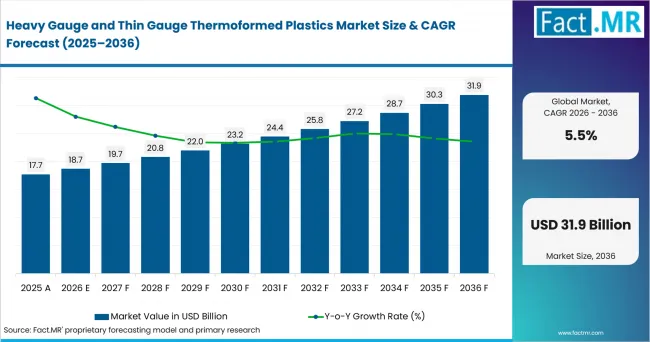
Heavy Gauge And Thin Gauge Thermoformed Plastics Market Value Analysis | Source: Fact.MR
What are the defining numbers behind Heavy Gauge and Thin Gauge Thermoformed Plastics Market growth?
USD 13.1 billion absolute opportunity by 2036 is led by thin gauge thermoformed plastics and food packaging.
- Demand Drivers in the Market
- Thin-gauge formats are expected to support high-volume thermoformed plastic product runs where pack shape must remain stable across fast filling lines.
- Eurostat reported in October 2025 that the EU generated 35.3 kg of plastic packaging waste per person in 2023. Food producers are expected to keep pack design under review where portion control and recovery claims affect buyer approval.
- Heavy-gauge thermoforming is likely to remain useful for reusable handling parts and protective covers that need stiffness without complex molds.
- PET containers and trays are anticipated to gain preference where buyers need clear packs with practical rigidity and recovery routes.
- Key Segments Analyzed
- By Product Category: Thin Gauge Thermoformed Plastics is expected to hold 58.0% share in 2026 since high-volume packaging needs fast forming and repeatable cavity quality.
- By Application: Food Packaging is projected to account for 34.0% share in 2026 as trays and formed containers remain common in chilled and prepared foods.
- By End User: Food & Beverage Industry is anticipated to capture 39.0% share in 2026 with packaging decisions tied to hygiene and shelf handling.
- By Distribution Channel: Direct Sales is estimated to represent 52.0% share in 2026 due to specification-led orders and recurring supply agreements.
- By Material Type: Polyethylene Terephthalate is forecast to hold 31.0% share in 2026 as clarity and formed-pack rigidity support food and retail uses.
- Analyst Opinion at Fact.MR
- Shambhu Nath Jha, Principal Consultant at Fact.MR, states, “Food packaging buyers are expected to review forming quality and sealing behavior first. Material consistency and supplier response then influence wider program approval.”
- Strategic Implications
- Packaging converters should align forming capacity with industrial packaging and food packaging programs where shape consistency and line speed influence repeat orders.
- Material suppliers can strengthen account access by supporting PET sheets that balance clarity with processing stability and buyer recovery review.
- Industrial part producers should separate heavy-gauge projects from commodity packaging work so buyers can compare durability and tooling needs clearly.
The USA leads at 6.2% CAGR through food packaging and industrial use. Germany follows at 6.0% through packaging engineering. China reaches 5.8% through production scale. Japan records 5.5% through precision forming. Canada posts 5.3% through retail packaging demand. France reaches 5.0% through sustainability review. India grows at 4.8% through packaged-food and manufacturing expansion.
How does the Heavy Gauge and Thin Gauge Thermoformed Plastics Market break down by segment?
Thin Gauge Thermoformed Plastics is expected to lead Product Category at 58.0% share in 2026. Food Packaging is projected to lead Application at 34.0% share in 2026.
Why does Thin Gauge Thermoformed Plastics lead Product Category?
Thin Gauge Thermoformed Plastics is expected to hold 58.0% share in 2026.
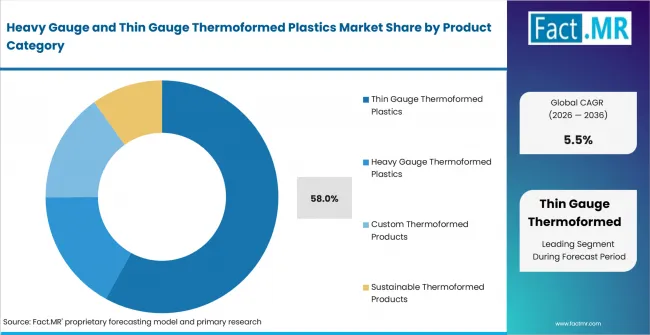
Heavy Gauge And Thin Gauge Thermoformed Plastics Market Analysis By Product Category | Source: Fact.MR
Thin Gauge Thermoformed Plastics leads because fast forming and efficient sheet use suit repeated packaging runs. The European Commission Joint Research Centre reported in July 2026 that plastic packaging placed on the market across 19 EU states reached 5.9 million tonnes in 2025. Heavy Gauge Thermoformed Plastics serves durable handling and protective applications.
Why does Food Packaging lead Application?
Food Packaging is forecast to represent 34.0% of the market in 2026.
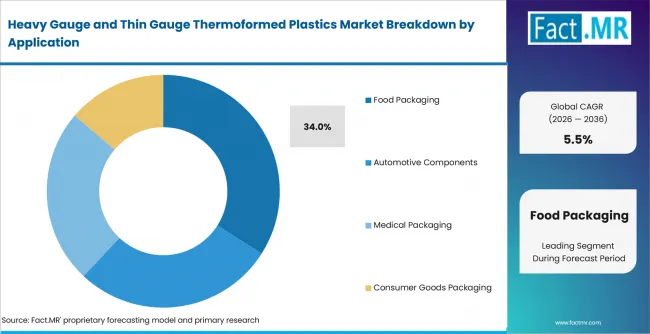
Heavy Gauge And Thin Gauge Thermoformed Plastics Market Analysis By Application | Source: Fact.MR
Trays and containers protect food during filling and shelf display. USDA Economic Research Service reported in June 2026 that U.S. food spending reached USD 2.51 trillion in 2025. That spending base keeps pack reliability under close review before products reach the shelf.
Why does Food & Beverage Industry lead End User?
Food & Beverage Industry is anticipated to capture 39.0% share in 2026.
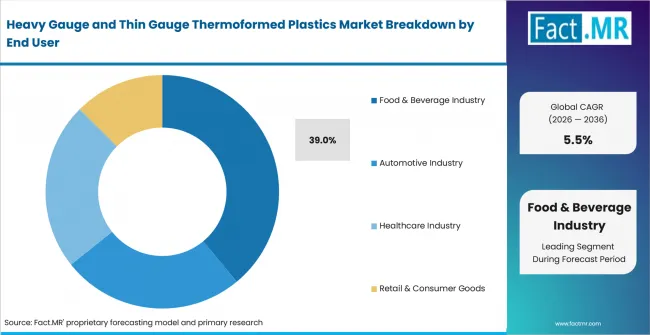
Heavy Gauge And Thin Gauge Thermoformed Plastics Market Analysis By End User | Source: Fact.MR
Repeat packaging requirements place food and beverage companies at the center of thermoformed plastics consumption. Eurostat reported in October 2025 that EU food waste reached around 130 kg per person in 2023. This does not prove pack purchases by itself. It explains why processors review portion control and handling protection.
Why does Direct Sales lead Distribution Channel?
Direct Sales is estimated to command 52.0% share in 2026.
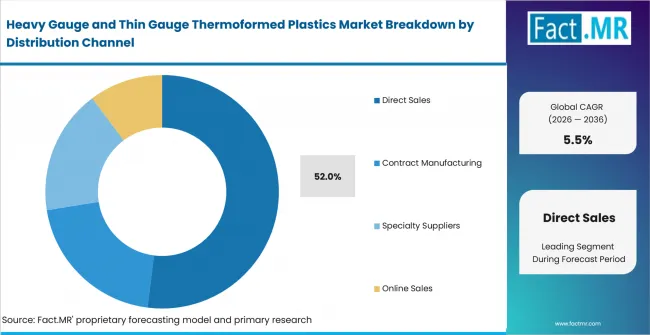
Heavy Gauge And Thin Gauge Thermoformed Plastics Market Analysis By Distribution Channel | Source: Fact.MR
Large-volume orders often begin with direct discussions about drawings and tooling. Suppliers may adjust sealing or dimensions during approval. This coordination favors Direct Sales for specification-led programs. Distributors remain more relevant for standardized products.
Why does Polyethylene Terephthalate lead Material Type?
Polyethylene Terephthalate is set to account for 31.0% share in 2026.
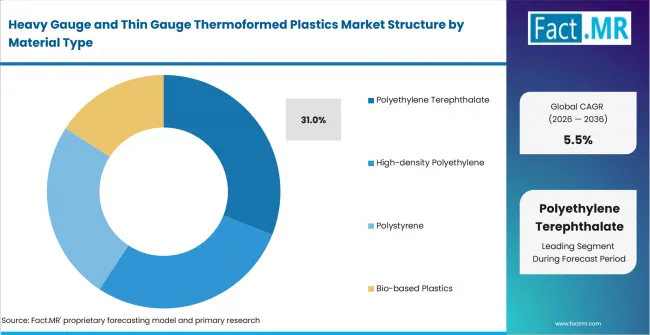
Heavy Gauge And Thin Gauge Thermoformed Plastics Market Analysis By Material Type | Source: Fact.MR
Clarity gives Polyethylene Terephthalate a useful position in food and retail packaging. The European Commission noted in July 2025 that EU rules require single-use PET beverage bottles to include 25.0% recycled plastic from 2025. That rule supports wider buyer focus on PET recovery evidence.
What is accelerating Heavy Gauge and Thin Gauge Thermoformed Plastics Market adoption, and what is holding it back?
Demand is expected to rise through packaging line efficiency and repeat food-sector ordering. Formed parts in industrial handling are expected to create another demand channel.
Drivers Impact Analysis
| DRIVER | (~) % IMPACT ON CAGR | GEOGRAPHIC RELEVANCE | IMPACT TIMELINE |
|---|---|---|---|
| Food packaging conversion | +1.8% | Global | Short term (<= 2 years) |
| Thin-gauge throughput advantage | +1.4% | North America, Europe, Asia Pacific | Short term (<= 2 years) |
| Direct-sales specification support | +1.0% | North America and Europe | Medium term (2-4 years) |
| PET material preference | +0.8% | Food packaging markets | Medium term (2-4 years) |
Source: Fact.MR analysis. Updated Aug 11, 2026
- Food packaging conversion: Formed trays and containers are expected to gain repeat orders where filling speed and product display are judged together.
- Thin-gauge throughput advantage: Thin-gauge formats are likely to remain attractive when converters need fast cycles and lower material use per pack.
- Direct-sales specification support: Direct supplier engagement helps buyers manage tooling review and material approval before commercial supply starts.
Opportunity Impact Analysis
| OPPORTUNITY | (~) % IMPACT ON CAGR | GEOGRAPHIC RELEVANCE | IMPACT TIMELINE |
|---|---|---|---|
| Recyclable PET tray platforms | +0.9% | USA, Germany, France, Canada | Medium term (2-4 years) |
| Heavy-gauge reusable handling parts | +0.7% | USA, Germany, China, India | Medium term (2-4 years) |
| Custom foodservice pack programs | +0.6% | North America, Europe, Asia Pacific | Medium term (2-4 years) |
| Automation-ready forming designs | +0.4% | Japan, Germany, China | Long term (>= 4 years) |
Source: Fact.MR analysis. Updated Aug 11, 2026
- Recyclable PET tray platforms: Suppliers that connect package design with sustainable plastic packaging expectations can improve their case in recovery-led programs.
- Heavy-gauge reusable handling parts: Durable trays and covers are expected to create opportunities where buyers want formed parts for repeated movement. Selected reusable food packaging systems follow the same durability need.
- Custom foodservice pack programs: Prepared-food brands are likely to seek packs that balance display and nesting. Sealing and transport performance shape repeat orders.
Restraints Impact Analysis
| RESTRAINT | (~) % IMPACT ON CAGR | GEOGRAPHIC RELEVANCE | IMPACT TIMELINE |
|---|---|---|---|
| Resin price and sheet availability | -0.9% | Global | Short term (<= 2 years) |
| Tooling and qualification cost | -0.7% | Developing markets | Medium term (2-4 years) |
| Food-contact and customer approval work | -0.5% | North America and Europe | Medium term (2-4 years) |
| Collection and recycling limitations | -0.4% | Global | Long term (>= 4 years) |
Source: Fact.MR analysis. Updated Aug 11, 2026
- Resin price and sheet availability: Buyers may delay specification changes when sheet supply makes pack economics harder to compare.
- Tooling and qualification cost: New thermoformed designs require tooling investment before approval. Smaller customers may slow orders until volumes are clearer.
- Collection and recycling limitations: Recovery gaps can restrict adoption where retailers prefer packaging tied to established material streams.
Which countries are scaling Heavy Gauge and Thin Gauge Thermoformed Plastics Market fastest?
- The country comparison spans 1.4 percentage points and shows a tight growth range across the forecast period.
- The USA remains 0.2 percentage point above Germany through food packaging scale and industrial supply programs.
- Germany remains 0.2 percentage point above China as specification discipline and packaging engineering support steady conversion.
- China remains 0.3 percentage point above Japan through manufacturing scale and higher packaged-food movement.
- Japan remains 0.2 percentage point above Canada as precision forming and careful customer review shape demand.
- Canada remains 0.3 percentage point above France through retail packaging demand and direct account supply.
- France remains 0.2 percentage point above India where sustainability review and price sensitivity create different adoption conditions.
Comparable CAGRs can create different entry conditions due to buyer qualification and material preferences. Full coverage spans North America and Europe. It also covers East Asia and South Asia and Pacific. Latin America, Middle East and Africa complete the regional view.
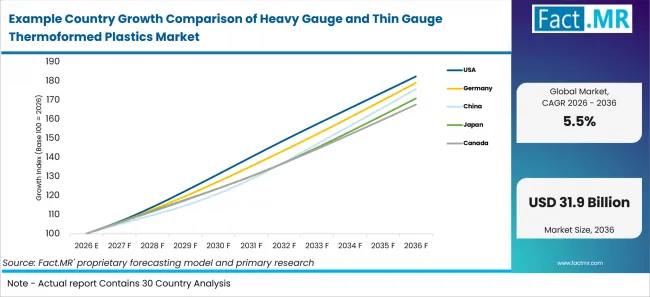
Example Country Growth Comparison Of Heavy Gauge And Thin Gauge Thermoformed Plastics Market | Source: Fact.MR
| Country | CAGR (2026-2036) |
|---|---|
| USA | 6.2% |
| Germany | 6.0% |
| China | 5.8% |
| Japan | 5.5% |
| Canada | 5.3% |
| France | 5.0% |
| India | 4.8% |
Source: Fact.MR analysis. Updated Aug 11, 2026
What supports USA adoption?
6.2% CAGR, supported by food packaging scale and industrial part demand.
USA buyers review forming quality and supply reliability before approval. Large food packaging orders support thin-gauge formats that run quickly and protect shelf presentation.
How is Germany scaling demand?
6.0% CAGR, supported by packaging engineering depth and industrial manufacturing use.
German buyers are expected to favor suppliers that document dimensional control and material consistency. Customers test formed parts before accepting new packaging or handling components.
What is driving China’s growth from 2026 to 2036?
5.8% CAGR, backed by manufacturing scale and food distribution demand.
China’s growth is supported by high packaging volumes and a large food distribution network. Demand is expected to remain steady as manufacturers require reliable packaging solutions for processed foods and broad retail supply chains.
How does Japan perform?
5.5% CAGR, led by specification discipline and precision forming requirements.
Japanese buyers often review surface quality and dimensions before wider use. Precision-focused purchasing is expected to favor suppliers that hold forming tolerances.
What supports Canada’s growth?
5.3% CAGR, supported by retail packaging and direct account supply.
Canada’s growth is supported by steady demand for chilled food packaging and retail trays. Suppliers are expected to benefit from direct customer relationships as food processors and retailers seek dependable packaging formats for routine distribution.
How is France developing demand?
5.0% CAGR, driven by food packaging requirements and sustainability review.
French demand is expected to depend on retailer expectations and material review. Clear trays support food display. Customer approval can take longer when recovery claims need evidence.
What supports India’s adoption?
4.8% CAGR, supported by packaged-food expansion and manufacturing growth.
India’s adoption is expected to remain cost-sensitive as buyers compare formed packs with lower-cost alternatives. The Press Information Bureau reported in April 2026 that the food processing PLI scheme seeks to generate ₹33,494 crore of processed food output.
Who leads the Heavy Gauge and Thin Gauge Thermoformed Plastics Market?
Placon Corporation and Novolex Holdings, LLC (Pactiv Evergreen) show direct relevance through packaging scale. TOPPAN Packaging adds thermoformed product exposure. Genpak LLC strengthens the foodservice field.
Brentwood Industries, Inc. adds heavy-gauge and custom thermoforming capability. Greiner Packaging International GmbH and Amcor plc broaden the field through plastic product and packaging manufacturing portfolios. TOPPAN Holdings completed its Sonoco TFP acquisition in April 2025. Amcor launched AmSecure thermoformed trays and rollstock in October 2025.
Which companies are the key providers?
Key companies profiled include Placon Corporation; Novolex Holdings, LLC (Pactiv Evergreen); TOPPAN Packaging; Genpak LLC; Brentwood Industries, Inc.; Greiner Packaging International GmbH; Amcor plc.
- Placon Corporation
- Novolex Holdings, LLC (Pactiv Evergreen)
- TOPPAN Packaging
- Genpak LLC
- Brentwood Industries, Inc.
- Greiner Packaging International GmbH
- Amcor plc
Bibliography
- Amcor plc. (2025, October 16). Amcor launches AmSecure™ thermoformed trays and rollstock, part of the HealthCare™ portfolio.
- European Commission, Directorate-General for Environment. (2025, July 8). Plastic waste: Commission consults on new rules for chemically-recycled content in plastic bottles.
- European Commission Joint Research Centre. (2026, July 6). Packaging materials in the EU: quantities stay significant, plastic grew by 11%.
- Eurostat. (2025, October 16). 130 kg of food wasted per person annually in the EU.
- Eurostat. (2025, October 22). Plastic packaging waste in the EU: 35.3 kg per person.
- Ministry of Food Processing Industries, Press Information Bureau. (2026, April 21). Strengthening India’s Food Processing Ecosystem.
- National Bureau of Statistics of China. (2026, February 28). Statistical communiqué of the People’s Republic of China on the 2025 national economic and social development.
- TOPPAN Holdings Inc. (2025, April 1). TOPPAN Holdings completes acquisition of Sonoco’s TFP business.
This Report Answers
- The report provides intelligence across Product Category; Application; End User; Distribution Channel; and Material Type.
- Segment analysis covers Thin Gauge Thermoformed Plastics and Food Packaging as the 2026 share leaders.
- Country outlook evaluates the USA and Germany alongside China and Japan. Canada, France and India complete the comparison.
- Competitive analysis profiles the listed providers across food packaging and custom thermoforming. Adjacent packaging manufacturing completes the provider view.
- Material assessment covers Polyethylene Terephthalate and other thermoformable materials. blister and other high visibility packaging uses complete the view.
What does the Heavy Gauge and Thin Gauge Thermoformed Plastics Market cover?
Thermoformed plastics are used to make thin-gauge packs and heavier formed parts. Plastic sheet is heated and shaped before it is cooled and trimmed into finished products.
The market covers trays and containers used by packaging buyers. Covers and inserts are included for industrial buyers. Food, retail and protective uses are included where shape and stiffness influence approval.
What is included in the scope?
The scope includes Product Category and Application. End User and Distribution Channel form the next part of the coverage. Material Type and Region complete the scope.
Coverage spans thin-gauge food packs and heavy-gauge trays. Formed covers and components are included when buyers use thermoformed parts. PET and polypropylene are included when converted into formed products. Polystyrene and polyethylene follow the same process-use rule. Selected plastic contract manufacturing activities are included when the work involves thermoformed parts.
What is excluded from the scope?
The scope excludes plastic products that are not made through thermoforming.
Flexible films and injection-molded products remain outside the scope. Blow-molded bottles and standalone resin sales are excluded. General packaging demand is included only when it uses heavy-gauge or thin-gauge thermoforming.
How Was the Analysis Built?
The analysis draws on 120+ sources and 35+ company portfolios. It reviews 25+ countries and more than 20 industry interviews.
- Primary Research: Primary research includes discussions with manufacturers and end users. These conversations examine purchasing priorities and approval requirements.
- Desk Research: Desk research covers government statistics and regulatory publications. Company filings and standards are reviewed where they support the market scope.
- Market Sizing and Forecasting: Market estimates combine historical performance and demand indicators. Segment shares and country-level growth are reviewed alongside barriers to expansion.
- Data Validation and Update Cycle: Findings are checked against interviews and public data. Updates review product launches and capacity changes.
Segmentation
What is the report’s scope and coverage?
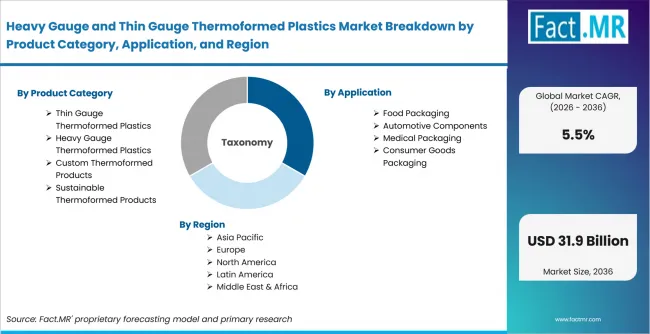
Heavy Gauge And Thin Gauge Thermoformed Plastics Market Breakdown By Product Category, Application, And Region | Source: Fact.MR
| Attribute | Details |
|---|---|
| Quantitative Units | USD billion |
| Market Definition | Formed plastic packaging and industrial components made through thin-gauge and heavy-gauge thermoforming where product shape, stiffness, display, protection and processing efficiency determine use |
| Product Category | Thin Gauge Thermoformed Plastics; Heavy Gauge Thermoformed Plastics |
| Application | Food Packaging; Industrial Packaging and Handling; Retail Display Packaging; Healthcare Packaging; Protective Component Packaging |
| End User | Food & Beverage Industry; Industrial Manufacturers; Retail and Consumer Goods Companies; Healthcare and Related Users |
| Distribution Channel | Direct Sales; Distributors; Converters and Supply Partners |
| Material Type | Polyethylene Terephthalate; Polypropylene; Polystyrene; Polyethylene; Other Thermoformable Materials |
| Regions Covered | North America; Latin America; Europe; East Asia; South Asia and Pacific; Middle East and Africa |
| Countries Covered | USA; Germany; China; Japan; Canada; France; India |
| Key Companies Profiled | Placon Corporation; Novolex Holdings, LLC (Pactiv Evergreen); TOPPAN Packaging; Genpak LLC; Brentwood Industries, Inc.; Greiner Packaging International GmbH; Amcor plc |
| Forecast Period | 2026 to 2036 |
| Approach | Hybrid top-down and bottom-up approach using packaging demand; thermoformed product use; thin-gauge and heavy-gauge application patterns; material preference; end-user purchasing behavior; direct-sales participation; country adoption patterns and company portfolio review |
Source: Fact.MR analysis. Updated Aug 11, 2026
How is the market segmented?
-
By Product Category
- Thin Gauge Thermoformed Plastics
- Rigid Packaging Trays
- Clamshell Packaging
- Heavy Gauge Thermoformed Plastics
- Industrial Components
- Equipment Housings
- Custom Thermoformed Products
- Custom Trays
- Custom Inserts
- Sustainable Thermoformed Products
- Biodegradable Thermoformed Products
- Recycled-content Thermoformed Products
- Thin Gauge Thermoformed Plastics
-
By Application
- Food Packaging
- Fresh Produce Packaging
- Ready-to-eat Meal Packaging
- Automotive Components
- Interior Trim Components
- Protective Equipment Covers
- Medical Packaging
- Medical Device Packaging
- Pharmaceutical Packaging
- Consumer Goods Packaging
- Electronics Packaging
- Household Goods Packaging
- Food Packaging
-
By End User
- Food & Beverage Industry
- Food Processing Companies
- Packaging Manufacturers
- Automotive Industry
- Original Equipment Manufacturers
- Industrial Equipment Manufacturers
- Healthcare Industry
- Medical Device Manufacturers
- Pharmaceutical Companies
- Retail & Consumer Goods
- Consumer Electronics Manufacturers
- Household Product Manufacturers
- Food & Beverage Industry
-
By Distribution Channel
- Direct Sales
- OEM Supply
- Industrial Distributors
- Contract Manufacturing
- Regional Distributors
- Export Sales
- Specialty Suppliers
- Medical Supply Distributors
- Healthcare Procurement
- Online Sales
- E-commerce Platforms
- Direct Retail Partnerships
- Direct Sales
-
By Material Type
- Polyethylene Terephthalate
- Amorphous Polyethylene Terephthalate
- Recycled Polyethylene Terephthalate
- High-density Polyethylene
- Acrylonitrile Butadiene Styrene
- Polypropylene
- Polystyrene
- High Impact Polystyrene
- Expanded Polystyrene
- Bio-based Plastics
- Polylactic Acid
- Recycled Plastic Blends
- Polyethylene Terephthalate
-
By Region
- North America
- Latin America
- Europe
- East Asia
- South Asia & Oceania
- Middle East and Africa
Frequently Asked Questions
How big is the heavy gauge and thin gauge thermoformed plastics market in 2026?
What is the CAGR of the heavy gauge and thin gauge thermoformed plastics market from 2026 to 2036?
Which product category leads the heavy gauge and thin gauge thermoformed plastics market?
Which application leads the heavy gauge and thin gauge thermoformed plastics market?
Who are the leading companies in the heavy gauge and thin gauge thermoformed plastics market?
Who worked on this report


Preview the report firsthand - request a free sample
Free SampleGet the brochure for pricing and purchase details
Download PDF