High-Hardness Slabstock Market Size, Share, Growth and Forecast (2026 - 2036)
The High-Hardness Slabstock Market is segmented by Foam Grade, by Application, by Conversion Format, by Buyer Type, by Hardness Band and Region. Forecast for 2026 to 2036.
What is the high-hardness slabstock market forecast to be worth by 2036?
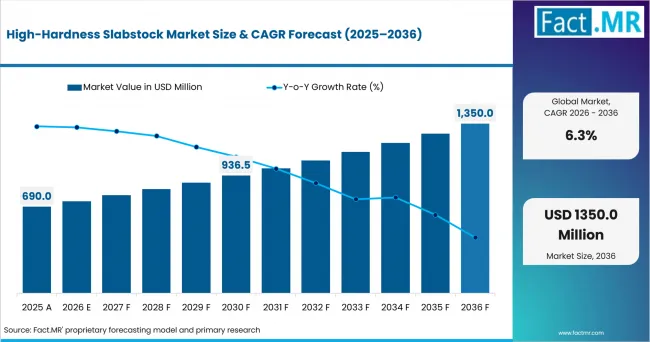
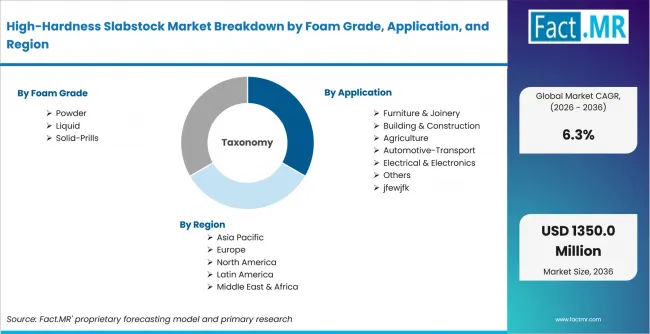
USD 735.0 million in 2026 to USD 1,350.0 million by 2036, at 6.3% CAGR.
- The high-hardness slabstock market crossed a valuation of USD 690.0 million in 2025. Demand is expected to increase from USD 735.0 million in 2026 to USD 1,350.0 million by 2036.
- The market is forecast to record 6.3% CAGR from 2026 to 2036 due to seating pads and fabricated support parts. High-hardness PU is projected to hold 41.0% share in 2026 owing to familiar processing routes.
- Firm polyurethane materials form the base of this market because slabstock blocks can be cut into sheets and pads after curing. The International Organization of Motor Vehicle Manufacturers reported 96.4 million vehicles produced in 2025 [1].
What are the defining numbers behind high-hardness slabstock growth?
USD 615.0 million absolute opportunity by 2036, led by India and China.
- Demand Drivers in the Market
- Furniture OEMs need firmer support layers for sofas and bedding cores sold through organized channels.
- Automotive suppliers need cut foam pads for bolsters and interior support programs.
- Packaging converters need reusable industrial pads for heavier goods movement and returnable transit work.
- Foam converters need better block consistency because poor hardness control raises scrap after cutting.
- Key Segments Analyzed
- By Foam Grade: High-hardness PU is projected to hold 41.0% share in 2026 due to known chemistry and converter familiarity.
- By Application: Furniture is anticipated to account for 34.0% share in 2026 owing to firmer cushion cores and support layers.
- By Conversion Format: Blocks are expected to hold 46.0% share in 2026 supported by flexible downstream cutting options.
- By Buyer Type: Foam converters are forecast to represent 38.0% share in 2026 attributable to custom cutting and laminating work.
- By Hardness Band: The 71 to 90 ILD band is estimated to hold 44.0% share in 2026 due to balanced firmness for seats and pads.
- By Geography: East Asia is forecast to hold 31.0% share in 2026 led by foam conversion scale in China and Japan.
- Analyst Opinion at Fact.MR
- Shambhu Nath Jha, Senior Analyst at Fact.MR, states, "High-hardness slabstock is a specification market more than a broad foam category. Buyers are asking whether a block holds firmness after cutting and lamination. Suppliers that control hardness variation are better placed to win recurring converter programs."
- Strategic Implications
- Foam producers should document hardness ranges before selling to large converters.
- Furniture OEMs need supplier checks that cover compression behavior after cutting.
- Automotive suppliers should align foam grades with seat support and trim requirements.
- Packaging converters need pad designs that reduce product movement during repeated handling.
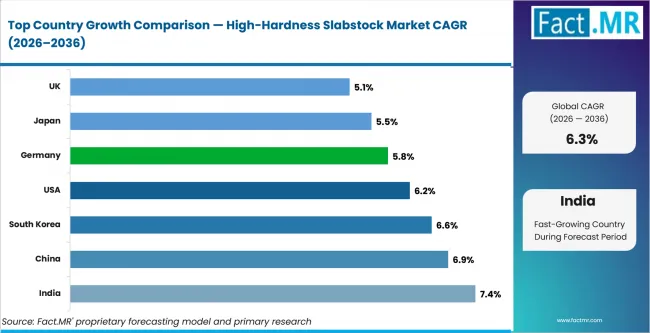
India is projected to record 7.4% CAGR through 2036 led by vehicle output and organized foam conversion. China is expected to expand at 6.9% CAGR through 2036 supported by vehicle production and local converter networks. South Korea is forecast to grow at 6.6% CAGR through 2036 owing to automotive exports and electronics packaging demand. The United States is expected to advance at 6.2% CAGR through 2036 due to foam replacement and fabrication needs. Germany is projected to rise at 5.8% CAGR through 2036 supported by automotive seating and machinery suppliers. Japan is forecast at 5.5% CAGR through 2036 due to precision foam conversion. The United Kingdom is expected to post 5.1% CAGR through 2036 owing to furniture and transport cushioning.
How does the high-hardness slabstock market break down by segment?
High-hardness PU leads at 41.0%; furniture leads at 34.0%.
Which foam grade dominates?
High-Hardness PU holds 41.0% share in 2026.
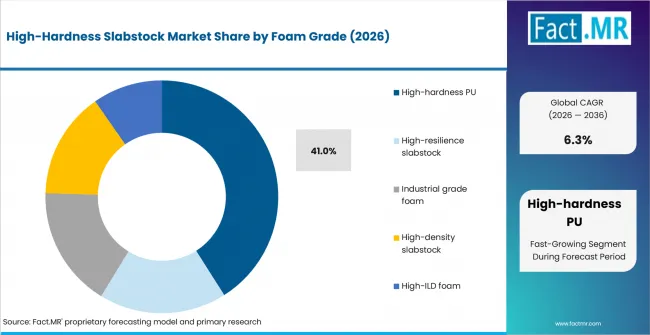
High-Hardness PU is expected to hold 41.0% share in 2026 due to adjustable firmness and familiar slabstock processing. Copolymer polyols matter in this part of the market because they help producers tune resilience and load-bearing behavior. Converter demand remains strongest where buyers need predictable cutting yield.
Which application dominates?
Furniture accounts for 34.0% share in 2026.
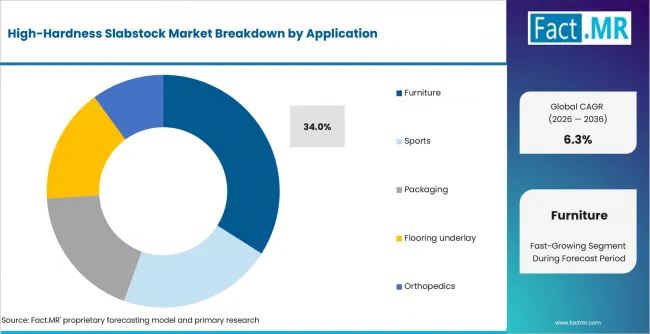
Furniture applications lead because firmer cushion cores improve support in sofas and bedding products. Europe uses about 35% of flexible slabstock polyurethane foam in upholstered furniture [2]. This application favors suppliers that can deliver consistent block firmness to furniture converters.
Which conversion format dominates?
Blocks lead with 46.0% share in 2026.
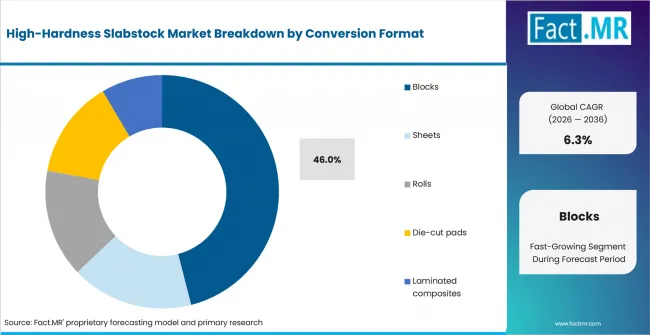
Blocks lead because converters can cut them into sheets and custom pads after curing. Foam mixing equipment and metering control affect density drift during block production. Better block control helps converters reduce scrap and serve repeat buyer programs.
Which buyer type dominates?
Foam converters hold 38.0% share in 2026.
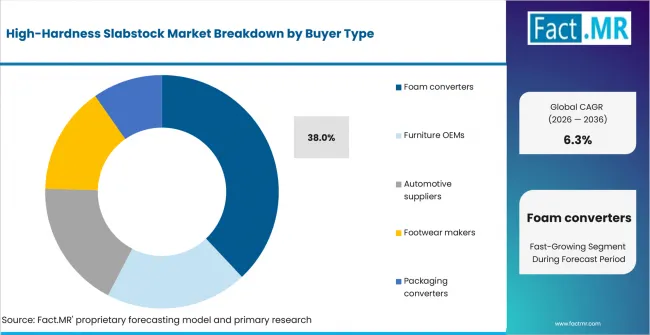
Foam converters lead because they connect bulk slabstock supply with application-specific shapes. They use polyurethane processing machines and cutting lines to serve buyers that need sheets, rolls and laminated parts. Supplier choice is shaped by block size and lead time.
Which hardness band dominates?
The 71 to 90 ILD band leads with 44.0% share in 2026.
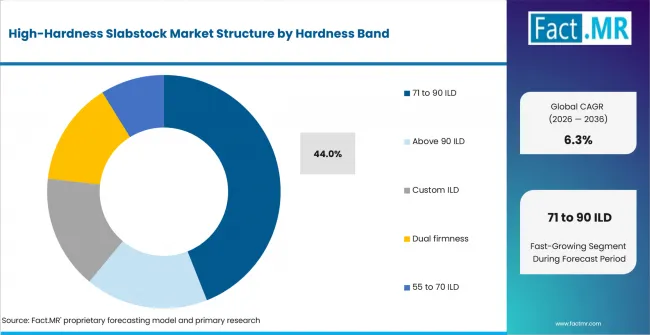
The 71 to 90 ILD band leads because it gives buyers firm support without making the foam too difficult to cut. Foam blowing agents remain relevant to density and cell structure control. The segment is strongest in seating pads and industrial support forms.
What is accelerating high-hardness slabstock demand, and what is holding it back?
Furniture support layers and automotive pads drive it; chemical handling rules and input costs restrain it.
The main driver is the need for firmer foam in seating and converted support products. The Federal Reserve reported United States motor vehicle assemblies at 10.63 million units in May 2026 on a seasonally adjusted annual rate basis [4]. Automotive foam use benefits where seat and interior pad programs need stable support.
The main restraint is chemical handling and raw material price exposure. Industrial users of diisocyanates in Europe must complete training before using products above 0.1% monomeric diisocyanates [5]. This does not stop slabstock production, but it raises compliance pressure for smaller converters.
Where do the biggest high-hardness slabstock opportunities sit?
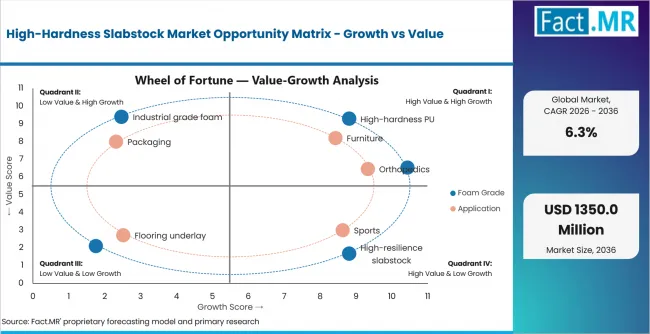
Automotive seating pads, industrial protection and orthopedic support.
- Automotive Seating Pads: Suppliers can target bolsters and trim support parts that need firmer cut foam.
- Industrial Protection: Converters can use plastic protective packaging demand to sell reusable pads for heavy goods movement.
- Orthopedic Support: Foam suppliers can serve pressure-relief seat cushions where buyers need firmer support and shape control.
- Material Substitution: Expanded polypropylene foam creates a benchmark because buyers compare weight and cushioning before specifying polyurethane pads.
Which countries are scaling high-hardness slabstock fastest?
India 7.4%, China 6.9%, South Korea 6.6%, USA 6.2%, Germany 5.8%, Japan 5.5%, United Kingdom 5.1%.
Based on regional analysis, the high-hardness slabstock market is segmented into North America, Latin America, Western Europe, Eastern Europe, East Asia, South Asia and Pacific and Middle East and Africa.
.webp)
| Country | CAGR |
|---|---|
| India | 7.4% |
| China | 6.9% |
| South Korea | 6.6% |
| United States | 6.2% |
| Germany | 5.8% |
| Japan | 5.5% |
| United Kingdom | 5.1% |

What is powering India’s lead?
7.4% CAGR, supported by vehicle output and organized foam conversion.
India is projected to record 7.4% CAGR through 2036 due to automotive output and organized furniture conversion. The Ministry of Heavy Industries reported passenger vehicle production of 53.8 lakh units during January to December 2025 [6]. Foam buyers in India need firm slabstock for seating pads and mattress support layers. Local suppliers with cutting capacity and delivery discipline are expected to gain better access to converter accounts.
How is China scaling high-hardness slabstock demand?
6.9% CAGR, driven by large automotive output and local converter networks.
China is expected to expand at 6.9% CAGR through 2036 owing to large vehicle output and broad foam conversion capacity. The State Council Information Office reported auto output of 34.531 million units in 2025 [3]. This base supports demand for firm pads used in interiors and logistics protection. Suppliers that serve both furniture and automotive buyers can improve utilization across block foam lines.
Why is South Korea an important conversion market?
6.6% CAGR, due to export-oriented automotive and electronics supply chains.
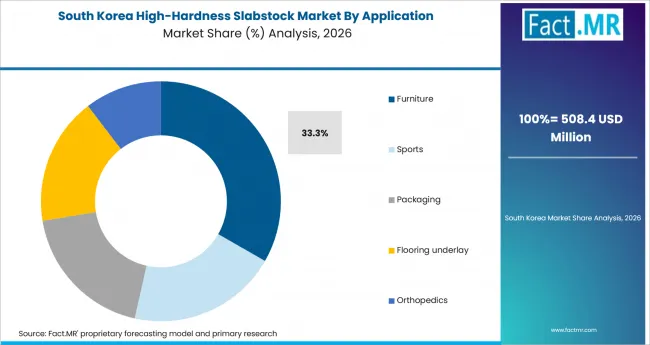
South Korea is forecast to grow at 6.6% CAGR through 2036 due to automotive exports and precision fabricated foam needs. The Ministry of Trade, Industry and Resources reported automobile exports of USD 5.83 billion in May 2026 [7]. Electronics packaging also supports demand for firmer pads that protect heavier goods. Buyers are expected to favor suppliers that can document tolerance and support repeat conversion orders.
What supports the USA outlook?
6.2% CAGR, supported by vehicle assemblies and furniture replacement demand.
The United States is expected to advance at 6.2% CAGR through 2036 due to automotive pad work and furniture replacement demand. Furniture converters also need firmer support layers for repair and replacement channels. Demand is likely to favor suppliers that offer block availability and dependable fabrication support.
What underpins Germany’s growth?
5.8% CAGR, backed by automotive seating and machinery-linked foam processing.
Germany is projected to rise at 5.8% CAGR through 2036 due to automotive seating and foam processing discipline. The German Association of the Automotive Industry reported domestic passenger car production of 305,900 units in January 2026 [8]. Foam buyers in Germany place weight on process control and compliance documentation. Suppliers with hardness testing and traceable production records are expected to hold stronger buyer access.
How does Japan perform in high-hardness slabstock?
5.5% CAGR, supported by precision conversion and durable cushioning needs.
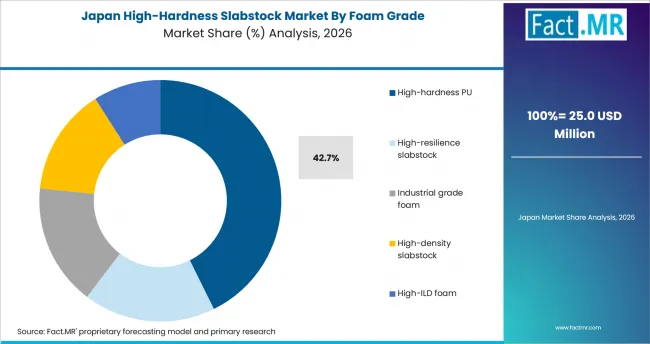
Japan is forecast at 5.5% CAGR through 2036 due to precision conversion and durable cushion requirements. The Japan Automobile Manufacturers Association reported 8.23 million motor vehicles produced in 2024 [9]. Furniture and automotive buyers in Japan often prioritize consistent quality over aggressive volume growth. This makes documented firmness control more valuable than broad catalog availability.
How does the United Kingdom perform in this market?
5.1% CAGR, supported by furniture conversion and lower vehicle output recovery.
The United Kingdom is expected to post 5.1% CAGR through 2036 owing to furniture conversion and selective automotive recovery. The Society of Motor Manufacturers and Traders reported 764,715 vehicles produced in 2025 [10]. Lower vehicle output keeps the country below India and China. Foam suppliers can still win through furniture programs and specialty pads for transport interiors.
Who leads the high-hardness slabstock landscape?
Carpenter Co., The Vita Group and FXI lead through foam production scale and conversion support.
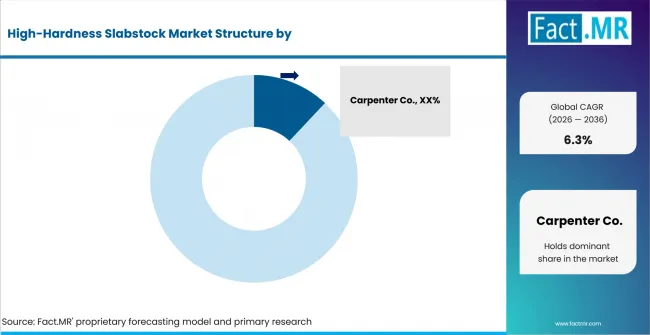
High-hardness slabstock competition is shaped by foam pouring scale and hardness control. Carpenter Co. states that its polyurethane block foams are used in vehicles, mattresses and packaging [11]. The company is listed as a direct slabstock supplier after Recticel Engineered Foams moved under Carpenter ownership instead of treating it as a separate current competitor.
The Vita Group adds European flexible polyurethane foam coverage and product development support. Its official profile states that the group operates 32 facilities across Europe [12]. FXI and Future Foam support North American supply. Sheela Foam and INOAC add regional depth in India and Japan. BASF, Covestro and Dow are treated as upstream material suppliers rather than finished slabstock competitors.
Competition through 2036 is expected to depend on repeatable firmness and reliable block supply. Buyers will compare rejection rates and converter support before price. Suppliers that combine formulation control with cut-ready block availability are expected to gain recurring programs.
Which companies are the key players?
Carpenter Co., The Vita Group, FXI, Future Foam, Sheela Foam, INOAC.
- Carpenter Co.
- The Vita Group
- FXI
- Future Foam
- Sheela Foam Limited
- INOAC Corporation
Bibliography
- [1] International Organization of Motor Vehicle Manufacturers. (2026, April 23). Auto industry growth shifted east in 2025 amid global repositioning. OICA.
- [2] European Association of Flexible Polyurethane Foam Blocks Manufacturers. (2024). Flexible polyurethane foam industry data. EUROPUR.
- [3] State Council Information Office of the People’s Republic of China. (2026, January 15). China’s auto output, sales reach new highs in 2025. State Council Information Office.
- [4] Board of Governors of the Federal Reserve System. (2026, June 15). Industrial production and capacity utilization, Table 3: Motor vehicle assemblies. Federal Reserve.
- [5] Health and Safety Authority of Ireland. (2024). Mandatory training requirements for professional and industrial users of diisocyanates. Health and Safety Authority.
- [6] Press Information Bureau, Government of India. (2026, February 10). Status of heavy industries sector. Ministry of Heavy Industries.
- [7] Ministry of Trade, Industry and Resources of the Republic of Korea. (2026, June 17). May 2026 automobile exports total USD 5.83 billion. MOTIR.
- [8] German Association of the Automotive Industry. (2026, February 3). Production and market in January 2026. VDA.
- [9] Japan Automobile Manufacturers Association. (2025, September 26). The motor industry of Japan 2025. JAMA.
- [10] Society of Motor Manufacturers and Traders. (2026, January 29). Tough year for auto, but new models and industrial strategy can deliver growth. SMMT.
- [11] Carpenter Co. (2026). Polyurethane foam. Carpenter Co.
- [12] The Vita Group. (2026). Leading polyurethane foam manufacturer. The Vita Group.
This Report Addresses
- Strategic intelligence on high-hardness slabstock across foam grade, application and buyer type.
- Segment analysis covering High-hardness PU, Furniture, Blocks, Foam converters and 71 to 90 ILD foam.
- Regional outlook covering India, China, South Korea, United States, Germany, Japan and United Kingdom.
- Competitive analysis of Carpenter Co., The Vita Group, FXI, Future Foam, Sheela Foam, INOAC.
- Scope assessment covering blocks, sheets, rolls, laminated composites and die-cut pads.
- Supplier assessment covering hardness control, block consistency and regional conversion support.
- Primary interviews, official source review and company portfolio checks support the forecast.
What does the high-hardness slabstock market cover?
Firm flexible polyurethane blocks and converted foam forms used for support and protection.
The high-hardness slabstock market covers high-hardness slabstock foams poured in block form for later cutting. It includes high-ILD foam grades and high-density flexible polyurethane foam. The market differs from molded foam because buyers purchase block or converted forms rather than part-shaped foam.
What is included in the scope?
High-hardness foam blocks, sheets, rolls and die-cut pads.
The scope includes high-density slabstock and high-ILD flexible foam. It covers blocks and sheets sold to converters. It also includes rolls and laminated composites supplied for furniture, automotive and industrial cushioning work.
What is excluded from the scope?
Molded foam parts, rigid construction foam and finished retail mattresses.
The scope excludes molded seating foam and rigid polyurethane insulation. It excludes spray foam systems sold for building work. It also excludes finished mattresses and finished furniture sold directly to retail consumers.
How was the analysis built?
100+ sources, 40+ company portfolios, 25+ countries, 20+ interviews.
- Primary Research: Primary research includes interviews with foam converters and furniture OEM sourcing teams. It includes input from automotive suppliers and packaging fabricators.
- Desk Research: Desk research reviews vehicle production data and flexible polyurethane foam applications. It covers chemical handling rules and official company product portfolios.
- Market-Sizing and Forecasting: Forecasting uses block foam volume and average selling price ranges. Application use rates and converter buying signals support the market assessment.
- Data Validation and Update Cycle: Forecasts are validated through supplier checks and end-use production signals. Vehicle output and conversion equipment indicators help confirm market direction.
What is the report’s scope and coverage?
| Attribute | Details |
|---|---|
| Quantitative Units | USD million in 2026 to USD million by 2036 |
| Market Definition | Firm flexible polyurethane slabstock foam sold as blocks and converted support forms |
| Foam Grade | High-density slabstock, High-ILD foam, High-hardness PU, High-resilience slabstock, Industrial grade foam |
| Application | Automotive, Furniture, Sports, Packaging, Flooring underlay, Orthopedics, Industrial pads |
| Conversion Format | Blocks, Sheets, Rolls, Die-cut pads, Laminated composites, CNC-cut shapes |
| Buyer Type | Foam converters, Furniture OEMs, Automotive suppliers, Footwear makers, Packaging converters |
| Hardness Band | 55 to 70 ILD, 71 to 90 ILD, Above 90 ILD, Custom ILD, Dual firmness |
| Regions Covered | North America, Latin America, Western Europe, Eastern Europe, East Asia, South Asia and Pacific, Middle East and Africa |
| Countries Covered | India, China, South Korea, United States, Germany, Japan, United Kingdom |
| Key Companies Profiled | Carpenter Co., The Vita Group, FXI, Future Foam, Sheela Foam Limited, INOAC Corporation |
| Forecast Period | 2026 to 2036 |
| Approach | Hybrid top-down and bottom-up approach using block demand, application use rates, supplier checks and official production data |
How is the market segmented?
-
By Foam Grade:
- High-density slabstock
- High-ILD foam
- High-hardness PU
- High-resilience slabstock
- Industrial grade foam
-
By Application:
- Automotive
- Furniture
- Sports
- Packaging
- Flooring underlay
- Orthopedics
- Industrial pads
-
By Conversion Format:
- Blocks
- Sheets
- Rolls
- Die-cut pads
- Laminated composites
- CNC-cut shapes
-
By Buyer Type:
- Foam converters
- Furniture OEMs
- Automotive suppliers
- Footwear makers
- Packaging converters
-
By Hardness Band:
- 55 to 70 ILD
- 71 to 90 ILD
- Above 90 ILD
- Custom ILD
- Dual firmness
-
By Region:
- North America
- United States
- Canada
- Mexico
- Latin America
- Brazil
- Argentina
- Rest of Latin America
- Western Europe
- Germany
- United Kingdom
- Italy
- Spain
- France
- Nordic
- BENELUX
- Rest of Western Europe
- Eastern Europe
- Russia
- Poland
- Hungary
- Balkan and Baltic
- Rest of Eastern Europe
- East Asia
- China
- Japan
- South Korea
- South Asia and Pacific
- India
- ASEAN
- Australia and New Zealand
- Rest of South Asia and Pacific
- Middle East and Africa
- GCC Countries
- South Africa
- Turkiye
- Rest of Middle East and Africa
- North America
- Frequently Asked Questions -
Which foam grade leads the High-Hardness Slabstock Market?
High-hardness PU leads with 41.0% share in 2026 due to familiar processing and firmness control.
Which country expands fastest in the High-Hardness Slabstock Market?
India is projected to record 7.4% CAGR through 2036 due to vehicle output and organized foam conversion.
How does China perform in the High-Hardness Slabstock Market?
China is expected to expand at 6.9% CAGR through 2036 supported by vehicle production and local converter networks.
How does South Korea perform in the High-Hardness Slabstock Market?
South Korea is forecast to grow at 6.6% CAGR through 2036 owing to automotive exports and electronics packaging demand.
How does the United States perform in the High-Hardness Slabstock Market?
The United States is expected to advance at 6.2% CAGR through 2036 due to foam replacement and fabrication needs.
How does Germany perform in the High-Hardness Slabstock Market?
Germany is projected to rise at 5.8% CAGR through 2036 supported by automotive seating and machinery suppliers.
How does Japan perform in the High-Hardness Slabstock Market?
Japan is forecast at 5.5% CAGR through 2036 due to precision foam conversion and durable cushioning needs.
How does the United Kingdom perform in the High-Hardness Slabstock Market?
The United Kingdom is expected to post 5.1% CAGR through 2036 owing to furniture and transport cushioning.
What is the primary driver in the High-Hardness Slabstock Market?
The primary driver is buyer need for firmer foam blocks that hold support after cutting and lamination.
What is the main restraint in the High-Hardness Slabstock Market?
The main restraint is chemical handling and raw material cost pressure across polyurethane slabstock production.
Why is ILD important in this market?
ILD is important because it tells buyers how much force is needed to compress the foam.
How is slabstock different from molded foam?
Slabstock is poured as a block and cut later. Molded foam is produced inside a part-shaped tool.
Table of Content
- Key Takeaways
- Market Size and CAGR
- Top Growth Driver
- Fastest Growing Segment
- Leading Region
- Key Companies
- Emerging Opportunities
- Executive Summary
- Global Market Outlook
- Demand-side Trends
- Supply-side Trends
- Technology Roadmap Analysis
- Analysis and Recommendations
- Analyst Perspective (What is happening? Why now? What should investors know?)
- Key Questions Answered
- How large is the market?
- What is the CAGR?
- What are key trends?
- Which region dominates?
- Who are the leaders?
- Market Overview
- Market Coverage / Taxonomy
- Market Definition / Scope / Limitations
- Research Methodology
- Chapter Orientation
- Analytical Lens and Working Hypotheses
- Market Structure, Signals, and Trend Drivers
- Benchmarking and Cross-market Comparability
- Market Sizing, Forecasting, and Opportunity Mapping
- Research Design and Evidence Framework
- Desk Research Programme (Secondary Evidence)
- Expert Input and Fieldwork (Primary Evidence)
- Tooling, Models, and Reference Databases
- Data Engineering and Model Build
- Quality Assurance and Audit Trail
- Market Background
- Market Dynamics (Drivers, Restraints, Opportunity, Trends)
- Scenario Forecast (Optimistic, Likely, Conservative)
- Impact Analysis
- AI Impact
- Sustainability Impact
- Regulatory Impact
- Technology Impact
- Consumer / Buyer Analysis
- Purchase Drivers
- Adoption Barriers
- Buyer Journey
- Opportunity Map Analysis
- Product Life Cycle Analysis
- Supply Chain Analysis
- Investment Feasibility Matrix
- Value Chain Analysis
- PESTLE and Porter's Analysis
- Regulatory Landscape
- Regional Parent Market Outlook
- Production and Consumption Statistics
- Import and Export Statistics
- Global Market Analysis and Forecast, 2021 to 2036
- Historical Market Size Value (USD Million) Analysis, 2021 to 2025
- Current and Future Market Size Value (USD Million) Projections, 2026 to 2036
- Y-o-Y Growth Trend Analysis
- Absolute $ Opportunity Analysis
- Global Market Pricing Analysis, 2021 to 2036
- Global Market Analysis and Forecast, By Foam Grade, 2021 to 2036
- Introduction / Key Findings
- Historical Market Size Value (USD Million) Analysis By Foam Grade, 2021 to 2025
- Current and Future Market Size Value (USD Million) Analysis and Forecast By Foam Grade, 2026 to 2036
- High-hardness PU
- High-resilience slabstock
- Industrial grade foam
- High-density slabstock
- High-ILD foam
- High-hardness PU
- Y-o-Y Growth Trend Analysis By Foam Grade, 2021 to 2025
- Absolute $ Opportunity Analysis By Foam Grade, 2026 to 2036
- Global Market Analysis and Forecast, By Application, 2021 to 2036
- Introduction / Key Findings
- Historical Market Size Value (USD Million) Analysis By Application, 2021 to 2025
- Current and Future Market Size Value (USD Million) Analysis and Forecast By Application, 2026 to 2036
- Furniture
- Sports
- Packaging
- Flooring underlay
- Orthopedics
- Industrial pads
- Automotive
- Furniture
- Y-o-Y Growth Trend Analysis By Application, 2021 to 2025
- Absolute $ Opportunity Analysis By Application, 2026 to 2036
- Global Market Analysis and Forecast, By Conversion Format, 2021 to 2036
- Introduction / Key Findings
- Historical Market Size Value (USD Million) Analysis By Conversion Format, 2021 to 2025
- Current and Future Market Size Value (USD Million) Analysis and Forecast By Conversion Format, 2026 to 2036
- Blocks
- Sheets
- Rolls
- Die-cut pads
- Laminated composites
- CNC-cut shapes
- Blocks
- Y-o-Y Growth Trend Analysis By Conversion Format, 2021 to 2025
- Absolute $ Opportunity Analysis By Conversion Format, 2026 to 2036
- Global Market Analysis and Forecast, By Buyer Type, 2021 to 2036
- Introduction / Key Findings
- Historical Market Size Value (USD Million) Analysis By Buyer Type, 2021 to 2025
- Current and Future Market Size Value (USD Million) Analysis and Forecast By Buyer Type, 2026 to 2036
- Foam converters
- Furniture OEMs
- Automotive suppliers
- Footwear makers
- Packaging converters
- Foam converters
- Y-o-Y Growth Trend Analysis By Buyer Type, 2021 to 2025
- Absolute $ Opportunity Analysis By Buyer Type, 2026 to 2036
- Global Market Analysis and Forecast, By Hardness Band, 2021 to 2036
- Introduction / Key Findings
- Historical Market Size Value (USD Million) Analysis By Hardness Band, 2021 to 2025
- Current and Future Market Size Value (USD Million) Analysis and Forecast By Hardness Band, 2026 to 2036
- 71 to 90 ILD
- Above 90 ILD
- Custom ILD
- Dual firmness
- 55 to 70 ILD
- 71 to 90 ILD
- Y-o-Y Growth Trend Analysis By Hardness Band, 2021 to 2025
- Absolute $ Opportunity Analysis By Hardness Band, 2026 to 2036
- Global Market Analysis and Forecast, By Region, 2021 to 2036
- Introduction
- Historical Market Size Value (USD Million) Analysis By Region, 2021 to 2025
- Current Market Size Value (USD Million) Analysis and Forecast By Region, 2026 to 2036
- North America
- Latin America
- Western Europe
- Eastern Europe
- East Asia
- South Asia and Pacific
- Middle East & Africa
- Market Attractiveness Analysis By Region
- North America Market Analysis and Forecast, By Country, 2021 to 2036
- Historical Market Size Value (USD Million) Trend Analysis By Market Taxonomy, 2021 to 2025
- Market Size Value (USD Million) Forecast By Market Taxonomy, 2026 to 2036
- By Country
- United States
- Canada
- Mexico
- By Foam Grade
- By Application
- By Conversion Format
- By Buyer Type
- By Hardness Band
- By Country
- Market Attractiveness Analysis
- By Country
- By Foam Grade
- By Application
- By Conversion Format
- By Buyer Type
- By Hardness Band
- Key Takeaways
- Latin America Market Analysis and Forecast, By Country
- Historical Market Size Value (USD Million) Trend Analysis By Market Taxonomy, 2021 to 2025
- Market Size Value (USD Million) Forecast By Market Taxonomy, 2026 to 2036
- By Country
- Brazil
- Chile
- Rest of Latin America
- By Foam Grade
- By Application
- By Conversion Format
- By Buyer Type
- By Hardness Band
- By Country
- Market Attractiveness Analysis
- By Country
- By Foam Grade
- By Application
- By Conversion Format
- By Buyer Type
- By Hardness Band
- Key Takeaways
- Western Europe Market Analysis and Forecast, By Country
- Historical Market Size Value (USD Million) Trend Analysis By Market Taxonomy, 2021 to 2025
- Market Size Value (USD Million) Forecast By Market Taxonomy, 2026 to 2036
- By Country
- Germany
- United Kingdom
- Italy
- Spain
- France
- Nordic
- BENELUX
- Rest of Western Europe
- By Foam Grade
- By Application
- By Conversion Format
- By Buyer Type
- By Hardness Band
- By Country
- Market Attractiveness Analysis
- By Country
- By Foam Grade
- By Application
- By Conversion Format
- By Buyer Type
- By Hardness Band
- Key Takeaways
- Eastern Europe Market Analysis and Forecast, By Country
- Historical Market Size Value (USD Million) Trend Analysis By Market Taxonomy, 2021 to 2025
- Market Size Value (USD Million) Forecast By Market Taxonomy, 2026 to 2036
- By Country
- Russia
- Poland
- Hungary
- Balkan & Baltic
- Rest of Eastern Europe
- By Foam Grade
- By Application
- By Conversion Format
- By Buyer Type
- By Hardness Band
- By Country
- Market Attractiveness Analysis
- By Country
- By Foam Grade
- By Application
- By Conversion Format
- By Buyer Type
- By Hardness Band
- Key Takeaways
- East Asia Market Analysis and Forecast, By Country
- Historical Market Size Value (USD Million) Trend Analysis By Market Taxonomy, 2021 to 2025
- Market Size Value (USD Million) Forecast By Market Taxonomy, 2026 to 2036
- By Country
- China
- Japan
- South Korea
- By Foam Grade
- By Application
- By Conversion Format
- By Buyer Type
- By Hardness Band
- By Country
- Market Attractiveness Analysis
- By Country
- By Foam Grade
- By Application
- By Conversion Format
- By Buyer Type
- By Hardness Band
- Key Takeaways
- South Asia and Pacific Market Analysis and Forecast, By Country
- Historical Market Size Value (USD Million) Trend Analysis By Market Taxonomy, 2021 to 2025
- Market Size Value (USD Million) Forecast By Market Taxonomy, 2026 to 2036
- By Country
- India
- ASEAN
- Australia & New Zealand
- Rest of South Asia and Pacific
- By Foam Grade
- By Application
- By Conversion Format
- By Buyer Type
- By Hardness Band
- By Country
- Market Attractiveness Analysis
- By Country
- By Foam Grade
- By Application
- By Conversion Format
- By Buyer Type
- By Hardness Band
- Key Takeaways
- Middle East & Africa Market Analysis and Forecast, By Country
- Historical Market Size Value (USD Million) Trend Analysis By Market Taxonomy, 2021 to 2025
- Market Size Value (USD Million) Forecast By Market Taxonomy, 2026 to 2036
- By Country
- Kingdom of Saudi Arabia
- Other GCC Countries
- Turkiye
- South Africa
- Other African Union
- Rest of Middle East & Africa
- By Foam Grade
- By Application
- By Conversion Format
- By Buyer Type
- By Hardness Band
- By Country
- Market Attractiveness Analysis
- By Country
- By Foam Grade
- By Application
- By Conversion Format
- By Buyer Type
- By Hardness Band
- Key Takeaways
- Key Countries Market Analysis
- United States
- Pricing Analysis
- Market Share Analysis, 2025
- By Foam Grade
- By Application
- By Conversion Format
- By Buyer Type
- By Hardness Band
- Canada
- Pricing Analysis
- Market Share Analysis, 2025
- By Foam Grade
- By Application
- By Conversion Format
- By Buyer Type
- By Hardness Band
- Mexico
- Pricing Analysis
- Market Share Analysis, 2025
- By Foam Grade
- By Application
- By Conversion Format
- By Buyer Type
- By Hardness Band
- Brazil
- Pricing Analysis
- Market Share Analysis, 2025
- By Foam Grade
- By Application
- By Conversion Format
- By Buyer Type
- By Hardness Band
- Chile
- Pricing Analysis
- Market Share Analysis, 2025
- By Foam Grade
- By Application
- By Conversion Format
- By Buyer Type
- By Hardness Band
- Germany
- Pricing Analysis
- Market Share Analysis, 2025
- By Foam Grade
- By Application
- By Conversion Format
- By Buyer Type
- By Hardness Band
- United Kingdom
- Pricing Analysis
- Market Share Analysis, 2025
- By Foam Grade
- By Application
- By Conversion Format
- By Buyer Type
- By Hardness Band
- Italy
- Pricing Analysis
- Market Share Analysis, 2025
- By Foam Grade
- By Application
- By Conversion Format
- By Buyer Type
- By Hardness Band
- Spain
- Pricing Analysis
- Market Share Analysis, 2025
- By Foam Grade
- By Application
- By Conversion Format
- By Buyer Type
- By Hardness Band
- France
- Pricing Analysis
- Market Share Analysis, 2025
- By Foam Grade
- By Application
- By Conversion Format
- By Buyer Type
- By Hardness Band
- India
- Pricing Analysis
- Market Share Analysis, 2025
- By Foam Grade
- By Application
- By Conversion Format
- By Buyer Type
- By Hardness Band
- ASEAN
- Pricing Analysis
- Market Share Analysis, 2025
- By Foam Grade
- By Application
- By Conversion Format
- By Buyer Type
- By Hardness Band
- Australia & New Zealand
- Pricing Analysis
- Market Share Analysis, 2025
- By Foam Grade
- By Application
- By Conversion Format
- By Buyer Type
- By Hardness Band
- China
- Pricing Analysis
- Market Share Analysis, 2025
- By Foam Grade
- By Application
- By Conversion Format
- By Buyer Type
- By Hardness Band
- Japan
- Pricing Analysis
- Market Share Analysis, 2025
- By Foam Grade
- By Application
- By Conversion Format
- By Buyer Type
- By Hardness Band
- South Korea
- Pricing Analysis
- Market Share Analysis, 2025
- By Foam Grade
- By Application
- By Conversion Format
- By Buyer Type
- By Hardness Band
- Russia
- Pricing Analysis
- Market Share Analysis, 2025
- By Foam Grade
- By Application
- By Conversion Format
- By Buyer Type
- By Hardness Band
- Poland
- Pricing Analysis
- Market Share Analysis, 2025
- By Foam Grade
- By Application
- By Conversion Format
- By Buyer Type
- By Hardness Band
- Hungary
- Pricing Analysis
- Market Share Analysis, 2025
- By Foam Grade
- By Application
- By Conversion Format
- By Buyer Type
- By Hardness Band
- Kingdom of Saudi Arabia
- Pricing Analysis
- Market Share Analysis, 2025
- By Foam Grade
- By Application
- By Conversion Format
- By Buyer Type
- By Hardness Band
- Turkiye
- Pricing Analysis
- Market Share Analysis, 2025
- By Foam Grade
- By Application
- By Conversion Format
- By Buyer Type
- By Hardness Band
- South Africa
- Pricing Analysis
- Market Share Analysis, 2025
- By Foam Grade
- By Application
- By Conversion Format
- By Buyer Type
- By Hardness Band
- United States
- Market Structure Analysis
- Competition Dashboard
- Competition Benchmarking
- Market Share Analysis of Top Players
- By Regional
- By Foam Grade
- By Application
- By Conversion Format
- By Buyer Type
- By Hardness Band
- Emerging Startups
- Innovation Benchmarking
- Competition Analysis
- Competition Deep Dive
- Carpenter Co.
- Overview
- Product Portfolio
- Profitability by Market Segments (Product/Age /Sales Channel/Region)
- Sales Footprint
- Strategy Overview
- Marketing Strategy
- Product Strategy
- Channel Strategy
- The Vita Group
- FXI
- Future Foam
- Sheela Foam Limited
- INOAC Corporation
- Carpenter Co.
- Competition Deep Dive
- Case Studies
- Success Stories
- Recent Developments
- Assumptions & Acronyms Used
List Of Table
- Table 1: Global Market Value (USD Million) Forecast by Region, 2021-2036
- Table 2: Global Market Value (USD Million) Forecast by Foam Grade, 2021-2036
- Table 3: Global Market Value (USD Million) Forecast by Application, 2021-2036
- Table 4: Global Market Value (USD Million) Forecast by Conversion Format, 2021-2036
- Table 5: Global Market Value (USD Million) Forecast by Buyer Type, 2021-2036
- Table 6: Global Market Value (USD Million) Forecast by Hardness Band, 2021-2036
- Table 7: North America Market Value (USD Million) Forecast by Country, 2021-2036
- Table 8: North America Market Value (USD Million) Forecast by Foam Grade, 2021-2036
- Table 9: North America Market Value (USD Million) Forecast by Application, 2021-2036
- Table 10: North America Market Value (USD Million) Forecast by Conversion Format, 2021-2036
- Table 11: North America Market Value (USD Million) Forecast by Buyer Type, 2021-2036
- Table 12: North America Market Value (USD Million) Forecast by Hardness Band, 2021-2036
- Table 13: Latin America Market Value (USD Million) Forecast by Country, 2021-2036
- Table 14: Latin America Market Value (USD Million) Forecast by Foam Grade, 2021-2036
- Table 15: Latin America Market Value (USD Million) Forecast by Application, 2021-2036
- Table 16: Latin America Market Value (USD Million) Forecast by Conversion Format, 2021-2036
- Table 17: Latin America Market Value (USD Million) Forecast by Buyer Type, 2021-2036
- Table 18: Latin America Market Value (USD Million) Forecast by Hardness Band, 2021-2036
- Table 19: Western Europe Market Value (USD Million) Forecast by Country, 2021-2036
- Table 20: Western Europe Market Value (USD Million) Forecast by Foam Grade, 2021-2036
- Table 21: Western Europe Market Value (USD Million) Forecast by Application, 2021-2036
- Table 22: Western Europe Market Value (USD Million) Forecast by Conversion Format, 2021-2036
- Table 23: Western Europe Market Value (USD Million) Forecast by Buyer Type, 2021-2036
- Table 24: Western Europe Market Value (USD Million) Forecast by Hardness Band, 2021-2036
- Table 25: Eastern Europe Market Value (USD Million) Forecast by Country, 2021-2036
- Table 26: Eastern Europe Market Value (USD Million) Forecast by Foam Grade, 2021-2036
- Table 27: Eastern Europe Market Value (USD Million) Forecast by Application, 2021-2036
- Table 28: Eastern Europe Market Value (USD Million) Forecast by Conversion Format, 2021-2036
- Table 29: Eastern Europe Market Value (USD Million) Forecast by Buyer Type, 2021-2036
- Table 30: Eastern Europe Market Value (USD Million) Forecast by Hardness Band, 2021-2036
- Table 31: East Asia Market Value (USD Million) Forecast by Country, 2021-2036
- Table 32: East Asia Market Value (USD Million) Forecast by Foam Grade, 2021-2036
- Table 33: East Asia Market Value (USD Million) Forecast by Application, 2021-2036
- Table 34: East Asia Market Value (USD Million) Forecast by Conversion Format, 2021-2036
- Table 35: East Asia Market Value (USD Million) Forecast by Buyer Type, 2021-2036
- Table 36: East Asia Market Value (USD Million) Forecast by Hardness Band, 2021-2036
- Table 37: South Asia and Pacific Market Value (USD Million) Forecast by Country, 2021-2036
- Table 38: South Asia and Pacific Market Value (USD Million) Forecast by Foam Grade, 2021-2036
- Table 39: South Asia and Pacific Market Value (USD Million) Forecast by Application, 2021-2036
- Table 40: South Asia and Pacific Market Value (USD Million) Forecast by Conversion Format, 2021-2036
- Table 41: South Asia and Pacific Market Value (USD Million) Forecast by Buyer Type, 2021-2036
- Table 42: South Asia and Pacific Market Value (USD Million) Forecast by Hardness Band, 2021-2036
- Table 43: Middle East & Africa Market Value (USD Million) Forecast by Country, 2021-2036
- Table 44: Middle East & Africa Market Value (USD Million) Forecast by Foam Grade, 2021-2036
- Table 45: Middle East & Africa Market Value (USD Million) Forecast by Application, 2021-2036
- Table 46: Middle East & Africa Market Value (USD Million) Forecast by Conversion Format, 2021-2036
- Table 47: Middle East & Africa Market Value (USD Million) Forecast by Buyer Type, 2021-2036
- Table 48: Middle East & Africa Market Value (USD Million) Forecast by Hardness Band, 2021-2036
List Of Figures
- Figure 1: Global Market Pricing Analysis
- Figure 2: Global Market Value (USD Million) Forecast 2021-2036
- Figure 3: Global Market Value Share and BPS Analysis by Foam Grade, 2026 and 2036
- Figure 4: Global Market Y-o-Y Growth Comparison by Foam Grade, 2026-2036
- Figure 5: Global Market Attractiveness Analysis by Foam Grade
- Figure 6: Global Market Value Share and BPS Analysis by Application, 2026 and 2036
- Figure 7: Global Market Y-o-Y Growth Comparison by Application, 2026-2036
- Figure 8: Global Market Attractiveness Analysis by Application
- Figure 9: Global Market Value Share and BPS Analysis by Conversion Format, 2026 and 2036
- Figure 10: Global Market Y-o-Y Growth Comparison by Conversion Format, 2026-2036
- Figure 11: Global Market Attractiveness Analysis by Conversion Format
- Figure 12: Global Market Value Share and BPS Analysis by Buyer Type, 2026 and 2036
- Figure 13: Global Market Y-o-Y Growth Comparison by Buyer Type, 2026-2036
- Figure 14: Global Market Attractiveness Analysis by Buyer Type
- Figure 15: Global Market Value Share and BPS Analysis by Hardness Band, 2026 and 2036
- Figure 16: Global Market Y-o-Y Growth Comparison by Hardness Band, 2026-2036
- Figure 17: Global Market Attractiveness Analysis by Hardness Band
- Figure 18: Global Market Value (USD Million) Share and BPS Analysis by Region, 2026 and 2036
- Figure 19: Global Market Y-o-Y Growth Comparison by Region, 2026-2036
- Figure 20: Global Market Attractiveness Analysis by Region
- Figure 21: North America Market Incremental Dollar Opportunity, 2026-2036
- Figure 22: Latin America Market Incremental Dollar Opportunity, 2026-2036
- Figure 23: Western Europe Market Incremental Dollar Opportunity, 2026-2036
- Figure 24: Eastern Europe Market Incremental Dollar Opportunity, 2026-2036
- Figure 25: East Asia Market Incremental Dollar Opportunity, 2026-2036
- Figure 26: South Asia and Pacific Market Incremental Dollar Opportunity, 2026-2036
- Figure 27: Middle East & Africa Market Incremental Dollar Opportunity, 2026-2036
- Figure 28: North America Market Value Share and BPS Analysis by Country, 2026 and 2036
- Figure 29: North America Market Value Share and BPS Analysis by Foam Grade, 2026 and 2036
- Figure 30: North America Market Y-o-Y Growth Comparison by Foam Grade, 2026-2036
- Figure 31: North America Market Attractiveness Analysis by Foam Grade
- Figure 32: North America Market Value Share and BPS Analysis by Application, 2026 and 2036
- Figure 33: North America Market Y-o-Y Growth Comparison by Application, 2026-2036
- Figure 34: North America Market Attractiveness Analysis by Application
- Figure 35: North America Market Value Share and BPS Analysis by Conversion Format, 2026 and 2036
- Figure 36: North America Market Y-o-Y Growth Comparison by Conversion Format, 2026-2036
- Figure 37: North America Market Attractiveness Analysis by Conversion Format
- Figure 38: North America Market Value Share and BPS Analysis by Buyer Type, 2026 and 2036
- Figure 39: North America Market Y-o-Y Growth Comparison by Buyer Type, 2026-2036
- Figure 40: North America Market Attractiveness Analysis by Buyer Type
- Figure 41: North America Market Value Share and BPS Analysis by Hardness Band, 2026 and 2036
- Figure 42: North America Market Y-o-Y Growth Comparison by Hardness Band, 2026-2036
- Figure 43: North America Market Attractiveness Analysis by Hardness Band
- Figure 44: Latin America Market Value Share and BPS Analysis by Country, 2026 and 2036
- Figure 45: Latin America Market Value Share and BPS Analysis by Foam Grade, 2026 and 2036
- Figure 46: Latin America Market Y-o-Y Growth Comparison by Foam Grade, 2026-2036
- Figure 47: Latin America Market Attractiveness Analysis by Foam Grade
- Figure 48: Latin America Market Value Share and BPS Analysis by Application, 2026 and 2036
- Figure 49: Latin America Market Y-o-Y Growth Comparison by Application, 2026-2036
- Figure 50: Latin America Market Attractiveness Analysis by Application
- Figure 51: Latin America Market Value Share and BPS Analysis by Conversion Format, 2026 and 2036
- Figure 52: Latin America Market Y-o-Y Growth Comparison by Conversion Format, 2026-2036
- Figure 53: Latin America Market Attractiveness Analysis by Conversion Format
- Figure 54: Latin America Market Value Share and BPS Analysis by Buyer Type, 2026 and 2036
- Figure 55: Latin America Market Y-o-Y Growth Comparison by Buyer Type, 2026-2036
- Figure 56: Latin America Market Attractiveness Analysis by Buyer Type
- Figure 57: Latin America Market Value Share and BPS Analysis by Hardness Band, 2026 and 2036
- Figure 58: Latin America Market Y-o-Y Growth Comparison by Hardness Band, 2026-2036
- Figure 59: Latin America Market Attractiveness Analysis by Hardness Band
- Figure 60: Western Europe Market Value Share and BPS Analysis by Country, 2026 and 2036
- Figure 61: Western Europe Market Value Share and BPS Analysis by Foam Grade, 2026 and 2036
- Figure 62: Western Europe Market Y-o-Y Growth Comparison by Foam Grade, 2026-2036
- Figure 63: Western Europe Market Attractiveness Analysis by Foam Grade
- Figure 64: Western Europe Market Value Share and BPS Analysis by Application, 2026 and 2036
- Figure 65: Western Europe Market Y-o-Y Growth Comparison by Application, 2026-2036
- Figure 66: Western Europe Market Attractiveness Analysis by Application
- Figure 67: Western Europe Market Value Share and BPS Analysis by Conversion Format, 2026 and 2036
- Figure 68: Western Europe Market Y-o-Y Growth Comparison by Conversion Format, 2026-2036
- Figure 69: Western Europe Market Attractiveness Analysis by Conversion Format
- Figure 70: Western Europe Market Value Share and BPS Analysis by Buyer Type, 2026 and 2036
- Figure 71: Western Europe Market Y-o-Y Growth Comparison by Buyer Type, 2026-2036
- Figure 72: Western Europe Market Attractiveness Analysis by Buyer Type
- Figure 73: Western Europe Market Value Share and BPS Analysis by Hardness Band, 2026 and 2036
- Figure 74: Western Europe Market Y-o-Y Growth Comparison by Hardness Band, 2026-2036
- Figure 75: Western Europe Market Attractiveness Analysis by Hardness Band
- Figure 76: Eastern Europe Market Value Share and BPS Analysis by Country, 2026 and 2036
- Figure 77: Eastern Europe Market Value Share and BPS Analysis by Foam Grade, 2026 and 2036
- Figure 78: Eastern Europe Market Y-o-Y Growth Comparison by Foam Grade, 2026-2036
- Figure 79: Eastern Europe Market Attractiveness Analysis by Foam Grade
- Figure 80: Eastern Europe Market Value Share and BPS Analysis by Application, 2026 and 2036
- Figure 81: Eastern Europe Market Y-o-Y Growth Comparison by Application, 2026-2036
- Figure 82: Eastern Europe Market Attractiveness Analysis by Application
- Figure 83: Eastern Europe Market Value Share and BPS Analysis by Conversion Format, 2026 and 2036
- Figure 84: Eastern Europe Market Y-o-Y Growth Comparison by Conversion Format, 2026-2036
- Figure 85: Eastern Europe Market Attractiveness Analysis by Conversion Format
- Figure 86: Eastern Europe Market Value Share and BPS Analysis by Buyer Type, 2026 and 2036
- Figure 87: Eastern Europe Market Y-o-Y Growth Comparison by Buyer Type, 2026-2036
- Figure 88: Eastern Europe Market Attractiveness Analysis by Buyer Type
- Figure 89: Eastern Europe Market Value Share and BPS Analysis by Hardness Band, 2026 and 2036
- Figure 90: Eastern Europe Market Y-o-Y Growth Comparison by Hardness Band, 2026-2036
- Figure 91: Eastern Europe Market Attractiveness Analysis by Hardness Band
- Figure 92: East Asia Market Value Share and BPS Analysis by Country, 2026 and 2036
- Figure 93: East Asia Market Value Share and BPS Analysis by Foam Grade, 2026 and 2036
- Figure 94: East Asia Market Y-o-Y Growth Comparison by Foam Grade, 2026-2036
- Figure 95: East Asia Market Attractiveness Analysis by Foam Grade
- Figure 96: East Asia Market Value Share and BPS Analysis by Application, 2026 and 2036
- Figure 97: East Asia Market Y-o-Y Growth Comparison by Application, 2026-2036
- Figure 98: East Asia Market Attractiveness Analysis by Application
- Figure 99: East Asia Market Value Share and BPS Analysis by Conversion Format, 2026 and 2036
- Figure 100: East Asia Market Y-o-Y Growth Comparison by Conversion Format, 2026-2036
- Figure 101: East Asia Market Attractiveness Analysis by Conversion Format
- Figure 102: East Asia Market Value Share and BPS Analysis by Buyer Type, 2026 and 2036
- Figure 103: East Asia Market Y-o-Y Growth Comparison by Buyer Type, 2026-2036
- Figure 104: East Asia Market Attractiveness Analysis by Buyer Type
- Figure 105: East Asia Market Value Share and BPS Analysis by Hardness Band, 2026 and 2036
- Figure 106: East Asia Market Y-o-Y Growth Comparison by Hardness Band, 2026-2036
- Figure 107: East Asia Market Attractiveness Analysis by Hardness Band
- Figure 108: South Asia and Pacific Market Value Share and BPS Analysis by Country, 2026 and 2036
- Figure 109: South Asia and Pacific Market Value Share and BPS Analysis by Foam Grade, 2026 and 2036
- Figure 110: South Asia and Pacific Market Y-o-Y Growth Comparison by Foam Grade, 2026-2036
- Figure 111: South Asia and Pacific Market Attractiveness Analysis by Foam Grade
- Figure 112: South Asia and Pacific Market Value Share and BPS Analysis by Application, 2026 and 2036
- Figure 113: South Asia and Pacific Market Y-o-Y Growth Comparison by Application, 2026-2036
- Figure 114: South Asia and Pacific Market Attractiveness Analysis by Application
- Figure 115: South Asia and Pacific Market Value Share and BPS Analysis by Conversion Format, 2026 and 2036
- Figure 116: South Asia and Pacific Market Y-o-Y Growth Comparison by Conversion Format, 2026-2036
- Figure 117: South Asia and Pacific Market Attractiveness Analysis by Conversion Format
- Figure 118: South Asia and Pacific Market Value Share and BPS Analysis by Buyer Type, 2026 and 2036
- Figure 119: South Asia and Pacific Market Y-o-Y Growth Comparison by Buyer Type, 2026-2036
- Figure 120: South Asia and Pacific Market Attractiveness Analysis by Buyer Type
- Figure 121: South Asia and Pacific Market Value Share and BPS Analysis by Hardness Band, 2026 and 2036
- Figure 122: South Asia and Pacific Market Y-o-Y Growth Comparison by Hardness Band, 2026-2036
- Figure 123: South Asia and Pacific Market Attractiveness Analysis by Hardness Band
- Figure 124: Middle East & Africa Market Value Share and BPS Analysis by Country, 2026 and 2036
- Figure 125: Middle East & Africa Market Value Share and BPS Analysis by Foam Grade, 2026 and 2036
- Figure 126: Middle East & Africa Market Y-o-Y Growth Comparison by Foam Grade, 2026-2036
- Figure 127: Middle East & Africa Market Attractiveness Analysis by Foam Grade
- Figure 128: Middle East & Africa Market Value Share and BPS Analysis by Application, 2026 and 2036
- Figure 129: Middle East & Africa Market Y-o-Y Growth Comparison by Application, 2026-2036
- Figure 130: Middle East & Africa Market Attractiveness Analysis by Application
- Figure 131: Middle East & Africa Market Value Share and BPS Analysis by Conversion Format, 2026 and 2036
- Figure 132: Middle East & Africa Market Y-o-Y Growth Comparison by Conversion Format, 2026-2036
- Figure 133: Middle East & Africa Market Attractiveness Analysis by Conversion Format
- Figure 134: Middle East & Africa Market Value Share and BPS Analysis by Buyer Type, 2026 and 2036
- Figure 135: Middle East & Africa Market Y-o-Y Growth Comparison by Buyer Type, 2026-2036
- Figure 136: Middle East & Africa Market Attractiveness Analysis by Buyer Type
- Figure 137: Middle East & Africa Market Value Share and BPS Analysis by Hardness Band, 2026 and 2036
- Figure 138: Middle East & Africa Market Y-o-Y Growth Comparison by Hardness Band, 2026-2036
- Figure 139: Middle East & Africa Market Attractiveness Analysis by Hardness Band
- Figure 140: Global Market - Tier Structure Analysis
- Figure 141: Global Market - Company Share Analysis