- Market Value (2025): USD 2.1 Bn
- Estimated Value (2026): USD 2.3 Bn
- Forecast Value (2036): USD 4.8 Bn
- CAGR (2026-2036): 7.6%
What is the Indium Tin Oxide Market forecast to be worth by 2036?
USD 2.3 billion in 2026 to USD 4.8 billion by 2036, at 7.6% CAGR.
- The indium tin oxide market crossed a valuation of USD 2.1 billion in 2025 as display, touch, solar; and specialty-coating demand supported material shipments.
- Demand is projected to increase from USD 2.3 billion in 2026 to USD 4.8 billion by 2036.
- The market is forecast to record a 7.6% CAGR from 2026 to 2036 as qualified target replacement, coated-area growth, and recovery economics shape purchasing.
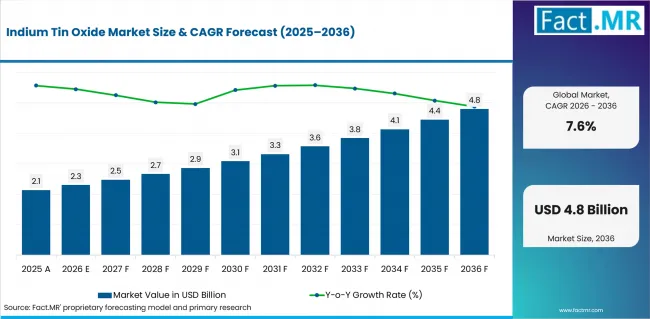
Indium Tin Oxide Market Value Analysis | Source: Fact.MR
What are the defining numbers behind Indium Tin Oxide Market growth?
USD 2.7 billion absolute opportunity from 2025 to 2036, led by ITO Targets, Flat Panel Displays; and Consumer Electronics Manufacturers.
- Demand Drivers in the Market
- Display and touch-panel manufacturers require transparent electrodes that maintain low sheet resistance and high optical transmission across large coated areas.
- Qualified sputtering recipes create recurring target replacement demand because a change in composition, geometry, or particle behavior can affect line yield.
- Photovoltaic cells, optoelectronic devices, specialty glass; and vehicle glazing expand demand beyond flat panel displays.
- Reclaim credits, target utilization, local inventory; and application engineering influence the total cost and continuity of supply.
- Key Segments Analyzed
- By Product Type: ITO Targets are projected to hold 37.0% share in 2026 because sputtering remains the main industrial route for repeatable transparent-conductive films.
- By Application: Flat Panel Displays are projected to account for 39.0% share in 2026 owing to large coated area and strict optical-electrical tolerances.
- By End User: Consumer Electronics Manufacturers are projected to represent 36.0% share in 2026 as device and display specifications cascade into material orders.
- By Distribution Channel: Direct Sales, OEM Contracts, Long-Term Supply Agreements; and Industrial Distributors structure procurement.
- By Form: Sputtering Targets, Cylindrical Targets, Planar Targets; and Coated Substrates serve different process routes.
- Analyst Opinion at Fact.MR
- Shambhu Nath Jha, Principal Consultant at Fact.MR, states: “ITO suppliers win repeat business by becoming part of the customer process rather than by offering nominal capacity. Lots must hold optical transmission; resistance; particle; and deposition performance within a narrow window. Closed-loop reclaim; local engineering; and disciplined change control reduce supply risk and qualification burden.”
- Strategic Implications
- Target producers should pair purity and density specifications with utilization data, spent-target return terms, and reclaim credits.
- Display and device manufacturers should treat a new ITO source as a process change that requires deposition, annealing, patterning; particle; and reliability checks. The same qualification burden appears in the display glass substrate and oled display markets.
- Coaters serving solar and sensitive substrates should qualify low-temperature deposition routes without weakening adhesion or electrical performance.
- Distributors should maintain local inventory and clear change-control records in concentrated electronics manufacturing clusters.
How does the Indium Tin Oxide Market break down by segment?
ITO Targets lead Product Type at 37.0%, Flat Panel Displays lead Application at 39.0%, and Consumer Electronics Manufacturers lead End User at 36.0% in 2026.
Why do ITO Targets lead Product Type?
ITO Targets hold 37.0% share in 2026.
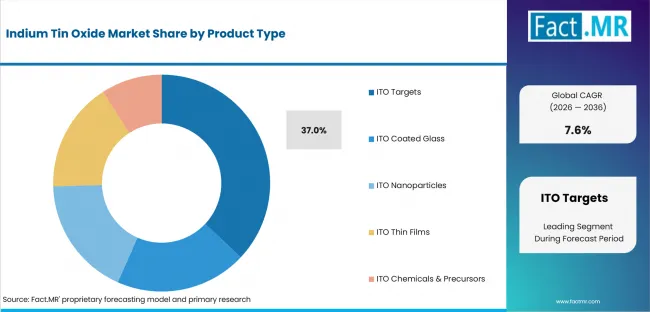
Indium Tin Oxide Market Analysis By Product Type | Source: Fact.MR
ITO targets convert a tightly specified ceramic composition into repeatable transparent-conductive films across long production runs. Rotary and planar formats can be matched to chamber design, deposition rate, and substrate width. Spent material can also enter reclaim programs; which links target geometry and utilization directly to purchasing economics.
Why do Flat Panel Displays lead Application?
Flat Panel Displays hold 39.0% share in 2026.
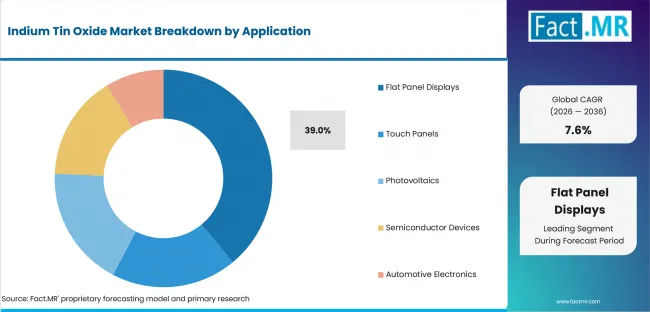
Indium Tin Oxide Market Analysis By Application | Source: Fact.MR
Flat panel displays combine large coated area with demanding optical and electrical tolerances. LCD and OLED producers screen film uniformity, resistance, transmission; pattern fidelity; and particle defects across repeated runs. Touch panels remain important; while photovoltaic and smart-glass uses broaden demand beyond display lines.
Why do Consumer Electronics Manufacturers lead End User?
Consumer Electronics Manufacturers hold 36.0% share in 2026.
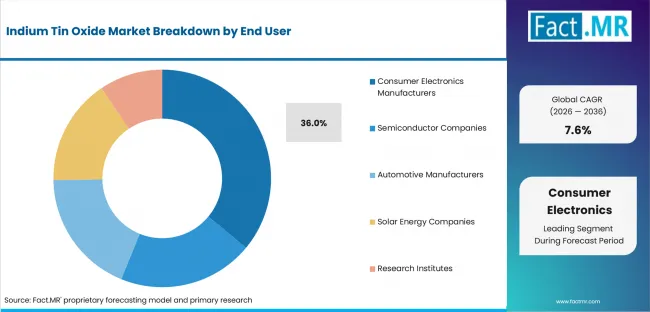
Indium Tin Oxide Market Analysis By End User | Source: Fact.MR
Consumer electronics manufacturers control brightness, power, touch response; thickness; durability; and cost targets that flow into display and material specifications. Display makers approve film stacks and coating windows; while device OEMs decide whether an established ITO recipe is retained; optimized; or challenged by another transparent conductor.
How do Distribution Channels shape ITO procurement?
Supplier access is organized around qualification support and supply continuity; no channel share is assigned.
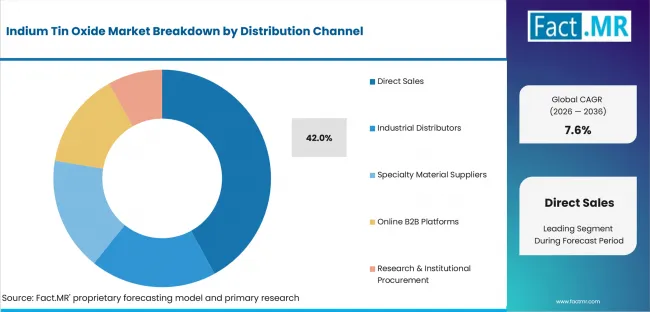
Indium Tin Oxide Market Analysis By Distribution Channel | Source: Fact.MR
Direct Sales and OEM Contracts suit large accounts that need technical review, target geometry control, and formal change management. Long-Term Supply Agreements help stabilize inventory and reclaim arrangements. Industrial Distributors serve smaller or dispersed buyers that need stocked materials; local documentation; and application support.
How does Form influence process qualification?
Sputtering Targets and Coated Substrates serve different points in the production chain; no form share is assigned.
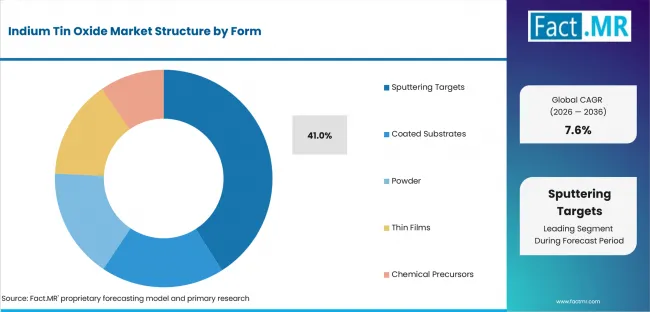
Indium Tin Oxide Market Analysis By Form | Source: Fact.MR
Cylindrical and planar targets are qualified inside deposition equipment and judged by film output, target utilization, and particle behavior. Coated substrates shift more process responsibility to the supplier. That route can simplify downstream production; but buyers still require consistent resistance; transmission; adhesion; and surface quality.
What is accelerating Indium Tin Oxide Market adoption, and what is holding it back?
Display and transparent-electrode capacity supports demand, while indium exposure and process qualification restrain switching. Low-temperature deposition and closed-loop recovery provide the clearest route to wider adoption. Material selection connects this demand with the coated glass and photovoltaics markets.
Drivers Impact Analysis
| DRIVER | QUALITATIVE RELEVANCE | GEOGRAPHIC RELEVANCE | IMPACT TIMELINE |
|---|---|---|---|
| OLED and quantum-dot display investment | High | South Korea and East Asia | Current forecast period |
| Replacement demand from qualified sputtering recipes | High | Japan, South Korea, and Taiwan | Current forecast period |
| Growth in touch and flat-panel electrode area | High | Global electronics clusters | Current forecast period |
| Photovoltaic and specialty-glass coating demand | Moderate | USA and Germany | Current forecast period |
| Automotive glazing and optoelectronic applications | Moderate | Germany, Japan, and USA | Current forecast period |
Source: Fact.MR analysis. Updated Aug 3, 2026
- Display investment: South Korea links two large panel manufacturers with roughly 1,290 materials, parts; and equipment SMEs. Planned OLED and quantum-dot investment through 2026 supports recurring demand for qualified transparent-conductive materials.
- Qualification lock-in: Once an ITO grade is embedded in a production recipe, buyers avoid casual substitutions. Repeated replacement demand therefore depends on lot consistency, target behavior; and fast technical response.
Opportunity Impact Analysis
| OPPORTUNITY | QUALITATIVE RELEVANCE | GEOGRAPHIC RELEVANCE | IMPACT TIMELINE |
|---|---|---|---|
| Low-temperature deposition for sensitive substrates | High | USA | Current forecast period |
| Closed-loop recovery of spent targets | High | Japan and East Asia | Current forecast period |
| Indium recovery from end-of-life electronics and photovoltaics | Moderate | Europe | Current forecast period |
| Local inventory and application engineering | Moderate | Japan, South Korea, and Taiwan | Current forecast period |
Source: Fact.MR analysis. Updated Aug 3, 2026
- Low-temperature deposition and recovery: The U.S. Department of Energy has supported a scalable ion-source route intended to deposit high-quality transparent conductive films without damaging sensitive solar-cell structures. Europe’s CLOSER project also targets indium recovery from electronics and renewable-energy systems. Together, these approaches lower coating risk and reduce primary-material exposure.
Restraints Impact Analysis
| RESTRAINT | QUALITATIVE RELEVANCE | GEOGRAPHIC RELEVANCE | IMPACT TIMELINE |
|---|---|---|---|
| Indium supply and price exposure | High | Global | Current forecast period |
| Process qualification for new suppliers or conductors | High | Japan, South Korea, and Taiwan | Current forecast period |
| Film uniformity, particle, and patterning risk | High | Display manufacturing clusters | Current forecast period |
| Alternative transparent conductors in selected uses | Moderate | Global | Current forecast period |
Source: Fact.MR analysis. Updated Aug 3, 2026
- Critical-material exposure: Indium appears on Canadian and Australian critical-minerals lists. Supply-chain vulnerability makes reclaim yield, secondary feedstock, inventory coverage; and contract terms important to the landed economics of ITO.
- Qualification burden: A buyer considering a new source or an alternative conductor must retest deposition rate, annealing, adhesion; resistance; transmission; patterning; particles; reliability; and downstream compatibility. That work slows switching even when a lower-cost option is available.
Which countries are scaling Indium Tin Oxide Market fastest?
Japan 8.9%, USA 8.6%, South Korea 8.3%; Germany 8.0%; Taiwan 7.7%; Canada 7.4%; and Australia 7.1% through 2036.
Regional analysis covers North America, Latin America, Western Europe; Eastern Europe; East Asia; South Asia and Pacific; and the Middle East and Africa.
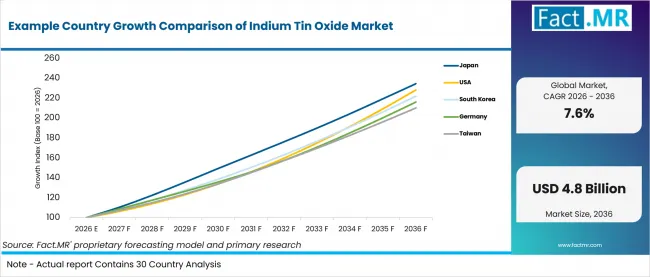
Example Country Growth Comparison Of Indium Tin Oxide Market | Source: Fact.MR
| COUNTRY | CAGR, 2026 TO 2036 |
|---|---|
| Japan | 8.9% |
| USA | 8.6% |
| South Korea | 8.3% |
| Germany | 8.0% |
| Taiwan | 7.7% |
| Canada | 7.4% |
| Australia | 7.1% |
Source: Fact.MR analysis. Updated Aug 3, 2026
What is shaping Japan's outlook through 2036?
8.9% CAGR through 2036, supported by long qualification cycles, material consistency; and recycling discipline.
Japan combines established electronic-material suppliers with demanding display and device accounts. Buyers emphasize purity, target behavior, lot consistency; particle control; and closed-loop recovery before a grade enters volume production. Local engineering and disciplined change control support repeat orders. Processing constraints also shape the consumer electronics and smartphone markets.
What is shaping USA's outlook through 2036?
8.6% CAGR through 2036, supported by a diverse base of solar, semiconductor; specialty-glass; automotive; defense; and research buyers.
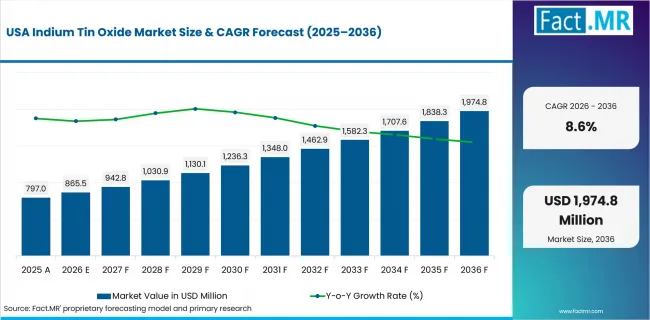
Indium Tin Oxide Market Country Value Analysis | Source: Fact.MR
USA demand is spread across several application groups rather than one display cluster. Orders are often application-specific and require tailored deposition support. The Department of Energy project on high-rate transparent-conductive-film deposition shows the focus on lowering coating cost without damaging sensitive device structures.
What is shaping South Korea's outlook through 2036?
8.3% CAGR through 2036, driven by concentrated OLED and display production.
South Korean panel manufacturers and their materials networks purchase around high-volume production lines. Uptime, rapid technical response, film uniformity; and target availability are decisive. The country’s display profile also links large panel makers with a broad base of materials; parts; and equipment suppliers.
What is shaping Germany's outlook through 2036?
8.0% CAGR through 2036, supported by photovoltaic, automotive; smart-glass; optical; and research applications.
Germany has a broader transparent-conductive-oxide demand base than display production alone. Purchasers connect ITO performance with coating temperature, optical design, energy applications; and industrial quality systems. Technical institutes and specialist coaters support evaluation of material and deposition options.
What is shaping Taiwan's outlook through 2036?
7.7% CAGR through 2036, shaped by tightly controlled supplier-change procedures and local engineering requirements.
Taiwanese foundries and electronics manufacturers use formal qualification systems for process materials. Buyers expect local inventory, technical access, and stable documentation because a change in transparent-conductive material can affect downstream patterning and device performance.
What is shaping Canada's outlook through 2036?
7.4% CAGR through 2036, with supply security and recovery economics influencing procurement.
Canada identifies indium as a critical mineral. That status raises attention to vulnerable supply chains, secondary feedstock, reclaim; and long-term sourcing terms. Suppliers that document recovery routes and maintain dependable inventory can reduce risk for domestic research and industrial users.
What is shaping Australia's outlook through 2036?
7.1% CAGR through 2036, with critical-mineral policy making traceability and material recovery commercially relevant.
Australia also treats indium as a critical mineral. Buyers therefore assess more than unit price. Source transparency, supply continuity, reclaim options; and compatibility with qualified deposition processes affect qualification and contract decisions. Supplier approval conditions remain relevant to the graphene and graphene electrodes markets.
Who leads the Indium Tin Oxide Market?
Competition centers on purity and target design. Coated-substrate capability and reclaim support also shape customer qualification.
JX Advanced Metals Corporation, Mitsui Mining & Smelting Co., Ltd.; Umicore; and Indium Corporation compete through material purity; target engineering; supply assurance; and recovery capability. Their commercial position depends on consistent output across target shapes; substrate temperatures; and repeated deposition cycles.
Corning Incorporated and Samsung Corning Advanced Glass connect ITO to glass and coated-substrate requirements. Thin Film Devices Inc. and Kintec Company Limited address coated-film and application needs. ITOCHU Corporation supports route-to-market access, while TOCALO Co., Ltd. adds coating and process-execution capability.
Recent activity points to stronger capital access and recycling capability. JX Advanced Metals began trading on the Tokyo Stock Exchange Prime Market in March 2025. Mitsui Mining & Smelting established the Kyushu Advanced Materials Development Center in April 2026 with a focus that includes rare-metal refining and recycling.
In March 2025, JX Advanced Metals Corporation began trading on the Tokyo Stock Exchange Prime Market. The listing gave the advanced-materials producer a direct public-equity platform separate from its former group structure.
In April 2026, Mitsui Mining & Smelting Co., Ltd. established the Kyushu Advanced Materials Development Center in Omuta; Fukuoka. The center is intended to develop advanced materials while advancing rare-earth and rare-metal refining and recycling technologies.
In May 2025, the U.S. Department of Energy updated its project record for Scion Plasma's single-beam ion-source technology for transparent conductive thin films. The program targets scalable, high-rate deposition of high-quality ITO for advanced solar-cell structures without damaging sensitive layers.
Which companies are the key providers?
JX Advanced Metals Corporation and Corning Incorporated are leading companies in the market.
- JX Advanced Metals Corporation
- Corning Incorporated
- Mitsui Mining & Smelting Co., Ltd.
- Umicore
- Samsung Corning Advanced Glass
- ITOCHU Corporation
- Indium Corporation
- TOCALO Co., Ltd.
- Thin Film Devices Inc.
- Kintec Company Limited
Bibliography
- U.S. Department of Energy. (2025, May 15). CX-101673: Developing a Single Beam Ion Source Technology for Efficient Manufacturing of Transparent Conductive Thin Films.
- KOTRA Invest KOREA. (n.d.; accessed 2026, July 29). Display.
- Fraunhofer Institute for Surface Engineering and Thin Films IST. (n.d.; accessed 2026, July 28). Transparent Conductive Oxides TCO.
- European Innovation Council and SMEs Executive Agency. (2026, May 26). I3 Instrument-Funded Projects Help Strengthen Europe's Critical Raw Materials Value Chains.
- Government of Canada. (2026, June 30). Canada's Critical Minerals.
This Report Addresses
- What is the Indium Tin Oxide Market worth in 2026, and what value is forecast for 2036?
- Which demand, purchasing, and operating pressures shape the Indium Tin Oxide Market?
- Why do ITO Targets, Flat Panel Displays, and Consumer Electronics Manufacturers lead their segments?
- How do growth rates and qualification conditions differ across the seven profiled countries?
- Which companies are profiled, and what determines competitive credibility?
- What scope boundary, evidence base, and methodology support the market assessment?
What does the Indium Tin Oxide Market cover?
ITO targets, coated substrates, powders; nanoparticles; deposited films; and chemicals or precursors used to deliver transparent conductivity.
The Indium Tin Oxide Market covers material and semi-finished product revenue within the defined Product Type, Application, End User; Distribution Channel; and Form structure. Commercial value is attached to ITO material; coating; or target supply rather than to the full value of the downstream display; device; vehicle; photovoltaic module; or smart-window system. Performance testing also influences the graphene interconnects and conductive carbon black markets.
The market differs from the broader transparent-conductor universe because its boundary is limited to indium tin oxide. Other conductive oxides, metal mesh, silver nanowires; graphene; and conductive polymers remain adjacent or substitute technologies.
What is included in the scope?
Revenue from ITO material, target, coated-substrate; film; and precursor supply across the defined segmentation universe.
The scope includes ITO Targets, Rotary Sputtering Targets, Planar Sputtering Targets; and ITO Coated Glass. Applications include Flat Panel Displays; LCD Displays; OLED Displays; and Touch Panels. Coverage also includes the defined End User; Distribution Channel; Form; regional; country; and company structures.
What is excluded from the scope?
Downstream finished products and alternative transparent conductors are outside the revenue boundary.
The scope excludes revenue from finished displays, devices, modules; vehicles; and smart-window systems. It also excludes IZO; IGZO; AZO; FTO; metal mesh; silver nanowires; graphene; conductive polymers; and other substitute transparent conductors. Service revenue that is not tied to an in-scope ITO product is also outside the market boundary.
How was the analysis built?
Primary interviews, desk research, shipment modelling; coated-area checks; and validation across product; application; company; and country evidence.
- Primary Research
- Structured consultations cover ITO and indium-material manufacturers, target fabricators, coaters; distributors; display and device manufacturers; semiconductor and photovoltaic companies; procurement teams; research institutions; and subject-matter specialists.
- Desk Research
- Desk research reviews official statistics and critical-mineral policies, government manufacturing programs, company filings and product documentation; technical institutes; industry information; patents; standards; and directly relevant public announcements.
- Market-Sizing and Forecasting
- The model combines shipment and price indicators for targets, coated substrates, powders; films; and precursors with installed deposition capacity; target replacement frequency; reclaim credits; coated area; line utilization; application mix; and country manufacturing conditions.
- Data Validation and Update Cycle
- Findings are cross-checked across company, country, product; and application evidence. Bottom-up estimates are reconciled with coated-area; production; and critical-material indicators while exclusions are tested against the stated revenue boundary. Production economics connect this demand with the EMI shielding and lcd panel markets.
Segmentation
What is the report’s scope and coverage?
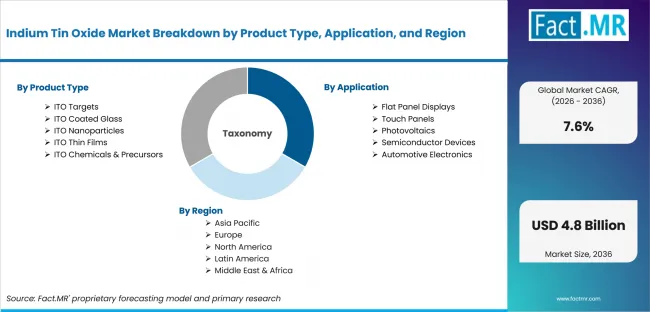
Indium Tin Oxide Market Breakdown By Product Type, Application, And Region | Source: Fact.MR
| Attribute | Details |
|---|---|
| Quantitative Units | USD 2.3 Billion (2026); USD 4.8 Billion (2036); 7.6% CAGR |
| Market Definition | Revenue from ITO targets, coated glass or polymer substrates, powders; nanoparticles; deposited films; and chemical precursors. |
| Product Type | ITO Targets; Rotary Sputtering Targets; Planar Sputtering Targets; ITO Coated Glass |
| Application | Flat Panel Displays; LCD Displays; OLED Displays; Touch Panels |
| End User | Consumer Electronics Manufacturers; Display Manufacturers; Device OEMs; Semiconductor Companies |
| Distribution Channel | Direct Sales; OEM Contracts; Long-Term Supply Agreements; Industrial Distributors |
| Form | Sputtering Targets; Cylindrical Targets; Planar Targets; Coated Substrates |
| Regions Covered | North America; Latin America; Western Europe; Eastern Europe; East Asia; South Asia and Pacific; Middle East and Africa |
| Countries Covered | Japan; USA; South Korea; Germany; Taiwan; Canada; Australia; 25+ additional countries |
| Key Companies Profiled | JX Advanced Metals Corporation; Corning Incorporated; Mitsui Mining & Smelting Co., Ltd.; Umicore; Samsung Corning Advanced Glass; ITOCHU Corporation; Indium Corporation; TOCALO Co., Ltd.; Thin Film Devices Inc.; Kintec Company Limited |
| Forecast Period | 2026 to 2036 |
| Approach | Hybrid bottom-up and top-down method using shipments, selling values, target replacement; reclaim cycles; coated area; buyer qualification; application output; and country indicators |
Source: Fact.MR analysis. Updated Aug 3, 2026
How is the market segmented?
-
By Product Type:
- ITO Targets
- Rotary Sputtering Targets
- Planar Sputtering Targets
- ITO Coated Glass
- Flat Panel Display Glass
- Touch Panel Glass
- ITO Nanoparticles
- Nano Powder
- Dispersed Nanoparticles
- ITO Thin Films
- Transparent Conductive Films
- Flexible Thin Films
- ITO Chemicals & Precursors
- Indium Precursors
- Tin Oxide Precursors
- ITO Targets
-
By Application:
- Flat Panel Displays
- LCD Displays
- OLED Displays
- Touch Panels
- Smartphones
- Tablets
- Photovoltaics
- Thin-Film Solar Cells
- BIPV Modules
- Semiconductor Devices
- Integrated Circuits
- Optoelectronic Devices
- Automotive Electronics
- Smart Windows
- Display Systems
- Flat Panel Displays
-
By End User:
- Consumer Electronics Manufacturers
- Display Manufacturers
- Device OEMs
- Semiconductor Companies
- Chip Manufacturers
- Foundries
- Automotive Manufacturers
- EV Manufacturers
- Automotive Electronics Suppliers
- Solar Energy Companies
- PV Module Manufacturers
- Thin-Film Cell Producers
- Research Institutes
- Universities
- Materials Research Laboratories
- Consumer Electronics Manufacturers
-
By Distribution Channel:
- Direct Sales
- OEM Contracts
- Long-Term Supply Agreements
- Industrial Distributors
- Authorized Distributors
- Regional Suppliers
- Specialty Material Suppliers
- Electronic Material Suppliers
- Thin Film Material Suppliers
- Online B2B Platforms
- Manufacturer Websites
- Industrial Marketplaces
- Research & Institutional Procurement
- Public Research Procurement
- Academic Supply Contracts
- Direct Sales
-
By Form:
- Sputtering Targets
- Cylindrical Targets
- Planar Targets
- Coated Substrates
- Glass Substrates
- Polymer Substrates
- Powder
- Nano Powder
- Micron Powder
- Thin Films
- Rigid Thin Films
- Flexible Thin Films
- Chemical Precursors
- Organometallic Precursors
- Metal Oxide Precursors
- Sputtering Targets
-
By Region:
- North America
- Latin America
- Western Europe
- Eastern Europe
- East Asia
- South Asia and Pacific
- Middle East & Africa
Frequently Asked Questions
Which Product Type leads the Indium Tin Oxide Market?
Which Application leads the Indium Tin Oxide Market?
Which End User leads the Indium Tin Oxide Market?
Which country records the highest CAGR in the Indium Tin Oxide Market?
How does USA perform in the Indium Tin Oxide Market?
How does South Korea perform in the Indium Tin Oxide Market?
How does Germany perform in the Indium Tin Oxide Market?
How does Taiwan perform in the Indium Tin Oxide Market?
How does Canada perform in the Indium Tin Oxide Market?
How does Australia perform in the Indium Tin Oxide Market?
What is the primary driver in the Indium Tin Oxide Market?
What is the main restraint in the Indium Tin Oxide Market?
Why are ITO Targets important?
Why does closed-loop recovery matter?
Who worked on this report


Preview the report firsthand - request a free sample
Free SampleGet the brochure for pricing and purchase details
Download PDF