High Hardness Slabstock Foams Market Size, Share, Growth and Forecast (2026 - 2036)
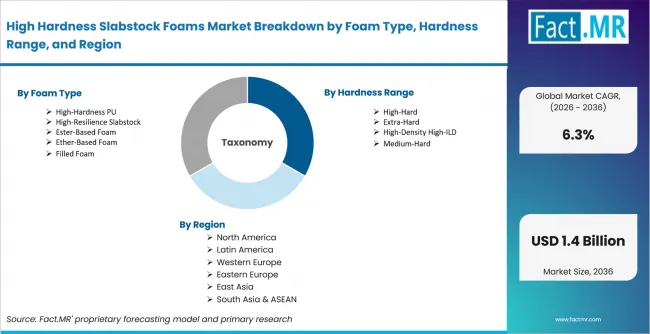
The High Hardness Slabstock Foams Market is segmented by Foam Type, by Hardness Range, by Application, by Production Method, by Buyer Type, and Region. Forecast for 2026 to 2036.
What is the high hardness slabstock foams market forecast to be worth by 2036?
USD 735.0 million in 2026 to USD 1,350 million by 2036, at 6.3% CAGR.
- The high hardness slabstock foams market crossed a valuation of USD 690.0 million in 2025. Demand is expected to increase from USD 735.0 million in 2026 to USD 1,350 million by 2036.
- The market is forecast to record 6.3% CAGR during 2026 to 2036 as seating, industrial pads and fabricated support parts require tighter indentation load deflection and density control.
- High hardness slabstock foam sits inside the larger flexible polyurethane foam value chain. The Polyurethane Foam Association states that more than 1.5 billion pounds of flexible polyurethane foam are produced in North America each year. [1]
- This supports demand because high-hardness grades represent a specification-led slice of broader polyurethane materials, not the whole flexible foam base.

What are the defining numbers behind high hardness slabstock foams growth?
USD 615.0 million absolute opportunity by 2036, led by China and India.
- Demand Drivers in the Market
- Automotive seat programs need high-ILD blocks because cushion support, bolsters and headrest parts must hold shape after repeated compression.
- North America offers a large base for high-hardness conversion because furniture, packaging and transport seating channels already buy flexible polyurethane foam through established converter networks.
- Industrial pads and protective packaging use firmer blocks when heavy products need cushioning that does not bottom out under load.
- Wider Europe is seeing slabstock activity shift eastward; the EUROPUR and EURO-MOULDERS 2025 conference noted a 0.10% decline in 2024 polyether slabstock foam output and pronounced regional variation. [4]
- Key Segments Analyzed
- By Foam Type: High-Hardness PU is expected to hold 41.0% share in 2026 because polyurethane chemistry gives converters a familiar route to firm support grades.
- By Hardness Range: High-Hard grades account for 38.0% share in 2026 because they balance support, cutting yield and application breadth.
- By Application: Automotive Seating is projected to capture 32.0% share in 2026 as seat cushions and support layers need repeat firmness.
- By Production Method: Continuous Slabstock is likely to hold 54.0% share in 2026 because large blocks support throughput and density control.
- By Buyer Type: OEM Component Suppliers account for 36.0% share in 2026 because repeat programs require documented hardness and density consistency.
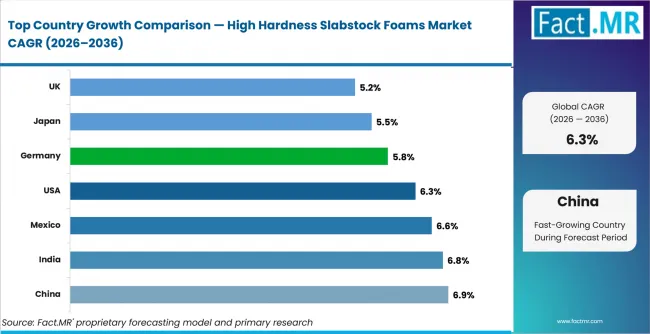
- By Geography: China is projected to record 6.9% CAGR through 2036 as vehicle production scale and local foam conversion capacity expand.
- Analyst Opinion at Fact.MR
- Shambhu Nath Jha, Senior Analyst at Fact.MR, states, "High-hardness slabstock foam is a specification market, not a simple volume pool. I see converters asking for blocks that cut cleanly, hold ILD and keep support after repeated compression. The suppliers that win repeat programs connect chemistry, block process control and downstream cutting knowledge. Automotive seating and industrial pads show this specification discipline most clearly."
- Strategic Implications
- Foam producers should qualify high-hardness grades with documented ILD, density, compression set and low-odor performance.
- Converters need CNC cutting and lamination control because hardness value can be lost during downstream processing.
- Automotive tier suppliers should bring foam suppliers into seat development earlier to reduce requalification cycles.
- Raw material suppliers can gain share by supporting high-load-bearing formulations with stable processing windows.
China is projected to record 6.9% CAGR through 2036 as automotive production scale and electric vehicle seating programs increase local conversion demand. India is expected to post 6.8% CAGR as vehicle output and price-sensitive furniture production expand. Mexico is forecast at 6.6% CAGR as North American seating supply chains keep using local foam conversion. The United States is projected to record 6.3% CAGR because automotive, furniture, packaging and industrial pad demand remain broad. Germany, Japan and the United Kingdom expand below China and India because their markets are more specification-heavy and replacement-led.
How does the high hardness slabstock foams market break down by segment?
High-hardness PU leads at 41.0%; automotive seating leads applications at 32.0%.
Which foam type dominates?
High-Hardness PU holds 41.0% share in 2026.
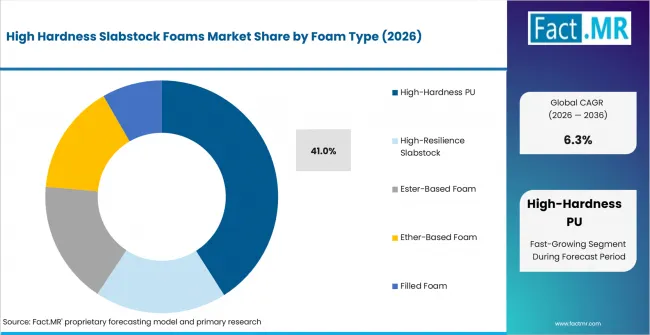
High-Hardness PU is expected to hold 41.0% share in 2026 because polyurethane slabstock gives converters a familiar route to firmness control. Raw material suppliers can adjust polyols, isocyanates, catalysts and fillers to reach the target support level. Polyurethane foam also has enough application breadth to move from furniture layers into automotive pads, orthopedics and industrial support parts.
Which hardness range dominates?
High-Hard grades hold 38.0% share in 2026.
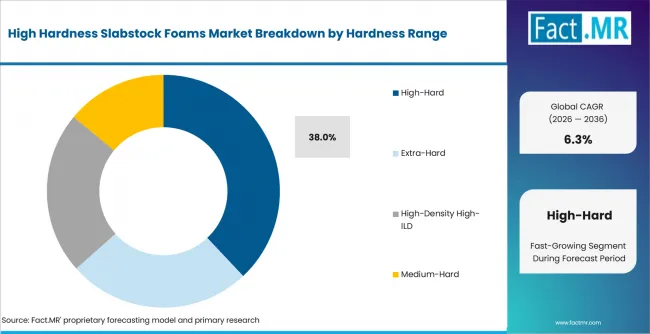
High-Hard grades lead because they give enough stiffness for seating and industrial pads without the conversion losses that can come with extra-hard blocks. The segment accounts for 38.0% share in 2026 as purchasing teams need firmness that still cuts cleanly and laminates well. Extra-hard and high-density high-ILD grades are used more selectively when the part must carry heavier load or retain shape in a thin profile.
Which application dominates?
Automotive Seating holds 32.0% share in 2026.
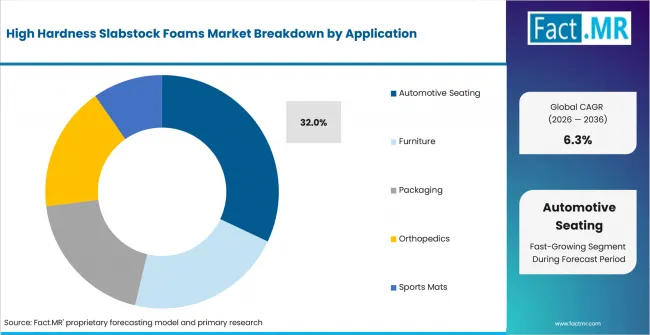
Automotive Seating leads by application. The segment accounts for 32.0% share in 2026 because seat cushions, bolsters, headrests and support layers are specified around comfort, durability and low-odor performance. Industrial pads and plastic protective packaging add demand when customers need firmer cushioning for heavier products.
Which production method dominates?
Continuous Slabstock holds 54.0% share in 2026.
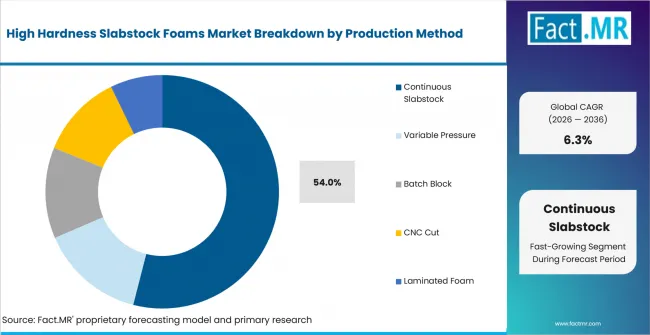
Continuous Slabstock holds 54.0% share in 2026 because it produces large rectangular blocks with better throughput than batch-only routes. Large blocks help converters improve nesting, reduce scrap and serve repeat purchase programs. Foam mixing equipment and polyurethane processing machines matter in this segment because metering accuracy affects density variation and hardness drift.
Which buyer type dominates?
OEM Component Suppliers hold 36.0% share in 2026.
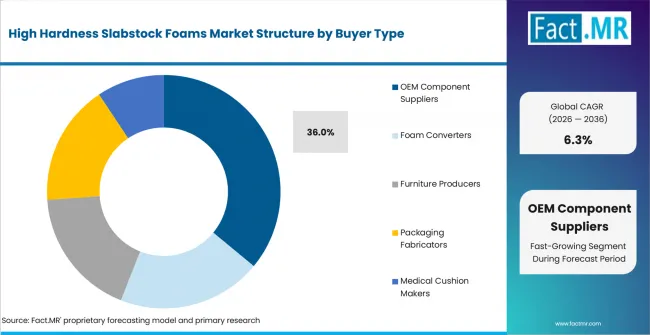
OEM Component Suppliers account for 36.0% share in 2026 because they buy foam for repeat programs and need proof that each block grade matches the same tolerance band. Foam converters are the next important buyer group because they translate blocks into cut pads, laminated sheets and shaped inserts. Furniture producers and packaging fabricators buy more selectively, but they still influence grade design when thickness and support requirements change.
What is accelerating high hardness slabstock foams demand, and what is holding it back?
Automotive support needs and density-controlled conversion drive it; raw material cost and cutting scrap restrain it.
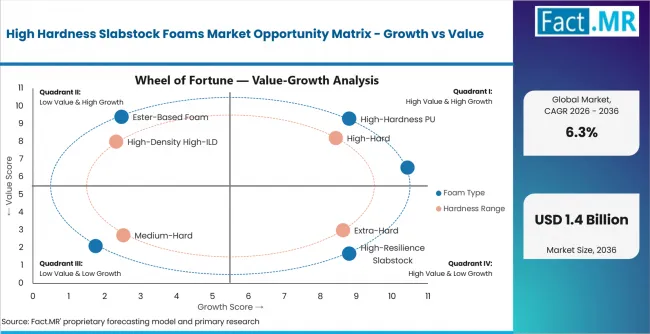
The main driver is the need for firmer support in vehicle interiors, industrial pads and load-bearing fabricated parts. BASF introduced biomass balance Elastoflex polyurethane foam systems for North American furniture applications in March 2025. [6] Foam blowing agents remain part of formulation planning where density, processing behavior and environmental rules affect foam economics.
The main restraint is the cost of density and conversion waste. Higher hardness often means more precise formulation control, tighter curing windows and less tolerance for process drift. When converters cut thin firm parts, scrap becomes more expensive because every off-spec block carries higher raw material value. The restraint is sharper for smaller fabricators that lack testing equipment or cannot run frequent ILD and compression-set checks.
Where do the biggest high hardness slabstock foams opportunities sit?
Automotive seating support, protective packaging and orthopedic pads.
- Automotive Seat Support: Suppliers can qualify high-hardness grades for cushions, bolsters and headrests where repeat compression performance is measured.
- Protective Packaging: Fabricators can use firmer foam blocks for heavier goods that need shock absorption and shape recovery. Protective packaging formats add volume where return damage costs justify a higher foam grade.
- Orthopedic and Medical Pads: High-hardness blocks can support braces, therapy pads and positioning cushions. Medical foam requirements create a channel for grades that combine firmness with controlled feel and clean cutting.
- Thermal and Load-Support Uses: High heat foam and expanded polypropylene foam show how related foam categories compete when customers compare temperature, weight and impact requirements.
Which countries are scaling high hardness slabstock foams fastest?
China 6.9%, India 6.8%, Mexico 6.6%, United States 6.3%, Germany 5.8%, Japan 5.5%, United Kingdom 5.2%.
Based on regional analysis, the high hardness slabstock foams market is segmented into North America, Latin America, Europe, East Asia, South Asia and Pacific, and Middle East and Africa.
.webp)
| Country | CAGR |
|---|---|
| China | 6.9% |
| India | 6.8% |
| Mexico | 6.6% |
| United States | 6.3% |
| Germany | 5.8% |
| Japan | 5.5% |
| United Kingdom | 5.2% |

What is powering China’s lead?
6.9% CAGR, supported by vehicle production scale and local foam conversion capacity.
China is projected to record 6.9% CAGR through 2036 because vehicle output, electric vehicle platforms and furniture conversion support local consumption of firm slabstock grades. International Organization of Motor Vehicle Manufacturers reported that China reached 34.53 million vehicles produced in 2025. [2] That production base gives seating suppliers a large reason to qualify high-hardness foam near assembly and trimming operations. Suppliers that combine local block production with technical support are expected to gain stronger access to automotive and industrial pad accounts.
Why is India expanding quickly?
6.8% CAGR, driven by vehicle output growth and price-sensitive local sourcing.
India is expected to expand at 6.8% CAGR through 2036 as vehicle production, mattress materials and furniture support layers scale together. The Society of Indian Automobile Manufacturers reported April 2026 production of 2,922,427 units across passenger vehicles, three-wheelers, two-wheelers and quadricycles. [14] Local purchasing teams often compare firmness against price and lead time before moving to imported grades. Domestic foamers and converters gain an advantage when they can offer consistent high-hardness blocks without forcing customers into long import cycles.
What supports Mexico’s faster-than-global outlook?
6.6% CAGR, supported by North American seating supply chains and export-oriented assembly.
Mexico is forecast to grow at 6.6% CAGR through 2036 because seat-component suppliers serve North American vehicle programs from local conversion hubs. The country benefits from proximity to United States assembly, cross-border logistics and repeat sourcing from tier suppliers. High-hardness slabstock demand is concentrated in seat pads, headrest support pieces, packaging inserts and industrial cushioning. Growth can move higher if local foam testing and cutting capacity expands near the automotive corridors.
What supports the United States outlook?
6.3% CAGR, driven by flexible foam production depth and broad end-use consumption.
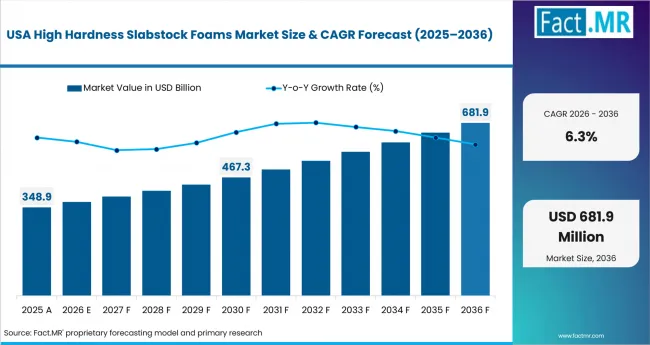
The United States is forecast to advance at 6.3% CAGR through 2036 as automotive seating, furniture, packaging and industrial pads continue to use high-hardness grades. Domestic converter depth supports faster specification changes and shorter supply cycles. Purchasing teams are expected to favor suppliers that can document ILD, density and compression-set results for repeat programs.
What underpins Germany’s growth?
5.8% CAGR, backed by EU automotive specifications and converter qualification discipline.
Germany is projected to rise at 5.8% CAGR through 2036 because automotive interiors and specification-heavy industrial applications require tight foam tolerances. The International Energy Agency reported Germany electric car sales reached a record 850,000 in 2025. [5] High-hardness foam demand is therefore linked to seat comfort, acoustic needs and durable interior support. Growth is below China and India because Germany starts from a more developed qualification base, but suppliers with documentation depth can defend higher-value programs.
Why is Japan an important specification market?
5.5% CAGR, supported by high-spec vehicle interiors and precision conversion requirements.
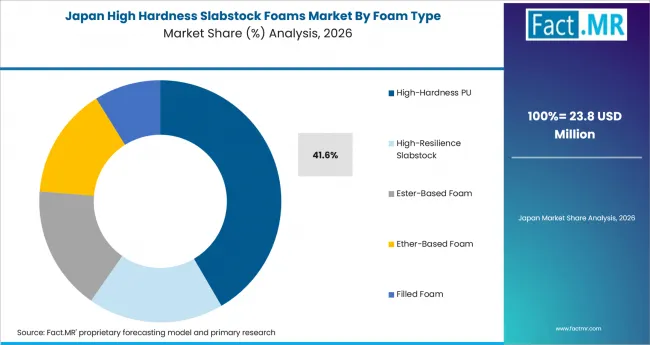
Japan is expected to post 5.5% CAGR through 2036 as automakers and component suppliers focus on durable comfort and low variation in seating materials. Japan Automobile Manufacturers Association materials show motor vehicle production totals of 8.23 million units for 2024, keeping the country among the major vehicle manufacturing bases. [15] Purchasing teams in Japan usually require stable quality records before switching foam grades. This makes the country a documentation-led opportunity for suppliers that can prove consistency instead of competing only on block price.
How does the United Kingdom perform?
5.2% CAGR, supported by furniture, bedding, packaging and imported block conversion.
The United Kingdom is forecast at 5.2% CAGR through 2036 because local furniture, bedding, packaging and automotive component channels still require firm foam parts, even as vehicle production has been under pressure. The Society of Motor Manufacturers and Traders reported 764,715 vehicles produced in 2025. [16] Demand is therefore more conversion-led than production-led. Suppliers can gain share through dependable delivery, smaller batch support and grades suited to furniture and fabricated packaging.
Who leads the high hardness slabstock foams landscape?
Carpenter Co., The Vita Group and Future Foam lead through slabstock scale and conversion expertise.
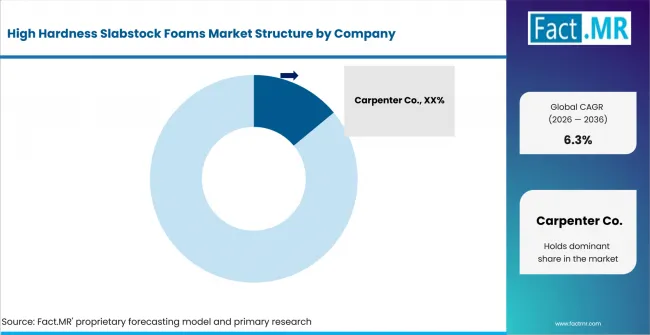
High hardness slabstock foams are supplied by integrated foam producers, regional converters and polyurethane raw material companies. Carpenter Co. supports polyurethane foam products for vehicles, mattresses, sofas, packaging, medical products, sport and leisure. [10] The Vita Group and Future Foam add regional converter depth, while Sheela Foam gives India a large local cushion and bedding materials base.
Raw material suppliers influence the market even when they do not sell converted blocks. BASF, Dow, Covestro and Huntsman provide polyols, isocyanates, systems and technical support that foamers use to tune hardness, resilience, low-emission performance and processing latitude. Competitive advantage is strongest where formulation support is paired with converter knowledge and repeat test data.
The company set focuses on active slabstock producers, converters, and polyurethane raw material suppliers. Recticel completed the acquisition of FoamPartner in March 2021 and then signed a deal with Carpenter for the sale of Recticel Engineered Foams in December 2021. Recticel’s 2024 Annual Report announcement describes the group around insulation-focused operations, so Recticel is excluded from the profiled company set because its current reporting is focused on insulation operations after the earlier engineered-foams transaction history. [13] FoamPartner is not profiled as a standalone company because it no longer operates as a separate profiled supplier.
Which companies are the key players?
Carpenter Co., The Vita Group, Sheela Foam, Future Foam, BASF, Dow and Covestro.
- Carpenter Co.
- The Vita Group
- Sheela Foam Limited
- Future Foam
- BASF SE
- Dow Inc.
- Covestro AG
Bibliography
- [1] Polyurethane Foam Association. (n.d.). Polyurethane Foam Association: Come learn with PFA!
- [2] International Organization of Motor Vehicle Manufacturers. (2026, April 23). Auto industry growth shifted east in 2025 amid global repositioning.
- [3] EUROPUR. (2025, July 7). 2025 slabstock PU foam plants in Wider Europe.
- [4] EURO-MOULDERS. (2025, June 11). EUROPUR & EURO-MOULDERS Annual Conference 2025.
- [5] International Energy Agency. (2026, May 20). Trends in electric cars. In Global EV Outlook 2026.
- [6] BASF. (2025, March 27). BASF introduces biomass balance flexible polyurethane foam systems for the North American furniture industry.
- [7] Huntsman Corporation. (2024, April 17). Huntsman launches new SHOKLESS™ polyurethane systems to help protect electric vehicle batteries.
- [8] The Vita Group. (2025, September 30). The first flexible PU manufacturer with approved SBTi targets.
- [9] The Vita Group. (2025, September 30). Our 2022 sustainability report has officially been launched!
- [10] Carpenter Co. (n.d.). Home.
- [11] Recticel Group. (2021, April 1). Recticel completes the acquisition of FoamPartner.
- [12] Recticel Group. (2021, December 7). Recticel signed a deal with Carpenter for the sale of its Recticel Engineered Foams business line.
- [13] Recticel Group. (2025, April 30). Our 2024 Annual Report is now live!
- [14] Society of Indian Automobile Manufacturers. (2026, May 14). Auto Industry Performance of April-2026.
- [15] Japan Automobile Manufacturers Association. (2025, October 1). The Motor Industry of Japan 2025.
- [16] Society of Motor Manufacturers and Traders. (2026, January 29). Tough year for Auto but new models and Industrial Strategy can deliver growth.
This Report Addresses
- Strategic intelligence on high hardness slabstock foams across foam type, hardness range, application, production method, buyer type and region.
- Segment analysis covering High-Hardness PU, High-Hard grades, Automotive Seating, Continuous Slabstock and OEM Component Suppliers.
- Regional outlook covering China, India, Mexico, United States, Germany, Japan and United Kingdom.
- Competitive analysis of Carpenter Co., The Vita Group, Sheela Foam, Future Foam, BASF, Dow and Covestro.
- Company validation covering Recticel and FoamPartner status corrections.
- Source-backed view of flexible polyurethane foam, slabstock activity, automotive output, electric vehicle seating signals and supplier activity.
What is the report’s scope and coverage?
| Attribute | Details |
|---|---|
| Quantitative Units | USD Million in 2026 to USD Million by 2036 at CAGR |
| Market Definition | High-hardness flexible slabstock foam blocks and cut or laminated parts used where load support is specified |
| Foam Type | High-Hardness PU, High-Resilience Slabstock, Ester-Based Foam, Ether-Based Foam, Filled Foam |
| Hardness Range | Medium-Hard, High-Hard, Extra-Hard, High-Density High-ILD |
| Application | Automotive Seating, Furniture, Packaging, Orthopedics, Sports Mats, Industrial Pads, Footwear |
| Production Method | Continuous Slabstock, Variable Pressure, Batch Block, CNC Cut, Laminated Foam |
| Buyer Type | OEM Component Suppliers, Foam Converters, Furniture Producers, Packaging Fabricators, Medical Cushion Makers |
| Regions Covered | North America, Latin America, Europe, East Asia, South Asia and Pacific, Middle East and Africa |
| Countries Covered | China, India, Mexico, United States, Germany, Japan, United Kingdom |
| Key Companies Profiled | Carpenter Co., The Vita Group, Sheela Foam Limited, Future Foam, BASF SE, Dow Inc., Covestro AG |
| Forecast Period | 2026 to 2036 |
| Approach | Hybrid top-down and bottom-up approach using flexible foam production signals, automotive output, supplier portfolio checks, converter validation and price-band modelling |
How is the market segmented?
-
By Foam Type:
- High-Hardness PU
- High-Resilience Slabstock
- Ester-Based Foam
- Ether-Based Foam
- Filled Foam
-
By Hardness Range:
- Medium-Hard
- High-Hard
- Extra-Hard
- High-Density High-ILD
-
By Application:
- Automotive Seating
- Furniture
- Packaging
- Orthopedics
- Sports Mats
- Industrial Pads
- Footwear
-
By Production Method:
- Continuous Slabstock
- Variable Pressure
- Batch Block
- CNC Cut
- Laminated Foam
-
By Buyer Type:
- OEM Component Suppliers
- Foam Converters
- Furniture Producers
- Packaging Fabricators
- Medical Cushion Makers
-
By Region:
- North America
- United States
- Canada
- Mexico
- Latin America
- Brazil
- Argentina
- Rest of Latin America
- Europe
- Germany
- United Kingdom
- France
- Italy
- Spain
- Rest of Europe
- East Asia
- China
- Japan
- South Korea
- South Asia and Pacific
- India
- ASEAN
- Australia and New Zealand
- Rest of South Asia and Pacific
- Middle East & Africa
- GCC Countries
- South Africa
- UAE
- Rest of Middle East & Africa
- North America
- Frequently Asked Questions -
Which foam type leads the High Hardness Slabstock Foams Market?
High-Hardness PU leads with 41.0% share in 2026 because it gives converters flexible formulation and known processing behavior.
Which country expands faster in the High Hardness Slabstock Foams Market?
China is projected to record 6.9% CAGR through 2036 as vehicle production scale and local foam conversion capacity expand.
How does India perform in the High Hardness Slabstock Foams Market?
India is expected to expand at 6.8% CAGR through 2036 as vehicle production and local foam sourcing increase.
How does Mexico perform in the High Hardness Slabstock Foams Market?
Mexico is forecast to grow at 6.6% CAGR through 2036 because North American seating supply chains support local conversion.
How does the United States perform in the High Hardness Slabstock Foams Market?
The United States is forecast to advance at 6.3% CAGR through 2036 as automotive, furniture, packaging and industrial pad demand remain broad.
What is the primary driver in the High Hardness Slabstock Foams Market?
The primary driver is the need for load-support foam in vehicle seating, industrial pads, packaging inserts and fabricated support parts.
What is the main restraint in the High Hardness Slabstock Foams Market?
The main restraint is density-related cost and cutting scrap, especially in thin firm parts with tight tolerances.
Why are high-hardness PU grades important in this market?
High-hardness PU grades are important because they let foamers tune firmness, resilience and processing behavior within established slabstock production systems.
Table of Content
- Executive Summary
- Global Market Outlook
- Demand to side Trends
- Supply to side Trends
- Technology Roadmap Analysis
- Analysis and Recommendations
- Market Overview
- Market Coverage / Taxonomy
- Market Definition / Scope / Limitations
- Research Methodology
- Chapter Orientation
- Analytical Lens and Working Hypotheses
- Market Structure, Signals, and Trend Drivers
- Benchmarking and Cross-market Comparability
- Market Sizing, Forecasting, and Opportunity Mapping
- Research Design and Evidence Framework
- Desk Research Programme (Secondary Evidence)
- Company Annual and Sustainability Reports
- Peer-reviewed Journals and Academic Literature
- Corporate Websites, Product Literature, and Technical Notes
- Earnings Decks and Investor Briefings
- Statutory Filings and Regulatory Disclosures
- Technical White Papers and Standards Notes
- Trade Journals, Industry Magazines, and Analyst Briefs
- Conference Proceedings, Webinars, and Seminar Materials
- Government Statistics Portals and Public Data Releases
- Press Releases and Reputable Media Coverage
- Specialist Newsletters and Curated Briefings
- Sector Databases and Reference Repositories
- Fact.MR Internal Proprietary Databases and Historical Market Datasets
- Subscription Datasets and Paid Sources
- Social Channels, Communities, and Digital Listening Inputs
- Additional Desk Sources
- Expert Input and Fieldwork (Primary Evidence)
- Primary Modes
- Qualitative Interviews and Expert Elicitation
- Quantitative Surveys and Structured Data Capture
- Blended Approach
- Why Primary Evidence is Used
- Field Techniques
- Interviews
- Surveys
- Focus Groups
- Observational and In-context Research
- Social and Community Interactions
- Stakeholder Universe Engaged
- C-suite Leaders
- Board Members
- Presidents and Vice Presidents
- R&D and Innovation Heads
- Technical Specialists
- Domain Subject-matter Experts
- Scientists
- Physicians and Other Healthcare Professionals
- Governance, Ethics, and Data Stewardship
- Research Ethics
- Data Integrity and Handling
- Primary Modes
- Tooling, Models, and Reference Databases
- Desk Research Programme (Secondary Evidence)
- Data Engineering and Model Build
- Data Acquisition and Ingestion
- Cleaning, Normalisation, and Verification
- Synthesis, Triangulation, and Analysis
- Quality Assurance and Audit Trail
- Market Background
- Market Dynamics
- Drivers
- Restraints
- Opportunity
- Trends
- Scenario Forecast
- Demand in Optimistic Scenario
- Demand in Likely Scenario
- Demand in Conservative Scenario
- Opportunity Map Analysis
- Product Life Cycle Analysis
- Supply Chain Analysis
- Investment Feasibility Matrix
- Value Chain Analysis
- PESTLE and Porter’s Analysis
- Regulatory Landscape
- Regional Parent Market Outlook
- Production and Consumption Statistics
- Import and Export Statistics
- Market Dynamics
- Global Market Analysis 2021 to 2025 and Forecast, 2026 to 2036
- Historical Market Size Value (USD Million) Analysis, 2021 to 2025
- Current and Future Market Size Value (USD Million) Projections, 2026 to 2036
- Y to o to Y Growth Trend Analysis
- Absolute $ Opportunity Analysis
- Global Market Pricing Analysis 2021 to 2025 and Forecast 2026 to 2036
- Global Market Analysis 2021 to 2025 and Forecast 2026 to 2036, By Foam Type
- Introduction / Key Findings
- Historical Market Size Value (USD Million) Analysis By Foam Type , 2021 to 2025
- Current and Future Market Size Value (USD Million) Analysis and Forecast By Foam Type , 2026 to 2036
- High-Hardness PU
- High-Resilience Slabstock
- Ester-Based Foam
- Ether-Based Foam
- Filled Foam
- High-Hardness PU
- Y to o to Y Growth Trend Analysis By Foam Type , 2021 to 2025
- Absolute $ Opportunity Analysis By Foam Type , 2026 to 2036
- Global Market Analysis 2021 to 2025 and Forecast 2026 to 2036, By Hardness Range
- Introduction / Key Findings
- Historical Market Size Value (USD Million) Analysis By Hardness Range, 2021 to 2025
- Current and Future Market Size Value (USD Million) Analysis and Forecast By Hardness Range, 2026 to 2036
- High-Hard
- Extra-Hard
- High-Density High-ILD
- Medium-Hard
- High-Hard
- Y to o to Y Growth Trend Analysis By Hardness Range, 2021 to 2025
- Absolute $ Opportunity Analysis By Hardness Range, 2026 to 2036
- Global Market Analysis 2021 to 2025 and Forecast 2026 to 2036, By Application
- Introduction / Key Findings
- Historical Market Size Value (USD Million) Analysis By Application, 2021 to 2025
- Current and Future Market Size Value (USD Million) Analysis and Forecast By Application, 2026 to 2036
- Automotive Seating
- Furniture
- Packaging
- Orthopedics
- Sports Mats
- Industrial Pads
- Footwear
- Automotive Seating
- Y to o to Y Growth Trend Analysis By Application, 2021 to 2025
- Absolute $ Opportunity Analysis By Application, 2026 to 2036
- Global Market Analysis 2021 to 2025 and Forecast 2026 to 2036, By Production Method
- Introduction / Key Findings
- Historical Market Size Value (USD Million) Analysis By Production Method, 2021 to 2025
- Current and Future Market Size Value (USD Million) Analysis and Forecast By Production Method, 2026 to 2036
- Continuous Slabstock
- Variable Pressure
- Batch Block
- CNC Cut
- Laminated Foam
- Continuous Slabstock
- Y to o to Y Growth Trend Analysis By Production Method, 2021 to 2025
- Absolute $ Opportunity Analysis By Production Method, 2026 to 2036
- Global Market Analysis 2021 to 2025 and Forecast 2026 to 2036, By Buyer Type
- Introduction / Key Findings
- Historical Market Size Value (USD Million) Analysis By Buyer Type, 2021 to 2025
- Current and Future Market Size Value (USD Million) Analysis and Forecast By Buyer Type, 2026 to 2036
- OEM Component Suppliers
- Foam Converters
- Furniture Producers
- Packaging Fabricators
- Medical Cushion Makers
- OEM Component Suppliers
- Y to o to Y Growth Trend Analysis By Buyer Type, 2021 to 2025
- Absolute $ Opportunity Analysis By Buyer Type, 2026 to 2036
- Global Market Analysis 2021 to 2025 and Forecast 2026 to 2036, By Region
- Introduction
- Historical Market Size Value (USD Million) Analysis By Region, 2021 to 2025
- Current Market Size Value (USD Million) Analysis and Forecast By Region, 2026 to 2036
- North America
- Latin America
- Western Europe
- Eastern Europe
- East Asia
- South Asia and Pacific
- Middle East & Africa
- Market Attractiveness Analysis By Region
- North America Market Analysis 2021 to 2025 and Forecast 2026 to 2036, By Country
- Historical Market Size Value (USD Million) Trend Analysis By Market Taxonomy, 2021 to 2025
- Market Size Value (USD Million) Forecast By Market Taxonomy, 2026 to 2036
- By Country
- USA
- Canada
- Mexico
- By Foam Type
- By Hardness Range
- By Application
- By Production Method
- By Buyer Type
- By Country
- Market Attractiveness Analysis
- By Country
- By Foam Type
- By Hardness Range
- By Application
- By Production Method
- By Buyer Type
- Key Takeaways
- Latin America Market Analysis 2021 to 2025 and Forecast 2026 to 2036, By Country
- Historical Market Size Value (USD Million) Trend Analysis By Market Taxonomy, 2021 to 2025
- Market Size Value (USD Million) Forecast By Market Taxonomy, 2026 to 2036
- By Country
- Brazil
- Chile
- Rest of Latin America
- By Foam Type
- By Hardness Range
- By Application
- By Production Method
- By Buyer Type
- By Country
- Market Attractiveness Analysis
- By Country
- By Foam Type
- By Hardness Range
- By Application
- By Production Method
- By Buyer Type
- Key Takeaways
- Western Europe Market Analysis 2021 to 2025 and Forecast 2026 to 2036, By Country
- Historical Market Size Value (USD Million) Trend Analysis By Market Taxonomy, 2021 to 2025
- Market Size Value (USD Million) Forecast By Market Taxonomy, 2026 to 2036
- By Country
- Germany
- UK
- Italy
- Spain
- France
- Nordic
- BENELUX
- Rest of Western Europe
- By Foam Type
- By Hardness Range
- By Application
- By Production Method
- By Buyer Type
- By Country
- Market Attractiveness Analysis
- By Country
- By Foam Type
- By Hardness Range
- By Application
- By Production Method
- By Buyer Type
- Key Takeaways
- Eastern Europe Market Analysis 2021 to 2025 and Forecast 2026 to 2036, By Country
- Historical Market Size Value (USD Million) Trend Analysis By Market Taxonomy, 2021 to 2025
- Market Size Value (USD Million) Forecast By Market Taxonomy, 2026 to 2036
- By Country
- Russia
- Poland
- Hungary
- Balkan & Baltic
- Rest of Eastern Europe
- By Foam Type
- By Hardness Range
- By Application
- By Production Method
- By Buyer Type
- By Country
- Market Attractiveness Analysis
- By Country
- By Foam Type
- By Hardness Range
- By Application
- By Production Method
- By Buyer Type
- Key Takeaways
- East Asia Market Analysis 2021 to 2025 and Forecast 2026 to 2036, By Country
- Historical Market Size Value (USD Million) Trend Analysis By Market Taxonomy, 2021 to 2025
- Market Size Value (USD Million) Forecast By Market Taxonomy, 2026 to 2036
- By Country
- China
- Japan
- South Korea
- By Foam Type
- By Hardness Range
- By Application
- By Production Method
- By Buyer Type
- By Country
- Market Attractiveness Analysis
- By Country
- By Foam Type
- By Hardness Range
- By Application
- By Production Method
- By Buyer Type
- Key Takeaways
- South Asia and Pacific Market Analysis 2021 to 2025 and Forecast 2026 to 2036, By Country
- Historical Market Size Value (USD Million) Trend Analysis By Market Taxonomy, 2021 to 2025
- Market Size Value (USD Million) Forecast By Market Taxonomy, 2026 to 2036
- By Country
- India
- ASEAN
- Australia & New Zealand
- Rest of South Asia and Pacific
- By Foam Type
- By Hardness Range
- By Application
- By Production Method
- By Buyer Type
- By Country
- Market Attractiveness Analysis
- By Country
- By Foam Type
- By Hardness Range
- By Application
- By Production Method
- By Buyer Type
- Key Takeaways
- Middle East & Africa Market Analysis 2021 to 2025 and Forecast 2026 to 2036, By Country
- Historical Market Size Value (USD Million) Trend Analysis By Market Taxonomy, 2021 to 2025
- Market Size Value (USD Million) Forecast By Market Taxonomy, 2026 to 2036
- By Country
- Kingdom of Saudi Arabia
- Other GCC Countries
- Turkiye
- South Africa
- Other African Union
- Rest of Middle East & Africa
- By Foam Type
- By Hardness Range
- By Application
- By Production Method
- By Buyer Type
- By Country
- Market Attractiveness Analysis
- By Country
- By Foam Type
- By Hardness Range
- By Application
- By Production Method
- By Buyer Type
- Key Takeaways
- Key Countries Market Analysis
- USA
- Pricing Analysis
- Market Share Analysis, 2025
- By Foam Type
- By Hardness Range
- By Application
- By Production Method
- By Buyer Type
- Canada
- Pricing Analysis
- Market Share Analysis, 2025
- By Foam Type
- By Hardness Range
- By Application
- By Production Method
- By Buyer Type
- Mexico
- Pricing Analysis
- Market Share Analysis, 2025
- By Foam Type
- By Hardness Range
- By Application
- By Production Method
- By Buyer Type
- Brazil
- Pricing Analysis
- Market Share Analysis, 2025
- By Foam Type
- By Hardness Range
- By Application
- By Production Method
- By Buyer Type
- Chile
- Pricing Analysis
- Market Share Analysis, 2025
- By Foam Type
- By Hardness Range
- By Application
- By Production Method
- By Buyer Type
- Germany
- Pricing Analysis
- Market Share Analysis, 2025
- By Foam Type
- By Hardness Range
- By Application
- By Production Method
- By Buyer Type
- UK
- Pricing Analysis
- Market Share Analysis, 2025
- By Foam Type
- By Hardness Range
- By Application
- By Production Method
- By Buyer Type
- Italy
- Pricing Analysis
- Market Share Analysis, 2025
- By Foam Type
- By Hardness Range
- By Application
- By Production Method
- By Buyer Type
- Spain
- Pricing Analysis
- Market Share Analysis, 2025
- By Foam Type
- By Hardness Range
- By Application
- By Production Method
- By Buyer Type
- France
- Pricing Analysis
- Market Share Analysis, 2025
- By Foam Type
- By Hardness Range
- By Application
- By Production Method
- By Buyer Type
- India
- Pricing Analysis
- Market Share Analysis, 2025
- By Foam Type
- By Hardness Range
- By Application
- By Production Method
- By Buyer Type
- ASEAN
- Pricing Analysis
- Market Share Analysis, 2025
- By Foam Type
- By Hardness Range
- By Application
- By Production Method
- By Buyer Type
- Australia & New Zealand
- Pricing Analysis
- Market Share Analysis, 2025
- By Foam Type
- By Hardness Range
- By Application
- By Production Method
- By Buyer Type
- China
- Pricing Analysis
- Market Share Analysis, 2025
- By Foam Type
- By Hardness Range
- By Application
- By Production Method
- By Buyer Type
- Japan
- Pricing Analysis
- Market Share Analysis, 2025
- By Foam Type
- By Hardness Range
- By Application
- By Production Method
- By Buyer Type
- South Korea
- Pricing Analysis
- Market Share Analysis, 2025
- By Foam Type
- By Hardness Range
- By Application
- By Production Method
- By Buyer Type
- Russia
- Pricing Analysis
- Market Share Analysis, 2025
- By Foam Type
- By Hardness Range
- By Application
- By Production Method
- By Buyer Type
- Poland
- Pricing Analysis
- Market Share Analysis, 2025
- By Foam Type
- By Hardness Range
- By Application
- By Production Method
- By Buyer Type
- Hungary
- Pricing Analysis
- Market Share Analysis, 2025
- By Foam Type
- By Hardness Range
- By Application
- By Production Method
- By Buyer Type
- Kingdom of Saudi Arabia
- Pricing Analysis
- Market Share Analysis, 2025
- By Foam Type
- By Hardness Range
- By Application
- By Production Method
- By Buyer Type
- Turkiye
- Pricing Analysis
- Market Share Analysis, 2025
- By Foam Type
- By Hardness Range
- By Application
- By Production Method
- By Buyer Type
- South Africa
- Pricing Analysis
- Market Share Analysis, 2025
- By Foam Type
- By Hardness Range
- By Application
- By Production Method
- By Buyer Type
- USA
- Market Structure Analysis
- Competition Dashboard
- Competition Benchmarking
- Market Share Analysis of Top Players
- By Regional
- By Foam Type
- By Hardness Range
- By Application
- By Production Method
- By Buyer Type
- Competition Analysis
- Competition Deep Dive
- Carpenter Co.
- Overview
- Product Portfolio
- Profitability by Market Segments (Product/Age /Sales Channel/Region)
- Sales Footprint
- Strategy Overview
- Marketing Strategy
- Product Strategy
- Channel Strategy
- The Vita Group
- Sheela Foam Limited
- Future Foam
- BASF SE
- Dow Inc.
- Covestro AG
- Carpenter Co.
- Competition Deep Dive
- Assumptions & Acronyms Used
List Of Table
- Table 1: Global Market Value (USD Million) Forecast by Region, 2021 to 2036
- Table 2: Global Market Value (USD Million) Forecast by Foam Type , 2021 to 2036
- Table 3: Global Market Value (USD Million) Forecast by Hardness Range, 2021 to 2036
- Table 4: Global Market Value (USD Million) Forecast by Application, 2021 to 2036
- Table 5: Global Market Value (USD Million) Forecast by Production Method, 2021 to 2036
- Table 6: Global Market Value (USD Million) Forecast by Buyer Type, 2021 to 2036
- Table 7: North America Market Value (USD Million) Forecast by Country, 2021 to 2036
- Table 8: North America Market Value (USD Million) Forecast by Foam Type , 2021 to 2036
- Table 9: North America Market Value (USD Million) Forecast by Hardness Range, 2021 to 2036
- Table 10: North America Market Value (USD Million) Forecast by Application, 2021 to 2036
- Table 11: North America Market Value (USD Million) Forecast by Production Method, 2021 to 2036
- Table 12: North America Market Value (USD Million) Forecast by Buyer Type, 2021 to 2036
- Table 13: Latin America Market Value (USD Million) Forecast by Country, 2021 to 2036
- Table 14: Latin America Market Value (USD Million) Forecast by Foam Type , 2021 to 2036
- Table 15: Latin America Market Value (USD Million) Forecast by Hardness Range, 2021 to 2036
- Table 16: Latin America Market Value (USD Million) Forecast by Application, 2021 to 2036
- Table 17: Latin America Market Value (USD Million) Forecast by Production Method, 2021 to 2036
- Table 18: Latin America Market Value (USD Million) Forecast by Buyer Type, 2021 to 2036
- Table 19: Western Europe Market Value (USD Million) Forecast by Country, 2021 to 2036
- Table 20: Western Europe Market Value (USD Million) Forecast by Foam Type , 2021 to 2036
- Table 21: Western Europe Market Value (USD Million) Forecast by Hardness Range, 2021 to 2036
- Table 22: Western Europe Market Value (USD Million) Forecast by Application, 2021 to 2036
- Table 23: Western Europe Market Value (USD Million) Forecast by Production Method, 2021 to 2036
- Table 24: Western Europe Market Value (USD Million) Forecast by Buyer Type, 2021 to 2036
- Table 25: Eastern Europe Market Value (USD Million) Forecast by Country, 2021 to 2036
- Table 26: Eastern Europe Market Value (USD Million) Forecast by Foam Type , 2021 to 2036
- Table 27: Eastern Europe Market Value (USD Million) Forecast by Hardness Range, 2021 to 2036
- Table 28: Eastern Europe Market Value (USD Million) Forecast by Application, 2021 to 2036
- Table 29: Eastern Europe Market Value (USD Million) Forecast by Production Method, 2021 to 2036
- Table 30: Eastern Europe Market Value (USD Million) Forecast by Buyer Type, 2021 to 2036
- Table 31: East Asia Market Value (USD Million) Forecast by Country, 2021 to 2036
- Table 32: East Asia Market Value (USD Million) Forecast by Foam Type , 2021 to 2036
- Table 33: East Asia Market Value (USD Million) Forecast by Hardness Range, 2021 to 2036
- Table 34: East Asia Market Value (USD Million) Forecast by Application, 2021 to 2036
- Table 35: East Asia Market Value (USD Million) Forecast by Production Method, 2021 to 2036
- Table 36: East Asia Market Value (USD Million) Forecast by Buyer Type, 2021 to 2036
- Table 37: South Asia and Pacific Market Value (USD Million) Forecast by Country, 2021 to 2036
- Table 38: South Asia and Pacific Market Value (USD Million) Forecast by Foam Type , 2021 to 2036
- Table 39: South Asia and Pacific Market Value (USD Million) Forecast by Hardness Range, 2021 to 2036
- Table 40: South Asia and Pacific Market Value (USD Million) Forecast by Application, 2021 to 2036
- Table 41: South Asia and Pacific Market Value (USD Million) Forecast by Production Method, 2021 to 2036
- Table 42: South Asia and Pacific Market Value (USD Million) Forecast by Buyer Type, 2021 to 2036
- Table 43: Middle East & Africa Market Value (USD Million) Forecast by Country, 2021 to 2036
- Table 44: Middle East & Africa Market Value (USD Million) Forecast by Foam Type , 2021 to 2036
- Table 45: Middle East & Africa Market Value (USD Million) Forecast by Hardness Range, 2021 to 2036
- Table 46: Middle East & Africa Market Value (USD Million) Forecast by Application, 2021 to 2036
- Table 47: Middle East & Africa Market Value (USD Million) Forecast by Production Method, 2021 to 2036
- Table 48: Middle East & Africa Market Value (USD Million) Forecast by Buyer Type, 2021 to 2036
List Of Figures
- Figure 1: Global Market Pricing Analysis
- Figure 2: Global Market Value (USD Million) Forecast 2021-2036
- Figure 3: Global Market Value Share and BPS Analysis by Foam Type, 2026 and 2036
- Figure 4: Global Market Y-o-Y Growth Comparison by Foam Type,2026 to 2036
- Figure 5: Global Market Attractiveness Analysis by Foam Type
- Figure 6: Global Market Value Share and BPS Analysis by Hardness Range, 2026 and 2036
- Figure 7: Global Market Y-o-Y Growth Comparison by Hardness Range,2026 to 2036
- Figure 8: Global Market Attractiveness Analysis by Hardness Range
- Figure 9: Global Market Value Share and BPS Analysis by Application, 2026 and 2036
- Figure 10: Global Market Y-o-Y Growth Comparison by Application,2026 to 2036
- Figure 11: Global Market Attractiveness Analysis by Application
- Figure 12: Global Market Value Share and BPS Analysis by Production Method, 2026 and 2036
- Figure 13: Global Market Y-o-Y Growth Comparison by Production Method,2026 to 2036
- Figure 14: Global Market Attractiveness Analysis by Production Method
- Figure 15: Global Market Value Share and BPS Analysis by Buyer Type, 2026 and 2036
- Figure 16: Global Market Y-o-Y Growth Comparison by Buyer Type,2026 to 2036
- Figure 17: Global Market Attractiveness Analysis by Buyer Type
- Figure 18: Global Market Value (USD Million) Share and BPS Analysis by Region, 2026 and 2036
- Figure 19: Global Market Y-o-Y Growth Comparison by Region,2026 to 2036
- Figure 20: Global Market Attractiveness Analysis by Region
- Figure 21: North America Market Incremental Dollar Opportunity,2026 to 2036
- Figure 22: Latin America Market Incremental Dollar Opportunity,2026 to 2036
- Figure 23: Western Europe Market Incremental Dollar Opportunity,2026 to 2036
- Figure 24: Eastern Europe Market Incremental Dollar Opportunity,2026 to 2036
- Figure 25: East Asia Market Incremental Dollar Opportunity,2026 to 2036
- Figure 26: South Asia and Pacific Market Incremental Dollar Opportunity,2026 to 2036
- Figure 27: Middle East & Africa Market Incremental Dollar Opportunity,2026 to 2036
- Figure 28: North America Market Value Share and BPS Analysis by Country, 2026 and 2036
- Figure 29: North America Market Value Share and BPS Analysis by Foam Type, 2026 and 2036
- Figure 30: North America Market Y-o-Y Growth Comparison by Foam Type,2026 to 2036
- Figure 31: North America Market Attractiveness Analysis by Foam Type
- Figure 32: North America Market Value Share and BPS Analysis by Hardness Range, 2026 and 2036
- Figure 33: North America Market Y-o-Y Growth Comparison by Hardness Range,2026 to 2036
- Figure 34: North America Market Attractiveness Analysis by Hardness Range
- Figure 35: North America Market Value Share and BPS Analysis by Application, 2026 and 2036
- Figure 36: North America Market Y-o-Y Growth Comparison by Application,2026 to 2036
- Figure 37: North America Market Attractiveness Analysis by Application
- Figure 38: North America Market Value Share and BPS Analysis by Production Method, 2026 and 2036
- Figure 39: North America Market Y-o-Y Growth Comparison by Production Method,2026 to 2036
- Figure 40: North America Market Attractiveness Analysis by Production Method
- Figure 41: North America Market Value Share and BPS Analysis by Buyer Type, 2026 and 2036
- Figure 42: North America Market Y-o-Y Growth Comparison by Buyer Type,2026 to 2036
- Figure 43: North America Market Attractiveness Analysis by Buyer Type
- Figure 44: Latin America Market Value Share and BPS Analysis by Country, 2026 and 2036
- Figure 45: Latin America Market Value Share and BPS Analysis by Foam Type, 2026 and 2036
- Figure 46: Latin America Market Y-o-Y Growth Comparison by Foam Type,2026 to 2036
- Figure 47: Latin America Market Attractiveness Analysis by Foam Type
- Figure 48: Latin America Market Value Share and BPS Analysis by Hardness Range, 2026 and 2036
- Figure 49: Latin America Market Y-o-Y Growth Comparison by Hardness Range,2026 to 2036
- Figure 50: Latin America Market Attractiveness Analysis by Hardness Range
- Figure 51: Latin America Market Value Share and BPS Analysis by Application, 2026 and 2036
- Figure 52: Latin America Market Y-o-Y Growth Comparison by Application,2026 to 2036
- Figure 53: Latin America Market Attractiveness Analysis by Application
- Figure 54: Latin America Market Value Share and BPS Analysis by Production Method, 2026 and 2036
- Figure 55: Latin America Market Y-o-Y Growth Comparison by Production Method,2026 to 2036
- Figure 56: Latin America Market Attractiveness Analysis by Production Method
- Figure 57: Latin America Market Value Share and BPS Analysis by Buyer Type, 2026 and 2036
- Figure 58: Latin America Market Y-o-Y Growth Comparison by Buyer Type,2026 to 2036
- Figure 59: Latin America Market Attractiveness Analysis by Buyer Type
- Figure 60: Western Europe Market Value Share and BPS Analysis by Country, 2026 and 2036
- Figure 61: Western Europe Market Value Share and BPS Analysis by Foam Type, 2026 and 2036
- Figure 62: Western Europe Market Y-o-Y Growth Comparison by Foam Type,2026 to 2036
- Figure 63: Western Europe Market Attractiveness Analysis by Foam Type
- Figure 64: Western Europe Market Value Share and BPS Analysis by Hardness Range, 2026 and 2036
- Figure 65: Western Europe Market Y-o-Y Growth Comparison by Hardness Range,2026 to 2036
- Figure 66: Western Europe Market Attractiveness Analysis by Hardness Range
- Figure 67: Western Europe Market Value Share and BPS Analysis by Application, 2026 and 2036
- Figure 68: Western Europe Market Y-o-Y Growth Comparison by Application,2026 to 2036
- Figure 69: Western Europe Market Attractiveness Analysis by Application
- Figure 70: Western Europe Market Value Share and BPS Analysis by Production Method, 2026 and 2036
- Figure 71: Western Europe Market Y-o-Y Growth Comparison by Production Method,2026 to 2036
- Figure 72: Western Europe Market Attractiveness Analysis by Production Method
- Figure 73: Western Europe Market Value Share and BPS Analysis by Buyer Type, 2026 and 2036
- Figure 74: Western Europe Market Y-o-Y Growth Comparison by Buyer Type,2026 to 2036
- Figure 75: Western Europe Market Attractiveness Analysis by Buyer Type
- Figure 76: Eastern Europe Market Value Share and BPS Analysis by Country, 2026 and 2036
- Figure 77: Eastern Europe Market Value Share and BPS Analysis by Foam Type, 2026 and 2036
- Figure 78: Eastern Europe Market Y-o-Y Growth Comparison by Foam Type,2026 to 2036
- Figure 79: Eastern Europe Market Attractiveness Analysis by Foam Type
- Figure 80: Eastern Europe Market Value Share and BPS Analysis by Hardness Range, 2026 and 2036
- Figure 81: Eastern Europe Market Y-o-Y Growth Comparison by Hardness Range,2026 to 2036
- Figure 82: Eastern Europe Market Attractiveness Analysis by Hardness Range
- Figure 83: Eastern Europe Market Value Share and BPS Analysis by Application, 2026 and 2036
- Figure 84: Eastern Europe Market Y-o-Y Growth Comparison by Application,2026 to 2036
- Figure 85: Eastern Europe Market Attractiveness Analysis by Application
- Figure 86: Eastern Europe Market Value Share and BPS Analysis by Production Method, 2026 and 2036
- Figure 87: Eastern Europe Market Y-o-Y Growth Comparison by Production Method,2026 to 2036
- Figure 88: Eastern Europe Market Attractiveness Analysis by Production Method
- Figure 89: Eastern Europe Market Value Share and BPS Analysis by Buyer Type, 2026 and 2036
- Figure 90: Eastern Europe Market Y-o-Y Growth Comparison by Buyer Type,2026 to 2036
- Figure 91: Eastern Europe Market Attractiveness Analysis by Buyer Type
- Figure 92: East Asia Market Value Share and BPS Analysis by Country, 2026 and 2036
- Figure 93: East Asia Market Value Share and BPS Analysis by Foam Type, 2026 and 2036
- Figure 94: East Asia Market Y-o-Y Growth Comparison by Foam Type,2026 to 2036
- Figure 95: East Asia Market Attractiveness Analysis by Foam Type
- Figure 96: East Asia Market Value Share and BPS Analysis by Hardness Range, 2026 and 2036
- Figure 97: East Asia Market Y-o-Y Growth Comparison by Hardness Range,2026 to 2036
- Figure 98: East Asia Market Attractiveness Analysis by Hardness Range
- Figure 99: East Asia Market Value Share and BPS Analysis by Application, 2026 and 2036
- Figure 100: East Asia Market Y-o-Y Growth Comparison by Application,2026 to 2036
- Figure 101: East Asia Market Attractiveness Analysis by Application
- Figure 102: East Asia Market Value Share and BPS Analysis by Production Method, 2026 and 2036
- Figure 103: East Asia Market Y-o-Y Growth Comparison by Production Method,2026 to 2036
- Figure 104: East Asia Market Attractiveness Analysis by Production Method
- Figure 105: East Asia Market Value Share and BPS Analysis by Buyer Type, 2026 and 2036
- Figure 106: East Asia Market Y-o-Y Growth Comparison by Buyer Type,2026 to 2036
- Figure 107: East Asia Market Attractiveness Analysis by Buyer Type
- Figure 108: South Asia and Pacific Market Value Share and BPS Analysis by Country, 2026 and 2036
- Figure 109: South Asia and Pacific Market Value Share and BPS Analysis by Foam Type, 2026 and 2036
- Figure 110: South Asia and Pacific Market Y-o-Y Growth Comparison by Foam Type,2026 to 2036
- Figure 111: South Asia and Pacific Market Attractiveness Analysis by Foam Type
- Figure 112: South Asia and Pacific Market Value Share and BPS Analysis by Hardness Range, 2026 and 2036
- Figure 113: South Asia and Pacific Market Y-o-Y Growth Comparison by Hardness Range,2026 to 2036
- Figure 114: South Asia and Pacific Market Attractiveness Analysis by Hardness Range
- Figure 115: South Asia and Pacific Market Value Share and BPS Analysis by Application, 2026 and 2036
- Figure 116: South Asia and Pacific Market Y-o-Y Growth Comparison by Application,2026 to 2036
- Figure 117: South Asia and Pacific Market Attractiveness Analysis by Application
- Figure 118: South Asia and Pacific Market Value Share and BPS Analysis by Production Method, 2026 and 2036
- Figure 119: South Asia and Pacific Market Y-o-Y Growth Comparison by Production Method,2026 to 2036
- Figure 120: South Asia and Pacific Market Attractiveness Analysis by Production Method
- Figure 121: South Asia and Pacific Market Value Share and BPS Analysis by Buyer Type, 2026 and 2036
- Figure 122: South Asia and Pacific Market Y-o-Y Growth Comparison by Buyer Type,2026 to 2036
- Figure 123: South Asia and Pacific Market Attractiveness Analysis by Buyer Type
- Figure 124: Middle East & Africa Market Value Share and BPS Analysis by Country, 2026 and 2036
- Figure 125: Middle East & Africa Market Value Share and BPS Analysis by Foam Type, 2026 and 2036
- Figure 126: Middle East & Africa Market Y-o-Y Growth Comparison by Foam Type,2026 to 2036
- Figure 127: Middle East & Africa Market Attractiveness Analysis by Foam Type
- Figure 128: Middle East & Africa Market Value Share and BPS Analysis by Hardness Range, 2026 and 2036
- Figure 129: Middle East & Africa Market Y-o-Y Growth Comparison by Hardness Range,2026 to 2036
- Figure 130: Middle East & Africa Market Attractiveness Analysis by Hardness Range
- Figure 131: Middle East & Africa Market Value Share and BPS Analysis by Application, 2026 and 2036
- Figure 132: Middle East & Africa Market Y-o-Y Growth Comparison by Application,2026 to 2036
- Figure 133: Middle East & Africa Market Attractiveness Analysis by Application
- Figure 134: Middle East & Africa Market Value Share and BPS Analysis by Production Method, 2026 and 2036
- Figure 135: Middle East & Africa Market Y-o-Y Growth Comparison by Production Method,2026 to 2036
- Figure 136: Middle East & Africa Market Attractiveness Analysis by Production Method
- Figure 137: Middle East & Africa Market Value Share and BPS Analysis by Buyer Type, 2026 and 2036
- Figure 138: Middle East & Africa Market Y-o-Y Growth Comparison by Buyer Type,2026 to 2036
- Figure 139: Middle East & Africa Market Attractiveness Analysis by Buyer Type
- Figure 140: Global Market - Tier Structure Analysis
- Figure 141: Global Market - Company Share Analysis