- Market Value (2025): USD 4.9 Bn
- Estimated Value (2026): USD 5.2 Bn
- Forecast Value (2036): USD 9.1 Bn
- CAGR (2026-2036): 5.7%
What is the Industrial Heat Treatment Services Market forecast to be worth by 2036?
USD 5.2 billion in 2026 to USD 9.1 billion by 2036 at 5.7% CAGR.
- The industrial heat treatment services market was valued at USD 4.9 billion in 2025, with automotive, aerospace and machinery activity included among the demand indicators.
- Demand is projected to increase from USD 5.2 billion in 2026 to USD 9.1 billion by 2036.
- The market is forecast to record 5.7% CAGR from 2026 to 2036 owing to service outsourcing, alloy qualification work and energy-aware furnace scheduling.
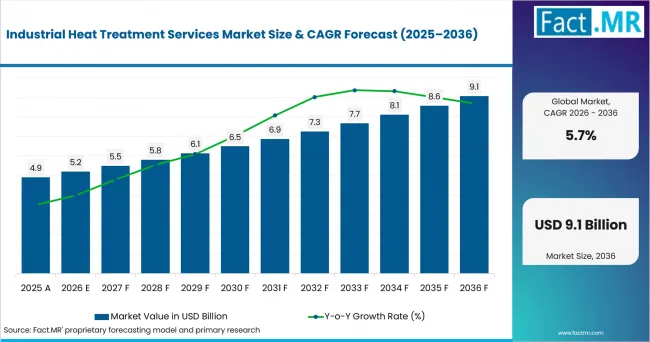
Industrial Heat Treatment Services Market Value Analysis | Source: Fact.MR
What are the defining numbers behind Industrial Heat Treatment Services Market growth?
USD 3.8 billion absolute opportunity by 2036, led by Case hardening and Steel alongside Automotive and Commercial/toll services.
- Demand Drivers in the Market
- Automotive component plants need carburizing and hardening services that protect gear, shaft and bearing life after machining.
- Aerospace manufacturers require vacuum processing and metallurgical records before high-value parts move into certified assemblies.
- Machinery builders use heat treating services to control wear on dies, tools and transmission parts.
- Medical and energy manufacturers are expected to require smaller certified batches where traceability carries more weight than furnace volume.
- Key Segments Analyzed
- By Process: Case hardening is expected to hold 28.0% share in 2026 because gears and shafts need hard surfaces with ductile cores.
- By Material: Steel is projected to account for 52.0% share in 2026 owing to its role across drivetrains, tools and industrial components.
- By End-Use Industry: Automotive is anticipated to capture 34.0% share in 2026 since powertrain and chassis parts remain repeat service users.
- By Service Model: Commercial/toll is estimated to represent 67.0% share in 2026 as plants avoid underused furnaces and certification overhead.
- Analyst Opinion at Fact.MR
- Shambhu Nath Jha, Principal Consultant at Fact.MR, states, “Industrial heat treatment services are judged by repeatable case depth, distortion control and documentation. Service providers are expected to win work where they can qualify furnace recipes quickly. The practical advantage is a network that combines process depth, inspection discipline and proximity to machining clusters.”
- Strategic Implications
- Manufacturers should qualify backup toll capacity before furnace outages interrupt machining and assembly schedules.
- Service providers should document temperature control, atmosphere control and post-treatment inspection in formats used by automotive and aerospace customers.
- Procurement teams should compare delivered part yield instead of only quoted treatment price.
- Investors should separate certified commercial heat treaters from captive furnace capacity that does not serve outside customers.
The United States is projected to record 8.1% CAGR through 2036 due to durable-goods orders and aerospace processing. The United Kingdom is forecast to post 6.8% CAGR as vehicle work sustains service demand. Germany is anticipated to advance at 6.7% CAGR owing to machinery orders. Japan is expected to reach 6.2% CAGR through transport equipment. France is estimated to record 6.1% CAGR, while Italy is projected to post 5.1% CAGR through toll furnace use.
How does the Industrial Heat Treatment Services Market break down by segment?
Case hardening leads Process at 28.0%; Steel leads Material at 52.0%.
Which process dominates?
Case hardening is projected to account for 28.0% share in 2026.
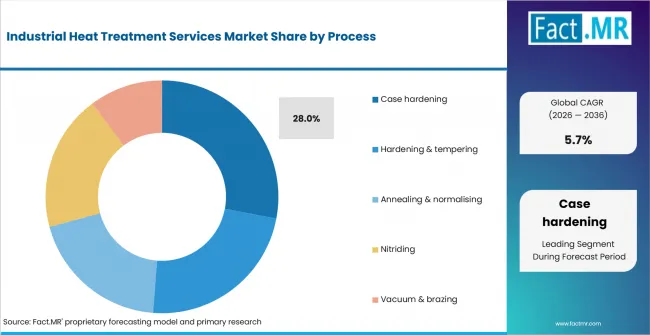
Industrial Heat Treatment Services Market Analysis By Process | Source: Fact.MR
Case hardening is expected to lead Process with 28.0% share in 2026 because gears and shafts require hard surfaces with tough cores. Its ability to improve wear resistance while maintaining core strength supports use across automotive and industrial components where durability, fatigue resistance and controlled mechanical performance remain important.
What leads the Material segment?
Steel is expected to hold 52.0% share in 2026.
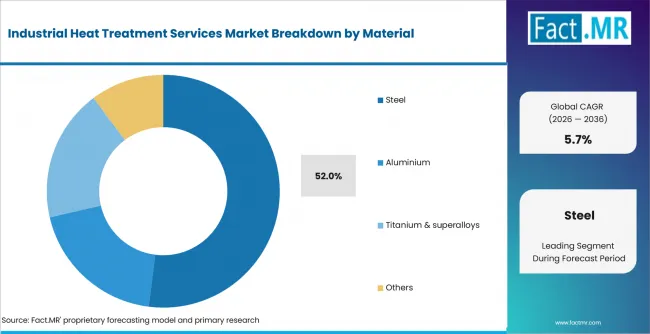
Industrial Heat Treatment Services Market Analysis By Material | Source: Fact.MR
Steel is estimated to lead Material with 52.0% share in 2026 because it is widely used in gears, shafts and structural components requiring controlled hardening. Its heat-treatment flexibility supports strength and wear resistance, while wear resistant steel adjacency reinforces the importance of heat-treated durability across industrial applications.
How does End-Use Industry shape demand?
Automotive is anticipated to lead with 34.0% share in 2026.
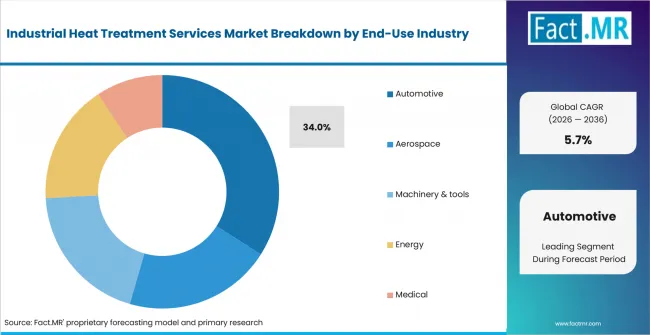
Industrial Heat Treatment Services Market Analysis By End Use Industry | Source: Fact.MR
Automotive is anticipated to lead End-Use Industry with 34.0% share in 2026 because gears, bearings, shafts and drivetrain components require repeatable heat treatment. High production volumes, demanding fatigue requirements and strict dimensional control support sustained demand for case hardening, tempering and related thermal-processing services across automotive manufacturing.
What supports Commercial/toll within Service Model?
Commercial/toll is estimated to represent 67.0% share in 2026.
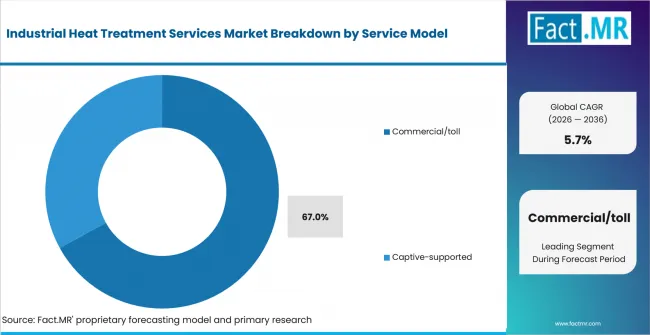
Industrial Heat Treatment Services Market Analysis By Service Model | Source: Fact.MR
Commercial/toll services are forecast to lead Service Model with 67.0% share in 2026 because many plants cannot justify captive furnace investment for uneven workloads. Outsourcing remains attractive where hot isostatic pressing, vacuum treatment and other specialized processes require expensive equipment, trained personnel and audited quality records.
What is accelerating Industrial Heat Treatment Services Market adoption, and what is holding it back?
Certified outsourcing drives it; energy cost and qualification time restrain it.
Drivers Impact Analysis
| DRIVER | (~) % IMPACT ON CAGR | GEOGRAPHIC RELEVANCE | IMPACT TIMELINE |
|---|---|---|---|
| Commercial/toll outsourcing | +1.5% | US, Germany, UK | Short term |
| Aerospace vacuum processing | +1.2% | US, France, Japan | Short term |
| Automotive case hardening | +1.0% | Germany, Italy, US | Medium term |
| Traceability and inspection | +0.8% | Aerospace, medical | Medium term |
| Tool-life extension | +0.6% | Machinery and die-making regions | Long term |
Source: Fact.MR analysis. Updated Aug 19, 2026
- Commercial/toll outsourcing: Manufacturers are expected to use external furnace capacity when work is uneven. The U.S. Census Bureau reported durable-goods orders of USD 334.8 billion in June 2026.
- Aerospace vacuum processing: Aerospace programs are expected to need vacuum furnaces where oxidation and distortion risks affect release. Bodycote plc added vacuum heat-treatment equipment in New Jersey in July 2026.
- Automotive case hardening: Case hardening is projected to remain central to gears and shafts. VDA reported that 2,109,200 passenger cars were produced in Germany during January–June 2026, down 3% from the same period in 2025.
Opportunity Impact Analysis
| OPPORTUNITY | (~) % IMPACT ON CAGR | GEOGRAPHIC RELEVANCE | IMPACT TIMELINE |
|---|---|---|---|
| Certified furnace networks | +0.9% | US, Europe | Medium term |
| HIP and vacuum capacity | +0.8% | Aerospace | Medium term |
| Maintenance-linked services | +0.6% | Mature markets | Long term |
| Small-batch alloy work | +0.5% | Medical, energy | Long term |
Source: Fact.MR analysis. Updated Aug 19, 2026
- Certified furnace networks: Multi-site providers are expected to gain where customers need continuity across machining and treatment. Bodycote plc acquired Spectrum Thermal Processing in January 2026 to expand Northeast U.S. capacity. Bodycote plc stated that the acquisition expands its Northeast U.S. footprint and regional heat-treatment capacity.
- Maintenance-linked services: Heat treaters are projected to benefit from recurring furnace upkeep around fixtures and atmosphere equipment. Furnace maintenance consumables demand is relevant where plants keep aging furnaces available. Service providers that combine processing and maintenance advice can reduce downtime risk.
- Small-batch alloy work: Medical and energy users are expected to place more orders with specialists. Bluewater Thermal Solutions announced in January 2026 that Saint Marys delivered burst heat treating capacity for a Tier 1 automotive supplier.
Restraints Impact Analysis
| RESTRAINT | (~) % IMPACT ON CAGR | GEOGRAPHIC RELEVANCE | IMPACT TIMELINE |
|---|---|---|---|
| Energy-price exposure | -1.1% | United States, United Kingdom, Germany | Short term |
| Qualification time | -0.8% | Aerospace, medical | Short term |
| Skilled furnace labor | -0.6% | Mature markets | Medium term |
| Distortion and rework risk | -0.5% | Automotive, tooling | Medium term |
Source: Fact.MR analysis. Updated Aug 19, 2026
- Energy-price exposure: Furnace economics are constrained by electricity and gas prices. The U.S. Energy Information Administration reported an industrial natural gas price of USD 8.43 per thousand cubic feet in February 2026. Providers are expected to price for volatility.
- Qualification time: Aerospace and medical customers are expected to slow supplier changes when furnace routes need records. Nadcap accreditation supports the market but lengthens entry for smaller facilities. The restraint keeps qualified networks valuable.
- Skilled furnace labor: Experienced operators remain necessary for atmosphere control and quench timing. Smaller providers are expected to limit new lines if training depth cannot match audit requirements. Capacity additions depend on staff as much as equipment.
- Distortion and rework risk: Poor setup can scrap machined parts after machining value has been added. Magnetic induction heating alternatives fit some localized hardening jobs, but furnace-based processing remains necessary for many batch treatments. Process selection therefore remains a buyer risk.
Which countries are scaling Industrial Heat Treatment Services Market fastest?
- The country comparison spans 3.00 percentage points across the forecast period.
- The United States remains 1.38 percentage points above the United Kingdom.
- The United Kingdom remains 0.06 percentage point above Germany.
- Germany remains 0.54 percentage point above Japan.
- Japan remains 0.06 percentage point above France.
- France remains 0.96 percentage point above Italy.
- Italy closes the displayed range through component clusters and toll service use.
Industrial Heat Treatment Services Market is segmented into North America, Latin America, Europe, East Asia, South Asia and Pacific, Middle East and Africa.
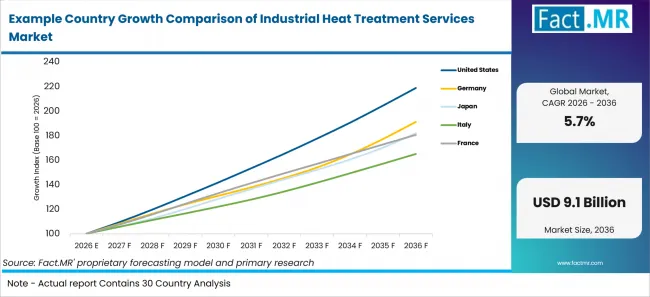
Example Country Growth Comparison Of Industrial Heat Treatment Services Market | Source: Fact.MR
| Country | CAGR |
|---|---|
| United States | 8.1% |
| United Kingdom | 6.8% |
| Germany | 6.7% |
| Japan | 6.2% |
| France | 6.1% |
| Italy | 5.1% |
Source: Fact.MR analysis. Updated Aug 19, 2026
What is powering United States adoption?
8.1% CAGR through 2036, driven by durable goods orders and aerospace processing.
United States growth is supported by stronger manufacturing activity and aerospace-related metallurgy demand. The Federal Reserve reported manufacturing output rose at a 4.7% annual rate in Q2 2026, while durable-goods orders reached USD 334.8 billion in June 2026. Energy costs, capacity utilization and aerospace documentation requirements may limit faster expansion.
How is the United Kingdom scaling service demand?
6.8% CAGR through 2036, driven by automotive production and aerospace-linked processing.
United Kingdom growth is supported by manufacturing activity and demand from automotive and aerospace programs. ONS reported manufacturing output increased 1.6% in the three months to May 2026, while SMMT recorded 764,715 vehicles produced in 2025. High energy prices, weaker vehicle production and export scheduling pressures may constrain service demand.
What supports Germany growth?
6.7% CAGR through 2036, shaped by machinery orders and car production.
Germany’s growth reflects its strong machinery and automotive manufacturing base. Destatis reported production increased 0.9% month on month in May 2026, while VDA recorded 2,109,200 passenger cars produced in January-June 2026. Higher electricity prices, producer-price inflation and uneven automotive platform releases may restrict heat-treatment service growth.
How does Japan perform?
6.2% CAGR through 2036, supported by transport equipment and supply-chain discipline.
Japan’s growth is supported by automotive production, tooling demand and strict process-control requirements. METI’s April 2026 survey expected manufacturing output to rise 2.2% in May 2026, while JAMA noted the auto industry supports 5.5 million livelihoods. Energy surcharges and shortages of trained furnace personnel may limit smaller-site expansion.
What supports the France outlook?
6.1% CAGR through 2036, backed by transport output and aerospace exports.
France’s growth is supported by aerospace activity and recovering exports. INSEE reported that French exports increased 2.6% quarter over quarter in Q2 2026, while earlier data showed that aeronautical and naval equipment contributed 1.9 percentage points to the 3.2% increase in exports in Q3 2025. Vacuum treatment and HIP demand benefit from certified aerospace work, although weaker manufacturing output and lengthy documentation requirements may slow service releases.
What underpins Italy demand?
5.1% CAGR through 2036, led by metal products and automotive components.
Italy’s growth is supported by metalworking clusters, tooling activity and automotive component production. ISTAT reported that Italian industrial production increased 0.7% month over month in March 2026 on a seasonally adjusted basis, while ANFIA and the Turin Chamber of Commerce estimated that Italy’s 2,134 automotive-component companies generated EUR 55.5 billion in automotive-attributable turnover in 2024. Producer-price inflation, gas exposure and automotive volatility may constrain treatment schedules.
Who leads the Industrial Heat Treatment Services Market?
Bodycote plc shows the documented competitive activity, while Aalberts Surface Technologies and Paulo strengthen the broader commercial heat-treatment provider landscape. Nitrex, Bluewater Thermal Solutions and Specialty Steel Treating further expand the competitive field across outsourced thermal-processing services.
Bodycote supports the market through certified furnace networks, aerospace heat-treatment capacity and recent U.S. expansion, including its 2026 acquisition of Spectrum Thermal Processing. Aalberts Surface Technologies and Paulo add depth to the profiled service-provider base. Nitrex contributes to the competitive set through heat-treating operations, while Bluewater Thermal Solutions demonstrated burst heat-treatment capacity for a Tier 1 automotive supplier. Specialty Steel Treating extends the field for commercial thermal-processing services.
Which companies are the key providers?
Key companies include Bodycote plc, Aalberts Surface Technologies, Paulo, Nitrex, Bluewater Thermal Solutions and Specialty Steel Treating, Inc. in the company set.
- Bodycote plc
- Aalberts Surface Technologies
- Paulo
- Nitrex
- Bluewater Thermal Solutions
- Specialty Steel Treating, Inc.
Bibliography
- Autorità di Regolazione per Energia Reti e Ambiente. (2026, July 1). ARERA: I numeri dei servizi pubblici. Pubblicati i volumi della Relazione Annuale dell’Autorità. I dati 2025 per elettricità, gas, acqua, rifiuti e telecalore.
- ANFIA. (2025, October 15). Osservatorio sulla componentistica automotive italiana e sui servizi per la mobilità – Ed. 2025.
- Bluewater Thermal Solutions. (2026, January 12). Bluewater Thermal Solutions’ Saint Marys facility delivers burst heat treating capacity for Tier 1 automotive supplier during planned maintenance.
- Bodycote plc. (2025, November 12). Bodycote achieves Nadcap accreditation at new Fairfield, Ohio facility.
- Bodycote plc. (2026, January 16). Bodycote expands U.S. aerospace & defence footprint with acquisition of Spectrum Thermal Processing.
- Bodycote plc. (2026, July 21). Bodycote expands aerospace and defense capacity across the eastern United States.
- Bodycote plc. (2026, July 14). Bodycote investment programme boosts thermal processing capacity across Europe.
- Bundesnetzagentur. (2026, January 5). Bundesnetzagentur publishes 2025 electricity market data.
- Department for Energy Security and Net Zero. (2026, July 16). DESNZ annual report and accounts 2025 to 2026. GOV.UK.
- Federal Statistical Office (Destatis). (2026, July 20). Producer prices in June 2026: +1.8% on June 2025.
- Institut national de la statistique et des études économiques. (2026, March 24). Foreign trade. In French economic outlook.
- Board of Governors of the Federal Reserve System. (2026, July 17). Industrial production and capacity utilization – G.17.
- Institut national de la statistique et des études économiques. (2026, July 3). In May 2026, manufacturing output fell back by 1.0%.
- Institut national de la statistique et des études économiques. (2026, July 30). In Q2 2026, GDP rebounded (+0.2% after -0.1%).
- Ministry of Economy, Trade and Industry. (2025, March 21). METI sets the surcharge rate for FY2025, renewable energy purchase prices for FY2025 onward, and other details relating to the FIT and FIP schemes.
- Ministry of Economy, Trade and Industry. (2026, April 30). Indices of industrial production: Preliminary report for March 2026.
- Nitrex. (2025, October 13). AICHELIN Group signs agreement to acquire Nitrex Heat Treating Solutions and UPC-Marathon.
This Report Answers
- The report provides intelligence on the Industrial Heat Treatment Services Market across Process and Material choices.
- Segment analysis covers Case hardening and Steel as the share leaders within the 2026 market.
- Country outlook evaluates the United States and United Kingdom alongside Germany and Japan. France and Italy complete the profiled comparison.
- Competitive analysis profiles Bodycote plc and Aalberts Surface Technologies alongside Paulo, Nitrex, Bluewater Thermal Solutions and Specialty Steel Treating, Inc..
- Service-model assessment covers Commercial/toll capacity and Captive-supported processing where manufacturers keep internal furnaces for recurring parts.
What does the Industrial Heat Treatment Services Market cover?
Industrial heat treatment services cover controlled furnace processing that changes the properties of metal parts after forming or machining. Coverage includes carburizing, hardening and tempering. The market also includes annealing, nitriding, vacuum brazing and batch records for customer audits.
What is included in the scope?
The scope includes commercial toll heat treaters and captive-supported operations that provide process capacity to manufacturers.
Included parts come from automotive and aerospace manufacturing. Machinery, energy and medical parts are included when thermal treatment is purchased. Surface preparation appears near the service path, but only process work tied to thermal treatment is counted. Coating pretreatment is linked only when it follows or precedes heat-treated metal work.
What is excluded from the scope?
The scope excludes furnace equipment sales, raw material sales and coating revenue without a heat treatment service contract.
It also excludes foundry melting, welding-only work and general maintenance unless the customer buys a qualifying heat treatment service. Industrial microwave heating is excluded unless a provider uses it as part of a thermal service workflow.
How Was the Analysis Built?
The analysis draws on 120+ sources, 35+ company portfolios, 25+ countries, and more than 20 industry interviews.
- Primary Research: Primary research includes discussions with manufacturers, service providers, technology developers, distributors, end users, procurement teams, and subject-matter experts. These conversations examine purchasing priorities, product adoption, operational challenges, approval requirements, competitive positioning, and the factors that influence wider market acceptance.
- Desk Research: Desk research covers government statistics, regulatory publications, company filings, trade data, technical studies, industry associations, standards, public policy, and other authoritative sources. Every source used in the analysis is documented in the bibliography.
- Market Sizing and Forecasting: Market estimates combine historical performance, demand indicators, pricing and volume trends, segment shares, company participation, country-level growth, adoption patterns, investment activity, and barriers to market expansion.
- Data Validation and Update Cycle: Findings are validated by comparing primary interviews with public data, company activity, regulatory changes, trade patterns, and industry developments. Regular updates review new product launches, capacity changes, partnerships, approvals, procurement trends, and shifts in commercial adoption.
Segmentation
What is the report’s scope and coverage?
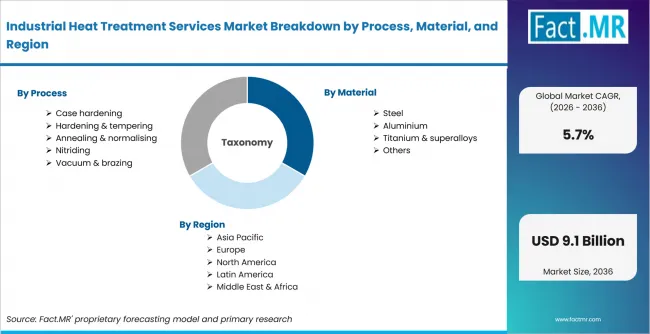
Industrial Heat Treatment Services Market Breakdown By Process, Material, And Region | Source: Fact.MR
| Attribute | Details |
|---|---|
| Quantitative Units | USD billion |
| Market Definition | Thermal processing services that change metal hardness, strength, stress profile and wear behavior |
| Process | Case hardening; Hardening & tempering; Annealing & normalising; Nitriding; Vacuum & brazing |
| Material | Steel; Aluminium; Titanium & superalloys; Others |
| End-Use Industry | Automotive; Aerospace; Machinery & tools; Energy; Medical |
| Service Model | Commercial/toll; Captive-supported |
| Regions Covered | North America; Latin America; Europe; East Asia; South Asia and Pacific; Middle East and Africa |
| Countries Covered | United States; United Kingdom; Germany; Japan; France; Italy |
| Key Companies Profiled | Bodycote plc; Aalberts Surface Technologies; Paulo; Nitrex; Bluewater Thermal Solutions; Specialty Steel Treating, Inc. |
| Forecast Period | 2026 to 2036 |
| Approach | Hybrid top-down and bottom-up approach using manufacturing output; automotive production; aerospace demand; energy costs; outsourcing; certification; alloy mix and company review |
Source: Fact.MR analysis. Updated Aug 19, 2026
How is the market segmented?
-
By Process:
- Case hardening
- Hardening & tempering
- Annealing & normalising
- Nitriding
- Vacuum & brazing
-
By Material:
- Steel
- Aluminium
- Titanium & superalloys
- Others
-
By End-Use Industry:
- Automotive
- Aerospace
- Machinery & tools
- Energy
- Medical
-
By Service Model:
- Commercial/toll
- Captive-supported
-
By Region:
- North America
- Latin America
- Europe
- East Asia
- South Asia and Oceania
- Middle East and Africa
Frequently Asked Questions
How big is the industrial heat treatment services market in 2026?
What is the CAGR of the industrial heat treatment services market from 2026 to 2036?
Which process leads the industrial heat treatment services market?
Which material leads the industrial heat treatment services market?
Who are the leading companies in the industrial heat treatment services market?
Who worked on this report


Preview the report firsthand - request a free sample
Free SampleGet the brochure for pricing and purchase details
Download PDF