- Market Value (2025): USD 1.5 Bn
- Estimated Value (2026): USD 1.6 Bn
- Forecast Value (2036): USD 2.9 Bn
- CAGR (2026-2036): 6.1%
What is the Intraoral X-Ray Market forecast to be worth by 2036?
USD 1.6 billion in 2026 to USD 2.9 billion by 2036 at 6.1% CAGR.
- The intraoral x-ray market reached USD 1.5 billion in 2025 as dental clinics and imaging providers replaced film workflows.
- Demand is projected to increase from USD 1.6 billion in 2026 to USD 2.9 billion by 2036.
- The market is forecast to record 6.1% CAGR from 2026 to 2036 owing to digital imaging replacement and stricter radiography-use decisions.
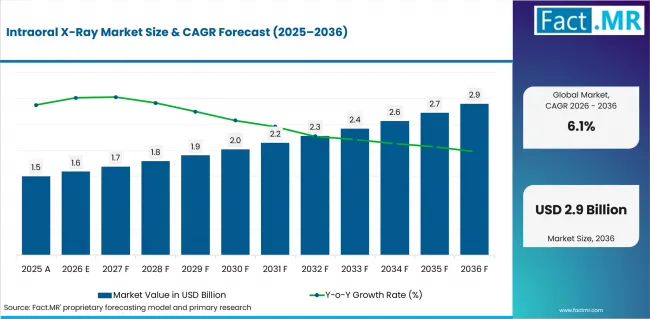
Intraoral X Ray Market Value Analysis | Source: Fact.MR
What are the defining numbers behind Intraoral X-Ray Market growth?
USD 1.3 billion absolute opportunity by 2036, led by Digital Intraoral X-Ray Systems and General Dentistry alongside Dental Clinics and Digital Radiography.
- Demand Drivers in the Market
- Digital intraoral x-ray systems are expected to remain the main specification point for chairside radiography. Dental practices use them when localized images are needed without extra setup time.
- General dentistry workflows are projected to sustain recurring demand because caries review and endodontic checks require focused 2D images. This keeps intraoral systems close to daily diagnosis instead of one-time replacement spending.
- Dental clinics are anticipated to prioritize documentation and service response when selecting systems. Software fit then becomes part of the purchase review.
- Digital radiography is expected to gain from clinical guidance that favors justified imaging and dose control. Manufacturers that support simple radiography protocols are likely to face fewer approval delays.
- Key Segments Analyzed
- By Product Type: Digital Intraoral X-Ray Systems is projected to hold 37.1% share in 2026 because dental practices use this category for localized chairside images.
- By Application: General Dentistry is forecast to account for 30.0% share in 2026 as routine exams and caries checks anchor everyday image demand.
- By End User: Dental Clinics is anticipated to capture 31.3% share in 2026 since most intraoral imaging decisions are made near direct patient care.
- By Distribution Channel: Direct Sales is estimated to represent 31.0% share in 2026 because installation support and training remain part of the purchase case.
- By Technology: Digital Radiography is expected to hold 44.3% share in 2026 as clinics replace film workflows with sensor-based imaging.
- Analyst Opinion at Fact.MR
- Shambhu Nath Jha, Senior Analyst at Fact.MR, states, “Intraoral x-ray systems are being judged on image quality and radiation-control support. Service reliability is expected to matter because clinics need device claims to match daily workflow evidence.”
- Strategic Implications
- Dental clinics benefit from defining their radiography workflow before equipment quotations shape the purchase. This makes sensor fit and service access easier to compare.
- Equipment providers need to connect device specifications with clinical-use evidence. Systems that fit dental digital x-ray workflows are expected to matter when practices compare dose control and image quality.
- Investors benefit from separating intraoral imaging demand from wider dental software and scanner activity. Exposure is clearer when revenue comes from dental radiology equipment and direct imaging support.
The USA is expected to record a 7.9% CAGR from 2026 to 2036 because replacement demand remains documentation-led. Japan is projected to record 7.3% CAGR as compact systems carry weight in clinical workflows. Germany is anticipated to grow at 6.7% through regulated purchasing and service expectations. The UK is estimated to post 6.1% CAGR through reimbursement-sensitive clinic decisions. Canada is forecast at 5.5% with replacement cycles shaping demand. Australia is projected to reach 4.9% through service coverage needs. Brazil is expected to post 4.3% during the same period because local distributor reach shapes account conversion.
How does the Intraoral X-Ray Market break down by segment?
Digital Intraoral X-Ray Systems are expected to lead Product Type at 37.1% share in 2026. General Dentistry is projected to lead Application at 30.0% share in 2026.
Which product type dominates?
Digital Intraoral X-Ray Systems are projected to account for 37.1% share in 2026.
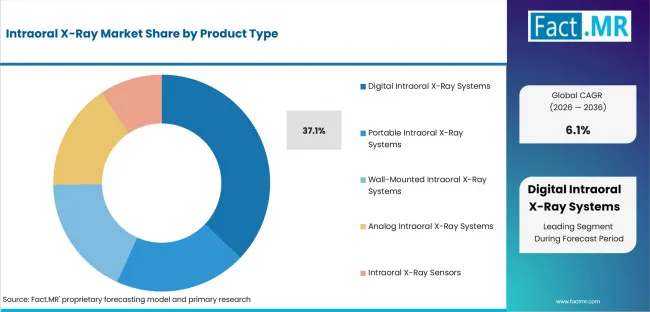
Intraoral X Ray Market Analysis By Product Type | Source: Fact.MR
Digital systems remain ahead as dental practices increasingly rely on immediate imaging during caries checks and endodontic procedures. Wired Digital Systems suit fixed treatment rooms, while Wireless Digital Systems offer easier movement and setup. Portable Intraoral X-Ray Systems serve clinics that require imaging across several rooms or treatment areas.
What leads the Application segment?
General Dentistry is expected to hold 30.0% share in 2026.
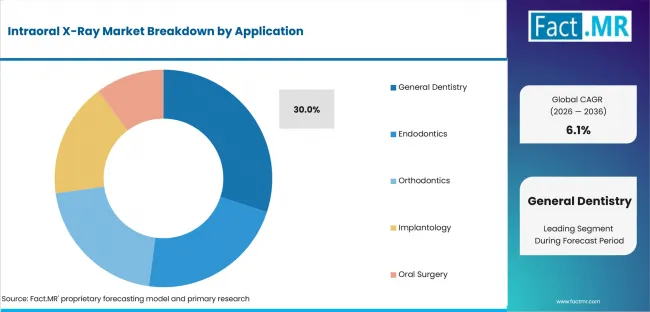
Intraoral X Ray Market Analysis By Application | Source: Fact.MR
Routine dental examinations keep general dentistry at the top because bitewing and periapical images are frequently used during diagnosis. Caries Detection and Endodontics generate steady demand when dentists need localized views before treatment. Orthodontics and Implantology contribute additional use where precise imaging supports planning and placement decisions.
How does End User shape demand?
Dental Clinics are anticipated to hold 31.3% share in 2026.
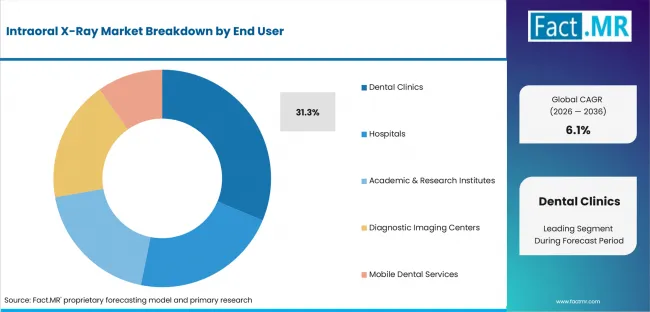
Intraoral X Ray Market Analysis By End User | Source: Fact.MR
Most purchases come from dental clinics because intraoral imaging is commonly performed during direct patient visits. Private Dental Clinics and Group Dental Practices form the largest customer base due to regular examination volumes. Hospitals and diagnostic imaging centers account for a smaller share, mainly when referred patients require further dental assessment.
Why does Direct Sales lead Distribution Channel?
Direct Sales is estimated to represent 31.0% share in 2026.
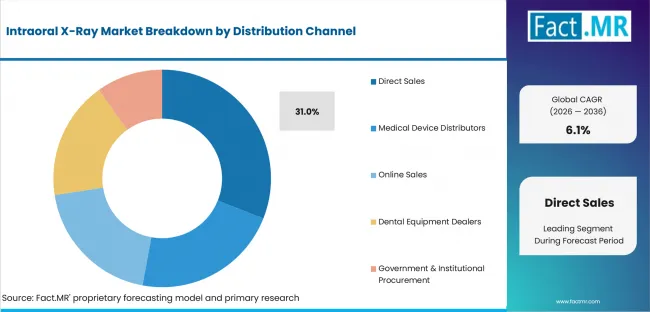
Intraoral X Ray Market Analysis By Distribution Channel | Source: Fact.MR
Clinics often prefer direct purchasing because suppliers can provide product demonstrations, installation help and staff training. OEM Sales and company representatives become more important when multisite dental groups want the same equipment across locations. Medical Device Distributors remain useful in markets where local maintenance and faster service access influence buying decisions.
What supports Digital Radiography within Technology?
Digital Radiography is forecast to hold 44.3% share in 2026.
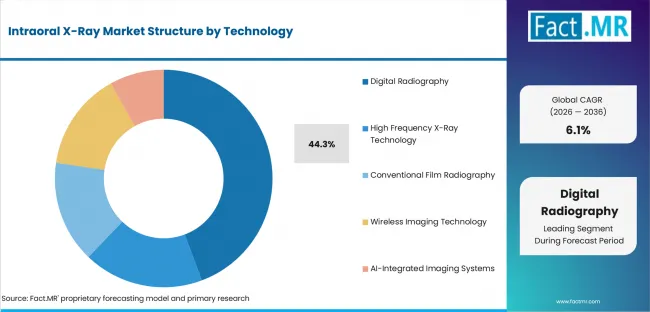
Intraoral X Ray Market Analysis By Technology | Source: Fact.MR
Faster image availability and easier record storage give digital radiography a clear advantage over film-based methods. CMOS Technology supports rapid image processing, whereas CCD Technology remains relevant in systems requiring dependable image quality. High Frequency X-Ray Technology further improves the segment by supporting consistent exposure and clearer diagnostic output.
What is accelerating Intraoral X-Ray Market adoption, and what is holding it back?
Demand is likely to grow through digital upgrades and routine dental imaging. High validation needs and costs may slow adoption among smaller clinics.
Drivers Impact Analysis
| DRIVER | QUALITATIVE RELEVANCE | GEOGRAPHIC RELEVANCE | IMPACT TIMELINE |
|---|---|---|---|
| Digital intraoral x-ray specification pull | High | USA and Japan | Short term (<= 2 years) |
| General dentistry workflow use | Moderate | USA, Germany | Short term (<= 2 years) |
| Clinic documentation and service review | Moderate | UK and Canada | Medium term (2-4 years) |
| Digital radiography replacement | Selective | Australia and Brazil | Medium term (2-4 years) |
| Clinical image storage and software fit | Selective | Multisite clinics | Long term (>= 4 years) |
Source: Fact.MR analysis. Updated Jul 29, 2026
- Digital intraoral x-ray specification pull: Customers are expected to compare sensor quality with installation support before approval. This gives manufacturers room to win orders through proof of image consistency and software fit.
- General dentistry workflow use: Routine exams are anticipated to keep intraoral imaging close to everyday dental care. Practices that manage caries and endodontic checks need systems that are quick to position.
- Clinic documentation and service review: Route-to-market strength is expected to matter where clinics ask for clear records and responsive support. Companies with service coverage are better placed to convert product interest into orders.
- Digital radiography replacement: Sensor-based imaging is projected to replace film systems where clinics need faster image review. This change supports demand for training and software setup.
- Clinical image storage and software fit: Digital systems are expected to gain when images move cleanly into practice software. This matters for group practices that need repeat records across several chairs.
Opportunity Impact Analysis
| OPPORTUNITY | QUALITATIVE RELEVANCE | GEOGRAPHIC RELEVANCE | IMPACT TIMELINE |
|---|---|---|---|
| General dentistry workflow packages | Moderate | USA | Medium term (2-4 years) |
| Provider network expansion | Selective | Japan and Germany | Medium term (2-4 years) |
| Digital intraoral validation support | Selective | Canada and Australia | Medium term (2-4 years) |
| Portable intraoral imaging use | Selective | Brazil and mobile care settings | Long term (>= 4 years) |
Source: Fact.MR analysis. Updated Jul 29, 2026
- General dentistry workflow packages: Companies are expected to gain from packages that combine sensors and software support. Bundled offers help clinics connect equipment spending with routine diagnosis.
- Provider network expansion: Channel expansion is anticipated to support adoption in markets where service access affects approval. Local response is important when clinics depend on uptime for daily imaging.
- Digital intraoral validation support: Validation services are expected to reduce hesitation around replacement purchases. Clear setup guidance helps practices compare new systems with existing clinical routines.
- Portable intraoral imaging use: Portable systems are projected to help clinics manage room-to-room imaging needs. The opportunity is more practical where providers can prove safe handling and consistent image output.
Restraints Impact Analysis
| RESTRAINT | QUALITATIVE RELEVANCE | GEOGRAPHIC RELEVANCE | IMPACT TIMELINE |
|---|---|---|---|
| Validation burden and reimbursement pressure | Moderate | USA and UK | Short term (<= 2 years) |
| Price sensitivity around general dentistry | Selective | Japan and Brazil | Medium term (2-4 years) |
| Slow conversion without service proof | Selective | Germany and Canada | Medium term (2-4 years) |
| Software and training friction | Selective | Global | Long term (>= 4 years) |
Source: Fact.MR analysis. Updated Jul 29, 2026
- Validation burden and reimbursement pressure: Replacement slows when clinics lack evidence of workflow value. Practices often need proof that image quality and training time fit the order decision.
- Price sensitivity around general dentistry: General dentistry purchases are expected to face tighter review when clinics serve routine cases. Price pressure becomes sharper when sensor replacement competes with other dental equipment needs.
- Slow conversion without service proof: Smaller companies lose traction when practices request service records and training support. Weak validation evidence extends approval time before procurement.
- Software and training friction: New systems are expected to face delays when staff need extra support after installation. Clinics may postpone replacement when software migration creates uncertainty.
Which countries are scaling Intraoral X-Ray Market fastest?
The country comparison is defined by a narrow spread between mature dental imaging markets. The gap between the USA and Brazil is 0.8 percentage points. The USA and Japan form the upper pair while Germany remains close to the global rate. The UK and Canada create a middle cluster below the global average. Australia and Brazil stand apart because service coverage and financing comfort carry more weight. This pattern reflects service depth and replacement timing instead of market size alone.
- The USA shows the highest listed rate because digital replacement is tied to documentation and service response. Clinics are expected to reward providers that support installation and training after purchase.
- Japan remains close to the USA as compact equipment and reliability carry weight in general dentistry workflows. Local service access is expected to influence repeat purchases.
- Germany stays near the global rate because institutional customers review performance evidence before switching systems. Device documentation is expected to remain central to supplier selection.
- The UK tracks slightly below the global rate as reimbursement review and life-cycle value shape purchasing. Direct support is expected to matter when clinics compare replacement timing.
- Canada remains tied to replacement cycles where geography makes dependable service coverage important. Providers with regional support are expected to face fewer procurement delays.
- Australia and Brazil depend more on local support and channel reach than on direct manufacturer coverage. Clinics are expected to evaluate affordability and service access before replacing older systems.
Comparable CAGRs can therefore produce different market entry conditions across these countries. Deployment timing depends on service coverage and clinical documentation while commercial readiness reflects channel depth and replacement budgets.
The full report provides country-level CAGR analysis across the listed regions. Coverage spans North America and Latin America. Europe and East Asia are included. South Asia and Pacific plus the Middle East and Africa complete the regional view.
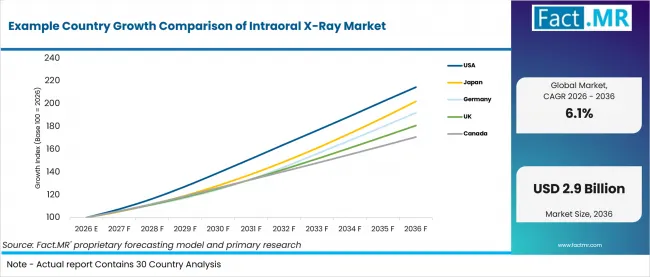
Example Country Growth Comparison Of Intraoral X Ray Market | Source: Fact.MR
| Country | CAGR (2026-2036) |
|---|---|
| USA | 7.9% |
| Japan | 7.3% |
| Germany | 6.7% |
| UK | 6.1% |
| Canada | 5.5% |
| Australia | 4.9% |
| Brazil | 4.3% |
Source: Fact.MR analysis. Updated Jul 29, 2026
What supports USA adoption?
7.9% CAGR, supported by digital replacement and documentation-led purchasing.
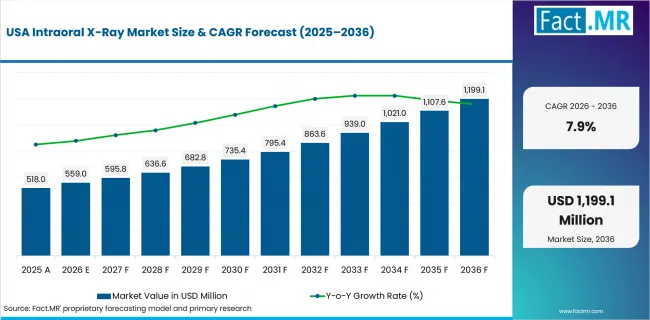
Intraoral X Ray Market Country Value Analysis | Source: Fact.MR
The USA’s growth reflects a market where practices expect clear image quality and service response before system replacement. Digital intraoral systems are expected to benefit from clinic demand for localized diagnostic images. Companies that prove installation support and workflow fit are likely to gain better account access.
How is Japan scaling demand?
7.3% CAGR, driven by general dentistry workflow use and compact equipment needs.
Japan’s growth is tied to dental practices that value reliability and small operating footprints. Intraoral systems are expected to fit clinics that need precise images without adding chairside delays. Service access and product dependability are likely to influence repeat purchasing.
What is driving Germany’s growth from 2026 to 2036?
6.7% CAGR, backed by performance evidence and regulated purchasing behavior.
Germany’s growth is shaped by customers that scrutinize documentation before approving medical device purchases. Dental clinics are expected to compare image quality and support terms before switching systems. This makes proof of compliance and service reliability central to adoption.
How is the UK developing demand?
6.1% CAGR, supported by value review and reimbursement-sensitive clinic spending.
The UK’s growth reflects a market where dental practices compare cost and clinical utility before expanding equipment budgets. Direct sales support is expected to matter when clinics need help with training and workflow setup. Adoption is likely to remain measured where replacement must fit reimbursement expectations.
How does Canada perform?
5.5% CAGR, led by replacement demand and service coverage requirements.
Canada’s growth reflects dispersed dental service delivery and the need for dependable support across large geographies. Clinics are expected to value digital radiography systems that reduce operating uncertainty. Companies with regional service networks are likely to perform better in replacement-led accounts.
What supports Australia’s growth?
4.9% CAGR, backed by compliance needs and remote service considerations.
Australia’s growth is shaped by distance and service access. Dental practices are expected to favor providers that support equipment after installation. Digital systems remain relevant where clinics need faster image capture and easier record storage.
How is Brazil developing demand?
4.3% CAGR, driven by distributor reach and financing comfort.
Brazil’s growth depends more on regional distribution than direct manufacturer coverage. Dental clinics are expected to evaluate affordability and service access before replacing older systems. Providers with local partners are likely to face fewer delays in account conversion.
Who leads the Intraoral X-Ray Market?
Dentsply Sirona and Envista Holdings show direct relevance through intraoral imaging portfolios. Planmeca Oy and Carestream Dental compete through equipment range and channel reach.
Competition is expected to depend on image quality and software compatibility. Installation support and after-sale service are expected to decide repeat orders. Vatech Co., Ltd. adds portable and intraoral imaging exposure. Acteon Group, Owandy Radiology and Midmark Corporation extend the provider field through intraoral x-ray units and sensors.
From 2026 to 2036, companies are likely to be compared on clinical evidence and service dependability. Providers that translate radiography safety requirements into usable training and workflow support are expected to gain stronger acceptance from dental clinics.
Which companies are the key providers?
Key companies include Dentsply Sirona, Envista Holdings, Planmeca Oy, Carestream Dental, Vatech Co., Ltd., Acteon Group, Owandy Radiology, and Midmark Corporation.
- Dentsply Sirona
- Envista Holdings
- Planmeca Oy
- Carestream Dental
- Vatech Co., Ltd.
- Acteon Group
- Owandy Radiology
- Midmark Corporation
Bibliography
- American Dental Association. (2026, January 5). New recommendations confirm dental X-rays most effectively used in moderation.
- Centers for Disease Control and Prevention. (2024, October 9). 2024 Oral Health Surveillance Report: Selected Findings.
- UK Health Security Agency. (2025, December 11). National diagnostic reference levels for dental radiography. Government of the United Kingdom.
- Planmeca Oy. (2025, March 25). Planmeca reveals new products in all major categories.
This Report Answers
- The report provides strategic intelligence on the Intraoral X-Ray Market across Product Type and Application choices that shape chairside dental radiography programs.
- Segment analysis covers Digital Intraoral X-Ray Systems and General Dentistry as the share leaders within the 2026 market.
- Country outlook evaluates the USA and Japan alongside Germany and the UK. Canada, Australia and Brazil complete the growth comparison across the profiled markets.
- Competitive analysis profiles Dentsply Sirona and Envista Holdings alongside Planmeca Oy and Carestream Dental. Vatech Co., Ltd. and Acteon Group complete the view with Owandy Radiology and Midmark Corporation.
- Technology assessment covers Digital Radiography and CMOS Technology. CCD Technology and High Frequency X-Ray Technology complete the view alongside wireless imaging and medical x-ray generator needs.
What does the Intraoral X-Ray Market cover?
Intraoral x-ray systems are used to capture localized dental images when caries review or treatment planning needs a focused view.
The Intraoral X-Ray Market covers digital intraoral x-ray systems and portable units where they are used for dental radiography. Coverage extends to intraoral x-ray sensors and related digital radiography technologies. The digital intraoral sensor replacement cycle remains inside the scope where the x-ray workflow is direct.
The market differs from broader dental imaging because commercial value comes from localized images captured inside the mouth. Extraoral imaging and CBCT are excluded unless they directly support an intraoral x-ray purchase decision. General dental practice software is excluded unless it is bundled with the imaging system.
What is included in the scope?
Intraoral x-ray systems are included where dental clinics and hospitals use them for chairside diagnosis.
The scope includes Product Type and Application alongside End User, Distribution Channel and Technology. Coverage spans Digital Intraoral X-Ray Systems and General Dentistry. Dental Clinics and Direct Sales complete the leading operating lens with Digital Radiography. It includes systems used for routine exams and caries detection. Sensors and imaging technologies are included when they directly support intraoral x-ray workflows.
What is excluded from the scope?
Unrelated dental equipment and general practice spending remain outside the scope of this market.
The scope excludes systems that do not capture or support intraoral dental radiographs. Standalone dental cameras are excluded unless they are bundled with x-ray imaging workflows. Intraoral scanners and 3D dental scanners are excluded when they are used only for impressions or restorative design. General dental impression system spending is excluded unless it directly affects an intraoral x-ray purchase decision.
How Was the Analysis Built?
The analysis draws on 120+ sources, 35+ company portfolios, 25+ countries, and more than 20 industry interviews.
- Primary Research: Primary research includes discussions with manufacturers, service providers, technology developers, distributors, end users, procurement teams, and subject-matter experts. These conversations examine purchasing priorities, product adoption, operational challenges, approval requirements, competitive positioning, and the factors that influence wider market acceptance.
- Desk Research: Desk research covers government statistics, regulatory publications, company filings, trade data, technical studies, industry associations, standards, public policy, and other authoritative sources. Every source used in the analysis is documented in the bibliography.
- Market Sizing and Forecasting: Market estimates combine historical performance, demand indicators, pricing and volume trends, segment shares, company participation, country-level growth, adoption patterns, investment activity, and barriers to market expansion.
- Data Validation and Update Cycle: Findings are validated by comparing primary interviews with public data, company activity, regulatory changes, trade patterns, and industry developments. Regular updates review new product launches, capacity changes, partnerships, approvals, procurement trends, and shifts in commercial adoption.
Segmentation
What is the report’s scope and coverage?
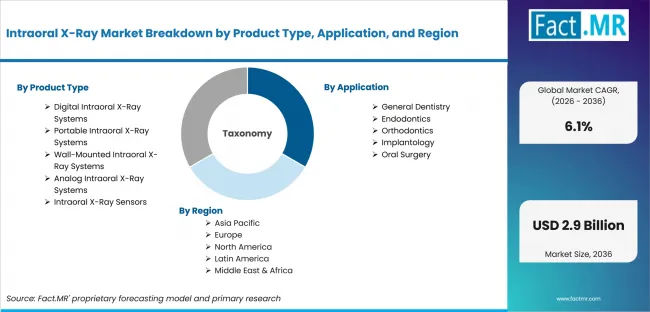
Intraoral X Ray Market Breakdown By Product Type, Application, And Region | Source: Fact.MR
| Attribute | Details |
|---|---|
| Quantitative Units | USD billion in 2026 to USD billion by 2036 at a CAGR |
| Market Definition | Intraoral X-Ray covers commercial demand and use of digital intraoral x-ray systems, sensors and related dental imaging equipment used for localized chairside radiographic views. |
| Product Type | Digital Intraoral X-Ray Systems; Wired Digital Systems; Wireless Digital Systems; Portable Intraoral X-Ray Systems; Handheld X-Ray Units; Battery Powered X-Ray Units; Wall-Mounted Intraoral X-Ray Systems; Fixed Wall Units; Adjustable Arm Units; Analog Intraoral X-Ray Systems; Film-Based X-Ray Systems; High Frequency Analog Systems; Intraoral X-Ray Sensors; CMOS Sensors; CCD Sensors |
| Application | General Dentistry; Routine Dental Examination; Caries Detection; Endodontics; Root Canal Diagnosis; Post-Treatment Evaluation; Orthodontics; Treatment Planning; Alignment Assessment; Implantology; Implant Site Evaluation; Bone Density Assessment; Oral Surgery; Tooth Extraction Planning; Trauma Assessment |
| End User | Dental Clinics; Private Dental Clinics; Group Dental Practices; Hospitals; General Hospitals; Specialty Dental Hospitals; Academic & Research Institutes; Dental Schools; Research Laboratories; Diagnostic Imaging Centers; Independent Imaging Centers; Multi-Specialty Diagnostic Centers; Mobile Dental Services; Community Dental Units; Mobile Healthcare Providers |
| Distribution Channel | Direct Sales; OEM Sales; Company Sales Representatives; Medical Device Distributors; National Distributors; Regional Distributors; Online Sales; Manufacturer Websites; B2B E-commerce Platforms; Dental Equipment Dealers; Authorized Dealers; Local Equipment Suppliers; Government & Institutional Procurement; Public Healthcare Procurement; Tender-Based Procurement |
| Technology | Digital Radiography; CMOS Technology; CCD Technology; High Frequency X-Ray Technology; DC High Frequency Generators; AC High Frequency Generators; Conventional Film Radiography; Speed D Film; Speed E/F Film; Wireless Imaging Technology; Wi-Fi Enabled Systems; Bluetooth Enabled Systems; AI-Integrated Imaging Systems; AI Image Enhancement; AI Diagnostic Assistance |
| Regions Covered | North America; Latin America; Europe; East Asia; South Asia and Pacific; Middle East and Africa |
| Countries Covered | USA; Japan; Germany; UK; Canada; Australia; Brazil |
| Key Companies Profiled | Dentsply Sirona; Envista Holdings; Planmeca Oy; Carestream Dental; Vatech Co., Ltd.; Acteon Group; Owandy Radiology; Midmark Corporation |
| Forecast Period | 2026 to 2036 |
| Approach | Hybrid top-down and bottom-up approach using dental clinic demand; intraoral radiography workflow; device replacement; service access; channel depth; application mix; clinical validation needs; country adoption patterns and company portfolio review |
Source: Fact.MR analysis. Updated Jul 29, 2026
How is the market segmented?
-
By Product Type:
- Digital Intraoral X-Ray Systems
- Wired Digital Systems
- Wireless Digital Systems
- Portable Intraoral X-Ray Systems
- Handheld X-Ray Units
- Battery Powered X-Ray Units
- Wall-Mounted Intraoral X-Ray Systems
- Fixed Wall Units
- Adjustable Arm Units
- Analog Intraoral X-Ray Systems
- Film-Based X-Ray Systems
- High Frequency Analog Systems
- Intraoral X-Ray Sensors
- CMOS Sensors
- CCD Sensors
-
By Application:
- General Dentistry
- Routine Dental Examination
- Caries Detection
- Endodontics
- Root Canal Diagnosis
- Post-Treatment Evaluation
- Orthodontics
- Treatment Planning
- Alignment Assessment
- Implantology
- Implant Site Evaluation
- Bone Density Assessment
- Oral Surgery
- Tooth Extraction Planning
- Trauma Assessment
-
By End User:
- Dental Clinics
- Private Dental Clinics
- Group Dental Practices
- Hospitals
- General Hospitals
- Specialty Dental Hospitals
- Academic & Research Institutes
- Dental Schools
- Research Laboratories
- Diagnostic Imaging Centers
- Independent Imaging Centers
- Multi-Specialty Diagnostic Centers
- Mobile Dental Services
- Community Dental Units
- Mobile Healthcare Providers
-
By Distribution Channel:
- Direct Sales
- OEM Sales
- Company Sales Representatives
- Medical Device Distributors
- National Distributors
- Regional Distributors
- Online Sales
- Manufacturer Websites
- B2B E-commerce Platforms
- Dental Equipment Dealers
- Authorized Dealers
- Local Equipment Suppliers
- Government & Institutional Procurement
- Public Healthcare Procurement
- Tender-Based Procurement
-
By Technology:
- Digital Radiography
- CMOS Technology
- CCD Technology
- High Frequency X-Ray Technology
- DC High Frequency Generators
- AC High Frequency Generators
- Conventional Film Radiography
- Speed D Film
- Speed E/F Film
- Wireless Imaging Technology
- Wi-Fi Enabled Systems
- Bluetooth Enabled Systems
- AI-Integrated Imaging Systems
- AI Image Enhancement
- AI Diagnostic Assistance
-
By Region:
- North America
- Latin America
- Europe
- East Asia
- South Asia and Pacific
- Middle East and Africa
Frequently Asked Questions
Which Product Type leads the market?
Which Application leads the market?
Which End User leads the market?
Which Distribution Channel leads the market?
Which Technology leads the market?
Which country records the highest listed CAGR?
What is the primary driver in this market?
What is the main restraint?
Why do dental clinics lead demand?
Who worked on this report


Preview the report firsthand - request a free sample
Free SampleGet the brochure for pricing and purchase details
Download PDF