- Market Value (2025): USD 350.8 Mn
- Estimated Value (2026): USD 375.0 Mn
- Forecast Value (2036): USD 730.0 Mn
- CAGR (2026-2036): 6.9%
What is the LED Fabric Lightboxes Market forecast to be worth by 2036?
USD 375.0 million in 2026 to USD 730.0 million by 2036 at 6.9% CAGR.
- The LED fabric lightboxes market crossed a valuation of USD 350.8 million in 2025 as event customers spent more on reusable illuminated booth graphics.
- Demand is projected to increase from USD 375.0 million in 2026 to USD 730.0 million by 2036.
- The market is forecast to record 6.9% CAGR from 2026 to 2036 owing to lower LED power demand and modular booth-wall integration.
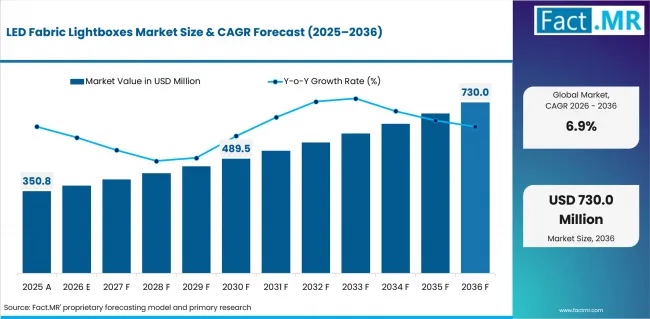
Led Fabric Lightboxes Market Value Analysis | Source: Fact.MR
What are the defining numbers behind LED Fabric Lightboxes Market growth?
USD 355.0 million absolute opportunity by 2036, led by Edge-lit boxes and Ultra-slim frames alongside Premium booth walls and SEG fabric prints.
- Demand Drivers in the Market
- Premium visual presentation is expected to raise demand where exhibition walls need clean brightness from aisle distance. Customers are expected to approve systems only when the full fabric face looks even during setup.
- Reusable illuminated graphics are anticipated to support repeat purchases since brands replace the fabric face without replacing the frame. Clear tension guidance helps agencies reuse the same display across several events.
- Lower LED power demand is projected to widen use in booth programs that must manage heat and cables. Event operators still need driver placement notes before approving longer wall runs.
- Modular booth-wall integration is estimated to strengthen replacement demand when exhibit builders repeat frame sizes. Standard dimensions make storage, transport and graphic replacement easier to plan.
- Key Segments Analyzed
- By Lighting Format: Edge-lit boxes are expected to hold 30.0% share in 2026 since they balance slim construction with controlled face brightness.
- By Frame Depth: Ultra-slim frames are projected to account for 26.0% share in 2026 as brands favor thinner booth walls where floor space is limited.
- By Use Case: Premium booth walls are anticipated to capture 32.0% share in 2026 since large illuminated backdrops remain highly visible during product launches and trade fairs.
- By Buyer Type: Exhibit builders are estimated to represent 28.0% share in 2026 because they choose frame systems before graphics and booth installation plans are finalized.
- By Graphic Type: SEG fabric prints are forecast to lead with 37.0% share in 2026 since silicone-edge fabric makes graphic replacement faster between events.
- Analyst Opinion at Fact.MR
- Shambhu Nath Jha, Senior Analyst at Fact.MR, states, “LED fabric lightboxes earn approval when the full graphic face remains evenly lit after repeated setup and transport. Customers are expected to compare providers through uniformity checks, guided power planning and tensioned graphic replacement speed.”
- Strategic Implications
- Event customers need to validate brightness across the full face before a lightbox enters the booth layout. This step reduces late changes to power routing and wall depth during installation.
- Product providers should divide LED modules and frame parts clearly within commercial packages. A clear scope helps agencies compare product value with service support before awarding repeat event work.
- Venue and agency operators benefit from using 3D rendering before fabrication to review wall placement and sight lines. The plan works best when it is paired with installation notes and on-site brightness checks.
AUMA reported in June 2026 that 66% of exhibitors at German trade fairs in 2025 came from outside Germany. The figure shows LED fabric lightbox purchases on its own. It also shows why providers need repeatable setup notes and brightness standards for international event programs.
The UAE is expected to register 7.6% growth over the same period. The USA is projected to advance at 6.9%, followed closely by Japan at 6.8%. The United Kingdom is anticipated to record a 6.6% CAGR, while Germany is estimated to grow at 6.3%.
How does the LED Fabric Lightboxes Market break down by segment?
Edge-lit boxes are expected to lead Lighting Format at 30.0% share. Ultra-slim frames are projected to lead Frame Depth at 26.0% share in 2026.
Why do Edge-lit boxes lead Lighting Format?
Edge-lit boxes are projected to account for 30.0% share in 2026.
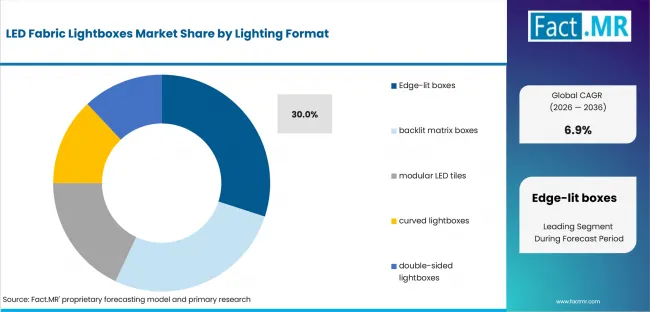
Led Fabric Lightboxes Market Analysis By Lighting Format | Source: Fact.MR
Edge-lit boxes hold the largest lighting format position since they give exhibitors a thinner system without placing LEDs behind the whole graphic face. Reflective interiors and diffuser planning reduce visible light patterns. Customers are expected to approve this option when brightness remains even after the fabric is reinstalled for another event.
Why do Ultra-slim frames lead Frame Depth?
Ultra-slim frames are expected to hold 26.0% share in 2026.
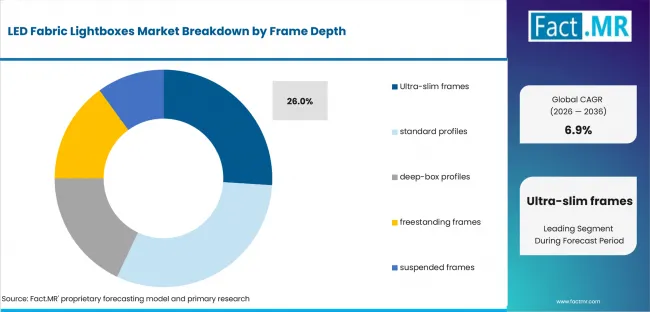
Led Fabric Lightboxes Market Analysis By Frame Depth | Source: Fact.MR
Ultra-slim frames lead frame depth where booth planners need illuminated walls that do not use extra floor space. Storage and repeat transport add to their value. Power routing remains the main approval risk because a thinner profile leaves less room for drivers and heat control.
Why do Premium booth walls lead Use Case?
Premium booth walls are anticipated to account for 32.0% share in 2026.
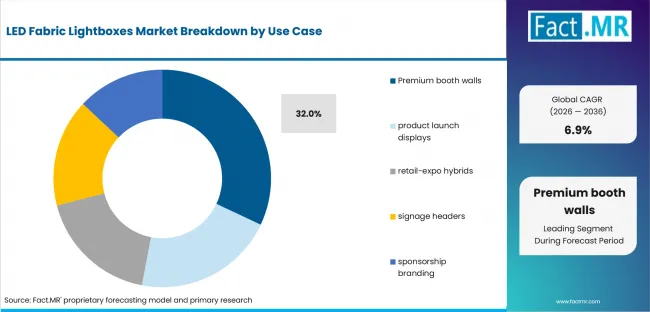
Led Fabric Lightboxes Market Analysis By Use Case | Source: Fact.MR
Premium booth walls lead use case because they carry the main brand message at exhibitions and product launches. The same display area often supports demos and sponsorship backdrops. Event customers therefore place more weight on full-face brightness than on frame price alone.
Why do Exhibit builders lead Buyer Type?
Exhibit builders are estimated to capture 28.0% share in 2026.
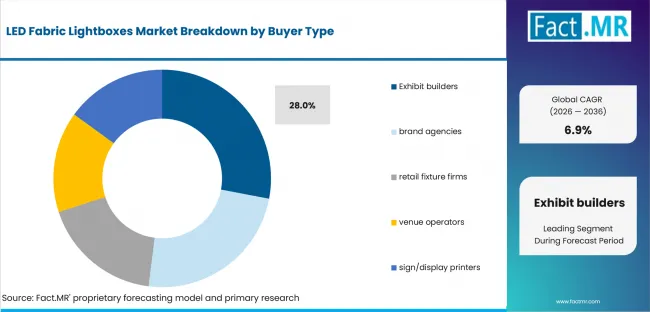
Led Fabric Lightboxes Market Analysis By Buyer Type | Source: Fact.MR
Exhibit builders lead buyer type because they turn brand plans into the physical booth system. Their role begins before graphics are printed and continues through lighting and installation planning. This position makes them the main decision point for repeatable frame dimensions.
Why do SEG fabric prints lead Graphic Type?
SEG fabric prints are forecast to represent 37.0% share in 2026.
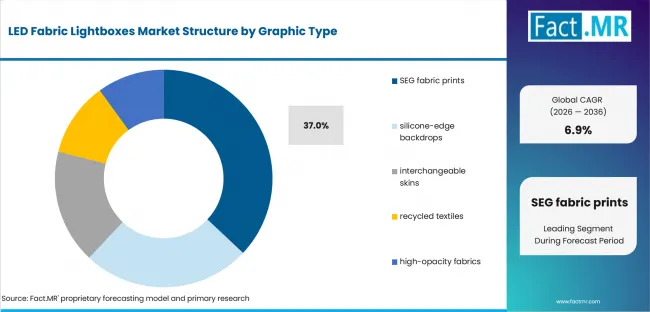
Led Fabric Lightboxes Market Analysis By Graphic Type | Source: Fact.MR
SEG fabric prints lead graphic type since silicone-edge graphics create a cleaner fit than loose fabric panels. The format supports faster image changes for repeat campaigns. Graphic quality still decides approval when dense ink areas reduce brightness across the display face.
What is accelerating LED Fabric Lightboxes Market adoption, and what is holding it back?
Premium visual presentation is expected to remain the primary adoption catalyst. Brightness inconsistency is anticipated to restrain growth when providers cannot prove full-face uniformity before installation.
Drivers Impact Analysis
| DRIVER | (~) % IMPACT ON CAGR | GEOGRAPHIC RELEVANCE | IMPACT TIMELINE |
|---|---|---|---|
| Premium visual presentation | +1.9% | Global | Short term (<= 2 years) |
| Reusable illuminated graphics | +1.4% | North America and Europe | Short term (<= 2 years) |
| Lower LED power demand | +1.1% | China and UAE | Medium term (2-4 years) |
| Modular booth-wall integration | +0.8% | Mature exhibition markets | Medium term (2-4 years) |
Source: Fact.MR analysis. Updated Jul 28, 2026
- Premium visual presentation: Customers are expected to value lightboxes when the display wall must carry a clean brand image under hall lighting. The purchase case is clearest when the provider shows brightness consistency before the event opens.
- Reusable illuminated graphics: Repeat campaigns are anticipated to support demand since the same frame holds new fabric artwork. This helps brand agencies reduce rebuild work when exhibition calendars include several stops.
- Lower LED power demand: Lower energy use is expected to improve the operating case for larger illuminated walls. The benefit is practical only when heat and cable routing are planned before installation.
- Modular booth-wall integration: Standard frame systems are projected to raise adoption where event programs use similar booth footprints. The same modules are then reconfigured without starting each project from a blank structure.
Opportunity Impact Analysis
| OPPORTUNITY | (~) % IMPACT ON CAGR | GEOGRAPHIC RELEVANCE | IMPACT TIMELINE |
|---|---|---|---|
| Remote brightness controls | +1.2% | USA and UK | Short term (<= 2 years) |
| Curved illuminated frames | +0.9% | Germany and Japan | Medium term (2-4 years) |
| Recycled SEG graphic programs | +0.6% | China and UAE | Medium term (2-4 years) |
Source: Fact.MR analysis. Updated Jul 28, 2026
- Remote brightness controls: Remote controls are expected to create upgrade value when venues use different ambient-light conditions. Providers are expected to position this feature as a practical tool for quick tuning and not as decoration.
- Curved illuminated frames: Curved formats are projected to support premium booth concepts that need a more distinctive visual edge. Adoption depends on proving that the curved face does not create dark corners or uneven graphic tension.
- Recycled SEG graphic programs: Recycled SEG graphic programs are anticipated to add value when customers replace artwork frequently. The opportunity is clearest where providers manage take-back and sorting without disrupting event schedules.
Restraints Impact Analysis
| RESTRAINT | (~) % IMPACT ON CAGR | GEOGRAPHIC RELEVANCE | IMPACT TIMELINE |
|---|---|---|---|
| Brightness inconsistency | -1.3% | Cost-sensitive regional markets | Short term (<= 2 years) |
| Power and cable planning | -1.0% | Highly regulated venues | Medium term (2-4 years) |
| Graphic light-blocking defects | -0.7% | Global | Short term (<= 2 years) |
Source: Fact.MR analysis. Updated Jul 28, 2026
- Brightness inconsistency: Uneven brightness is expected to delay approval when the customer cannot review the full graphic face before the event. The issue is harder to fix once the wall is already built on site.
- Power and cable planning: Poor power planning is anticipated to weaken the purchase case for larger modular layouts. Exhibit crews need a clear wiring plan before the frame and graphic arrive at the venue.
- Graphic light-blocking defects: Heavy ink coverage is expected to reduce light transfer and create dark bands across the fabric. Providers are expected to manage this risk through print testing and artwork guidance before final production.
Which countries are scaling LED Fabric Lightboxes Market fastest?
Country growth is led by UAE with both markets above the 6.9% global CAGR. USA tracks the global figure. Japan, UK and Germany form a lower but stable group. The difference reflects event frequency, booth turnaround needs and the way exhibitors reuse illuminated graphics across venues.
- UAE remains above the global average since fast event turnaround raises the value of pre-tested lightboxes. Providers that control brightness before delivery are expected to gain an advantage in venue-heavy schedules.
- USA follows the global CAGR because brands often require measured visual performance before repeating a display concept. Procurement is expected to focus on brightness records, graphic replacement speed and service availability.
- Japan stays close to the global rate where compact booth layouts favor ultra-slim frames. The purchase decision is expected to depend on cable planning and reliable operation in space-limited settings.
- UK growth depends on recurring show programs and agency-led brand activations. Remote brightness controls are expected to matter when one display package moves between venues with different lighting conditions.
- Germany records the lowest listed CAGR in this group but remains technically demanding. Customers are expected to require clear documentation and stable brightness before approving multi-event use.
Comparable CAGRs therefore produce different market entry conditions across these countries. Deployment timing depends on how well the provider proves brightness and graphic replacement before the first event. Commercial readiness reflects local installation support and the ability to reuse systems without visible quality loss.
The full report provides country-level CAGR analysis across North America, Latin America, Europe, East Asia, South Asia, Oceania and the Middle East and Africa.
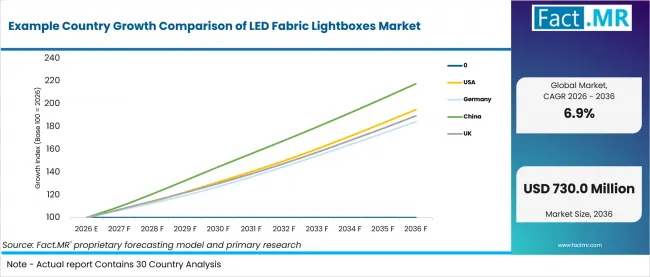
Example Country Growth Comparison Of Led Fabric Lightboxes Market | Source: Fact.MR
| Country | CAGR (2026-2036) |
|---|---|
| UAE | 7.6% |
| USA | 6.9% |
| Japan | 6.8% |
| UK | 6.6% |
| Germany | 6.3% |
Source: Fact.MR analysis. Updated Jul 28, 2026
What is driving UAE's growth through 2036?
7.6% CAGR, led by high event turnover and short installation windows.
UAE demand is expected to come from exhibition venues and international brand activations that require fast setup and clean presentation. Premium booth walls fit this environment because the visual impact is clear to visitors immediately. Power and cable planning remain important when last-minute changes delay installation during tight event schedules.
What is driving USA's growth through 2036?
6.9% CAGR, backed by measurement-led exhibitor procurement.
USA adoption reflects a mature exhibition environment where customers compare display options through repeatability and service evidence. Exhibit builders are expected to remain central because they handle the booth structure and graphic changeover plan. Providers that document brightness checks are expected to reduce approval friction across recurring programs.
What is driving Japan's growth through 2036?
6.8% CAGR, driven by compact systems and reliable operation.
Japan's outlook is shaped by compact booth layouts and demand for clean installation details. Ultra-slim frames are expected to fit this requirement because they reduce wall depth without removing the illuminated effect. Limited space still restricts driver placement and cable routing.
What is driving UK's growth through 2036?
6.6% CAGR, supported by recurring shows and agency-led brand programs.
UK growth is projected to reflect repeat exhibitor activity and agency-led display planning. Remote brightness controls are expected to help when the same lightbox moves between venues with different ambient-light conditions. Providers are expected to combine graphic handling instructions with a clear service route for quick replacement.
What is driving Germany's growth through 2036?
6.3% CAGR, led by international event participation and strict technical review.
Germany's growth reflects a trade-fair base where exhibitors and stand builders often expect well-documented systems. Premium booth walls are expected to gain demand when providers prove the full graphic face remains bright and consistent. Rejection risk rises when light leakage or dark bands appear during setup.
Who leads the LED Fabric Lightboxes Market?
beMatrix and Aluvision show the direct relevance because both support modular exhibit systems and illuminated booth-wall presentation. Moss, Matrix Frame and SEG Systems broaden the field through fabric graphics and lightbox product depth.
beMatrix supports modular exhibit work through frame and lightbox systems. Aluvision competes through modular light walls and lightboxes for exhibition stands. Moss adds edge-lit lightboxes and fabric graphics for event environments. Matrix Frame remains relevant through SEG frames and portable lightbox systems used for trade-show presentation. SEG Systems expanded the outdoor LED fabric lightbox route with Backlit Snap in April 2025.
Competition through 2036 will focus on bright displays and frames that are easy to use. Suppliers will also be judged on simple setup, safe packaging, and quick technical help. Jewelry stands and ring displays support the wider demand for attractive retail presentation, but they are not part of the LED fabric lightbox market.
Which companies are the key providers?
Key companies include beMatrix; Aluvision; Moss; Matrix Frame; SEG Systems.
- beMatrix
- Aluvision
- Moss
- Matrix Frame
- SEG Systems
Bibliography
- Association of the German Trade Fair Industry. (2026).
- Moss. (2025, May 5).
- Greenhouse and Energy Minimum Standards Regulator. (2025, November 18). GEMS (LED lamps) Determination 2025. Australian Government.
- SEG Systems. (2025, April 22). SEG Systems introduces Backlit Snap: The first outdoor LED fabric snap frame lightbox.
This Report Answers
- The report provides strategic intelligence on the LED Fabric Lightboxes Market across Lighting Format and Frame Depth choices that shape exhibit-display purchasing.
- Segment analysis covers Edge-lit boxes and Ultra-slim frames as the leading 2026 categories within the market.
- Country outlook evaluates China and UAE alongside USA and Japan. UK and Germany complete the growth comparison across the profiled markets.
- Competitive analysis profiles beMatrix and Aluvision alongside Moss, Matrix Frame and SEG Systems.
- Use-case assessment covers Premium booth walls and product launch displays. Retail-expo hybrids, signage headers and sponsorship branding complete the application view.
What does the LED Fabric Lightboxes Market cover?
Illuminated display frames that place LED lighting behind or along the edge of tensioned fabric graphics.
The LED fabric lightboxes market covers LED modules and lightbox frames delivered as an exhibition display system. It includes drivers, diffusion elements and fabric graphics when they form part of the sold or rented lightbox package. Commercial value comes from the complete display function and not from an unrelated component sale.
The market differs from broader display equipment because the boundary is defined by illuminated fabric-face performance. Digital signage systems are excluded when the main value comes from programmable screen content. Outdoor advertising assets are excluded unless they use a fabric lightbox format in a temporary or semi-permanent event display package.
What is included in the scope?
LED fabric lightboxes are used across exhibit builders, brand agencies, retail fixture firms, venue operators and sign/display printers.
The scope includes Lighting Format and Frame Depth alongside Use Case, Buyer Type and Graphic Type. Coverage spans edge-lit boxes and backlit matrix boxes. Modular LED tiles, curved lightboxes and double-sided lightboxes complete the format scope. Ultra-slim frames and standard profiles are included with deep-box, freestanding and suspended configurations.
Premium booth walls remain in scope when the display is sold or rented as an illuminated fabric system. Product launch displays and retail-expo hybrids are included under the same rule. Point of purchase packaging is outside the boundary unless an illuminated SEG frame is part of the display package. Retail ready packaging is excluded when it functions only as transport or shelf packaging.
What is excluded from the scope?
General signage, architectural lighting and unrelated event services remain outside the scope of this market.
The scope excludes unlit fabric frames, general electrical installation and venue construction that does not deliver the defined product function. Lighting fixtures are excluded when they are sold as building or architectural products instead of integrated exhibit lightboxes. Interactive projector systems are excluded because image projection uses a different product mechanism from an LED-lit fabric face.
General event management, floor-space rental and exhibitor business revenue are excluded. Jewelry display stands and ring displays remain separate categories because they present small products and not illuminated booth-wall graphics. 3D rendering is treated as a planning input and is not counted as product revenue unless it is bundled with a sold lightbox system.
How Was the Analysis Built?
The analysis draws on 120+ sources, 35+ company portfolios, 25+ countries, and more than 20 industry interviews.
- Primary Research: Primary research includes discussions with manufacturers, service providers, technology developers, distributors, end users, procurement teams, and subject-matter experts. These conversations examine purchasing priorities, product adoption, operational challenges, approval requirements, competitive positioning, and the factors that influence wider market acceptance.
- Desk Research: Desk research covers government statistics, regulatory publications, company filings, trade data, technical studies, industry associations, standards, public policy, and other authoritative sources. Every source used in the analysis is documented in the bibliography.
- Market Sizing and Forecasting: Market estimates combine historical performance, demand indicators, pricing and volume trends, segment shares, company participation, country-level growth, adoption patterns, investment activity, and barriers to market expansion.
- Data Validation and Update Cycle: Findings are validated by comparing primary interviews with public data, company activity, regulatory changes, trade patterns, and industry developments. Regular updates review new product launches, capacity changes, partnerships, approvals, procurement trends, and shifts in commercial adoption.
Segmentation
What is the report's scope and coverage?
| Attribute | Details |
|---|---|
| Quantitative Units | USD million in 2026 to USD million by 2036 at CAGR |
| Market Definition | Illuminated display frames that use LED modules behind or along the edge of tensioned fabric graphics and are delivered as commercial event, exhibit or retail-expo display systems |
| Lighting Format | Edge-lit boxes; Backlit matrix boxes; Modular LED tiles; Curved lightboxes; Double-sided lightboxes |
| Frame Depth | Ultra-slim frames; Standard profiles; Deep-box profiles; Freestanding frames; Suspended frames |
| Use Case | Premium booth walls; Product launch displays; Retail-expo hybrids; Signage headers; Sponsorship branding |
| Buyer Type | Exhibit builders; Brand agencies; Retail fixture firms; Venue operators; Sign/display printers |
| Graphic Type | SEG fabric prints; Silicone-edge backdrops; Interchangeable skins; Recycled textiles; High-opacity fabrics |
| Regions Covered | North America; Latin America; Europe; East Asia; South Asia and Pacific; Middle East and Africa |
| Countries Covered | USA; Canada; Brazil; Mexico; Germany; U.K.; France; Italy; Spain; South Korea; Japan; China; India; Australia and New Zealand; GCC Countries; South Africa; UAE |
| Key Companies Profiled | beMatrix; Aluvision; Moss; Matrix Frame; SEG Systems |
| Forecast Period | 2026 to 2036 |
| Approach | Hybrid top-down and bottom-up approach using display-system demand; segment shares; country growth; company participation; event procurement patterns; and adoption barriers |
Source: Fact.MR analysis. Updated Jul 28, 2026
How is the market segmented?
-
By Lighting Format:
- Edge-lit boxes
- Backlit matrix boxes
- Modular LED tiles
- Curved lightboxes
- Double-sided lightboxes
-
By Frame Depth:
- Ultra-slim frames
- Standard profiles
- Deep-box profiles
- Freestanding frames
- Suspended frames
-
By Use Case:
- Premium booth walls
- Product launch displays
- Retail-expo hybrids
- Signage headers
- Sponsorship branding
-
By Buyer Type:
- Exhibit builders
- Brand agencies
- Retail fixture firms
- Venue operators
- Sign/display printers
-
By Graphic Type:
- SEG fabric prints
- Silicone-edge backdrops
- Interchangeable skins
- Recycled textiles
- High-opacity fabrics
-
By Region:
- North America
- USA
- Canada
- Latin America
- Brazil
- Mexico
- Rest of Latin America
- Europe
- Germany
- U.K.
- France
- Italy
- Spain
- Rest of Europe
- East Asia
- South Korea
- Japan
- China
- South Asia & Oceania
- India
- Australia & New Zealand
- Rest of South Asia & Oceania
- Middle East & Africa
- GCC Countries
- South Africa
- UAE
- Rest of Middle East & Africa
- North America
Frequently Asked Questions
Which Lighting Format leads the market?
Which Frame Depth leads the market?
Which Use Case leads the market?
Which Buyer Type leads the market?
Which Graphic Type leads the market?
What is the primary driver in this market?
What is the main restraint?
Why do SEG fabric prints lead demand?
Who worked on this report


Preview the report firsthand - request a free sample
Free SampleGet the brochure for pricing and purchase details
Download PDF