- Base Value(2025): 771.4 Mn
- Estimated Value(2026): 821.5 Mn
- Forecast Value (2036): 1542.1 Mn
- CAGR (2026 - 2036): 6.5%
Mood-Support Botanicals Market Overview, Growth Outlook, and Forecast by Fact.MR
- In 2025, the mood-support botanicals market was valued at USD 771.4 million.
- Demand for mood-support botanical products is projected to grow to USD 821.5 million in 2026 and reach USD 1,542.1 million by 2036.
- The market is expected to expand at a CAGR of 6.5% during the forecast period.
- The mood-support botanicals market is projected to create an absolute dollar opportunity of USD 720.6 Million between 2026 and 2036.
- Market growth is driven by rising consumer awareness regarding mental wellness, increasing demand for natural stress-management solutions, and growing adoption of adaptogenic and herbal supplements for emotional well-being support.
- Expanding interest in clean-label, plant-based nutraceuticals, along with increasing consumption of functional beverages and botanical wellness products, is further supporting market expansion globally.
- In addition, growing e-commerce penetration, lifestyle-related stress conditions, and rising preference for preventive healthcare solutions continue to accelerate market demand.
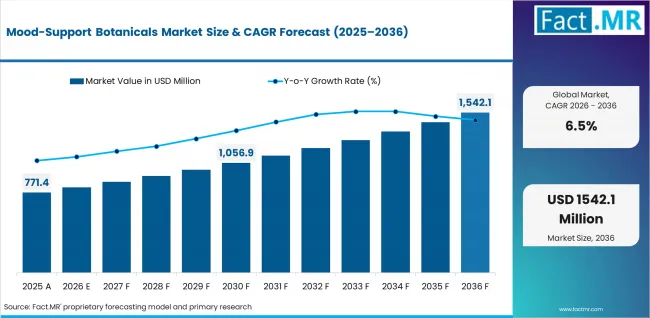
Mood Support Botanicals Market Value Analysis | Source: Fact.MR
Summary of the Mood-Support Botanicals Market
- Market Snapshot
- Global mood-support botanicals market revenue stood at USD 821.5 million in 2026 and is forecast to reach USD 1,542.1 million by 2036.
- At a 6.5% CAGR from 2026 to 2036, the market is expected to expand ~1.6x in value, creating an absolute dollar opportunity of USD 720.6 Million.
- The growth of the market is driven by increasing consumer focus on emotional health, growing stress-related health issues, and popularity of plant-based supplements for mood balance and relaxation support.
- The rising demand for plant-based nutraceuticals, adaptogenic products, clean label wellness products are contributing to accelerating demand in mature as well as emerging markets.
- Grossing up the expansion of eCommerce wellness platforms, premium herbal supplement brands, and functional beverage innovations is also fueling global market reach.
- Demand and Growth Drivers
- Increasing incidence of stress, anxiety, sleep disorders, and lifestyle-related mental wellness issues
- Increasing consumer awareness towards natural and botanical based products rather than synthetic mood support products
- Rising usage of adaptogens, such as Ashwagandha, Rhodiola Rosea, Holy Basil, and more in the wellness formulations
- The functional beverage, gummy and personalized supplement categories are all expanding rapidly
- Increasing knowledge of preventive healthcare and holistic wellness products
- Growing availability of digital wellness brands and direct-to-consumer supplement platforms.
- Need for solutions providing:
- Natural stress management support
- Emotional wellness and relaxation benefits
- Improved cognitive balance and focus
- Sleep quality enhancement
- Clean-label and organic ingredient formulations
- Plant-based preventive healthcare alternatives
- Convenient and personalized supplement delivery formats
- Product and Segment View
- Adaptogens account for 33.8% of ingredient type share in 2026, emerging as the leading segment due to strong consumer demand for stress-management and cortisol-support formulations.
- Capsules & Tablets hold 39.8% of product form share in 2026, supported by convenience, dosage consistency, and widespread availability through retail and online channels.
- Conventional Botanicals represent 56.2% of nature share in 2026, reflecting broader affordability and large-scale commercial availability, although organic formulations are witnessing faster growth.
- Stress Management accounts for 33.6% of application share in 2026, driven by rising workplace stress, urban lifestyle pressures, and increasing consumer awareness regarding mental wellness.
- E-commerce captures 29.8% of distribution channel share in 2026, supported by rising online supplement purchases, subscription wellness models, and growing digital health engagement.
- Geography and Competitive Outlook
- Rising herbal wellness adoption, growing awareness regarding mental well-being, and increasing penetration of botanical nutraceutical products are driving strong market growth across East Asia, South Asia & Pacific, and North America.
- Major growth markets in the Mood-Support Botanicals Market include India (9.3% CAGR), Japan (8.4% CAGR), China (8.1% CAGR), Brazil (7.6% CAGR), Canada (7.4% CAGR), United States (5.7% CAGR), and South Korea (5.5% CAGR) during the forecast period.
- Market growth is supported by:
- Rising consumer spending on mental wellness products
- Increasing demand for adaptogens and herbal supplements
- Growing popularity of clean-label and plant-based nutrition
- Expansion of premium wellness and functional beverage categories
- Increasing adoption of direct-to-consumer supplement models
- Growth in personalized wellness and preventive healthcare trends
- Prominent players in the market include Gaia Herbs, Himalaya Wellness, Herb Pharm, Traditional Medicinals, Moon Juice, Nature’s Bounty, Swisse Wellness, Organic India, NOW Foods, and Jarrow Formulas.
- Analyst Opinion
- Shambhu Nath Jha, Principal Consultant at Fact.MR, opines, “CXO leaders are expected to recognize that future competitive advantage in the mood-support botanicals market will increasingly depend on developing clinically supported botanical formulations, expanding adaptogen-based product portfolios, leveraging clean-label and plant-based wellness trends, and strengthening direct-to-consumer and digital wellness distribution strategies to address rising global demand for stress management, emotional wellness, and preventive mental health support
Mood-Support Botanicals Market — At a Glance
| Attribute | Details |
|---|---|
| Market Value 2025 | USD 771.4 Million |
| Market Value 2026 | USD 821.5 Million |
| Market Value 2036 | USD 1,542.1 Million |
| Absolute Dollar Opportunity | USD 720.6 Million |
| Total Growth | 87.70% |
| CAGR | 6.50% |
| Growth Multiple | 1.9x |
| Key Demand Theme | Rising consumer focus on emotional wellness, increasing demand for adaptogenic and herbal stress-management solutions, growing preference for plant-based nutraceuticals, expansion of functional wellness products, and increasing adoption of preventive healthcare supplements |
| Leading Ingredient Type | Adaptogens |
| Ingredient Type Share | 33.8% |
| Leading Product Form | Capsules & Tablets |
| Product Form Share | 39.8% |
| Leading Nature Segment | Conventional Botanicals |
| Nature Segment Share | 56.2% |
| Leading Distribution Channel | E-commerce |
| Distribution Channel Share | 29.8% |
| Leading Application | Stress Management |
| Application Share | 33.6% |
| Key Growth Regions | East Asia, South Asia & Pacific, North America |
| Key Companies | Gaia Herbs, Himalaya Wellness, Herb Pharm, Traditional Medicinals, Moon Juice, Nature’s Bounty, Swisse Wellness, Organic India, NOW Foods, Jarrow Formulas |
| Segmentation by Ingredient Type | Adaptogens, Calming & Relaxation Botanicals, Cognitive Mood Botanicals, Mood-Elevating Botanicals, Traditional/Ayurvedic Botanicals |
| Segmentation by Product Form | Capsules & Tablets, Powders, Gummies, Liquid Extracts/Tinctures, Functional Beverages |
| Segmentation by Nature | Organic Botanicals, Conventional Botanicals |
| Segmentation by Distribution Channel | E-commerce, Pharmacies & Drug Stores, Health & Wellness Stores, Supermarkets/Hypermarkets, Practitioner/Clinical Channels |
| Segmentation by Application | Stress Management, Anxiety & Relaxation, Sleep Support, Cognitive Health & Focus, Emotional Wellness, Women’s Mood Support |
| Segmentation by Region | North America, Latin America, East Asia, South Asia & Pacific, Western Europe, Eastern Europe, Middle East & Africa |
Source: Fact.MR analysis. Updated May 21, 2026
Key Growth Drivers, Constraints, and Opportunities
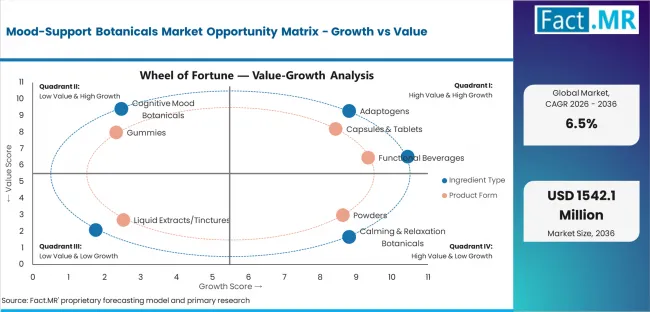
Mood Support Botanicals Market Opportunity Matrix Growth Vs Value | Source: Fact.MR
Key Factors Driving Growth
- Global awareness of stress, anxiety, emotional well-being and mental health prevention is higher than ever and is driving demand for mood-support botanicals.
- Growing consumer preference for natural, plant-based and clean-label dietary supplements over synthetic mood management products is contributing to the growth of the market in various global wellness sectors.
- Increasing popularity of adaptogens such as Ashwagandha, Rhodiola, Holy Basil, etc. in dietary supplements, functional drinks and personalized wellness solutions, are hindering market growth.
- The rise of e-commerce wellness platforms, supplement brands that sell directly to consumers, and digital health ecosystems are making products more accessible and engaging consumers worldwide.
| Growth Driver | Demand Impact | Time Horizon | Key Impact Area | Fact.MR Insight |
|---|---|---|---|---|
| Rising consumer focus on stress management and emotional wellness | High | Short–Mid Term | Demand for mood-support supplements & adaptogenic formulations | Increasing awareness regarding mental wellness, anxiety management, and preventive healthcare is significantly driving adoption of botanical mood-support products globally. |
| Growing preference for natural and plant-based wellness solutions | High | Short–Mid Term | Clean-label nutraceuticals & herbal supplement demand | Consumers are increasingly shifting toward plant-based and non-synthetic emotional wellness solutions, accelerating demand for botanical supplements and adaptogens. |
| Expanding adoption of adaptogens in functional wellness products | Medium-High | Mid–Long Term | Product innovation & premium wellness positioning | Adaptogens such as Ashwagandha, Rhodiola, and Holy Basil are witnessing strong integration into supplements, gummies, and functional beverages for stress resilience and cognitive wellness. |
| Increasing penetration of e-commerce and direct-to-consumer wellness platforms | Medium-High | Mid–Long Term | Digital supplement retail & consumer accessibility | Rapid expansion of online wellness ecosystems and subscription-based supplement models is improving consumer engagement and accelerating market penetration globally. |
| Rising development of clinically validated and standardized botanical formulations | Medium-High | Mid–Long Term | Scientific substantiation & premium product development | Increasing investment in clinical research, ingredient standardization, and evidence-based wellness products is strengthening consumer trust and supporting long-term market expansion. |
Source: Fact.MR analysis. Updated May 21, 2026
Key Market Constraints
- The commercialization of the product may be restricted in some regions due to the complex regulations of the health claims, ingredient approvals and botanical standardization.
- Raw material quality, supply consistency and active compound concentration can all vary and pose formulation and supply chain challenges for producers.
- Gentle proofing the more traditional botanicals while some may have limited clinical substantiation may also detract consumer confidence and limit further medical acceptance.
- Higher cost associated with clinically standardized and organic botanical ingredients could affect adoption in value-conscious consumers.
Key Opportunity Areas
- Growing demand for prevention from wellness and mental health management is expected to provide a positive impact on the long-term growth of the botanical supplement manufacturers.
- The growing demand for personalized nutrition, mood-specific formulations, and scientifically validated adaptogen formulations is creating opportunities for new premium products.
- Further penetration into younger consumers is also expected to be driven by the expansion of functional drinks, nootropic wellness products, and convenient supplement delivery systems.
- The commercialization of more clinically substantiated botanical ingredients into nutraceutical and wellness will also propel business growth in the long-term.
Segment-wise Analysis of the Mood-Support Botanicals Market
- Adaptogens account for 33.8% share of the ingredient type segment in 2026, driven by increasing consumer demand for stress-management solutions, rising adoption of Ashwagandha and Rhodiola-based formulations, and growing awareness regarding adaptogenic support for emotional wellness and cognitive balance.
- Capsules & Tablets represent 39.8% share of the product form segment in 2026, supported by strong consumer preference for convenient dosage formats, higher product stability, accurate ingredient dosing, and widespread availability through retail and e-commerce wellness channels.
- Conventional Botanicals hold 56.2% share of the nature segment in 2026, owing to their broader commercial availability, cost-effectiveness, established supply chains, and extensive use across mainstream nutraceutical and herbal supplement formulations globally.
The mood-support botanicals market is segmented by ingredient type, product form, nature, consumer group, distribution channel, application, and region.
Which Ingredient Type Segment Topped the Mood-Support Botanicals Market?
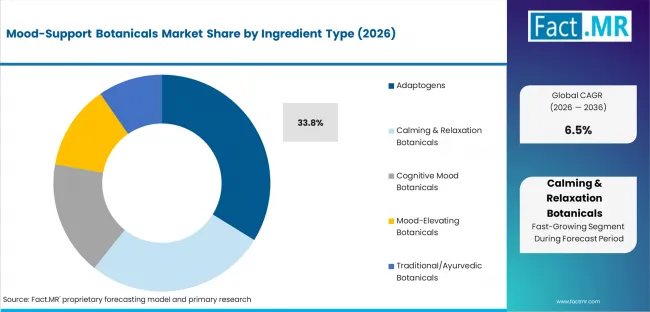
Mood Support Botanicals Market Analysis By Ingredient Type | Source: Fact.MR
Adaptogens are projected to account for 33.8% of the largest share by 2026 in the Mood-Support Botanicals Market. This supremacy is due to increasing worldwide demand for stress management products, growing consumer awareness with respect to adaptogenic wellness products, and high adoption of ingredients including Ashwagandha, Rhodiola, and Holy Basil in dietary supplements, functional beverages, and emotional wellness products.
Which Product Form Segment Accounts for the Highest Share in the Market?
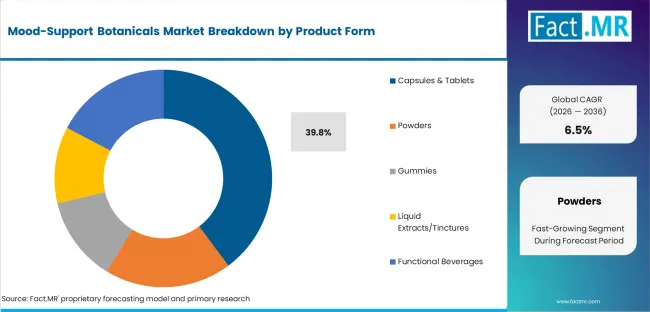
Mood Support Botanicals Market Analysis By Product Form | Source: Fact.MR
Capsules and Tablets are expected to hold a largest share 39.8% in the product form segment in 2026. This is due to the high demand for handy and simple to consume supplements, the provision of accurate dosage, greater product stability, and easy availability in pharmacies, health stores, and on-line wellness platforms.
Which Nature Segment Leads the Market?
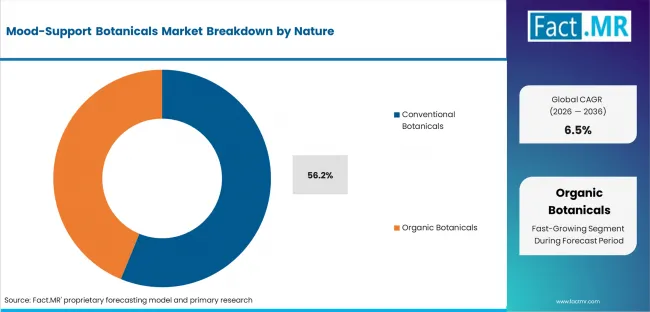
Mood Support Botanicals Market Analysis By Nature | Source: Fact.MR
Conventional Botanicals are anticipated to hold the highest market share, accounting for 56.2% in 2026, owing to their broader commercial availability, lower product cost, established raw material supply chains, and widespread usage in mainstream nutraceutical and herbal wellness products. Increasing global demand for affordable botanical supplements further supports segment growth.
Which Distribution Channel Segment Holds the Largest Share in the Market?
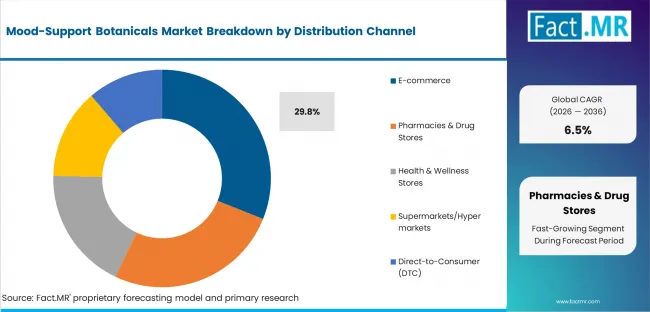
Mood Support Botanicals Market Analysis By Distribution Channel | Source: Fact.MR
E-commerce is projected to dominate the distribution channel segment, capturing 29.8% share in 2026. This leadership is driven by increasing online supplement purchases, rapid expansion of direct-to-consumer wellness brands, wider product accessibility, subscription-based supplement models, and rising consumer preference for digital wellness shopping platforms.
Regional Outlook Across Key Markets
North America, Latin America, Western Europe, Eastern Europe, East Asia, South Asia & Oceania, and Middle East & Africa are the geographies covered in this report. It comprises a consumer insights analysis on consumer awareness on emotional wellness and stress management, acceptance of botanical and adaptogenic supplements, nutraceutical and functional wellness industry development, growth of e-commerce and direct-to-consumer wellness platforms, demand for clean-label and plant-based products, regulatory progress related to herbal supplements, and high consumption of mood-support formulations in world wellness and preventive health care markets.
.webp "Top Country Growth Comparison Mood Support Botanicals Market Cagr (2026 2036)")
Top Country Growth Comparison Mood Support Botanicals Market Cagr (2026 2036) | Source: Fact.MR
CAGR Table
| Country | CAGR (%) |
|---|---|
| India | 9.3% |
| Japan | 8.4% |
| China | 8.1% |
| South Korea | 5.5% |
| United States | 5.7% |
| Brazil | 7.6% |
| Canada | 7.4% |
Source: Fact.MR analysis. Updated May 21, 2026
Source: Fact.MR (FMR) analysis, based on proprietary forecasting model and primary research.
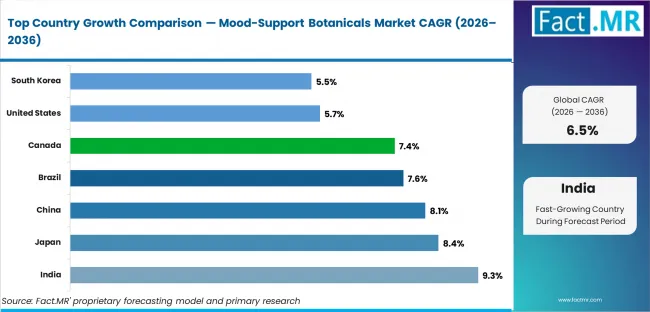
Mood Support Botanicals Market Cagr Analysis By Country | Source: Fact.MR
North America Mood-Support Botanicals Market
The North American region is considered one of the most commercially developed in the mood-support botanicals market due to increased consumption of nutraceuticals, heightened consciousness of emotional well-being, preventive health practices, and greater adaptogens' supplements demand. The further development of e-commerce wellness portals, high-quality botanical products, and functional beverages will aid market growth in this region. Among the prominent firms in the area, Gaia Herbs, Nature’s Bounty, NOW Foods, and Jarrow Formulas are bolstering their presence via clinical botanical products and wellness initiatives.
- U.S.: Demand for mood-support botanicals in the U.S. is projected to rise at 5.7% CAGR through 2036. Growth is driven by increasing stress-management awareness, rising demand for adaptogenic supplements, expansion of functional wellness products, and growing adoption of preventive emotional wellness solutions.
- Canada: Demand for mood-support botanicals in Canada is projected to grow at 7.4% CAGR through 2036, supported by increasing consumer preference for clean-label herbal supplements, rising wellness spending, and expanding adoption of plant-based emotional wellness products.
Europe Mood-Support Botanicals Market
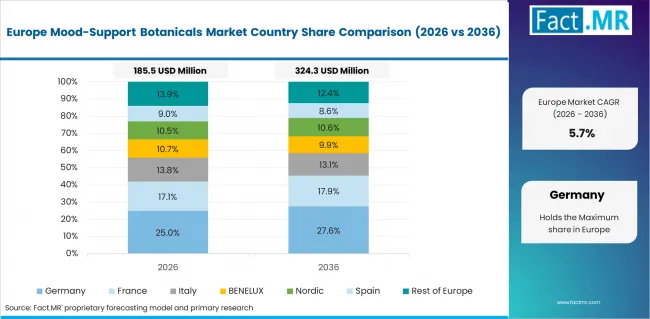
Mood Support Botanicals Market Europe Country Market Share Analysis, 2026 & 2036 | Source: Fact.MR
Europe accounts for a robust botanical wellness and herbal supplement market in the global natural healthcare products owing to growing consumers inclination towards natural healthcare products in the region, increasing adoption of preventive wellness solutions, and growing demand for clinically supported botanical formulations. The region is also experiencing growth in organic nutraceuticals, stress relief supplements, and emotional wellness. Players such as Himalaya Wellness, Swisse Wellness and regional herbal wellness brands are further consolidating their market position with luxury botanical wellness ranges.
- Germany: Demand for mood-support botanicals in Germany is projected to rise steadily through 2036, supported by increasing interest in herbal wellness products, scientifically validated adaptogenic supplements, and clean-label nutraceutical solutions.
- France: Demand for mood-support botanicals in France is supported by increasing adoption of natural stress-management formulations, premium organic wellness supplements, and expansion of functional herbal wellness categories.
- Italy: Market growth in Italy is supported by increasing consumer demand for plant-based wellness solutions, rising awareness regarding emotional health management, and expansion of herbal supplement retail channels.
East Asia Mood-Support Botanicals Market
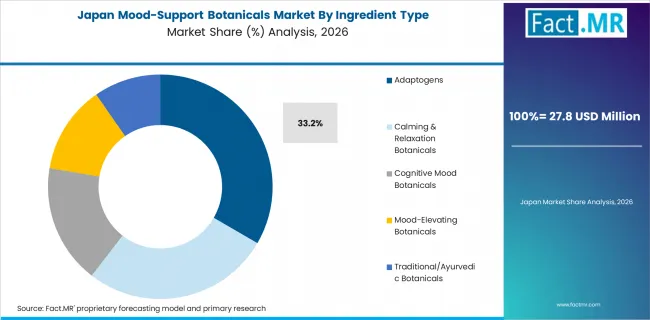
Mood Support Botanicals Market Japan Market Share Analysis By Ingredient Type | Source: Fact.MR
East Asia is poised to be a significant growth region for mood-support botanicals with a strong traditional herbal medicine culture, growing functional wellness industries, and rising consumer focus on emotional health and stress resilience. Regional producers are also focusing more on adaptogenic-based formulations, cognitive wellness products and customized nutraceuticals.
- China: Demand for mood-support botanicals in China is projected to rise at 8.1% CAGR through 2036, driven by increasing herbal supplement consumption, rising middle-class wellness spending, expansion of functional beverage demand, and growing preventive healthcare awareness.
- Japan: Demand for mood-support botanicals in Japan is expected to grow at 8.4% CAGR through 2036 due to rising focus on stress reduction, aging population wellness needs, growing sleep-support product demand, and increasing adoption of premium functional nutrition products.
- South Korea: Demand for mood-support botanicals in South Korea is projected to rise at 5.5% CAGR through 2036, supported by growing interest in cognitive wellness products, functional nutrition trends, and increasing adaptogen consumption.
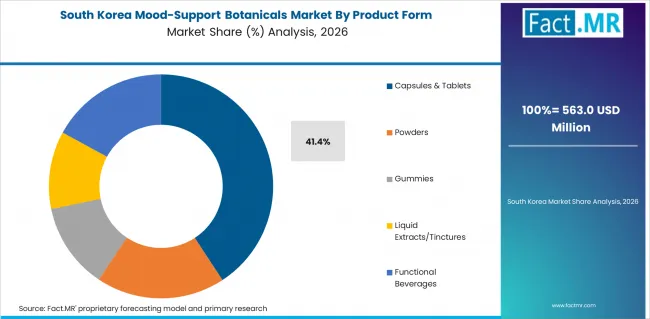
Mood Support Botanicals Market South Korea Market Share Analysis By Product Form | Source: Fact.MR
South Asia & Pacific Mood-Support Botanicals Market
South Asia & Pacific is anticipated to be the fastest-growing region in the Mood-Support Botanicals Market, owing to robust growth of the Ayurvedic heritage, increasing nutraceutical consumption among the people, growing middle class wellness spending, and rising awareness about herbal products for stress-management. Regional companies are aggressively launching adaptogen-infused supplements, botanical drinks and clean-label wellness products.
- India: Demand for mood-support botanicals in India is projected to rise at 9.3% CAGR through 2036, driven by growing adoption of Ayurvedic wellness products, increasing stress-related lifestyle concerns, rapid expansion of herbal supplement brands, and rising consumer preference for natural preventive healthcare solutions.
Latin America Mood-Support Botanicals Market
The development of the botanical commerce in wellness in Latin America is being driven by awareness in emotional wellness, organic natural healthcare products, and higher penetration of herbal nutraceutical channels of distribution. Urban populations are trending towards functional wellness drinks and plant-based supplements.
- Brazil: Demand for mood-support botanicals in Brazil is projected to rise at 7.6% CAGR through 2036, supported by increasing adoption of herbal wellness supplements, growing emotional wellness awareness, and rising demand for natural stress-management solutions.
The Fact.MR report analyzes market trends, regulatory frameworks, competitive benchmarking, consumer wellness behavior, ingredient adoption patterns, product innovation strategies, and long-term growth opportunities across individual countries in North America, Latin America, Europe, East Asia, South Asia & Pacific, and Middle East & Africa. Readers gain detailed insights into nutraceutical industry expansion, adaptogen adoption trends, e-commerce penetration, botanical ingredient commercialization, and future emotional wellness market opportunities across developed and emerging global markets.
Competitive Benchmarking and Company Positioning
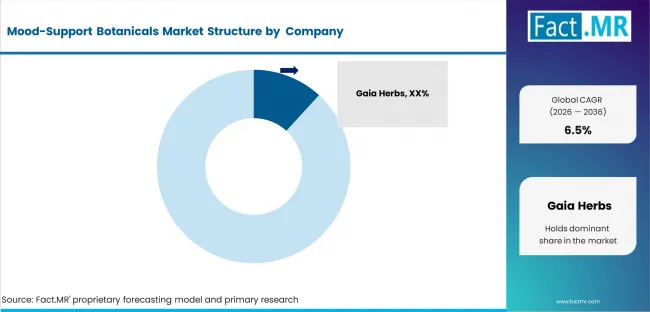
Mood Support Botanicals Market Analysis By Company | Source: Fact.MR
Leading Companies Shaping the Mood-Support Botanicals Market
The market for mood-support botanicals is moderately fragmented and includes Gaia Herbs, Himalaya Wellness, Herb Pharm, Traditional Medicinals, Moon Juice, Nature’s Bounty, Swisse Wellness, Organic India, NOW Foods, and Jarrow Formulas. Competitive forces include clinical effectiveness, standardized ingredients, natural labeling, innovations in product development, and a prominent e-commerce strategy. Top-of-mind brands leverage their unique selling points in adaptogenic herbal blends, quality plant sources, transparency in labeling, and functional wellness categories.
Companies are developing products that address stress management supplements, functional beverages, gummies, and customized wellness products to enhance emotional health and brain functions. On the other hand, local and new entrants are competing by introducing Ayurvedic concepts, cost-effective plant-based products, direct consumer sales, and influencer marketing campaigns directed towards millennials, preventative care, and holistic wellness worldwide.
Recent Industry Developments
- Gaia Herbs – Sustainable Packaging Refresh for Botanical Wellness Portfolio (August 2025)
- Gaia Herbs introduced a sustainability-focused packaging refresh designed to reduce waste, improve recyclability, and simplify wellness product categorization across its herbal supplement portfolio. The initiative strengthens Gaia Herbs’ clean-label and premium botanical positioning while supporting consumer engagement in stress-management, sleep-support, and emotional wellness product categories.
- Natural Field – Release of Ashwagandha White Paper and Liposome Research Expansion (December 2025)
- Natural Field released a new Ashwagandha White Paper and announced landmark liposome research achievements at the 2025 FTA Super Ingredients Conference. The initiative strengthens the company’s scientific positioning in adaptogenic wellness formulations and supports innovation in bioavailability-enhanced mood-support and stress-management botanical ingredients.
- TopGum – Launch of Women’s Botanical Gummies Featuring Shatavari (September 2025)
- TopGum launched a new women-focused gummy supplement line featuring Shatavari and targeted botanical ingredients designed for emotional wellness, hormonal balance, and stress-management applications. The launch expands TopGum’s presence in functional nutraceutical gummies and supports growth in personalized botanical wellness solutions.
- Traditional Medicinals – Launch of Rosy Mood™ and Stress Ease® Calm Teas (October 2025)
- Traditional Medicinals launched Rosy Mood™ and Stress Ease® Calm herbal teas targeting emotional wellness, relaxation support, and stress management. The product expansion strengthens the company’s position in botanical mood-support beverages and responds to increasing consumer demand for natural calming and emotional wellness solutions.
- Gaia Herbs – Partnership with SuppCo for Third-Party Quality Verification (March 2026)
- Gaia Herbs partnered with SuppCo to introduce third-party TrustScore™ verification across its botanical wellness portfolio. The partnership enhances ingredient transparency, sourcing validation, and consumer trust while strengthening Gaia Herbs’ competitive positioning in clinically supported adaptogenic and mood-support supplements.
Leading Companies Shaping the Mood-Support Botanicals Market
- Gaia Herbs
- Himalaya Wellness
- Herb Pharm
- Traditional Medicinals
- Moon Juice
- Nature’s Bounty
- Swisse Wellness
- Organic India
- NOW Foods
- Jarrow Formulas
Sources and Research References
- [1] Gaia Herbs, “We’re Getting A New Look! The Scoop On Gaia Herbs Sustainable Packaging Update”, August 2025
- [2] Natural Field, “Natural Field Releases ‘Ashwagandha White Paper’ and Landmark Liposome Research Achievements at 2025 FTA (Food Research Exchange Super Ingredients Conference)”, December 2025
- [3] Nutritional Outlook, “TopGum Launches Women’s Gummy Line Featuring Shatavari and Targeted Botanicals”, September 2025
- [4] Traditional Medicinals, “Traditional Medicinals® Launches Rosy Mood™ and Stress Ease® Calm Teas”, October 2025
- [5] Gaia Herbs, “Gaia Herbs® Partners with SuppCo for Third-Party Quality Verification”, March 2026
Mood-Support Botanicals Market Definition
Mood-Support botanicals market is a plant-based ingredient-based market where emotional well-being, stress management, relaxation, cognitive balance, and overall mental wellness. These products typically contain adaptogens and calming botanicals, as well as herbs that support cognition and traditional herbal ingredients which are available as capsules, powders, gummies, teas, tinctures and functional beverages. Mood support herbs are commonly used for stress relief, anxiety relief, sleep support, emotional health, and brain function. The market caters to consumers who want natural and preventive wellness products and is widely applicable to the global nutraceutical, dietary supplements, herbal wellness, functional food and beverages and preventive healthcare industries.
Mood-Support BotanicalsMarket Inclusions
The report of the mood-support botanicals market analysis provides a complete view of the global and regional market for the 2025–2036 forecast period. It offers detailed insights into the various segments by ingredient type, product form, nature, consumer group, distribution channel and application, and also analyzes the regional adoption trends, competitive landscape, consumer wellness behavior, product innovation, and botanical ingredient development. In addition, the report highlights new trends, such as adaptogen-based wellness products, clean label and organic botanical products, functional beverages for mental wellness, personalized nutrition solutions, plant-based preventive health care, cognitive wellness botanicals and growth of direct-to-consumer and e-commerce wellness platforms.
Mood-Support Botanicals Market Exclusions
This analysis is pertained to a plant ingredient, herb extracts, and botanical formulation for mood support, emotional well-being, stress relievers, relaxation aids, sleep support and cognitive balancing applications. However, the review does not consider synthetic pharmaceutical antidepressant drugs, anxiolytic drugs under prescription, or psychiatric therapies, or mainstream medications for mental health. The review also excludes all-purpose dietetic products that are not intended mood or emotional wellness, such as those focused on sports nutrition, immune system support, weight reduction, digestive health or general vitamin or mineral supplements, unless they have a botanical function for supporting mood.
Mood-Support Botanicals Market Research Methodology
- Primary Research
- In order to calculate the size of the mood-support botanicals market, Fact.MR has considered top-down as well as bottom-up methodologies from a global perspective. Rigorous primary research was conducted with key industry participants across the value chain, such as suppliers of botanical ingredients, manufacturers of nutraceutical products, brands of herbal supplements, companies producing functional beverages, wellness retailers, distributors in e-commerce, healthcare practitioners, and consultants in the industry to validate key market trends, patterns of consumer adoption, pricing dynamics, strategies of innovation, and outlook of future demand.
- Desk Research
- This report incorporates intelligence collected from business annual reports, investor presentations, nutraceutical industry reports, botanical supplement white papers, herbal wellness journals, scientific research on adaptogens and mood support ingredients, trade, government and consumer wellness trend analyses databases and publications, government health and dietary supplement statistics, regulatory publications, and consumer wellness trend analyses. Other references included are a number of reports on functional foods, preventive healthcare, plant-based nutrition, and mental wellness supplements.
- Market-Sizing and Forecasting
- Fact.MR’s market estimation approach is a robust method where revenue generated by manufacturers of botanical supplements, herbal wellness products, and functional beverage providers is analyzed via bottom-up approach and further scrutinized through a top-down approach in terms of considering the overall ecosystem of botanical supplements, nutraceuticals and mental wellness products in significant regional and application domains.
- Data Validation and Update Cycle
- Market projections were validated through the triangulation of primary interviews, company financials analysis, ingredient demand analysis, retail sales trends, e-commerce penetration rates, regional wellness consumption patterns, and historical growth of botanical and adaptogen-based offerings. Forecasts are subject to change periodically as a result of shifts in consumer behavior, changes in the regulatory landscape, ingredient innovations, further scientific substantiation of herbal formulations, growing digital wellness platforms, and global trends in preventive healthcare and mental wellness expenditure.
Segmentation
Scope of Analysis
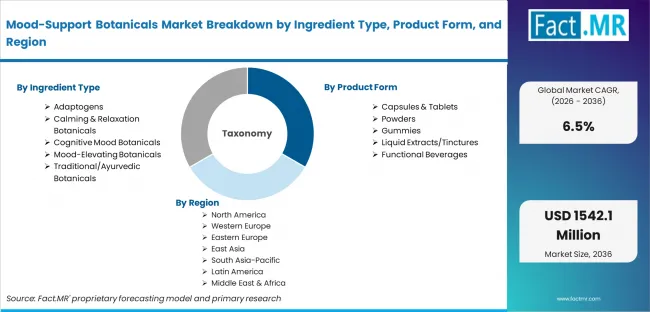
Mood Support Botanicals Market Breakdown By Ingredient Type, Product Form, And Region | Source: Fact.MR
Parameter |
Details |
|---|---|
| Quantitative Units | USD 771.4 million (2025) to USD 1,542.1 million (2036), at a CAGR of 6.5% |
| Market Definition | The mood-support botanicals market covers plant-based ingredients, herbal extracts, adaptogens, and botanical formulations designed to support stress management, emotional wellness, relaxation, cognitive balance, sleep support, and overall mental well-being. These products include capsules, powders, gummies, tinctures, teas, and functional beverages formulated using ingredients such as Ashwagandha, Rhodiola, Holy Basil, Saffron, Lemon Balm, Ginseng, and other mood-support botanicals used across nutraceutical, dietary supplement, herbal wellness, and preventive healthcare industries. |
| Regions Covered | North America, Eastern Europe, Western Europe, East Asia, South Asia & Pacific, Latin America, Middle East & Africa |
| Countries Covered | USA, Canada, Germany, France, Italy, China, Japan, India, South Korea, Brazil, Australia, UAE, South Africa, and 20+ countries |
| Key Companies | Gaia Herbs, Himalaya Wellness, Herb Pharm, Traditional Medicinals, Moon Juice, Nature’s Bounty, Swisse Wellness, Organic India, NOW Foods, Jarrow Formulas |
| Forecast Period | 2026 to 2036 |
| Approach | Hybrid demand-side and top-down methodology based on botanical supplement consumption trends, adaptogen adoption rates, emotional wellness demand, preventive healthcare spending, functional beverage expansion, e-commerce penetration, clean-label nutraceutical growth, and increasing investments in clinically validated herbal formulations, validated through primary interviews with nutraceutical manufacturers, botanical ingredient suppliers, wellness retailers, healthcare practitioners, distributors, and industry experts across key global regions. |
Source: Fact.MR analysis. Updated May 21, 2026
Analysis by Ingredient Type, Product Form, Nature, Distribution Channel, Application, and Region
-
Mood-Support Botanicals Market by Ingredient Type:
- Adaptogens
- Ashwagandha
- Rhodiola Rosea
- Holy Basil (Tulsi)
- Ginseng
- Schisandra
- Calming & Relaxation Botanicals
- Chamomile
- Lavender
- Lemon Balm
- Passionflower
- Valerian Root
- Cognitive Mood Botanicals
- Bacopa Monnieri
- Ginkgo Biloba
- Gotu Kola
- Mood-Elevating Botanicals
- Saffron
- St. John’s Wort
- Mucuna Pruriens
- Traditional/Ayurvedic Botanicals
- Brahmi
- Jatamansi
- Shankhpushpi
- Adaptogens
-
Mood-Support Botanicals Market by Product Form:
- Capsules & Tablets
- Powders
- Gummies
- Liquid Extracts/Tinctures
- Functional Beverages
-
Mood-Support Botanicals Market by Nature:
- Organic Botanicals
- Conventional Botanicals
-
Mood-Support Botanicals Market by Distribution Channel:
- E-commerce
- Pharmacies & Drug Stores
- Health & Wellness Stores
- Supermarkets/Hypermarkets
- Practitioner/Clinical Channels
-
Mood-Support Botanicals Market by Application:
- Stress Management
- Anxiety & Relaxation
- Sleep Support
- Cognitive Health & Focus
- Emotional Wellness
- Women’s Mood Support
-
Mood-Support Botanicals Market by Region:
- North America
- USA
- Canada
- Mexico
- Latin America
- Brazil
- Chile
- Rest of LATAM
- East Asia
- China
- Japan
- South Korea
- Taiwan
- South Asia & Pacific
- India
- Singapore
- Australia
- ASEAN
- Western Europe
- Germany
- France
- U.K.
- Italy
- Spain
- BENELUX
- Nordic
- Rest of Western Europe
- Eastern Europe
- Poland
- Hungary
- Czech Republic
- Balkan & Baltics
- Rest of Eastern Europe
- Middle East and Africa
- Kingdom of Saudi Arabia
- United Arab Emirates
- South Africa
- Rest of Middle East and Africa
- North America
Frequently Asked Questions
How large is the demand for Mood-Support Botanicals in the global market in 2025?
What will be the market size of the Mood-Support Botanicals Market by 2036?
What is the expected demand growth for the Mood-Support Botanicals Market between 2026 and 2036?
How significant is the growth outlook for India in this market?
Which company is identified as a leading player in the Mood-Support Botanicals Market?
Who worked on this report


Preview the report firsthand - request a free sample
Free SampleGet the brochure for pricing and purchase details
Download PDF