- Market Value (2025): USD 405 Mn
- Estimated Value (2026): USD 430 Mn
- Forecast Value (2036): USD 582 Mn
- CAGR (2026-2036): 3.1%
What is the needleless connector caps market forecast to be worth by 2036?
USD 430 million in 2026 to USD 582 million by 2036 at 3.1% CAGR.
- The Needleless Connector Caps Market was valued at USD 405 million in 2025.
- The market is estimated at USD 430 million in 2026. It is projected to reach USD 582 million by 2036.
- The market is forecast to expand at 3.1% CAGR during the forecast period as infection prevention programs continue expanding and vascular access procedures remain high across healthcare facilities.
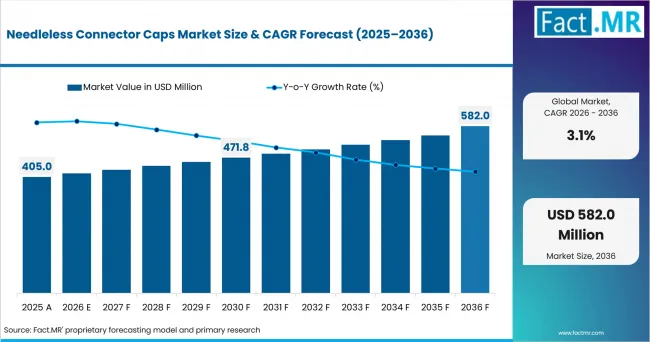
Needleless Connector Caps Market Market Value Analysis | Source: Fact.MR
What are the defining numbers behind needleless connector cap growth?
USD 152 million absolute opportunity by 2036 led by the United States and Germany.
- Demand Drivers in the Market
- Key Segments Analyzed
- By Cap Type: Alcohol Caps are expected to hold 38.0% share in 2026 because they provide rapid connector disinfection before line access.
- By Connector Compatibility: Neutral Connectors are projected to account for 35.0% share in 2026 because they are widely used across healthcare facilities.
- By Application: Central Lines are expected to hold 41.0% share in 2026 because they require strict infection prevention throughout treatment.
- By End User: Hospitals are projected to account for 61.0% share in 2026 because they perform the highest number of vascular access procedures.
- By Geography: The United States is projected to record 3.6% CAGR through 2036.
- Analyst Opinion at Fact.MR
- Shambhu Nath Jha, Senior Analyst at Fact.MR, states, "Needleless connector caps have become an important component of catheter care programs. Healthcare providers continue adopting passive disinfection products that reduce contamination risk and improve patient safety. Continued emphasis on infection prevention will support steady market growth."
- Strategic Implications
- Expand production of disinfecting connector caps.
- Improve compatibility across connector platforms.
- Strengthen partnerships with hospitals and infusion providers.
- Invest in advanced antimicrobial disinfection technologies.
Needleless connector caps are protective devices placed over IV connectors to disinfect access points and reduce microbial contamination before catheter use. They support safer infusion therapy while simplifying routine catheter maintenance.
The United States is projected to record 3.6% CAGR through 2036 because hospitals continue expanding bloodstream infection prevention programs. Germany is expected to grow at 3.3% CAGR due to wider adoption of catheter disinfection products. Japan is forecast to expand at 3.1% CAGR as healthcare providers strengthen vascular access protocols. China is projected to register 2.9% CAGR through 2036 because hospital infrastructure continues improving. South Korea is expected to grow at 2.8% CAGR due to increasing investment in critical care services.
How does the needleless connector caps market break down by segment?
Alcohol Caps lead at 38.0%. Hospitals lead at 61.0%.
Which cap type accounts for the largest market share?
Alcohol Caps hold 38.0% share in 2026.
Alcohol caps lead because they provide rapid disinfection before every catheter access. They help reduce microbial contamination while supporting consistent catheter care practices. Healthcare providers prefer these caps because they are simple to apply. ICU Medical announced that the U.S. FDA granted 510(k) clearance for new labeling claims for its Clave™ portfolio of needle-free IV connectors. The updated labeling includes peer-reviewed clinical evidence showing that hospitals standardizing on Clave technology achieved greater reductions in catheter-related bloodstream infections and lower associated healthcare costs compared with non-Clave hospitals.
Why are neutral connectors the preferred compatibility segment?
Neutral Connectors account for 35.0% share in 2026.
Neutral connectors generate the highest demand because they are widely used across hospitals. They help maintain stable fluid flow while reducing complications during vascular access. Disinfecting caps designed for neutral connectors improve protection without changing routine clinical practice. This supports wider product adoption. Demand continues increasing across infusion therapy.
Which application generates the highest product demand?
Central Lines hold 41.0% share in 2026.
Central lines account for the largest share because they remain in place for extended treatment periods. They also require strict infection prevention throughout catheter use. Needleless connector caps help protect access points between treatments. This supports safer infusion therapy and lower contamination risk. Demand remains strongest across intensive care and oncology services. A clinical study published in JMIR Human Factors evaluated the BD PosiFlush SafeScrub, which combines a prefilled saline syringe with an integrated disinfection cap. The device yielded approximately double the "scrub-the-hub" compliance (34%) before flushing compared to standard alcohol pads and prefilled saline syringes (17%).
Which end-user group leads market demand?
Hospitals lead with 61.0% share in 2026.
Hospitals remain the largest end users because they perform the highest number of vascular access procedures. They also maintain strict catheter care standards across clinical departments. Many hospitals continue adopting disinfecting caps as part of bloodstream infection prevention programs. This supports consistent product demand. Large healthcare systems remain the primary purchasers.
What is accelerating needleless connector caps demand, and what is holding it back?
Infection prevention drives demand while pricing limits wider adoption.
Hospitals continue strengthening catheter care protocols to reduce bloodstream infections. Clinical guidelines are encouraging routine use of disinfecting connector caps during vascular access. The number of patients requiring infusion therapy also continues increasing.
Growth in oncology care and intensive care services further supports market demand. Higher product cost remains a challenge for budget sensitive healthcare facilities. Some providers continue balancing clinical benefits against operating expenses. A real-world clinical study funded by Becton, Dickinson and Company evaluated the BD PureHub™ Disinfecting Cap across multiple European sites. The study found that clinicians successfully attached and removed disinfection caps in ≥99.7% of applicable needlefree connectors without any mechanical failure, malfunctions, or defects.
Where are future opportunities emerging?
- Home Infusion Services
- More patients are receiving long-term infusion therapy at home. Disinfecting caps improve catheter safety outside hospitals.
- Oncology Centers
- Cancer treatment often requires repeated vascular access. Infection prevention remains a clinical priority.
- Emergency Departments
- Rapid vascular access is common in emergency care. Disinfecting caps support safer catheter management.
- Outpatient Infusion Clinics
- Outpatient infusion services continue expanding. Disposable connector caps simplify routine catheter care.
Which countries are scaling needleless connector caps fastest?
United States 3.6%, Germany 3.3%, Japan 3.1%, China 2.9%, South Korea 2.8%.
Regional demand is supported by stronger infection prevention programs, wider adoption of vascular access devices and continued investment in patient safety. North America remains the leading regional market while Asia Pacific continues expanding through healthcare infrastructure development.
| Country | CAGR (2026-2036) |
|---|---|
| United States | 3.6% |
| Germany | 3.3% |
| Japan | 3.1% |
| China | 2.9% |
| South Korea | 2.8% |
Source: Fact.MR analysis. Updated Jun 29, 2026
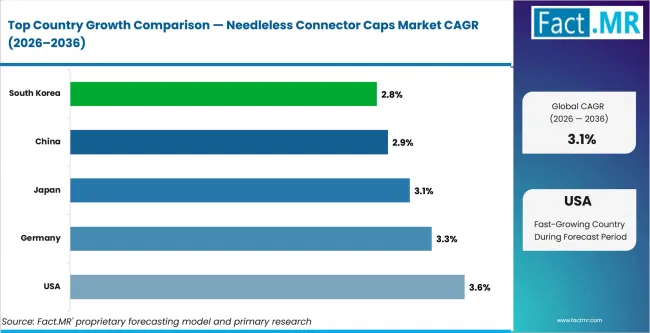
Needleless Connector Caps Market Cagr Analysis By Country | Source: Fact.MR
Why does the United States remain the largest market?
3.6% CAGR, supported by comprehensive catheter care programs
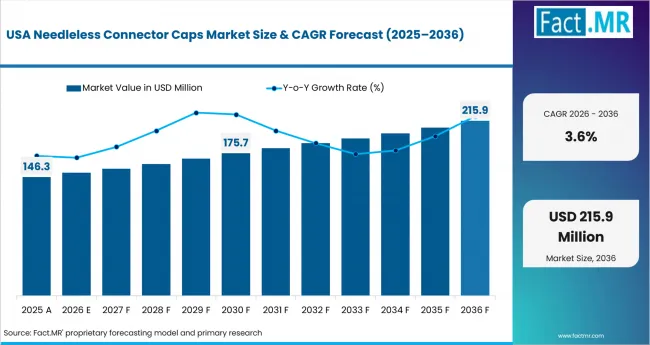
Needleless Connector Caps Market Country Value Analysis | Source: Fact.MR
The United States is projected to expand at a 3.6% CAGR through 2036 because hospitals have well established bloodstream infection prevention protocols. Healthcare providers routinely use disinfecting caps to improve catheter care across critical care and infusion settings. Demand is also supported by high volumes of central line procedures. Clinical guidelines continue encouraging consistent catheter disinfection practices. The country is expected to maintain its leadership throughout the forecast period.
What is supporting steady demand in Germany?
3.3% CAGR, backed by strong hospital infection control
Germany is expected to grow at a 3.3% CAGR because hospitals continue expanding the use of disinfecting connector caps. Healthcare providers place strong emphasis on reducing healthcare associated infections through standardized catheter care. Growing adoption of advanced vascular access products also supports market demand. Hospital quality improvement programs continue encouraging product use. Germany remains one of the leading European markets.
How is Japan strengthening vascular access safety?
3.1% CAGR, driven by long-term infusion care
Japan is forecast to register a 3.1% CAGR by 2036 because hospitals continue increasing the use of needleless connector caps across healthcare facilities. Long-term infusion therapy and an aging population support steady demand for infection prevention products. Healthcare providers continue improving catheter maintenance practices. This supports stable market growth throughout the forecast period.
Why is China becoming an attractive growth market?
2.9% CAGR, supported by expanding healthcare capacity
China is projected to expand at a 2.9% CAGR because investment in hospital infrastructure and modern infusion services continues increasing. More healthcare facilities are adopting infection prevention products as clinical standards improve. Demand is rising across tertiary hospitals and large urban healthcare centers. Continued healthcare investment supports long-term market expansion.
How is South Korea advancing catheter care practices?
2.8% CAGR, supported by modern healthcare services
South Korea is expected to record a 2.8% CAGR through 2036 because hospitals continue strengthening infection prevention through improved vascular access management. Healthcare providers are adopting disposable catheter care products to improve patient safety. Growth is also supported by expanding intensive care services. Rising awareness of bloodstream infection prevention continues supporting product demand. The country continues building demand for advanced vascular access products.
How are companies competing in the needleless connector caps market?
Solventum / Curos, ICU Medical, BD, B. Braun, Merit Medical lead the market
Competition is focused on infection prevention performance and product ease of use. Manufacturers continue improving disinfecting cap designs that simplify catheter care while reducing contamination risk. Product development also emphasizes compatibility with a broad range of needleless connectors.
Hospitals remain the largest customer group because they perform the highest number of vascular access procedures. Outpatient infusion centers are steadily increasing purchases as more therapies shift beyond traditional hospital settings. Home infusion providers also represent a growing source of demand. Central line applications continue generating the largest share of product demand because they require strict infection prevention throughout treatment. Peripheral IV therapy and dialysis access also support steady product consumption across healthcare facilities.
Solventum / Curos and ICU Medical continue strengthening their positions through infection prevention technologies and vascular access solutions. B. Braun continue expanding their portfolios through product improvements, broader distribution and clinical education programs. Companies that deliver dependable product quality and consistent clinical performance are expected to strengthen their market position through 2036.
Who are the leading companies in the Needleless Connector Caps Market?
Solventum / Curos, ICU Medical, BD, B. Braun, Merit Medical
- Solventum / Curos
- ICU Medical
- BD
- B. Braun
- Merit Medical
Bibliography
- ICU Medical, Inc. (2025, September 18). ICU Medical announces new FDA 510(k) cleared labeling claims for Clave™ portfolio of needlefree IV connectors with powerful new infection control data. ICU Medical.
- De Boer, K., Simpson, J., Sharma, P., & Steele, T. J. (2025, December 15). Enhancing safety in clinical practice: Cross-sectional, within-subjects, simulated-use compliance study using BD PosiFlush SafeScrub. JMIR Human Factors, 12, e78967.
- Serrano Díaz, L., Defilippo, B., Windpassinger, M., Maes, S., Gesto Lagüela, M. E., Steele, T. J., Serrano, J., & De Boer, K. (2026, February 26). The safety and efficacy of disinfection cap use in a real-world environment. Medical Devices: Evidence and Research, 19, 1–8.
- Solventum. (2026). 3M™ Curos™ Disinfecting Cap for Needleless Connectors. Solventum.
- ICU Medical, Inc. (2026). SwabCap™ disinfecting cap for needlefree connectors. ICU Medical.
- BD. (2026). PureHub™ Disinfecting Cap. BD.
- B. Braun. (2026). SwabCap® disinfecting cap for needleless connectors. B. Braun.
This Report Addresses
- Strategic assessment of needleless connector cap technologies.
- Analysis of cap type and connector compatibility trends.
- Evaluation of application and end-user demand.
- Regional outlook covering the United States, Germany, Japan, China, and South Korea.
- Competitive assessment of major vascular access manufacturers.
- Analysis of catheter care and bloodstream infection prevention trends.
- Evaluation of hospital purchasing and outpatient infusion growth.
- Primary interviews and supplier benchmarking supporting market estimates.
- Assessment of product innovation across disinfecting connector caps.
- Analysis of future opportunities across vascular access applications.
What does the needleless connector caps market cover?
Protective caps designed to disinfect needleless IV connectors.
The market covers disposable connector caps used to reduce microbial contamination during vascular access and infusion therapy.
Which products are included?
Needleless connector disinfection products.
The scope includes alcohol caps, CHG caps, passive disinfection caps, active scrubbing caps and cap strips.
What falls outside the scope?
Standard IV connectors without disinfection caps.
The scope excludes vascular catheters, infusion pumps, and conventional connector systems without protective caps.
What methodology supports this study?
100+ sources, 30+ company assessments, 25+ countries, and industry interviews.
- Primary Research:
- Interviews with infection prevention specialists, infusion nurses, hospital procurement teams and medical device manufacturers.
- Desk Research:
- Analysis of vascular access guidelines, catheter care protocols and healthcare investment.
- Market Sizing and Forecasting:
- Estimates based on catheter procedure volumes, disinfecting cap adoption and hospital purchasing trends.
- Data Validation and Update Cycle:
- Forecasts validated through supplier benchmarking and expert interviews.
Segmentation
What is the report's scope and coverage?
| Attribute | Details |
|---|---|
| Quantitative Units | USD Million in 2026 to USD Million by 2036 |
| Market Definition | Covers disposable disinfecting caps designed to protect needleless IV connectors from microbial contamination |
| Cap Types Covered | Alcohol Caps, CHG Caps, Passive Disinfection Caps, Active Scrubbing Caps, Cap Strips |
| Connector Compatibility Covered | Neutral Connectors, Positive Displacement, Negative Displacement, Split Septum, Extension-Set Connectors |
| Applications Covered | Central Lines, Peripheral IV Lines, Oncology Infusion, ICU Infusion, Dialysis Access |
| End Users Covered | Hospitals, Outpatient Infusion, Emergency Departments, Oncology Centers, Home Infusion |
| Regions Covered | North America, Western Europe, Asia Pacific, Latin America, Middle East & Africa |
| Key Countries Covered | United States, Germany, Japan, China, South Korea |
| Companies Covered | Solventum / Curos, ICU Medical, BD, B. Braun, Baxter, Merit Medical |
| Forecast Period | 2026 to 2036 |
| Research Approach | Hybrid top-down and bottom-up methodology using vascular access procedure volumes, catheter care practices and hospital purchasing analysis |
Source: Fact.MR analysis. Updated Jun 29, 2026
How is the market categorized?
-
By Cap Type
- Alcohol Caps
- CHG Caps
- Passive Disinfection Caps
- Active Scrubbing Caps
- Cap Strips
-
By Connector Compatibility
- Neutral Connectors
- Positive Displacement
- Negative Displacement
- Split Septum
- Extension-Set Connectors
-
By Application
- Central Lines
- Peripheral IV Lines
- Oncology Infusion
- ICU Infusion
- Dialysis Access
-
By End User
- Hospitals
- Outpatient Infusion
- Emergency Departments
- Oncology Centers
- Home Infusion
-
Region:
- North America
- United States
- Canada
- Europe
- Germany
- United Kingdom
- France
- Italy
- Spain
- Asia Pacific
- China
- Japan
- South Korea
- India
- Singapore
- Latin America
- Brazil
- Mexico
- Argentina
- Middle East & Africa
- GCC Countries
- South Africa
- Israel
- North America
Frequently Asked Questions
Which cap type accounts for the largest market share?
Why do central line applications generate the highest demand?
What is driving market growth?
Which country expands fastest in the Needleless Connector Caps Market?
What is the biggest challenge for manufacturers?
Which end-user segment generates the highest demand?
Why are alcohol caps widely preferred?
How are home infusion services influencing demand?
What opportunities are emerging for manufacturers?
Why are healthcare providers adopting needleless connector caps?
Who worked on this report


Preview the report firsthand - request a free sample
Free SampleGet the brochure for pricing and purchase details
Download PDF