NIS2 & Cyber Resilience Act Compliance Services Market Size, Share, Growth and Forecast (2026 - 2036)
The NIS2 & Cyber Resilience Act Compliance Services Market is segmented by Service Type, by Compliance Area, by Customer Type, by Delivery Model, by End Use, by Enterprise Size, and Region. Forecast for 2026 to 2036.
What is the NIS2 & Cyber Resilience Act Compliance Services Market forecast to be worth by 2036?
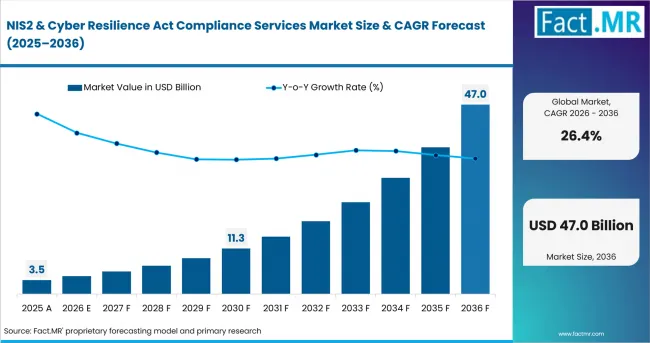
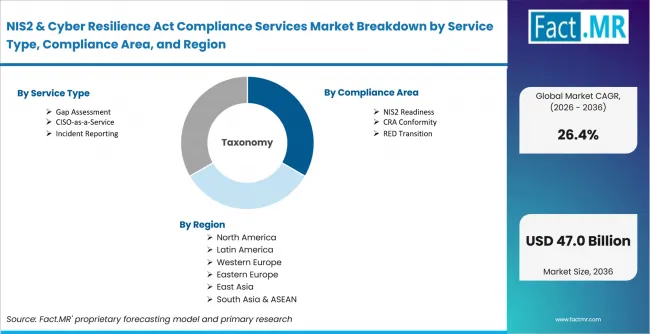
USD 4.50 billion in 2026 to USD 47.00 billion by 2036, at 26.4% CAGR.
- The NIS2 & cyber resilience act compliance services market crossed a valuation of USD 3.56 billion in 2025. Demand is expected to increase from USD 4.50 billion in 2026 to USD 47.00 billion by 2036.
- The market is forecast to record 26.4% CAGR during 2026 to 2036 as European Union cyber rules move from legal review to evidence-led implementation.
- The market's expansion is primarily attributed to the implementation phase of the EU's NIS2 Directive and Cyber Resilience Act, which is creating sustained demand for compliance advisory and product-security assessment services.
- As regulated entities move from regulatory preparation to evidence-based compliance programs, service providers are seeing increased engagement across gap analysis and CRA conformity assessment initiatives.
What are the defining numbers behind NIS2 and CRA services growth?
USD 42.50 billion absolute opportunity by 2036, led by Germany and Italy.
- Demand Drivers in the Market
- NIS2 readiness starts with entity classification, board accountability and a documented cyber risk management program.
- The Cyber Resilience Act adds connected-product obligations for vulnerability handling and conformity support.
- Incident reporting services gain budget because buyers must align internal response playbooks with regulator timelines.
- Product makers need software bill of materials support because connected-device evidence now affects European Union market access.
- Key Segments Analyzed
- By Service Type: Gap Assessment is expected to hold 30.0% share in 2026 because buyers need a practical starting point before remediation budgets are approved.
- By Compliance Area: NIS2 Readiness is projected to capture 46.0% share in 2026 because entity obligations are broader and earlier than full product conformity work.
- By Customer Type: Regulated Entities are likely to account for 52.0% share in 2026 as energy, health, transport and digital operators prepare supervisory evidence.
- By Delivery Model: Consulting-Led delivery is projected to hold 38.0% share in 2026 because buyers need legal-to-technical interpretation before tools can be specified.
- By End Use: Critical Infrastructure is expected to hold 35.0% share in 2026 because service continuity and incident reporting sit at the center of NIS2 planning.
- By Geography: Germany is projected to record 28.8% CAGR through 2036 as registration workflows and industrial compliance depth support higher service intensity.
- Analyst Opinion at Fact.MR
- Shambhu Nath Jha, Senior Analyst at Fact.MR, states, “NIS2 and the Cyber Resilience Act are turning cyber compliance into an operating file that must survive regulator review. I see buyers asking one direct question first: can the provider convert legal duties into evidence that a board, auditor and product customer can read? Providers with incident reporting practice and product conformity depth have the clearest path to higher-value contracts.”
- Strategic Implications
- Regulated entities should classify scope before buying tools or managed cyber services.
- Product makers need vulnerability-handling evidence before Cyber Resilience Act reporting duties begin.
- Testing and certification providers should connect product conformity with cyber technical files.
- Advisory firms need repeatable evidence calendars to retain buyers after first gap assessments.
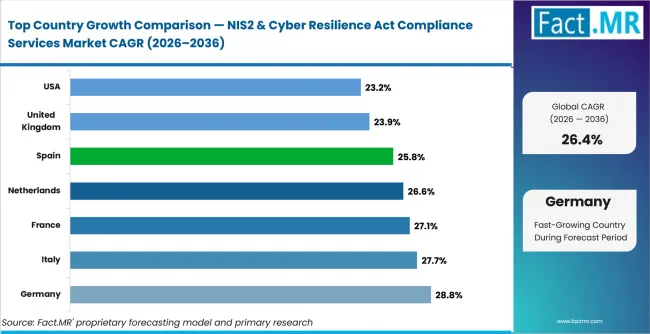
Germany is projected to record 28.8% CAGR through 2036 as national registration and reporting workflows expand. Italy is expected to post 27.7% CAGR because its National Cybersecurity Agency moved affected entities into a staged registration process. France is forecast to grow at 27.1% CAGR as cyber incident governance remains visible for public bodies and critical operators. The Netherlands is likely to advance at 26.6% CAGR as digital infrastructure buyers prepare supplier assurance files. Spain is set to record 25.8% CAGR as incident visibility pushes entities toward structured readiness work.
How does the NIS2 & Cyber Resilience Act Compliance Services Market break down by segment?
Gap Assessment leads at 30.0%; NIS2 Readiness leads at 46.0%.
Which service type leads?
Gap Assessment holds 30.0% share in 2026.
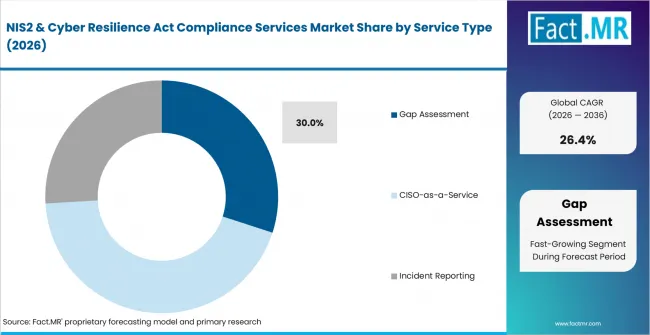
Gap Assessment leads because buyers need to know whether they are in scope and what must be fixed before a regulator asks for evidence. The work usually starts with entity classification, control mapping and remediation sequencing. Many buyers then add incident reporting drills and supplier assurance once the gap file has been accepted internally.
Which compliance area leads?
NIS2 Readiness holds 46.0% share in 2026.
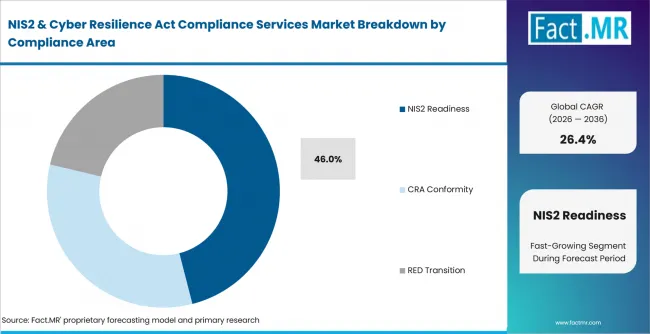
NIS2 Readiness leads because the directive affects more sectors and starts earlier than full Cyber Resilience Act product conformity. Digital infrastructure buyers also connect readiness with data center logical security when cloud and hosting services fall under stricter control evidence. This segment remains the first budget line for entities that need governance records before technical remediation.
Which customer type leads?
Regulated Entities hold 52.0% share in 2026.
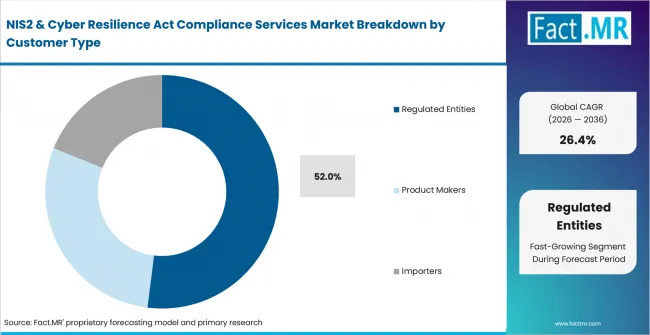
Regulated Entities lead because the direct buyer is often an operator of a covered or important service. These buyers need audit evidence for supervisory review and board oversight. The group includes energy, transport, health, finance, water, digital infrastructure and public administration entities.
Which delivery model leads?
Consulting-Led delivery holds 38.0% share in 2026.
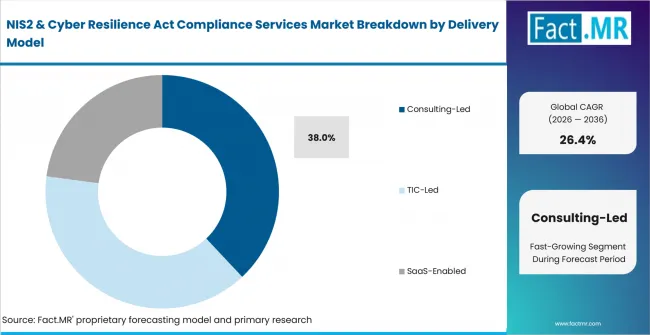
Consulting-Led delivery leads because the first spending wave is shaped by interpretation and implementation sequencing. Buyers need providers to define scope, map controls and assign responsibility before remediation begins. Some accounts add managed security services when internal teams cannot maintain evidence files across the year.
Which end use leads?
Critical Infrastructure holds 35.0% share in 2026.
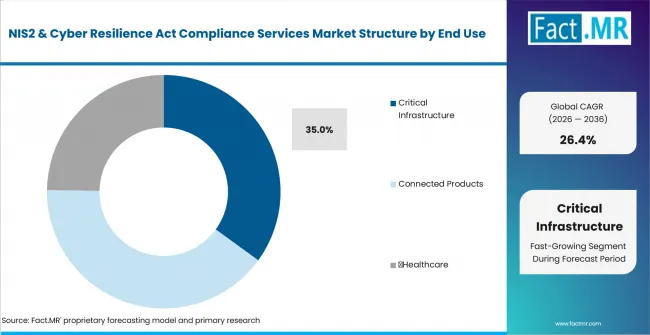
Critical Infrastructure leads early demand because continuity duties create direct management exposure. Incident reporting readiness is not only a technical exercise. It also requires escalation authority, service-impact assessment and evidence that suppliers understand their role during disruption. Product makers tied to automotive cyber security programs face similar proof expectations when connected components enter regulated supply chains.
What is accelerating NIS2 and CRA compliance demand, and what is holding it back?
National NIS2 enforcement and CRA reporting dates drive it; provider capacity restrains it.
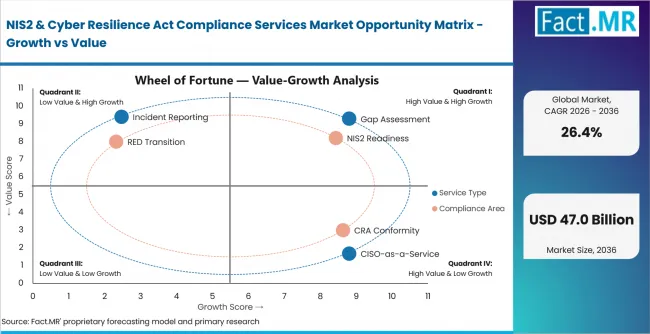
The main driver is the move from European Union legislation into national implementation. The European Commission sent reasoned opinions to 19 member states in May 2025 for failing to notify full NIS2 transposition. That step moved compliance from policy monitoring into country-level execution. Buyers now need scope checks, control registers and reporting routes that fit their competent authority.
The Cyber Resilience Act adds a second driver because manufacturers must prepare vulnerability handling and product documentation before September 2026 reporting duties begin. Services linked to agentic AI cybersecurity can be relevant when software behavior affects product risk classification. The main restraint is provider capacity because few suppliers combine legal interpretation, product-security testing and incident reporting practice.
Where do the biggest NIS2 and CRA compliance opportunities sit?
Entity classification, product conformity and recurring evidence maintenance.
- Entity Classification: Advisory firms can convert legal scope into board-approved compliance plans.
- Product Conformity: Testing bodies can support software bills of materials, vulnerability handling and technical files.
- Recurring Evidence: Managed providers can update compliance records after the first gap assessment is complete.
Which countries are scaling NIS2 and CRA compliance services fastest?
Germany 28.8%, Italy 27.7%, France 27.1%, the Netherlands 26.6%, Spain 25.8%, the United Kingdom 23.9%, the United States 23.2%.
Based on regional analysis, the NIS2 & Cyber Resilience Act Compliance Services Market is segmented into Europe, North America, Asia Pacific, Latin America, and Middle East and Africa.
.webp)
| Country | CAGR |
|---|---|
| Germany | 28.8% |
| Italy | 27.7% |
| France | 27.1% |
| Netherlands | 26.6% |
| Spain | 25.8% |
| United Kingdom | 23.9% |
| United States | 23.2% |

What is powering Germany’s lead?
28.8% CAGR, supported by BSI registration workflows and industrial compliance depth.
Germany starts from a large industrial base and a national cyber authority with established reporting infrastructure. The Federal Office for Information Security said new NIS2 duties apply from December 2025 through its portal route. Germany is projected to record 28.8% CAGR through 2036 because industrial operators need board evidence and supplier-risk controls. Providers with cyber services and product conformity depth are better placed because buyers often need one file for NIS2 governance and connected-product review.
Why is Italy moving quickly?
27.7% CAGR, supported by National Cybersecurity Agency registration and affected-entity scale.
Italy has a clear regulatory trigger because the National Cybersecurity Agency opened a staged registration process for NIS entities. The agency stated that more than 20,000 organizations were involved in the second implementation phase. Italy is expected to expand at 27.7% CAGR through 2036 as registration moves buyers from filing into remediation planning. The supplier opening is concentrated in managed support that turns registration data into controls and incident playbooks.
Why is France an important compliance market?
27.1% CAGR, supported by ANSSI incident workload and regulated-sector coordination.
French buyers tend to ask whether a compliance program can withstand public-sector and sectoral cyber review. The French Cybersecurity Agency processed 4,386 security events in 2024. France is forecast to grow at 27.1% CAGR through 2036 as authority-led cyber coordination keeps reporting evidence visible for boards. Secure external communication also supports readiness work where email encryption controls are linked to incident notification and supplier exchange.
What supports the Netherlands outlook?
26.6% CAGR, supported by digital infrastructure concentration and vulnerability notification duties.
The Netherlands matters because its digital infrastructure, logistics base and cloud-connected economy create dense supplier interdependence. The National Cyber Security Centre tells organizations to prepare for the Cyberbeveiligingswet and highlights registration, incident reporting and duty-of-care requirements. The Netherlands is expected to advance at 26.6% CAGR through 2036 as buyers ask for repeatable vulnerability handling and supplier assurance. Providers that connect CDN security with evidence files can serve cloud and content-delivery buyers.
How is Spain scaling compliance readiness?
25.8% CAGR, supported by incident visibility and industry-facing cyber support.
Spain’s compliance demand is shaped by incident visibility across companies, citizens and critical operators. The Spanish National Cybersecurity Institute managed 122,223 cybersecurity incidents in 2025. Spain is projected to rise at 25.8% CAGR through 2036 because incident-heavy operating conditions support demand for structured readiness files. Ransomware protection services can attach to compliance programs when buyers connect incident cleanup with NIS2 evidence.
Why does the United Kingdom remain relevant?
23.9% CAGR, supported by domestic cyber reform and European Union customer exposure.
United Kingdom buyers do not fall directly under European Union NIS2. Many suppliers still serve European regulated customers and connected-product channels. The Cyber Security and Resilience Bill proposes reforms to improve domestic defenses and protect critical public services. The United Kingdom is forecast at 23.9% CAGR through 2036 as suppliers map one control set to domestic rules and European Union evidence requests. Critical infrastructure protection is a useful related benchmark for regulated service continuity.
How does the United States shape global services demand?
23.2% CAGR, supported by product exports and European Union customer requirements.
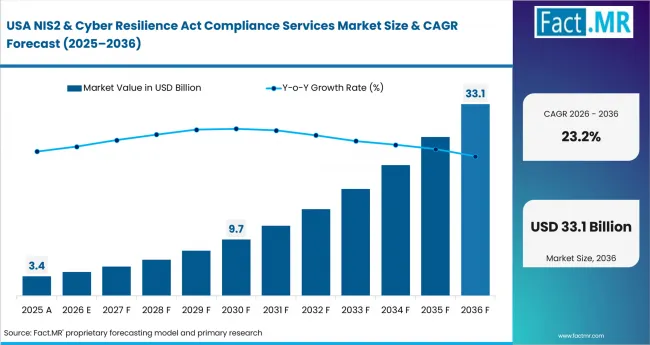
The United States is a supply-side market for this service category because many software and device vendors sell into Europe. The Federal Bureau of Investigation reported 859,532 internet crime complaints in 2024 and losses of USD 16.6 billion. The United States is expected to post 23.2% CAGR through 2036 as exporters prepare Cyber Resilience Act technical evidence for European access. Resilient networks also matter when cloud and device vendors serve regulated customers with service continuity requirements.
Who leads the NIS2 & Cyber Resilience Act Compliance Services landscape?
NCC Group, Bureau Veritas Cybersecurity and TÜV SÜD lead through advisory, testing and product-security depth.
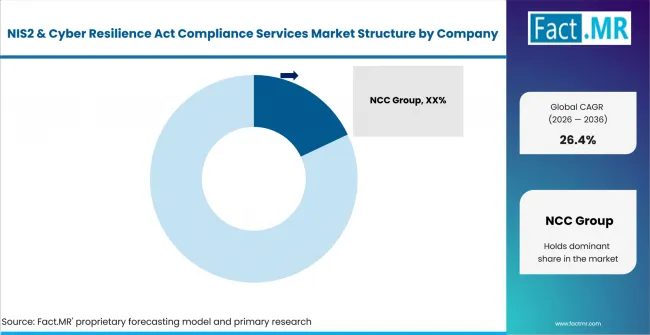
NIS2 and CRA compliance services are used by regulated entities, product makers and suppliers that need trusted evidence before supervisory review. NCC Group supports NIS2 readiness and practical implementation work. Bureau Veritas Cybersecurity brings Secura and Security Innovation into one cyber brand after the July 2025 launch. TÜV SÜD and TÜV Rheinland compete where testing, inspection and certification credibility is needed for connected-product evidence.
ONEKEY supports product makers through software bill of materials, firmware analysis and CRA reporting support. Deloitte and EY compete through enterprise governance, regulatory mapping and board-level compliance programs. Buyers that operate regulated transport systems may also connect readiness with railway cyber security when operational technology sits inside service continuity plans.
Competition through 2036 depends on whether providers can connect legal interpretation with technical proof. Advisory-only providers can win early scope work. Providers that can maintain annual evidence files, incident playbooks and product-security documentation are expected to retain larger accounts.
Which companies are the key players?
NCC Group, Bureau Veritas Cybersecurity, TÜV SÜD, TÜV Rheinland, ONEKEY, Deloitte and EY.
- NCC Group
- Bureau Veritas Cybersecurity
- TÜV SÜD
- TÜV Rheinland
- ONEKEY
- Deloitte
- EY
Bibliography
- [1] European Commission. (2026, January 20). NIS2 Directive: Securing network and information systems.
- [2] European Commission. (2025, May 7). Commission calls on 19 Member States to fully transpose the NIS2 Directive.
- [3] European Commission. (2025, December 3). Cyber Resilience Act.
- [4] European Commission. (2026, April 23). Cyber Resilience Act: Reporting obligations.
- [5] European Union. (2024, October 17). Commission Implementing Regulation (EU) 2024/2690 of 17 October 2024 laying down rules for the application of Directive (EU) 2022/2555.
- [6] Federal Office for Information Security. (2025, December 5). NIS-2-Umsetzungsgesetz ab morgen in Kraft.
- [7] Agenzia per la Cybersicurezza Nazionale. (2025, March 13). NIS, avviata la seconda fase.
- [8] Agence nationale de la sécurité des systèmes d’information. (2025, March 11). Panorama de la cybermenace 2024.
- [9] National Cyber Security Centre. (2026). Cyberbeveiligingswet (NIS2).
- [10] Instituto Nacional de Ciberseguridad. (2026, February 9). Balance de ciberseguridad 2025.
- [11] Department for Science, Innovation and Technology. (2026, April 30). Cyber security breaches survey 2025/2026.
- [12] Federal Bureau of Investigation. (2025). 2024 IC3 annual report.
- [13] Fox-IT. (2025, April 16). The NIS2 Directive: Key considerations & practical steps to achieve NIS2 compliance.
- [14] Bureau Veritas. (2025, July 1). Launch of “Bureau Veritas Cybersecurity”.
- [15] TÜV SÜD. (2025, February 18). Focus on cybersecurity and current EU regulations.
- [16] Sommer, T. (2026, February 5). Cyber Resilience Act enters phase 1: Reporting requirements for manufacturers begin in 2026. ONEKEY.
- [17] Deloitte Belgium. (2025, August 18). Navigating the EU Cyber Resilience Act: A strategic guide to compliance, risk mitigation, and competitive advantage.
- [18] Scheelen, Y., & Boel, L. (2026, March 3). How the Cyber Resilience Act raises the bar for digital product security. EY Belgium.
This Report Addresses
- Strategic intelligence on NIS2 and Cyber Resilience Act services across service type, compliance area and customer type.
- Segment analysis covering Gap Assessment, NIS2 Readiness, Regulated Entities, Consulting-Led delivery and Critical Infrastructure.
- Regional outlook covering Germany, Italy, France, the Netherlands, Spain, the United Kingdom and the United States.
- Competitive analysis of NCC Group, Bureau Veritas Cybersecurity, TÜV SÜD, TÜV Rheinland, ONEKEY, Deloitte and EY.
- Service assessment covering entity classification, incident reporting readiness, product conformity and managed compliance support.
- Regulatory assessment covering NIS2, the Cyber Resilience Act, the Radio Equipment Directive and the Digital Operational Resilience Act overlap.
- Primary interviews, provider checks, official source review and regulatory deadline tracking support the forecast.
What does the NIS2 & Cyber Resilience Act Compliance Services Market cover?
Compliance evidence, incident-readiness and product-security support for NIS2 entities and connected-product manufacturers.
The NIS2 & Cyber Resilience Act Compliance Services Market covers consulting, assessment, testing and managed compliance support tied to the European Union Network and Information Systems Directive 2 and the Cyber Resilience Act. It includes gap assessment and chief information security officer-as-a-service. It also includes incident reporting readiness, product-security conformity support, vulnerability handling and audit evidence preparation.
What is included in the scope?
NIS2 readiness, CRA conformity support and recurring compliance evidence maintenance.
The scope includes entity classification, cyber risk management gap assessment and board accountability support. It covers incident reporting workflows, supplier-risk control mapping and tabletop exercises. It includes Cyber Resilience Act product-security assessment, technical documentation, software bill of materials review and conformity preparation.
What is excluded from the scope?
General cyber software and legal advice without technical compliance evidence.
The scope excludes general cyber tools sold without NIS2 or Cyber Resilience Act compliance support. It excludes managed detection and response contracts unless they include compliance reporting and evidence work. It excludes legal advice that does not convert obligations into controls, technical files or audit records.
How was the analysis built?
100+ sources, 55+ provider portfolios, 30+ countries, 25+ expert checks.
- Primary Research:
- Primary research includes interviews with cyber compliance consultants, product-security leads, testing bodies and enterprise risk teams.
- Desk Research:
- Desk research reviews European Union regulation pages, national cybersecurity authority updates and company service pages.
- Market-Sizing and Forecasting:
- Forecasting uses affected-entity base, product-maker base and average service intensity.
- Data Validation and Update Cycle:
- Forecasts are validated through provider checks, official deadline tracking and service-line changes.
What is the report’s scope and coverage?
| Attribute | Details |
|---|---|
| Quantitative Units | USD Billion in 2026 to USD Billion by 2036 at CAGR |
| Market Definition | Compliance, readiness, reporting and product-security services tied to NIS2 and the Cyber Resilience Act |
| Service Type | Gap Assessment, CISO-as-a-Service, Incident Reporting, Product Security, Audit Support |
| Compliance Area | NIS2 Readiness, CRA Conformity, RED Transition, DORA Alignment, Supplier Assurance |
| Customer Type | Regulated Entities, Product Makers, Importers, Distributors, ICT Providers |
| Delivery Model | Consulting-Led, TIC-Led, SaaS-Enabled, Managed Support, Legal-Technical |
| End Use | Critical Infrastructure, Connected Products, Digital Infrastructure, Healthcare, Manufacturing |
| Enterprise Size | Large Enterprises, Mid-Market, SMEs, Public Bodies, Product Startups |
| Regions Covered | Europe, North America, Asia Pacific, Latin America, Middle East and Africa |
| Countries Covered | Germany, Italy, France, Netherlands, Spain, United Kingdom, United States |
| Key Companies Profiled | NCC Group, Bureau Veritas Cybersecurity, TÜV SÜD, TÜV Rheinland, ONEKEY, Deloitte and EY |
| Forecast Period | 2026 to 2036 |
| Approach | Hybrid top-down and bottom-up approach using regulated-entity count, connected-product maker base, compliance intensity, provider capacity and official deadline validation |
How is the market segmented?
-
By Service Type:
- Gap Assessment
- CISO-as-a-Service
- Incident Reporting
- Product Security
- Audit Support
-
By Compliance Area:
- NIS2 Readiness
- CRA Conformity
- RED Transition
- DORA Alignment
- Supplier Assurance
-
By Customer Type:
- Regulated Entities
- Product Makers
- Importers
- Distributors
- ICT Providers
-
By Delivery Model:
- Consulting-Led
- TIC-Led
- SaaS-Enabled
- Managed Support
- Legal-Technical
-
By End Use:
- Critical Infrastructure
- Connected Products
- Digital Infrastructure
- Healthcare
- Manufacturing
-
By Enterprise Size:
- Large Enterprises
- Mid-Market
- SMEs
- Public Bodies
- Product Startups
-
By Region:
- North America
- United States
- Canada
- Mexico
- Latin America
- Brazil
- Argentina
- Rest of Latin America
- Europe
- Germany
- United Kingdom
- France
- Italy
- Spain
- Rest of Europe
- Asia Pacific
- China
- India
- Japan
- South Korea
- ASEAN
- Middle East & Africa
- GCC Countries
- South Africa
- UAE
- Rest of Middle East & Africa
- North America
- Frequently Asked Questions -
How should buyers understand the current position of the NIS2 & Cyber Resilience Act Compliance Services Market?
The market is estimated to be an active compliance category as European cyber rules move into implementation.
How is this market expected to develop through the forecast period?
The market is projected to expand as buyers need repeat evidence for boards, regulators and product customers.
What growth pattern is expected for NIS2 and CRA compliance services?
The market is forecast to advance faster than general cyber advisory because legal duties now require technical proof.
Which service type has the clearest early lead?
Gap Assessment leads because buyers need scope checks and control gaps before remediation spending is approved.
Which compliance area creates the first spending wave?
NIS2 Readiness creates the first spending wave because entity obligations arrive before full connected-product conformity work.
Which buyer group is most active in this market?
Regulated Entities are the main buyers because they carry direct supervisory exposure and board accountability.
Which delivery model is preferred in early projects?
Consulting-Led delivery is preferred because buyers need legal-to-technical interpretation before tools are specified.
Why does Critical Infrastructure matter in this market?
Critical Infrastructure matters because service continuity and incident reporting sit at the center of NIS2 planning.
Which country shows the strongest pull for NIS2 and CRA compliance services?
Germany shows the strongest pull because registration workflows and industrial compliance depth support higher service intensity.
How does Italy support demand in this market?
Italy supports demand because staged registration moves affected entities into active remediation planning.
How does France fit into the compliance services outlook?
France is important because incident governance keeps cyber evidence visible for public bodies and critical operators.
What supports demand for NIS2 and CRA compliance services?
Demand is supported by buyers that need to convert legal duties into evidence regulators can review.
What limits wider use of these services?
Wider use is constrained by provider capacity and the shortage of suppliers with product-security depth.
Why are product makers important in this market?
Product makers are important because the Cyber Resilience Act turns vulnerability handling into a market-access requirement.
Table of Content
- Executive Summary
- Demand to side Trends
- Supply to side Trends
- Technology Roadmap Analysis
- Analysis and Recommendations
- Market Definition / Scope / Limitations
- Research Methodology
- Chapter Orientation
- Analytical Lens and Working Hypotheses
- Market Structure, Signals, and Trend Drivers
- Benchmarking and Cross-market Comparability
- Market Sizing, Forecasting, and Opportunity Mapping
- Research Design and Evidence Framework
- Desk Research Programme (Secondary Evidence)
- Company Annual and Sustainability Reports
- Peer-reviewed Journals and Academic Literature
- Corporate Websites, Product Literature, and Technical Notes
- Earnings Decks and Investor Briefings
- Statutory Filings and Regulatory Disclosures
- Technical White Papers and Standards Notes
- Trade Journals, Industry Magazines, and Analyst Briefs
- Conference Proceedings, Webinars, and Seminar Materials
- Subscription Datasets and Paid Sources
- Social Channels, Communities, and Digital Listening Inputs
- Additional Desk Sources
- Expert Input and Fieldwork (Primary Evidence)
- Primary Modes
- Qualitative Interviews and Expert Elicitation
- Quantitative Surveys and Structured Data Capture
- Blended Approach
- Why Primary Evidence is Used
- Field Techniques
- Interviews
- Surveys
- Focus Groups
- Observational and In-context Research
- Social and Community Interactions
- Stakeholder Universe Engaged
- C-suite Leaders
- Board Members
- Presidents and Vice Presidents
- R&D and Innovation Heads
- Technical Specialists
- Domain Subject-matter Experts
- Scientists
- Physicians and Other Healthcare Professionals
- Governance, Ethics, and Data Stewardship
- Research Ethics
- Data Integrity and Handling
- Primary Modes
- Tooling, Models, and Reference Databases
- Desk Research Programme (Secondary Evidence)
- Data Engineering and Model Build
- Data Acquisition and Ingestion
- Cleaning, Normalisation, and Verification
- Synthesis, Triangulation, and Analysis
- Quality Assurance and Audit Trail
- Market Background
- Market Dynamics
- Drivers
- Restraints
- Opportunity
- Trends
- Scenario Forecast
- Demand in Optimistic Scenario
- Global Market Analysis 2021 to 2025 and Forecast, 2026 to 2036
- Historical Market Size Value (USD Million) Analysis, 2021 to 2025
- Current and Future Market Size Value (USD Million) Projections, 2026 to 2036
- Y to o to Y Growth Trend Analysis
- Absolute $ Opportunity Analysis
- Global Market Pricing Analysis 2021 to 2025 and Forecast 2026 to 2036
- Global Market Analysis 2021 to 2025 and Forecast 2026 to 2036, By Service Type
- Introduction / Key Findings
- Historical Market Size Value (USD Million) Analysis By Service Type , 2021 to 2025
- Current and Future Market Size Value (USD Million) Analysis and Forecast By Service Type , 2026 to 2036
- Gap Assessment
- CISO-as-a-Service
- Incident Reporting
- Gap Assessment
- Y to o to Y Growth Trend Analysis By Service Type , 2021 to 2025
- Absolute $ Opportunity Analysis By Service Type , 2026 to 2036
- Global Market Analysis 2021 to 2025 and Forecast 2026 to 2036, By Compliance Area
- Introduction / Key Findings
- Historical Market Size Value (USD Million) Analysis By Compliance Area, 2021 to 2025
- Current and Future Market Size Value (USD Million) Analysis and Forecast By Compliance Area, 2026 to 2036
- NIS2 Readiness
- CRA Conformity
- RED Transition
- NIS2 Readiness
- Y to o to Y Growth Trend Analysis By Compliance Area, 2021 to 2025
- Absolute $ Opportunity Analysis By Compliance Area, 2026 to 2036
- Global Market Analysis 2021 to 2025 and Forecast 2026 to 2036, By Customer Type
- Introduction / Key Findings
- Historical Market Size Value (USD Million) Analysis By Customer Type, 2021 to 2025
- Current and Future Market Size Value (USD Million) Analysis and Forecast By Customer Type, 2026 to 2036
- Regulated Entities
- Product Makers
- Importers
- Regulated Entities
- Y to o to Y Growth Trend Analysis By Customer Type, 2021 to 2025
- Absolute $ Opportunity Analysis By Customer Type, 2026 to 2036
- Global Market Analysis 2021 to 2025 and Forecast 2026 to 2036, By Delivery Model:
- Introduction / Key Findings
- Historical Market Size Value (USD Million) Analysis By Delivery Model:, 2021 to 2025
- Current and Future Market Size Value (USD Million) Analysis and Forecast By Delivery Model:, 2026 to 2036
- Consulting-Led
- TIC-Led
- SaaS-Enabled
- Consulting-Led
- Y to o to Y Growth Trend Analysis By Delivery Model:, 2021 to 2025
- Absolute $ Opportunity Analysis By Delivery Model:, 2026 to 2036
- Global Market Analysis 2021 to 2025 and Forecast 2026 to 2036, By End Use
- Introduction / Key Findings
- Historical Market Size Value (USD Million) Analysis By End Use, 2021 to 2025
- Current and Future Market Size Value (USD Million) Analysis and Forecast By End Use, 2026 to 2036
- Critical Infrastructure
- Connected Products
- Healthcare
- Critical Infrastructure
- Y to o to Y Growth Trend Analysis By End Use, 2021 to 2025
- Absolute $ Opportunity Analysis By End Use, 2026 to 2036
- Global Market Analysis 2021 to 2025 and Forecast 2026 to 2036, By Region
- Introduction
- Historical Market Size Value (USD Million) Analysis By Region, 2021 to 2025
- Current Market Size Value (USD Million) Analysis and Forecast By Region, 2026 to 2036
- North America
- Latin America
- Western Europe
- Eastern Europe
- East Asia
- South Asia and Pacific
- Middle East & Africa
- Market Attractiveness Analysis By Region
- North America Market Analysis 2021 to 2025 and Forecast 2026 to 2036, By Country
- Historical Market Size Value (USD Million) Trend Analysis By Market Taxonomy, 2021 to 2025
- Market Size Value (USD Million) Forecast By Market Taxonomy, 2026 to 2036
- By Country
- USA
- Canada
- Mexico
- By Service Type
- By Compliance Area
- By Customer Type
- By Delivery Model:
- By End Use
- By Country
- Market Attractiveness Analysis
- By Country
- By Service Type
- By Compliance Area
- By Customer Type
- By Delivery Model:
- By End Use
- Key Takeaways
- Latin America Market Analysis 2021 to 2025 and Forecast 2026 to 2036, By Country
- Historical Market Size Value (USD Million) Trend Analysis By Market Taxonomy, 2021 to 2025
- Market Size Value (USD Million) Forecast By Market Taxonomy, 2026 to 2036
- By Country
- Brazil
- Chile
- Rest of Latin America
- By Service Type
- By Compliance Area
- By Customer Type
- By Delivery Model:
- By End Use
- By Country
- Market Attractiveness Analysis
- By Country
- By Service Type
- By Compliance Area
- By Customer Type
- By Delivery Model:
- By End Use
- Key Takeaways
- Western Europe Market Analysis 2021 to 2025 and Forecast 2026 to 2036, By Country
- Historical Market Size Value (USD Million) Trend Analysis By Market Taxonomy, 2021 to 2025
- Market Size Value (USD Million) Forecast By Market Taxonomy, 2026 to 2036
- By Country
- Germany
- UK
- Italy
- Spain
- France
- Nordic
- BENELUX
- Rest of Western Europe
- By Service Type
- By Compliance Area
- By Customer Type
- By Delivery Model:
- By End Use
- By Country
- Market Attractiveness Analysis
- By Country
- By Service Type
- By Compliance Area
- By Customer Type
- By Delivery Model:
- By End Use
- Key Takeaways
- Eastern Europe Market Analysis 2021 to 2025 and Forecast 2026 to 2036, By Country
- Historical Market Size Value (USD Million) Trend Analysis By Market Taxonomy, 2021 to 2025
- Market Size Value (USD Million) Forecast By Market Taxonomy, 2026 to 2036
- By Country
- Russia
- Poland
- Hungary
- Balkan & Baltic
- Rest of Eastern Europe
- By Service Type
- By Compliance Area
- By Customer Type
- By Delivery Model:
- By End Use
- By Country
- Market Attractiveness Analysis
- By Country
- By Service Type
- By Compliance Area
- By Customer Type
- By Delivery Model:
- By End Use
- Key Takeaways
- East Asia Market Analysis 2021 to 2025 and Forecast 2026 to 2036, By Country
- Historical Market Size Value (USD Million) Trend Analysis By Market Taxonomy, 2021 to 2025
- Market Size Value (USD Million) Forecast By Market Taxonomy, 2026 to 2036
- By Country
- China
- Japan
- South Korea
- By Service Type
- By Compliance Area
- By Customer Type
- By Delivery Model:
- By End Use
- By Country
- Market Attractiveness Analysis
- By Country
- By Service Type
- By Compliance Area
- By Customer Type
- By Delivery Model:
- By End Use
- Key Takeaways
- South Asia and Pacific Market Analysis 2021 to 2025 and Forecast 2026 to 2036, By Country
- Historical Market Size Value (USD Million) Trend Analysis By Market Taxonomy, 2021 to 2025
- Market Size Value (USD Million) Forecast By Market Taxonomy, 2026 to 2036
- By Country
- India
- ASEAN
- Australia & New Zealand
- Rest of South Asia and Pacific
- By Service Type
- By Compliance Area
- By Customer Type
- By Delivery Model:
- By End Use
- By Country
- Market Attractiveness Analysis
- By Country
- By Service Type
- By Compliance Area
- By Customer Type
- By Delivery Model:
- By End Use
- Key Takeaways
- Middle East & Africa Market Analysis 2021 to 2025 and Forecast 2026 to 2036, By Country
- Historical Market Size Value (USD Million) Trend Analysis By Market Taxonomy, 2021 to 2025
- Market Size Value (USD Million) Forecast By Market Taxonomy, 2026 to 2036
- By Country
- Kingdom of Saudi Arabia
- Other GCC Countries
- Turkiye
- South Africa
- Other African Union
- Rest of Middle East & Africa
- By Service Type
- By Compliance Area
- By Customer Type
- By Delivery Model:
- By End Use
- By Country
- Market Attractiveness Analysis
- By Country
- By Service Type
- By Compliance Area
- By Customer Type
- By Delivery Model:
- By End Use
- Key Takeaways
- Key Countries Market Analysis
- USA
- Pricing Analysis
- Market Share Analysis, 2025
- By Service Type
- By Compliance Area
- By Customer Type
- By Delivery Model:
- By End Use
- Canada
- Pricing Analysis
- Market Share Analysis, 2025
- By Service Type
- By Compliance Area
- By Customer Type
- By Delivery Model:
- By End Use
- Mexico
- Pricing Analysis
- Market Share Analysis, 2025
- By Service Type
- By Compliance Area
- By Customer Type
- By Delivery Model:
- By End Use
- Brazil
- Pricing Analysis
- Market Share Analysis, 2025
- By Service Type
- By Compliance Area
- By Customer Type
- By Delivery Model:
- By End Use
- Chile
- Pricing Analysis
- Market Share Analysis, 2025
- By Service Type
- By Compliance Area
- By Customer Type
- By Delivery Model:
- By End Use
- Germany
- Pricing Analysis
- Market Share Analysis, 2025
- By Service Type
- By Compliance Area
- By Customer Type
- By Delivery Model:
- By End Use
- UK
- Pricing Analysis
- Market Share Analysis, 2025
- By Service Type
- By Compliance Area
- By Customer Type
- By Delivery Model:
- By End Use
- Italy
- Pricing Analysis
- Market Share Analysis, 2025
- By Service Type
- By Compliance Area
- By Customer Type
- By Delivery Model:
- By End Use
- Spain
- Pricing Analysis
- Market Share Analysis, 2025
- By Service Type
- By Compliance Area
- By Customer Type
- By Delivery Model:
- By End Use
- France
- Pricing Analysis
- Market Share Analysis, 2025
- By Service Type
- By Compliance Area
- By Customer Type
- By Delivery Model:
- By End Use
- India
- Pricing Analysis
- Market Share Analysis, 2025
- By Service Type
- By Compliance Area
- By Customer Type
- By Delivery Model:
- By End Use
- ASEAN
- Pricing Analysis
- Market Share Analysis, 2025
- By Service Type
- By Compliance Area
- By Customer Type
- By Delivery Model:
- By End Use
- Australia & New Zealand
- Pricing Analysis
- Market Share Analysis, 2025
- By Service Type
- By Compliance Area
- By Customer Type
- By Delivery Model:
- By End Use
- China
- Pricing Analysis
- Market Share Analysis, 2025
- By Service Type
- By Compliance Area
- By Customer Type
- By Delivery Model:
- By End Use
- Japan
- Pricing Analysis
- Market Share Analysis, 2025
- By Service Type
- By Compliance Area
- By Customer Type
- By Delivery Model:
- By End Use
- South Korea
- Pricing Analysis
- Market Share Analysis, 2025
- By Service Type
- By Compliance Area
- By Customer Type
- By Delivery Model:
- By End Use
- Russia
- Pricing Analysis
- Market Share Analysis, 2025
- By Service Type
- By Compliance Area
- By Customer Type
- By Delivery Model:
- By End Use
- Poland
- Pricing Analysis
- Market Share Analysis, 2025
- By Service Type
- By Compliance Area
- By Customer Type
- By Delivery Model:
- By End Use
- Hungary
- Pricing Analysis
- Market Share Analysis, 2025
- By Service Type
- By Compliance Area
- By Customer Type
- By Delivery Model:
- By End Use
- Kingdom of Saudi Arabia
- Pricing Analysis
- Market Share Analysis, 2025
- By Service Type
- By Compliance Area
- By Customer Type
- By Delivery Model:
- By End Use
- Turkiye
- Pricing Analysis
- Market Share Analysis, 2025
- By Service Type
- By Compliance Area
- By Customer Type
- By Delivery Model:
- By End Use
- South Africa
- Pricing Analysis
- Market Share Analysis, 2025
- By Service Type
- By Compliance Area
- By Customer Type
- By Delivery Model:
- By End Use
- USA
- Market Structure Analysis
- Competition Dashboard
- Competition Benchmarking
- Market Share Analysis of Top Players
- By Regional
- By Service Type
- By Compliance Area
- By Customer Type
- By Delivery Model:
- By End Use
- Competition Analysis
- Competition Deep Dive
- NCC Group
- Overview
- Product Portfolio
- Profitability by Market Segments (Product/Age /Sales Channel/Region)
- Sales Footprint
- Strategy Overview
- Marketing Strategy
- Product Strategy
- Channel Strategy
- Bureau Veritas Cybersecurity
- TÜV SÜD
- TÜV Rheinland
- ONEKEY
- Deloitte
- EY
- NCC Group
- Competition Deep Dive
- Market Dynamics
- Assumptions & Acronyms Used
List Of Table
- Table 1: Global Market Value (USD Million) Forecast by Region, 2021 to 2036
- Table 2: Global Market Value (USD Million) Forecast by Service Type , 2021 to 2036
- Table 3: Global Market Value (USD Million) Forecast by Compliance Area, 2021 to 2036
- Table 4: Global Market Value (USD Million) Forecast by Customer Type, 2021 to 2036
- Table 5: Global Market Value (USD Million) Forecast by Delivery Model:, 2021 to 2036
- Table 6: Global Market Value (USD Million) Forecast by End Use, 2021 to 2036
- Table 7: North America Market Value (USD Million) Forecast by Country, 2021 to 2036
- Table 8: North America Market Value (USD Million) Forecast by Service Type , 2021 to 2036
- Table 9: North America Market Value (USD Million) Forecast by Compliance Area, 2021 to 2036
- Table 10: North America Market Value (USD Million) Forecast by Customer Type, 2021 to 2036
- Table 11: North America Market Value (USD Million) Forecast by Delivery Model:, 2021 to 2036
- Table 12: North America Market Value (USD Million) Forecast by End Use, 2021 to 2036
- Table 13: Latin America Market Value (USD Million) Forecast by Country, 2021 to 2036
- Table 14: Latin America Market Value (USD Million) Forecast by Service Type , 2021 to 2036
- Table 15: Latin America Market Value (USD Million) Forecast by Compliance Area, 2021 to 2036
- Table 16: Latin America Market Value (USD Million) Forecast by Customer Type, 2021 to 2036
- Table 17: Latin America Market Value (USD Million) Forecast by Delivery Model:, 2021 to 2036
- Table 18: Latin America Market Value (USD Million) Forecast by End Use, 2021 to 2036
- Table 19: Western Europe Market Value (USD Million) Forecast by Country, 2021 to 2036
- Table 20: Western Europe Market Value (USD Million) Forecast by Service Type , 2021 to 2036
- Table 21: Western Europe Market Value (USD Million) Forecast by Compliance Area, 2021 to 2036
- Table 22: Western Europe Market Value (USD Million) Forecast by Customer Type, 2021 to 2036
- Table 23: Western Europe Market Value (USD Million) Forecast by Delivery Model:, 2021 to 2036
- Table 24: Western Europe Market Value (USD Million) Forecast by End Use, 2021 to 2036
- Table 25: Eastern Europe Market Value (USD Million) Forecast by Country, 2021 to 2036
- Table 26: Eastern Europe Market Value (USD Million) Forecast by Service Type , 2021 to 2036
- Table 27: Eastern Europe Market Value (USD Million) Forecast by Compliance Area, 2021 to 2036
- Table 28: Eastern Europe Market Value (USD Million) Forecast by Customer Type, 2021 to 2036
- Table 29: Eastern Europe Market Value (USD Million) Forecast by Delivery Model:, 2021 to 2036
- Table 30: Eastern Europe Market Value (USD Million) Forecast by End Use, 2021 to 2036
- Table 31: East Asia Market Value (USD Million) Forecast by Country, 2021 to 2036
- Table 32: East Asia Market Value (USD Million) Forecast by Service Type , 2021 to 2036
- Table 33: East Asia Market Value (USD Million) Forecast by Compliance Area, 2021 to 2036
- Table 34: East Asia Market Value (USD Million) Forecast by Customer Type, 2021 to 2036
- Table 35: East Asia Market Value (USD Million) Forecast by Delivery Model:, 2021 to 2036
- Table 36: East Asia Market Value (USD Million) Forecast by End Use, 2021 to 2036
- Table 37: South Asia and Pacific Market Value (USD Million) Forecast by Country, 2021 to 2036
- Table 38: South Asia and Pacific Market Value (USD Million) Forecast by Service Type , 2021 to 2036
- Table 39: South Asia and Pacific Market Value (USD Million) Forecast by Compliance Area, 2021 to 2036
- Table 40: South Asia and Pacific Market Value (USD Million) Forecast by Customer Type, 2021 to 2036
- Table 41: South Asia and Pacific Market Value (USD Million) Forecast by Delivery Model:, 2021 to 2036
- Table 42: South Asia and Pacific Market Value (USD Million) Forecast by End Use, 2021 to 2036
- Table 43: Middle East & Africa Market Value (USD Million) Forecast by Country, 2021 to 2036
- Table 44: Middle East & Africa Market Value (USD Million) Forecast by Service Type , 2021 to 2036
- Table 45: Middle East & Africa Market Value (USD Million) Forecast by Compliance Area, 2021 to 2036
- Table 46: Middle East & Africa Market Value (USD Million) Forecast by Customer Type, 2021 to 2036
- Table 47: Middle East & Africa Market Value (USD Million) Forecast by Delivery Model:, 2021 to 2036
- Table 48: Middle East & Africa Market Value (USD Million) Forecast by End Use, 2021 to 2036
List Of Figures
- Figure 1: Global Market Pricing Analysis
- Figure 2: Global Market Value (USD Million) Forecast 2021-2036
- Figure 3: Global Market Value Share and BPS Analysis by Service Type, 2026 and 2036
- Figure 4: Global Market Y-o-Y Growth Comparison by Service Type,2026 to 2036
- Figure 5: Global Market Attractiveness Analysis by Service Type
- Figure 6: Global Market Value Share and BPS Analysis by Compliance Area, 2026 and 2036
- Figure 7: Global Market Y-o-Y Growth Comparison by Compliance Area,2026 to 2036
- Figure 8: Global Market Attractiveness Analysis by Compliance Area
- Figure 9: Global Market Value Share and BPS Analysis by Customer Type, 2026 and 2036
- Figure 10: Global Market Y-o-Y Growth Comparison by Customer Type,2026 to 2036
- Figure 11: Global Market Attractiveness Analysis by Customer Type
- Figure 12: Global Market Value Share and BPS Analysis by Delivery Model:, 2026 and 2036
- Figure 13: Global Market Y-o-Y Growth Comparison by Delivery Model:,2026 to 2036
- Figure 14: Global Market Attractiveness Analysis by Delivery Model:
- Figure 15: Global Market Value Share and BPS Analysis by End Use, 2026 and 2036
- Figure 16: Global Market Y-o-Y Growth Comparison by End Use,2026 to 2036
- Figure 17: Global Market Attractiveness Analysis by End Use
- Figure 18: Global Market Value (USD Million) Share and BPS Analysis by Region, 2026 and 2036
- Figure 19: Global Market Y-o-Y Growth Comparison by Region,2026 to 2036
- Figure 20: Global Market Attractiveness Analysis by Region
- Figure 21: North America Market Incremental Dollar Opportunity,2026 to 2036
- Figure 22: Latin America Market Incremental Dollar Opportunity,2026 to 2036
- Figure 23: Western Europe Market Incremental Dollar Opportunity,2026 to 2036
- Figure 24: Eastern Europe Market Incremental Dollar Opportunity,2026 to 2036
- Figure 25: East Asia Market Incremental Dollar Opportunity,2026 to 2036
- Figure 26: South Asia and Pacific Market Incremental Dollar Opportunity,2026 to 2036
- Figure 27: Middle East & Africa Market Incremental Dollar Opportunity,2026 to 2036
- Figure 28: North America Market Value Share and BPS Analysis by Country, 2026 and 2036
- Figure 29: North America Market Value Share and BPS Analysis by Service Type, 2026 and 2036
- Figure 30: North America Market Y-o-Y Growth Comparison by Service Type,2026 to 2036
- Figure 31: North America Market Attractiveness Analysis by Service Type
- Figure 32: North America Market Value Share and BPS Analysis by Compliance Area, 2026 and 2036
- Figure 33: North America Market Y-o-Y Growth Comparison by Compliance Area,2026 to 2036
- Figure 34: North America Market Attractiveness Analysis by Compliance Area
- Figure 35: North America Market Value Share and BPS Analysis by Customer Type, 2026 and 2036
- Figure 36: North America Market Y-o-Y Growth Comparison by Customer Type,2026 to 2036
- Figure 37: North America Market Attractiveness Analysis by Customer Type
- Figure 38: North America Market Value Share and BPS Analysis by Delivery Model:, 2026 and 2036
- Figure 39: North America Market Y-o-Y Growth Comparison by Delivery Model:,2026 to 2036
- Figure 40: North America Market Attractiveness Analysis by Delivery Model:
- Figure 41: North America Market Value Share and BPS Analysis by End Use, 2026 and 2036
- Figure 42: North America Market Y-o-Y Growth Comparison by End Use,2026 to 2036
- Figure 43: North America Market Attractiveness Analysis by End Use
- Figure 44: Latin America Market Value Share and BPS Analysis by Country, 2026 and 2036
- Figure 45: Latin America Market Value Share and BPS Analysis by Service Type, 2026 and 2036
- Figure 46: Latin America Market Y-o-Y Growth Comparison by Service Type,2026 to 2036
- Figure 47: Latin America Market Attractiveness Analysis by Service Type
- Figure 48: Latin America Market Value Share and BPS Analysis by Compliance Area, 2026 and 2036
- Figure 49: Latin America Market Y-o-Y Growth Comparison by Compliance Area,2026 to 2036
- Figure 50: Latin America Market Attractiveness Analysis by Compliance Area
- Figure 51: Latin America Market Value Share and BPS Analysis by Customer Type, 2026 and 2036
- Figure 52: Latin America Market Y-o-Y Growth Comparison by Customer Type,2026 to 2036
- Figure 53: Latin America Market Attractiveness Analysis by Customer Type
- Figure 54: Latin America Market Value Share and BPS Analysis by Delivery Model:, 2026 and 2036
- Figure 55: Latin America Market Y-o-Y Growth Comparison by Delivery Model:,2026 to 2036
- Figure 56: Latin America Market Attractiveness Analysis by Delivery Model:
- Figure 57: Latin America Market Value Share and BPS Analysis by End Use, 2026 and 2036
- Figure 58: Latin America Market Y-o-Y Growth Comparison by End Use,2026 to 2036
- Figure 59: Latin America Market Attractiveness Analysis by End Use
- Figure 60: Western Europe Market Value Share and BPS Analysis by Country, 2026 and 2036
- Figure 61: Western Europe Market Value Share and BPS Analysis by Service Type, 2026 and 2036
- Figure 62: Western Europe Market Y-o-Y Growth Comparison by Service Type,2026 to 2036
- Figure 63: Western Europe Market Attractiveness Analysis by Service Type
- Figure 64: Western Europe Market Value Share and BPS Analysis by Compliance Area, 2026 and 2036
- Figure 65: Western Europe Market Y-o-Y Growth Comparison by Compliance Area,2026 to 2036
- Figure 66: Western Europe Market Attractiveness Analysis by Compliance Area
- Figure 67: Western Europe Market Value Share and BPS Analysis by Customer Type, 2026 and 2036
- Figure 68: Western Europe Market Y-o-Y Growth Comparison by Customer Type,2026 to 2036
- Figure 69: Western Europe Market Attractiveness Analysis by Customer Type
- Figure 70: Western Europe Market Value Share and BPS Analysis by Delivery Model:, 2026 and 2036
- Figure 71: Western Europe Market Y-o-Y Growth Comparison by Delivery Model:,2026 to 2036
- Figure 72: Western Europe Market Attractiveness Analysis by Delivery Model:
- Figure 73: Western Europe Market Value Share and BPS Analysis by End Use, 2026 and 2036
- Figure 74: Western Europe Market Y-o-Y Growth Comparison by End Use,2026 to 2036
- Figure 75: Western Europe Market Attractiveness Analysis by End Use
- Figure 76: Eastern Europe Market Value Share and BPS Analysis by Country, 2026 and 2036
- Figure 77: Eastern Europe Market Value Share and BPS Analysis by Service Type, 2026 and 2036
- Figure 78: Eastern Europe Market Y-o-Y Growth Comparison by Service Type,2026 to 2036
- Figure 79: Eastern Europe Market Attractiveness Analysis by Service Type
- Figure 80: Eastern Europe Market Value Share and BPS Analysis by Compliance Area, 2026 and 2036
- Figure 81: Eastern Europe Market Y-o-Y Growth Comparison by Compliance Area,2026 to 2036
- Figure 82: Eastern Europe Market Attractiveness Analysis by Compliance Area
- Figure 83: Eastern Europe Market Value Share and BPS Analysis by Customer Type, 2026 and 2036
- Figure 84: Eastern Europe Market Y-o-Y Growth Comparison by Customer Type,2026 to 2036
- Figure 85: Eastern Europe Market Attractiveness Analysis by Customer Type
- Figure 86: Eastern Europe Market Value Share and BPS Analysis by Delivery Model:, 2026 and 2036
- Figure 87: Eastern Europe Market Y-o-Y Growth Comparison by Delivery Model:,2026 to 2036
- Figure 88: Eastern Europe Market Attractiveness Analysis by Delivery Model:
- Figure 89: Eastern Europe Market Value Share and BPS Analysis by End Use, 2026 and 2036
- Figure 90: Eastern Europe Market Y-o-Y Growth Comparison by End Use,2026 to 2036
- Figure 91: Eastern Europe Market Attractiveness Analysis by End Use
- Figure 92: East Asia Market Value Share and BPS Analysis by Country, 2026 and 2036
- Figure 93: East Asia Market Value Share and BPS Analysis by Service Type, 2026 and 2036
- Figure 94: East Asia Market Y-o-Y Growth Comparison by Service Type,2026 to 2036
- Figure 95: East Asia Market Attractiveness Analysis by Service Type
- Figure 96: East Asia Market Value Share and BPS Analysis by Compliance Area, 2026 and 2036
- Figure 97: East Asia Market Y-o-Y Growth Comparison by Compliance Area,2026 to 2036
- Figure 98: East Asia Market Attractiveness Analysis by Compliance Area
- Figure 99: East Asia Market Value Share and BPS Analysis by Customer Type, 2026 and 2036
- Figure 100: East Asia Market Y-o-Y Growth Comparison by Customer Type,2026 to 2036
- Figure 101: East Asia Market Attractiveness Analysis by Customer Type
- Figure 102: East Asia Market Value Share and BPS Analysis by Delivery Model:, 2026 and 2036
- Figure 103: East Asia Market Y-o-Y Growth Comparison by Delivery Model:,2026 to 2036
- Figure 104: East Asia Market Attractiveness Analysis by Delivery Model:
- Figure 105: East Asia Market Value Share and BPS Analysis by End Use, 2026 and 2036
- Figure 106: East Asia Market Y-o-Y Growth Comparison by End Use,2026 to 2036
- Figure 107: East Asia Market Attractiveness Analysis by End Use
- Figure 108: South Asia and Pacific Market Value Share and BPS Analysis by Country, 2026 and 2036
- Figure 109: South Asia and Pacific Market Value Share and BPS Analysis by Service Type, 2026 and 2036
- Figure 110: South Asia and Pacific Market Y-o-Y Growth Comparison by Service Type,2026 to 2036
- Figure 111: South Asia and Pacific Market Attractiveness Analysis by Service Type
- Figure 112: South Asia and Pacific Market Value Share and BPS Analysis by Compliance Area, 2026 and 2036
- Figure 113: South Asia and Pacific Market Y-o-Y Growth Comparison by Compliance Area,2026 to 2036
- Figure 114: South Asia and Pacific Market Attractiveness Analysis by Compliance Area
- Figure 115: South Asia and Pacific Market Value Share and BPS Analysis by Customer Type, 2026 and 2036
- Figure 116: South Asia and Pacific Market Y-o-Y Growth Comparison by Customer Type,2026 to 2036
- Figure 117: South Asia and Pacific Market Attractiveness Analysis by Customer Type
- Figure 118: South Asia and Pacific Market Value Share and BPS Analysis by Delivery Model:, 2026 and 2036
- Figure 119: South Asia and Pacific Market Y-o-Y Growth Comparison by Delivery Model:,2026 to 2036
- Figure 120: South Asia and Pacific Market Attractiveness Analysis by Delivery Model:
- Figure 121: South Asia and Pacific Market Value Share and BPS Analysis by End Use, 2026 and 2036
- Figure 122: South Asia and Pacific Market Y-o-Y Growth Comparison by End Use,2026 to 2036
- Figure 123: South Asia and Pacific Market Attractiveness Analysis by End Use
- Figure 124: Middle East & Africa Market Value Share and BPS Analysis by Country, 2026 and 2036
- Figure 125: Middle East & Africa Market Value Share and BPS Analysis by Service Type, 2026 and 2036
- Figure 126: Middle East & Africa Market Y-o-Y Growth Comparison by Service Type,2026 to 2036
- Figure 127: Middle East & Africa Market Attractiveness Analysis by Service Type
- Figure 128: Middle East & Africa Market Value Share and BPS Analysis by Compliance Area, 2026 and 2036
- Figure 129: Middle East & Africa Market Y-o-Y Growth Comparison by Compliance Area,2026 to 2036
- Figure 130: Middle East & Africa Market Attractiveness Analysis by Compliance Area
- Figure 131: Middle East & Africa Market Value Share and BPS Analysis by Customer Type, 2026 and 2036
- Figure 132: Middle East & Africa Market Y-o-Y Growth Comparison by Customer Type,2026 to 2036
- Figure 133: Middle East & Africa Market Attractiveness Analysis by Customer Type
- Figure 134: Middle East & Africa Market Value Share and BPS Analysis by Delivery Model:, 2026 and 2036
- Figure 135: Middle East & Africa Market Y-o-Y Growth Comparison by Delivery Model:,2026 to 2036
- Figure 136: Middle East & Africa Market Attractiveness Analysis by Delivery Model:
- Figure 137: Middle East & Africa Market Value Share and BPS Analysis by End Use, 2026 and 2036
- Figure 138: Middle East & Africa Market Y-o-Y Growth Comparison by End Use,2026 to 2036
- Figure 139: Middle East & Africa Market Attractiveness Analysis by End Use
- Figure 140: Global Market - Tier Structure Analysis
- Figure 141: Global Market - Company Share Analysis