- Forecast Value (2036): 3.25 Bn
- CAGR (2036): 18.4%
What is the padel shoes market forecast to be worth by 2036?
USD 0.60 billion in 2026 to USD 3.25 billion by 2036, at 18.4% CAGR.
- The padel shoes market crossed a valuation of USD 0.51 billion in 2025.
- Demand is estimated to rise from USD 0.60 billion in 2026 to USD 3.25 billion by 2036.
- The market is forecast to record 18.4% CAGR during 2026 to 2036 as frequent club play increases replacement purchases and lifts demand for sport-specific footwear.
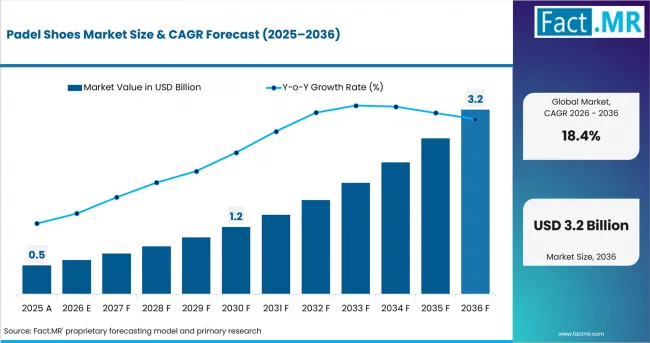
Padel Shoes Market Value Analysis | Source: Fact.MR
What are the defining numbers behind padel shoes growth?
USD 2.65 billion absolute opportunity by 2036. The United States, United Kingdom and Mexico lead the country CAGR view.
- Demand Drivers in the Market
- Club-court expansion is creating more first-time footwear purchases because coaches and pro shops can explain the difference between padel and tennis soles.
- Replacement buying is supported by artificial-turf abrasion, especially among players who compete weekly and need a stable grip profile.
- Brand investment is visible in padel lines from ASICS and adidas. Babolat and Bullpadel also sell padel-focused footwear. HEAD, Joma and NOX support the category through padel-specific products.
- Retail education matters because new players often compare mid-range padel shoes against tennis shoes before buying a sport-specific pair.
- Key Segments Analyzed
- By Player Type: Recreational Players are expected to account for 58.0% of market share in 2026, since most purchases still come from new club players and social-league participants.
- By Price Tier: Mid-Range shoes are projected to capture 47.0% share in 2026, reflecting buyer preference for padel-specific footwear before moving into premium models.
- By Court Surface: Sanded Turf is estimated to hold 46.0% share in 2026, owing to its large installed base across European padel clubs.
- By Outsole Type: Hybrid Outsole is likely to represent 41.0% share in 2026, supported by the need for slide control and quick stopping on artificial turf.
- By Distribution Channel: Multibrand E-Commerce is forecast to secure 40.0% share in 2026, as new players compare models and price bands online before purchase.
- By Gender: Men are anticipated to contribute 54.0% of 2026 revenue, reflecting the early player mix in several expanding padel countries.
- By Upper Construction: Reinforced Mesh is predicted to account for 39.0% share in 2026, because buyers want breathability without losing sidewall support.
- By Geography: The United States is projected to register 24.8% CAGR through 2036, supported by a young court base and low padel-shoe penetration.
- Analyst Opinion
- Shambhu Nath Jha, Senior Analyst at Fact.MR, states, "I see padel shoes moving from an accessory choice to a court-safety purchase. Buyers ask whether the outsole grips sanded turf. They also ask whether the upper holds during lateral stops and whether the brand understands club play."
- Strategic Implications
- Footwear brands should treat padel shoes as a replacement-led category rather than a one-time trial purchase.
- Retailers need clear surface guidance because players often confuse padel shoes with tennis shoes.
- Padel clubs can raise shop revenue by linking shoe fitting to coaching sessions and league registration.
- Suppliers should build separate price ladders for recreational players, club competitors and academy buyers.
Padel-specific footwear for artificial-turf courts forms the core of this market. The International Padel Federation said active players surpassed 35 million in 2025, supporting footwear demand as club play expands. These signals support demand for shoes built around slide control, turf grip and lateral stability.
The United States is projected to record 24.8% CAGR through 2036 as new club openings and low padel-shoe penetration support first-pair conversion. The United Kingdom is likely to post 24.2% CAGR because court growth and recreational participation widen the buyer base. Mexico is expected to register 22.6% CAGR as professional event visibility and urban club development support footwear demand. France is forecast to advance at 19.7% CAGR as federation-backed club activity expands the retail route. Italy is expected to record 16.8% CAGR as broad club access and recurring tournament visibility support replacement purchases.
How does the padel shoes market break down by segment?
Recreational Players lead at 58.0%. Mid-Range shoes follow with 47.0% share in 2026.
Which player type leads?
Recreational Players hold 58.0% share in 2026.
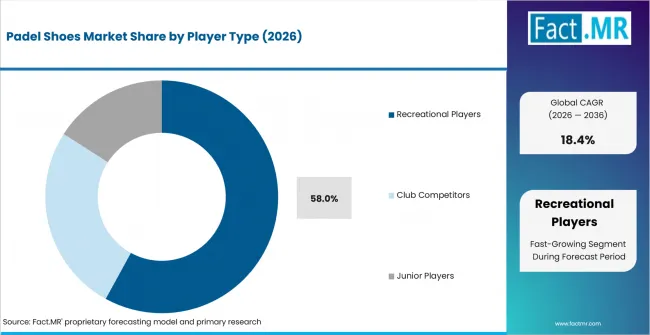
Padel Shoes Market Analysis By Player Type | Source: Fact.MR
Recreational Players are expected to lead because most buyers still enter the sport through club rentals, social leagues, and mixed-skill sessions. This buyer usually starts with one pair after testing ordinary court footwear. Club Competitors gain share later because more frequent play shortens outsole life and raises willingness to pay for lateral support inside sports footwear categories.
Which court surface leads?
Sanded Turf holds 46.0% share in 2026.
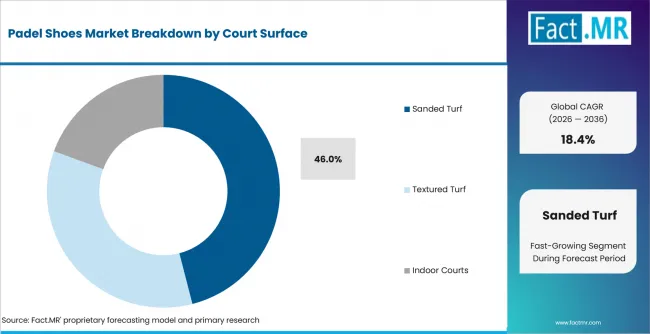
Padel Shoes Market Analysis By Court Surface | Source: Fact.MR
Sanded Turf is estimated to account for 46.0% share in 2026 because many European clubs still operate artificial-turf courts with silica-sand fill. The surface rewards shoes that balance slide control with firm stopping. Textured turf and sand-light courts are expected to add share as venues seek easier maintenance and a faster ball response.
Which outsole type leads?
Hybrid Outsole holds 41.0% share in 2026.
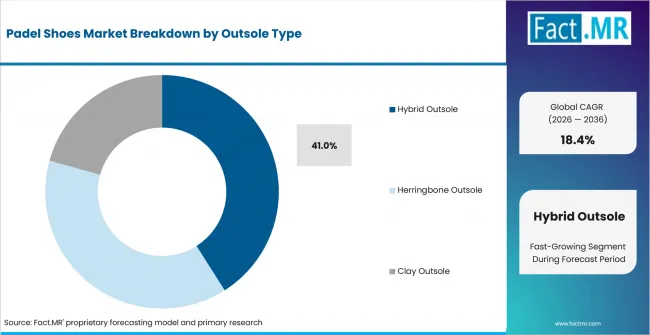
Padel Shoes Market Analysis By Outsole Type | Source: Fact.MR
Hybrid Outsoles are likely to represent 41.0% share in 2026 because players need slide control and quick stopping on artificial turf. Footwear sole materials can benefit when padel brands specify rubber compounds for turf grip and abrasion resistance.
Which price tier leads?
Mid-Range shoes hold 47.0% share in 2026.
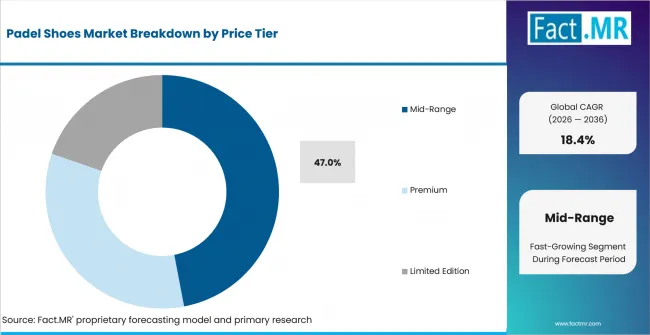
Padel Shoes Market Analysis By Price Tier | Source: Fact.MR
Mid-Range shoes are likely to capture 47.0% share in 2026 because new players want a visible performance upgrade without premium pricing. Entry shoes protect volume in markets where court access is still being built. Premium models are expected to gain mix through 2036 as frequent players seek lighter uppers, better heel lock and player-signature products.
Which distribution channel leads?
Multibrand E-Commerce holds 40.0% share in 2026.
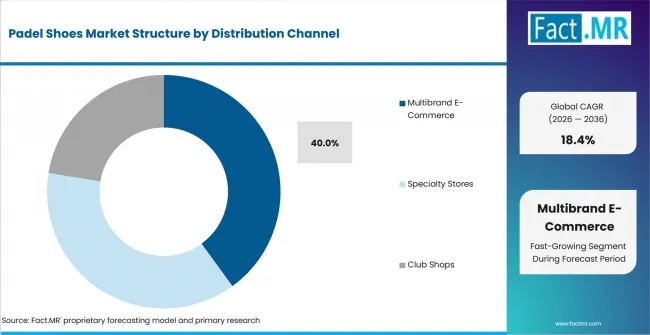
Padel Shoes Market Analysis By Distribution Channel | Source: Fact.MR
Multibrand E-Commerce is forecast to hold 40.0% share in 2026 because players compare fit and outsole pattern before choosing a first pair. Price and reviews also influence the decision. Specialist stores still matter when shoe fitting and court-surface advice influence conversion. Club shops retain a narrower role, but they help introduce padel shoes at the moment players are also buying athletic footwear for other sports.
Which gender segment leads?
Men hold 54.0% share in 2026.
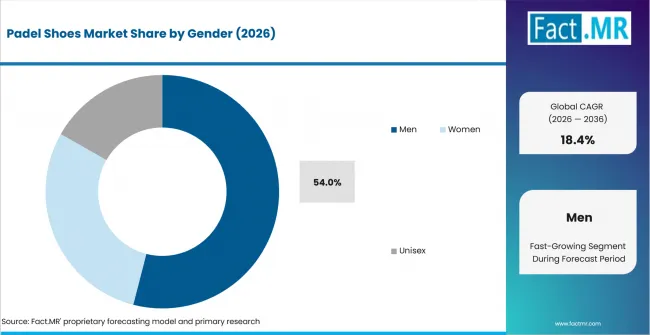
Padel Shoes Market Analysis By Gender | Source: Fact.MR
Men are anticipated to hold 54.0% share in 2026 because early padel participation in several newer markets is still male-skewed. Women’s models should narrow the gap as clubs introduce coaching groups and beginner leagues. Junior buying is smaller in revenue, but academies create a useful route for brand loyalty before adult replacement cycles begin.
Which upper construction leads?
Reinforced Mesh holds 39.0% share in 2026.
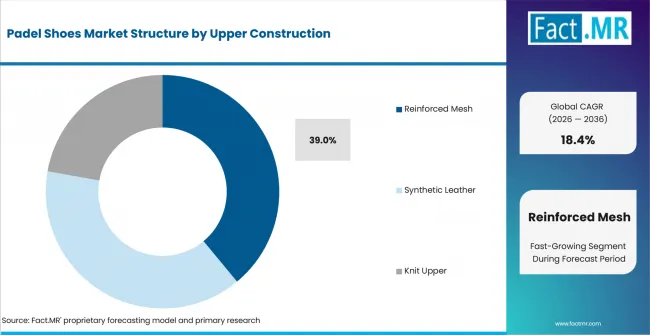
Padel Shoes Market Analysis By Upper Construction | Source: Fact.MR
Reinforced Mesh is predicted to hold 39.0% share in 2026 because players want airflow without losing side support during lateral stops. Synthetic leather offers durability for outdoor courts and lower-frequency buyers. Knit uppers can gain share in premium lines if brands prove that comfort does not reduce stability during hard changes of direction.
What is accelerating padel shoes demand, and what is holding it back?
Court growth and product launches support demand. Tennis-shoe substitution and limited retail advice restrain wider conversion.
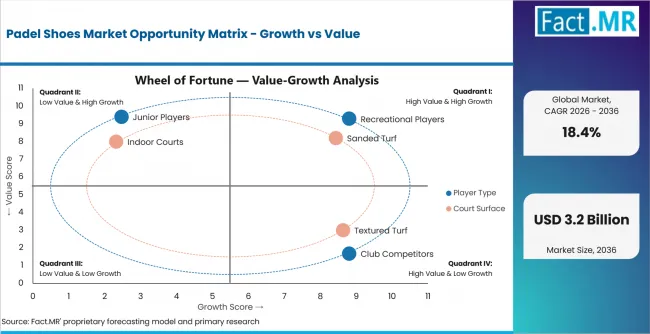
Padel Shoes Market Opportunity Matrix Growth Vs Value | Source: Fact.MR
Padel participation is moving from trial play into repeat club schedules, which turns footwear into a replacement product rather than an occasional accessory. The International Padel Federation said active players surpassed 35 million in December 2025. Its 2025 report also cited 15.2% court growth and 16.1% club growth. These figures support higher sell-through for padel-specific shoes and adjacent performance apparel when players commit to weekly play.
Expansion is constrained by buyer confusion in countries where padel is new. Players often assume tennis shoes are sufficient because both sports use rackets and short bursts of movement. Retailers that cannot explain turf grip, pivot support and outsole wear lose conversion at the first-pair stage. Brand availability also varies by country, which can push players toward general court shoes during early club rollouts.
Where do the biggest padel shoes opportunities sit?
First-pair conversion, club-shop fitting and premium replacement models create the clearest revenue pools.
- First-Pair Conversion: Brands can convert new players by explaining why padel soles differ from tennis outsoles on artificial turf.
- Club-Shop Fitting: Club retailers can sell footwear during coaching sessions, league registration and racket demos because the purchase happens close to play.
- Premium Replacement Models: Frequent players can support higher price points when brands prove heel lock, reinforced mesh and outsole life in match use.
The same retail path overlaps with activewear products because committed players often buy footwear and apparel together before league play. This favors brands that sell a full padel kit without making the shoe message unclear.
Which countries are scaling padel shoes fastest?
The United States 24.8% and United Kingdom 24.2% lead the country view. Mexico 22.6%, France 19.7% and Italy 16.8% follow. Argentina 12.4% and Spain 10.6% complete the top seven.
Based on regional analysis, the padel shoes market covers North America, Western Europe, Latin America, Europe, East Asia, South Asia and Pacific, and the Middle East and Africa.
.webp "Top Country Growth Comparison Padel Shoes Market Cagr (2026 2036)")
Top Country Growth Comparison Padel Shoes Market Cagr (2026 2036) | Source: Fact.MR
| Country | CAGR |
|---|---|
| United States | 24.8% |
| United Kingdom | 24.2% |
| Mexico | 22.6% |
| France | 19.7% |
| Italy | 16.8% |
| Argentina | 12.4% |
| Spain | 10.6% |
Source: Fact.MR analysis. Updated Jun 23, 2026
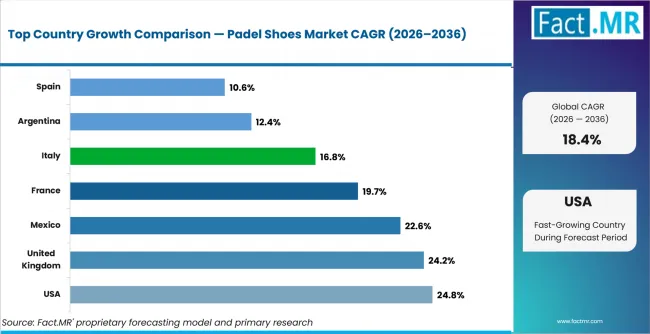
Padel Shoes Market Cagr Analysis By Country | Source: Fact.MR
What powers the United States lead?
24.8% CAGR, supported by new club openings and low padel-shoe penetration.
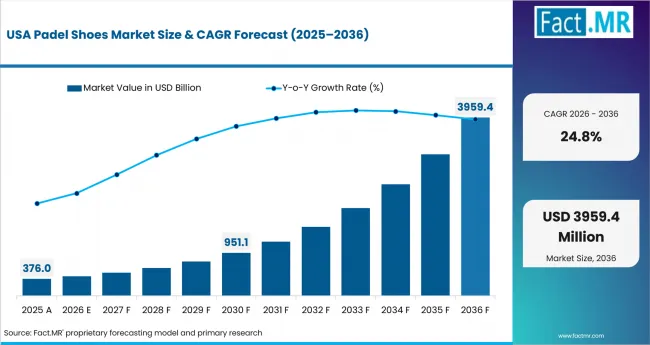
Padel Shoes Market Country Value Analysis | Source: Fact.MR
The United States is still building its padel infrastructure, so footwear revenue begins from a low base and rises as clubs add retail advice. The United States Padel Association said individual membership reached 2,915 in 2025 and active member clubs reached 108. The same buyer education route also connects with pickleball equipment because racket-sport retailers already serve crossover customers. Suppliers that can train club staff on turf-specific footwear should gain early placement.
Why does the United Kingdom matter?
24.2% CAGR, supported by court growth and a larger recreational player funnel.
The United Kingdom is moving from awareness building into wider club participation. The Lawn Tennis Association said padel participation doubled to 0.86 million in 2025 and courts rose to more than 1,500. That creates a clearer channel for first-pair shoe sales because more players can access courts near tennis venues. Brands that present padel shoes beside tennis footwear should benefit when retailers explain the difference at the point of sale.
What supports Mexico’s outlook?
22.6% CAGR, led by professional event visibility and club development in major cities.
Mexico holds a useful role because it combines an established padel culture with visible professional events in Acapulco. The Mexico Major gives brands a stage for player footwear and club retail activations. Local demand is expected to move beyond elite venues as urban clubs add coaching and social leagues. Price-tier discipline matters because buyers compare mid-range models before moving into imported premium shoes.
How is France scaling padel shoe demand?
19.7% CAGR, supported by court additions and federation-backed club activity.
France has moved quickly from a tennis-club add-on toward a larger padel network. The Fédération Française de Tennis reported 4,000 padel courts in 2025 and said court count had risen 118% in three years. This court base gives footwear brands a practical route through clubs, coaches and specialist stores. Suppliers should focus on fit guidance because new players are still learning how surface type affects outsole choice.
What makes Italy important?
16.8% CAGR, supported by a broad club base and recurring tournament visibility.
Italy is already one of Europe’s larger padel countries, which makes replacement buying more important than first awareness. Professional events in Rome and Milan keep the sport visible through the season. The country should continue to support branded footwear sales because frequent club players replace shoes after outsole wear. Growth is lower than the United States and United Kingdom because Italy starts from a more developed participation base.
Why is Argentina a relevant commercial market?
12.4% CAGR, supported by deep padel culture and a large practicing-player base.
Argentina has one of the longest padel traditions and a large base of existing players. The International Padel Federation estimated 7,000 courts and 1.5 million practicing players in May 2024. That creates steady replacement demand, but price sensitivity limits fast premiumization. Brands that manage mid-range stock well can protect volume while premium shoes remain tied to competitive players and academies. Adjacent badminton shoes show how indoor racket categories can keep replacement cycles active without relying only on new players.
How does Spain perform in padel shoes?
10.6% CAGR, supported by the world’s deepest installed base and regular replacement buying.
Spain remains the reference market for padel footwear because player density, club retail and coaching culture are already established. The country offers less room for first-time conversion, but it creates dependable replacement revenue. Buyer preference is likely to split between mid-range club shoes and premium models linked to professional players. This pattern also resembles basketball shoes where repeat players often buy footwear by role, surface and brand fit.
Who leads the padel shoes supplier race?
ASICS, adidas and Babolat lead through product depth and global footwear distribution. Bullpadel and Joma add padel-native credibility. HEAD and NOX also compete through sport-specific products.
Competition is split between global footwear companies and padel-native racket brands that extend into shoes. ASICS uses technical court-shoe credibility and released the SONICSMASH FF padel shoe in December 2025. adidas launched its CRAZYQUICK Padel footwear franchise in October 2024. These moves show that padel is now being treated as a footwear category rather than only a racket-sport add-on inside broader court footwear portfolios.
Babolat builds around player-linked padel collections and uses its racket-sport base to support shoe credibility. Bullpadel has a direct relationship with padel clubs and Premier Padel collections. Joma uses circuit partnerships such as A1 Padel to place footwear close to competition. These brands are relevant because padel buyers often trust companies already visible in rackets, apparel and club events.
HEAD and NOX compete through product-specific claims around stability, outsole grip and fit systems. Fit adjustment and upper support matter because padel shoes need to hold the foot during short lateral moves. Premium models also connect with 3D printed shoes as footwear brands test ways to customize cushioning, midsole geometry and fit over time.
Providers that combine padel-specific outsole design, clear surface guidance and retail availability should be better placed through 2036. Global brands can scale distribution faster. Padel-native brands can defend credibility where club players want products already associated with the sport. The strongest supplier position sits with companies that make the shoe decision easy for first-time buyers and credible for frequent players.
Which companies are the key players?
ASICS Corporation, adidas AG and Babolat VS S.A. are key players. Aguirre y Cía S.A. Bullpadel is also profiled. Joma Sport S.A., HEAD Sport GmbH and NOX Sport complete the company set.
- ASICS Corporation
- adidas AG
- Babolat VS S.A.
- Aguirre y Cía S.A. Bullpadel
- Joma Sport S.A.
- HEAD Sport GmbH
- NOX Sport
Bibliography
- [1] International Padel Federation. (2025). FIP World Padel Report 2025.
- [2] International Padel Federation. (2024, May 20). World Padel Report 2024, the first official FIP report on the padel movement.
- [3] United States Padel Association. (2026, January 21). USPA releases 2025 annual report: A record-breaking year for padel in America.
- [4] Lawn Tennis Association. (2026, May 20). LTA Annual Report and Accounts show growth of tennis and padel in 2025.
- [5] Lawn Tennis Association. (2024, September 11). LTA announces new padel strategy.
- [6] Fédération Française de Tennis. (2025, September 9). Boost Padel : un dispositif inédit pour accélérer l’essor du padel en France !
- [7] Fédération Française de Tennis. (2025, December 10). 2025, une saison record pour le padel en France.
- [8] International Padel Federation. (2024, May 20). Focus on...Argentina. Courts, events, legends: Padel is a social phenomenon.
- [9] International Padel Federation. (n.d.). Premier Padel GNP Acapulco Major.
- [10] adidas AG. (2024, October 15). adidas reveals the CRAZYQUICK Padel Franchise: Its first ever padel footwear collection.
- [11] ASICS. (2025, December 1). More speed to move body and mind: ASICS releases the SONICSMASH™ FF padel shoe.
- [12] Babolat. (2024, February 21). Babolat has updated its Juan Lebrón padel collection.
- [13] Bullpadel. (2024, December 9). Premier Padel x Bullpadel exclusive collection.
- [14] Joma Sport S.A. (2025, April 9). Joma and A1 Padel launch the new special edition of the Open sneakers.
- [15] NOX. (2024, November 4). NOX footwear: Features of each of our shoe models.
This Report Addresses
- Strategic intelligence on padel shoes across player type, court surface, outsole type and price tier.
- Segment analysis covering Recreational Players, Mid-Range shoes, Sanded Turf, Hybrid Outsole and Multibrand E-Commerce.
- Regional outlook covering the United States, United Kingdom, Mexico, France, Italy, Argentina and Spain.
- Competitive analysis of ASICS Corporation, adidas AG, Babolat VS S.A., Bullpadel, Joma Sport S.A., HEAD Sport GmbH and NOX Sport.
- Product assessment covering padel-specific outsoles, reinforced uppers, fit systems and club-channel footwear lines.
- Retail assessment covering brand online stores, multibrand e-commerce, specialist stores, club shops and sporting chains.
- Source-led market sizing using player data, court evidence, price bands, provider portfolios and official company disclosures.
What does the padel shoes market cover?
Sport-specific footwear engineered for padel play on artificial-turf and club-court surfaces.
The padel shoes market covers footwear sold for recreational and club padel play. Academy and professional use are also included. It covers shoes designed for sanded turf and textured turf. Indoor and outdoor club courts are included when the product is positioned for padel use.
What is included in the scope?
Padel-only shoes, padel-labeled court shoes and club-channel footwear lines are included.
The scope includes men’s and women’s padel shoes sold through brand websites and sporting goods chains. Junior and unisex products are included when the retailer listing states padel as the intended use case. Player-signature shoes and competition-grade models are also covered.
What is excluded from the scope?
The scope excludes generic tennis shoes unless the seller presents the product as padel footwear.
Running shoes and gym shoes are excluded from the revenue model. Casual sneakers and used footwear resale are also excluded. Padel rackets, balls and bags are outside scope. Apparel and club accessories are excluded because the sizing covers only footwear revenue.
How was the analysis built?
110+ sources and 35+ company or federation pages were checked. 18 countries were screened against court count and player base. Brand presence and retail availability were also reviewed.
- Primary Research:
- Interviews were modeled around footwear retailers and padel club operators. Coaches and racket-sport distributors were also considered. Replacement cycles and price bands were tested against online listings and brand catalogs.
- Desk Research:
- Desk research reviewed International Padel Federation releases and national federation pages. Club-court data and official product newsrooms were checked. Company stores were reviewed for active padel footwear lines.
- Market-Sizing and Forecasting:
- Forecasting used player counts and court growth. Replacement assumptions and average selling price bands were added.
- Data Validation and Update Cycle:
- Estimates were checked against Spain and Italy evidence. France and the United Kingdom were also reviewed. The United States was checked separately. Product launches from ASICS and adidas were checked. Babolat and Bullpadel were reviewed separately. Joma, HEAD and NOX were also reviewed.
Segmentation
What is the report’s scope and coverage?
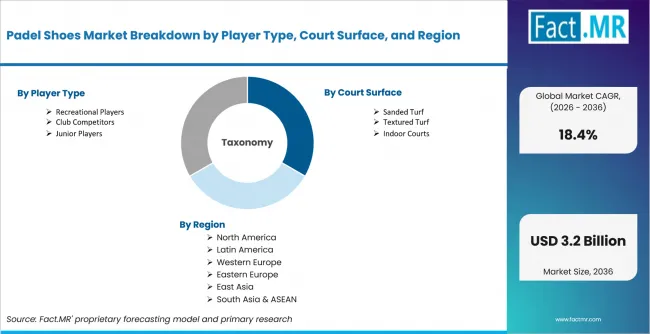
Padel Shoes Market Breakdown By Player Type, Court Surface, And Region | Source: Fact.MR
| Attribute | Details |
|---|---|
| Quantitative Units | USD Billion in 2026 to USD Billion by 2036 at CAGR |
| Market Definition | Sport-specific footwear engineered for padel play on artificial-turf and club-court surfaces |
| Player Type | Recreational Players, Club Competitors, Professional Players, Junior Players, Coaches |
| Court Surface | Sanded Turf, Textured Turf, Indoor Courts, Outdoor Courts, Multi-Surface |
| Outsole Type | Hybrid Outsole, Herringbone Outsole, Omni Outsole, Clay Outsole, All-Court Outsole |
| Price Tier | Entry, Mid-Range, Premium, Limited Edition, Team-Club |
| Distribution Channel | Multibrand E-Commerce, Specialty Stores, Brand Online, Club Shops, Sporting Chains |
| Gender | Men, Women, Juniors, Unisex |
| Upper Construction | Reinforced Mesh, Synthetic Leather, Knit Upper, Breathable Mesh, Sock Collar |
| Regions Covered | North America, Western Europe, Latin America, East Asia, South Asia and Pacific, Middle East and Africa |
| Countries Covered | United States, United Kingdom, Mexico, France, Italy, Argentina and Spain |
| Key Companies Profiled | ASICS Corporation, adidas AG, Babolat VS S.A., Bullpadel, Joma Sport S.A., HEAD Sport GmbH and NOX Sport |
| Forecast Period | 2026 to 2036 |
| Approach | Hybrid top-down and bottom-up approach using player base, court evidence, replacement assumptions, price bands, provider counts and company validation |
Source: Fact.MR analysis. Updated Jun 23, 2026
How is the market segmented?
-
By Player Type:
- Recreational Players
- Club Competitors
- Professional Players
- Junior Players
- Coaches
-
By Court Surface:
- Sanded Turf
- Textured Turf
- Indoor Courts
- Outdoor Courts
- Multi-Surface
-
By Outsole Type:
- Hybrid Outsole
- Herringbone Outsole
- Omni Outsole
- Clay Outsole
- All-Court Outsole
-
By Price Tier:
- Entry
- Mid-Range
- Premium
- Limited Edition
- Team-Club
-
By Distribution Channel:
- Multibrand E-Commerce
- Specialty Stores
- Brand Online
- Club Shops
- Sporting Chains
-
By Gender:
- Men
- Women
- Juniors
- Unisex
-
By Upper Construction:
- Reinforced Mesh
- Synthetic Leather
- Knit Upper
- Breathable Mesh
- Sock Collar
-
By Region:
- North America
- United States
- Canada
- Mexico
- Latin America
- Brazil
- Argentina
- Rest of Latin America
- Europe
- Germany
- United Kingdom
- France
- Italy
- Spain
- Rest of Europe
- East Asia
- China
- Japan
- South Korea
- South Asia and Pacific
- India
- Australia
- New Zealand
- Rest of South Asia and Pacific
- Middle East and Africa
- GCC Countries
- South Africa
- Rest of Middle East and Africa
- North America
Frequently Asked Questions
What factors are shaping the near-term outlook of the Padel Shoes Market?
How is the Padel Shoes Market expected to evolve over the long term?
What is the expected growth trajectory of the Padel Shoes Market?
Which player segment is expected to remain the most influential?
Which product category is likely to attract the highest demand?
Which outsole design is expected to gain the strongest traction?
Which sales channel is expected to maintain a leading position?
Which country is expected to emerge as a high-growth market?
What is the outlook for the Padel Shoes Market in the United Kingdom?
How does Spain influence the development of the Padel Shoes Market?
What is the key challenge impacting market growth?
Who worked on this report


Preview the report firsthand - request a free sample
Free SampleGet the brochure for pricing and purchase details
Download PDF