- Base Value(2026): 1.4 Bn
- Estimated Value(2026): 1.4 Bn
- Forecast Value (2036): 5.0 Bn
- CAGR (2026 - 2036): 13.5%
PCR Compliance Market Forecast and Outlook 2026 to 2036
A 2026 level of USD 1.4 billion sets the operating scale for the PCR compliance market, with the period through 2036 pointing to USD 5.0 billion under a 13.50% CAGR.
PCR Compliance Market Key Takeaways
- PCR Compliance Market Value (2026): USD 1.4 billion
- PCR Compliance Market Forecast Value (2036): USD 5.0 billion
- PCR Compliance Market Forecast CAGR 2026 to 2036: 13.5%
- Leading End-use in PCR Compliance Market: FMCG and packaging
- Leading Compliance Service in PCR Compliance Market: Certification and audit services
- Key Growth Regions in PCR Compliance Market: Asia Pacific, North America, Europe, Latin America, Middle East & Africa
- Top Players in PCR Compliance Market: TÜV SÜD AG, DIN CERTCO (TÜV Rheinland Group), UL Solutions Inc., Intertek Group plc, SGS SA, Centre Testing International Group Co., Ltd. (CTI), Japan Quality Assurance Organization (JQA)
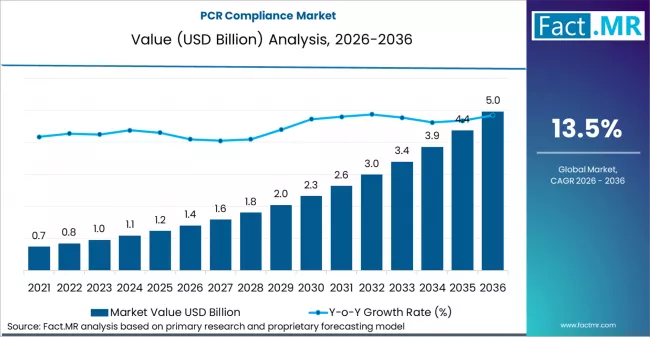
Pcr Compliance Market Market Value Analysis | Source: Fact.MR
This activity sits inside governance and sourcing functions rather than inside manufacturing lines. Companies use compliance frameworks to control risk, protect market access, and align internal reporting across brands, regions, and suppliers. Once a product group is brought under a PCR program, the work does not end. Data flows, supplier declarations, mass balance records, and audit trails become part of routine management cycles.
Teams value systems that reduce manual handling, shorten audit preparation time, and keep evidence ready for customers and authorities. The commercial impact comes from scale. One framework often covers dozens or hundreds of SKUs. Growth follows wider regulatory coverage and broader adoption by retailers and brand groups, not from changes in packaging formats or materials themselves.
PCR Compliance Market
| Metric | Value |
|---|---|
| Market Value (2026) | USD 1.4 billion |
| Forecast Value (2036) | USD 5.0 billion |
| Forecast CAGR 2026 to 2036 | 13.5% |
Source: Fact.MR analysis. Updated Jan 27, 2026
Category
| Category | Segments |
|---|---|
| End-use | FMCG and packaging; Electronics and retail; Export compliance; High-precision compliance; Emerging regulation; Others |
| Compliance Service | Certification and audit services; Regulatory testing; PCR verification; Certification testing; Others |
| Regulation Scope | EU PPWR or DPP; FDA or FTC; Trade standards; JIS standards; Others |
| Verification Technology | Chain-of-custody and mass balance; Lab validation and digital reporting; Digital certificates; High-accuracy labs; Others |
| Region | North America; Europe; Asia Pacific; Latin America; Middle East & Africa |
Source: Fact.MR analysis. Updated Jan 27, 2026
Segmental Analysis
Why Does FMCG and Packaging Drive the Largest Share of PCR Compliance Activity?
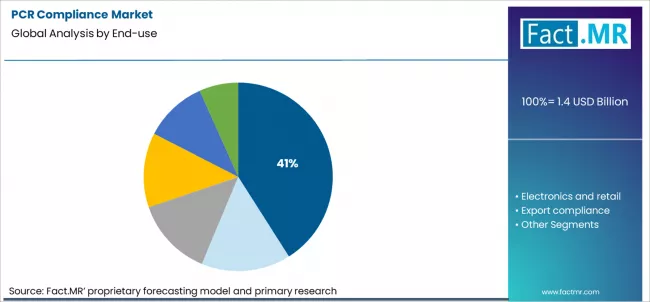
Pcr Compliance Market Analysis By End Use | Source: Fact.MR
FMCG and packaging represent 41% of end-use participation in the PCR compliance market. This segment manages large packaging portfolios with frequent artwork changes, material substitutions, and supplier shifts. Each change triggers a need to confirm recycled content levels against declared specifications. Retail distribution also places these products under continuous scrutiny from brand owners and channel partners. Compliance teams in this sector handle high document volumes tied to product families rather than to single items. Portfolio breadth increases the number of certificates, test reports, and declarations that must stay current. Electronics and export programs operate on narrower ranges. The constant turnover of consumer packaging keeps this end-use group at the center of compliance workload.
What Makes Certification and Audit Services the Most Used Compliance Offering?
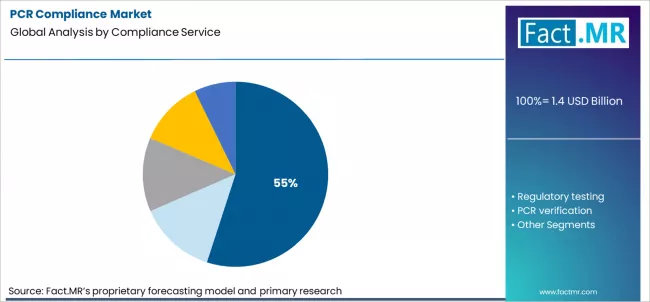
Pcr Compliance Market Analysis By Compliance Service | Source: Fact.MR
Certification and audit services account for 55% of compliance service usage in the PCR compliance market. These services sit at the point where material claims, supplier data, and finished product declarations meet formal verification. Brand owners and retailers rely on audit statements to support labeling and regulatory filings across multiple regions. Internal quality teams also use these audits as reference records during procurement reviews. Renewal cycles create repeat demand, even when product structures remain unchanged. Testing and verification services address specific technical questions. Most compliance programs still begin and end with certification steps that confirm system wide adherence to declared recycled content requirements.
What are the Drivers, Restraints, and Key Trends of the PCR Compliance Market?
- Drivers: Regulatory requirements and corporate procurement policies that mandate minimum post-consumer recycled (PCR) content in packaging and other plastic applications are creating demand for compliant resin and material solutions across consumer goods, retail, and industrial sectors.
- Restraint: Variability in availability and quality of PCR feedstock, combined with price differences compared with virgin polymers, restricts consistent supply and slows adoption in cost-sensitive product lines.
- Trend 1: Broadening of certification and traceability systems that validate PCR content and support transparent reporting for brand compliance needs.
- Trend 2: Development of PCR material grades tailored for specific applications, including rigid containers, films, and thermoformed components, to enhance performance parity with traditional resins.
Analysis of the PCR Compliance Market by Key Country
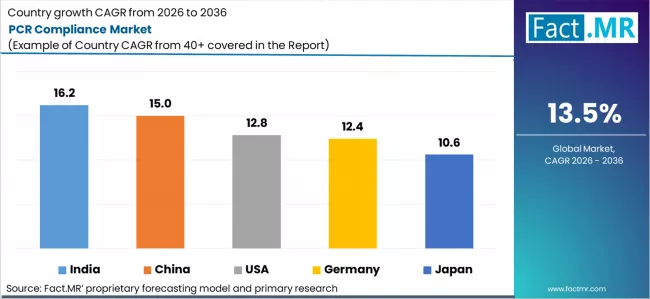
Pcr Compliance Market Cagr Analysis By Country | Source: Fact.MR
| Country | CAGR 2026 to 2036 |
|---|---|
| Germany | 12.4% |
| USA | 12.8% |
| China | 15.0% |
| Japan | 10.6% |
| India | 16.2% |
Source: Fact.MR analysis. Updated Jan 27, 2026
The report covers an in-depth analysis of 40+ countries; top-performing countries are highlighted below.
How Are Regulatory Audits and Retail Scorecards in Germany Shaping PCR Compliance?
Growth in Germany runs at about 12.4% per year through 2036. Demand is driven by mandatory recycled content targets, documentation checks, and retailer compliance programs. Brand owners focus on chain of custody records, material balance reporting, and audit readiness. Packaging and procurement teams work together to secure certified supply. Conversions proceed in stages because contract changes and supplier qualification require time. Distribution relies on a limited set of resin producers and converters with verified certification systems. Volume growth tracks portfolio wide compliance rollouts rather than single product changes. Market development remains tied to regulatory enforcement cycles and retailer scorecards rather than voluntary brand initiatives.
How Are Corporate Targets and Disclosure Rules in USA Shaping PCR Compliance?
Growth in USA runs at about 12.8% per year through 2036. Demand follows public commitments on recycled content, retailer requirements, and investor reporting expectations. Product teams evaluate availability, performance consistency, and cost impact of certified materials. Procurement processes emphasize long term contracts and traceability systems. Conversions often begin with high volume product lines before spreading across portfolios. Distribution relies on resin suppliers, compounders, and converters with audit capabilities. Volume growth tracks companywide compliance roadmaps rather than isolated brand pilots. Market development remains tied to governance frameworks and reporting obligations rather than consumer facing labeling programs alone.
What Is Driving Faster Expansion of PCR Compliance in China?
Growth in China runs at about 15.0% per year through 2036. Demand rises from policy support for recycled material use, large scale packaging volumes, and platform level requirements. Operators prioritize scale, documentation control, and stable supply chains. Compliance systems focus on material tracking and batch level verification. Purchasing aligns with multi-year material transition plans. Local reprocessing capacity influences supplier choice. Volume increases follow adoption by major beverage, food delivery, and consumer goods platforms. Market development remains tied to industrial scale system building rather than niche brand programs or voluntary certification uptake.
How Are Structured Compliance Frameworks in Japan Shaping PCR Adoption?
Growth in Japan runs at about 10.6% per year through 2036. Demand follows corporate packaging standards, government guidelines, and retailer operating rules. Product teams focus on material traceability, consistent quality, and clear documentation. Packaging changes proceed cautiously because line stability and defect rates receive close attention. Purchasing decisions emphasize reliability and long term supplier relationships. Distribution remains concentrated among approved resin and recycling partners. Volume growth tracks scheduled portfolio updates and compliance programs. Market development stays tied to disciplined system improvement rather than rapid experimentation or frequent changes in material sourcing strategies.
What Is Accelerating PCR Compliance in India?
Growth in India runs at about 16.2% per year through 2036. Demand rises from enforcement of waste management rules, brand compliance programs, and expansion of packaged goods. Companies focus on basic documentation, supply continuity, and cost balance. Procurement emphasizes access to certified material and regional processing capacity. Conversions often begin with large brands and high volume categories. Distribution relies on a mix of local recyclers, converters, and polymer suppliers. Volume growth follows formalization of packaging systems and retail expansion. Market development remains tied to regulatory enforcement and system building rather than voluntary brand leadership programs.
How Do Audit Scope and Recognition Frameworks Shape Competition in the PCR Compliance Market?
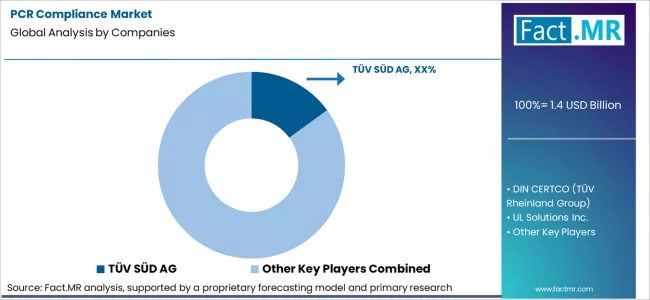
Pcr Compliance Market Analysis By Company | Source: Fact.MR
Access to PCR compliance programs is determined by recognition status, audit methodology, and acceptance by brand governance teams rather than by inspection fees. Brand owners first define chain of custody models, mass balance rules, and reporting cycles, then select certification partners that fit those frameworks. TÜV SÜD, SGS, UL Solutions, Intertek, and DIN CERTCO compete through global audit coverage and established retailer acceptance. CTI and JQA hold positions where regional manufacturing bases and local authority recognition matter more than network size. Buyers compare providers using audit consistency, turnaround times, dispute handling records, and data management systems. Once a certification route is embedded in sourcing policy, volumes follow portfolio expansion and regulatory coverage growth. Competitive shifts usually occur after rule revisions, mutual recognition changes, or retailer mandate updates.
Key Players in PCR Compliance Market
- TÜV SÜD AG
- DIN CERTCO (TÜV Rheinland Group)
- UL Solutions Inc.
- Intertek Group plc
- SGS SA
- Centre Testing International Group Co., Ltd. (CTI)
- Japan Quality Assurance Organization (JQA)
References
- European Commission. (2024). Proposal for a regulation of the European Parliament and of the Council on packaging and packaging waste and repealing Directive 94/62/EC. European Commission.
- European Commission. (2023). Proposal for a regulation establishing a framework for setting ecodesign requirements for sustainable products and repealing Directive 2009/125/EC. European Commission.
- European Commission, Joint Research Centre. (2023). The future of packaging in a circular economy: Material use, reuse systems and waste prevention. Publications Office of the European Union.
- Organisation for Economic Co-operation and Development. (2023). Global plastics outlook: Policy scenarios to 2060. OECD Publishing.
- International Organization for Standardization. (2023). ISO 59004: Circular economy - Vocabulary, principles and guidance for implementation. ISO.
Segmentation
Scope of the Report
| Items | Values |
|---|---|
| Quantitative Units (2026) | USD billion |
| End-use | FMCG and packaging, electronics and retail, export compliance, high-precision compliance, emerging regulation, others |
| Compliance Service | Certification and audit services, regulatory testing, PCR verification, certification testing |
| Regulation Scope | EU PPWR or DPP, FDA or FTC, trade standards, JIS standards |
| Verification Technology | Chain-of-custody and mass balance, lab validation and digital reporting, digital certificates, high-accuracy labs |
| Regions Covered | Asia Pacific, Europe, North America, Latin America, Middle East & Africa |
| Countries Covered | United States, Canada, Mexico, Germany, United Kingdom, France, Italy, Spain, Nordics, BENELUX, China, Japan, South Korea, India, Australia & New Zealand, ASEAN, Brazil, Chile, Saudi Arabia, Turkey, South Africa, and other regional markets |
| Key Companies Profiled | TÜV SÜD AG, DIN CERTCO (TÜV Rheinland Group), UL Solutions Inc., Intertek Group plc, SGS SA, Centre Testing International Group Co., Ltd. (CTI), Japan Quality Assurance Organization (JQA) |
| Additional Attributes | Dollar value by compliance service and regulation scope; focus on chain-of-custody, mass balance, and audit readiness; demand driven by PCR mandates, retailer scorecards, and corporate governance reporting |
Source: Fact.MR analysis. Updated Jan 27, 2026
PCR Compliance Market Segmentation
-
End-use :
- FMCG & packaging
- Electronics & retail
- Export compliance
- High-precision compliance
- Emerging regulation
- Others
-
Compliance Service :
- Certification & audit services
- Regulatory testing
- PCR verification
- Certification testing
- Others
-
Regulation Scope :
- EU PPWR or DPP
- FDA or FTC
- Trade standards
- JIS standards
- Others
-
Verification Technology :
- Chain-of-custody & mass balance
- Lab validation & digital reporting
- Digital certificates
- High-accuracy labs
- Others
-
Region :
- Asia Pacific
- China
- Japan
- South Korea
- India
- Australia & New Zealand
- ASEAN
- Rest of Asia Pacific
- Europe
- Germany
- United Kingdom
- France
- Italy
- Spain
- Nordic
- BENELUX
- Rest of Europe
- North America
- United States
- Canada
- Mexico
- Latin America
- Brazil
- Chile
- Rest of Latin America
- Middle East & Africa
- Kingdom of Saudi Arabia
- Other GCC Countries
- Turkey
- South Africa
- Other African Union
- Rest of Middle East & Africa
- Asia Pacific
Frequently Asked Questions
How big is the pcr compliance market in 2026?
What will be the size of pcr compliance market in 2036?
How much will be the pcr compliance market growth between 2026 and 2036?
What are the key product types in the pcr compliance market?
Which compliance service segment to contribute significant share in the pcr compliance market in 2026?
Who worked on this report


Preview the report firsthand - request a free sample
Free SampleGet the brochure for pricing and purchase details
Download PDF