- Base Value(2025): 4.8 Bn
- Estimated Value(2026): 5.0 Bn
- Forecast Value (2036): 6.8 Bn
- CAGR (2026 - 2036): 3.1%
Piston Liners Market Forecast and Outlook By Fact.MR
The piston liners market was valued at USD 4.8 billion in 2025. The market is projected to reach USD 5.0 billion in 2026 and USD 6.8 billion by 2036, expanding at a CAGR of 3.1% during the forecast period. Alloyed cast iron liners are expected to lead material type with a 34.8% share in 2026. Passenger vehicle engines are projected to remain the leading engine type with a 52.4% share in 2026. OEM sales are expected to lead channel demand with a 67.2% share in 2026, even as the aftermarket stays commercially important in heavy-duty and rebuild cycles.
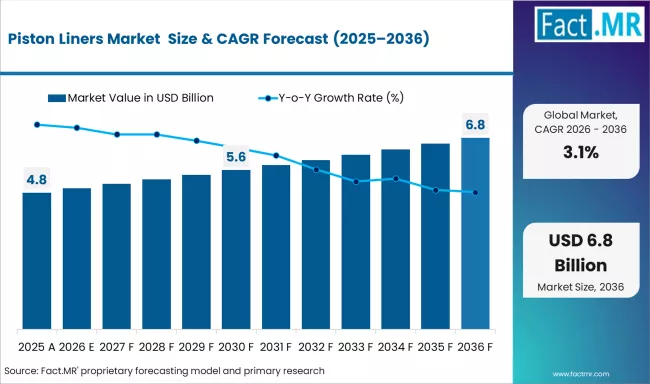
Piston Liners Market Market Value Analysis | Source: Fact.MR
Key Drivers
- Emission durability pressure: Automakers are under pressure to deliver lower friction, tighter tolerances, and longer engine-life performance as emissions compliance extends across longer vehicle life cycles. Euro 7 extends durability expectations and pushes more disciplined in-cylinder engineering.
- Hybrid-heavy transition: The vehicle parc is not moving from combustion to full electric in one straight line. Hybrids continue to occupy a large part of new registrations, which keeps demand alive for advanced liners in efficient internal combustion architectures.
- Commercial engine persistence: Trucks, off-highway equipment, generators, and industrial engines remain slower to electrify. That preserves demand for durable liners, especially in high-load applications where repairability and thermal resistance matter.
Key Segments Analyzed in the Report
- Material type: grey cast iron liners, alloyed cast iron liners, steel liners, aluminum-compatible thin-wall liners, and others
- Engine type: passenger vehicle engines, commercial vehicle engines, off-highway and industrial engines
- Sales channel: OEM and aftermarket
- Region: North America, Latin America, Western Europe, Eastern Europe, East Asia, South Asia and Pacific, and Middle East and Africa
Analyst Opinion
Shambhu Nath Jha, Principal Consultant at Fact.MR says, "Value in piston liners is not pooling in commodity iron alone. It is concentrating in precision metallurgy, thin-wall compatibility with lighter engine blocks, and supply programs that serve both OEM fitment and long-tail replacement demand across commercial and industrial fleets."
Piston Liners Market Definition
The piston liners market comprises cylinder liners used within internal combustion engines to form the running surface for pistons and piston rings under high-temperature, high-friction operating conditions. It includes grey cast iron liners, alloyed cast iron liners, steel liners, thin-wall liners for aluminum blocks, and related precision-machined variants. These products serve passenger vehicles, commercial vehicles, off-highway equipment, industrial engines, and selected power generation applications where wear resistance, thermal stability, lubrication control, and rebuild economics remain commercially critical.
Piston Liners Market Inclusions
- Revenue generated from OEM and aftermarket sales of finished engine liners used in automotive, commercial vehicle, off-highway, and industrial engine applications
- Value captured from standard, alloyed, and lightweight-compatible liner formats supplied as precision engine components
- Regional demand across developed and emerging manufacturing and replacement markets
Piston Liners Market Exclusions
- Complete engine block sales, except where liners are separately priced and supplied as identifiable components
- Finished vehicle revenue and broader powertrain system revenue not attributable to liners
- General metal sleeves and non-automotive wear components outside engine cylinder applications
Piston Liners Market Research Methodology
This study evaluates the piston liners market across material type, engine type, sales channel, and region, with 2025 as the base year and 2026 to 2036 as the forecast period. Market value is assessed in revenue terms. The analysis incorporates regulatory direction on vehicle emissions and durability, vehicle production and registration trends, electrification pace, scrappage and fleet renewal policies, and company disclosures from major engine component suppliers including portfolio positioning, manufacturing footprints, and technology programs. Triangulation combines these inputs with installed-base replacement logic, engine mix assumptions, and application-level demand weighting across passenger, commercial, and industrial use cases.
Key Drivers, Restraints, and Trends in Piston Liners Market
Drivers
Stricter emissions and durability rules are forcing engine makers to extract more efficiency from every combustion cycle, which raises the importance of friction control, wear resistance, and heat management inside the cylinder. The European Commission’s Euro 7 framework extends compliance expectations over longer useful life, and the EPA’s Phase 3 rule tightens standards for heavy-duty vehicles from model year 2027, keeping pressure on combustion-engine optimization rather than allowing purely legacy designs to persist. At the same time, the transition is proving hybrid-heavy rather than fully electric in the near term. ACEA showed hybrid-electric vehicles held 34.5% of EU registrations in 2025, while combined petrol and diesel still represented 35.5%, which means liner demand does not disappear simply because electrification is rising.
Restraints
Battery-electric adoption keeps capping long-duration growth in light vehicles, especially in China and Europe where EV penetration is moving faster than many engine-component suppliers would prefer. IEA expects electric car sales to exceed 20 million worldwide in 2025, and that changes long-term volume assumptions for combustion parts. Cost pressure is another restraint because liners are often negotiated as mature engineered components, which compresses margins for standard grades. The market also faces platform risk as some OEMs reduce engine families and consolidate suppliers. In passenger vehicles, thinner blocks and evolving thermal architectures raise qualification demands, which can slow supplier switching and raise tooling burdens.
Trends
The market is shifting toward higher-performance liners that support lighter engines, tighter clearances, and compatibility with aluminum block architectures. TPR states that cylinder liners are key functional parts within combustion chambers and highlights its mass production of AZLOC liners for aluminum engine blocks, which signals where materials engineering is creating differentiation. The heavy-duty side is also evolving rather than disappearing. Tenneco disclosed participation in more than 100 hydrogen-related projects and specifically referenced cylinder liners among the in-cylinder components being engineered for efficient hydrogen combustion in commercial trucks, off-highway vehicles, and industrial engines. That points to a market where premium engineering content expands even when unit growth stays moderate.
Segmental Analysis
Piston Liners Market Analysis by Material Type
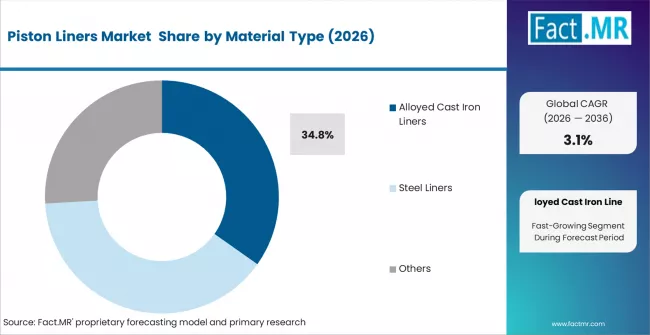
Piston Liners Market Analysis By Material Type | Source: Fact.MR
Alloyed cast iron liners are expected to account for 34.8% of the market in 2026, making them the leading material class. They lead because they balance machinability, wear resistance, thermal stability, and cost better than steel or more specialized lightweight formats across a broad range of gasoline, diesel, and hybrid engines. Grey cast iron remains large in legacy and cost-sensitive applications, but alloyed grades are better aligned with durability and friction-performance demands in modern engine programs. TPR’s liner portfolio and its commercial emphasis on cast-wrap liners for aluminum blocks reinforce the shift toward engineered, application-specific liner materials rather than plain commodity sleeves.
Piston Liners Market Analysis by Sales Channel
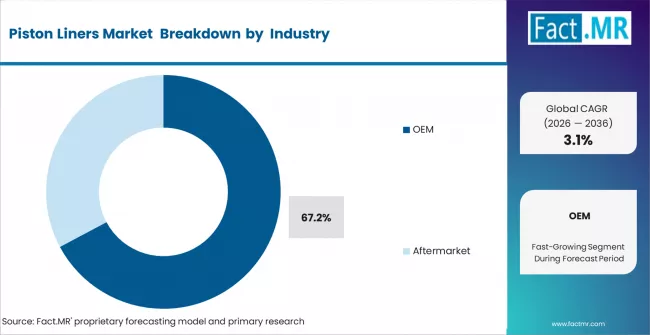
Piston Liners Market Analysis By Sales Channel | Source: Fact.MR
OEM is projected to hold 67.2% of the market in 2026. It leads because liner selection is locked deep into engine design, block metallurgy, thermal management, and endurance testing, which makes OEM sourcing structurally larger than replacement demand. Aftermarket revenue remains meaningful in trucks, generators, off-highway machinery, and engine rebuild ecosystems, but new-engine fitment still anchors volume. MAHLE’s 2024 annual report lists cylinder liners within a global portfolio serving passenger cars, commercial vehicles, large engines, and two-wheeled vehicles, showing how liner revenue remains tied to broad original-equipment programs across multiple vehicle classes.
Competitive Aligners for Market Players
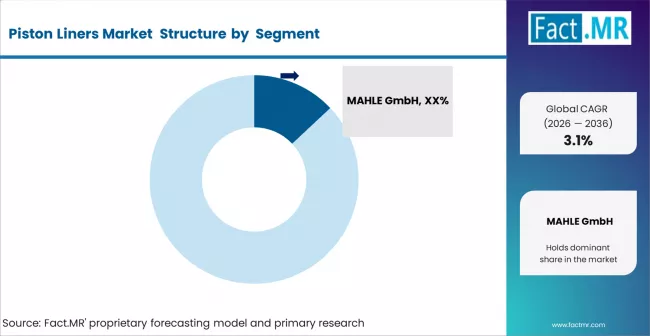
Piston Liners Market Analysis By Company | Source: Fact.MR
Competitive advantage in piston liners does not come from catalog breadth alone. Buyers need metallurgical consistency, precision machining, aluminum-block compatibility, validation support, and dependable multi-region manufacturing. The strongest suppliers combine OEM engineering access with aftermarket staying power, particularly in commercial and industrial engines where replacement economics remain attractive. MAHLE positions cylinder liners within a globally scaled engine-components portfolio across passenger cars, commercial vehicles, and large engines, while TPR shows a manufacturing footprint for cylinder liners in India, Korea, Vietnam, the United States, Turkey, and Brazil. Tenneco’s hydrogen-combustion work signals that future relevance will come from liners suited to new combustion environments, not just legacy diesel demand. Leadership is being built around design-in capability, material science, and globally resilient supply execution.
Key Players in Piston Liners Market
- MAHLE GmbH
- TPR Co., Ltd.
- DRiV Incorporated / Tenneco
- Rheinmetall AG
- Cummins Inc.
- Federal-Mogul TP Liners, Inc.
- Kirloskar Oil Engines Limited
- Cooper Corporation Pvt. Ltd.
- Perfect Circle India Limited
- Y&T Power Tech., Inc.
Strategic Outlook by Fact.MR on Piston Liners Market
The piston liners market is moving from broad-volume combustion dependence toward selective value concentration in advanced materials, hybrid-compatible engine programs, and hard-to-electrify duty cycles. The next phase will be shaped by liner performance in aluminum blocks, heavy-duty emissions durability, and the ability to support both conventional and alternative-fuel combustion platforms. Winners will be suppliers that stay embedded in OEM development cycles, maintain multi-region production depth, and convert materials expertise into premium, specification-led programs.
Bibliography
- International Energy Agency. 2025. Global EV Outlook 2025.
- European Automobile Manufacturers’ Association. 2026. New car registrations: +1.8% in 2025; battery-electric 17.4% market share.
- European Commission. 2023. Commission welcomes political agreement on the Euro 7 Regulation.
- United States Environmental Protection Agency. 2024. Final Rule: Greenhouse Gas Emissions Standards for Heavy-Duty Vehicles - Phase 3.
- MAHLE. 2024. Annual Report 2024.
- TPR Co., Ltd. 2024. TPR Integrated Report 2024.
- Tenneco. 2023. 2023 Sustainability Report
Segmentation
Scope of the Report
| Metric | Value |
|---|---|
| Market Value | USD 4.8 billion in 2025 to USD 6.8 billion by 2036 |
| CAGR | 3.1% from 2026 to 2036 |
| Base Year | 2025 |
| Forecast Period | 2026 to 2036 |
| Product Type Segmentation | Grey Cast Iron Liners, Alloyed Cast Iron Liners, Steel Liners, Aluminum-compatible Thin-wall Liners, Others |
| Workflow Segmentation | Passenger Vehicle Engines, Commercial Vehicle Engines, Off-highway and Industrial Engines |
| End User Segmentation | OEM, Aftermarket |
| Regions Covered | North America, Latin America, Western Europe, Eastern Europe, East Asia, South Asia and Pacific, Middle East and Africa |
Source: Fact.MR analysis. Updated Mar 16, 2026
Frequently Asked Questions
What is the projected size of the Piston Liners Market by 2036?
What is the CAGR of the Piston Liners Market from 2026 to 2036?
Which material type leads the Piston Liners Market in 2026?
Which engine type dominates the Piston Liners Market?
Which sales channel leads the Piston Liners Market in 2026?
What is driving growth in the Piston Liners Market?
Who worked on this report


Preview the report firsthand - request a free sample
Free SampleGet the brochure for pricing and purchase details
Download PDF