- Base Value(2025): 1050 Mn
- Forecast Value (2035): 1743 Mn
- CAGR (2035): 6.2%
Recycled Wetsuits Market Outlook 2025 to 2035
The global recycled wetsuits market is expected to reach USD 1,743 Million by 2035, up from USD 1,050 Million in 2025. During the forecast period 2025 to 2035, the industry is projected to expand at a CAGR of 5.2%.
The market of the recycled wetsuits is growing as the environmental consciousness and sustainable fashion trends become increasing. The growth is driven by growing consumer demands on eco-friendly sport and outdoor products, which depend on recycling innovations and materials. The adoption is increased by surging water sports participation, tougher environmental protocol, and brand commitment to sustainability.
The improvement of the recycling cycle and models of the circular economy helps decrease waste and recycled wetsuits become one of the primary answers to the challenge of plastic pollution in the oceans and landfills.
Quick Stats for Recycled Wetsuits Market
- Industry Value (2025): USD 1,050 Million
- Projected Value (2035): USD 1,743 Million
- Forecast CAGR (2025 to 2035): 5.2%
- Leading Segment (2025): Hardware (72% Market Share)
- Fastest Growing Country (2025-2035): China (24.2% CAGR)
- Top Key Players: Patagonia, Rip Curl, O’Neill, Billabong, Xcel Wetsuits, Snawve, and Quiksilver
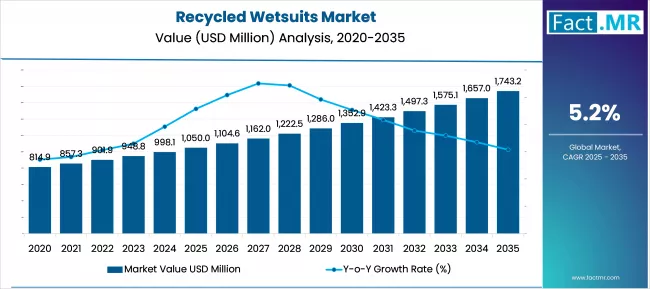
Recycled Wetsuits Market Market Value Analysis | Source: Fact.MR
What are the drivers of the Recycled Wetsuits Market?
The recycled wetsuits market is experiencing booming growth since more consumers and businesses are putting more emphasis on sustainability and environmentally friendly decisions in sports and outdoor activities. The rise in environmental consciousness and the strengthening of regulations on the ocean and plastic wastes are generating a demand to seek an eco-friendly alternative in the watersports sector.
Recycled wetsuits are worn by environmentally-conscious surfers, divers and outdoor players and they are made out of recycled neoprene and plastics. Recycling technologies are also improved with the aim of increasing durability, comfort, and price, and because of this, recycled wetsuits are also attractive. The increase in popularity of water sports and brand investments by circular economy practices and industry partnerships makes the adoption of the market faster worldwide.
What are the regional trends of the Recycled Wetsuits Market?
The environmental awareness, development of infrastructure, and regulatory systems influence the uptake of recycled wetsuits market across the region.
North America is the most adopted in the market, with good sustainability policy, state of the art recycling technologies, and high participation in watersports in the US and Canada.
In Europe, the high environmental standards and consumer attitude to the environment favor the wearing of a recycled wetsuit, particularly in such nations as Germany, France, and the Netherlands.
Asia-Pacific, with China, Japan and Australia taking the lead, demonstrates an expanding demand owing to the increased water sports activities, greater environmental consciousness and an increased recycling.
Recycled wetsuits are slowly gaining acceptance in Latin America and the Middle East due to the rise of new sustainable-oriented brands and the increase of outdoor sports.
What are the challenges and restraining factors of the Recycled Wetsuits Market?
The recycled wetsuits market has a number of challenges, among which are high cost of production, because of the complex process involved in recycling, and lack of quality recycled neoprene. Failure to adopt and have standardized recycling practices leads to unequal product performance and quality on a geographical basis.
Small and medium-sized manufacturers find it difficult to scale the operations because of high costs of recycling technologies and poor access to modern devices. The lack of confidence of consumers in durability and performance over the traditional wetsuits prevents market expansion.
In other areas, regulatory hurdles and lack of incentive to encourage sustainable production also limit industry growth. Also, there is low awareness in the emergent markets regarding recycled wetsuits, which slows down adoption, and operational problems are compounded by supply chain inefficiencies.
Country-Wise Insights
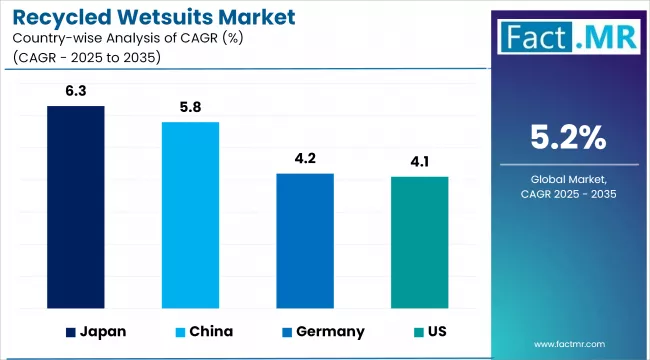
Recycled Wetsuits Market Cagr Analysis By Country | Source: Fact.MR
USA leads recycled wetsuits market with eco-conscious consumer demand
The Recycled Wetsuits Market in USA is surging at a very high rate due to the high participation in watersports like surfing, diving, and paddle boards and also because of high environmental consciousness. California, Hawaii, and Florida are of interest because they boast a large community along the coast and environmentally-sensitive consumer base.
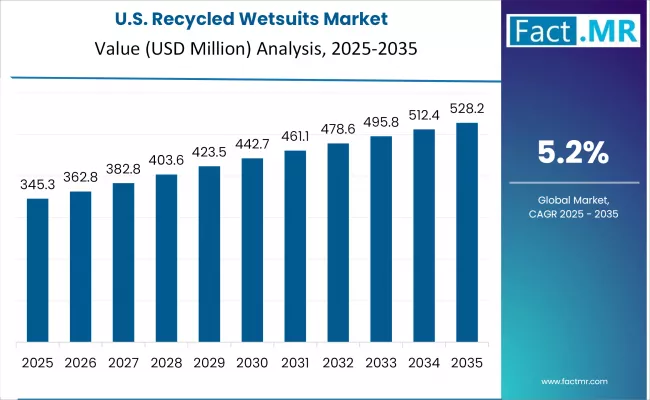
Recycled Wetsuits Market Country Value Analysis | Source: Fact.MR
Well-known brands and start-ups are developing high-technology recycling and sustainable materials, and they are supported by laws that encourage the use of the circular economy. Consumers seek greener sportswear and the shift to minimize the ocean plastic waste contributes to the development of the market. The increased outdoor activities, and the brand commitment to sustainability further boost the use of the recycled wetsuits in the US market.
Germany drives growth with strict environmental regulations, recycling focus
The recycled wetsuits market in Germany is expanding at a steady pace due to the tight environmental regulations and high demand of the sustainable products among the consumers. Germany prioritizes the circular economy with the well-developed recycling facilities and policies that encourage the environmentally friendly production. Key manufacturing regions including North Rhine-Westphalia and Bavaria incorporate some of the best neoprene recycling technologies to achieve performance and sustainability requirements.
The popularity of recycled wetsuits among water sports enthusiasts is increasing because of the increase in awareness of plastic pollution in oceans and the regulation of wetsuits. The local brands, along with environmental organizations work together, and the consumers, as environmentally responsible consumers, prefer products that assist in minimizing the carbon footprint, which propels Germany as one of the top markets in Europe.
Japan grows recycled wetsuits market via advanced technology adoption
The recycled wetsuits market in Japan is expanding because of increasing environmental consciousness and high-tech production and recycling. The watersports such as Shizuoka and Chiba have hotspots along the coast and have increased the demand of sustainable wetsuits.
The consumers of Japan are becoming more environmentally friendly and this has been backed up by the government policies on the adoption of green products and recycling. Brands also utilize the robust research and development infrastructure of Japan to develop high-performance recycled recycled wet suit that has durability and comfort similar to traditional one.
Against this backdrop, cooperation between industry players and the environmental groups reinforces the market adoption. The emphasis on the minimization of plastic waste in the sea and enhancing sustainable sportswear solutions renders Japan a significant market in the Asian-Pacific region.
Category-Wise Analysis
Recycled Neoprene dominates due to flexibility, durability, and sustainability
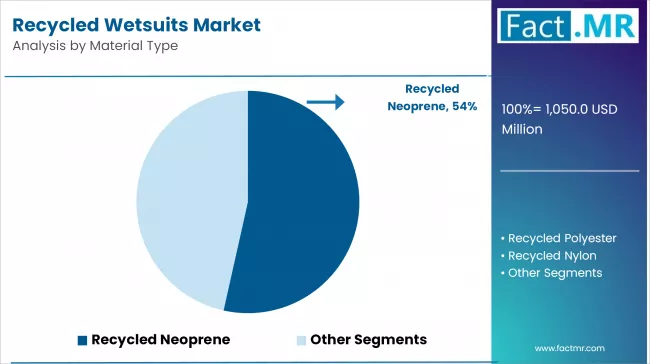
Recycled Wetsuits Market Analysis By Material Type | Source: Fact.MR
Recycled Neoprene is the predominant type of material in the Recycled Wetsuits Market because of its high flexibility, insulation, and durability that are indispensable when it comes to watersports. It is constructed using used wetsuit and industrial waste neoprene that is used and therefore it is environmental friendly due to the reduction of neoprene disposal in landfill and ocean.
The brands focusing on recycled neoprene will attract environmentally conscious consumers that want to have performance and sustainability in one product. High recycling methods contribute to keeping the material quality, and there is no worry about the material distance in terms of durability to virgin neoprene.
With increasing environmental restrictions and the preference of consumers to greener products, recycled neoprene has a huge market potential in such strategic areas as the USA, Germany, and Japan.
Surfing drives demand as eco-conscious consumers seek sustainable gear
Surfing is the biggest application sector in Recycled Wetsuits Market due to the popularity of surfing in the world as a competitive sport and a recreational sport. According to this, areas like California (USA), Australia, and Japan have a high number of surfers who are embracing the use of eco-friendly wetsuits to minimize the amounts of footprints they have on the environment.
The rise in awareness of the issue of ocean pollution, as well as brand promotion in regard to sustainability, boosts the desire in recycled wetsuits. The products offer the required insulation and flexibility to the surfers and meet their objectives of conservation of the oceans. The segment will increase consistently, as a result of the environmentally-conscience lifestyle trends.
Post-consumer recycling leads by repurposing used wetsuits sustainably
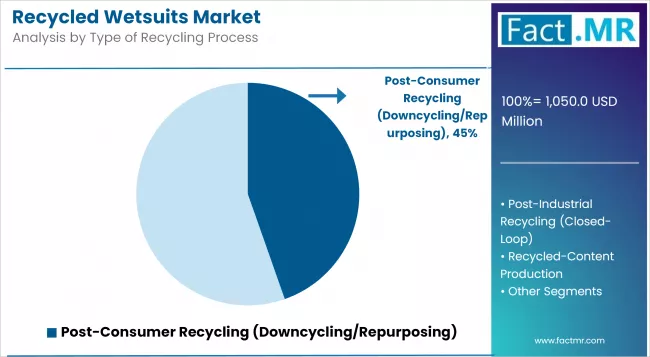
Recycled Wetsuits Market Analysis By Type Of Recycling Process | Source: Fact.MR
The recycling process segment of the Recycled Wetsuits Market is dominated by Post-Consumer Recycling (Down cycling/ Repurposing ). This is done by picking up used wetsuits used by consumers, cleaning, and converting them into products that can be reused in the formation of new recycled wetsuits or even other related products. It will prevent the material loop closure, minimize waste, and facilitate the circular economy.
Large brands and producers are increasingly spending on recycling infrastructure after consumption to meet the increasing demand and regulation on the environment and the demand on sustainable products by consumers. Challenges such as the sustenance of material quality and economical cost have been faced in the process however innovation in recycling technologies has enhanced performance thus making it one of the major sources of growth in the market in the whole world.
Competitive Analysis
The Key players in the Recycled Wetsuits Market are Patagonia, Rip Curl, O’Neill, Billabong, Xcel Wetsuits, Snawve and Quiksilver
The Recycled Wetsuits Market is a rapidly growing competitive industry with major players paying keen attention to sustainable innovation and material development in the quest to win market share. Top brands borrow and invest in enhanced recycling technologies, better neoprene alternatives and environment friendly manufacturing processes to raise the durability, comfort, and performance of their products.
Vertical integration by the market leaders which entails control of design, production, and distribution, and regional players which deal with local markets with niche and customizable solutions. One of the competitive differentiators is sustainability, material efficiency and lower carbon footprint.
Recent Development
- In September 2025, Rip Curl also enhanced its sustainability in Europe by cooperating with Circular Flow. This is in harmony with the global Rip Curl Recycling Your Wetsuit program that aims at giving old wetsuits second life use by recycling and giving them a new purpose. The project makes an emphasis on Rip Curl to reduce the amount of waste and promote the idea of the circular economy within the wetsuit industry.
- In June 2024, The owner of Billabong, Liberated Brands, launched the first of its kind of wetsuit, the Upcycler, which is made in post-consumer recycled materials. This is an innovative product made through a progression of progressive technologies like recycled polyester and neoprene alternatives, to create an extremely high performance wetsuit with a significantly reduced environmental impact.
Fact.MR has provided detailed information about the price points of key manufacturers of Recycled Wetsuits Market positioned across regions, sales growth, production capacity, and speculative technological expansion, in the recently published report.
Methodology and Industry Tracking Approach
A report by Fact.MR (2025) about the Global Recycled Wetsuits Market has surveyed 10,500 stakeholders and 30 countries are covered, with at least 300 respondents in each region. End-users and service providers (watersports retailers, sports equipment manufacturers, and environmental organizations) constituted about 60% and industry experts, recycling technology developers, material scientists, and policymakers constituted about 40 percent.
The information was gathered in the period of September 2024 - August 2025, and the specific areas were the trends in the industry, innovations in the recycling process, the influence of regulations, the market opportunities, and challenges.
More than 250 secondary sources, including the patents, industry publications, regulatory systems, as well as scholarly research, were evaluated with state-of-the-art strategies such as regression analysis and scenario-based forecasting to have the right market information.
With Fact.MR monitoring consumer behavior, product efficacy, industry trends, and market opportunities since 2018, this report is becoming an authoritative source of information that stakeholders can rely on.
Segmentation
Segmentation of Recycled Wetsuits Market
-
By Material Type :
- Recycled Neoprene
- Recycled Polyester
- Recycled Nylon
- Others (e.g., natural rubber blends)
-
By Type of Recycling Process :
- Post-Consumer Recycling (Downcycling/Repurposing)
- Post-Industrial Recycling (Closed-Loop)
- Recycled-Content Production
-
By Product Form :
- Full Wetsuits
- Shorty Wetsuits
- Spring Suits
- Rash Guards
-
By Application :
- Surfing
- Scuba Diving
- Triathlon
- Paddleboarding
- Others (e.g., kayaking, swimming)
-
By End-User :
- Men
- Women
- Children
-
By Region :
- North America
- Latin America
- Western Europe
- Eastern Europe
- East Asia
- South Asia & Pacific
- Middle East & Africa
Frequently Asked Questions
What was the Global Recycled Wetsuits Market Size Reported by Fact.MR for 2025?
Who are the Major Players Operating in the Recycled Wetsuits Market?
What is the Estimated Valuation of the Recycled Wetsuits Market in 2035?
What Value CAGR did the Recycled Wetsuits Market Exhibit Over the Last Five Years?
Who worked on this report


Preview the report firsthand - request a free sample
Free SampleGet the brochure for pricing and purchase details
Download PDF