- Base Value(2025): 98.3 Bn
- Estimated Value(2026): 102.8 Bn
- Forecast Value (2036): 164.2 Bn
- CAGR (2026 - 2036): 4.8%
Self-Administered Biologics Market Forecast and Outlook 2026 To 2036
In 2025, the self-administered biologics market was valued at USD 98.3 billion. Based on FACT.MR analysis, demand for self-administered biologics is estimated to grow to USD 102.8 billion in 2026 and USD 164.2 billion by 2036. FACT.MR projects a CAGR of 4.8% during the forecast period.
The market is set to add an absolute USD 61.4 billion between 2026 and 2036, a gain that is transformational in scale and reflects the compound effect of ageing populations in high-income economies, sustained biosimilar entry expanding patient access across middle-income markets, and the progressive shift of chronic disease management from clinic-administered IV infusions to subcutaneous home injection formats. Growth is moderated by biologic pricing pressures from reference pricing policies in Europe, increasing biosimilar competition compressing originator revenues in mature indications, and the high cost of next-generation wearable injector development that not all manufacturers can sustain.
Industry leadership has underscored the strategic centrality of device-biologic co-development. Riccardo Marcon, Senior Vice President of Drug Containment Solutions, Stevanato Group states, “There is a pressing market need for innovative solutions to support larger volumes of up to 20mL in a self-administered setting while strictly maintaining safety, therapeutic efficacy, and patient convenience."
Country level growth varies by disease burden, reimbursement policy, and digital health readiness. China leads with 14.2% CAGR, supported by expanded biologic reimbursement and rising domestic biosimilar production. India follows at 12.8%, driven by local manufacturers expanding pen injector portfolios and broader government access programs. Canada grows at 11.9% as provincial drug plans promote biosimilar substitution and home injection adoption. The United States records 9.8% growth, sustained by specialty pharmacy expansion and payer incentives despite market maturity. The United Kingdom posts 6.7%, where NHS biosimilar switching increases self-administration volumes but reference pricing limits revenue growth.
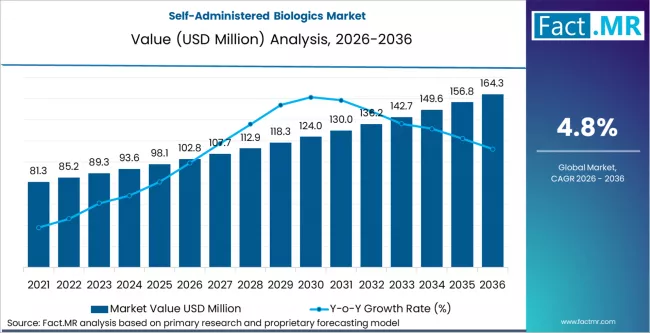
Self Administered Biologics Market Market Value Analysis | Source: Fact.MR
Market Definition
The self-administered biologics market encompasses biological medicines, including monoclonal antibodies, fusion proteins, cytokine inhibitors, insulin analogues, and peptide hormones, that are formulated and packaged for patient self-injection outside of clinical settings using prefilled syringes, autoinjectors, pen injectors, or wearable patch-pump devices. These products treat chronic autoimmune conditions, endocrine disorders, infectious diseases, and oncology support indications. The market is defined by the combination of the biologic molecule and its delivery device system, sold through hospital pharmacy, retail, online, and specialty clinic distribution channels to patients managed on long-term or recurring self-injection regimens.
Market Inclusions
The report covers global and regional market sizing from 2026 to 2036, segmented by product type, therapeutic area, and distribution channel. It analyses pricing dynamics across originator and biosimilar segments, device platform adoption trends, reimbursement policy impacts on patient access, and the competitive positioning of leading biologic manufacturers and their delivery device partners across North America, Europe, Asia-Pacific, Latin America, and Middle East and Africa.
Market Exclusions
The scope excludes biologic medicines administered exclusively by healthcare professionals in clinical or hospital settings via intravenous infusion, unless a subcutaneous self-administration formulation is commercially available for the same molecule. It also omits small-molecule specialty drugs, inhaled biologics not delivered by injection, and gene therapy or cell therapy products that require clinical administration infrastructure, focusing strictly on self-injectable biologic drug-device combinations and their immediate supply chain and distribution intermediaries.
Research Methodology
- Primary Research: Primary research involved structured interviews with specialty pharmacy directors, hospital formulary pharmacists, and rheumatology and endocrinology clinic managers in the United States, Germany, United Kingdom, Japan, and India, as well as device development leads at biologic manufacturers and contract device organisations.
- Desk Research: Desk research synthesized data from FDA product approval databases, EMA public assessment reports, national reimbursement authority formulary publications, company annual reports and investor presentations from listed biologic manufacturers, and peer-reviewed adherence and patient preference studies published in clinical pharmacology journals.
- Market-Sizing and Forecasting: Market sizing employed a hybrid top-down and bottom-up approach, combining diagnosed patient population estimates by therapeutic area and country with average annual drug cost by product type and delivery format, anchored against disclosed net sales figures from publicly listed manufacturers and biosimilar market share data from national health authority reports.
- Data Validation and Update Cycle: Outputs were cross-validated against disclosed segment revenues from Amgen, AbbVie, Eli Lilly, and Novo Nordisk investor filings, reconciled semi-annually with new biologic approvals, biosimilar market entry events, and national reimbursement policy updates published by FDA, EMA, and national health technology assessment bodies.
Summary
-
Market Definition
- Self-administered biologics are injectable biological medicines, including monoclonal antibodies, insulin analogues, and cytokine inhibitors, packaged in patient-operable autoinjectors, prefilled syringes, pen devices, or wearable pumps for long-term home management of chronic autoimmune, endocrine, oncology, and infectious disease indications.
-
Demand Drivers
- Payer-led biosimilar substitution mandates in Canada, the United Kingdom, and multiple European Union countries are generating new self-injection patient volumes by enabling broader formulary access to adalimumab, etanercept, and trastuzumab subcutaneous biosimilars at reimbursed prices that previously excluded lower-income patient populations from biologic therapy.
- Rising prevalence of type 2 diabetes, rheumatoid arthritis, and inflammatory bowel disease across Asia-Pacific markets is creating structurally new demand for self-injectable biologics in countries where historically low biologic penetration rates offer the largest untapped patient populations relative to diagnosed disease burden.
- Specialty pharmacy channel expansion and digital adherence platform integration in the United States are extending the commercial reach of autoinjector-delivered biologics into home infusion settings, reducing hospital administration dependency and enabling biologic manufacturers to capture incremental patient retention value through connected device programmes.
-
Key Segments Analyzed
- By Product Type, Prefilled Syringes command 35% share, reflecting their established role as the most broadly deployed self-injection platform across originator biologics and biosimilars; their compatibility with existing aseptic fill-finish manufacturing infrastructure gives them cost and regulatory pathway advantages that pen injectors and autoinjectors are only beginning to close.
- By Therapeutic Area, Autoimmune & Chronic Diseases leads at 40% share, driven by the high patient volume and long treatment duration of rheumatoid arthritis, psoriasis, Crohn's disease, and multiple sclerosis indications, which generate repeat prescription cycles that make self-injection format optimization commercially critical for manufacturers.
- By Distribution Channel, Hospital Pharmacies hold 40% share as the primary dispensing point for high-cost originator biologics under specialty distribution agreements, while Online Pharmacies are the fastest-growing channel as payer digital health programs and specialty pharmacy home delivery models expand biologic dispensing beyond traditional retail and clinical settings.
-
Analyst Opinion at FACT.MR
- Shambhu Nath Jha, Principal Consultant at Fact.MR, opines, 'CXOs will find this report essential for understanding how reimbursement policy evolution across biosimilar markets and the commercial premium commanded by superior device platforms are reshaping the revenue architecture of self-administered biologics, and which therapeutic areas and geographies offer the highest near-term return on device investment.'
-
Executive Takeaways
- Biologic manufacturers approaching patent cliffs should invest in next-generation subcutaneous formulation development and auto injector platform upgrades before biosimilar entry, using device differentiation to maintain formulary preference and patient retention in markets where biosimilar substitution is automated or payer-mandated.
- Specialty pharmacy operators should build digital adherence programme capabilities that combine connected device data, patient coaching, and refill automation, positioning themselves as value-added distribution partners rather than commodity dispensers to capture preferred distribution agreements from biologic manufacturers protecting patient retention.
- Manufacturers targeting Asia-Pacific growth should prioritise local clinical data generation for subcutaneous formulations in regional regulatory submissions, given that China's NMPA and India's CDSCO increasingly require country-specific pharmacokinetic bridging data for drug-device combination approvals, creating a regulatory entry barrier that early movers can exploit as a competitive advantage.
-
Methodology
- Market sizing was built from patient population models by therapeutic area and country, calibrated against national health authority reimbursement data and manufacturer net sales disclosures to ensure aggregate estimates align with observable commercial revenue trajectories.
- Biosimilar market shares and pricing dynamics were modelled using national tender outcome data, pharmacy substitution rate reports from health technology assessment bodies, and disclosed biosimilar revenue segments from AbbVie, Amgen, and Pfizer investor filings.
- Device adoption rates were estimated using launch timing data from FDA 510(k) clearances and CE-marked combination product approvals, combined with primary research on prescriber and patient preference across delivery format categories.
Segmental Analysis
Self-administered Biologics Market Analysis by Product Type
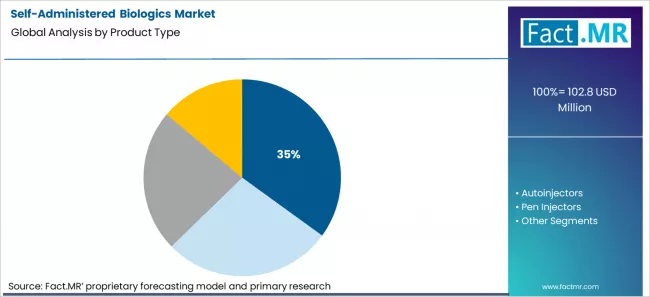
Self Administered Biologics Market Analysis By Product Type | Source: Fact.MR
Prefilled syringes are projected to hold 35% share in 2026. They remain dominant because they are simple, widely compatible with existing manufacturing lines, and easier to launch globally without proprietary device complexity. This makes them the preferred format for biosimilars and rapid new product entry.
- Becton Dickinson announced a USD 1.2 billion investment in 2023 to expand prefilled syringe capacity and develop polymer based platforms suited for high concentration biologics [5].
- Auto injector innovation is advancing as well. Antares Pharma, now part of Halozyme Therapeutics, expanded commercial use of its VIBEX QuickShot platform to improve injection comfort and patient adherence [6].
Self-administered Biologics Market Analysis by Therapeutic Area
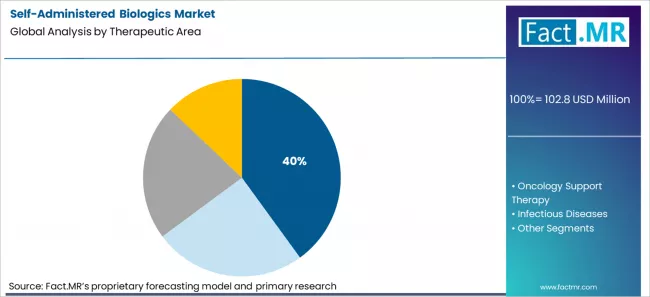
Self Administered Biologics Market Analysis By Therapeutic Area | Source: Fact.MR
Autoimmune and chronic diseases are expected to hold 40% market share in 2026. Long treatment durations and high adherence needs make device experience critical in this segment. The large installed base of patients using self-injection continues to drive demand.
- In oncology, Roche and Genentech completed EU rollout of subcutaneous trastuzumab and pertuzumab, with rapid patient transition from IV infusion to faster injection formats [7].
- In endocrinology, Eli Lilly launched the connected Tempo Pen system in 2023, integrating insulin dosing with digital monitoring platforms and reinforcing the shift toward data enabled self-administration [8].
Drivers, Restraints, and Opportunities
FACT.MR analysts note that the self-administered biologics market has grown over two decades on the back of major autoimmune and endocrine blockbusters such as adalimumab, etanercept, and insulin glargine. The sector is now entering a second transition phase, where biosimilar competition and next generation biologics in oncology and rare diseases are reshaping revenue mix and growth patterns.
The central dynamic is clear. Biosimilar are lowering prices in mature autoimmune categories, reducing per unit revenue. At the same time, lower prices are expanding patient access and increasing total treatment volumes. Originator companies are shifting strategy toward device innovation, high concentration formulations, and subcutaneous versions of IV drugs. This product and device integration allows manufacturers to offset drug price pressure with device services, adherence tools, and patient support programs that generate recurring value.
- Biosimilar reimbursement mandates in Canada have accelerated switching from originators to lower cost alternatives, directly increasing autoinjector volumes across provinces [2].
- China’s National Healthcare Security Administration expanded its reimbursement list in 2023 to include more subcutaneous biologics, significantly enlarging the eligible patient pool for rheumatoid arthritis and psoriasis treatments [3].
- Wearable injectors are also gaining traction. High volume biologics now require delivery systems beyond traditional syringes. BD Medical’s Libertas and Enable Injections’ enJogo platforms entered commercial agreements in 2023 and 2024, marking the shift from pilot programs to scaled adoption [4].
Regional Analysis
The self-administered biologics market is analyzed across North America, Europe, Asia-Pacific, Latin America, and Middle East and Africa. Regional variation is driven by national reimbursement policy, biosimilar adoption rates, chronic disease prevalence, and specialty pharmacy infrastructure maturity. The full report offers detailed market attractiveness analysis comparing payer dynamics, device platform preferences, and competitive intensity by region.
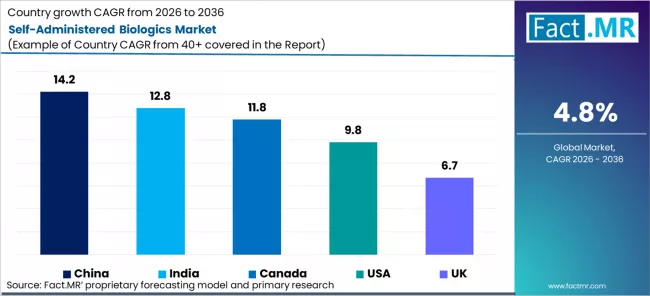
Self Administered Biologics Market Cagr Analysis By Country | Source: Fact.MR
| Country | CAGR% |
|---|---|
| China | 14.2% |
| India | 12.8% |
| Canada | 11.9% |
| United States | 9.8% |
| United Kingdom | 6.7% |
Source: Fact.MR analysis. Updated Feb 23, 2026
Source: Fact.MR (FACT.MR) analysis, based on proprietary forecasting model and primary research
North America Self-administered Biologics Market Analysis
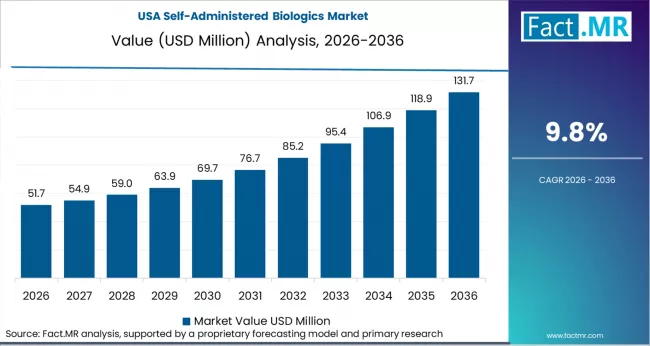
Self Administered Biologics Market Country Value Analysis | Source: Fact.MR
North America remains the largest revenue contributor to the self-administered biologics market. High list prices, strong specialty pharmacy networks, and complex payer systems protect originator revenues even as biosimilar gain share. Leading companies such as Amgen, AbbVie, and Eli Lilly and Company maintain dominance through payer contracts and proprietary delivery devices.
- United States: The U.S. market is projected to grow at 9.8% CAGR through 2036. Around five million patients use self-injectable autoimmune biologics supported by specialty pharmacies and pharmacy benefit managers. The Inflation Reduction Act will introduce Medicare drug price negotiations from 2026, affecting select biologics including insulin. Manufacturers are responding with device innovation and expanded domestic production to defend formulary position.
Europe Self-administered Biologics Market Analysis
Europe acts as a global testing ground for biosimilar policy. Reference pricing and national substitution programs have accelerated the shift from originators to biosimilars. Companies such as Sandoz and Samsung Bioepis compete strongly in tender driven systems where device compatibility influences procurement outcomes.
- United Kingdom: The UK market is expected to grow at 6.7% CAGR through 2036. NHS England’s biosimilar programme has rapidly shifted patients to lower cost adalimumab and etanercept autoinjectors. By 2024, biosimilars captured most rheumatology share. Updated NHS frameworks and NICE guidance support high concentration subcutaneous formulations, reinforcing device upgrades and standardizing biosimilar self-injection across secondary care.
Asia Pacific Self-administered Biologics Market Analysis
Asia Pacific offers the strongest volume growth potential. Rising chronic disease prevalence and expanding reimbursement are creating new patient populations. Domestic companies such as Biocon Biologics and 3SBio compete alongside multinational firms, with pricing and local manufacturing scale playing a central role.
- China: China is projected to grow at 14.2% CAGR through 2036. Expanded reimbursement under the National Healthcare Security Administration has widened access to subcutaneous biologics for rheumatology patients. Faster regulatory reviews for drug device combinations are reducing approval timelines. Domestic manufacturers are scaling autoinjector production, increasing competition and raising quality standards across the biologics sector.
- India: India is forecast to grow at 12.8% CAGR through 2036. Biocon Biologics expanded biosimilar insulin and trastuzumab pen injector distribution through government tenders in 2023. Updated guidance from the Central Drugs Standard Control Organisation clarified approval pathways for combination devices. National non communicable disease programmes are also expanding insulin access at primary care level, strengthening public demand.
- Canada: Canada is expected to grow at 11.9% CAGR through 2036. Provincial biosimilar transition policies have moved large patient populations onto lower cost autoinjectors. Health Canada updated combination product regulations in 2023, aligning with global standards. The Canadian Agency for Drugs and Technologies in Health now evaluates device features in reimbursement reviews, making delivery technology more central to market access decisions.
Competitive Aligners for Market Players
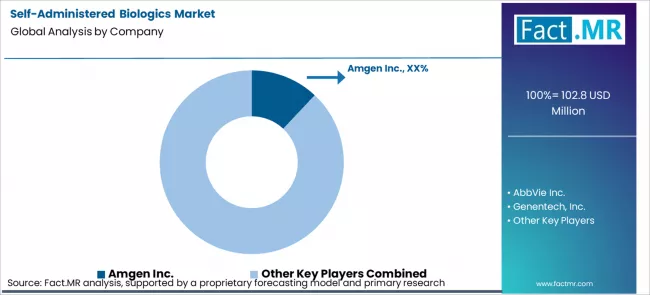
Self Administered Biologics Market Analysis By Company | Source: Fact.MR
The self-administered biologics market is moderately concentrated among leading originator companies. Major manufacturers such as AbbVie, Amgen, Johnson & Johnson, Eli Lilly and Company, Pfizer, Roche, Sanofi, Bristol Myers Squibb, Merck & Co., and Novartis together generate roughly two thirds of global revenue. High development costs, long clinical timelines, and complex regulatory pathways limit entry to well capitalized firms.
The biosimilar segment is more fragmented. Companies such as Samsung Bioepis, Sandoz, Celltrion, Biocon Biologics, and Pfizer Biosimilars compete across selected molecules.
Competitive advantage increasingly depends on delivery devices, patient support programs, and payer contracts rather than molecule patents alone. AbbVie’s Humira lifecycle strategy showed how device upgrades can extend market leadership. Similarly, connected insulin pens and new subcutaneous formats help companies maintain reimbursement strength even after exclusivity ends.
Large pharmacy benefit managers shape access through formulary control and substitution mandates. As a result, manufacturers must prove that device features improve outcomes or reduce total care costs to secure preferred positioning at scale.
Key Players
- Amgen Inc.
- AbbVie Inc.
- Genentech, Inc.
- Johnson & Johnson
- Pfizer Inc.
- Sanofi S.A.
- Bristol Myers Squibb Company
- Merck & Co., Inc.
- GSK plc
- Regeneron Pharmaceuticals, Inc.
- Novartis AG
- Eli Lilly and Company
Report Address
- Market intelligence for strategic planning with analysis of self-injection platform migration from prefilled syringes toward autoinjectors, pen devices, and wearable injectors across originator and biosimilar segments.
- Market size and forecast showing valuation of USD 102.8 billion in 2026 and projected USD 164.2 billion by 2036 at 4.8% CAGR.
- Growth opportunity mapping across biosimilar autoinjector platforms, connected device programmes, high-concentration subcutaneous formulations, and online pharmacy distribution channel expansion.
- Segment and regional forecasts covering all major countries with product type, therapeutic area, and distribution channel breakdowns.
- Competition strategy assessment of originator and biosimilar manufacturers including payer contracting models, device platform investment strategies, and specialty pharmacy partnership structures.
- Product and compliance tracking of FDA drug-device combination approval pathways, EMA biosimilar guidance updates, and national health technology assessment reimbursement policy changes affecting self-injection biologic access.
- Biosimilar market penetration analysis comparing transition rate timelines and device substitution dynamics across North America, Europe, and Asia-Pacific.
- Report delivery in Excel, PowerPoint, and PDF formats with fully validated data, primary research evidence, and source documentation.
Bibliography
- [1] Stevanato Group. (2026, January 16). Datwyler, LTS Device Technologies, and Stevanato Group collaborate to expand self-delivery options for large-volume drugs
- [2] British Columbia Ministry of Health, Biosimilar Drugs Policy Update, May 2019 (updated through 2023).
- [3] National Healthcare Security Administration, People's Republic of China, 2023 National Reimbursement Drug List Announcement, December 2023.
- [4] Enable Injections, Commercial Partnership Announcements 2024, March 2024.
- [5] Becton Dickinson and Company, Fiscal Year 2023 Annual Report and Investor Day Presentation, November 2023.
- [6] Halozyme Therapeutics, VIBEX QuickShot Partnership Programme Update, Annual Report 2023, February 2024.
- [7] Enable Injections, enJogo Wearable Injector Commercial Agreement Announcement, January 2024.
- [8] AbbVie Inc., Annual Report 2023 - Immunology Pipeline Section, February 2024.
Segmentation
Scope of Report
| Items | Values |
|---|---|
| Quantitative Units | USD 102.8 billion (2026) to USD 164.2 billion (2036), at a CAGR of 4.8% |
| Market Definition | Self-administered biologics are injectable biological medicines, including monoclonal antibodies, insulin analogues, and cytokine inhibitors, packaged in patient-operable autoinjectors, prefilled syringes, pen devices, or wearable pumps for long-term home management of chronic autoimmune, endocrine, oncology, and infectious disease indications. |
| Product Type | Prefilled Syringes, Autoinjectors, Pen Injectors, Wearable, Injectors |
| Therapeutic Area | Autoimmune & Chronic Diseases, Oncology Support Therapy, Infectious Diseases, Endocrinology |
| Distribution Channel | Hospital Pharmacies, Retail Pharmacies, Online Pharmacies, Specialty Clinics |
| Regions Covered | Asia Pacific, Europe, North America, Latin America, Middle East & Africa |
| Countries Covered | China, Japan, South Korea, Australia & New Zealand, India, ASEAN, Rest of Asia Pacific, Norway, Germany, United Kingdom, France, Spain, Netherlands, Nordics, Rest of Europe, United States, Canada, Mexico, Brazil, Chile, Ecuador, Rest of Latin America, Kingdom of Saudi Arabia, United Arab Emirates, South Africa, Turkey, Rest of Middle East & Africa |
| Key Companies Profiled | Amgen Inc., AbbVie Inc., Genentech, Inc., Johnson & Johnson, Pfizer Inc., Sanofi S.A., Bristol Myers Squibb Company, Merck & Co., Inc., GSK plc, Regeneron Pharmaceuticals, Inc., Novartis AG, and Eli Lilly and Company. |
| Forecast Period | 2026 to 2036 |
| Approach | Top down and bottom up market modeling validated through primary interviews with biologic manufacturers, biosimilar developers, specialty pharmacy executives, hospital procurement heads, and regulatory consultants, supported by national reimbursement data, health technology assessment reports, biologic sales disclosures, clinical trial databases, and company reported revenue and manufacturing investment figures. |
Source: Fact.MR analysis. Updated Feb 23, 2026
Self-administered Biologics Market by Segment
-
By Product Type :
- Prefilled Syringes
- Autoinjectors
- Pen Injectors
- Wearable Injectors
-
By Therapeutic Area :
- Autoimmune & Chronic Diseases
- Oncology Support Therapy
- Infectious Diseases
- Endocrinology
-
By Distribution Channel :
- Hospital Pharmacies
- Retail Pharmacies
- Online Pharmacies
- Specialty Clinics
-
Region :
- Asia Pacific
- China
- Japan
- South Korea
- Australia & New Zealand
- India
- ASEAN
- Rest of Asia Pacific
- Europe
- Germany
- United Kingdom
- France
- Spain
- Italy
- Nordics
- Rest of Europe
- North America
- United States
- Canada
- Mexico
- Latin America
- Brazil
- Argentina
- Rest of Latin America
- Middle East & Africa
- United Arab Emirates
- Kingdom of Saudi Arabia
- South Africa
- Rest of Middle East & Africa
- Asia Pacific
Frequently Asked Questions
How large is the self-administered biologics market in 2025?
What will the market size be in 2026?
What is the projected market size by 2036?
What is the expected CAGR for the forecast period 2026 to 2036?
Which Product Type segment holds the largest market share?
Which Therapeutic Area segment dominates in 2026?
Which Distribution Channel holds the largest share?
Which country shows the fastest CAGR?
What is the absolute dollar growth from 2026 to 2036?
How significant is the United States self-administered biologics market?
Who worked on this report


Preview the report firsthand - request a free sample
Free SampleGet the brochure for pricing and purchase details
Download PDF