- Market Value (2025): USD 1.0 Bn
- Estimated Value (2026): USD 1.2 Bn
- Forecast Value (2036): USD 6.7 Bn
- CAGR (2026-2036): 18.4%
What is the Solid-State Breaker Systems Market forecast to be worth by 2036?
USD 1.2 billion in 2026 to USD 6.7 billion by 2036 at an 18.4% CAGR.
- The Solid-State Breaker Systems Market reached USD 1.0 billion in 2025.
- Demand is projected to increase from USD 1.2 billion in 2026 to USD 6.7 billion by 2036.
- The market is forecast to record 18.4% CAGR from 2026 to 2036 as data centers, DC microgrids and EV charging sites specify faster electronic protection.
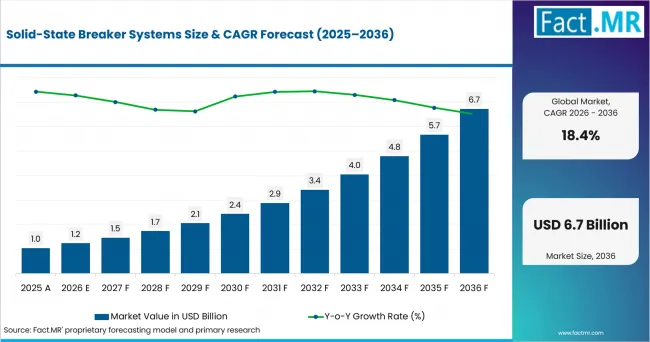
Solid State Breaker Systems Value Analysis | Source: Fact.MR
What are the defining numbers behind Solid-State Breaker Systems Market growth?
An absolute opportunity of USD 5.5 billion is expected between 2026 and 2036.
- Demand Drivers in the Market
- Data center operators need faster fault isolation as higher rack power raises short-circuit energy. Lawrence Berkeley National Laboratory’s June 2026 United States Data Center Energy Usage Report: 2025 Update estimates that data centers could account for 11.8% of total U.S. electricity use by 2030. Semiconductor breakers are expected to protect these loads before a fault spreads across power rooms.
- Battery storage integrators need bidirectional current interruption for inverter-connected systems. The U.S. Energy Information Administration reported in August 2026 that operational battery storage reached 43.6 GW at the end of 2025. Resettable solid-state protection is anticipated to gain attention where batteries and converters share DC buses.
- Power-electronics designers need SiC devices that reduce conduction loss in energized protection paths. Better device efficiency is expected to help breaker suppliers manage heat in compact modules and lower operating losses in continuous-duty DC protection.
- Key Segments Analyzed
- By Semiconductor Platform: SiC MOSFET is expected to hold 39.0% share in 2026 due to lower conduction losses and strong fit with fast DC interruption.
- By Voltage Class: <1 kV is projected to account for 31.0% share in 2026 supported by data center cabinets and low-voltage microgrids.
- By Application: Data centers are anticipated to capture 26.0% share in 2026 attributable to rising power density and uptime targets.
- By Protection Function: Ultra-fast short-circuit isolation is estimated to represent 34.0% share in 2026 owing to microsecond fault clearing needs.
- Analyst Opinion at Fact.MR
- Shambhu Nath Jha, Principal Consultant at Fact.MR, states, "Solid-state breakers are drawing attention because DC systems expose faults faster than many mechanical devices are built to clear. The market is projected to expand as buyers connect protection performance with uptime, safety and converter reliability. Suppliers should combine certified breaker hardware, SiC device depth and field guidance for data center and storage projects."
- Strategic Implications
- Breaker manufacturers should publish interruption speed, loss profile and certification evidence in one technical package for facility engineers.
- Power-module suppliers should align SiC MOSFET and JFET portfolios with breaker duty cycles and thermal paths.
- System integrators should qualify protection settings early in data center and ESS designs to reduce panel redesign later.
- Channel partners should train service teams on remote reset and diagnostic workflows for DC cabinets.
South Korea is forecast to post 23.4% CAGR through 2036 supported by distribution ESS funding. The USA is projected to record 21.1% CAGR through rising data center electricity demand. The UK is anticipated to advance at 20.7% CAGR with AI Growth Zone power-access reforms. Japan is estimated to reach 19.7% CAGR attributable to AI and semiconductor policy support. Germany is forecast to grow at 18.9% CAGR through grid expansion and power-electronics capability.
How does the Solid-State Breaker Systems Market break down by segment?
SiC MOSFET leads Semiconductor Platform at 39.0%; Ultra-fast short-circuit isolation leads Protection Function at 34.0%.
Which Semiconductor Platform dominates?
SiC MOSFET is expected to hold 39.0% share in 2026.
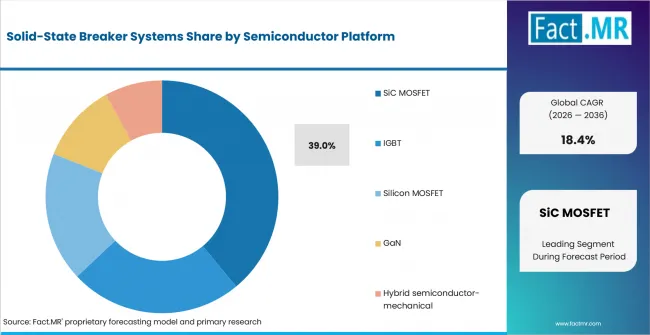
Solid State Breaker Systems Analysis By Semiconductor Platform | Source: Fact.MR
SiC MOSFET platforms lead because solid-state breakers remain energized during normal operation and must manage conduction loss. Their faster switching and thermal behavior help designers build compact modules for DC cabinets. IGBT platforms continue in higher-power architectures where established controls remain useful. Silicon MOSFETs retain an important role in lower-voltage designs. Separately, Infineon reported in June 2026 that its production-released CoolSiC™ JFET in Q-DPAK achieves RDS(on) values as low as 1.6 mΩ at 750 V.
What leads the Voltage Class segment?
<1 kV is projected to account for 31.0% share in 2026.
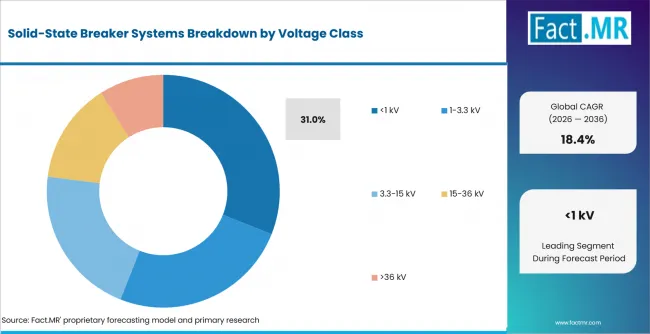
Solid State Breaker Systems Analysis By Voltage Class | Source: Fact.MR
<1 kV systems lead because many early commercial uses are tied to low-voltage DC panels, EV chargers and data center distribution. These systems help engineering teams test fast electronic protection before moving into medium-voltage DC networks. The 1-3.3 kV range follows where storage converters raise system voltage.
How does Application shape demand?
Data centers are anticipated to capture 26.0% share in 2026.
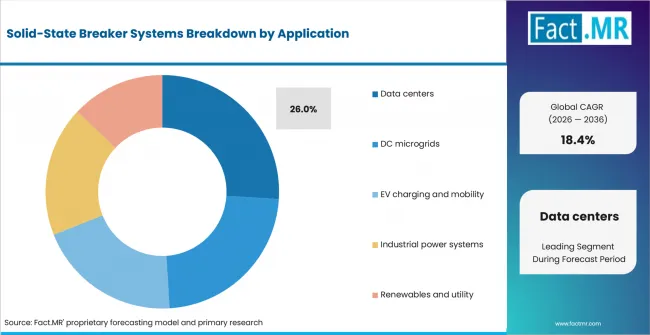
Solid State Breaker Systems Analysis By Application | Source: Fact.MR
Data centers lead application demand because uptime economics make short fault-clearing times valuable. Higher power density increases the need for protection that isolates a fault before equipment damage spreads. DC microgrids follow as campuses and distributed energy projects add storage. EV charging sites create another adoption route as depot cabinets require compact protection. DOE’s July 2025 FEMP fact sheet stated that U.S. data center energy use is projected to grow at a 13% to 27% compound annual rate from 2023 through 2028.
What supports demand for ultra-fast short-circuit isolation within Protection Function?
Ultra-fast short-circuit isolation is estimated to represent 34.0% share in 2026.
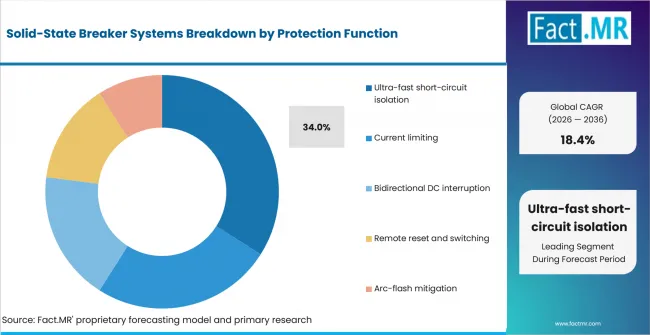
Solid State Breaker Systems Analysis By Protection Function | Source: Fact.MR
Ultra-fast short-circuit isolation leads because it defines the main reason many buyers evaluate semiconductor breakers. Mechanical devices often clear faults on a slower time scale, while semiconductor systems interrupt electronically. Current limiting follows where operators need to reduce peak fault energy. Bidirectional DC interruption becomes more relevant in storage and charger designs. ABB reported in July 2026 that SACE Infinitus can deliver fault interruption below 25 microseconds.
What is accelerating Solid-State Breaker Systems Market adoption, and what is holding it back?
DC fault speed drives adoption; qualification cost restrains it.
Drivers Impact Analysis
| Driver | (~) % IMPACT ON CAGR | Geographic Relevance | Impact Timeline |
|---|---|---|---|
| Data center DC protection needs | +2.4% | North America, Europe, East Asia | Short term (<= 2 years) |
| Battery storage and microgrid expansion | +1.9% | USA, South Korea, Germany | Medium term (2-4 years) |
| SiC device performance gains | +1.5% | Japan, Germany, South Korea | Medium term (2-4 years) |
| EV charging cabinet density | +1.1% | UK, USA, Japan | Long term (>= 4 years) |
Source: Fact.MR analysis. Updated Sep 7, 2026
- Data center DC protection needs: Facility engineers increasingly prioritize rapid fault interruption as data centers operate with denser electrical loads. Semiconductor-based breakers can support faster protection, compact architectures, and coordinated control across modern DC power systems.
- Battery storage and microgrid expansion: Energy-storage and microgrid systems create bidirectional current flows that require coordinated converter and breaker behavior. Solid-state protection can support faster fault handling, remote control, and more flexible protection strategies across distributed energy systems.
- SiC device performance gains: Advances in silicon carbide power semiconductors can improve the efficiency and thermal performance of normally energized breaker paths. Lower-loss devices strengthen the operating case for compact solid-state protection in high-power DC and electrified systems.
- EV charging cabinet density: High-power charging cabinets need compact protection that can respond quickly to faults and support remote reset or system coordination. Solid-state breakers can become more relevant as charging networks expand and operators seek to reduce service interruptions across distributed sites.
Opportunity Impact Analysis
| Opportunity | (~) % IMPACT ON CAGR | Geographic Relevance | Impact Timeline |
|---|---|---|---|
| Data center low-voltage DC rooms | +1.5% | USA, UK, Germany | Medium term (2-4 years) |
| ESS and renewable microgrids | +1.2% | South Korea, USA, Japan | Medium term (2-4 years) |
| Certified breaker packages | +0.9% | Europe, North America | Short term (<= 2 years) |
Source: Fact.MR analysis. Updated Sep 7, 2026
- Data center low-voltage DC rooms: Low-voltage DC power rooms provide a practical entry point for solid-state protection. Earlier integration of breaker requirements into electrical design can favor suppliers that provide validated DC protection packages with clear performance and installation guidance.
- ESS and renewable microgrids: Energy-storage systems and renewable microgrids create recurring demand for bidirectional current protection. Solid-state circuit breakers can support faster fault response, remote control, and coordinated protection across distributed DC power architectures.
- Certified breaker packages: Buyers increasingly value protection systems that combine rapid interruption with certification, lifecycle documentation, and clear service requirements. Complete product files help plant engineers compare protection performance, installation needs, maintenance expectations, and system compatibility during qualification.
Restraints Impact Analysis
| Restraint | (~) % IMPACT ON CAGR | Geographic Relevance | Impact Timeline |
|---|---|---|---|
| Higher upfront electronics cost | -0.8% | Global | Short term (<= 2 years) |
| Application-specific coordination work | -0.6% | Global | Medium term (2-4 years) |
| Thermal management requirements | -0.4% | North America, East Asia, Europe | Medium term (2-4 years) |
Source: Fact.MR analysis. Updated Sep 7, 2026
- Higher upfront electronics cost: Solid-state breakers contain more power-electronic and control components than conventional protection devices, increasing initial system cost. Engineering teams therefore weigh the premium against potential benefits such as faster interruption, reduced downtime, lower maintenance needs, and improved arc-flash management.
- Application-specific coordination work: Solid-state and hybrid breakers require careful coordination with converters, power supplies, and other protective devices in DC systems. Engineers must match breaker behavior with circuit characteristics, fault-current rise rates, and system protection requirements before deployment.
- Thermal management requirements: Continuous current through semiconductor switching paths generates heat that must be controlled inside compact breaker assemblies. Even with lower-loss devices, heat sinks, airflow, enclosure design, and operating temperature remain important qualification considerations.
Which countries are scaling the Solid-State Breaker Systems Market through 2036?
- The country comparison spans 4.47 percentage points and forms three growth bands across the forecast period.
- South Korea remains 2.28 percentage points above the USA through distribution ESS funding and local SiC capacity build-out.
- The USA remains 0.38 percentage point above the UK as data center power demand and grid funding expand together.
- The UK remains 0.98 percentage point above Japan as AI Growth Zone reforms improve power access for data center projects.
- Japan remains 0.83 percentage point above Germany through AI and semiconductor support tied to high-efficiency power electronics.
Comparable CAGRs create different entry conditions due to power access, grid reinforcement, ESS deployment and local SiC supply. Full report coverage includes North America, Latin America, Western Europe, Eastern Europe, East Asia, South Asia & Pacific and Middle East & Africa.
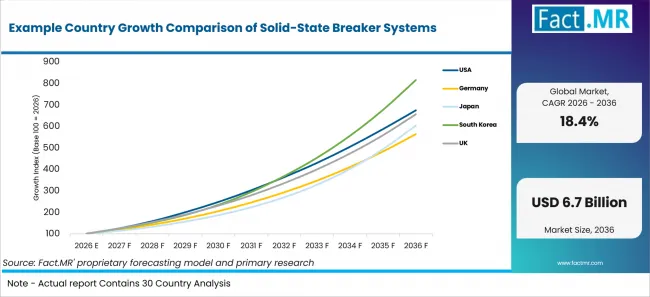
Example Country Growth Comparison Of Solid State Breaker Systems | Source: Fact.MR
| Country | CAGR (2026-2036) |
|---|---|
| South Korea | 23.4% |
| USA | 21.1% |
| UK | 20.7% |
| Japan | 19.7% |
| Germany | 18.9% |
Source: Fact.MR analysis. Updated Sep 7, 2026
What is powering South Korea’s lead?
23.4% CAGR, supported by SiC power semiconductor capacity build-out.
Korean utilities and microgrid developers are moving toward storage-backed distribution networks. South Korea is forecast to post 23.4% CAGR through 2036. Busan said in May 2026 that the city plans KRW 40 billion for a second 8-inch SiC power semiconductor fab by 2027. Local device capacity helps breaker designers align SiC switches with converter controls.
How is the USA scaling demand?
21.1% CAGR, driven by data center load growth and grid infrastructure funding.
U.S. data center operators and storage integrators are increasing interest in fast cabinet-level isolation. The USA is projected to record 21.1% CAGR through 2036. DOE announced in March 2026 that SPARK provides approximately USD 1.9 billion for electricity infrastructure investments. Grid-upgrade activity increases the need for faster protection around large loads and storage interfaces.
What supports the UK outlook?
20.7% CAGR, backed by AI Growth Zone power-access reforms.
UK data center projects face power-access constraints that favor earlier protection planning. The UK is anticipated to advance at 20.7% CAGR through 2036. DSIT said in November 2025 that AI Growth Zone interventions reduce time to power by up to five years. Shorter grid-access timelines are expected to pull breaker evaluation earlier in data center electrical design.
How does Japan perform?
19.7% CAGR, led by AI and semiconductor industrial support.
Japanese equipment makers are aligning high-efficiency power electronics with AI and semiconductor capacity planning. Japan is estimated to reach 19.7% CAGR through 2036. METI said in February 2025 that the AI and semiconductor framework provides more than JPY 10 trillion in public support over seven years. Local device know-how supports breaker platforms that require SiC and gate-control validation.
What underpins Germany’s growth?
18.9% CAGR, supported by grid expansion and power-electronics engineering.
Germany’s route to adoption runs through grid reinforcement and factory power systems. Germany is forecast to grow at 18.9% CAGR through 2036. Bundesnetzagentur said in January 2026 that it approved roughly 2,000 km of power lines in 2025. HVDC line progress gives solid-state breaker suppliers a clearer path for DC protection discussions.
Who leads the Solid-State Breaker Systems Market?
ABB and Siemens offer dedicated solid-state circuit breakers; Eaton also participates through its Polaris SSCB.
ABB is active through SACE Infinitus, an IEC 60947-2-certified solid-state circuit breaker for DC protection. Siemens competes through SENTRON 3QD2, which incorporates Infineon CoolSiC™ MOSFET power modules for fast semiconductor-based circuit protection.
Eaton participates through its Polaris solid-state circuit breaker, covering 800 VDC to 1,500 VDC applications and providing fault interruption in less than 20 microseconds.
Competitive differentiation in solid-state breaker systems centers on interruption speed, conduction losses, thermal management, power density, integration and application support.
Which companies are the key providers?
Key companies include ABB, Eaton, Siemens, and Atom Power.
- ABB
- Eaton
- Siemens
- Atom Power
Bibliography
- ABB. (2026, July 16). ABB published the first Type III Environmental Product Declaration for a solid state circuit breaker.
- Bundesnetzagentur. (2026, January 2). Energy transition clears crucial hurdle – significant progress in electricity grid expansion in 2025.
- Department for Science, Innovation and Technology. (2025, November 13). Delivering AI Growth Zones.
- Department for Transport. (2026, February 26). Electric vehicle public charging infrastructure statistics: January 2026.
- Johnston, S., Rangel-Santos, A., Parsons, A., Campbell, B., Jukevar, S., Zhou, X., Tureski, B., & Chacko, J. (2026, January). Deploying 800VDC architectures for large-amperage data centers (Publication No. WP017005EN). Eaton.
- Ministry of Climate, Energy and Environment. (2026, February 20). Carbon-neutral “next-generation distributed power grid” launches full-scale rollout this year.
- Ministry of Economy, Trade and Industry. (2025, February 7). Press conference by Minister Muto (Excerpt).
- Siemens. (2026, April 15). Siemens launches groundbreaking portfolio for the era of direct current technology.
- Siemens. (2026, June 8). Siemens and Infineon leverage silicon carbide technology to advance electrical protection in data centers and factories.
- U.S. Department of Energy, Office of Electricity. (2026, March 12). Speed to Power through Accelerated Reconductoring and other Key Advanced Transmission Technology Upgrades (SPARK).
- U.S. Department of Energy, Federal Energy Management Program. (2025, August 11). Data center energy efficiency [Fact sheet].
- Smith, S. J., Hubbard, A., Newkirk, A., Ganeshalingam, M., Holecek, B., Sartor, D. A., Mills, M., & Shehabi, A. (2026, June). United States data center energy usage report: 2025 update. Lawrence Berkeley National Laboratory.
- U.S. Energy Information Administration. (2026, August 7). Battery storage capacity averaged 70% growth over the last three years.
This Report Answers
- The report explains where solid-state breaker systems are used across semiconductor platform, voltage class, application and protection function.
- Segment analysis identifies leading subsegments and the technical reasons engineering teams prioritize them.
- Country analysis examines South Korea, USA, UK, Japan and Germany with grid or policy mechanisms supporting adoption.
- Competitive analysis reviews ABB, Eaton, Siemens, Atom Power.
- Application analysis assesses how data centers, microgrids and EV charging sites influence breaker selection.
What does the Solid-State Breaker Systems Market cover?
The Solid-State Breaker Systems Market covers breaker equipment that uses semiconductor switching to detect and interrupt faults faster than mechanical-only protection. It includes sensing electronics, control functions and switching devices used to isolate DC and hybrid circuits.
The assessment covers systems used in data centers, DC microgrids, EV charging, industrial power rooms and renewable-energy networks.
What is included in the scope?
The scope includes standalone solid-state breakers and breaker modules used in DC power distribution systems, EV charging cabinets, storage-connected microgrids and industrial power panels. It also includes certified breaker packages linked to switchgear and protection devices when semiconductor interruption is part of the product function.
It includes SiC MOSFET, IGBT, Silicon MOSFET, GaN and hybrid designs. The scope also covers remote reset, current limiting and bidirectional DC interruption.
What is excluded from the scope?
Purely mechanical molded case circuit breakers are outside the scope when sold as conventional AC or DC protection devices. Bare SiC and GaN power semiconductors are also outside the scope when sold as discrete components.
General contactors, relays and switch-disconnectors are excluded unless semiconductor interruption and breaker-level fault protection are integrated. Converter hardware is counted only inside a defined protection package.
How Was the Analysis Built?
The analysis draws on 120+ sources, 35+ company portfolios, 25+ countries, and more than 20 industry interviews.
- Primary Research: Primary research includes discussions with manufacturers, service providers, technology developers, distributors, end users, and subject-matter experts. These conversations examine purchasing priorities, product adoption, operational challenges, approval requirements, competitive positioning, and the factors that influence wider market acceptance.
- Desk Research: Desk research covers government statistics, regulatory publications, company filings, trade data, technical studies, industry associations, standards, public policy, and other authoritative sources. Every source used in the analysis is documented in the bibliography.
- Market Sizing and Forecasting: Market estimates combine historical performance, demand indicators, pricing and volume trends, segment shares, company participation, country-level growth, adoption patterns, investment activity, and barriers to market expansion.
- Data Validation and Update Cycle: Findings are validated by comparing primary interviews with public data, company activity, regulatory changes, trade patterns, and industry developments. Regular updates review new product launches, capacity changes, partnerships, approvals, and shifts in commercial adoption.
Segmentation
What is the report’s scope and coverage?
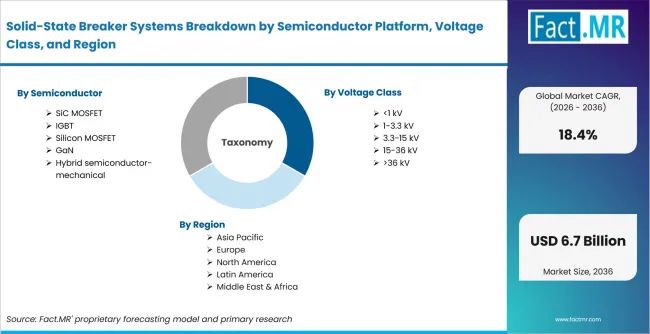
Solid State Breaker Systems Breakdown By Semiconductor Platform, Voltage Class, And Region | Source: Fact.MR
| Attribute | Details |
|---|---|
| Quantitative Units | USD Billion |
| Market Definition | Systems that interrupt or limit current using semiconductor switching devices, control electronics and sensing functions for fast fault isolation in DC and hybrid electrical networks. |
| Semiconductor Platform | SiC MOSFET; IGBT; Silicon MOSFET; GaN; Hybrid semiconductor-mechanical |
| Voltage Class | <1 kV; 1-3.3 kV; 3.3-15 kV; 15-36 kV; >36 kV |
| Application | Data centers; DC microgrids; EV charging and mobility; Industrial power systems; Renewables and utility |
| Protection Function | Ultra-fast short-circuit isolation; Current limiting; Bidirectional DC interruption; Remote reset and switching; Arc-flash mitigation |
| Regions Covered | North America; Latin America; Western Europe; Eastern Europe; East Asia; South Asia & Pacific; Middle East & Africa |
| Countries Covered | South Korea; USA; UK; Japan; Germany |
| Key Companies Profiled | ABB; Eaton; Siemens; Atom Power |
| Forecast Period | 2026 to 2036 |
| Approach | Hybrid top-down and bottom-up approach using DC distribution projects, breaker portfolios, semiconductor platforms, application demand, country-level energy investment and provider validation. |
Source: Fact.MR analysis. Updated Sep 7, 2026
How is the market segmented?
-
By Semiconductor Platform:
- SiC MOSFET
- IGBT
- Silicon MOSFET
- GaN
- Hybrid semiconductor-mechanical
-
By Voltage Class:
- <1 kV
- 1-3.3 kV
- 3.3-15 kV
- 15-36 kV
- >36 kV
-
By Application:
- Data centers
- DC microgrids
- EV charging and mobility
- Industrial power systems
- Renewables and utility
-
By Protection Function:
- Ultra-fast short-circuit isolation
- Current limiting
- Bidirectional DC interruption
- Remote reset and switching
- Arc-flash mitigation
-
By Region:
- North America
- Latin America
- Western Europe
- Eastern Europe
- East Asia
- South Asia & Pacific
- Middle East & Africa
Frequently Asked Questions
How big is the solid-state breaker systems market in 2026?
What is the CAGR of the solid-state breaker systems market from 2026 to 2036?
Which semiconductor platform leads the solid-state breaker systems market?
Which application leads the solid-state breaker systems market?
Which companies are profiled in the solid-state breaker systems market?
Who worked on this report


Preview the report firsthand - request a free sample
Free SampleGet the brochure for pricing and purchase details
Download PDF