- Market Value (2025): USD 4.3 Bn
- Estimated Value (2026): USD 4.9 Bn
- Forecast Value (2036): USD 19.1 Bn
- CAGR (2026-2036): 14.6%
What is the Speech To Text Api Market forecast to be worth by 2036?
USD 4.9 billion in 2026 to USD 19.1 billion by 2036, at a 14.6% CAGR.
Language-model demand should be read beside Fact.MR's Natural Language Processing Market, since speech-to-text APIs become more valuable when text feeds downstream NLP workflows.
- The speech to text api market reached USD 4.3 billion in 2025 as developers and AI platform buyers spent against a clear use case: API-based conversion of spoken audio into usable text for real-time, batch, search, analytics, compliance and workflow use cases.
- Demand is projected to increase from USD 4.9 billion in 2026 to USD 19.1 billion by 2036, at a 14.6% CAGR.
- The market is forecast to record 14.6% CAGR from 2026 to 2036 as contact centers, healthcare documentation teams, media workflows and developer platforms expand use of managed transcription APIs.
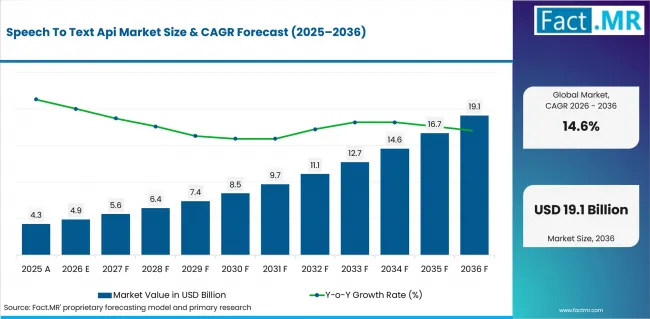
Speech To Text Api Market Value Analysis | Source: Fact.MR
What are the defining numbers behind Speech To Text Api Market growth?
USD 14.2 billion absolute opportunity is expected by 2036.
Enterprise meeting use connects with Fact.MR's Business Transcription Market, where accuracy, speaker handling and turnaround shape paid adoption.
- Demand Drivers in the Market
- Cloud-based APIs lead as developers can add transcription without running speech infrastructure. Usage-based pricing and managed model updates fit variable audio workloads.
- Customer service and contact centers lead as calls create large volumes of audio that need transcripts for agent assist, QA, compliance, search and analytics.
- Large enterprises lead as they have the audio volume, compliance burden and integration budget to use speech APIs across service, HR, legal, media and operations.
- Deep learning-based speech recognition leads because modern models improve recognition across noisy audio, accents, domain vocabulary and streaming use cases.
- Key Segments Analyzed
- By Deployment Model: Cloud-based APIs is projected to hold 62.4% share in 2026. Cloud-based APIs lead as they remove infrastructure setup and allow developers to consume transcription through managed endpoints.
- By Application: Customer Service & Contact Centers is projected to hold 31.5% share in 2026. Customer service and contact centers lead because calls, chats and voice interactions create high-volume audio that must be transcribed for search, compliance and workflow automation.
- By End User: Large Enterprises is projected to hold 41.9% share in 2026. Large enterprises lead as they have high audio volume, security requirements and budget for customization and integration.
- By Industry Vertical: IT & Telecommunications is projected to hold 29.7% share in 2026. IT and telecommunications lead as these firms build or operate digital services where voice data must become searchable and actionable.
- By Technology: Deep Learning-based Speech Recognition is projected to hold 48.4% share in 2026. Deep learning-based speech recognition leads because accuracy, language coverage and noise handling are now model-driven differentiators.
- Analyst Opinion at Fact.MR
- Shambhu Nath Jha, Sr. Consultant at Fact.MR, opines, "Speech-to-text APIs win when a transcript can trigger the next workflow without manual cleanup. Buyers will compare accuracy in noisy audio, domain vocabulary support, latency, privacy controls and cost predictability before standardizing a provider."
- Strategic Implications
- API providers should publish latency, accuracy evaluation guidance, language coverage and data-handling controls clearly.
- Enterprises should benchmark speech APIs on their own audio before scaling contact-center or healthcare use cases.
- Platform teams should connect transcripts to QA, search, analytics and workflow tools so the API has business value beyond text output.
USA continues to be a leading market and is projected to grow at a CAGR of 18.95%; other key markets include Canada, Germany, Australia and South Korea.
How does the Speech To Text Api Market break down by segment?
Cloud-based APIs leads Deployment Model at 62.4%.
Healthcare workflows should be compared with Fact.MR's Medical Transcription Services Market, because clinical speech data needs stronger privacy and terminology control.
Why does Cloud-based APIs lead Deployment Model?
Cloud-based APIs is projected to account for 62.4% share in 2026.
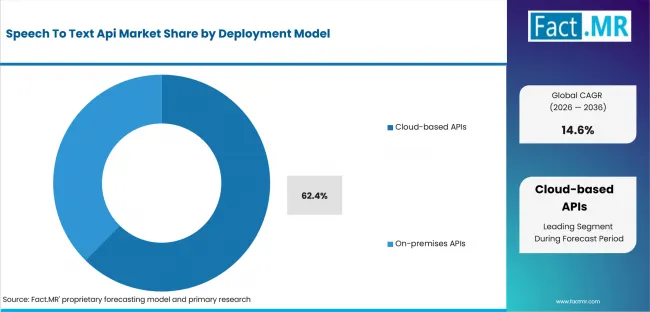
Speech To Text Api Market Analysis By Deployment Model | Source: Fact.MR
Cloud-based APIs lead as they remove infrastructure setup and allow developers to consume transcription through managed endpoints.
Why does Customer Service & Contact Centers lead Application?
Customer Service & Contact Centers is projected to account for 31.5% share in 2026.
Customer service and contact centers lead because calls, chats and voice interactions create high-volume audio that must be transcribed for search, compliance and workflow automation.
Why does Large Enterprises lead End User?
Large Enterprises is projected to account for 41.9% share in 2026.
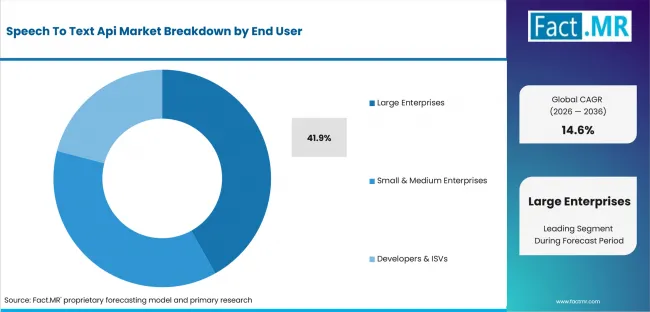
Speech To Text Api Market Analysis By End User | Source: Fact.MR
Large enterprises lead as they have high audio volume, security requirements and budget for customization and integration.
Why does IT & Telecommunications lead Industry Vertical?
IT & Telecommunications is projected to account for 29.7% share in 2026.
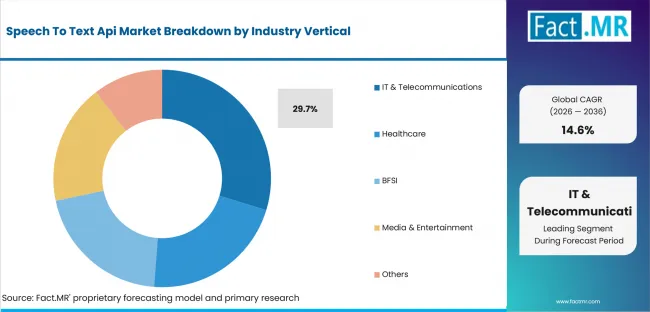
Speech To Text Api Market Analysis By Industry Vertical | Source: Fact.MR
IT and telecommunications lead as these firms build or operate digital services where voice data must become searchable and actionable.
Why does Deep Learning-based Speech Recognition lead Technology?
Deep Learning-based Speech Recognition is projected to account for 48.4% share in 2026.
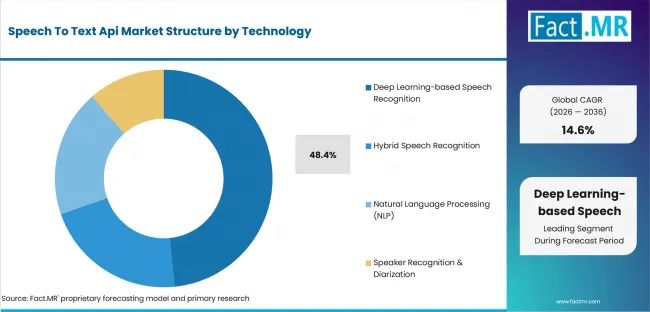
Speech To Text Api Market Analysis By Technology | Source: Fact.MR
Deep learning-based speech recognition leads because accuracy, language coverage and noise handling are now model-driven differentiators.
What is accelerating Speech To Text Api Market adoption, and what is holding it back?
Contact centers, accessibility workflows, clinical documentation and media captioning are the clearest demand routes. The main drag is accuracy loss in noisy audio, domain vocabulary gaps, data-residency limits and uncertain per-minute API cost.
Conversational interfaces link to Fact.MR's Bot Services Market, where speech input improves handoff from voice to automated support.
Drivers Impact Analysis
| DRIVER | QUALITATIVE RELEVANCE | GEOGRAPHIC RELEVANCE | IMPACT TIMELINE |
|---|---|---|---|
| Managed cloud transcription endpoints | High | South Korea | Short term (<=2 years) |
| Contact-center QA and analytics | High | USA | Short term (<=2 years) |
| Enterprise workflow integration | Moderate | Canada | Medium term (2-4 years) |
| Deep-learning model improvement | Selective | Germany | Medium term (2-4 years) |
Source: Fact.MR analysis. Updated Jul 30, 2026
- Managed cloud transcription endpoints: Cloud-based APIs lead as developers can add transcription without running speech infrastructure. Usage-based pricing and managed model updates fit variable audio workloads.
- Contact-center QA and analytics: Customer service and contact centers lead as calls create large volumes of audio that need transcripts for agent assist, QA, compliance, search and analytics.
- Enterprise workflow integration: Large enterprises lead as they have the audio volume, compliance burden and integration budget to use speech APIs across service, HR, legal, media and operations.
- Deep-learning model improvement: Deep learning-based speech recognition leads because modern models improve recognition across noisy audio, accents, domain vocabulary and streaming use cases.
Opportunity Impact Analysis
| OPPORTUNITY | QUALITATIVE RELEVANCE | GEOGRAPHIC RELEVANCE | IMPACT TIMELINE |
|---|---|---|---|
| Domain vocabulary customization | High | South Korea | Medium term (2-4 years) |
| Real-time agent assist | Moderate | USA | Medium term (2-4 years) |
| Multilingual and low-resource coverage | Selective | Canada | Medium term (2-4 years) |
Source: Fact.MR analysis. Updated Jul 30, 2026
- Domain vocabulary customization: Domain-specific vocabularies for healthcare, legal, finance and technical support can lift accuracy and contract value.
- Real-time agent assist: Real-time agent-assist and compliance monitoring can move speech-to-text from a transcription tool into a workflow trigger.
- Multilingual and low-resource coverage: Multilingual and low-resource language coverage can expand adoption in markets where English-first APIs underperform.
Restraints Impact Analysis
| RESTRAINT | QUALITATIVE RELEVANCE | GEOGRAPHIC RELEVANCE | IMPACT TIMELINE |
|---|---|---|---|
| Accent, noise and speaker-overlap accuracy gaps | High | South Korea | Short term (<=2 years) |
| Sensitive voice-data privacy requirements | Moderate | USA | Medium term (2-4 years) |
| High-volume API cost exposure | Selective | Germany | Medium term (2-4 years) |
Source: Fact.MR analysis. Updated Jul 30, 2026
- Accent, noise and speaker-overlap accuracy gaps: Accuracy varies by accent, noise, speaker overlap and domain vocabulary, which can reduce trust in automated workflows.
- Sensitive voice-data privacy requirements: Privacy and data-residency requirements slow adoption when voice data contains sensitive customer or patient information.
- High-volume API cost exposure: API cost can rise quickly for high-volume archives, long calls and always-on streaming use cases.
Which countries are scaling Speech To Text Api Market fastest?
Country rates show where buying conditions and supplier proof are already stronger.
Front-desk automation connects with Fact.MR's AI Kiosk Market, especially where kiosks need voice capture in noisy public settings.
- South Korea: The market is expected to grow at a CAGR of 10.20% from 2026 to 2036. South Korea's growth is supported by strong digital-service adoption, call-center modernization and demand for Korean-language accuracy.
- USA: The market is expected to grow at a CAGR of 18.95% from 2026 to 2036. USA demand is shaped by large contact centers, developer ecosystems, healthcare documentation and media transcription workloads.
- Canada: The market is expected to grow at a CAGR of 13.12% from 2026 to 2036. Canada benefits from bilingual service needs, enterprise cloud adoption and regulated-sector demand for secure transcription.
- Germany: The market is expected to grow at a CAGR of 16.04% from 2026 to 2036. Germany's outlook depends on data protection, enterprise security review and German-language accuracy in customer operations.
- Australia: The market is expected to grow at a CAGR of 11.70% from 2026 to 2036. Australia's adoption is supported by cloud contact centers and media workflows, with accent handling a practical evaluation point.
- UK: The market is expected to grow at a CAGR of 14.56% from 2026 to 2036. UK growth is tied to financial services, public-sector transcription, contact centers and accessibility requirements.
- Japan: The market is expected to grow at a CAGR of 17.48% from 2026 to 2036. Japan's market is shaped by call-center automation, aging workforce pressures and high expectations for Japanese speech accuracy.
The full report provides country-level CAGR analysis across North America, Latin America, Europe, East Asia, South Asia and Oceania, and the Middle East and Africa.
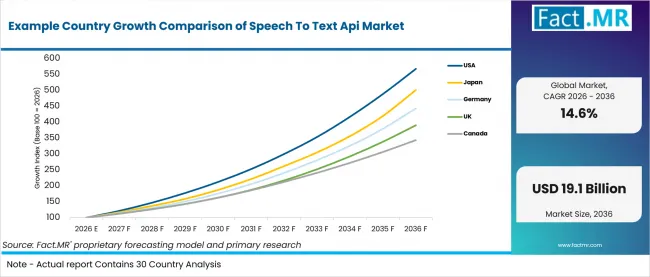
Example Country Growth Comparison Of Speech To Text Api Market | Source: Fact.MR
| Country | CAGR (2026-2036) |
|---|---|
| South Korea | 10.20% |
| USA | 18.95% |
| Canada | 13.12% |
| Germany | 16.04% |
| Australia | 11.70% |
| UK | 14.56% |
| Japan | 17.48% |
Source: Fact.MR analysis. Updated Jul 30, 2026
What is shaping South Korea's outlook through 2036?
10.20% CAGR from 2026 to 2036.
South Korea's growth is supported by strong digital-service adoption, call-center modernization and demand for Korean-language accuracy.
What is shaping USA's outlook through 2036?
18.95% CAGR from 2026 to 2036.
USA demand is shaped by large contact centers, developer ecosystems, healthcare documentation and media transcription workloads.
What is shaping Canada's outlook through 2036?
13.12% CAGR from 2026 to 2036.
Canada benefits from bilingual service needs, enterprise cloud adoption and regulated-sector demand for secure transcription.
What is shaping Germany's outlook through 2036?
16.04% CAGR from 2026 to 2036.
Germany's outlook depends on data protection, enterprise security review and German-language accuracy in customer operations.
What is shaping Australia's outlook through 2036?
11.70% CAGR from 2026 to 2036.
Australia's adoption is supported by cloud contact centers and media workflows, with accent handling a practical evaluation point.
Who leads the Speech To Text Api Market?
Google LLC; Microsoft Corporation; Amazon Web Services (AWS); IBM Corporation are among the visible providers in the speech to text api market.
Google LLC and Microsoft Corporation are among the most visible providers. Competition is shaped by product proof, channel access and buyer trust.
Between 2026 and 2036, market rivalry is likely to center on clearer positioning around Cloud-based APIs, stronger documentation and better support at the point of purchase.
Which companies are the key providers?
Key companies include Google LLC; Microsoft Corporation; Amazon Web Services (AWS); IBM Corporation; OpenAI; Speechmatics; Deepgram; AssemblyAI.
- Google LLC
- Microsoft Corporation
- Amazon Web Services (AWS)
- IBM Corporation
- OpenAI
- Speechmatics
- Deepgram
- AssemblyAI
Bibliography
- NIST, Speech Analytics.
- NIST, OpenASR Challenge.
- W3C, Web Speech API Specification.
- Microsoft Learn, Speech-to-Text Documentation.
- Google Cloud, Speech-to-Text Documentation.
- AWS, Amazon Transcribe.
This Report Answers
- The report provides strategic intelligence on the Speech To Text Api Market across segment choices that shape the 2026 market structure.
- Segment analysis covers Cloud-based APIs and Customer Service & Contact Centers as the share leaders within the 2026 market.
- Country outlook evaluates the listed markets by CAGR and explains the adoption conditions in each country.
- Competitive analysis profiles the named providers and evaluates competition around product proof, channel access and buyer trust.
- Related coverage connects this report with adjacent natural-language processing, transcription-services and conversational-AI markets.
What does the Speech To Text Api Market cover?
The Speech To Text Api Market covers cloud, hybrid and on-premise speech-to-text APIs, SDKs and transcription endpoints used for real-time streaming, batch transcription, custom speech models, contact-center analytics, accessibility, media and documentation workflows.
The Speech To Text Api Market covers cloud, hybrid and on-premise speech-to-text APIs, SDKs and transcription endpoints used for real-time streaming, batch transcription, custom speech models, contact-center analytics, accessibility, media and documentation workflows.
Adjacent spending is included only when it is part of the same purchase decision or operating use case.
What is included in the scope?
The scope includes Deployment Model, Application, End User, Industry Vertical, Technology and regional demand.
Coverage includes adjacent segment options only when they are purchased for the same defined market use.
What is excluded from the scope?
standalone dictation devices, human-only transcription services, text-to-speech products, voice biometrics without transcription and general NLP tools without speech recognition.
The scope excludes standalone dictation devices, human-only transcription services, text-to-speech products, voice biometrics without transcription and general NLP tools without speech recognition.
How Was the Analysis Built?
The analysis combines primary research with desk research focused on the speech to text api market, its segment structure and country-level demand.
- Primary Research: Interviews and validation discussions test buyer priorities, adoption barriers, pricing logic and operating requirements.
- Desk Research: The assessment reviews company disclosures, public datasets, regulatory material, technical literature and industry records relevant to the market.
- Market Sizing and Forecasting: Estimates combine top-down and bottom-up checks across demand signals, segment shares, country activity, company participation and adoption constraints.
- Data Validation and Update Cycle: Findings are validated against public evidence, company activity and country-level adoption patterns before final use.
Segmentation
What is the report's scope and coverage?
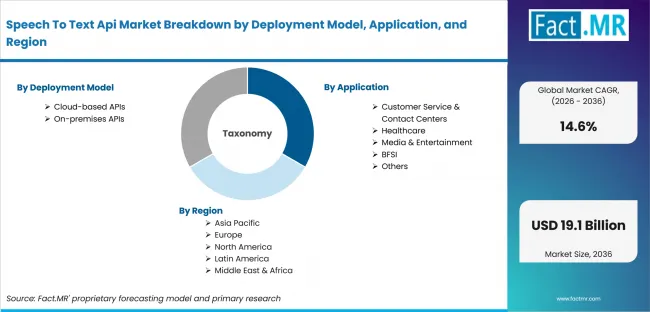
Speech To Text Api Market Breakdown By Deployment Model, Application, And Region | Source: Fact.MR
| Attribute | Details |
|---|---|
| Quantitative Units | USD 4.9 billion in 2026 to USD 19.1 billion by 2036, at a 14.6% CAGR. |
| Market Definition | Speech To Text Api Market covers cloud, hybrid and on-premise speech-to-text APIs, SDKs and transcription endpoints used for real-time streaming, batch transcription, custom speech models, contact-center analytics, accessibility, media and documentation workflows. |
| Deployment Model | Cloud-based APIs; Public Cloud; Hybrid Cloud; On-premises APIs; Enterprise Servers; Private Infrastructure |
| Application | Customer Service & Contact Centers; Call Transcription; Virtual Assistants; Healthcare; Clinical Documentation; Medical Dictation; Media & Entertainment; Subtitling; Content Transcription; BFSI; Voice Authentication; Call Analytics; Others; Education; Legal & Government |
| End User | Large Enterprises; Multinational Enterprises; Public Sector Organizations; Small & Medium Enterprises; Small Businesses; Mid-sized Businesses; Developers & ISVs; Independent Developers; Software Vendors |
| Industry Vertical | IT & Telecommunications; Cloud Service Providers; Software Companies; Healthcare; Hospitals; Telehealth Providers; BFSI; Banking; Insurance; Media & Entertainment; Broadcasting; Digital Media; Others; Education; Retail |
| Technology | Deep Learning-based Speech Recognition; Transformer Models; End-to-End Neural Networks; Hybrid Speech Recognition; HMM-DNN Models; Statistical Language Models; Natural Language Processing (NLP); Intent Recognition; Entity Extraction; Speaker Recognition & Diarization; Speaker Identification; Multi-speaker Segmentation |
| Regions Covered | North America; Latin America; Europe; East Asia; South Asia and Oceania; Middle East and Africa |
| Countries Covered | South Korea; USA; Canada; Germany; Australia; UK; Japan |
| Key Companies Profiled | Google LLC; Microsoft Corporation; Amazon Web Services (AWS); IBM Corporation; OpenAI; Speechmatics; Deepgram; AssemblyAI |
| Forecast Period | 2026 to 2036 |
| Approach | Hybrid top-down and bottom-up assessment using demand indicators, segment mix, country growth, company participation and public evidence relevant to the category. |
Source: Fact.MR analysis. Updated Jul 30, 2026
How is the market segmented?
-
By Deployment Model:
- Cloud-based APIs
- Public Cloud
- Hybrid Cloud
- On-premises APIs
- Enterprise Servers
- Private Infrastructure
-
By Application:
- Customer Service & Contact Centers
- Call Transcription
- Virtual Assistants
- Healthcare
- Clinical Documentation
- Medical Dictation
- Media & Entertainment
- Subtitling
- Content Transcription
- BFSI
- Voice Authentication
- Call Analytics
- Others
- Education
- Legal & Government
-
By End User:
- Large Enterprises
- Multinational Enterprises
- Public Sector Organizations
- Small & Medium Enterprises
- Small Businesses
- Mid-sized Businesses
- Developers & ISVs
- Independent Developers
- Software Vendors
-
By Industry Vertical:
- IT & Telecommunications
- Cloud Service Providers
- Software Companies
- Healthcare
- Hospitals
- Telehealth Providers
- BFSI
- Banking
- Insurance
- Media & Entertainment
- Broadcasting
- Digital Media
- Others
- Education
- Retail
-
By Technology:
- Deep Learning-based Speech Recognition
- Transformer Models
- End-to-End Neural Networks
- Hybrid Speech Recognition
- HMM-DNN Models
- Statistical Language Models
- Natural Language Processing (NLP)
- Intent Recognition
- Entity Extraction
- Speaker Recognition & Diarization
- Speaker Identification
- Multi-speaker Segmentation
-
By Region:
- North America
- Latin America
- Europe
- East Asia
- South Asia and Oceania
- Middle East and Africa
Frequently Asked Questions
Which Deployment Model leads the market?
Which Application leads the market?
Which End User leads the market?
Which Industry Vertical leads the market?
Which Technology leads the market?
Which country records the highest listed CAGR?
What is the primary driver in this market?
What is the main restraint?
Who worked on this report


Preview the report firsthand - request a free sample
Free SampleGet the brochure for pricing and purchase details
Download PDF