- Market Value (2025): USD 1.2 Bn
- Estimated Value (2026): USD 1.3 Bn
- Forecast Value (2036): USD 2.8 Bn
- CAGR (2026-2036): 7.8%
What is the Sulfate-Free Cleanser Thickeners Market forecast to be worth by 2036?
USD 1.3 Billion in 2026 to USD 2.8 Billion by 2036 at a 7.8% CAGR.
- The Sulfate-Free Cleanser Thickeners Market crossed a valuation of USD 1.2 Billion in 2025.
- Demand is projected to increase from USD 1.3 Billion in 2026 to USD 2.8 Billion by 2036.
- The market is forecast to record 7.8% CAGR from 2026 to 2036 as shampoo brands and cleanser formulators rebuild viscosity around mild surfactants.
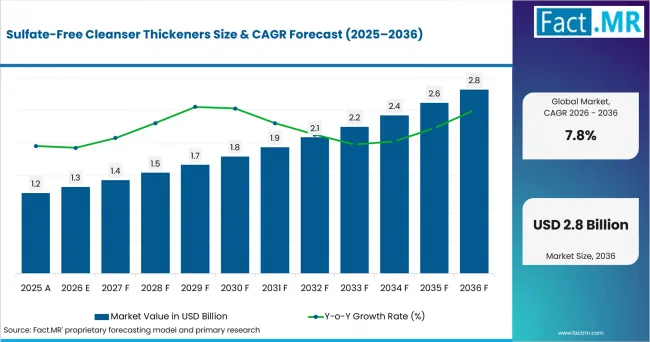
Sulfate Free Cleanser Thickeners Value Analysis | Source: Fact.MR
What are the defining numbers behind Sulfate-Free Cleanser Thickeners Market growth?
USD 1.5 Billion absolute opportunity between 2026 and 2036.
- Demand Drivers in the Market
- Shampoo formulators need salt-light viscosity systems because sulfate-free surfactants do not thicken like SLES-based bases.
- FDA reported 1,298,361 unique, active cosmetic product listings under MoCRA as of June 30, 2026.
- Contract manufacturers need cold-processable thickeners so short-run cleanser launches keep texture and clarity targets.
- EU fragrance-allergen rules require covered fragrance allergens to be individually listed in the ingredients of rinse-off cosmetics when their concentration exceeds 0.01%, increasing formulation and label-review requirements for scented cleansers.
- Key Segments Analyzed
- By Thickener Chemistry: Cellulose derivatives are expected to hold 34.0% share in 2026 because they fit clear gel viscosity and mild surfactant systems.
- By Product System: Shampoo is projected to account for 37.0% share in 2026 owing to frequent reformulation around sulfate-free claims.
- By Rheology: Low-shear viscosity is anticipated to capture 33.0% share in 2026 due to its role in pour feel and shelf appearance.
- By Claim: Sulfate-free compatible is estimated to represent 36.0% share in 2026 since formulators shortlist thickeners by surfactant compatibility first.
- Analyst Opinion at Fact.MR
- Shambhu Nath Jha, Principal Consultant at Fact.MR, states, "The hard part of sulfate-free cleansing is rebuilding texture after sulfates are removed. Suppliers are expected to gain preference when they combine application data, rinse-off testing and clear guidance for cellulose, starch, gum and associative systems."
- Strategic Implications
- Ingredient suppliers should publish sulfate-free viscosity curves by surfactant blend and pH range.
- Formulation laboratories should test clarity, foam and suspension together before approving a thickener system.
- Brand teams should connect claim language with ingredient documentation before launching natural-origin cleanser lines.
- Distributors should stock cellulose and starch systems alongside associative polymers to support quick trial work.
China is projected to record 8.9% CAGR through 2036 due to cosmetics retail expansion. The USA is expected to post 8.4% CAGR as MoCRA makes formulation data more visible. Germany is anticipated to advance at 8.2% CAGR supported by EU chemical supply depth. Japan is estimated to hold 7.3% CAGR owing to beauty e-commerce. France is forecast to register 6.9% CAGR as retail recovery supports cleanser renewal.
How does the Sulfate-Free Cleanser Thickeners Market break down by segment?
Cellulose derivatives lead at 34.0%; shampoo leads at 37.0%.
Which Thickener Chemistry dominates?
Cellulose derivatives hold 34.0% share in 2026.
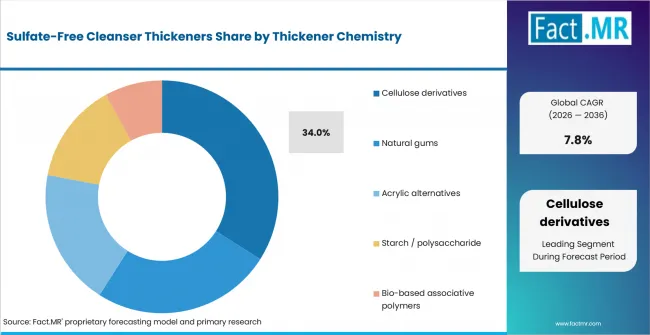
Sulfate Free Cleanser Thickeners Analysis By Thickener Chemistry | Source: Fact.MR
Cellulose derivatives are expected to lead Thickener Chemistry at 34.0% share in 2026 because they offer clear viscosity control without forcing a harsh surfactant base. Natural gums support brands that want a plant-derived texture story. Acrylic alternatives remain relevant where suspension and clarity need tighter control. Nouryon’s 2025 specialty rheology materials describe starch-based biopolymers and gum-based ingredients, including Cekol® 150 cellulose gum, as formulation tools for texture and stabilization.
What leads the Product System segment?
Shampoo accounts for 37.0% share in 2026.
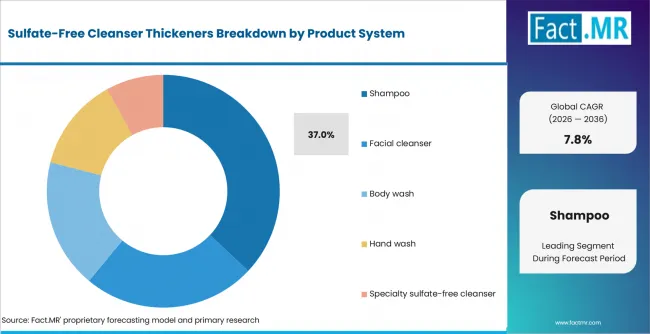
Sulfate Free Cleanser Thickeners Analysis By Product System | Source: Fact.MR
Shampoo is projected to account for 37.0% share in 2026 owing to repeat use and consumer sensitivity around foam feel. Facial cleansers need softer after-feel and clear low-viscosity gels. Body wash and hand wash use thickeners to balance pumpability with foam. METI reported Japan cosmetics and pharmaceuticals B-to-C e-commerce at JPY 1.015 trillion in 2024.
How does Rheology shape demand?
Low-shear viscosity holds 33.0% share in 2026.
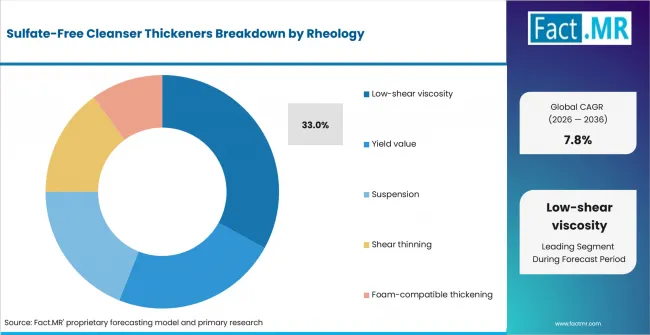
Sulfate Free Cleanser Thickeners Analysis By Rheology | Source: Fact.MR
Low-shear viscosity is anticipated to hold 33.0% share in 2026 because shoppers judge cleanser thickness before use. Yield value supports exfoliating particles, pearlizers or oil droplets. Shear thinning supports pump bottles and squeeze packs. Clariant lists Genapol LT as a rheology modifier for rinse-off personal care products.
What supports the Claim segment?
Sulfate-free compatible leads with 36.0% share in 2026.
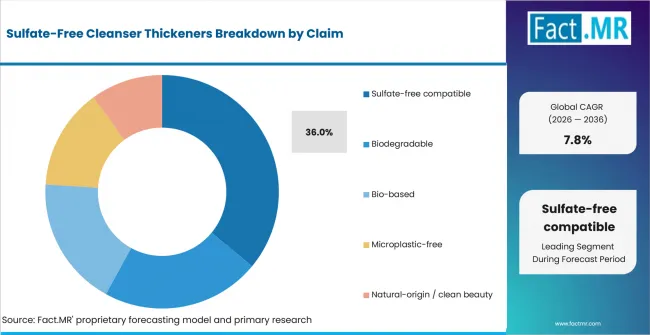
Sulfate Free Cleanser Thickeners Analysis By Claim | Source: Fact.MR
Sulfate-free compatible is estimated to hold 36.0% share in 2026 because formulators first check whether the thickener works with mild surfactant blends. Biodegradable and bio-based claims influence shortlist decisions where brands reduce acrylic dependence. Microplastic-free claims also affect EU-facing rinse-off products. BASF reported in April 2025 that Lamesoft OP Plus, a wax-based readily biodegradable opacifier dispersion, is suitable for formulations using alternatives to sulfate surfactants.
What is accelerating Sulfate-Free Cleanser Thickeners Market adoption, and what is holding it back?
Sulfate-free reformulation drives it; viscosity instability restrains it.
Drivers Impact Analysis
| DRIVER | (~) % IMPACT ON CAGR |
GEOGRAPHIC RELEVANCE |
IMPACT TIMELINE |
|---|---|---|---|
| Sulfate-free reformulation complexity | +1.8% | Global | Short term (<= 2 years) |
| Cosmetic product documentation load | +1.2% | USA, China, Europe | Medium term (2-4 years) |
| Natural-origin texture claims | +1.0% | Europe, Japan | Medium term (2-4 years) |
| Shampoo and cleanser SKU renewal | +0.8% | Global | Long term (>= 4 years) |
Opportunity Impact Analysis
| OPPORTUNITY | (~) % IMPACT ON CAGR |
GEOGRAPHIC RELEVANCE |
IMPACT TIMELINE |
|---|---|---|---|
| Cellulose and starch-based systems | +1.0% | Global | Medium term (2-4 years) |
| Foam-compatible associative thickening | +0.8% | USA, Europe | Short term (<= 2 years) |
| Localized beauty formulation support | +0.6% | China, Japan | Long term (>= 4 years) |
Restraints Impact Analysis
| RESTRAINT | (~) % IMPACT ON CAGR |
GEOGRAPHIC RELEVANCE |
IMPACT TIMELINE |
|---|---|---|---|
| Salt response variability | -0.6% | Global | Short term (<= 2 years) |
| Ingredient screening and listing work | -0.5% | USA, Europe, China | Medium term (2-4 years) |
| Mass-channel price pressure | -0.4% | USA, Europe, Japan | Long term (>= 4 years) |
Which countries are scaling Sulfate-Free Cleanser Thickeners Market fastest?
- The country comparison spans 2.0 percentage points and forms three practical growth bands across the forecast period.
- China remains 0.5 percentage point above the USA as cosmetics retail expansion and local formulation activity support demand for sulfate-free cleanser thickeners.
- The USA remains 0.2 percentage point above Germany through personal-care spending, mass-market sulfate-free reformulation and stronger formulation-documentation requirements.
- Germany remains 0.9 percentage point above Japan as chemical-industry depth and EU-facing formulation requirements support cellulose, gum and other rheology systems.
- Japan remains 0.4 percentage point above France through beauty e-commerce, cosmetic shipment recovery and demand for low-shear viscosity in premium cleansing formats.
- France closes the displayed range as retail recovery, dermocosmetic positioning and natural-origin formulation requirements support selective thickener adoption.
Comparable CAGRs can create different entry conditions due to beauty retail depth, formulation requirements, regulatory documentation, surfactant compatibility and local ingredient-supply capability. Full report coverage includes North America, Latin America, Western Europe, Eastern Europe, East Asia, South Asia & Pacific, Middle East & Africa.
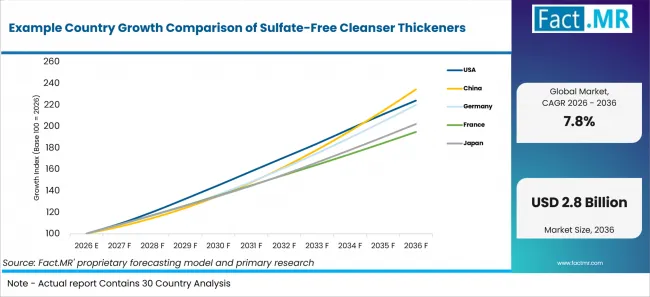
Example Country Growth Comparison Of Sulfate Free Cleanser Thickeners | Source: Fact.MR
| Country | CAGR |
|---|---|
| China | 8.9% |
| USA | 8.4% |
| Germany | 8.2% |
| Japan | 7.3% |
| France | 6.9% |
What supports China adoption?
8.9% CAGR, driven by cosmetics retail expansion and local formulation activity.
China’s National Bureau of Statistics reported that cosmetics retail sales by enterprises above the designated size reached CNY 244.5 billion in the first half of 2026. This retail scale supports sulfate-free cleanser reformulation as domestic brands and contract manufacturers seek thickeners that maintain clarity, foam feel and viscosity across shampoos, facial cleansers and other mild surfactant systems.
How is the USA scaling demand?
8.4% CAGR, supported by personal-care spending and MoCRA-related formulation activity.
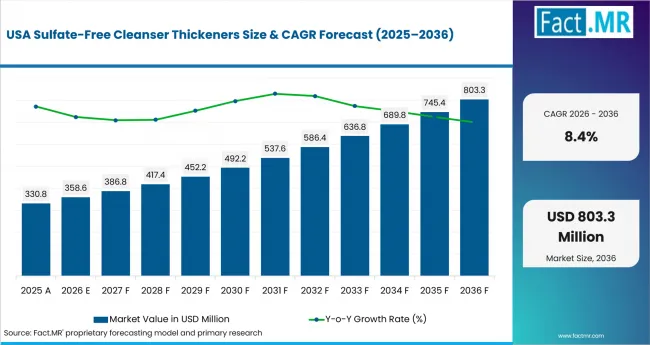
Sulfate Free Cleanser Thickeners Country Value Analysis | Source: Fact.MR
BLS reported that average annual U.S. spending on personal care products and services reached USD 978 per consumer unit in 2024. This broad consumer base supports demand for sulfate-free cleanser thickeners as shampoo and body-wash brands expand mild formulations and require supplier data covering pH response, clarity, suspension and foam-compatible viscosity.
What supports Germany’s outlook?
8.2% CAGR, shaped by retail resilience and chemical-industry depth.
Destatis reported that real retail sales of pharmacies and cosmetic, pharmaceutical and medical products increased 3.6% from January to October 2025. This supports continued cleanser formulation activity, while German laboratories increasingly evaluate cellulose, gum and other natural-origin rheology systems for clear gels and EU-facing sulfate-free product claims.
How does Japan perform?
7.3% CAGR, led by digital beauty channels and cosmetic shipment recovery.
METI reported cosmetics and pharmaceuticals B-to-C e-commerce of JPY 1.015 trillion in 2024. Strong digital beauty channels support sulfate-free cleanser demand as Japanese hair-care and facial-care brands develop premium formulas requiring controlled low-shear viscosity, balanced rinse feel and consistent clarity across online and specialty retail channels.
What underpins France’s growth?
6.9% CAGR, driven by retail recovery and EU formulation requirements.
INSEE reported that in-store retail sales of non-food products increased 2.9% in volume in France in 2025. This retail recovery supports sulfate-free cleanser development across pharmacy, dermocosmetic and mass-market lines, where formulators use natural-origin thickeners to differentiate sensitive-skin products while maintaining viscosity and rinse-off performance.
Who leads the Sulfate-Free Cleanser Thickeners Market?
BASF and Lubrizol offer direct cleanser-thickener coverage, while Ashland and Clariant add natural-origin and rinse-off rheology options.
BASF participates through rheology and texture technologies including Cosmedia® Gel CC and Verdessence® Xanthan, while its 2025 personal-care concepts highlight cleansing formulations using alternatives to sulfate surfactants. Lubrizol is active through Carbopol® Aqua SF rheology modifiers for surfactant-based cleansing systems and announced the Brazilian pre-launch of Carbopol® BioSense polymer in March 2025.
Ashland provides cellulosic and nature-derived texture ingredients, including Natrosol™ hydroxyethylcellulose and Texturpure™ SA-2, for hair and skin-care formulations and cleansing systems. Clariant supports rinse-off formulations through Genapol LT and a broader portfolio of personal-care rheology modifiers.
Evonik contributes biosurfactant technologies for personal-care cleansing, including RHEANCE® and SOPHANCE® glycolipid solutions. Nouryon adds starch-based biopolymer rheology materials, including Structure® products used to control texture, viscosity and formulation stability in hair, skin and bath-and-shower applications.
Which companies are the key providers?
The company set reviewed in this report includes BASF, Lubrizol, Ashland, Clariant, Evonik and Nouryon.
- BASF
- Lubrizol
- Ashland
- Clariant
- Evonik
- Nouryon
Bibliography
- U.S. Bureau of Labor Statistics. (2026, February 12). Housing and transportation accounted for 50 percent of household spending in 2024. The Economics Daily.
- U.S. Census Bureau. (2025, July 29). Monthly state retail sales for April 2025.
- National Bureau of Statistics of China. (2026, July 16). Total retail sales of consumer goods in the first half of 2026.
- National Medical Products Administration. (2025, December 22). Policy interpretation of the NMPA’s opinions on deepening the reform of cosmetics regulation and promoting high-quality industry development.
- General Administration of Customs of the People’s Republic of China. (2026, January 8). (6) China’s major imports by quantity and value, Dec 2025 (in USD).
- Eurostat. (2025, September 29). EU exports of chemicals reach a new record high.
- Eurostat. (2026, June 17). Household material welfare across the EU in 2025.
- Statistisches Bundesamt (Destatis). (2025, November 28). Einzelhandelsumsatz im Oktober 2025 real um 0,3 % niedriger als im Vormonat [Retail sales in October 2025 decreased by 0.3% in real terms month on month].
- Gallot, P., Bonfils, J., Finot, J., Gamrasni, A., & Lépine, N. (2026, June 18). The economic situation of trade in 2025 and early 2026: Report prepared for the Commission for National Commercial Accounts (Working Paper No. DT2026-08). INSEE.
- INSEE. (2026, July 10). In June 2026, consumer prices rose by 1.8% year on year.
- Ministry of Economy, Trade and Industry. (2025, August 26). Results of FY2024 e-commerce market survey compiled.
- BASF. (2025, April 3). BASF launches natural-based innovations for personal care at in-cosmetics Global 2025.
- BASF. (2025, January 14). Cosmet’Agora 2025: BASF showcases recent product launches and advances in climate-adaptive beauty routines.
- The Lubrizol Corporation. (2025, March 28). Lubrizol partners with Suzano for pre-launch of Carbopol® BioSense in Brazil, advancing biodegradable solutions.
- Ashland Inc. (2026, April 8). Ashland Technology Platforms and new personal care ingredients open differentiated growth opportunities for formulators at in-cosmetics Global.
- Clariant. (2026, August 12). Genapol LT.
- Evonik. (2025, April 8). in-cosmetics® global 2025: Evonik meets growing customer demand for high-performance, eco-friendly solutions.
- Evonik. (2025, February 12). PCHi 2025: Evonik introduces next-generation system solutions with stronger commitment to Chinese market.
- Nouryon. (2025, December 10). Nouryon advances South America growth strategy with new customer experience and innovation center in Brazil for its home and personal care business.
This Report Addresses
- The report addresses thickener chemistry and product system choices for sulfate-free cleansing formulation work.
- Regional outlook covers China, USA, Germany, Japan and France across the 2026 to 2036 forecast period.
- Competitive analysis reviews BASF, Lubrizol, Ashland, Clariant, Evonik and Nouryon by verified market relevance.
- Chemistry assessment covers cellulose derivatives, natural gums, acrylic alternatives, starch systems and bio-based associative polymers.
- Use-case assessment covers shampoo, facial cleanser, body wash, hand wash and specialty sulfate-free cleanser systems.
- The forecast uses primary interviews, provider portfolio checks and official source review to support market sizing.
What does the Sulfate-Free Cleanser Thickeners Market cover?
Cellulose derivatives, natural gums, acrylic alternatives and starch systems used for sulfate-free cleanser viscosity control.
The Sulfate-Free Cleanser Thickeners Market covers rheology ingredients that build viscosity, pour feel and suspension in cleanser formulas without SLS or SLES. It includes cellulose derivatives, natural gums, acrylic alternatives and starch systems.
The market differs from the broader rheology modifier category because coverage is limited to rinse-off cleansing systems. Leave-on creams, paints, adhesives and pharmaceutical gels are outside the scope unless sold for sulfate-free personal cleansing.
What is included in the scope?
Sulfate-free cleanser thickener systems used in shampoo, facial cleanser, body wash and hand wash applications.
The scope includes thickeners used in shampoo, facial cleanser, body wash, hand wash and specialty sulfate-free cleanser systems. It covers low-shear viscosity, yield value, suspension and foam-compatible thickening claims. Adjacent coverage on natural rheology modifiers, sulfate-free shampoo, sulfate-free body wash and sodium lauroyl isethionate surfactant provides context for related ingredient choices.
What is excluded from the scope?
Leave-on cosmetics and non-personal-care rheology additives are outside the scope.
The scope excludes leave-on skin creams, color cosmetics, pharmaceutical gels and industrial rheology additives. It also excludes surfactants when they are sold without a thickening or rheology-control role in sulfate-free cleanser formulations.
How was the analysis built?
120+ sources, 35+ company portfolios, 25+ countries, and more than 20 interviews.
- Primary Research: Primary research included discussions with ingredient suppliers, formulation laboratories, contract manufacturers, brand teams and distributors. These discussions reviewed cleanser viscosity, foam behavior, clarity, suspension and documentation needs.
- Desk Research: Desk research covered government statistics, regulator updates, company releases, product pages, trade data, official retail data and ingredient portfolio material. Every used evidence source appears in the bibliography.
- Market Sizing and Forecasting: Market estimates combined cleanser format mix, leading segment shares, country CAGR inputs, formulation intensity, thickener chemistry adoption and supplier participation across the forecast period.
- Data Validation and Update Cycle: Findings were checked against official statistics, product activity, company announcements and portfolio mapping. Updates review new launches, regulatory shifts, claim changes and formulation support evidence.
What is the report’s scope and coverage?
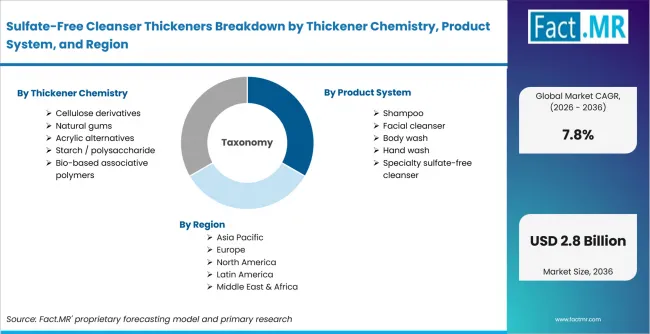
Sulfate Free Cleanser Thickeners Breakdown By Thickener Chemistry, Product System, And Region | Source: Fact.MR
| Attribute | Details |
|---|---|
| Quantitative Units | USD billion |
| Market Definition | Rheology ingredients used to build viscosity, pour feel and suspension in sulfate-free cleanser formulations without SLS or SLES, including cellulose derivatives, natural gums, acrylic alternatives, starch systems and bio-based associative polymers. |
| Thickener Chemistry | Cellulose derivatives; Natural gums; Acrylic alternatives; Starch systems; Bio-based associative polymers |
| Product System | Shampoo; Facial cleanser; Body wash; Hand wash; Specialty sulfate-free cleansers |
| Rheology | Low-shear viscosity; Yield value; Suspension; Foam-compatible thickening |
| Claim | Sulfate-free compatible; Biodegradable; Bio-based; Microplastic-free; Natural-origin |
| Regions Covered | North America; Latin America; Western Europe; Eastern Europe; East Asia; South Asia & Pacific; Middle East & Africa |
| Countries Covered | China; United States; Germany; Japan; France |
| Key Companies Profiled | BASF; Lubrizol; Ashland; Clariant; Evonik; Nouryon |
| Forecast Period | 2026 to 2036 |
| Approach | Hybrid top-down and bottom-up approach using cleanser-format mix, thickener chemistry adoption, rheology requirements, formulation intensity, country growth, supplier participation and verified provider portfolio review. |
How is the market segmented?
-
By Thickener Chemistry
- Cellulose derivatives
- Natural gums
- Acrylic alternatives
- Starch / polysaccharide
- Bio-based associative polymers
-
By Product System
- Shampoo
- Facial cleanser
- Body wash
- Hand wash
- Specialty sulfate-free cleanser
-
By Rheology
- Low-shear viscosity
- Yield value
- Suspension
- Shear thinning
- Foam-compatible thickening
-
By Claim
- Sulfate-free compatible
- Biodegradable
- Bio-based
- Microplastic-free
- Natural-origin / clean beauty
-
By Region
- North America
- Latin America
- Western Europe
- Eastern Europe
- East Asia
- South Asia & Pacific
- Middle East & Africa