- Market Value (2025): USD 53.3 Mn
- Estimated Value (2026): USD 66 Mn
- Forecast Value (2036): USD 560 Mn
- CAGR (2026-2036): 23.8%
What is the Tool Health Copilots market forecast to be worth by 2036?
USD 66 million in 2026 to USD 560 million by 2036, at a 23.8% CAGR.
- The tool health copilots market reached USD 53.3 million in 2025.
- Demand is projected to increase from USD 66 million in 2026 to USD 560 million by 2036.
- The market is forecast to record a 23.8% CAGR from 2026 to 2036 as foundries, memory makers and equipment OEMs use assisted diagnostics to reduce downtime.
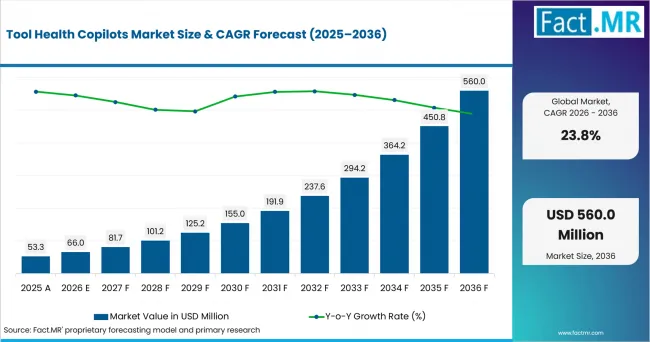
Tool Health Copilots Market Value Analysis | Source: Fact.MR
What are the defining numbers behind Tool Health Copilots market growth?
USD 494 million absolute opportunity by 2036, led by failure prediction, etch & deposition and foundries.
- Demand Drivers in the Market
- Fab maintenance teams need machine condition monitoring tools that translate alarms into ranked failure risks before wafer movement is interrupted.
- Process engineers need guided troubleshooting because vacuum, pump and chamber data often come from different vendor systems during a single fault event.
- Equipment OEM service teams need remote diagnostic context to help field engineers separate tool wear from recipe-specific process drift.
- Foundry operations teams need maintenance scheduling support since high tool utilization leaves less room for long manual checks.
- Key Segments Analyzed
- By Copilot Capability: Failure prediction is expected to hold 35.0% share in 2026 because early-warning value is easiest to measure against avoided downtime.
- By Equipment Domain: Etch & deposition is projected to account for 31.0% share in 2026 as chamber-condition drift affects yield and tool availability.
- By Deployment: Cloud is anticipated to capture 46.0% share in 2026 due to fleet-level learning across similar tool families and fabs.
- By End User: Foundries are estimated to represent 42.0% share in 2026 owing to dense tool fleets and high service-response expectations.
- By Region: USA is forecast to hold 26.0% share in 2026, supported by fab investment and stronger interest in production analytics.
- Analyst Opinion at Fact.MR
- Shambhu Nath Jha, Principal Consultant at Fact.MR, states, "Tool health copilots are drawing attention because fab engineers need action guidance. Adoption is expected to move first where downtime has a direct wafer-start penalty. Suppliers should combine failure models, equipment-domain knowledge and workflow records so fab teams trust recommendations."
- Strategic Implications
- Software vendors should connect copilot recommendations with asset performance management systems so fabs compare warning quality against maintenance outcomes.
- Equipment OEMs should package diagnostic models with service procedures to keep recommended actions tied to approved maintenance practice.
- Fab operators should validate copilots by tool family before expanding across full process areas or multiple sites.
- Cloud providers should offer data-isolation controls because process engineers are expected to treat tool traces as sensitive manufacturing data.
The USA is projected to record 25.64% CAGR through 2036, supported by CHIPS-funded fab projects. Taiwan is expected to post 25.44% CAGR through foundry scale. South Korea is forecast to advance at 25.38% CAGR as memory production keeps uptime risk visible. China is anticipated to reach 25.33% CAGR on domestic electronics output. Japan is estimated to record 25.27% CAGR due to tool-manufacturing depth. Singapore is projected to post 25.20% CAGR as wafer-fab investment expands service demand.
How does the Tool Health Copilots market break down by segment?
Failure prediction leads at 35.0%; cloud leads deployment at 46.0%.
Which Copilot Capability dominates?
Failure prediction is expected to hold 35.0% share in 2026.
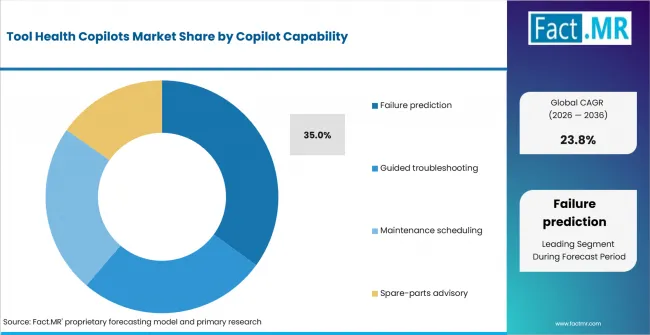
Tool Health Copilots Market Analysis By Copilot Capability | Source: Fact.MR
Failure prediction leads because it gives fabs a measurable link between tool signals and avoided downtime. Demand also overlaps with semiconductor defect inspection equipment where faster fault recognition protects yield learning. SEMI reported in April 2026 that semiconductor test equipment sales increased 55.0% in 2025.
What leads the Equipment Domain segment?
Etch & deposition is projected to account for 31.0% share in 2026.
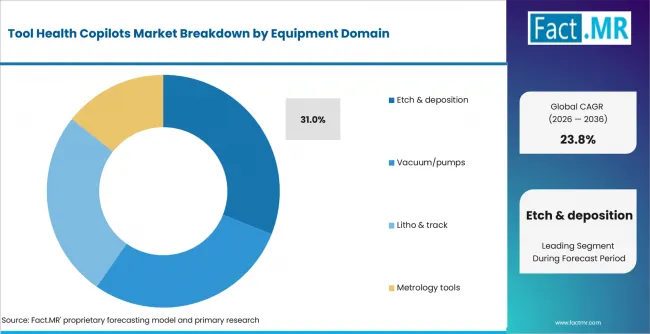
Tool Health Copilots Market Analysis By Equipment Domain | Source: Fact.MR
Etch and deposition tools are suited to copilots because chamber health, vacuum stability and process drift affect wafer outcomes quickly. The domain connects naturally with semiconductor dry etch systems where process repeatability influences maintenance response. Applied Materials introduced SEMVision H20 in February 2025 with advanced AI image recognition for faster analysis of buried nanoscale defects.
How does Deployment shape demand?
Cloud is anticipated to lead with 46.0% share in 2026.
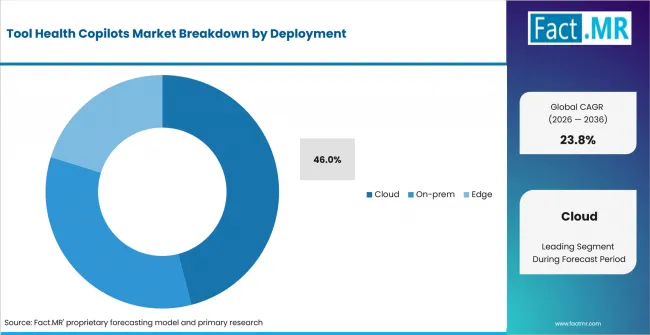
Tool Health Copilots Market Analysis By Deployment | Source: Fact.MR
Cloud leads because similar tool fleets learn from more events when data rules allow shared analytics. On-prem remains relevant for fabs that restrict external tool data. Edge systems serve sites needing low-latency warnings near controllers.
What supports Foundries within End User?
Foundries are estimated to represent 42.0% share in 2026.
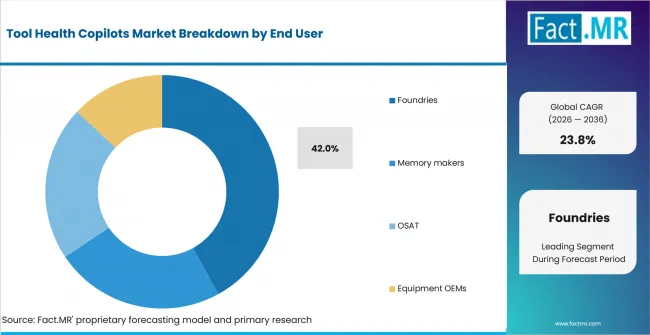
Tool Health Copilots Market Analysis By End User | Source: Fact.MR
Foundries lead because uptime losses move quickly into wafer-start delays and customer delivery pressure. DGBAS reported in May 2026 that Taiwan’s manufacturing sector grew 26.18% in 2026Q1, mainly due to output expansion in semiconductors, computers, electronics and optical products.
What makes the USA the largest regional contributor?
USA accounts for 26.0% share in 2026.
The USA leads the regional split because new fab projects require disciplined maintenance planning during construction, ramp and qualification. GAO reported in December 2025 that, as of July 2025, Commerce had awarded USD 30.9 billion in direct CHIPS incentive funding to 19 companies across 40 projects.
What is accelerating Tool Health Copilots Market adoption, and what is holding it back?
Adoption is expected to rise through fab uptime pressure and AI-guided maintenance. Growth is constrained by tool-data access, model validation and workflow integration.
Drivers Impact Analysis
| DRIVER | (~) % IMPACT ON CAGR | GEOGRAPHIC RELEVANCE | IMPACT TIMELINE |
|---|---|---|---|
| Failure prediction for high-utilization fab tools | +2.6% | USA, Taiwan, South Korea | Short term (<= 2 years) |
| Cloud learning across similar equipment fleets | +1.8% | Global | Medium term (2-4 years) |
| Digital twins for maintenance and process control | +1.3% | USA, Singapore | Medium term (2-4 years) |
| Guided troubleshooting for vacuum, etch and deposition tools | +1.0% | East Asia, North America | Long term (>= 4 years) |
Source: Fact.MR analysis. Updated Aug 21, 2026
- Cloud learning across similar equipment fleets: Cloud deployment is expected to support model updates across repeated tool types when fabs approve controlled data movement.
- Digital twins for maintenance and process control: The U.S. Department of Commerce awarded USD 285 million to Semiconductor Research Corporation Manufacturing Consortium Corporation in January 2025 to establish and operate SMART USA, a CHIPS Manufacturing USA institute focused on semiconductor digital twins.
Opportunity Impact Analysis
| OPPORTUNITY | (~) % IMPACT ON CAGR | GEOGRAPHIC RELEVANCE | IMPACT TIMELINE |
|---|---|---|---|
| Guided troubleshooting for engineers | +1.5% | Global | Short term (<= 2 years) |
| Vacuum and pump health monitoring | +1.2% | East Asia, USA | Medium term (2-4 years) |
| Fab ramp support in new semiconductor projects | +0.9% | USA, Singapore | Long term (>= 4 years) |
Source: Fact.MR analysis. Updated Aug 21, 2026
- Guided troubleshooting for engineers: Copilots are expected to reduce decision time when technicians must connect alarms, maintenance history and process context.
- Vacuum and pump health monitoring: EBARA announced in December 2025 that it planned to add digital functions to its EV-H dry vacuum pump, including failure prediction and utility-consumption visualization.
- Fab ramp support in new semiconductor projects: New fabs need maintenance playbooks during qualification. Copilots are expected to help teams record fault patterns before full-volume production stabilizes.
Restraints Impact Analysis
| RESTRAINT | (~) % IMPACT ON CAGR | GEOGRAPHIC RELEVANCE | IMPACT TIMELINE |
|---|---|---|---|
| Restricted access to tool data | -0.8% | Global | Short term (<= 2 years) |
| False alarms during model training | -0.5% | USA, East Asia | Medium term (2-4 years) |
| Vendor-specific equipment interfaces | -0.4% | Global | Long term (>= 4 years) |
Source: Fact.MR analysis. Updated Aug 21, 2026
- Restricted access to tool data: Fabs often keep process traces on site when tool health data exposes sensitive recipe or yield information.
- False alarms during model training: Maintenance teams are expected to require plant-specific validation before allowing copilot recommendations into daily scheduling.
- Vendor-specific equipment interfaces: Older tools and proprietary formats slow deployment because data normalization work precedes useful fault prediction.
Which countries are scaling the Tool Health Copilots Market through 2036?
- The country comparison spans 0.44 percentage point and forms a tight adoption band across advanced semiconductor manufacturing hubs.
- The USA remains 0.20 percentage point above Taiwan as CHIPS-funded projects expand the domestic fab base.
- Taiwan remains 0.06 percentage point above South Korea through foundry utilization and semiconductor equipment spending.
- South Korea remains 0.05 percentage point above China as memory production keeps tool uptime tied to export performance.
- China remains 0.06 percentage point above Japan through domestic electronics output and semiconductor equipment purchases.
- Japan remains 0.07 percentage point above Singapore due to tool-manufacturing depth and IC production activity.
- Singapore closes the displayed range through wafer-fab investment and regional semiconductor service depth.
Comparable CAGRs create different entry conditions because each country has a different fab mix and service base. Full coverage includes North America, Latin America, Western Europe, Eastern Europe, East Asia, South Asia & Pacific, Middle East & Africa.
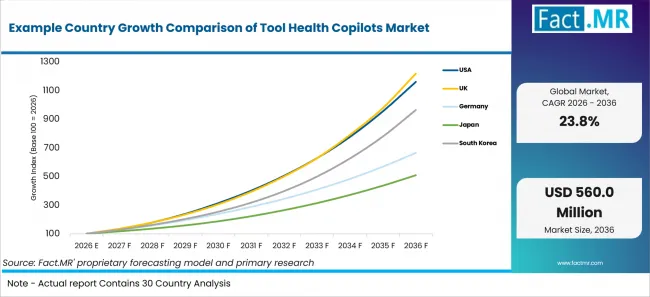
Example Country Growth Comparison Of Tool Health Copilots Market | Source: Fact.MR
| Country | CAGR |
|---|---|
| United States | 25.64% |
| Taiwan | 25.44% |
| South Korea | 25.38% |
| China | 25.33% |
| Japan | 25.27% |
| Singapore | 25.20% |
Source: Fact.MR analysis. Updated Aug 21, 2026
What supports USA adoption?
25.64% CAGR through 2036, supported by CHIPS-funded fab projects and service-cost pressure in advanced tooling.
The USA’s growth reflects semiconductor investment, digital-twin development and pressure to protect uptime across increasingly complex fabs. Commerce had awarded USD 30.9 billion in direct funding across 40 CHIPS projects by July 2025, while a USD 285 million award to Semiconductor Research Corporation Manufacturing Consortium Corporation was announced in January 2025 to establish and operate SMART USA, an institute focused on semiconductor digital twins. Tool-health copilots can support maintenance analytics, although cybersecurity restrictions, weaker equipment spending and legacy tool interfaces may slow deployment.
How is Taiwan scaling demand?
25.44% CAGR through 2036, led by foundry capacity, export depth and high tool utilization.
Taiwan’s growth reflects high foundry utilization, expanding semiconductor output and strong equipment investment. Taiwan’s manufacturing sector grew 26.18% year over year in Q1 2026, while semiconductor equipment spending rose 90% to a record USD 31.5 billion in 2025. Copilots can compare recurring alarms across similar chambers, although validation requirements and mature maintenance systems mean vendors must prove measurable decision improvements.
What supports South Korea adoption?
25.38% CAGR through 2036, supported by memory manufacturing scale and semiconductor export recovery.
South Korea’s growth reflects large memory production, rising semiconductor exports and expanding service capacity. South Korea’s ICT exports reached USD 264.3 billion in 2025, while semiconductor equipment spending increased 26% to USD 25.8 billion. Tool-health copilots can support deposition, etch and vacuum maintenance, although tightly controlled analytics environments and plant-specific model training may extend adoption cycles.
How does China expand adoption?
25.33% CAGR through 2036, shaped by domestic electronics output and semiconductor equipment demand.
China’s growth reflects a large electronics manufacturing base and rising integrated-circuit output. Major companies in China’s electronic information manufacturing sector recorded operating revenue of RMB 17.4 trillion in 2025, while integrated-circuit output increased 10.9% to 484.3 billion units. On-premise copilots can fit sensitive fab environments, although export controls, mixed tool sources and localized control systems may complicate model portability and integration.
What supports Japan adoption?
25.27% CAGR through 2036, supported by domestic tool expertise and IC production activity.
Japan’s growth reflects established semiconductor equipment expertise and continued integrated-circuit production activity. Copilots can support mixed fleets of old and new tools, although language-specific workflows, softer semiconductor sales and hardware-first qualification priorities may restrain software adoption.
How is Singapore developing demand?
25.20% CAGR through 2036, led by wafer-fab investment and advanced packaging activity.
Singapore’s growth reflects continued wafer-fab investment, manufacturing commitments and a compact semiconductor support ecosystem. UMC’s expansion is expected to lift local capacity above one million wafers annually, while manufacturing drew S$12.1 billion in fixed-asset commitments in 2025. Tool-health copilots can support rapid maintenance response, although limited engineering labor and extra review of sensitive operational data may constrain rollout.
Who leads the Tool Health Copilots Market?
Cohu/Tignis provides AI-driven anomaly detection, predictive maintenance and process-control software for semiconductor manufacturing, while Applied Materials provides AI-assisted eBeam defect-review technology.
INFICON offers fab process-monitoring and fault-detection technology; EBARA is developing failure-prediction functions for dry vacuum pumps.
Which companies are the key providers?
Key companies include Applied Materials; Cohu, including Tignis; INFICON; and EBARA.
- Applied Materials
- Cohu, including Tignis
- INFICON
- EBARA
Bibliography
- Applied Materials, Inc. (2025, February 19). Applied Materials accelerates chip defect review with next-gen eBeam system.
- Cohu, Inc. (2025, January 7). Cohu completes acquisition of Tignis.
- Directorate General of Budget, Accounting and Statistics. (2026, May 29). GDP: Preliminary estimate for 2026Q1, and outlook for 2026.
- EBARA Corporation. (2025, November 17). EBARA to establish second overhaul plant for dry vacuum pumps in Korea.
- EBARA Corporation. (2025, December 17). EBARA launches new dry vacuum pump and plasma abatement system.
- Ministry of Trade, Industry and Resources. (2026, January 15). ICT exports post record annual performance in 2025.
- Semiconductor Industry Association. (2026, February 6). Global annual semiconductor sales increase 25.6% to $791.7 billion in 2025.
- SEMI. (2026, April 7). AI demand, advanced logic and memory drive record semiconductor equipment billings in 2025.
- United Microelectronics Corporation. (2025, April 1). UMC unveils new fab expansion in Singapore in grand opening ceremony.
- Micron Technology, Inc. (2026, January 26). Micron breaks ground on advanced wafer fabrication facility in Singapore.
- Singapore Economic Development Board. (2026, February 9). EDB Year 2025 in Review.
- National Institute of Standards and Technology. (2025, January 3). Biden-Harris Administration awards Semiconductor Research Corporation Manufacturing Consortium Corporation $285M for new CHIPS Manufacturing USA Institute for digital twins, headquartered in North Carolina.
- U.S. Government Accountability Office. (2025, December 11). Semiconductors: Information on projects funded to strengthen U.S. supply chain (GAO-26-107882).
This Report Answers
- The report explains tool health copilots across capability, equipment domain, deployment and end user.
- Segment analysis identifies leading subsegments and fab priorities.
- Country analysis examines semiconductor hubs and the policy, investment or production mechanisms supporting adoption.
- Competitive analysis reviews providers across AI process control, vacuum service, diagnostics and asset-health analytics.
- Application analysis assesses how uptime risk, fault isolation and tool-data access shape purchase decisions.
What does the Tool Health Copilots Market cover?
The Tool Health Copilots Market covers software that improves equipment-health decisions in semiconductor fabs. It includes predictive analytics, guided troubleshooting, maintenance scheduling and spare-parts advisory tools. The assessment overlaps with IoT-enabled equipment maintenance solutions where sensor data and analytics are used to reduce unplanned downtime.
The assessment covers cloud, on-prem and edge deployment across vacuum, etch, deposition, litho, track and metrology equipment. Demand is assessed across foundries, memory makers, OSAT and equipment OEMs.
What is included in the scope?
The scope includes licensed or subscription software that turns tool-health data into maintenance guidance. It also includes commercial platforms built around operational twin dashboards, model-based diagnostics and equipment-specific service workflows.
It includes failure models, troubleshooting copilots, scheduling engines and spare-parts tools used by fab engineering teams and equipment-service organizations.
What is excluded from the scope?
The scope excludes standalone semiconductor equipment, raw sensors, general MES platforms, EDA software, wafer inspection hardware and manual field-service contracts sold without tool-health copilot software.
General maintenance software is excluded when it is not configured for semiconductor equipment health. Basic alarm dashboards are excluded without assisted diagnosis.
How Was the Analysis Built?
The analysis draws on 120+ sources, 35+ company portfolios, 25+ countries and 20+ industry interviews.
- Primary Research: Interviews cover manufacturers, service providers, technology developers, end users and procurement teams. These discussions examine purchasing priorities, adoption barriers and competitive positioning.
- Desk Research: Desk research covers government statistics, company filings, technical studies, public policy and authoritative industry sources. Sources are documented in the bibliography.
- Market Sizing and Forecasting: Estimates combine historical performance, demand indicators, segment shares, country growth, adoption patterns and investment activity.
- Data Validation and Update Cycle: Findings are validated against public data, company activity and trade patterns. Updates review launches, capacity changes, partnerships, approvals and procurement shifts.
Segmentation
What is the report’s scope and coverage?
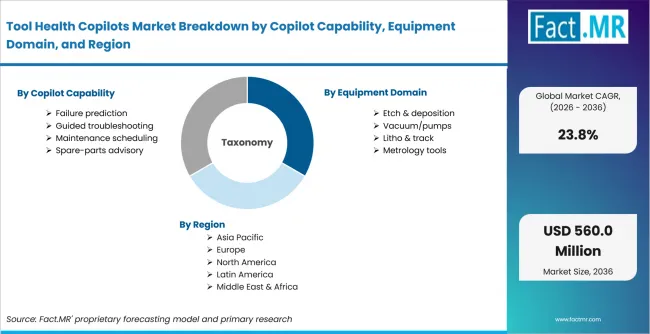
Tool Health Copilots Market Breakdown By Copilot Capability, Equipment Domain, And Region | Source: Fact.MR
| Attribute | Details |
|---|---|
| Quantitative Units | USD million |
| Market Definition | Software copilots that analyze semiconductor equipment health data and recommend failure prediction, troubleshooting, maintenance scheduling or spare-parts actions. |
| Copilot Capability | Failure prediction; Guided troubleshooting; Maintenance scheduling; Spare-parts advisory |
| Equipment Domain | Vacuum/pumps; Etch & deposition; Litho & track; Metrology tools |
| Deployment | Cloud; On-prem; Edge |
| End User | Foundries; Memory makers; OSAT; Equipment OEMs |
| Regions Covered | North America; Latin America; Western Europe; Eastern Europe; East Asia; South Asia & Pacific; Middle East & Africa |
| Countries Covered | United States; Taiwan; South Korea; China; Japan; Singapore |
| Key Companies Profiled | Applied Materials; Cohu, including Tignis; INFICON; EBARA |
| Forecast Period | 2026 to 2036 |
| Approach | Hybrid top-down and bottom-up approach using semiconductor equipment fleets, tool service activity, fab investment, deployment mix and provider portfolio review. |
Source: Fact.MR analysis. Updated Aug 21, 2026
How is the market segmented?
-
By Copilot Capability:
- Failure prediction
- Guided troubleshooting
- Maintenance scheduling
- Spare-parts advisory
-
By Equipment Domain:
- Vacuum/pumps
- Etch & deposition
- Litho & track
- Metrology tools
-
By Deployment:
- Cloud
- On-prem
- Edge
-
By End User:
- Foundries
- Memory makers
- OSAT
- Equipment OEMs
-
By Region:
- North America
- Latin America
- Western Europe
- Eastern Europe
- East Asia
- South Asia & Pacific
- Middle East & Africa
Frequently Asked Questions
How big is the tool health copilots market in 2026?
What is the CAGR of the tool health copilots market from 2026 to 2036?
Which copilot capability leads the tool health copilots market?
Which equipment domain leads the tool health copilots market?
Who are the leading companies in the tool health copilots market?
Who worked on this report


Preview the report firsthand - request a free sample
Free SampleGet the brochure for pricing and purchase details
Download PDF