- Base Value(2025): 5.8 Bn
- Estimated Value(2026): 6.2 Bn
- Forecast Value (2036): 11.5 Bn
- CAGR (2026 - 2036): 6.4%
Viscosupplementation Market Analysis and Forecast by Fact.MR
- The global viscosupplementation market is estimated at US$ 5.8 billion in 2025 and has been forecast to expand at a CAGR of 6.4% to reach US$ 11.5 billion by 2036.
- Viscosupplementation involves intra-articular injection of hyaluronic acid (HA) preparations to restore synovial fluid viscosity and reduce pain in osteoarthritic joints.
- Single-injection products lead the product segment, with biofermentation-derived HA accounting for the largest source category.
- Knee osteoarthritis is the dominant treatment indication. Hospitals and orthopedic clinics form the primary treatment settings. Single-dose prefilled syringes represent the leading product form.
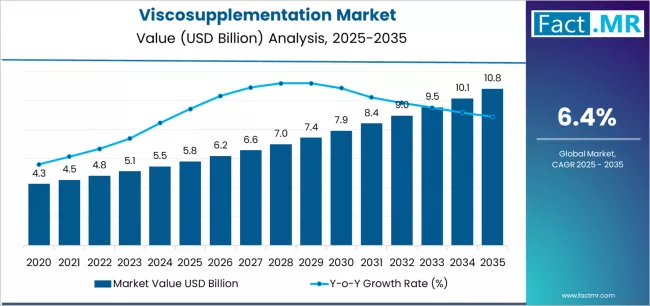
Viscosupplementation Market Market Value Analysis | Source: Fact.MR
Summary of Viscosupplementation Market
- Market Snapshot
- In 2025, the global Viscosupplementation Market was valued at approximately USD 5.8 billion.
- The market is estimated to reach USD 6.2 billion in 2026 and is projected to attain USD 11.5 billion by 2036.
- The viscosupplementation market is likely to expand at a CAGR of 6.4% during the forecast period.
- The market is anticipated to create an absolute dollar opportunity of USD 5.3 billion between 2026 and 2036.
- Single Injection Viscosupplementation accounts for 38.6% of product share in 2026.
- China (7.9%) and India (7.5%) are the key growth markets during the forecast period.
- Demand and Growth Drivers
- Osteoarthritis prevalence growth, affecting over 500 million people globally, is expanding the patient population eligible for viscosupplementation as a conservative management option before joint replacement.
- Patient preference for non-surgical, minimally invasive treatment options is supporting viscosupplementation adoption as an alternative to total knee arthroplasty for moderate osteoarthritis.
- Single-injection viscosupplementation product adoption is improving patient convenience and reducing clinic visit burden compared to traditional 3-injection and 5-injection regimens.
- Sports medicine application growth for cartilage preservation and early-stage joint degeneration in younger, active patients is expanding the treatment indication beyond elderly osteoarthritis.
- Ultrasound-guided injection technique adoption is improving accuracy of intra-articular delivery, reducing extra-articular injection rates and improving clinical outcomes.
- Product and Segment View
- Single Injection Viscosupplementation accounts for 38.6% of the product segment in 2026, supported by strong installed base and continued procurement across primary end use channels.
- Biofermentation Derived Hyaluronic Acid accounts for 55.2% of the source segment in 2026, reflecting concentrated demand across established application areas.
- Knee Osteoarthritis accounts for 46.8% of the application segment in 2026, with adoption rising across both developed and emerging markets.
- Key segmentation includes:
- Product: Single Injection Viscosupplementation, Multi Injection Visco supplementation, Sodium Hyaluronate Based Products
- Source: Biofermentation Derived Hyaluronic Acid, Animal Derived Hyaluronic Acid
- Application: Knee Osteoarthritis, Hip Osteoarthritis, Shoulder Osteoarthritis
- End Use: Hospitals, Orthopedic Clinics, Rehabilitation Centers
- These systems enable:
- Targeted procurement and specification alignment across buyer segments
- Performance benchmarking across product and application categories
- Regional demand mapping across 30 plus countries
- Geography and Competitive Outlook
- North America accounts for a large share of global demand, supported by established procurement channels and a mature buyer base.
- Europe shows stable demand, with Germany (5.7%) contributing through regulatory compliance and institutional procurement for viscosupplementation products.
- Asia Pacific demand is led by China (7.9%) and India (7.5%).
- China (7.9%) and India (7.5%) are the fastest growing country markets during the forecast period.
- Leading companies include Zimmer Biomet Holdings, Inc., DePuy Synthes (a Johnson & Johnson company), Fidia Farmaceutici S.p.A., Sanofi S.A., Smith & Nephew plc.
- Analyst Opinion
- Shambhu Nath Jha, Principal Consultant at Fact.MR, says 'The viscosupplementation market operates in a contested clinical evidence environment where patient demand and clinical practice outpace guideline endorsement in some markets. Zimmer Biomet leads through its orthopedic market position and Gel-One product. The market is growing despite AAOS guideline controversy because patient preference for non-surgical options and real-world clinical experience sustain prescriber adoption. Single-injection convenience, ultrasound-guided technique improvement, and indication expansion to non-knee joints will drive the next phase of growth.'
Key Growth Drivers, Constraints, and Opportunities
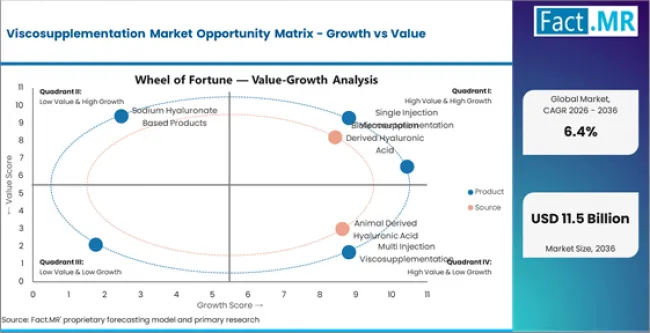
Viscosupplementation Market Opportunity Matrix Growth Vs Value | Source: Fact.MR
Key Factors Driving Growth
- Osteoarthritis prevalence growth, affecting over 500 million people globally, is expanding the patient population eligible for viscosupplementation as a conservative management option before joint replacement.
- Patient preference for non-surgical, minimally invasive treatment options is supporting viscosupplementation adoption as an alternative to total knee arthroplasty for moderate osteoarthritis.
- Single-injection viscosupplementation product adoption is improving patient convenience and reducing clinic visit burden compared to traditional 3-injection and 5-injection regimens.
Key Market Constraints
- Clinical evidence controversy, with some guidelines questioning viscosupplementation efficacy versus placebo injection, creates prescriber uncertainty and payer coverage variability.
- AAOS conditional recommendation against viscosupplementation for knee osteoarthritis limits adoption among U.S. orthopedic surgeons who follow society guidelines.
- Competition from corticosteroid injections, which are less expensive and immediately available, creates a lower-cost alternative for symptomatic joint pain management.
Key Opportunity Areas
- Cross-linked HA formulations with extended duration of action (6 to 12 months) are creating premium product positioning that reduces re-injection frequency and improves patient value proposition.
- Hip, shoulder, and ankle osteoarthritis indication expansion is broadening the addressable joint market beyond the dominant knee osteoarthritis category.
- Regenerative medicine combination approaches pairing viscosupplementation with platelet-rich plasma (PRP) or stem cell therapy are creating integrated joint preservation treatment protocols.
Segment-wise Analysis of the Viscosupplementation Market
- Single Injection Viscosupplementation holds 38.6% of the product segment in 2026, supported by established demand channels and continued procurement across primary end use applications.
- Biofermentation Derived Hyaluronic Acid holds 55.2% of the source segment in 2026, supported by established demand channels and continued procurement across primary end use applications.
- Knee Osteoarthritis holds 46.8% of the application segment in 2026, supported by established demand channels and continued procurement across primary end use applications.
The viscosupplementation market is segmented by product, source, application, end use, and region.
By product, the market covers Single Injection Viscosupplementation, Multi Injection Viscosupplementation, Sodium Hyaluronate Based Products.
By source, coverage includes Biofermentation Derived Hyaluronic Acid, Animal Derived Hyaluronic Acid.
Which Product Segment Dominates the Viscosupplementation Market?
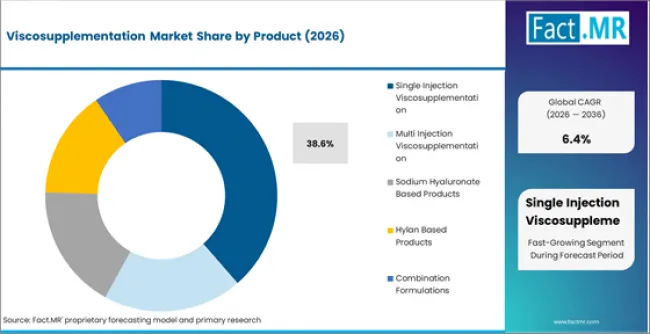
Viscosupplementation Market Analysis By Product | Source: Fact.MR
Single Injection Viscosupplementation is expected to account for 38.6% of the product segment in 2026. Within this category, High Molecular Weight Hyaluronic Acid, Moderate Molecular Weight Hyaluronic Acid represent the primary sub-segments generating procurement activity. The depth of the single injection viscosupplementation installed base across product applications sustains replacement demand and limits share erosion from newer alternatives in the viscosupplementation market.
Multi Injection Viscosupplementation is the second largest category in the product segment, with demand concentrated in Three Injection Regimen and Five Injection Regimen. Growth in multi injection viscosupplementation reflects shifting buyer requirements within the viscosupplementation market toward this category.
Which Source Segment Dominates the Viscosupplementation Market?
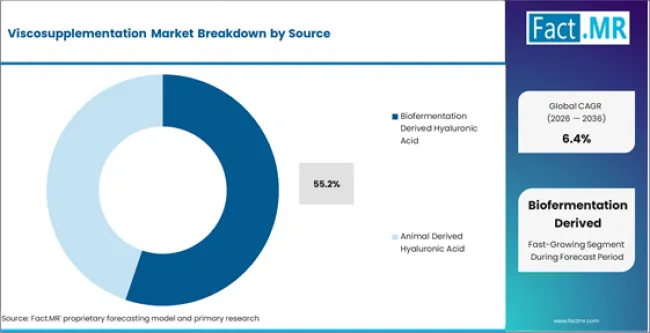
Viscosupplementation Market Analysis By Source | Source: Fact.MR
Biofermentation Derived Hyaluronic Acid is expected to account for 55.2% of the source segment in 2026. Within this category, Bacterial Fermentation Based Hyaluronic Acid, Streptococcus Zooepidemicus Based Production represent the primary sub-segments generating procurement activity. The depth of the biofermentation derived hyaluronic acid installed base across source applications sustains replacement demand and limits share erosion from newer alternatives in the viscosupplementation market.
Animal Derived Hyaluronic Acid is the second largest category in the source segment, with demand concentrated in Rooster Comb Derived Hyaluronic Acid and Bovine Derived Hyaluronic Acid. Growth in animal derived hyaluronic acid reflects shifting buyer requirements within the viscosupplementation market toward this category.
Which Application Segment Dominates the Viscosupplementation Market?
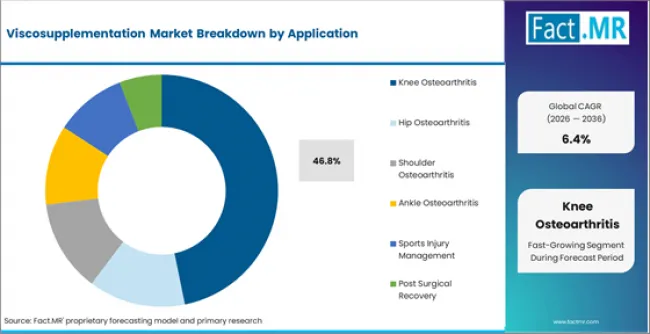
Viscosupplementation Market Analysis By Application | Source: Fact.MR
Knee Osteoarthritis is expected to account for 46.8% of the application segment in 2026. Within this category, Mild Osteoarthritis Treatment, Moderate Osteoarthritis Treatment, High Severity Osteoarthritis Management represent the primary sub-segments generating procurement activity. The depth of the knee osteoarthritis installed base across application applications sustains replacement demand and limits share erosion from newer alternatives in the viscosupplementation market.
Hip Osteoarthritis holds the second position within the application segment. Expansion of hip osteoarthritis use cases is creating incremental demand as the viscosupplementation market diversifies beyond the primary category.
Which Product Trend is Shaping the Next Phase of Growth in the Viscosupplementation Market?
Single-injection viscosupplementation products are the product format driving the strongest growth within the market. Traditional HA viscosupplementation required 3 to 5 weekly injections, creating patient inconvenience and clinic scheduling burden. Single-injection formulations using high-molecular-weight cross-linked HA deliver a full treatment course in one clinic visit, dramatically improving patient compliance and reducing per-treatment clinic resource utilization.
Zimmer Biomet Gel-One, Sanofi Synvisc-One, and other single-injection products have captured a growing share of the viscosupplementation market by offering superior convenience without sacrificing clinical efficacy. For orthopedic practices, single-injection products reduce appointment complexity and enable more patients to complete treatment courses. The trend toward single-injection convenience is accelerating as new HA formulations achieve regulatory approval with evidence supporting equivalent or superior duration of clinical benefit.
Regional Outlook Across Key Markets
.webp "Top Country Growth Comparison Viscosupplementation Market Cagr (2026 2036)")
Top Country Growth Comparison Viscosupplementation Market Cagr (2026 2036) | Source: Fact.MR
- China is growing at 7.9%, supported by osteoarthritis prevalence, orthopedic procedure growth, and domestic HA manufacturing.
- India is growing at 7.5%, supported by high knee OA prevalence, orthopedic specialty expansion, and non-surgical treatment preference.
- USA is growing at 6.8%, supported by Medicare coverage, sports medicine prescribing, and ultrasound-guided technique adoption.
- Brazil is growing at 6.3%, supported by orthopedic capacity growth, non-surgical OA demand, and ANVISA regulatory pathways.
CAGR Table
| Country | CAGR (%) |
|---|---|
| China | 7.9% |
| India | 7.5% |
| USA | 6.8% |
| Brazil | 6.3% |
| Germany | 5.7% |
| UK | 5.4% |
| Japan | 4.9% |
Source: Fact.MR analysis. Updated May 27, 2026
Source: Fact MR (FMR) analysis, based on proprietary forecasting model and primary research.
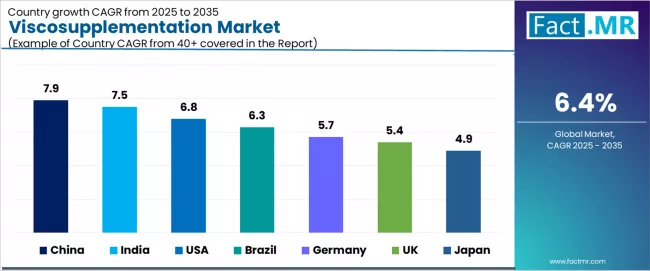
Viscosupplementation Market Cagr Analysis By Country | Source: Fact.MR
Market Outlook for Viscosupplementation in China
The China Viscosupplementation market is projected to grow at a CAGR of 7.9% through 2036. China is the fastest-growing viscosupplementation market, driven by osteoarthritis prevalence and expanding orthopedic procedure volumes.
- Aging population demographics and high osteoarthritis prevalence create a large patient base seeking conservative joint management.
- Hospital orthopedic departments in tier-1 and tier-2 cities provide the primary treatment infrastructure for viscosupplementation.
- Domestic HA manufacturers including Bloomage Biotechnology produce cost-competitive viscosupplementation products.
Viscosupplementation Demand Trends in India
The India Viscosupplementation market is projected to grow at a CAGR of 7.5% through 2036. Growing orthopedic specialty capacity and osteoarthritis awareness support viscosupplementation market development in India.
- High osteoarthritis prevalence, particularly knee OA in the aging population, creates substantial treatment demand.
- Orthopedic specialty clinics in major cities are adopting viscosupplementation as part of conservative joint management protocols.
- Patient preference for non-surgical treatments in a population with limited joint replacement access supports HA injection adoption.
USA Viscosupplementation Market Growth Outlook
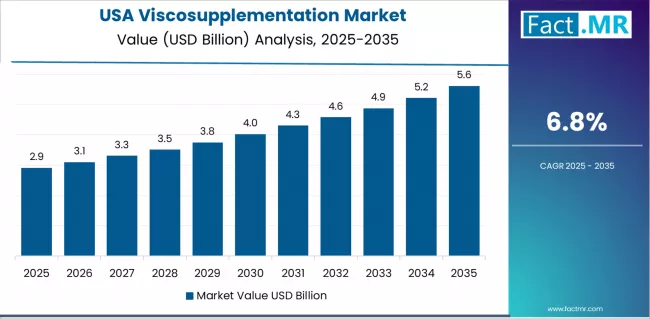
Viscosupplementation Market Country Value Analysis | Source: Fact.MR
The USA Viscosupplementation market is projected to grow at a CAGR of 6.8% through 2036. The U.S. is a major viscosupplementation market despite AAOS guideline controversy, sustained by orthopedic prescriber practice patterns and patient demand.
- Medicare Part B coverage for viscosupplementation, though subject to prior authorization, supports access for the elderly OA population.
- Sports medicine physicians and non-surgical orthopedic specialists are primary prescribers, often operating independently of AAOS guideline recommendations.
- Ultrasound-guided injection technique adoption is improving treatment accuracy and clinical outcomes in office-based settings.
Brazil Viscosupplementation Market Demand Analysis
The Brazil Viscosupplementation market is projected to grow at a CAGR of 6.3% through 2036. Growing orthopedic surgery capacity and middle-class healthcare spending support viscosupplementation demand in Brazil.
- Private orthopedic clinics in Sao Paulo and major cities provide the primary treatment channel for HA injection procedures.
- Patient demand for non-surgical OA management creates market opportunity in a population with limited joint replacement access.
- ANVISA regulatory pathways support market access for both imported and domestically produced HA viscosupplementation products.
Viscosupplementation Market Growth Assessment in Germany
The Germany Viscosupplementation market is projected to grow at a CAGR of 5.7% through 2036. Established orthopedic practice and insurance coverage support viscosupplementation demand in Germany.
- German Orthopedic Society (DGOOC) practice guidelines inform viscosupplementation use in knee OA management.
- Statutory and private health insurance coverage for indicated viscosupplementation supports patient access.
- Outpatient orthopedic practice model supports high-volume office-based HA injection procedures.
Viscosupplementation Market Opportunity Outlook in UK
The UK Viscosupplementation market is projected to grow at a CAGR of 5.4% through 2036. NICE guidance and NHS orthopedic pathways shape viscosupplementation practice in the United Kingdom.
- NICE osteoarthritis guidelines provide clinical framework for conservative OA management including intra-articular therapy.
- NHS orthopedic referral pathways include viscosupplementation as a treatment option before joint replacement consideration.
- Private orthopedic and sports medicine clinics supplement NHS provision with self-pay viscosupplementation services.
Demand Landscape for Viscosupplementation in Japan
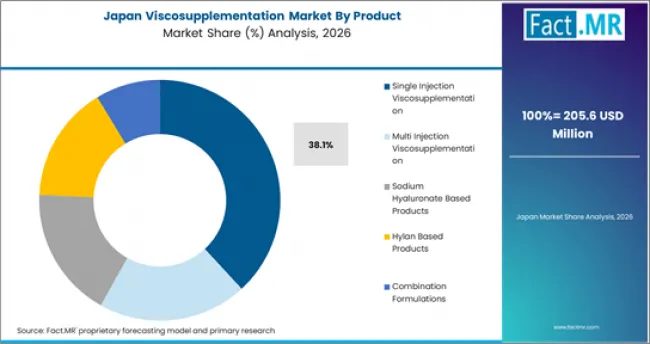
Viscosupplementation Market Japan Market Share Analysis By Product | Source: Fact.MR
The Japan Viscosupplementation market is projected to grow at a CAGR of 4.9% through 2036. Aging demographics and high OA prevalence sustain viscosupplementation demand in Japan.
- Japan has the highest OA prevalence rates relative to population among major economies, driven by aging demographics.
- NHI coverage for viscosupplementation supports patient access through orthopedic clinic prescribing.
- Seikagaku Corporation maintains a strong domestic position in HA-based orthopedic products for the Japanese market.
Competitive Benchmarking and Company Positioning
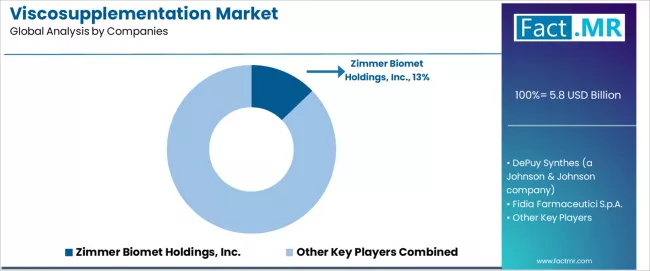
Viscosupplementation Market Analysis By Company | Source: Fact.MR
Viscosupplementation Market Analysis By Company
- Zimmer Biomet Holdings, Inc., DePuy Synthes (a Johnson & Johnson company), Fidia Farmaceutici S.p.A., Sanofi S.A. hold established positions in the global viscosupplementation market through broad product portfolios, geographic reach, and growing capabilities in higher specification categories.
- Smith & Nephew plc, Anika Therapeutics, Inc., Seikagaku Corporation, Ferring Pharmaceuticals participate across specific price tiers, end use segments, and regional channels, with competition shaped by product quality, service support, and distribution access.
- HA formulation durability, single-injection product availability, orthopedic surgeon prescriber relationships, and clinical evidence supporting efficacy versus placebo are the primary competitive differentiators.
Zimmer Biomet Holdings Inc. leads the viscosupplementation market through its Gel-One single-injection product and orthopedic market position. DePuy Synthes (Johnson and Johnson) participates through orthopedic procedural integration. Fidia Farmaceutici S.p.A. competes through its Hyalgan multi-injection product and HA manufacturing capability. Sanofi S.A. holds a position through Synvisc-One. Smith and Nephew plc serves through its sports medicine and joint care portfolio.
Competition is shaped by product format (single vs. multi-injection), HA formulation characteristics (molecular weight, cross-linking), and orthopedic channel relationships. Single-injection products are gaining share from multi-injection alternatives. HA sourcing (biofermentation vs. animal-derived) influences product positioning in markets where biosafety concerns affect prescriber and patient preference. Corticosteroid injections remain the primary competitive alternative rather than competing viscosupplementation products.
Key Companies in the Viscosupplementation Market
Zimmer Biomet Holdings, Inc., DePuy Synthes (a Johnson & Johnson company), Fidia Farmaceutici S.p.A., Sanofi S.A. are among the leading players in the viscosupplementation market globally, supported by strong brand visibility and broad product portfolios.
Smith & Nephew plc, Anika Therapeutics, Inc., Seikagaku Corporation, Ferring Pharmaceuticals hold established positions across specific categories, supported by durable products and regional distribution.
Recent Industry Developments
- Zimmer Biomet Holdings, Inc. - Extended Duration HA Product (January 2026)
- Zimmer Biomet Holdings, Inc. launched a next-generation cross-linked HA viscosupplementation product with clinical evidence supporting 12-month duration of pain relief from a single injection.
- DePuy Synthes (a Johnson & Johnson company) - Hip OA Indication (2025)
- DePuy Synthes (a Johnson & Johnson company) received regulatory approval for its single-injection HA product in hip osteoarthritis, expanding the treatable joint indication beyond knee OA.
- Fidia Farmaceutici S.p.A. - PRP Combination Protocol (2025)
- Fidia Farmaceutici S.p.A. published clinical data supporting a combined viscosupplementation-PRP injection protocol showing superior outcomes compared to HA injection alone in moderate knee OA.
- Sanofi S.A. - Ultrasound Guidance Kit (February 2026)
- Sanofi S.A. introduced an integrated ultrasound-guided injection kit bundling HA syringe with single-use ultrasound probe cover and anatomical targeting guide.
Leading Companies Shaping the Viscosupplementation Market
- Zimmer Biomet Holdings, Inc.
- DePuy Synthes (a Johnson & Johnson company)
- Fidia Farmaceutici S.p.A.
- Sanofi S.A.
- Smith & Nephew plc
- Anika Therapeutics, Inc.
- Seikagaku Corporation
- Ferring Pharmaceuticals
- Lifecore Biomedical, LLC
- LG Life Sciences Ltd.
Sources and Research References
- Zimmer Biomet Holdings, Inc.. Product portfolio and corporate announcements.
- DePuy Synthes (a Johnson & Johnson company). Product portfolio and corporate announcements.
- Fidia Farmaceutici S.p.A.. Product portfolio and corporate announcements.
- Industry association statistics, regulatory publications, trade databases, and company product catalogs.
- Primary interviews with manufacturers, distributors, buyers, and institutional users.
This bibliography is provided for reader reference and is not exhaustive. The full report contains the complete reference list and detailed citations.
Key Questions This Report Addresses
- What is the current and future size of the Viscosupplementation Market?
- How fast is the Viscosupplementation Market expected to grow between 2026 and 2036?
- Which product is likely to lead the market by 2026?
- Which source segment is expected to account for the highest demand by 2026?
- What factors are driving demand in this market globally?
- How is technology adoption influencing the market structure?
- Which countries are projected to show the fastest growth through 2036?
- What is driving market expansion in China and India?
- Who are the key companies active in the Viscosupplementation Market?
- How does Fact.MR estimate and validate the market forecast?
Viscosupplementation Market Definition
The viscosupplementation market covers products, technologies, and services associated with product, source, application categories. The scope includes global and regional market size and forecasts for 2026 to 2036 across product, source, application, end use, and region.
Viscosupplementation Market Inclusions
- The scope covers global and regional market size and forecasts for 2026 to 2036 across product, source, application, end use, and region.
- It includes regional demand analysis across major geographies, based on factors such as technology adoption, regulatory requirements, institutional spending, and commercial demand patterns.
- The report includes pricing and cost analysis across entry-level, mid-range, and premium categories, including hardware, software, and service components where applicable.
- It covers technology trends, market drivers and constraints, and the competitive landscape, including product portfolios, pricing strategy, geographic reach, and distribution expansion of leading players.
Viscosupplementation Market Exclusions
- The scope excludes adjacent categories, general-purpose alternatives, and products not specifically classified under the viscosupplementation market taxonomy.
- It excludes custom-built in-house solutions, informal unbranded products with low market visibility, and rental or leasing services without direct product sales.
- The report excludes military or defense-grade variants, industrial systems outside the defined scope, and non-commercial applications without market transaction data.
- It also excludes software-only platforms sold independently from hardware, unless they are part of the defined product or service taxonomy.
Viscosupplementation Market Research Methodology
- The methodology combines secondary research, primary interviews, and forecast modelling.
- It draws on 120 plus secondary sources and benchmarks 65 plus company product portfolios.
- Market sizing covers 30 plus countries through a demand-side model, supported by top-down validation.
- Key inputs include end use adoption rates, technology penetration, pricing benchmarks, and regional procurement patterns.
- The model cross-checks demand with shipments, pricing trends, channel mix, and product launches.
- Primary validation includes 25 plus interviews across manufacturers, distributors, buyers, and institutional users.
- Final estimates go through trade-flow checks, sales-pattern review, and sensitivity testing.
Segmentation
Scope of Analysis
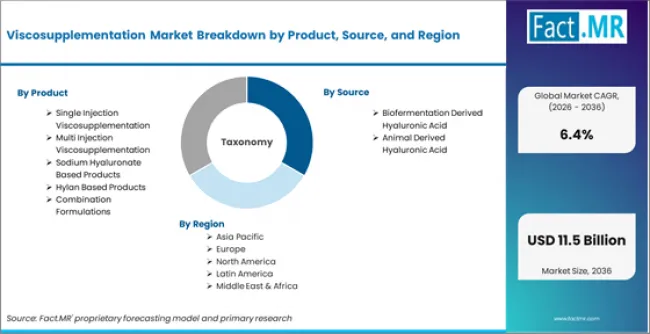
Viscosupplementation Market Breakdown By Product, Source, And Region | Source: Fact.MR
| Parameter | Details |
|---|---|
| Quantitative Units | USD 6.2 billion to USD 11.5 billion, at a CAGR of 6.4% |
| Market Definition | The Viscosupplementation Market covers products, technologies, and services across product, source, application categories for commercial, institutional, and consumer applications. |
| Regions Covered | North America, Latin America, Europe, East Asia, South Asia and Pacific, Middle East and Africa |
| Countries Covered | USA, Canada, UK, Germany, China, India, 30 plus countries |
| Key Companies | Zimmer Biomet Holdings, Inc., DePuy Synthes (a Johnson & Johnson company), Fidia Farmaceutici S.p.A., Sanofi S.A., Smith & Nephew plc, Anika Therapeutics, Inc., Seikagaku Corporation, Ferring Pharmaceuticals, Lifecore Biomedical, LLC, LG Life Sciences Ltd. |
| Forecast Period | 2026 to 2036 |
| Approach | Hybrid demand-side and top-down methodology built on country-level application demand, product benchmarking, pricing analysis, shipment validation, and primary interviews across manufacturers, distributors, and end users |
Source: Fact.MR analysis. Updated May 27, 2026
Viscosupplementation Market Segmentation
-
HospitalViscosupplementation Market Segmented by Product:
- Single Injection Viscosupplementation
- High Molecular Weight Hyaluronic Acid
- Moderate Molecular Weight Hyaluronic Acid
- Multi Injection Viscosupplementation
- Three Injection Regimen
- Five Injection Regimen
- Sodium Hyaluronate Based Products
- Non Cross Linked Hyaluronic Acid
- Cross Linked Hyaluronic Acid
- Hylan Based Products
- Hylan G F 20
- Hylan Derivatives
- Combination Formulations
- Hyaluronic Acid with Anti Inflammatory Agents
- Hyaluronic Acid with Analgesics
- Single Injection Viscosupplementation
-
Viscosupplementation Market Segmented by Source:
- Biofermentation Derived Hyaluronic Acid
- Bacterial Fermentation Based Hyaluronic Acid
- Streptococcus Zooepidemicus Based Production
- Animal Derived Hyaluronic Acid
- Rooster Comb Derived Hyaluronic Acid
- Bovine Derived Hyaluronic Acid
- Biofermentation Derived Hyaluronic Acid
-
Viscosupplementation Market Segmented by Application:
- Knee Osteoarthritis
- Mild Osteoarthritis Treatment
- Moderate Osteoarthritis Treatment
- High Severity Osteoarthritis Management
- Hip Osteoarthritis
- Shoulder Osteoarthritis
- Ankle Osteoarthritis
- Sports Injury Management
- Joint Lubrication Therapy
- Post Injury Recovery
- Post Surgical Recovery
- Arthroscopy Recovery Support
- Orthopedic Rehabilitation
- Knee Osteoarthritis
-
Viscosupplementation Market Segmented by End Use:
- Hospitals
- Orthopedic Departments
- Surgical Centers
- Orthopedic Clinics
- Rehabilitation Centers
- Ambulatory Surgical Centers
- Hospitals
-
Viscosupplementation Market Segmented by Product Form:
- Single Dose Syringes
- Prefilled Syringes
- Sterile Injectable Syringes
- Multi Dose Vials
- Liquid Injectable Solutions
- Gel Based Injectable Formulations
- Single Dose Syringes
-
Viscosupplementation Market by Region:
- North America
- USA
- Canada
- Mexico
- Latin America
- Brazil
- Chile
- Rest of Latin America
- Western Europe
- Germany
- UK
- Italy
- Spain
- France
- Nordic
- BENELUX
- Rest of Western Europe
- Eastern Europe
- Russia
- Poland
- Hungary
- Balkan & Baltic
- Rest of Eastern Europe
- East Asia
- China
- Japan
- South Korea
- South Asia and Pacific
- India
- ASEAN
- Australia & New Zealand
- Rest of South Asia and Pacific
- Middle East & Africa
- Kingdom of Saudi Arabia
- Other GCC Countries
- Turkiye
- South Africa
- Other African Union
- Rest of Middle East & Africa
- North America
Frequently Asked Questions
How big is the viscosupplementation market in 2026?
What will be the size of viscosupplementation market in 2036?
How much will be the viscosupplementation market growth between 2026 and 2036?
What are the key product types in the viscosupplementation market?
Which source segment is expected to contribute significant share in the viscosupplementation market in 2026?
Who worked on this report


Preview the report firsthand - request a free sample
Free SampleGet the brochure for pricing and purchase details
Download PDF