- Market Value (2025): USD 318.8 Mn
- Estimated Value (2026): USD 350 Mn
- Forecast Value (2036): USD 891 Mn
- CAGR (2026-2036): 9.8%
What is the Aircraft Cabin Air Purification Modules market forecast to be worth by 2036?
USD 350 million in 2026 to USD 891 million by 2036 at 9.8% CAGR.
- The aircraft cabin air purification modules market was valued at USD 318.8 million in 2025, with airline fleet utilization and cabin retrofit planning included among the demand indicators.
- Demand is projected to increase from USD 350 million in 2026 to USD 891 million by 2036.
- The market is forecast to record 9.8% CAGR from 2026 to 2036 owing to HEPA replacement cycles, UV-C evaluation and line-fit cabin-system integration.
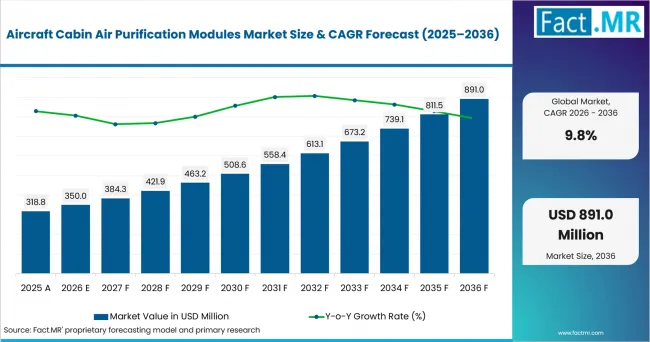
Aircraft Cabin Air Purification Modules Market Value Analysis | Source: Fact.MR
What are the defining numbers behind Aircraft Cabin Air Purification Modules Market growth?
USD 541 million absolute opportunity by 2036, led by HEPA filtration and Line-fit systems alongside narrow-body aircraft and U.S. demand.
- Demand Drivers in the Market
- Airlines need cabin filtration modules that fit routine maintenance windows.
- OEM engineering teams prioritize line-fit modules because certification is easier during production.
- MRO providers benefit when HEPA replacement kits use existing certification pathways.
- Fleet operators are expected to compare UV-C and ionisation options against proven HEPA performance.
- Key Segments Analyzed
- By Technology: HEPA filtration is expected to hold 45.0% share in 2026 due to proven particulate-removal performance and service familiarity.
- By Aircraft Type: Narrow-body aircraft are projected to account for 44.0% share in 2026 because high cycle frequency raises replacement planning value.
- By Fit: Line-fit (OEM) is anticipated to capture 58.0% share in 2026 as built-in modules reduce retrofit approval work.
- By Region: The United States is estimated to represent 33.0% share in 2026 owing to a large active airline fleet and certification depth.
- Analyst Opinion at Fact.MR
- Shambhu Nath Jha, Principal Consultant at Fact.MR states, “Cabin air modules are no longer evaluated only as replacement filters. Airlines are expected to ask for evidence that filtration and maintenance records stay aligned across aircraft families. Suppliers that combine certification support with service access are better placed to move from trial units into fleet decisions.”
- Strategic Implications
- Airline maintenance teams should map replacement intervals before selecting retrofit modules.
- OEM program managers should confirm weight and airflow assumptions before approving line-fit packages.
- Module suppliers should document HEPA performance and ultraviolet safety limits clearly.
- Investors should separate aircraft-certified systems from consumer air-purifier claims.
Canada is forecast to record 12.1% CAGR through 2036 on domestic passenger recovery and transborder route pressure. The United States is expected to post 10.8% CAGR with installed-fleet scale. The United Kingdom is projected to advance at 10.7% CAGR, followed by Japan at 10.2%, Germany at 10.1% and France at 10.1%.
How does the Aircraft Cabin Air Purification Modules market break down by segment?
HEPA filtration leads Technology at 45.0%; Line-fit systems lead Fit at 58.0%.
Which technology dominates?
HEPA filtration is projected to account for 45.0% share in 2026.
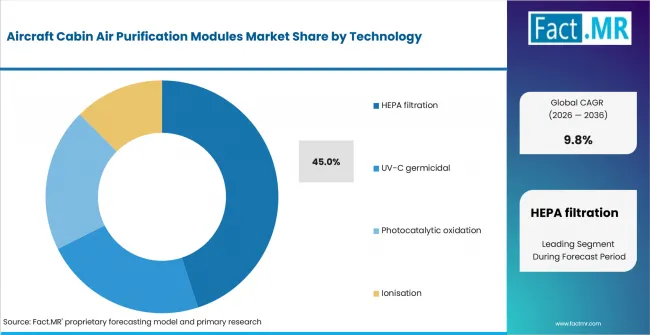
Aircraft Cabin Air Purification Modules Market Analysis By Technology | Source: Fact.MR
HEPA filtration is expected to lead Technology because airlines already understand filter replacement and maintenance documentation. UV-C germicidal modules are projected to gain attention where air-path disinfection
is reviewed. Photocatalytic oxidation remains selective due to by-product questions. Ionisation is estimated to stay smaller until cabin-safety evidence is easier to compare. The FAA stated in September 2025 that most U.S. commercial airplanes use HEPA filters that remove 99.97% of particulate material.
What leads the Aircraft Type segment?
Narrow-body aircraft are expected to hold 44.0% share in 2026.
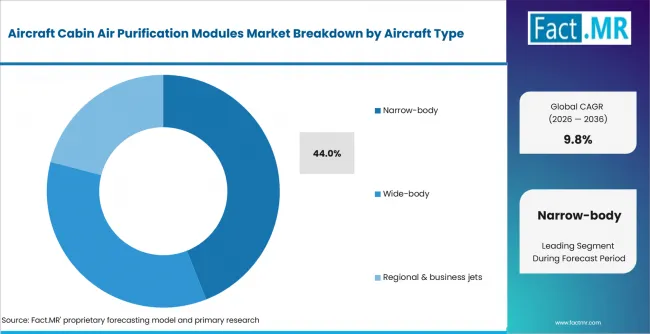
Aircraft Cabin Air Purification Modules Market Analysis By Aircraft Type | Source: Fact.MR
Narrow-body aircraft are anticipated to lead Aircraft Type with 44.0% share in 2026, supported by frequent rotations and predictable cabin-maintenance requirements. The UK Civil Aviation Authority reported in 2026 that 302 million passengers passed through UK airports in 2025, reinforcing sustained airline activity and cabin-system servicing demand.
How does Fit shape demand?
Line-fit (OEM) is anticipated to lead with 58.0% share in 2026.
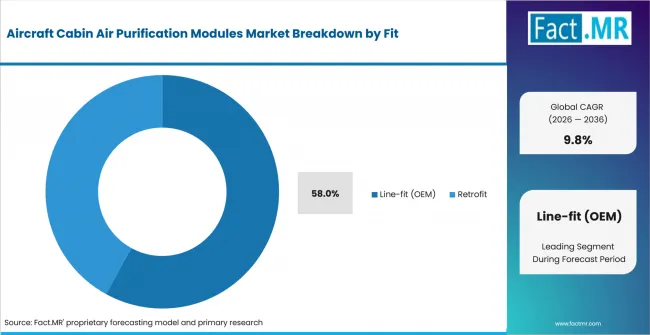
Aircraft Cabin Air Purification Modules Market Analysis By Fit | Source: Fact.MR
Line-fit systems are projected to lead Fit with 58.0% share in 2026 because purification modules can be integrated before aircraft delivery and certified within original equipment configurations. ONS reported in July 2026 that repair and maintenance of civil aircraft and engines rose 14.1% in 2025 to GBP 3.7 billion.
What is accelerating Aircraft Cabin Air Purification Modules Market adoption, and what is holding it back?
Cabin-air assurance drives it; retrofit complexity restrains it.
Drivers Impact Analysis
| Driver | (~) % Impact on CAGR | Geographic Relevance | Impact Timeline |
|---|---|---|---|
| HEPA replacement planning | +2.4% | North America and Europe | Short term (<= 2 years) |
| Line-fit integration | +2.0% | USA, France, Germany | Short term (<= 2 years) |
| Narrow-body utilization | +1.8% | USA, UK, Japan | Medium term (2-4 years) |
| Passenger comfort scrutiny | +1.3% | Global airline networks | Medium term (2-4 years) |
| Certified retrofit pathways | +0.9% | MRO hubs | Long term (>= 4 years) |
Source: Fact.MR analysis. Updated Aug 18, 2026
- HEPA replacement planning: Airlines are expected to prioritize modules with documented filter performance and predictable service access. FAA cabin-air guidance gives operators a clearer basis for comparing HEPA claims.
- Line-fit integration: OEM adoption is projected to reduce later modification work because airflow, sensors and wiring are handled before delivery. This favors suppliers that support certification data early.
- Narrow-body utilization: High-cycle aircraft are anticipated to increase replacement planning value. Cabin modules that shorten maintenance touch time are expected to gain preference.
- Passenger comfort scrutiny: Airlines are expected to treat air quality as part of cabin comfort. Clear claims carry more weight when passenger routes remain crowded.
- Certified retrofit pathways: Aftermarket programs are forecast to benefit when an STC or installation kit reduces uncertainty. MRO teams still need aircraft-specific approval evidence before scheduling work.
Opportunity Impact Analysis
| Opportunity | (~) % Impact on CAGR | Geographic Relevance | Impact Timeline |
|---|---|---|---|
| Combined filtration and sensing | +1.2% | USA and Europe | Medium term (2-4 years) |
| UV-C safety documentation | +0.9% | Japan and France | Medium term (2-4 years) |
| Aftermarket HEPA kits | +0.8% | North America | Short term (<= 2 years) |
| Cabin refurbishment bundling | +0.6% | UK, France, Germany | Long term (>= 4 years) |
Source: Fact.MR analysis. Updated Aug 18, 2026
- Combined filtration and sensing: Modules that connect filtration with maintenance signals are expected to create a clearer service record. Related context appears in aircraft cabin environment sensors coverage and connected cabin air quality monitoring.
- UV-C safety documentation: UV-C modules are projected to gain where suppliers can prove exposure limits and installation safeguards. Aircraft-level evidence is expected to decide acceptance.
- Aftermarket HEPA kits: Approved HEPA kits are anticipated to widen retrofit access where airlines want cabin air upgrades without a full interior redesign. Collins documentation supports this route.
Restraints Impact Analysis
| Restraint | (~) % Impact on CAGR | Geographic Relevance | Impact Timeline |
|---|---|---|---|
| Retrofit downtime | -1.2% | Airline fleets | Short term (<= 2 years) |
| Certification evidence load | -1.0% | USA, Europe, Japan | Short term (<= 2 years) |
| Weight and energy limits | -0.8% | All aircraft types | Medium term (2-4 years) |
| Technology comparison risk | -0.5% | UV-C and ionisation buyers | Long term (>= 4 years) |
Source: Fact.MR analysis. Updated Aug 18, 2026
- Retrofit downtime: Aircraft operators are expected to delay optional modules when installation time conflicts with scheduled maintenance. Retrofit suppliers need simple kit documentation to reduce that friction.
- Certification evidence load: Every aircraft air-system change is anticipated to face documentation review around airflow, materials and safety. Weak evidence can slow airline approval even when the module works technically.
- Weight and energy limits: Additional cabin hardware is projected to face scrutiny when it affects weight or electrical load. Smaller modules with clear performance claims are easier to evaluate.
- Technology comparison risk: Airlines are expected to be cautious when UV-C or ionisation claims are harder to compare with HEPA filtration. Procurement teams need evidence that suits certified aircraft environments.
Which countries are scaling Aircraft Cabin Air Purification Modules Market fastest?
- The country comparison spans 2.00 percentage points across the forecast period.
- Canada remains 1.28 percentage points above the United States through air traffic recovery and transborder route pressure.
- The United States remains 0.08 percentage point above the United Kingdom because installed-fleet scale supports recurring module service.
- The United Kingdom remains 0.49 percentage point above Japan through airport throughput and civil-aircraft maintenance activity.
- Japan remains 0.11 percentage point above Germany as domestic air travel and inbound tourism support cabin-utilization needs.
- Germany remains 0.04 percentage point above France due to aircraft equipment depth and European supply-chain participation.
- France closes the displayed range through aerospace production scale and air-traffic recovery.
Aircraft Cabin Air Purification Modules Market is segmented into North America, Latin America, Europe, East Asia, South Asia and Pacific, Middle East and Africa.
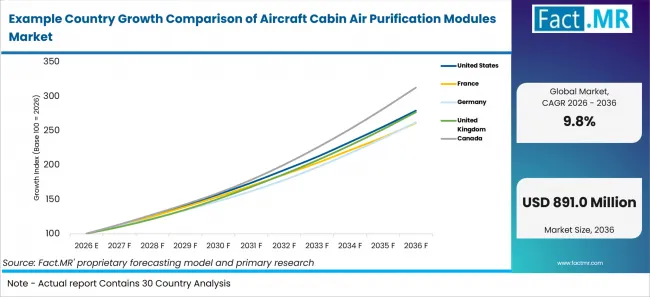
Example Country Growth Comparison Of Aircraft Cabin Air Purification Modules Market | Source: Fact.MR
| Country | CAGR |
|---|---|
| Canada | 12.1% |
| United States | 10.8% |
| United Kingdom | 10.7% |
| Japan | 10.2% |
| Germany | 10.1% |
| France | 10.1% |
Source: Fact.MR analysis. Updated Aug 18, 2026
What is powering Canada’s lead?
12.1% CAGR through 2036, driven by airline traffic recovery and transborder route pressure.
Canada’s growth is supported by recovering airline activity and recurring cabin-service requirements. Statistics Canada reported 7.0 million Level I carrier passengers and 4.5 million screened passengers in April 2026. Compact HEPA modules fit routine maintenance, although weaker Canada-U.S. traffic, utilization priorities and delayed investment in UV-C or ionisation systems may restrain adoption.
How is the United States scaling cabin air purification demand?
10.8% CAGR through 2036, supported by installed-fleet scale and FAA cabin-air standards.
United States growth reflects its large commercial fleet and sustained passenger volumes. BTS reported 69.5 million scheduled-service passengers in January 2026, while FAA forecasts the fleet rising from 7,387 aircraft in 2024 to 10,607 by 2045. Retrofit downtime, certification requirements and stronger safety evidence for UV-C and ionisation may limit faster deployment.
What supports the United Kingdom outlook?
10.7% CAGR through 2036, shaped by airport throughput and civil-aircraft maintenance.
United Kingdom growth is supported by high passenger throughput and expanding maintenance activity. The UK CAA reported 302 million airport passengers in 2025, while ONS said civil-aircraft repair and maintenance increased 14.1% to GBP 3.7 billion. Mandatory maintenance priorities, certification paperwork and airport-cost pressures may delay supplemental cabin-air upgrades.
What underpins Japan’s growth?
10.2% CAGR through 2036, backed by domestic aviation and inbound travel.
Japan’s growth reflects strong domestic aviation and international visitor activity. MLIT reported 112.50 million domestic scheduled passengers in FY2025, while JNTO recorded 42,683,600 visitor arrivals in 2025, up 15.8%. These traffic levels provide a substantial operating base for cabin-system demand, although compact cabin configurations, technology comparisons, and a 6.8% year-over-year decline in June 2026 visitor arrivals may influence retrofit decisions.
How does Germany perform?
10.1% CAGR through 2036, led by aerospace production and equipment supply depth.
Germany’s growth is supported by a large aerospace industry and rising passenger traffic. BDLI reported EUR 62.0 billion in aerospace revenue in 2025, including EUR 45.0 billion from civil aviation, while Destatis recorded airport traffic growth of 3.9%. Retrofit competition, aviation costs and energy reviews may temper additional cabin-air hardware adoption.
What supports France growth?
10.1% CAGR through 2036, supported by aerospace output and air-traffic recovery.
France’s growth is backed by a deep aerospace manufacturing base and recovering air traffic. DGAC reported first-half 2026 traffic 1.1% above 2019 levels, while GIFAS recorded EUR 85.6 billion in 2025 aerospace revenue, with civil aeronautics representing 74%. Aircraft downtime, weaker transport-equipment output and safety positioning may constrain retrofit demand.
Who leads the Aircraft Cabin Air Purification Modules Market?
Collins Aerospace and Honeywell Aerospace show the clearest competitive relevance, while Safran / Safran Filtration Systems strengthens the broader filtration landscape.
Collins Aerospace supports the aftermarket HEPA route, with the report specifically noting that Collins documentation supports approved HEPA retrofit kits. Honeywell Aerospace and Safran / Safran Filtration Systems broaden competition across aircraft filtration and cabin-system requirements. Donaldson Company and Pall Corporation add filtration depth, while Aviation Clean Air extends the competitive set for aircraft air-treatment solutions.
Which companies are the key providers?
Key companies include Collins Aerospace, Honeywell Aerospace, Safran / Safran Filtration Systems, Donaldson Company, Inc., Pall Corporation and Aviation Clean Air, LLC in the company set.
- Collins Aerospace
- Honeywell Aerospace
- Safran / Safran Filtration Systems
- Donaldson Company, Inc.
- Pall Corporation
- Aviation Clean Air, LLC
Bibliography
- German Aerospace Industries Association (BDLI). (2026, May 27). BDLI industry data 2026: Aerospace industry sets new records for revenue and employment.
- Bureau of Transportation Statistics. (2026, April 10). January 2026 U.S. airline traffic data down 1.8% from the same month last year. U.S. Department of Transportation.
- UK Civil Aviation Authority. (2026, February 24). UK aviation officially breaks records with over 300m passenger journeys in 2025.
- UK Civil Aviation Authority. (2026, March 31). Aviation regulator publishes Initial Proposals for Heathrow H8 price cap.
- Statistisches Bundesamt (Destatis). (2026, January 29). 3,9 % mehr Fluggäste im Jahr 2025 als im Vorjahr [3.9% more passengers in 2025 than in the previous year].
- Statistisches Bundesamt (Destatis). (2026, April 2). 2,1 Milliarden Euro Luftverkehrsteuer für 84,0 Millionen Fluggäste im Jahr 2025 angemeldet [€2.1 billion in aviation tax registered for 84.0 million passengers in 2025].
- Federal Aviation Administration. (2025, September 4). Cabin air quality.
- Federal Aviation Administration. (2025). FAA Aerospace Forecast Fiscal Years 2025–2045.
- Groupement des Industries Françaises Aéronautiques et Spatiales. (2026, May 11). 2025 results: The French aerospace industry remains strongly positioned for the future.
- Institut national de la statistique et des études économiques. (2025, October 3). In August 2025, manufacturing output fell by 0.7%.
- Office for National Statistics. (2026, July 24). UK manufacturers' sales by product: 2025.
- Statistics Canada. (2026, May 29). Screened passenger traffic at Canadian airports, April 2026.
- Statistics Canada. (2026, June 25). Aircraft movement and civil aviation statistics, April 2026.
This Report Answers
- The report provides intelligence on Aircraft Cabin Air Purification Modules Market across aerospace filters and cabin-system choices that shape airline procurement.
- Segment analysis covers HEPA filtration and Line-fit systems as the share leaders while drawing adjacent context from cabin air sterilization systems.
- Country outlook evaluates Canada and the United States alongside the United Kingdom and Japan. Germany and France complete the profiled markets.
- Competitive analysis profiles Collins Aerospace and Honeywell Aerospace alongside Safran / Safran Filtration Systems, Donaldson Company, Inc., Pall Corporation and Aviation Clean Air, LLC.
- Scope review connects cabin purification with aircraft oxygen systems and aircraft heat exchangers where aircraft environmental systems affect integration planning.
What does the Aircraft Cabin Air Purification Modules Market cover?
Aircraft cabin air purification modules are installed to treat recirculated or supplied cabin air inside certified aircraft systems.
The market covers filtration, air-disinfection and air-treatment modules where performance, safety evidence and maintenance procedures decide purchase approval.
Coverage extends to HEPA filtration, UV-C germicidal modules and photocatalytic oxidation. Ionisation is included where the technology is sold for cabin air treatment.
What is included in the scope?
The scope includes line-fit and retrofit cabin modules for narrow-body, wide-body, regional and business aircraft. Related cabin systems such as aircraft cabin management systems are included only where air-quality module integration is relevant.
Airline MRO, OEM installation and approved aftermarket kits are included. Supporting materials such as aircraft cleaning chemicals are treated as adjacent categories and not counted as modules.
What is excluded from the scope?
Standalone airport purifiers and consumer room purifiers remain outside the scope. General HVAC equipment is excluded unless sold as an aircraft-certified cabin module.
The scope excludes unrelated environmental systems and aircraft thermal hardware unless the product is directly tied to cabin air treatment. Sensor-only products are used only as adjacent context.
How Was the Analysis Built?
The analysis draws on 120+ sources, 35+ company portfolios, 25+ countries, and more than 20 industry interviews.
- Primary Research: Primary research includes discussions with manufacturers, service providers, technology developers, distributors, end users, procurement teams, and subject-matter experts. These conversations examine purchasing priorities, product adoption, operational challenges, approval requirements, competitive positioning, and the factors that influence wider market acceptance.
- Desk Research: Desk research covers government statistics, regulatory publications, company filings, trade data, technical studies, industry associations, standards, public policy, and other authoritative sources. Every source used in the analysis is documented in the bibliography.
- Market Sizing and Forecasting: Market estimates combine historical performance, demand indicators, pricing and volume trends, segment shares, company participation, country-level growth, adoption patterns, investment activity, and barriers to market expansion.
- Data Validation and Update Cycle: Findings are validated by comparing primary interviews with public data, company activity, regulatory changes, trade patterns, and industry developments. Regular updates review new product launches, capacity changes, partnerships, approvals, procurement trends, and shifts in commercial adoption.
Segmentation
What is the report’s scope and coverage?
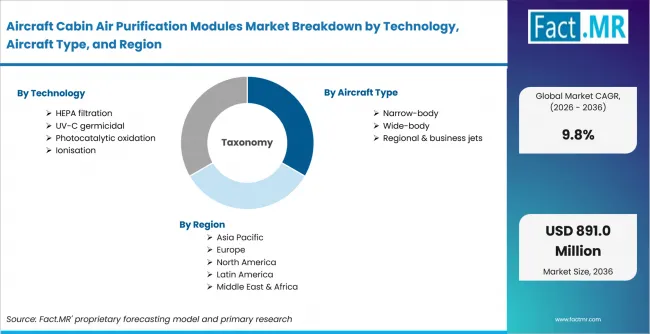
Aircraft Cabin Air Purification Modules Market Breakdown By Technology, Aircraft Type, And Region | Source: Fact.MR
| Attribute | Details |
|---|---|
| Quantitative Units | USD million |
| Market Definition | Aircraft-installed cabin air filtration, disinfection and air-treatment modules used within certified cabin environmental-control systems. Coverage includes HEPA, UV-C, photocatalytic oxidation and ionisation modules for OEM line-fit and retrofit use. |
| Technology | HEPA filtration; UV-C germicidal; Photocatalytic oxidation; Ionisation |
| Aircraft Type | Narrow-body; Wide-body; Regional and business jets |
| Fit | Line-fit (OEM); Retrofit |
| Regions Covered | North America; Latin America; Europe; East Asia; South Asia and Pacific; Middle East and Africa |
| Countries Covered | Canada; United States; United Kingdom; Japan; Germany; France |
| Key Companies Profiled | Collins Aerospace; Honeywell Aerospace; Safran / Safran Filtration Systems; Donaldson Company, Inc.; Pall Corporation; Aviation Clean Air, LLC |
| Forecast Period | 2026 to 2036 |
| Approach | Hybrid top-down and bottom-up approach using aircraft fleet activity; cabin air-quality requirements; HEPA replacement needs; retrofit certification activity; line-fit integration; MRO demand; regional aviation activity; country adoption patterns and company portfolio review |
Source: Fact.MR analysis. Updated Aug 18, 2026
How is the market segmented?
-
By Technology:
- HEPA filtration
- UV-C germicidal
- Photocatalytic oxidation
- Ionisation
-
By Aircraft Type:
- Narrow-body
- Wide-body
- Regional and business jets
-
By Fit:
- Line-fit (OEM)
- Retrofit
-
By Region:
- North America
- Latin America
- Europe
- East Asia
- South Asia and Pacific
- Middle East and Africa
Frequently Asked Questions
How big is the aircraft cabin air purification modules market in 2026?
What is the CAGR of the aircraft cabin air purification modules market from 2026 to 2036?
Which technology leads the aircraft cabin air purification modules market?
Which aircraft type leads the aircraft cabin air purification modules market?
Who are the leading companies in the aircraft cabin air purification modules market?
Who worked on this report


Preview the report firsthand - request a free sample
Free SampleGet the brochure for pricing and purchase details
Download PDF