- Market Value (2025): USD 272.0 Bn
- Estimated Value (2026): USD 286.4 Bn
- Forecast Value (2036): USD 480.0 Bn
- CAGR (2026-2036): 5.3%
What is the Chilled Deli Food Market forecast to be worth by 2036?
USD 286.4 billion in 2026 to USD 480.0 billion by 2036, at 5.3% CAGR.
- The chilled deli food market reached USD 272.0 billion in 2025 as supermarkets, food manufacturers, and fresh-convenience specialists served recurring refrigerated meal demand.
- Demand is projected to increase from USD 286.4 billion in 2026 to USD 480.0 billion by 2036.
- The market is forecast to record a 5.3% CAGR from 2026 to 2036 as buyers seek convenient meals that fit controlled cold-chain and shelf-life requirements.
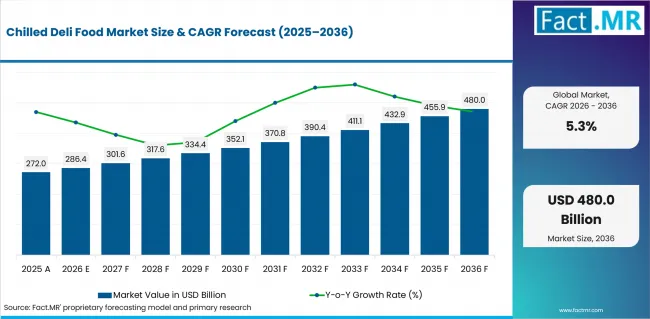
Chilled Deli Food Market Value Analysis | Source: Fact.MR
What are the defining numbers behind Chilled Deli Food Market growth?
USD 193.6 billion absolute opportunity by 2036, led by Ready-to-eat Meals, Modified Atmosphere Packaging; and Supermarkets & Hypermarkets.
- Demand Drivers in the Market
- Retailers need low-preparation meal solutions that cover breakfast, lunch, dinner; and entertaining without requiring a staffed deli counter.
- Food manufacturers need refrigerated formats that preserve portion control and meal variety while supporting centralized production and multi-store distribution.
- Private-label and branded suppliers need dependable cold-chain service because short-life products lose margin quickly through stockouts and waste.
- Category buyers use chilled meals, deli meats, cheese; seafood; and dips to build cross-category baskets inside frequent grocery trips.
- Key Segments Analyzed
- By Product: Ready-to-eat Meals are projected to hold 36.0% share in 2026 because they combine ingredient selection, preparation, portioning; and clean-up in one purchase.
- By Packaging: Modified Atmosphere Packaging is anticipated to capture 42.0% share in 2026 by protecting color, texture, flavor; and usable life across refrigerated distribution. Packaging and shelf-life requirements also affect the food cold chain and food cold chain logistics markets.
- By Distribution Channel: Supermarkets & Hypermarkets are forecast to account for 48.0% share in 2026 because they combine refrigerated space, assortment, promotion; and frequent replenishment.
- By End User: Household demand spans families, working professionals, and senior consumers; with each group applying different tests for portion size; convenience; and value.
- By Storage Type: Refrigerated, short shelf-life, extended shelf-life; and freshly prepared products require different production; date-control; and replenishment routines.
- Analyst Opinion at Fact.MR
- Shambhu Nath Jha, Principal Consultant at Fact.MR, states: "Chilled deli suppliers will not win shelf space on convenience alone. Retailers need proof that the product; package; sanitation system; and replenishment model work together. The strongest offers extend usable life without trading away sensory quality; traceability; or recycling readiness. That combination protects margin by reducing waste; recalls; and emergency markdowns."
- Strategic Implications
- Manufacturers should validate shelf life under the actual temperature variation and handling conditions used across retail distribution, not only under laboratory storage.
- Retail buyers should compare waste, markdowns, service levels; and recall readiness alongside the supplier's quoted unit price.
- Packaging suppliers should develop format changes with product technologists because gas mix, seal integrity, purge behavior; and portion architecture affect commercial performance together.
- Protein processors and fresh-convenience specialists should maintain site-level traceability and rapid replenishment before expanding across national retail programs.
How does the Chilled Deli Food Market break down by segment?
Ready-to-eat Meals lead Product at 36.0%, Modified Atmosphere Packaging leads Packaging at 42.0%, and Supermarkets & Hypermarkets lead Distribution Channel at 48.0%.
Why do Ready-to-eat Meals lead Product?
Ready-to-eat Meals hold 36.0% share in 2026.
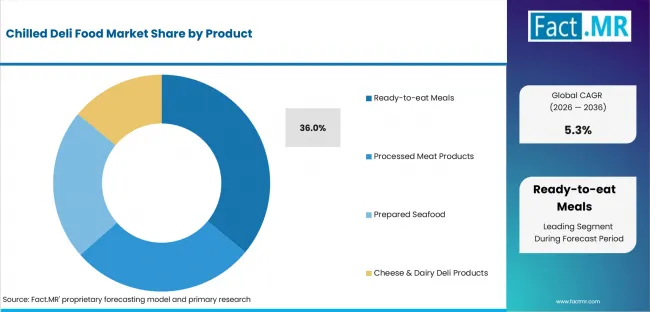
Chilled Deli Food Market Analysis By Product | Source: Fact.MR
Ready-to-eat meals replace several household tasks in a single refrigerated purchase. Sandwiches, salads, and pasta meals fit different dayparts and let retailers rotate flavors; portions; and price points without changing the basic cold-case model. Their commercial advantage comes from purchase frequency and basket fit rather than the value of any single ingredient. Channel economics connect this demand with the retail ready packaging and ready meal trays markets.
Why does Modified Atmosphere Packaging lead Packaging?
Modified Atmosphere Packaging holds 42.0% share in 2026.
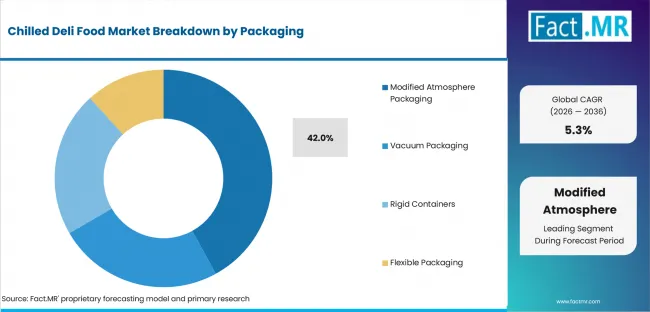
Chilled Deli Food Market Analysis By Packaging | Source: Fact.MR
Modified atmosphere packaging supports the central economic requirement of chilled deli food: enough usable life to connect centralized production with distributed retail. Tray-sealed, vacuum-skin, and gas-flushed formats can be adjusted for oxidation; respiration; purge; and presentation needs across meals; meats; seafood; cheese; and dips. The package must protect the product without creating a seal; recycling; or material-cost problem elsewhere in the system.
Why do Supermarkets & Hypermarkets lead Distribution Channel?
Supermarkets & Hypermarkets hold 48.0% share in 2026.
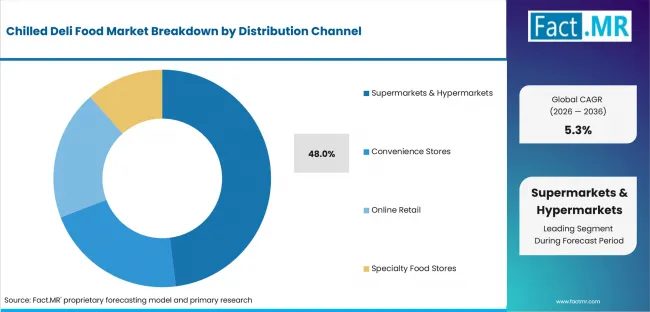
Chilled Deli Food Market Analysis By Distribution Channel | Source: Fact.MR
Supermarkets and hypermarkets control the refrigerated space, promotion calendar, replenishment rhythm; and cross-merchandising needed to scale chilled deli products. They can position sliced meats beside cheese; salads beside meal solutions; and prepared seafood near premium occasions. Centralized category management also gives large retailers direct influence over specifications; packaging formats; and supplier service levels.
How does End User shape chilled deli purchasing?
Household demand is spread across families, working professionals, and senior consumers.
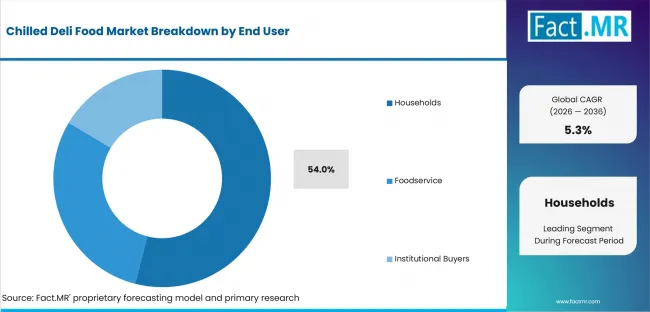
Chilled Deli Food Market Analysis By End User | Source: Fact.MR
Families value shareable portions and predictable value, while working professionals place more weight on speed and portability. Senior consumers can favor smaller portions, clear date marking; and products that reduce cooking effort. Suppliers therefore need pack and recipe architecture that matches the intended household occasion instead of treating convenience as one uniform need.
How does Storage Type affect operating economics?
Storage choice determines the balance among freshness, usable life, waste; and replenishment frequency.
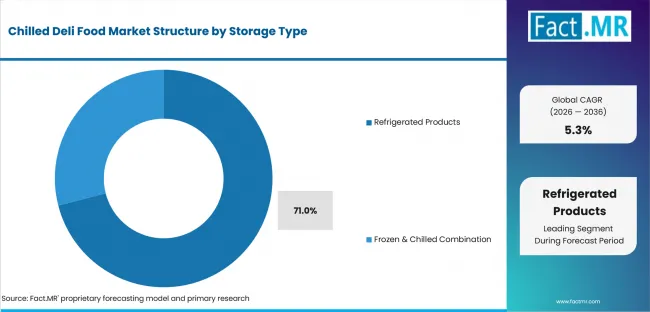
Chilled Deli Food Market Analysis By Storage Type | Source: Fact.MR
Short shelf-life and freshly prepared lines can support premium sensory cues but require accurate demand planning and rapid delivery. Extended shelf-life products widen the distribution radius, yet they must still preserve flavor, texture; and clean presentation. Refrigerated products across all three routes depend on strict date control and stable temperatures from factory release to the retail case.
What is accelerating Chilled Deli Food Market adoption, and what is holding it back?
Routine demand for low-preparation meals drives growth, food-safety and shelf-life failures restrict listings, and packaging redesign creates the clearest operating opportunity.
Drivers Impact Analysis
| DRIVER | QUALITATIVE RELEVANCE | GEOGRAPHIC RELEVANCE | IMPACT TIMELINE |
|---|---|---|---|
| Routine demand for low-preparation meals | High | USA | Current forecast period |
Source: Fact.MR analysis. Updated Aug 3, 2026
Retailers are expected to supply meal solutions across more dayparts without asking shoppers to cook from raw ingredients or wait for foodservice preparation. The United Kingdom Food Security Digest 2025 recorded 184 grams of ready meals and convenience meat products purchased per person per week in the financial year ending 2024, more than three times the 1980 level. That pattern supports frequent chilled purchases rather than occasional trial. Ingredient and processing decisions remain relevant to the fresh meat packaging and food retail markets.
Opportunity Impact Analysis
| OPPORTUNITY | QUALITATIVE RELEVANCE | GEOGRAPHIC RELEVANCE | IMPACT TIMELINE |
|---|---|---|---|
| Packaging redesign | High | Germany | Current forecast period |
Source: Fact.MR analysis. Updated Aug 3, 2026
Packaging redesign can extend usable life, improve portion control, reduce material; and protect presentation when it begins with the product and distribution model. The European Commission confirmed in February 2025 that the Packaging and Packaging Waste Regulation had entered into force and would generally apply from August 2026. Suppliers therefore need formats that meet shelf-life and handling needs while preparing for tighter composition; recyclability; and waste-prevention requirements.
Restraints Impact Analysis
| RESTRAINT | QUALITATIVE RELEVANCE | GEOGRAPHIC RELEVANCE | IMPACT TIMELINE |
|---|---|---|---|
| Food-safety and shelf-life failures | High | UK | Current forecast period |
Source: Fact.MR analysis. Updated Aug 3, 2026
Food safety remains a binding commercial restraint because many chilled ready-to-eat products are consumed without a final kill step. The CDC closed a deli-meat Listeria outbreak investigation in January 2025 after reporting 61 cases, 60 hospitalizations, and 10 deaths across 19 states. Such events raise retailer audit; environmental-monitoring; sanitation-verification; traceability; insurance; and recall-readiness requirements across the category.
Which countries are scaling Chilled Deli Food Market fastest?
UK records 6.0% CAGR, followed by USA at 5.7%, Germany at 5.4%; France at 5.1%; and Japan at 4.8% through 2036.
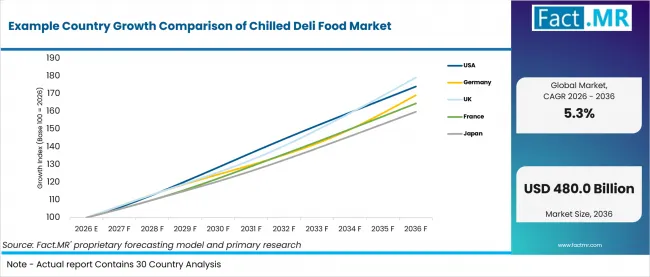
Example Country Growth Comparison Of Chilled Deli Food Market | Source: Fact.MR
| COUNTRY | CAGR, 2026 to 2036 |
|---|---|
| USA | 5.7% |
| Germany | 5.4% |
| UK | 6.0% |
| France | 5.1% |
| Japan | 4.8% |
Source: Fact.MR analysis. Updated Aug 3, 2026
What is shaping USA's outlook through 2036?
5.7% CAGR through 2036, supported by centralized specifications and large refrigerated networks.
Large supermarket, club, and foodservice buyers in the USA purchase chilled deli products through national or regional specifications. Suppliers need traceability; sanitation evidence; dependable cold-chain coverage; and rapid response when a site or lot falls outside control limits. Scale is valuable only when every plant and distribution node can support the same service and recall standard.
What is shaping Germany's outlook through 2036?
5.4% CAGR through 2036, shaped by value discipline, automated retail systems; and packaging compliance.
German grocery buyers emphasize consistent quality, efficient case formats, competitive pricing; and packaging that works with automated retail handling. The move toward recyclable and lower-waste formats adds another qualification layer. Suppliers that reduce material or extend life must still protect seal performance; presentation; and line efficiency.
What is shaping the UK's outlook through 2036?
6.0% CAGR through 2036, led by private-label fresh convenience and rapid product rotation.
UK retailers buy a large share of fresh convenience food through private-label programs. Commercial success depends on rapid development, frequent replenishment, accurate forecasting; and tightly controlled waste. The channel can scale a product quickly; but service failures or weak sell-through also become visible quickly across short-life ranges.
What is shaping France's outlook through 2036?
5.1% CAGR through 2036, supported by prepared-meal use alongside established charcuterie and cheese demand.
France combines long-established charcuterie and cheese purchasing with growing use of prepared meals among older households. Product acceptance depends on taste, provenance, portion fit; and value rather than convenience alone. Retailers can use chilled deli ranges to connect traditional products with smaller and easier meal solutions. Buyer occasions also influence the rapid food safety testing and nisin as natural antimicrobial in ready to eat foods markets.
What is shaping Japan's outlook through 2036?
4.8% CAGR through 2036, supported by compact portions, precise date control; and dependable urban cold chains.
Japanese convenience, supermarket, and e-commerce channels place close attention on presentation; portion size; date marking; and delivery discipline. Dense urban distribution supports frequent replenishment; while high quality expectations leave little room for seal failure; temperature abuse; or inconsistent appearance. Suppliers need local format adaptation rather than simple transfer of a global pack.
Who leads the Chilled Deli Food Market?
Nestlé S.A. is a leading company in the market. Its position reflects branded scale, retail access, and participation across prepared foods. Tyson Foods; Inc.; Hormel Foods Corporation; and Kraft Heinz Company also compete through recognized brands; manufacturing reach; and broad grocery distribution.
JBS S.A., BRF S.A., and Cranswick plc bring protein-processing depth and route-to-market coverage. Their competitive position depends on converting meat and poultry capability into chilled formats that meet retailer specifications for portion; shelf life; labeling; and supply continuity.
Greencore Group plc, 2 Sisters Food Group, and Samworth Brothers are closely tied to retailer-led fresh convenience and short-life execution. Competition through 2036 is expected to center on replenishment accuracy; food-safety control; product rotation; packaging compliance; and the ability to scale private-label programs without losing site-level discipline.
Which companies are the key providers?
Nestlé S.A. and Tyson Foods, Inc. are leading companies in the market.
- Nestlé S.A.
- Tyson Foods, Inc.
- Hormel Foods Corporation
- JBS S.A.
- Kraft Heinz Company
- Greencore Group plc
- 2 Sisters Food Group
- BRF S.A.
- Samworth Brothers
- Cranswick plc
Bibliography
- Centers for Disease Control and Prevention. (2025, January 31). Listeria Outbreak Linked to Meats Sliced at Delis.
- European Commission. (2025, February 11). New Rules for a More Sustainable and Competitive Packaging Economy.
- UK Department for Environment, Food & Rural Affairs. (2025, December 11). United Kingdom Food Security Digest 2025.
- Institut national de la statistique et des études économiques. (2024, February 27). Évolution de la consommation des ménages selon l’âge de 2009 à 2019.
- Statistics Bureau of Japan. (2025, September). Statistical Handbook of Japan 2025.
This Report Addresses
- What is the Chilled Deli Food Market worth in 2026, and what value is forecast for 2036?
- Which demand, purchasing, food-safety; and operating pressures shape the market?
- Why do Ready-to-eat Meals, Modified Atmosphere Packaging, and Supermarkets & Hypermarkets lead their segments?
- How do country growth rates and channel conditions differ across the profiled markets?
- Which companies are profiled, and what determines competitive credibility?
- What scope boundary, evidence base, segmentation; and methodology support the assessment?
What does the Chilled Deli Food Market cover?
Chilled ready-to-eat meals, processed deli meats, prepared seafood; and chilled cheese or dairy deli products sold within the defined commercial boundary.
The Chilled Deli Food Market covers revenue from refrigerated products purchased for direct consumption or limited final preparation. The assessment follows Product, Packaging, Distribution Channel; End User; Storage Type; and Region. Commercial value is attached to the chilled food product; while packaging is treated as a segmentation attribute rather than a separate packaging-material revenue pool. Retail execution creates a related demand signal in the chilled soup and ready to eat soup markets.
What is included in the scope?
Products sold through refrigerated retail and institutional channels when chilled preparation, storage, and shelf-life management are central to the offer.
Coverage includes ready-to-eat meals, sandwiches, salads; pasta meals; processed deli meats; prepared seafood; and chilled cheese or dairy deli products. It also covers modified-atmosphere; tray-sealed; vacuum-skin; and gas-flushed formats; together with household and institutional purchasing across the listed storage types and regions.
What is excluded from the scope?
Raw or unprepared food, ambient and frozen-only substitutes, standalone packaging revenue; delivery-platform fees; restaurant billings; and downstream menu revenue are excluded.
Raw meat and seafood are outside the boundary unless they are processed and sold as chilled deli products. Frozen-only or ambient substitutes are excluded, as are packaging components sold separately from food, restaurant service revenue; delivery commissions; and the value of downstream meals that use chilled deli products as an input.
How was the analysis built?
- Primary Research
- Primary research includes structured discussions with chilled-food manufacturers, protein processors, packaging suppliers; distributors; retail category teams; food-safety and technical teams; foodservice and institutional buyers; and subject-matter specialists. Interviews test product scope; pricing; shelf-life requirements; channel economics; purchase criteria; replenishment; and adoption frictions.
- Desk Research
- Desk research reviews official statistics, food-safety records, packaging regulation; company filings; retail and trade material; technical documentation; and dated first-party announcements. Evidence is screened for direct relevance to the defined product; company; country; and revenue boundary.
- Market-Sizing and Forecasting
- Market sizing reconciles the 2025 and 2026 values with product and channel revenue patterns, segment shares, country conditions; cold-chain and packaging requirements; household and institutional demand; and assumptions for pricing; product mix; distribution expansion; and waste reduction through 2036.
- Data Validation and Update Cycle
- Findings are cross-checked across independent evidence types and tested against the market definition. Validation reviews numerical reconciliation, company scope, segment logic; country-specific causality; and the exclusion of packaging; restaurant; delivery-platform; and frozen or ambient substitute revenue. Product-positioning choices also matter in the seafood packaging and foodservice packaging markets.
Segmentation
What is the report’s scope and coverage?
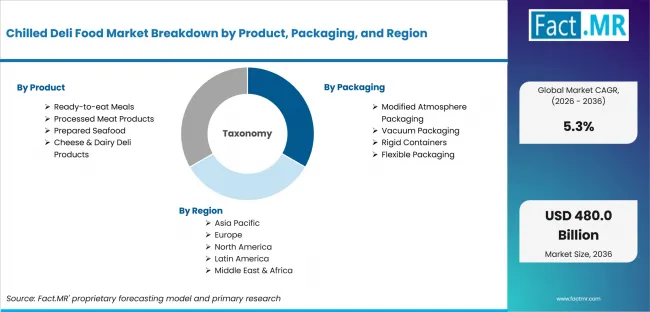
Chilled Deli Food Market Breakdown By Product, Packaging, And Region | Source: Fact.MR
| Attribute | Details |
|---|---|
| Quantitative Units | USD 286.4 Billion in 2026 to USD 480.0 Billion by 2036 at 5.3% CAGR |
| Market Definition | Revenue from chilled ready-to-eat meals, processed deli meats, prepared seafood; and chilled cheese or dairy deli products sold within the defined packaging; channel; end-user; and storage universe. |
| Product | Ready-to-eat Meals; Sandwiches; Salads; Pasta Meals |
| Packaging | Modified Atmosphere Packaging; Tray-sealed Packaging; Vacuum Skin Packaging; Gas-flushed Packaging |
| Distribution Channel | Supermarkets & Hypermarkets; Hypermarkets; Supermarkets; Food Retail Chains |
| End User | Households; Families; Working Professionals; Senior Consumers |
| Storage Type | Refrigerated Products; Short Shelf-life Products; Extended Shelf-life Products; Freshly Prepared Products |
| Regions Covered | North America; Latin America; Western Europe; Eastern Europe; East Asia; South Asia and Pacific; Middle East and Africa |
| Countries Covered | USA; Germany; UK; France; Japan |
| Key Companies Profiled | Nestlé S.A.; Tyson Foods, Inc.; Hormel Foods Corporation; JBS S.A.; Kraft Heinz Company; Greencore Group plc; 2 Sisters Food Group; BRF S.A.; Samworth Brothers; Cranswick plc |
| Forecast Period | 2026 to 2036 |
| Approach | Hybrid bottom-up and top-down sizing that reconciles company and channel evidence, product and segment revenue, country conditions; cold-chain requirements; and the defined revenue boundary. |
Source: Fact.MR analysis. Updated Aug 3, 2026
How is the market segmented?
-
By Product:
- Ready-to-eat Meals
- Sandwiches
- Salads
- Pasta Meals
- Processed Meat Products
- Sliced Ham
- Roast Beef
- Turkey Breast
- Prepared Seafood
- Smoked Salmon
- Cooked Shrimp
- Seafood Salads
- Cheese & Dairy Deli Products
- Sliced Cheese
- Cheese Spreads
- Deli Dips
- Ready-to-eat Meals
-
By Packaging:
- Modified Atmosphere Packaging
- Tray-sealed Packaging
- Vacuum Skin Packaging
- Gas-flushed Packaging
- Vacuum Packaging
- Flexible Vacuum Packs
- Rigid Vacuum Packs
- Resealable Vacuum Packs
- Rigid Containers
- Plastic Containers
- Paperboard Containers
- Microwaveable Trays
- Flexible Packaging
- Pouches
- Wrap Films
- Resealable Bags
- Modified Atmosphere Packaging
-
By Distribution Channel:
- Supermarkets & Hypermarkets
- Hypermarkets
- Supermarkets
- Food Retail Chains
- Convenience Stores
- Gas Station Stores
- Neighborhood Stores
- Express Stores
- Online Retail
- E-commerce Platforms
- Quick Commerce
- Grocery Delivery Services
- Specialty Food Stores
- Delicatessens
- Gourmet Stores
- Butcher Shops
- Supermarkets & Hypermarkets
-
By End User:
- Households
- Families
- Working Professionals
- Senior Consumers
- Foodservice
- Restaurants
- Cafés
- Catering Services
- Institutional Buyers
- Hospitals
- Educational Institutions
- Corporate Cafeterias
- Households
-
By Region:
- North America
- Latin America
- Western Europe
- Eastern Europe
- East Asia
- South Asia and Pacific
- Middle East and Africa
- USA
- Germany
- UK
- France
- Japan
- North America
Frequently Asked Questions
What is the Chilled Deli Food Market worth in 2026?
What is the Chilled Deli Food Market forecast to reach by 2036?
What CAGR is projected from 2026 to 2036?
Which Product leads the Chilled Deli Food Market?
Which Packaging type leads the market?
Which Distribution Channel leads the market?
Which country records the highest listed CAGR?
How does the USA perform through 2036?
How does Germany perform through 2036?
How does France perform through 2036?
How does Japan perform through 2036?
What is the primary driver in the Chilled Deli Food Market?
What is the clearest opportunity in the market?
What is the main restraint in the market?
Why is Modified Atmosphere Packaging important?
Who worked on this report


Preview the report firsthand - request a free sample
Free SampleGet the brochure for pricing and purchase details
Download PDF