- Base Value(2024): 2.4 Bn
- Forecast Value (2035): 5.6 Bn
- CAGR (2035): 7.9%
Cica Cream Market Outlook 2025 to 2035
The global Cica cream market is expected to reach USD 5.6 Billion by 2035, up from estimated value of USD 2.6 Billion in 2025. During the forecast period 2025 to 2035, the industry is projected to expand at a CAGR of 7.8%.
The Cica creams market is led by an increasing number of people living with sensitive skin conditions, the growing demand for clean-label and natural formulations and the increasing number of people using products suggested by dermatologists as a barrier-repair. Moreover, sustainability efforts via refill-ready packaging and eco-certified ingredients also drive adoption, with Cica creams at the heart of the latest skincare and dermo-cosmetic innovation globally.
Quick Stats for Cica Cream Market
- Industry Value (2025): USD 2.6 Billion
- Projected Value (2035): USD 5.6 Billion
- Forecast CAGR (2025 to 2035): 7.8%
- Leading Segment (2025): Soothing & Healing Creams (35% Market Share)
- Fastest Growing Country (2025-2035): South Korea (7.5% CAGR)
- Top Key Players:Dr. Jart+, belif, Innisfree, Laneige, Skin1004, CosRx, Beauty of Joseon, Mizon, Etude House, Round Lab, and O Hui
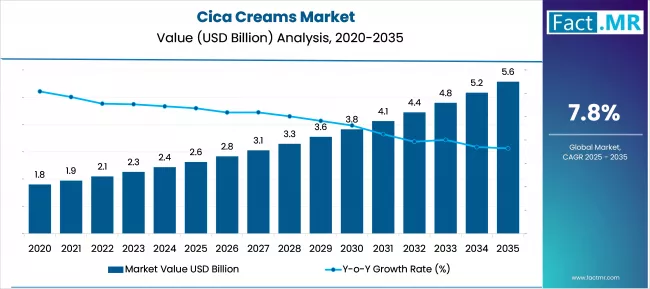
Cica Creams Market Market Value Analysis | Source: Fact.MR
What are the key factors driving growth in the Cica Cream Market?
A significant force in the market is the increase in skin sensitivity and barrier breakdown worldwide due to excessive use of actives, pollution, and stresses. Consumers are shifting to centella-containing products due to their calming, restorative and non-irritating effects. The clean-beauty movement also drives the desire to be interested in familiar, clinically proven botanicals - especially those the consumer already knows such as Cica.
What adds further plausibility is the recommendation of dermatologists, as well as their presence in post-procedure routines. In turn, brands use these drivers to create high-quality, gentle formulations that can be trusted and used every day.
What are the key trends driving growth in the Cica Cream market?
Recent developments in the Cica cream market involve the use of Centella Asiatica together with advanced actives such as peptides, bakuchiol or encapsulated antioxidants to enhance functionality. There is an increasing trend in packaging innovation that includes refillable jars and sustainable tubes that suit the preference of eco-conscious consumers.
Transparency is becoming a trend--brands are labeling how ingredients are sourced, what percentage of the product is active Centella, and adding QR codes to trace how it was grown.
Lastly, a trend to less is more and barrier-healing textures and formulations to be overlaid onto actives or used post-clinical procedure is both efficient and gentle.
What factors hinder the growth of the Cica Cream market?
The Cica cream market has some challenges, even though it is popular. Other consumers might have sensitivities to certain extracts or formulations and need careful patch testing. Due to the popularity of Cica in marketing, there is a risk of oversaturation and fatigue of the ingredients among knowledgeable buyers.
In addition, active quality and standardization may be difficult and expensive to achieve consistency across formulations. There could be more regulatory questioning of botanical claims and labels would have to prove to be effective. Lastly, the niche positioning, which tends to be premium priced, could be an inhibitor to market adoption in cost conscious areas or mass markets.
What are the key regional trends driving the Cica Cream Market growth?
North America
Uptake of Centella Asiatica-infused creams is being driven by consumer adoption of clean labeled, plant based, and sensitive skin skincare. The increasing knowledge about dermatologist-approved clean beauty also contributes to the increase in Cica Cream demand.
East Asia
Being the source and epicenter of Cica skincare, particularly when it comes to K-Beauty, East Asia is the most demanded part of the world due to high cultural alignment, excellent formulations, and extensive herbal skincare tradition.
Western Europe
Consumers prefer natural, scientifically confirmed and superior skincare, which enhance growth. In Western Europe, where brands that emphasize wellness and clean labeling of products are on the rise, brands marketing Centella as a calming agent with reduced ingredients are making inroads.
Country-wise Outlook
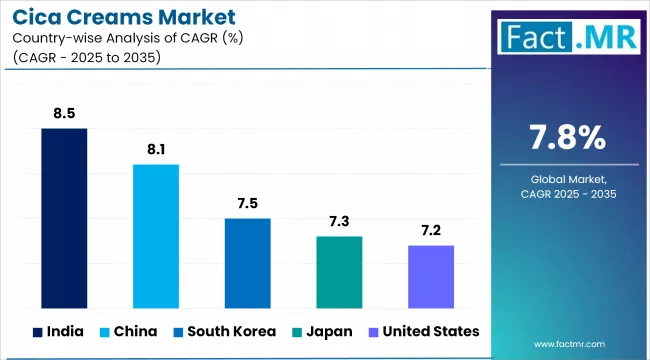
Cica Creams Market Cagr Analysis By Country | Source: Fact.MR
K-Beauty Standards and Dermaceutical Trends Power South Korea’s Cica Cream Market
The success of Cica cream market in South Korea is based on the combination of cosmetic innovation and soothing dermaceutical. K-beauty routines are popular with a particular focus on healing and barrier-reparative ingredients such as Centella Asiatica. Large retailers and cosmetic leaders are marketing bare, effective skincare in environmentally friendly packaging. Eco-labels, non-cruelty statements and microplastic prohibitions are converging with the shifting health concerns of consumers and are moving Cica Cream into the mainstream of environmentally friendly self-care.
Ingredient Transparency and Digital Beauty Fuel China’s Cica Cream Market
The Cica cream business is rapidly developing in China as more people are concerned about ingredient transparency and increased skin sensitivity. As online shops such as Tmall and Xiaohongshu shape the consumer demands, there is an increased demand to use dermatologically-supported and green-labeled skincare. Homegrown brands are using recyclable packaging and plant-based actives. Clean labeling and influencer accountability regulations have helped spawn a host of safer, more natural Cica creams that are already spreading in urban and Tier 2 cities.
Ayurveda Revival and Gen-Z Demand Accelerate India’s Cica Cream Market
The Cica cream market in India is changing as the traditional skincare knowledge meets the contemporary clean beauty needs. Gen-Z consumers want plant-based, calming creams that will fight skin stress caused by pollution. Brands are also adding Centella Asiatica with Ayurvedic botanicals as well as launching sustainable packaging types. Retailers are responding through the provision of paraben-free; vegan; and cruelty-free Cica products in accordance with ethical consumerism and the broader green beauty movement in India.
Category-Wise Market Outlook
Soothing & Healing Creams Lead with Dermal Recovery Focus
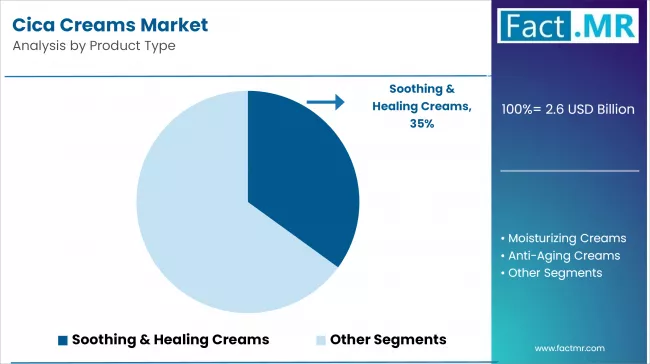
Cica Creams Market Analysis By Product Type | Source: Fact.MR
Soothing & Healing Creams are currently the most rapidly expanding product category because of its ability to soothe inflamed skin and repair the skin barrier. Dermatologists and influencers aggressively promote these creams with such conditions as eczema, redness, and inflammation. They are gaining growing popularity especially in markets where awareness on skin sensitivity and minimalistic skin care practices are on the increase.
Multi-Ingredient Formulas Thrive on Synergistic Skincare
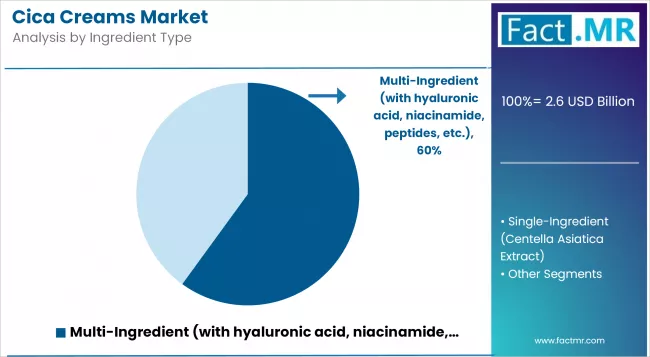
Cica Creams Market Analysis By Ingredient Type | Source: Fact.MR
Multi-Ingredient Cica Creams are gaining momentum due to the holistic nature of their skincare properties which include Centella Asiatica with niacinamide, hyaluronic acid, and peptides. These combinations are aimed at addressing several skin issues at a time, and are best suited to consumers seeking simplified, multitasking products. They are particularly widespread among Millennial and Gen Z users who want to see results more quickly and with minimum effort.
Post-Procedure Care Booms with Clinical Skincare Trust
Post-Procedure Care is the sub-segment with the highest growth rate because increasing numbers of consumers are seeking dermatology services such as laser, microneedling, and chemical peels. Professionals are suggesting cica creams as part of post-treatment recovery because of its barrier-repair and calming effects. Both medical and luxury skincare channel adoption is being motivated by clinical validation and high efficacy.
Competitive Analysis
Competitive Outlook: Cica Cream Market
The Cica Cream market is booming, thanks to brands like Dr. Jart+, belif, Innisfree, and Laneige leading the K-beauty pack with well-researched, dermatologist-tested formulas that center around calming, hydrating, and repairing sensitive skin. CosRx and Skin1004 have created devoted followings with their minimal, ingredient-first talent, spotlighting high-purity Centella Asiatica that hails from either Madagascar or Korea.
Both Beauty of Joseon and Purito appeal to younger consumers for their mix of tradition and transparency, offering mild, EWG-certified products that cater to both traditional needs and modern aesthetics.
Meanwhile, VT Cosmetics, Etude House, and Round Lab keep things fun yet still effective, creating everyday Cica solutions with mass appeal. Prestige brands such as Erborian, Dermalogica, and Peach & Lily balance Eastern botanicals with Western science to deliver upscale care for compromised skin barriers. Luxury brands like Sulwhasoo, O Hui, Mizon, and Bloomeffects take a more opulent angle incorporating Cica into lush, sensorial formulations based in herbal or floral revelation.
Key players in the Cica Cream market are Dr. Jart+, belif, Innisfree, Laneige, Skin1004, CosRx, Beauty of Joseon, VT Cosmetics, Erborian, Dermalogica, Peach & Lily, Bloomeffects, Sulwhasoo, Purito, Mizon, Etude House, Round Lab, O Hui.
Recent Development
- In March 2025, SKIN1004 launched the Probio-Cica Bakuchiol Eye Cream, blending Centella Asiatica with bakuchiol (a plant-based retinol alternative) to enhance elasticity, calm the skin, and reduce the appearance of fine lines around the eyes.
- In March 2025, Amorepacific’s Primera Nia Cica Cream & Cushion was recognized at the iF Design Award for its eco-conscious, minimalist packaging-featuring a refillable container that prioritizes both sensitive-skin care and sustainability.
Fact.MR has provided detailed information about the price points of key manufacturers of Cica Cream market positioned across regions, sales growth, production capacity, and speculative technological expansion, in the recently published report.
Methodology and Industry Tracking Approach
In this report, it examines the relationship between the growth of the Cica Cream Market and each of the three drivers of sustainable packaging formats, progressive skincare ingredient solutions, and commercialization of eco-dermatology products, both in the cosmetic and pharmaceutical sphere. The movement, as observed here, is largely influenced by consumerism in clean-label skincare, plant-based, and novel barrier-repair delivery systems.
Having consulted more than 8,000 stakeholders in 38 countries and 350+ confirmed industry contacts around the world, the study serves as a force balancing competing developments in recyclable tubes, refill-ready creams containers, biodegradable films on skincare packaging, and manufacturing models that can be scaled to fast-track commercialization.
Recyclable mono-material packaging, clinically directed delivery systems that protect ingredient stability and skin bioavailability, and an increase in the acceptance of sustainably certified modular packaging of creams are all on the list of market growth drivers. This will still depend on digital design platforms, digital twins as lifecycle assessments and AI-improved supply chain models to bring efficiency, transparency, and permanence to Cica cream production ecosystems.
The benchmark 2024-2025 is focused on active ingredients innovations, the dynamics of sustainable packaging and the development of regulatory regulations (safety, compliance, and dermatological usability), with the involvement of 225 opinion leaders, such as R&D experts, sustainability officers, policy advisors, and investors. It is also developed through the basis of more than 250 edited datasets, which contribute to an unparalleled understanding of the innovation, consumer adoption, and consolidation that impact the global Cica Cream economy.
Segmentation
Segmentation of Cica Cream Market Research
-
By Product Type :
- Moisturizing Creams
- Anti-Aging Creams
- Brightening Creams
- Soothing & Healing Creams
- Others (overnight masks, tinted creams)
-
By Ingredient Type :
- Single-Ingredient (Centella Asiatica Extract)
- Multi-Ingredient (with hyaluronic acid, niacinamide, peptides, etc.)
-
By Skin Concern :
- Sensitive Skin
- Dry Skin
- Acne-Prone Skin
- Redness & Irritation
- Anti-Aging & Wrinkle Care
- Post-Procedure Care
-
By End User :
- Women
- Men
- Unisex
-
By Distribution Channel :
- Online Retail (e-commerce platforms, brand-owned websites)
- Offline Retail
- Supermarkets & Hypermarkets
- Pharmacies & Drugstores
- Specialty Beauty Stores
- Departmental Stores
-
By Region :
- North America
- Latin America
- Western Europe
- Eastern Europe
- East Asia
- South Asia & Pacific
- Middle East & Africa
Frequently Asked Questions
What was the Global Cica Cream Market Size Reported by Fact.MR for 2024?
Who are the Major Players Operating in the Cica Cream Market?
What is the Estimated Valuation of the Cica Cream Market in 2035?
What Value CAGR did the Cica Cream Market Exhibit Over the Last Five Years?
Who worked on this report


Preview the report firsthand - request a free sample
Free SampleGet the brochure for pricing and purchase details
Download PDF