- Market Value (2025): USD 65.5 Mn
- Estimated Value (2026): USD 75 Mn
- Forecast Value (2036): USD 290.5 Mn
- CAGR (2026-2036): 14.5%
What is the gate docking radar market forecast to be worth by 2036?
USD 75 million in 2026 to USD 290.5 million by 2036, at 14.5% CAGR.
- The gate docking radar market crossed a valuation of USD 65.5 million in 2025.
- Demand is expected to increase from USD 75 million in 2026 to USD 290.5 million by 2036.
- The market is forecast to record a 14.5% CAGR from 2026 to 2036 as airports add radar-backed sensing to A-VDGS, apron safety and bridge-control workflows.
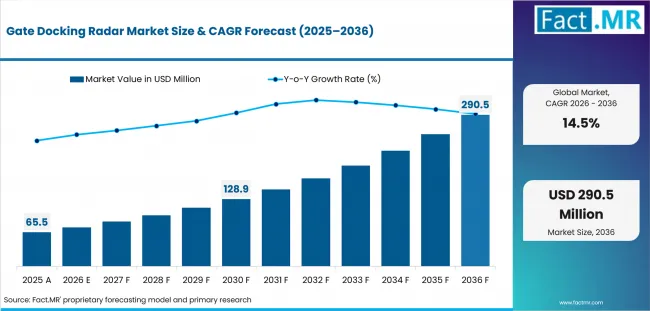
Gate Docking Radar Market Market Value Analysis | Source: Fact.MR
What are the defining numbers behind gate docking radar market growth?
USD 215.5 million absolute opportunity by 2036, led by radar-fusion A-VDGS and obstacle detection.
- Demand Drivers in the Market
- Airport operators need radar-backed guidance that supports safer docking during low visibility.
- Systems integrators need radar data that connects stand sensing with apron workflows.
- Gate equipment OEMs need sensor modules that improve bridge and stand coordination.
- Aviation safety teams need obstacle detection around aircraft parking zones.
- Key Segments Analyzed
- By Radar Type: Sensor-fusion radar is expected to hold 36.0% share in 2026 because radar is usually paired with laser or camera inputs.
- By Function: Obstacle detection leads because radar improves hazard sensing around active stands. The segment is projected to capture 34.0% share in 2026.
- By Airport Area: Contact gates are likely to account for 43.0% share in 2026 because they have the strongest docking and bridge-control need.
- By Integration: A-VDGS integration is expected to hold 45.0% share in 2026 because radar is most often deployed inside docking guidance systems.
- By Buyer Type: Airport operators are projected to record 48.0% share in 2026 because they own stand safety and turnaround outcomes.
- Analyst Opinion at Fact.MR
- Shambhu Nath Jha, Senior Analyst at Fact.MR, states, “Gate docking radar is becoming a practical safety layer inside modern A-VDGS. The market will grow where radar improves low-visibility docking, obstacle detection and stand confidence without creating extra workflow burden. Suppliers that prove field reliability and clean integration will be better placed than vendors selling radar as an isolated sensor.”
- Strategic Implications
- Radar suppliers should prove detection performance in rain, glare, fog and jet blast zones.
- Airport operators should prioritize high-density gates and low-visibility stands for early upgrades.
- Systems integrators should connect radar alerts with A-VDGS and apron safety platforms.
- Gate equipment OEMs should align radar data with bridge-control and stand-readiness workflows.
Gate docking radar is a smaller part of the airport docking guidance systems market. The focus is on radar modules and radar-based sensor fusion used at aircraft stands. These systems also support airport operations when radar data helps confirm aircraft arrival and manage gate release timing.
ADB SAFEGATE won a 2024 project to modernize Advanced Visual Docking Guidance Systems at Frankfurt International Airport with Safedock X units and AiPRON Manager. [1] This supports the market boundary because radar-enabled docking is moving into low-visibility apron modernization. Radar-assisted stands also complement airfield ground lighting upgrades when airports improve guidance and surface safety together.
The United States is projected to record 15.8% CAGR through 2036 as hub airports upgrade A-VDGS and apron safety systems. Germany is expected to post 15.1% CAGR through 2036 as Frankfurt-style modernization supports radar-enabled docking. China is likely to record 14.6% CAGR as large hubs and cargo aprons add stand monitoring. Singapore is forecast to advance at 14.0% CAGR as dense gate operations require higher stand accuracy. India is set to record 13.5% CAGR as airport expansion projects add docking guidance and apron safety systems.
How does the gate docking radar market break down by segment?
Sensor-fusion radar leads at 36.0%; A-VDGS integration leads at 45.0%.
Which radar type dominates?
Sensor-fusion radar holds 36.0% share in 2026.
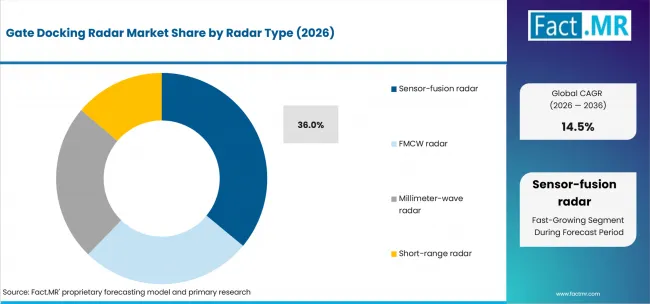
Gate Docking Radar Market Analysis By Radar Type | Source: Fact.MR
Sensor-fusion radar is expected to hold 36.0% share in 2026 because aircraft docking systems rarely rely on radar alone. Radar is usually paired with infrared laser, 3D scanning or camera inputs to improve confidence in low visibility. Short-range radar follows where obstacle detection is the primary use case. FMCW radar supports distance measurement and approach monitoring. Millimeter-wave radar is gaining attention where compact sensing and weather resilience matter. ADB SAFEGATE states that Safedock X pairs infrared laser and 3D scanning technology with a radar sensor for low-visibility performance. [2]
Which function dominates?
Obstacle detection lead with 34.0% share in 2026.
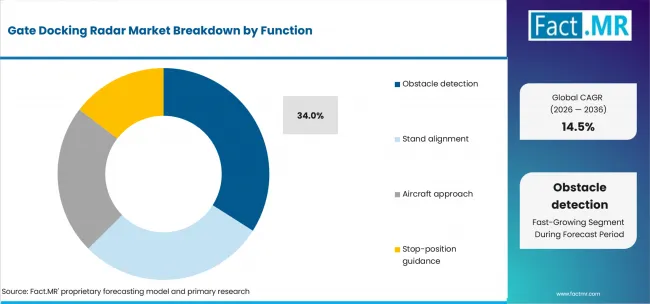
Gate Docking Radar Market Analysis By Function | Source: Fact.MR
Obstacle detection leads because radar can help identify objects near the stand before they create aircraft contact risk. The segment is projected to capture 34.0% share in 2026 as airports focus on safer gate approach and stand clearance. Aircraft approach follows because radar helps monitor final movement toward the stop point. Stand alignment is important where aircraft type and bridge position must match. Stop-position guidance remains core because pilots need accurate final-stop instructions.
Which airport area dominates?
Contact gates hold 43.0% share in 2026.
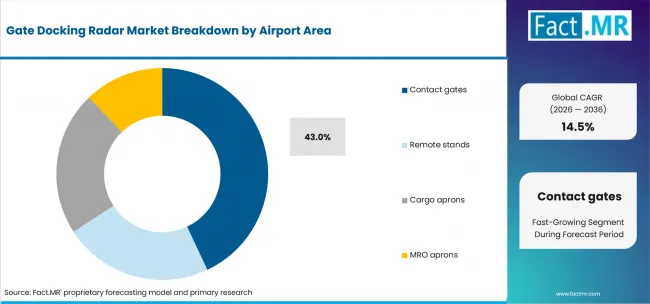
Gate Docking Radar Market Analysis By Airport Area | Source: Fact.MR
Contact gates lead because aircraft docking accuracy affects bridge alignment, turnaround timing and ramp safety. The airport-area segment is likely to account for 43.0% share in 2026 as high-use gates adopt radar-enabled A-VDGS. Remote stands follow where apron control teams need guidance without bridge infrastructure. Cargo aprons use radar where night operations and equipment movement increase risk. MRO aprons adopt radar where towing and aircraft positioning require extra safety checks. ACI World projected global passenger traffic to reach 9.5 billion in 2024, supporting the need for better gate efficiency. [4]
Which integration dominates?
A-VDGS integration holds 45.0% share in 2026.
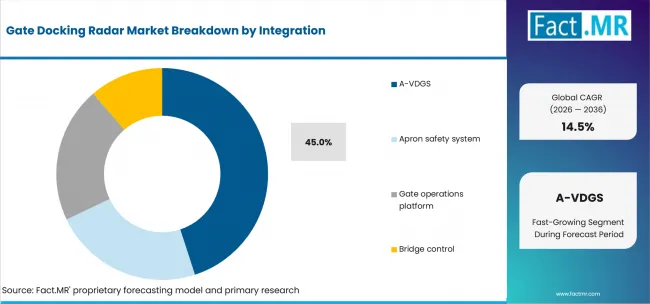
Gate Docking Radar Market Analysis By Integration | Source: Fact.MR
A-VDGS integration leads because radar is mainly added as a sensing element inside advanced docking systems. The integration segment is expected to hold 45.0% share in 2026 as airports use radar for low-visibility guidance and obstacle detection. Apron safety systems follow where radar alerts support ground teams. Gate operations platforms use radar data for stand readiness. Bridge control integration grows where the final aircraft stop position affects automated bridge movement. TK Airport Solutions states that ApronVision connects A-VDGS with automated boarding bridge operations and apron activity surveillance. [3]
Which buyer type dominates?
Airport operators hold 48.0% share in 2026.
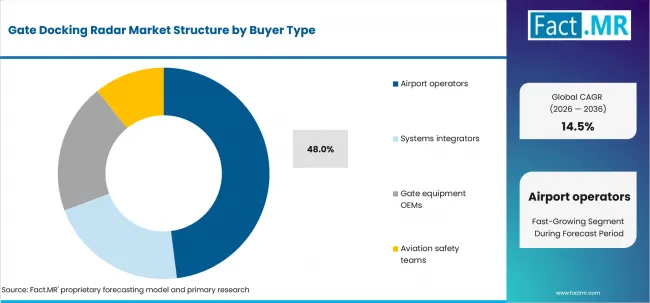
Gate Docking Radar Market Analysis By Buyer Type | Source: Fact.MR
Airport operators lead because they manage gate safety, stand utilization and aircraft turnaround outcomes. The buyer-type segment is projected to record 48.0% share in 2026 as airports invest in A-VDGS refresh programs and radar-backed apron safety. Systems integrators follow because radar modules must connect with gate and apron platforms. Gate equipment OEMs use radar data to improve bridge-control logic. Aviation safety teams influence adoption through stand-risk reviews. IATA highlighted safety and global standardization as ground handling priorities in 2025. [5]
What is accelerating Gate Docking Radar Market adoption, and what is holding it back?
A-VDGS modernization and low-visibility safety drive it; radar integration burden and cost restrain it.
Drivers Impact Analysis
| DRIVER | (~) % IMPACT ON CAGR | GEOGRAPHIC RELEVANCE | IMPACT TIMELINE |
|---|---|---|---|
| A-VDGS refresh programs adding radar for low-visibility docking | +1.6% | United States, Germany, China, Singapore | Short term (≤ 2 years) |
| Apron safety needs increasing obstacle detection at contact gates | +1.3% | Large hubs globally | Short term (≤ 2 years) |
| Gate operations platforms requiring stand-level sensing data | +1.1% | North America, Europe, Asia-Pacific | Medium term (2–4 years) |
| Bridge-control integration raising value of accurate stop-position guidance | +0.9% | Large hubs and high-use regional airports | Medium term (2–4 years) |
| Radar resilience supporting docking in fog, rain and glare | +0.7% | Europe, East Asia, Middle East | Long term (≥ 4 years) |
Source: Fact.MR analysis. Updated Jul 6, 2026
- A-VDGS refresh programs
- A-VDGS refresh programs are the strongest driver because airports are replacing older docking systems with sensor-rich units. Radar adds value when visibility is poor or apron objects are difficult to detect. The driver is strongest at large hubs and high-frequency regional airports. Radar-enabled refresh also helps airports standardize stand guidance across terminals.
- Apron safety
- Apron safety supports demand because contact gates have aircraft, service vehicles and workers operating close together. Radar can help detect obstacles during final approach to the stop point. Docking radar data can also reduce conflict with aircraft tugs when tow movements occur near active stands. Safety-led business cases are easier to justify at busy gates.
- Gate operations platforms
- Gate operations platforms need accurate stand-level data. Radar can confirm aircraft approach, stop position and obstacle status before other ground activities begin. This supports better turnaround sequencing. It also helps apron teams reduce manual checks at high-use gates.
- Bridge-control integration
- Bridge-control integration raises radar value because the aircraft final stop point affects bridge movement and service readiness. Radar-backed guidance can reduce alignment uncertainty. This helps airports prepare bridge movement with fewer delays. It also supports safer coordination around aircraft tow tractors when aircraft are moved between stand and remote parking.
- Radar resilience
- Radar resilience supports adoption because cameras and optical sensors can be affected by glare, fog and heavy rain. Radar improves confidence when one sensing method is degraded. This is useful for mixed aircraft fleets and high-density aprons. Airports will favor systems that combine reliable detection with simple operating procedures.
Opportunity Impact Analysis
| OPPORTUNITY | (~) % IMPACT ON CAGR | GEOGRAPHIC RELEVANCE | IMPACT TIMELINE |
|---|---|---|---|
| Millimeter-wave radar for compact gate-sensing modules | +1.0% | United States, Germany, Japan, Singapore | Medium term (2–4 years) |
| Radar retrofit modules for older A-VDGS installations | +0.8% | United States, Europe, India | Short term (≤ 2 years) |
| Sensor-fusion radar for cargo and remote stands | +0.7% | China, India, Middle East, North America | Medium term (2–4 years) |
| MRO apron radar for safer tow and positioning workflows | +0.5% | United States, Japan, UAE, Singapore | Long term (≥ 4 years) |
Source: Fact.MR analysis. Updated Jul 6, 2026
- Millimeter-wave radar
- Millimeter-wave radar creates opportunity because airports need compact sensors that can detect objects in difficult weather. These modules can support gate docking without large hardware changes. They can also strengthen obstacle alerts around aircraft service zones. Apron safety programs become more valuable when radar data is paired with ground support equipment tires and equipment maintenance records.
- Radar retrofit modules
- Radar retrofit modules create opportunity because many airports already operate older A-VDGS units. Adding radar can improve low-visibility performance without a full gate redesign. This route fits brownfield terminals and regional airports. It also supports phased modernization across high-risk stands first.
- Sensor-fusion radar
- Sensor-fusion radar creates opportunity at cargo aprons and remote stands where gate layouts are less standardized. Radar can work with camera or LiDAR inputs to improve obstacle detection. This helps apron control teams track aircraft position before servicing begins. The same data can help sequence belt loaders once aircraft stop position is confirmed.
- MRO apron radar
- MRO apron radar creates opportunity because aircraft movement during maintenance can involve towing, temporary equipment and large work zones. Radar can help confirm safe positioning around hangars and apron stands. This supports safer movement of widebody aircraft. MRO adoption will grow where safety teams need stronger evidence during towing and parking.
Restraints Impact Analysis
| RESTRAINT | (~) % IMPACT ON CAGR | GEOGRAPHIC RELEVANCE | IMPACT TIMELINE |
|---|---|---|---|
| Radar integration complexity inside A-VDGS and gate platforms | -1.1% | Global, strongest in brownfield airports | Short term (≤ 2 years) |
| Higher cost compared with laser-only docking systems | -0.9% | Regional airports and budget-constrained hubs | Medium term (2–4 years) |
| False alarms and sensor tuning needs in busy apron zones | -0.8% | Global | Medium term (2–4 years) |
| Limited radar-specific procurement evidence outside advanced hubs | -0.6% | Emerging airport markets | Long term (≥ 4 years) |
Source: Fact.MR analysis. Updated Jul 6, 2026
- Radar integration complexity
- Radar integration complexity is the main restraint because radar must work with A-VDGS displays, gate systems and apron safety workflows. Older airports may have mixed systems and custom operating procedures. Sensor tuning can take time. This can slow multi-stand deployment.
- Higher cost
- Higher cost slows adoption because radar-enabled systems cost more than simpler guidance solutions. Regional airports may upgrade only selected contact gates first. Large hubs may phase radar by terminal or aircraft type. Suppliers need to show safety and low-visibility benefits clearly.
- False alarms
- False alarms can reduce confidence if radar detects harmless movement as a hazard. Busy aprons have people, vehicles and service equipment close to the aircraft path. Sensor thresholds must be tuned carefully. Airport teams need clear alert logic before wider use.
- Limited procurement evidence
- Radar-specific procurement evidence is still limited outside advanced A-VDGS projects. Many airport tenders refer to docking guidance systems without naming the radar module. This makes market sizing more difficult. Adoption will become clearer as more projects specify low-visibility radar performance.
Which countries are scaling gate docking radar fastest?
United States 15.8%; Germany 15.1%; China 14.6%; Singapore 14.0%; India 13.5%.
Based on regional analysis, the gate docking radar market is segmented into North America, Western Europe, East Asia, South Asia, Latin America, and Middle East and Africa.
| Country | CAGR |
|---|---|
| United States | 15.8% |
| Germany | 15.1% |
| China | 14.6% |
| Singapore | 14.0% |
| India | 13.5% |
Source: Fact.MR analysis. Updated Jul 6, 2026
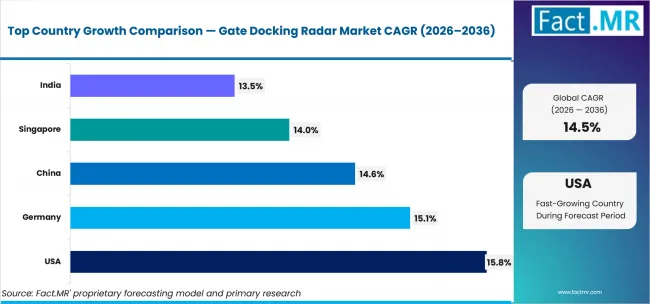
Gate Docking Radar Market Cagr Analysis By Country | Source: Fact.MR
What is powering the United States lead?
15.8% CAGR, driven by ADB SAFEGATE and multi-airport A-VDGS refresh programs.
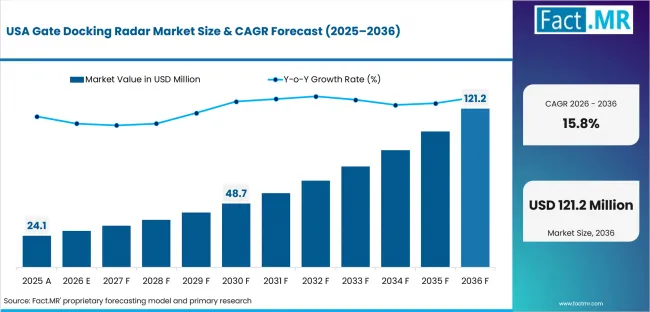
Gate Docking Radar Market Country Value Analysis | Source: Fact.MR
The United States is projected to record 15.8% CAGR from 2026 to 2036 as hub airports upgrade docking guidance and apron safety sensing. Radar adoption will focus on contact gates, low-visibility stands and bridge-control integration. Growth will favor sensor-fusion radar inside A-VDGS refresh programs.
How is Germany scaling gate docking radar demand?
15.1% CAGR, driven by Frankfurt-style modernization and radar-enabled stand safety.
Germany is expected to post 15.1% CAGR through 2036 as major airports modernize advanced docking guidance systems. Demand will focus on low-visibility operations and contact gates with high aircraft movement. Supplier selection will depend on radar reliability, integration support and field-proven A-VDGS performance.
What supports China’s outlook?
14.6% CAGR, driven by large hub expansion and automated apron operations.
China is likely to record 14.6% CAGR by 2036 as large airports and cargo aprons add stand sensing and docking guidance. Radar-enabled systems will be adopted where gate density, night operations and apron congestion create safety pressure. Growth will favor hybrid arrays that can connect with apron control systems.
What underpins Singapore’s growth?
14.0% CAGR, supported by high-density gate operations and stand automation.
Singapore is forecast to advance at 14.0% CAGR through 2036 as airport operators prioritize precise docking and safe stand turnaround. Radar adoption will focus on contact gates and apron safety systems. Growth will favor low-false-alarm systems that work reliably in dense operating environments.
How is India scaling gate docking radar adoption?
13.5% CAGR, driven by new airport projects and terminal modernization.
India is set to record 13.5% CAGR through 2036 as new airport projects and terminal upgrades include A-VDGS and apron safety systems. Radar-specific adoption will begin at larger hubs and high-use stands. Retrofit-friendly modules will matter as older terminals modernize gradually.
Who leads the gate docking radar market?
ADB SAFEGATE leads direct radar-enabled A-VDGS coverage, while TK Airport Solutions and Honeywell strengthen docking guidance pathways.
Gate docking radar is supplied by A-VDGS vendors, airport systems integrators and sensor ecosystem providers. ADB SAFEGATE is the clearest direct supplier through Safedock X and the Safedock family. TK Airport Solutions is highly relevant through ApronVision and advanced docking guidance. Honeywell is relevant through A-VDGS and airport automation pathways.
Bosch Mobility / Bosch Engineering is relevant through radar sensing capability, but it is better viewed as an enabling radar technology pathway than a direct airport docking supplier. Radar-backed stand confirmation can also help sequence air start units when engine-start preparation depends on safe aircraft positioning.
Competition through 2036 will be shaped by radar accuracy, low-visibility performance, false-alarm control, A-VDGS integration and service support. Stand-level radar data can also reduce timing conflicts with aircraft refueler activity when apron teams coordinate service windows.
Suppliers that combine radar with gate operations and apron safety workflows will be better placed than sensor-only providers. Fueling-area coordination creates another practical link with hydrant dispensers where final aircraft position affects safe servicing.
Which companies are the key providers?
ADB SAFEGATE and TK Airport Solutions are key providers. Honeywell is also profiled. Bosch Mobility / Bosch Engineering completes the company set through product-family and enabling radar pathways.
- ADB SAFEGATE
- Honeywell
- TK Airport Solutions
- Bosch Mobility / Bosch Engineering
- Texas Instruments
Bibliography
- ADB SAFEGATE. (2024, April 15). ADB SAFEGATE wins project to modernize advanced visual docking guidance at Frankfurt International Airport. ADB SAFEGATE.
- ADB SAFEGATE. (2026). Safedock X: Advanced Visual Docking Guidance System. ADB SAFEGATE.
- TK Airport Solutions. (2026). Advanced Visual Docking Guidance System. TK Airport Solutions.
- Airports Council International World. (2024, September 18). ACI World projects 10% growth for passenger traffic in 2024 to reach 9.5 billion. ACI World.
- International Air Transport Association. (2025, May 13). Ground handling priorities: Safety, baggage, global standardization and sustainability. International Air Transport Association.
- Honeywell. (2026). Safe and efficient airside operations. Honeywell.
- Texas Instruments. (2026). mmWave radar sensors. Texas Instruments.
This Report Addresses
- Strategic intelligence on gate docking radar across radar type and function.
- Segment analysis covering Sensor-fusion Radar and Obstacle Detection.
- Regional outlook covering the United States, Germany, China, Singapore and India.
- Competitive analysis of ADB SAFEGATE, Honeywell, TK Airport Solutions, and Bosch Mobility / Bosch Engineering.
- Technology assessment covering short-range radar, FMCW radar, millimeter-wave radar and sensor-fusion radar.
- Use case assessment covering aircraft approach, stand alignment, obstacle detection and stop-position guidance.
- Radar-specific procurement screening separates radar-enabled A-VDGS from broader aircraft docking sensors.
- Primary interviews, provider checks and official source review support the forecast.
What does the gate docking radar market cover?
Radar modules and radar-fusion systems used for aircraft stand docking and apron hazard detection.
The gate docking radar market covers short-range radar and sensor-fusion radar. These systems support aircraft approach and stop-position guidance.
The market differs from broad aircraft docking sensor coverage because radar is the central sensing element. It excludes laser-only A-VDGS, camera-only apron monitoring and basic visual stand guidance unless radar is included as a sensing module.
What is included in the scope?
Radar-based docking sensors, radar-fusion arrays and stand-level apron safety modules.
The scope includes short-range radar and sensor-fusion radar. Function coverage includes aircraft approach and stop-position guidance.
Airport-area coverage includes contact gates, remote stands, cargo aprons and MRO aprons. Integration coverage includes A-VDGS, apron safety systems, gate operations platforms and bridge control. Radar data becomes more valuable when it helps align aircraft with passenger boarding bridge movement at the final stop position.
Buyer-type coverage includes airport operators and aviation safety teams. The scope also includes radar modules added during A-VDGS refresh programs.
What is excluded from the scope?
Non-radar docking systems and broad airport platforms are outside the scope.
The scope excludes visual-only marshalling systems and air traffic control radar. It also excludes terminal operating systems unless revenue is tied to gate docking radar or radar-fusion stand sensing.
How was the analysis built?
100+ sources, 40+ company portfolios, 25+ countries, 20+ interviews.
- Primary Research:
- Primary research includes interviews with airport operators, A-VDGS suppliers and apron safety teams. It includes input from gate equipment OEMs, systems integrators and civil aviation stakeholders.
- Desk Research:
- Desk research reviews official A-VDGS pages, radar-enabled docking releases, apron safety guidance, gate integration systems and airport modernization projects.
- Market-Sizing and Forecasting:
- Forecasting uses A-VDGS retrofit demand, stand count, low-visibility operations, radar attachment rates and airport traffic growth.
- Data Validation and Update Cycle:
- Forecasts are validated through provider checks and technical interviews. Radar type mapping, procurement evidence and gate integration requirements help confirm market direction.
Segmentation
What is the report’s scope and coverage?
| Attribute | Details |
|---|---|
| Quantitative Units | USD Million in 2026 to USD Million by 2036 at CAGR |
| Market Definition | Radar modules and radar-fusion systems used for aircraft stand docking and apron hazard detection |
| Radar Type | Short-range radar; FMCW radar; millimeter-wave radar; sensor-fusion radar |
| Function | Aircraft approach; stand alignment; obstacle detection; stop-position guidance |
| Airport Area | Contact gates; remote stands; cargo aprons; MRO aprons |
| Integration | A-VDGS; apron safety system; gate operations platform; bridge control |
| Buyer Type | Airport operators; systems integrators; gate equipment OEMs; aviation safety teams |
| Regions Covered | North America; Western Europe; East Asia; South Asia; Latin America; Middle East and Africa |
| Countries Covered | United States; Germany; China; Singapore; India |
| Key Companies Profiled | ADB SAFEGATE; Honeywell; TK Airport Solutions; Bosch Mobility / Bosch Engineering; Texas Instruments |
| Forecast Period | 2026 to 2036 |
| Approach | Hybrid top-down and bottom-up approach using A-VDGS modernization, radar attachment rates, stand count, low-visibility operations and provider validation |
Source: Fact.MR analysis. Updated Jul 6, 2026
How is the market segmented?
-
By Radar Type:
- Short-range radar
- FMCW radar
- Millimeter-wave radar
- Sensor-fusion radar
-
By Function:
- Aircraft approach
- Stand alignment
- Obstacle detection
- Stop-position guidance
-
By Airport Area:
- Contact gates
- Remote stands
- Cargo aprons
- MRO aprons
-
By Integration:
- A-VDGS
- Apron safety system
- Gate operations platform
- Bridge control
-
By Buyer Type:
- Airport operators
- Systems integrators
- Gate equipment OEMs
- Aviation safety teams
-
Region:
- North America
- United States
- Canada
- Western Europe
- Germany
- United Kingdom
- France
- Netherlands
- Spain
- East Asia
- China
- Japan
- South Korea
- South Asia
- India
- Singapore
- Thailand
- Latin America
- Brazil
- Mexico
- Chile
- Middle East Africa
- UAE
- Saudi Arabia
- South Africa
- North America
Frequently Asked Questions
Which radar type leads the Gate Docking Radar Market?
Which function leads the Gate Docking Radar Market?
Which airport area leads the Gate Docking Radar Market?
Which integration leads the Gate Docking Radar Market?
Which buyer type leads the Gate Docking Radar Market?
Which country expands fastest in the Gate Docking Radar Market?
How does Germany perform in the Gate Docking Radar Market?
How does China perform in the Gate Docking Radar Market?
How does Singapore perform in the Gate Docking Radar Market?
How does India perform in the Gate Docking Radar Market?
What is the primary driver in the Gate Docking Radar Market?
What is the main restraint in the Gate Docking Radar Market?
Why is sensor-fusion radar important?
Why do airport operators dominate demand?
Who worked on this report


Preview the report firsthand - request a free sample
Free SampleGet the brochure for pricing and purchase details
Download PDF