- Market Value (2025): USD 901.6 Mn
- Estimated Value (2026): USD 980 Mn
- Forecast Value (2036): USD 2257 Mn
- CAGR (2026-2036): 8.7%
What is the Heat-Stable Functional Beverage Ingredients Market forecast to be worth by 2036?
USD 980 million in 2026 to USD 2,257 million by 2036 at 8.7% CAGR.
- The heat-stable functional beverage ingredients market crossed a valuation of USD 901.6 million in 2025 as nutrition claims moved into shelf-stable drinks.
- Demand is projected to increase from USD 980 million in 2026 to USD 2257 million by 2036.
- The market is forecast to record 8.7% CAGR from 2026 to 2036 as formulators require heat tolerance without sediment, cooked notes or potency loss.
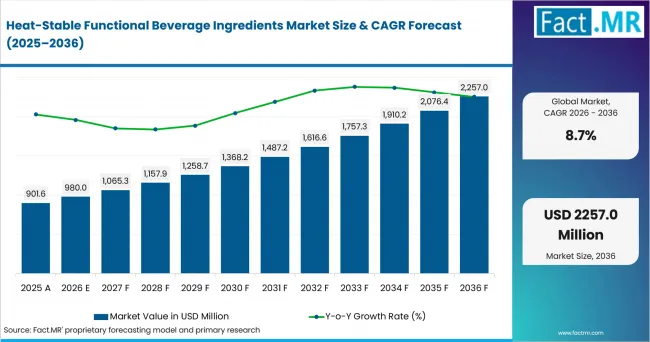
Heat Stable Functional Beverage Ingredients Market Value Analysis | Source: Fact.MR
What are the defining numbers behind Heat-Stable Functional Beverage Ingredients Market growth?
USD 1,277 million absolute opportunity by 2036, led by Heat-stable proteins, RTD protein & dairy and UHT/aseptic processing.
- Demand Drivers in the Market
- Protein-fortified beverages can face grittiness, haze, sedimentation and shelf-life instability; formulation performance can vary with heat, shear, pH and protein solubility.
- Sensitive vitamins and botanicals can lose potency under heat exposure, while minerals and plant extracts can create undesirable tastes; coating and encapsulation can be used to improve stability and palatability.
- Contract manufacturers require ingredients that disperse consistently and remain compatible with the intended aseptic process; the report treats process-specific line compatibility as a qualification criterion.
- The Australian Bureau of Statistics reported in March 2025 that apparent consumption of non-alcoholic beverages increased by 8.7 grams to 409.3 grams per capita per day in 2023-24, a 2.2% increase from 2022-23.
- Key Segments Analyzed
- By Ingredient Type: Heat-stable proteins are expected to hold 30.0% share in 2026, making them the largest listed ingredient category.
- By Beverage Format: RTD protein & dairy is projected to account for 34.0% share in 2026, making it the largest listed beverage format.
- By Processing: UHT/aseptic is anticipated to capture 42.0% share in 2026, making it the largest listed processing category.
- Analyst Opinion at Fact.MR
- Shambhu Nath Jha, Principal Consultant at Fact.MR, states, "The buying decision in this market starts with proof that an ingredient survives a real beverage process. Suppliers are expected to win qualification when they show heat stability, dispersion and taste control under UHT or pasteurization conditions. Well-supported proposals combine formulation data with sensory support and documentation that helps brands move from pilot batches to commercial filling lines."
- Strategic Implications
- Ingredient suppliers should document thermal stability under UHT, pasteurization and retort conditions before positioning products for beverage use.
- Beverage brands should test proteins, minerals and botanicals against shelf-life, taste and sediment targets during concept development.
- Kerry launched Smart Taste on September 30, 2025, a range of taste solutions designed to help food and beverage manufacturers address cost, supply, nutrition, regulation and sustainability pressures without compromising taste.
- Investors should separate broad nutrition ingredient exposure from formulations that have evidence of beverage heat tolerance and line compatibility.
Australia is forecast to post 11.0% CAGR through 2036. The United States is projected to record 10.3% CAGR. Germany is anticipated to advance at 9.3% CAGR. Japan is estimated to reach 9.0% CAGR. France is forecast to record 8.9% CAGR. The United Kingdom is expected to post 8.9% CAGR.
How does the Heat-Stable Functional Beverage Ingredients Market break down by segment?
Heat-stable proteins lead at 30.0%; RTD protein & dairy leads at 34.0%.
Which ingredient type dominates?
Heat-stable proteins hold 30.0% share in 2026.
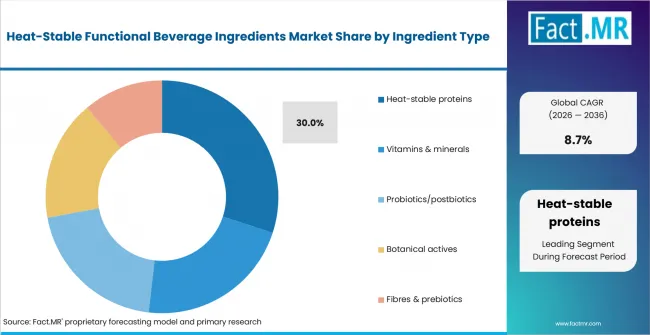
Heat Stable Functional Beverage Ingredients Market Analysis By Ingredient Type | Source: Fact.MR
Heat-stable proteins lead Ingredient Type because beverage makers need functional ingredients that maintain performance during thermal processing and extended storage. Their role is especially important in protein-enriched drinks exposed to UHT or aseptic conditions, where stability, texture and nutritional functionality must remain consistent throughout manufacturing and shelf life.
What leads the beverage format segment?
RTD protein & dairy holds 34.0% share in 2026.
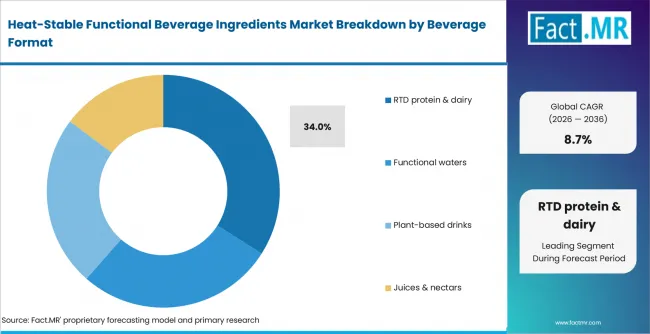
Heat Stable Functional Beverage Ingredients Market Analysis By Beverage Format | Source: Fact.MR
RTD protein & dairy leads Beverage Format as convenient, ready-to-consume products combine nutrition with easy consumption. Formulators must manage grittiness, haze, sedimentation, off-notes and shelf-life instability when adding proteins, making taste, texture and physical stability important factors during product development and commercial-scale beverage production.
How does processing shape demand?
UHT/aseptic leads with 42.0% share in 2026.
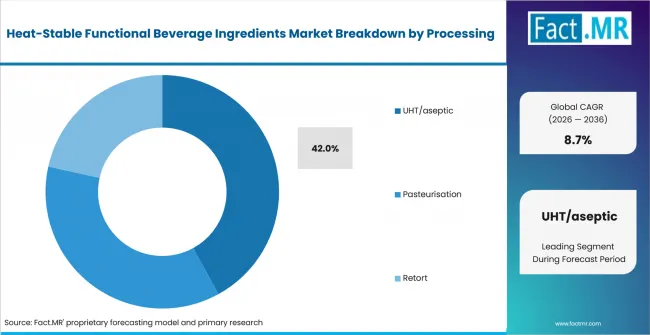
Heat Stable Functional Beverage Ingredients Market Analysis By Processing | Source: Fact.MR
UHT/aseptic processing leads because beverage manufacturers need extended shelf life while maintaining ingredient stability and product safety. Functional ingredients used in these systems must tolerate intensive thermal treatment without excessive loss of performance. Suppliers therefore need process-specific evidence covering stability, sensory quality and compatibility before commercial formulation approval.
What is accelerating Heat-Stable Functional Beverage Ingredients Market adoption, and what is holding it back?
Protein beverage expansion drives it; heat degradation restrains it.
Drivers Impact Analysis
| DRIVER | (~) % IMPACT ON CAGR | GEOGRAPHIC RELEVANCE | IMPACT TIMELINE |
|---|---|---|---|
| Heat-stable protein use | +2.3% | USA, Germany, Japan | Short term (<= 2 years) |
| Vitamin and mineral fortification | +1.8% | USA, Europe, Japan | Short term (<= 2 years) |
| UHT and aseptic formats | +1.6% | USA, Europe, Australia | Medium term (2-4 years) |
| Plant-based beverage formulation | +1.2% | Europe, Australia, Japan | Medium term (2-4 years) |
| Taste and masking systems | +0.9% | USA, Europe, Australia | Long term (>= 4 years) |
Source: Fact.MR analysis. Updated Aug 18, 2026
- Heat-stable protein use: Protein-fortified beverages can face grittiness, haze, sedimentation and shelf-life instability. Formulators are expected to favor suppliers that provide process-specific stability data and scale-up support.
- Vitamin and mineral fortification: Sensitive vitamins and botanicals can degrade under heat exposure, while minerals can create undesirable tastes. Suppliers are anticipated to focus on coating, encapsulation and other formulation approaches that protect stability and palatability.
- Plant-based beverage formulation: Plant-protein beverages can require taste, dispersion and suspension support. Suppliers with application data addressing those formulation issues are expected to gain earlier access to launch briefs.
- Taste and masking systems: First-party supplier evidence identifies bitterness, astringency, metallic notes and other off-notes as formulation challenges in functional ingredients. Formulators are expected to value systems that improve taste while maintaining the intended formulation.
Opportunity Impact Analysis
| OPPORTUNITY | (~) % IMPACT ON CAGR | GEOGRAPHIC RELEVANCE | IMPACT TIMELINE |
|---|---|---|---|
| Retort-stable proteins | +1.1% | Japan, USA, Australia | Medium term (2-4 years) |
| Postbiotic beverage concepts | +0.9% | Japan, Germany, UK | Medium term (2-4 years) |
| Prebiotic fibre systems | +0.8% | France, Germany, USA | Long term (>= 4 years) |
| Flavor-masked plant proteins | +0.7% | USA, Europe, Australia | Short term (<= 2 years) |
Source: Fact.MR analysis. Updated Aug 18, 2026
- Postbiotic beverage concepts: ISAPP defines postbiotics as preparations of inanimate microorganisms and/or their components that confer a health benefit on the host and notes that microorganisms can be deliberately inactivated using heat or other technologies. Functionality after processing should be demonstrated for the specific preparation.
- Prebiotic fibre systems: Beverage formulation guidance notes that soluble fibres require appropriate solubility, pH stability and clarity, and that unsuitable fibre selection or use levels can contribute to haze, phase separation, excessive thickness or grittiness in low-pH or clear systems.
Restraints Impact Analysis
| RESTRAINT | (~) % IMPACT ON CAGR | GEOGRAPHIC RELEVANCE | IMPACT TIMELINE |
|---|---|---|---|
| Heat degradation and overage cost | -1.1% | Global | Short term (<= 2 years) |
| Protein sedimentation | -0.9% | Protein beverage manufacturers | Short term (<= 2 years) |
| Clean-label and claim proof | -0.7% | Europe, Japan, USA | Medium term (2-4 years) |
| Acidic beverage compatibility | -0.5% | Juices, nectars, functional waters | Medium term (2-4 years) |
Source: Fact.MR analysis. Updated Aug 18, 2026
- Heat degradation and overage cost: dsm-firmenich identifies heat as a degradation risk for sensitive vitamins and botanicals and describes coating and encapsulation as approaches for protecting potency and shelf life.
- Protein sedimentation: Beverage formulation guidance identifies sedimentation and shelf-life instability as challenges in protein-fortified beverages and notes that heat, shear and pH can affect protein performance during processing.
- Acidic beverage compatibility: Protein and fibre performance can vary with pH, and low-pH or clear beverage systems can be vulnerable to haze, phase separation, grittiness and other stability problems.
Which countries are scaling Heat-Stable Functional Beverage Ingredients Market fastest?
- The country comparison spans 2.10 percentage points across the forecast period.
- Australia remains 0.69 percentage point above the United States in the report’s 2026-2036 CAGR comparison.
- The United States remains 0.97 percentage point above Germany in the report’s 2026-2036 CAGR comparison.
- Germany remains 0.36 percentage point above Japan in the report’s 2026-2036 CAGR comparison.
- Japan remains 0.04 percentage point above France in the report’s 2026-2036 CAGR comparison.
- France remains 0.04 percentage point above the United Kingdom in the report’s 2026-2036 CAGR comparison.
- The United Kingdom closes the displayed CAGR range at 8.9%.
Comparable CAGRs create different entry conditions because heat-stable ingredients are qualified through processing trials, sensory tests and claim documentation. Full report coverage includes North America, Latin America, Europe, East Asia, South Asia and Pacific, and Middle East and Africa.
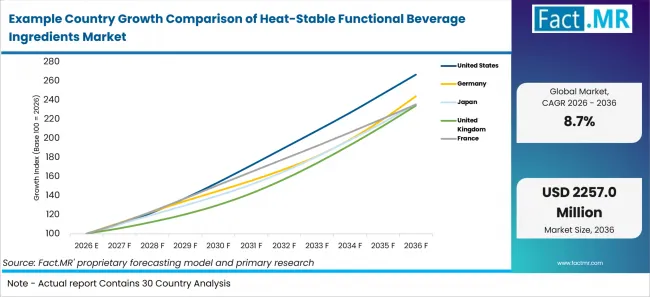
Example Country Growth Comparison Of Heat Stable Functional Beverage Ingredients Market | Source: Fact.MR
| Country | CAGR (2026-2036) |
|---|---|
| Australia | 11.0% |
| United States | 10.3% |
| Germany | 9.3% |
| Japan | 9.0% |
| France | 8.9% |
| United Kingdom | 8.9% |
Source: Fact.MR analysis. Updated Aug 18, 2026
What supports Australia adoption?
11.0% CAGR, supported by rising consumption of electrolyte and energy drinks.
Australia’s growth is supported by expanding demand for functional beverages and hydration-focused products. Australian Bureau of Statistics data show that apparent consumption of electrolyte and energy drinks increased by 9.4 grams per capita per day, or 61.8%, between 2018-19 and 2023-24, reaching 24.6 grams per capita per day in 2023-24.
How is the United States scaling demand?
10.3% CAGR, supported by protein-beverage demand and established whey ingredient supply.
The United States benefits from a developed protein-ingredient ecosystem supporting functional beverage formulation. USDA Economic Research Service reported in January 2026 that U.S. whey protein concentrate exports declined 20.7% year over year during January–October 2025.
What supports Germany growth?
9.3% CAGR, backed by expanding non-alcoholic beverage production and changing consumption patterns.
Germany’s market development is supported by growing production across alcohol-free beverage categories. The Federal Statistical Office (Destatis) reported on July 29, 2025 that Germany produced almost 579 million litres of non-alcoholic beer intended for sale in 2024, 96.1% more than in 2014, when production was just over 295 million litres.
How does Japan perform?
9.0% CAGR, supported by dairy production and established beverage-processing capabilities.
Japan’s outlook is shaped by its established dairy sector and demand for processed beverage formats. Strong manufacturing capabilities support functional beverage development, while reliable ingredient availability helps producers expand protein-enriched and shelf-stable offerings. Established processing expertise also supports formulation consistency, product quality and broader commercial adoption.
What underpins France demand?
8.9% CAGR, supported by established food and beverage manufacturing activity.
France’s demand is tied to its broad food and beverage processing base, where manufacturers continue to evaluate functional ingredients and shelf-stable formulations. Insee reported on July 3, 2026 that output in France’s food and beverage industries decreased 0.3% in May 2026 after remaining stable in April.
What supports the United Kingdom outlook?
8.9% CAGR, backed by a sizeable beverage industry and strong export activity.
The United Kingdom benefits from an established beverage manufacturing and export base. The Department for Environment, Food & Rural Affairs reported on April 30, 2026 that beverages had the greatest export value among the listed UK Food, Feed and Drink SITC groups in 2025, at GBP 8,183 million in current prices. Beverage export value was 0.2% lower than in 2024 in current prices and 5.5% lower in real terms.
Who leads the Heat-Stable Functional Beverage Ingredients Market?
dsm-firmenich and Kerry provide taste and nutrition capabilities, while ADM and BASF SE also provide beverage-related ingredient solutions.
The competitive analysis profiles dsm-firmenich, Kerry Group, ADM and BASF SE for beverage-related taste, nutrition, flavor and formulation capabilities.
BASF SE contributes aroma ingredients for beverage flavor applications. In March 2025, BASF SE announced two new Isobionics biotech flavor ingredients, including Natural alpha-Humulene 90, which BASF SE states is suitable for non-alcoholic and alcoholic beverages as well as essential-oil applications. Glanbia plc / Glanbia Nutritionals and Ingredion Incorporated complete the profiled provider set.
Which companies are the key providers?
dsm-firmenich and Kerry Group are key providers. ADM and BASF SE are also profiled. Glanbia plc / Glanbia Nutritionals and Ingredion Incorporated complete the company set.
- dsm-firmenich
- ADM
- Kerry Group
- BASF SE
- Glanbia plc / Glanbia Nutritionals
- Ingredion Incorporated
Bibliography
- Australian Bureau of Statistics. (2025, March 28). Apparent consumption of selected foodstuffs, Australia, 2023–24 financial year.
- BASF. (2025, March 24). BASF Aroma Ingredients innovates with two new Isobionics® biotech flavor ingredients.
- Department for Environment, Food & Rural Affairs. (2026, April 30). UK trade in food, feed and drink, 2025 provisional. GOV.UK.
- dsm-firmenich. (2025, July 10). dsm-firmenich launches new ModulaSENSE® maskers: Unlocking the full potential of Vertis™ CanolaPRO® in ready-to-mix drinks and protein bars.
- Statistisches Bundesamt (Destatis). (2025, July 29). Produktion von alkoholfreiem Bier mit +96,1 % in den vergangenen zehn Jahren fast verdoppelt [Production of non-alcoholic beer almost doubled in the past ten years, up 96.1%].
- Institut national de la statistique et des études économiques. (2026, July 3). In May 2026, manufacturing output fell back by 1.0%.
- Kerry. (2025, September 30). Kerry launches Smart Taste™ to help customers navigate market complexities without compromising on taste.
- U.S. Department of Agriculture, Economic Research Service. (2026, August 13). Supply and utilization of dairy product categories (monthly and annual) [Data set].
- dsm-firmenich. (2025, October 17). Overcome formulation challenges with advanced powder technology.
- Ingredion. (2026, May 26). The essentials of modern beverage formulation.
This Report Answers
- The report covers Heat-Stable Functional Beverage Ingredients Market choices across Ingredient Type, Beverage Format and Processing.
- Segment analysis covers Heat-stable proteins and RTD protein & dairy as the 2026 share leaders within their parent categories.
- Country outlook evaluates Australia and the United States alongside Germany, Japan, France and the United Kingdom.
- Competitive analysis profiles dsm-firmenich, Kerry Group, ADM and BASF SE. Glanbia plc / Glanbia Nutritionals and Ingredion Incorporated complete the provider set.
- Processing assessment covers UHT/aseptic, Pasteurisation and Retort as the main thermal routes shaping ingredient qualification.
What does the Heat-Stable Functional Beverage Ingredients Market cover?
The market covers ingredients used to build functional beverages where nutrition or sensory claims must survive thermal processing.
Coverage includes heat-stable proteins and vitamins. Mineral systems, postbiotics, botanical actives and prebiotic fiber are included when they are formulated for drink systems. The scope connects with non-alcoholic beverages only where ingredient performance depends on UHT, aseptic, pasteurized or retort processing.
Ingredient coverage links to protein ingredients when the commercial problem is beverage heat tolerance. It also connects to plant protein where taste masking, dispersion and shelf-life proof decide whether higher protein dosage is practical.
What is included in the scope?
The scope includes beverage-grade systems that retain function after UHT, aseptic, pasteurized or retort processing.
Probiotic products are included only where postbiotic or heat-compatible formats are used in beverages. Botanical extracts are included when botanical materials are selected for beverage taste, positioning or functional use. Prebiotic fiber systems are included where solubility and heat stability fit ready-to-drink formats.
What is excluded from the scope?
Finished drinks are excluded except as downstream demand indicators.
General beverage flavors are excluded unless they have a stated stability, functional or processing role. Dietary supplements are outside the scope unless they are sold as beverage premixes or used by drink manufacturers.The scope excludes unrelated cognitive beverage additives when the ingredient is not heat-stable or beverage-process relevant. General wellness ingredients without beverage qualification data are outside the scope. Company revenue without a clear connection to heat-stable beverage formulation is excluded from the analysis.
How Was the Analysis Built?
The analysis draws on 120+ sources, 35+ company portfolios, 25+ countries, and more than 20 industry interviews.
- Primary Research: Primary research includes discussions with manufacturers, service providers, technology developers, distributors, end users, procurement teams, and subject-matter experts. These conversations examine purchasing priorities, product adoption, operational challenges, approval requirements, competitive positioning, and the factors that influence wider market acceptance.
- Desk Research: Desk research covers government statistics, regulatory publications, company filings, trade data, technical studies, industry associations, standards, public policy, and other authoritative sources. Every source used in the analysis is documented in the bibliography.
- Market Sizing and Forecasting: Market estimates combine historical performance, demand indicators, pricing and volume trends, segment shares, company participation, country-level growth, adoption patterns, investment activity, and barriers to market expansion.
- Data Validation and Update Cycle: Findings are validated by comparing primary interviews with public data, company activity, regulatory changes, trade patterns, and industry developments. Regular updates review new product launches, capacity changes, partnerships, approvals, procurement trends, and shifts in commercial adoption.
Segmentation
What is the report's scope and coverage?
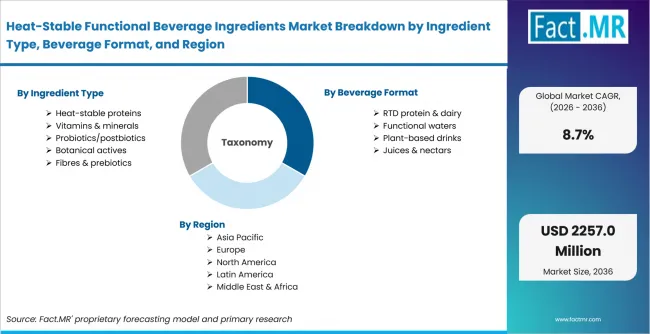
Heat Stable Functional Beverage Ingredients Market Breakdown By Ingredient Type, Beverage Format, And Region | Source: Fact.MR
| Attribute | Details |
|---|---|
| Quantitative Units | USD million in 2026 to USD million by 2036 at CAGR |
| Market Definition | Functional beverage ingredients that retain nutritional, sensory or technical performance after UHT, aseptic, pasteurized or retort processing |
| Ingredient Type | Heat-stable proteins; Vitamins & minerals; Probiotics/postbiotics; Botanical actives; Fibres & prebiotics |
| Beverage Format | RTD protein & dairy; Functional waters; Plant-based drinks; Juices & nectars |
| Processing | UHT/aseptic; Pasteurisation; Retort |
| Regions Covered | North America; Latin America; Europe; East Asia; South Asia and Pacific; Middle East and Africa |
| Countries Covered | Australia; United States; Germany; Japan; France; United Kingdom |
| Key Companies Profiled | dsm-firmenich; ADM; Kerry Group; BASF SE; Glanbia plc / Glanbia Nutritionals; Ingredion Incorporated |
| Forecast Period | 2026 to 2036 |
| Approach | Hybrid top-down and bottom-up approach using beverage ingredient demand; heat-treatment qualification; RTD protein activity; dairy and plant protein use; vitamin and mineral fortification; postbiotic and fibre formulation; UHT and retort processing; country adoption patterns and company portfolio review |
Source: Fact.MR analysis. Updated Aug 18, 2026
How is the market segmented?
-
By Ingredient Type
- Heat-stable proteins
- Vitamins & minerals
- Probiotics/postbiotics
- Botanical actives
- Fibres & prebiotics
-
By Beverage Format
- RTD protein & dairy
- Functional waters
- Plant-based drinks
- Juices & nectars
-
By Processing
- UHT/aseptic
- Pasteurisation
- Retort
-
By Region
- North America
- Latin America
- Europe
- East Asia
- South Asia and Pacific
- Middle East and Africa
Frequently Asked Questions
How big is the heat-stable functional beverage ingredients market in 2026?
What is the CAGR of the heat-stable functional beverage ingredients market from 2026 to 2036?
Which ingredient type leads the heat-stable functional beverage ingredients market?
Which beverage format leads the heat-stable functional beverage ingredients market?
Who are the leading companies in the heat-stable functional beverage ingredients market?
Who worked on this report


Preview the report firsthand - request a free sample
Free SampleGet the brochure for pricing and purchase details
Download PDF