- Market Value (2025): USD 1,090 Mn
- Estimated Value (2026): USD 1,150 Mn
- Forecast Value (2036): USD 2,040 Mn
- CAGR (2026-2036): 5.9%
What is the Industrial Container Washing Systems Market forecast to be worth by 2036?
USD 1,150 million in 2026 to USD 2,040 million by 2036 at a 5.9% CAGR.
- The Industrial Container Washing Systems Market reached USD 1,090 million in 2025.
- Demand is projected to increase from USD 1,150 million in 2026 to USD 2,040 million by 2036.
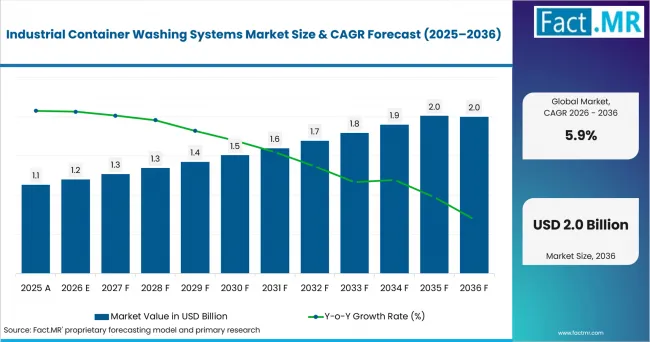
Industrial Container Washing Systems Market Value Analysis | Source: Fact.MR
What are the defining numbers behind Industrial Container Washing Systems Market growth?
An absolute opportunity of USD 890 million is expected between 2026 and 2036.
- Demand Drivers in the Market
- Reusable packaging rules are increasing the number of transport and industrial containers that remain in circulation. The EU Packaging and Packaging Waste Regulation generally applies from August 2026 and sets requirements for the reusable or recoverable nature of packaging. As drums and IBCs complete more rotations, operators need washing capacity between fill cycles. The same applies to crates and grouped transport packaging. Cleaning therefore becomes a recurring step instead of occasional reconditioning.
- Food and beverage users need repeatable sanitation before reusable containers return to production or transport. U.S. FDA sanitary transportation requirements require transport equipment to be suitable and adequately cleanable, while FDA guidance for reusable bulk food containers calls for cleaning and sanitizing before reuse. This supports investment in systems that can reproduce defined wash conditions across repeated cycles.
- Industrial drum and IBC reconditioning creates a recurring equipment requirement. The U.S. Environmental Protection Agency notes that reconditioning facilities clean steel and plastic drums and IBCs for resale and reuse, with washing using water and caustic solution as a common process. Higher container throughput therefore increases demand for wash stations, residue handling and automated cycle control.
- Operating cost is pushing buyers toward recirculation and targeted spray technologies. NUMAFA container washers use closed water recirculation and programmable wash settings, while Alfa Laval rotary-jet equipment is designed to reduce water and wash-fluid use during barrel, drum and IBC cleaning. These features can lower utility use per cycle and support higher utilization of the installed wash line.
- Mixed container fleets increase the value of configurable washing equipment. Food processors and chemical handlers may need to clean drums and totes on the same site. Pooling operators may also handle crates and kegs. Systems that can change wash recipes and nozzle arrangements reduce the need for separate lines. Adjustable product holders make automated investment easier to justify.
- Key Segments Analyzed
- Drums & pails account for 32.0% of Container Type in 2026 because these reusable formats are common across chemicals, oils and food applications and are routinely cleaned before reconditioning or refill.
- High-pressure spray holds 41.0% of Cleaning Method in 2026, supported by its ability to deliver targeted mechanical cleaning across different container geometries within recirculating wash systems.
- Food & beverage represents 35.0% of End-Use Industry in 2026 as reusable food-contact containers require controlled cleaning and sanitation before the next production or transport cycle.
- Fully automatic inline accounts for 55.0% of Automation Level in 2026 because centralized wash operations need repeatable cycle control and higher throughput with less manual handling between wash, rinse and drying stages.
- Analyst Opinion at Fact.MR
- Shambhu Nath Jha, Principal Consultant at Fact.MR, states, “Demand is moving toward systems that can process reusable containers at repeatable hygiene standards while controlling water use and turnaround time. Fully automatic inline configurations lead Automation Level in 2026 because centralized wash operations benefit from consistent cycle control and continuous material flow. Suppliers that combine flexible container handling with recirculation, drying and service support are better aligned with food, chemical and pooling applications through 2036.”
- Strategic Implications
- Wash-hub operators should size equipment around the actual container mix and daily rotation volume. A line optimized for crates may require different handling and nozzle arrangements from one processing drums or IBCs.
- Food and beverage buyers should qualify wash systems against sanitation procedures and documentation needs before comparing throughput, because a faster cycle has limited value if cleaning cannot be reproduced or verified.
- Equipment suppliers can improve lifecycle economics by integrating water recirculation, filtration and drying where the application permits. These features reduce the utility burden attached to each additional reuse cycle.
- Pooling and logistics operators should prioritize changeover flexibility because mixed container fleets can otherwise create idle time between formats and weaken the economics of a centralized wash hub.
- Chemical and reconditioning facilities should evaluate residue handling and wastewater requirements alongside the washer itself, since the previous contents of drums and IBCs affect cleaning chemistry and disposal obligations.
How does the Industrial Container Washing Systems Market break down by segment?
The market is segmented by Container Type, Cleaning Method, End-Use Industry and Automation Level.
Why do Drums & pails lead Container Type?
Drums & pails lead Container Type in 2026.
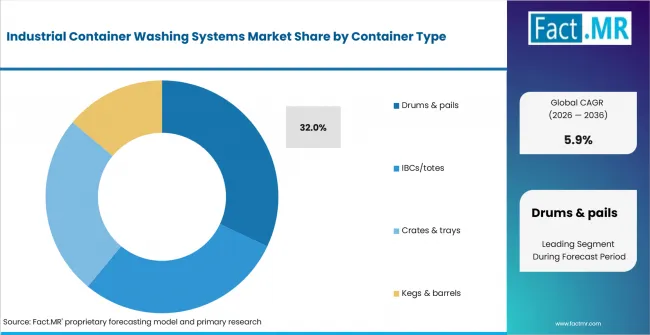
Industrial Container Washing Systems Market Analysis By Container Type | Source: Fact.MR
Drums and pails lead because they handle industrial liquids and ingredients across formal reconditioning loops. The U.S. Environmental Protection Agency identifies steel and plastic drums among industrial containers that are routinely cleaned and restored. These containers are also tested and certified for reuse.
Their comparatively standardized format also makes mechanical handling easier to automate. Buyers can configure dedicated loading, spray and drying stages around recurring drum dimensions, which supports consistent cycle times at reconditioning facilities and industrial wash hubs.
Why does High-pressure spray lead Cleaning Method?
High-pressure spray leads Cleaning Method in 2026.
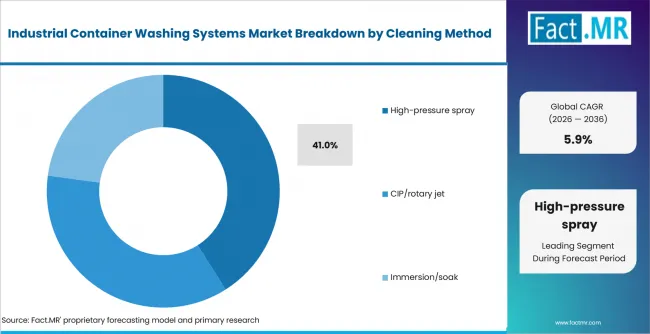
Industrial Container Washing Systems Market Analysis By Cleaning Method | Source: Fact.MR
High-pressure spray leads because cleaning energy can be directed at internal surfaces while water is circulated through a closed wash system. The method can be adapted through nozzle placement and pressure settings for drums, crates and larger containers without immersing the full container in a bath.
Commercial equipment illustrates the operating logic. NUMAFA uses rotating spray frames and recirculated water in its container washers, while Kärcher offers high-pressure interior cleaning systems for drums and IBCs. Buyers therefore gain a method that can integrate heating and dosing. Filtration and drying can be added as throughput requirements increase.
Why does Food & beverage lead End-Use Industry?
Food & beverage leads End-Use Industry in 2026.
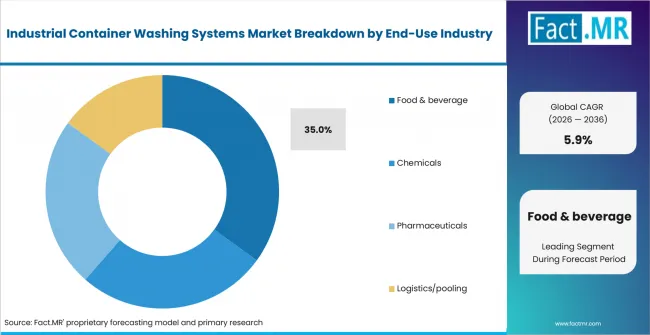
Industrial Container Washing Systems Market Analysis By End Use Industry | Source: Fact.MR
Food and beverage leads because a reusable container must return to a hygienic condition before it carries another product. FDA sanitary transportation rules require transport equipment to be suitable and adequately cleanable, while food hygiene frameworks place cleaning and sanitation within routine contamination control.
This turns washing into a recurring production step for crates and totes. Kegs and food-grade drums follow the same cycle. Buyers therefore value repeatable wash recipes and controlled temperatures. Drying also matters because inconsistent cleaning can interrupt reuse even when the container remains mechanically serviceable.
Why does Fully automatic inline lead Automation Level?
Fully automatic inline leads Automation Level in 2026.
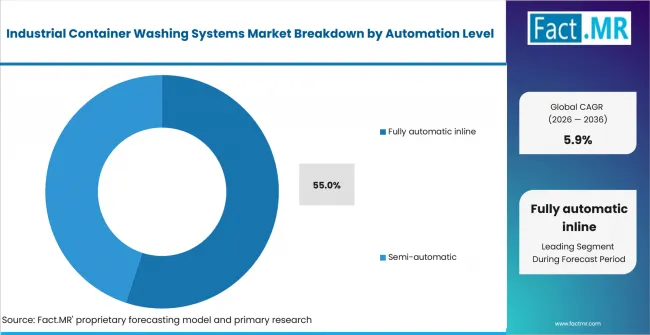
Industrial Container Washing Systems Market Analysis By Automation Level | Source: Fact.MR
Fully automatic inline systems lead because centralized wash operations must load and wash containers before rinsing and drying them with predictable cycle control. Automation reduces manual transfers between stages and allows operating settings to be standardized for recurring container formats.
NUMAFA offers both semi-automatic and fully automatic configurations and reports throughput of up to 300 containers per hour on its industrial container washer range. This type of capacity is relevant to pooling operations and wash hubs where the equipment must process repeated rotations without making labor the main throughput constraint.
What is accelerating Industrial Container Washing Systems Market adoption, and what is holding it back?
Drivers Impact Analysis
| Driver | (~) % Impact on CAGR | Geographic Relevance | Impact Timeline |
|---|---|---|---|
| EU PPWR reuse targets and FDA FSMA sanitary transport compliance | +0.8% | Europe, North America | Near term |
| Expansion of returnable container pooling in food and chemical supply chains | +0.7% | Global | Near term |
| Adoption of water-recycling high-pressure spray systems cutting operating cost | +0.5% | Europe, Asia-Pacific | Mid term |
| Digital wash validation and RFID container tracking integration | +0.4% | North America, Europe | Mid term |
Source: Fact.MR analysis. Updated Aug 19, 2026
Opportunity Impact Analysis
| Opportunity | (~) % Impact on CAGR | Geographic Relevance | Impact Timeline |
|---|---|---|---|
| Managed wash services for third-party logistics and pooling operators | +0.6% | Europe, North America | Mid term |
| Pharmaceutical GMP-compliant wash systems with validated cleaning protocols | +0.5% | Global | Mid term |
| Retrofit water-recycling modules for existing semi-automatic wash stations | +0.3% | Asia-Pacific, Europe | Long term |
Source: Fact.MR analysis. Updated Aug 19, 2026
Restraints Impact Analysis
| Restraint | (~) % Impact on CAGR | Geographic Relevance | Impact Timeline |
|---|---|---|---|
| High capital cost of fully automatic inline systems limiting adoption among small reconditioners | -0.5% | Asia-Pacific, Latin America | Near term |
| Water discharge regulations raising wastewater treatment cost for wash facilities | -0.4% | Europe, North America | Mid term |
| Limited standardization of IBC and tote dimensions complicating automatic wash programming | -0.3% | Global | Long term |
Source: Fact.MR analysis. Updated Aug 19, 2026
Which countries are scaling the Industrial Container Washing Systems Market through 2036?
- Netherlands: Rotterdam combines process-industry activity with extensive packaging and transport infrastructure, including movement of oils and fats in drums, jerrycans and tank containers. That concentration of reusable industrial packaging supports demand for multi-format washing close to storage and distribution operations.
- United States: EPA oversight of drum reconditioning and FDA sanitary transportation requirements create two distinct demand channels. Reconditioners need systems for cleaning drums and IBCs for reuse, while food operators need equipment and procedures that can support sanitary handling of reusable transport containers.
- Germany: Chemical manufacturing and machinery investment sustain demand for industrial cleaning equipment, while the PPWR application framework increases attention to packaging reuse across the EU. Wash systems are therefore relevant where drums and IBCs circulate through chemical production and distribution loops.
- Italy: Food processing and beverage production create regular cleaning cycles for crates and kegs. Barrels and totes follow the same cycle. Istat reported positive wine-production volumes in 2025, reinforcing the operating base for reusable containers that must be cleaned before returning to production or distribution.
- France: France is implementing policy for professional packaging that explicitly supports reduction and reuse, including transport and grouped packaging. As more professional packaging remains in circulation, washing becomes part of the infrastructure required to complete each reuse cycle.
- Japan: Japan has institutionalized HACCP-based hygiene management for food business operators and maintains standards for food containers and packaging. This supports demand for controlled washing where reusable containers move through food production and logistics environments.
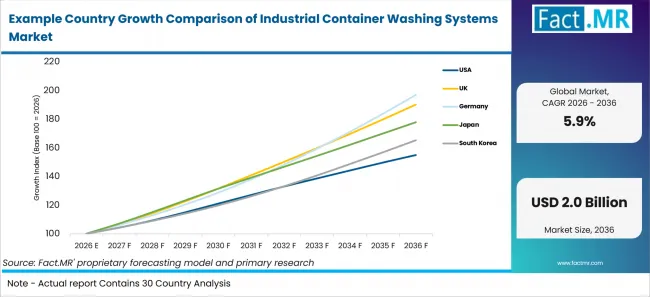
Example Country Growth Comparison Of Industrial Container Washing Systems Market | Source: Fact.MR
Country CAGR (2026-2036)
| Country | CAGR (2026-2036) |
|---|---|
| Netherlands | 6.92% |
| United States | 8.04% |
| Germany | 6.76% |
| Italy | 5.04% |
| France | 5.90% |
| Japan | 5.15% |
Source: Fact.MR analysis. Updated Aug 19, 2026
What is driving the Netherlands' growth through 2036?
The Netherlands is forecast to expand at a 6.92% CAGR from 2026 to 2036.
Rotterdam supports process industries that use dedicated packaging and transport infrastructure for oils and fats. Other industrial products move in drums and tank containers. This creates a practical base for centralized washing where containers are returned and inspected before preparation for another use cycle.
The PPWR generally applies from August 2026 and places new requirements on packaging reuse and recoverability across the EU. Dutch operators handling reusable industrial packaging therefore have a clearer reason to invest in wash capacity that can serve repeated rotations and mixed container formats.
What is driving the United States' growth through 2036?
The United States is forecast to expand at an 8.04% CAGR from 2026 to 2036.
EPA states that drum reconditioning facilities clean steel and plastic drums and IBCs for resale and reuse. Washing with water and caustic solution is one of the core reconditioning processes, creating recurring demand for wash systems where containers move through industrial reuse loops.
Food applications add a separate compliance mechanism. FDA guidance for multi-use bulk food containers states that reusable tanks, totes and drums should be adequately cleaned and sanitized before reuse. This favors equipment that can deliver repeatable cycles and documented operating conditions.
What is driving Germany's growth through 2036?
Germany is forecast to expand at a 6.76% CAGR from 2026 to 2036.
Germany has a substantial manufacturing base for chemicals and machinery, both of which use reusable industrial packaging and cleaning equipment. Destatis reported quarter-on-quarter production growth in the chemical industry in the first quarter of 2025, supporting continued handling of drums and IBCs across industrial supply chains.
PPWR implementation adds another reason to plan for container reuse. Where transport packaging remains in circulation for more rotations, chemical distributors and reconditioners need dependable washing, residue removal and drying before containers can be returned to service.
What is driving Italy's growth through 2036?
Italy is forecast to expand at a 5.04% CAGR from 2026 to 2036.
Italy has recurring container-washing demand from food and beverage production. Istat reported that food, beverage and tobacco industry volumes increased by 1.4% in 2025, while wine production volumes rose by 2.9%. Crates and kegs used around these operations require cleaning before reuse. The same applies to barrels and food-grade totes.
The purchasing mechanism is therefore tied to rotation frequency and hygiene rather than container sales alone. Regional processors can use semi-automatic systems at lower throughput, while larger facilities have an incentive to move toward automatic handling when daily container returns increase.
What is driving France's growth through 2036?
France is forecast to expand at a 5.90% CAGR from 2026 to 2036.
French policy for professional packaging links national reuse measures with the PPWR and identifies transport and grouped packaging as areas for reuse objectives. Financial support measures are also intended to encourage reuse of professional packaging.
This creates a direct equipment requirement: reusable packaging cannot complete repeated commercial cycles without cleaning, inspection and preparation. Wash systems therefore become relevant to food processors, logistics operators and industrial users managing returnable containers.
What is driving Japan's growth through 2036?
Japan is forecast to expand at a 5.15% CAGR from 2026 to 2036.
Japan institutionalized hygiene management based on HACCP principles for food business operators through amendments to the Food Sanitation Act. The same reform introduced a positive-list system for food containers and packaging, reinforcing controlled handling around food-contact materials.
For reusable crates and totes, this supports investment in repeatable washing and sanitation rather than ad hoc manual cleaning. Other containers have the same need. Buyers can also use automated controls to standardize cycle time and temperature across recurring container formats.
Who leads the Industrial Container Washing Systems Market?
NUMAFA supplies dedicated industrial container washers in semi-automatic and fully automatic configurations. Its systems use rotating spray frames, closed water recirculation and programmable wash settings across different container sizes, which aligns directly with the market’s Container Type and Automation Level requirements.
Alfa Laval competes through Gamajet rotary-jet equipment designed for barrels and drums. The equipment also serves IBCs. Kärcher offers modular container-cleaning systems and drum or IBC cleaning stations for food and chemical applications. Logistics applications are also covered. These suppliers compete on cleaning effectiveness and water use. Buyers also compare cycle time with integration into filtration or drying.
MHT Technology, Nilfisk and DENIOS are also profiled in the market assessment. Buyer qualification depends on whether a provider can meet the required container geometry, throughput and cleaning chemistry while supporting installation and service at the operating site.
Competition is therefore shaped by application fit rather than a single equipment specification. A food processor may prioritize hygienic design and repeatable sanitation, while a chemical reconditioner may give more weight to residue handling, wastewater compatibility and flexibility across drums and IBCs.
Which companies are the key providers?
Key companies profiled include NUMAFA; MHT Technology; Alfa Laval (Gamajet); Kärcher; Nilfisk; and DENIOS.
- NUMAFA
- MHT Technology
- Alfa Laval (Gamajet)
- Kärcher
- Nilfisk
- DENIOS
Research Sources and Bibliography
- European Commission. (2026). Packaging Waste. Directorate-General for Environment.
- U.S. Food and Drug Administration. (2016). FSMA Final Rule on Sanitary Transportation of Human and Animal Food.
- U.S. Food and Drug Administration. (2003). Guidance for Industry: Bulk Transport of Juice Concentrates and Certain Shelf-Stable Juices.
- U.S. Environmental Protection Agency. (2026). Used Drum Management and Reconditioning.
- Port of Rotterdam Authority. (2026). Process Industry.
- Federal Statistical Office of Germany. (2025). Gross Domestic Product: Detailed Economic Performance Results, First Quarter 2025.
- Istat. (2026). Economic Accounts for Agriculture: Year 2025.
- Ministry for Ecological Transition, France. (2026). Professional Packaging.
- Ministry of Health, Labour and Welfare, Japan. (2018). Amendment of the Food Sanitation Act.
- NUMAFA. (2026). Container Washing Machines for Industrial Use.
- Alfa Laval. (2026). Barrel/Drum/IBC Rotary Jet Heads.
- Kärcher. (2026). Container Cleaning.
This Report Answers
- How demand for industrial container washing systems changes across Container Type and Cleaning Method. How End-Use Industry and Automation Level affect demand.
- Why drums & pails and high-pressure spray hold their respective segment positions in 2026. Why food & beverage and fully automatic inline configurations lead the remaining segments.
- How country growth differs between the Netherlands and the United States through 2036. How Germany and Italy compare with France and Japan.
- Which operating requirements influence supplier selection in food and chemical applications. Which requirements matter in pharmaceutical and pooling applications.
- How reuse, sanitation requirements and wash-line economics affect equipment purchasing decisions.
What does the Industrial Container Washing Systems Market cover?
The Industrial Container Washing Systems Market covers equipment designed to clean reusable industrial packaging between fill or distribution cycles. Included container formats are drums, pails, IBCs, totes, crates, trays, kegs and barrels used across the stated end-use industries.
The assessment covers high-pressure spray, CIP/rotary jet and immersion/soak cleaning, together with semi-automatic and fully automatic inline system configurations. Integrated rinsing, drying, filtration, dosing and water-recirculation functions are included when supplied as part of the washing system.
What is included in the scope?
The scope includes factory-assembled washing stations and inline wash systems sold to industrial end users, container reconditioners and operators that wash reusable containers as part of a pooling or logistics workflow. Equipment is assessed at the system level rather than as isolated nozzles or cleaning chemicals.
Demand is evaluated across food & beverage, chemicals, pharmaceuticals and logistics/pooling applications. The market includes systems configured for one container format as well as flexible lines that can process several approved formats through change parts or programmable wash settings.
What is excluded from the scope?
The scope excludes manual pressure washers and portable cleaning units that are not designed as industrial container-washing systems. Standalone cleaning chemicals, spare parts, wastewater-treatment equipment and service contracts are excluded when sold separately from the wash system.
General tank-cleaning equipment used only for fixed process vessels is outside the market unless it is designed specifically for the reusable container formats included in the segmentation. Revenue from container rental, pooling and reconditioning services is not counted as equipment-market revenue.
How Was the Analysis Built?
Fact.MR is of the opinion that this assessment combines primary research with a structured review of public information and industry evidence relevant to the market.
- Primary Research: Interviews with wash-system manufacturers, process engineers, reconditioners, food and chemical plant operators, and procurement teams examine container mix, throughput requirements, sanitation needs and equipment replacement decisions.
- Desk Research: The review covers packaging-reuse regulation, food-safety requirements, industrial container reconditioning, official production data and company product documentation. External sources used in the analysis are recorded in the bibliography.
- Market Sizing and Forecasting: Estimates combine wash-system installations, average system value, container rotation, automation mix and end-use demand. Country forecasts reflect the local concentration of reusable-container workflows and the pace of equipment replacement or capacity expansion.
- Data Validation and Update Cycle: Evidence is reviewed against the defined market scope, segment boundaries and forecast period. The assessment is updated when source data, technology conditions, regulation or supplier activity materially changes the outlook.
Segmentation
Research Scope and Coverage
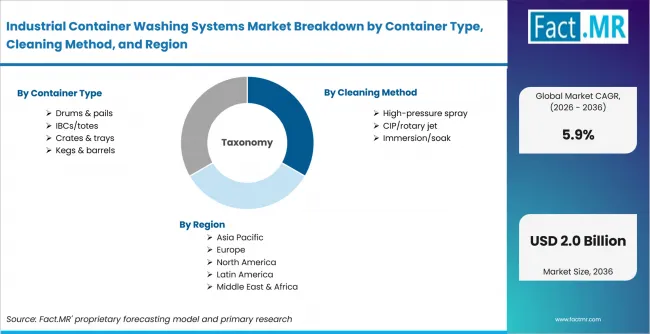
Industrial Container Washing Systems Market Breakdown By Container Type, Cleaning Method, And Region | Source: Fact.MR
| Attribute | Details |
|---|---|
| Quantitative Units | USD Million |
| Market Definition | Automated washing systems for drums, IBCs, crates and reusable containers that clean, sanitize and dry industrial packaging for reuse. |
| Segments Covered | Container Type; Cleaning Method; End-Use Industry; Automation Level |
| Regions Covered | North America; Latin America; Western Europe; Eastern Europe; East Asia; South Asia & Pacific; Middle East & Africa |
| Countries Covered | Netherlands; United States; Germany; Italy; France; Japan |
| Key Companies Profiled | NUMAFA; MHT Technology; Alfa Laval (Gamajet); Kärcher; Nilfisk; DENIOS |
| Forecast Period | 2026 to 2036 |
| Approach | Hybrid top-down and bottom-up approach using installed wash-system demand, container rotation, equipment throughput, segment mix, country growth and supplier portfolio review |
Source: Fact.MR analysis. Updated Aug 19, 2026
Market Breakdown by Segments
-
By Container Type:
- Drums & pails
- IBCs/totes
- Crates & trays
- Kegs & barrels
-
By Cleaning Method:
- High-pressure spray
- CIP/rotary jet
- Immersion/soak
-
By End-Use Industry:
- Food & beverage
- Chemicals
- Pharmaceuticals
- Logistics/pooling
-
By Automation Level:
- Semi-automatic
- Fully automatic inline
-
By Region:
- North America
- Latin America
- Western Europe
- Eastern Europe
- East Asia
- South Asia & Pacific
- Middle East & Africa
Frequently Asked Questions
What is the Industrial Container Washing Systems Market value in 2026?
At what CAGR is the market projected to grow?
What is the projected market value by 2036?
Which Container Type leads the market?
Which Cleaning Method leads the market?
Which End-Use Industry leads the market?
Which Automation Level leads the market?
What CAGR is projected for the United States?
What is the primary driver in this market?
What is the main restraint?
Which companies are included in the market assessment?
Who worked on this report


Preview the report firsthand - request a free sample
Free SampleGet the brochure for pricing and purchase details
Download PDF