- Market Value (2025): USD 2.4 Bn
- Estimated Value (2026): USD 2.7 Bn
- Forecast Value (2036): USD 9.1 Bn
- CAGR (2026-2036): 12.8%
What is the Infrastructure Partnership Platforms Market forecast to be worth by 2036?
USD 2.7 billion in 2026 to USD 9.1 billion by 2036 at 12.8% CAGR.
- The Infrastructure Partnership Platforms Market crossed a valuation of USD 2.4 billion in 2025.
- Demand is projected to increase from USD 2.7 billion in 2026 to USD 9.1 billion by 2036.
- The market is forecast to record 12.8% CAGR from 2026 to 2036 as sponsors and delivery consortia digitize partner selection records.
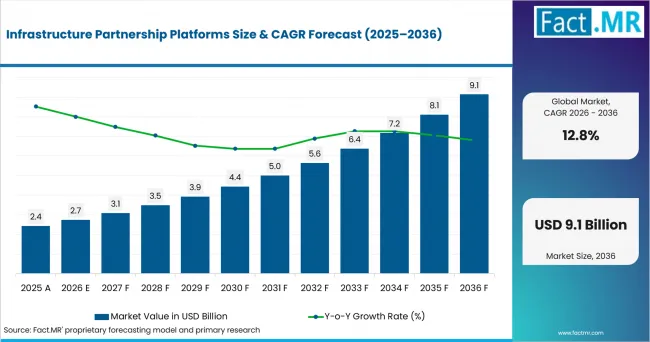
Infrastructure Partnership Platforms Value Analysis | Source: Fact.MR
What are the defining numbers behind Infrastructure Partnership Platforms Market growth?
USD 6.4 billion absolute opportunity between 2026 and 2036, led by Cloud SaaS, EPC / contractors and transport projects.
- Demand Drivers in the Market
- Public owners need partner shortlists and approval records tied to large-funded work. The U.S. Census Bureau reported that public construction spending was at a seasonally adjusted annual rate of USD 543.4 billion in July 2026.
- Digital infrastructure sponsors need partner screening before grant-funded buildouts move into construction. NTIA stated in June 2025 that BEAD provides USD 42.45 billion for high-speed broadband access.
- Contractors need shared consortium workspaces because bids, claims and document approvals move across several independent organizations.
- Investors and lenders need controlled data rooms so feasibility files, concession terms and risk notes remain traceable during finance review.
- Key Segments Analyzed
- By Platform Function: Project partner discovery is expected to hold 24.0% share in 2026 due to early qualification needs across public and private project groups.
- By Project Type: Transport is projected to account for 25.0% share in 2026 owing to long approval paths and multi-agency delivery.
- By Participant: EPC / contractors are anticipated to represent 29.0% share in 2026 because they coordinate design teams, delivery partners and contract records.
- By Deployment: Cloud SaaS is estimated to account for 53.0% share in 2026 supported by distributed access and secure record sharing.
- Analyst Opinion at Fact.MR
- Shambhu Nath Jha, Principal Consultant at Fact.MR, states, "Infrastructure partnerships are becoming a record-management problem before they become a delivery problem. Sponsors need to know which organization approved which file and when the decision moved forward. Platforms that combine partner discovery, secure data rooms and finance-ready audit trails are expected to gain preference with contractors, agencies and lenders."
- Strategic Implications
- Platform vendors should build partner discovery, data-room control and approval trails into one workflow.
- Public agencies should use comparable audit trails before project awards and concession review.
- Contractors should prepare data rooms before contract discussions so drawings, claims and approvals remain traceable.
- Investors should favor platforms that separate document ownership from viewing rights across lender, sponsor and advisor groups.
Italy is anticipated to post 14.7% CAGR through 2036 due to PNRR delivery and grid-program coordination. Germany is projected to record 13.1% CAGR with long-term federal infrastructure funding. The USA is forecast to advance at 12.8% CAGR supported by transport and broadband programs. The UK is expected to hold 12.4% CAGR on the back of infrastructure pipeline visibility. France is estimated to reach 11.3% CAGR through power-grid renewal and transport-network planning.
How does the Infrastructure Partnership Platforms Market break down by segment?
Cloud SaaS leads Deployment at 53.0%; EPC / contractors lead Participant at 29.0%.
Which Platform Function dominates?
Project partner discovery is expected to hold 24.0% share in 2026.
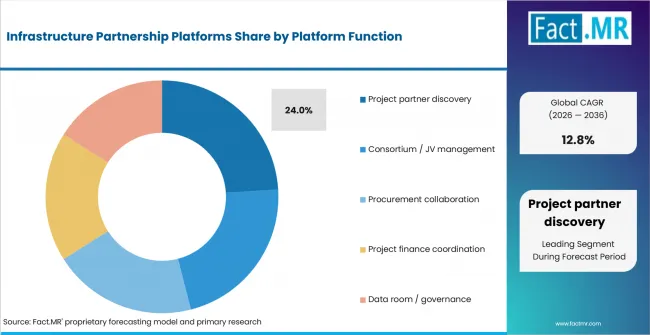
Infrastructure Partnership Platforms Analysis By Platform Function | Source: Fact.MR
Project partner discovery leads because the earliest project decision is often the selection of qualified groups before tender teams form. Agencies and sponsors need clean evidence on contractor history, finance strength and technical fit. These needs connect to the data controls used in common design environments.
What leads the Project Type segment?
Transport is projected to account for 25.0% share in 2026.
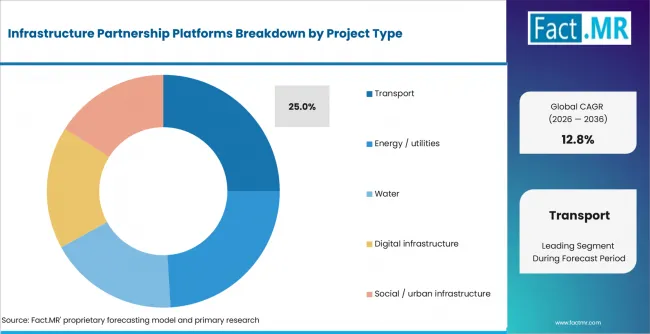
Infrastructure Partnership Platforms Analysis By Project Type | Source: Fact.MR
Transport projects use partnership platforms because rail, road and port programs involve many public bodies and private delivery partners. These projects carry long approval paths and several engineering handoffs. Cloud workspaces give sponsors a controlled place for role assignment and finance documentation.
How does Participant shape demand?
EPC / contractors are anticipated to represent 29.0% share in 2026.
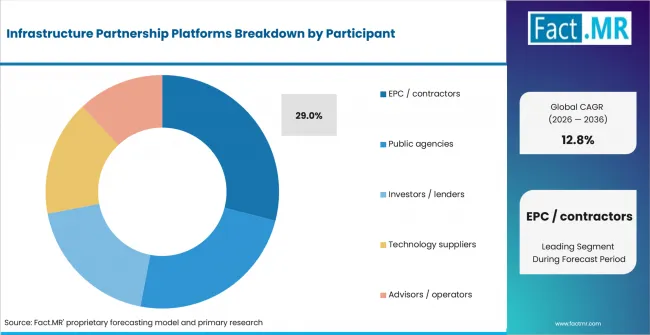
Infrastructure Partnership Platforms Analysis By Participant | Source: Fact.MR
EPC / contractors account for the largest participant base because they work between owners, designers and specialist subcontractors. They need a platform that records who reviewed drawings, who accepted change notes and which files were shared with lenders. Oracle Aconex fits this use case by bringing project information, communication and process control into one cloud environment.
What supports Cloud SaaS within Deployment?
Cloud SaaS is estimated to account for 53.0% share in 2026.
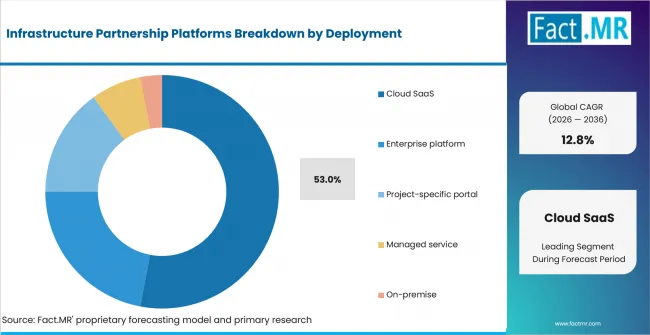
Infrastructure Partnership Platforms Analysis By Deployment | Source: Fact.MR
Cloud SaaS leads because partnership records must be shared across organizations that use separate internal systems. Cloud access reduces setup time for new partners and supports project-specific permission control. Sponsors still need strong governance because infrastructure records often contain finance files and public-contract material.
What is accelerating Infrastructure Partnership Platforms Market adoption, and what is holding it back?
Demand is expected to rise through infrastructure pipelines and consortium governance needs. Adoption is restrained by legacy records, data controls and skills gaps.
Drivers Impact Analysis
| DRIVER | (~) % IMPACT ON CAGR | GEOGRAPHIC RELEVANCE | IMPACT TIMELINE |
|---|---|---|---|
| Public pipeline visibility | +1.8% | North America, Western Europe | Short term (<= 2 years) |
| Project partner governance | +1.5% | Global | Medium term (2-4 years) |
| Project finance data rooms | +1.1% | Europe, North America | Medium term (2-4 years) |
| Common data environments | +0.9% | Global | Long term (>= 4 years) |
Source: Fact.MR analysis. Updated Sep 10, 2026
Opportunity Impact Analysis
| OPPORTUNITY | (~) % IMPACT ON CAGR | GEOGRAPHIC RELEVANCE | IMPACT TIMELINE |
|---|---|---|---|
| Cloud portals for multi-agency programs | +1.4% | North America, Europe | Medium term (2-4 years) |
| Energy and digital-infrastructure data rooms | +1.0% | Europe, East Asia | Long term (>= 4 years) |
| AI-assisted search across project records | +0.8% | Global | Short term (<= 2 years) |
Source: Fact.MR analysis. Updated Sep 10, 2026
Restraints Impact Analysis
| RESTRAINT | (~) % IMPACT ON CAGR | GEOGRAPHIC RELEVANCE | IMPACT TIMELINE |
|---|---|---|---|
| Legacy tender and document systems | -0.6% | Global | Short term (<= 2 years) |
| Cybersecurity and public-sector data controls | -0.5% | North America, Europe | Medium term (2-4 years) |
| Capability gaps among sponsors and SMEs | -0.4% | Global | Long term (>= 4 years) |
Source: Fact.MR analysis. Updated Sep 10, 2026
Which countries are scaling the Infrastructure Partnership Platforms Market through 2036?
- The country comparison spans 3.4 percentage points and forms three practical growth bands across the forecast period.
- Italy remains 1.6 percentage points above Germany due to PNRR delivery and grid-program coordination.
- Germany remains 0.3 percentage point above the USA through long-term federal infrastructure funding.
- The USA remains 0.4 percentage point above the UK due to transport and broadband funding activity.
- The UK remains 1.1 percentage points above France due to infrastructure pipeline visibility and public program planning.
- France closes the displayed range through power-grid renewal and transport-network planning.
Comparable CAGRs create different entry conditions due to project pipelines, public funding visibility, digital readiness and infrastructure policy. Full report coverage includes North America, Latin America, Western Europe, Eastern Europe, East Asia, South Asia & Pacific, Middle East & Africa.
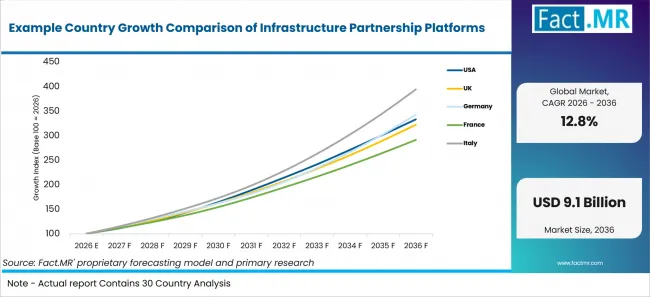
Example Country Growth Comparison Of Infrastructure Partnership Platforms | Source: Fact.MR
| Country | CAGR (2026-2036) |
|---|---|
| Italy | 14.7% |
| Germany | 13.1% |
| United States | 12.8% |
| United Kingdom | 12.4% |
| France | 11.3% |
Source: Fact.MR analysis. Updated Sep 10, 2026
What supports Italy adoption?
14.7% CAGR, supported by PNRR delivery and infrastructure-program coordination.
Italy’s Ministry of Infrastructure and Transport reported in December 2025 that approximately 10,000 construction sites were active in 2025 under the PNRR measures within the ministry’s responsibility. The project base is expected to lift platform use because sponsors need partner records, concession files and delivery evidence across ministries, local bodies and contractors.
What is supporting Germany’s adoption?
13.1% CAGR, supported by federal infrastructure funding and climate-neutrality investment.
Germany’s Federal Ministry of Finance stated in January 2026 that EUR 500 billion is being made available over a 12-year infrastructure and climate-neutrality fund. The funding base is expected to favor platforms that connect public agencies, contractors and advisors around controlled project records.
What supports USA demand?
12.8% CAGR, supported by transportation funding and digital infrastructure programs.
The U.S. Department of Transportation reported that 73.73% of enacted IIJA budget authority with adjustments had been obligated as of June 30, 2026. The funding movement is expected to support platform demand where agencies and contractors need shared records for grants, agreements and delivery milestones.
What supports the United Kingdom’s growth?
12.4% CAGR, supported by infrastructure investment visibility and regional construction activity.
The Office for National Statistics reported in July 2026 that new work infrastructure construction in Great Britain reached GBP 37.3 billion in 2025. The market is projected to advance as sponsors and investors use digital records to compare project timing, roles and finance evidence.
How does France perform?
11.3% CAGR, supported by power-grid renewal and transport-network planning.
RTE stated in February 2025 that its electricity transmission network plan points to about EUR 100 billion of investment to 2040. France is expected to need partnership platforms for grid, transport and digital infrastructure projects that depend on coordinated public review and investor-ready records.
Who leads the Infrastructure Partnership Platforms Market?
Oracle supports project delivery through Aconex and Primavera solutions for project controls, document management and cross-organization coordination. Aconex provides a common project environment in which participating organizations retain ownership and control of their own information while securely sharing records and collaborating across project workflows.
Autodesk supports AECO workflows through Autodesk Forma, which connects planning, design, construction and operations within a unified industry cloud. In March 2026, Autodesk Construction Cloud joined Autodesk Forma, with its products represented under the Forma brand, including Forma Data Management, Forma Design Collaboration and Forma Build.
Bentley Systems supports infrastructure project delivery through ProjectWise, SYNCHRO and Bentley Infrastructure Cloud Connect, combining engineering information management, project collaboration and 4D construction workflows. Trimble participates through Trimble Connect and ProjectSight, supporting model and file sharing, document control, project records and configurable construction workflows.
Procore provides construction-management capabilities for civil and infrastructure contractors, including project records, document-based workflows and AI-supported tools. Octave supports engineering and construction workflows through its Design-Build solutions, including Octave Forte, Octave OnSite, Octave Loop and InConcert, with capabilities spanning industrial design, engineering information, materials management and capital-project execution.
Across these suppliers, product portfolios emphasize controlled information access, cross-organization collaboration, document and model management, workflow automation, project controls and integration between design, construction and project-data systems.
Which companies are the key providers?
Companies active in the Infrastructure Partnership Platforms Market include Oracle, Autodesk, Bentley Systems, Trimble, Procore and Octave.
- Oracle
- Autodesk
- Bentley Systems
- Trimble
- Procore
- Octave
Bibliography
- U.S. Census Bureau. (2026, September 1). Monthly construction spending, July 2026.
- National Telecommunications and Information Administration. (2025, June 6). BEAD restructuring policy notice.
- National Infrastructure and Service Transformation Authority. (2026, March 9). Infrastructure Pipeline update signals future workforce needs.
- Federal Ministry of Finance. (2026, January 23). Disbursement of funds from the Special Fund for Infrastructure and Climate Neutrality in 2025.
- Ministero delle Infrastrutture e dei Trasporti. (2025, December 2). Al MAXXI protagonista il PNRR del MIT.
- U.S. Department of Transportation. (2026, August 10). Infrastructure Investment and Jobs Act (IIJA) funding status.
- Office for National Statistics. (2026, July 1). Infrastructure in the UK, investment and net stocks: July 2026.
- RTE. (2025, February 13). RTE présente les grandes orientations de sa stratégie de transformation du réseau de transport d’électricité à l’horizon 2040.
- Bentley Systems, Incorporated. (2025, October 15). Bentley Systems announces Bentley Infrastructure Cloud Connect.
- Trimble. (2026, September 2). Trimble Connect integration.
- Bunszel, A. (2026, March 24). Autodesk Construction Cloud is now Autodesk Forma. Autodesk.
- Procore Technologies, Inc. (2025, October 15). Procore advances the future of construction with new AI innovations at Groundbreak 2025.
- Octave Intelligence plc. (2026, August 31). Octave and MAIRE collaborate on the application of AI across engineering and construction workflows.
- Oracle. (2026, April 13). New Oracle Aconex capabilities improve project transparency and control.
This Report Answers
- The report explains where infrastructure partnership platforms are used across platform function and project type. It also covers participant roles and deployment models.
- Segment analysis identifies the leading subsegments and the operational reasons sponsors prioritize them.
- Country analysis examines the listed markets and the infrastructure funding or policy mechanisms supporting platform use.
- Competitive analysis reviews current providers across project collaboration, construction cloud, engineering data and capital-project control.
- Application analysis assesses how partner discovery, data-room control and approval evidence influence platform selection.
What does the Infrastructure Partnership Platforms Market cover?
The Infrastructure Partnership Platforms Market covers software that helps agencies, contractors, investors and advisors coordinate partner records across infrastructure projects.
The market includes platforms that support partner discovery, consortium records, bid files, finance data rooms and governance evidence. Operational twin dashboards is adjacent where project records move into live infrastructure views.
The assessment covers transport, energy and utilities, water, digital infrastructure, and social or urban infrastructure projects. utility analytics and energy analytics fits nearby project environments where infrastructure data supports planning and operational review.
What is included in the scope?
The scope includes licensed and subscription platforms for partner discovery, consortium records, bid collaboration, project finance coordination and data-room governance. energy intelligence solutions is adjacent where project coordination links to energy infrastructure planning.
It includes project-specific portals and cloud SaaS platforms used by EPC / contractors, agencies, lenders and advisors. asset performance management is related where records shift from project delivery into asset operations.
It also includes hosted workspaces that manage permissions, evidence trails and cross-company records. digital twin as-a-service shows a neighboring hosted model for infrastructure data use.
What is excluded from the scope?
The scope excludes standalone design authoring tools, raw construction equipment and general office software sold without infrastructure partnership workflows. virtual commissioning remains adjacent when simulation supports project delivery.
Standalone engineering models are outside the scope when they lack partner discovery or data-room governance. BIM extraction software is adjacent when model data is converted into structured project records.
Pure IT outsourcing platforms are outside the scope when they manage infrastructure operations without multi-party project governance. managed infrastructure services remains nearby where delivery support extends into operations.
General construction information tools are outside the scope when they focus only on design files. building information modeling remains a related workflow when models become part of shared infrastructure evidence.
How Was the Analysis Built?
The analysis draws on 120+ sources, 35+ company portfolios, 25+ countries, and more than 20 industry interviews.
- Primary Research: Primary research includes discussions with platform vendors, infrastructure sponsors, contractors, technology developers, advisors, lenders and subject-matter experts. These conversations examine platform selection, partner onboarding, data-room control, approval requirements and wider adoption factors.
- Desk Research: Desk research covers government statistics, public infrastructure pipelines, company releases, technical documentation, standards, public policy and other authoritative sources. Key public sources referenced in this report are documented in the bibliography.
- Market Sizing and Forecasting: Market estimates combine historical performance, project pipeline indicators, deployment mix, participant behavior, country-level growth, adoption patterns, investment activity and barriers to expansion.
- Data Validation and Update Cycle: Findings are validated by comparing primary interviews with public data, company activity, regulatory changes and industry developments. Regular updates review new platforms, partnerships, approvals and shifts in commercial adoption.
Segmentation
What is the report’s scope and coverage?
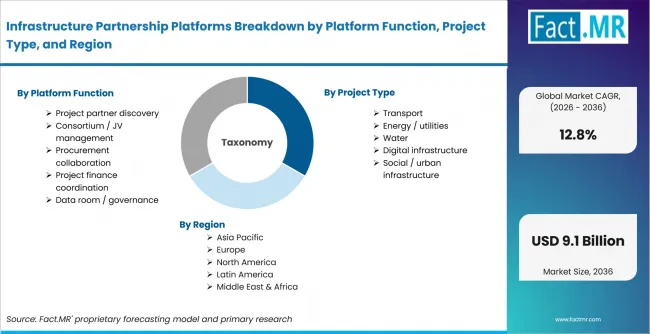
Infrastructure Partnership Platforms Breakdown By Platform Function, Project Type, And Region | Source: Fact.MR
| Attribute | Details |
|---|---|
| Quantitative Units | USD billion |
| Market Definition | Software platforms used to identify infrastructure partners, manage consortium and JV records, coordinate bid collaboration, control project-finance data rooms and govern multi-party infrastructure evidence. |
| Platform Function | Project partner discovery; Consortium / JV management; Bid collaboration; Project finance coordination; Data room / governance |
| Project Type | Transport; Energy / utilities; Water; Digital infrastructure; Social / urban infrastructure |
| Participant | EPC / contractors; Public agencies; Investors / lenders; Technology suppliers; Advisors / operators |
| Deployment | Cloud SaaS; Enterprise platform; Project-specific portal; Managed service; On-premise |
| Regions Covered | North America; Latin America; Western Europe; Eastern Europe; East Asia; South Asia & Pacific; Middle East & Africa |
| Countries Covered | United States; United Kingdom; Germany; France; Italy |
| Companies Profiled | Oracle; Autodesk; Bentley Systems; Trimble; Procore; Octave |
| Forecast Period | 2026 to 2036 |
| Approach | Hybrid top-down and bottom-up approach using project pipeline indicators, deployment mix, participant behavior, country-level growth and provider portfolio review. |
Source: Fact.MR analysis. Updated Sep 10, 2026
How is the market segmented?
-
By Platform Function
- Project partner discovery
- Consortium / JV management
- Bid collaboration
- Project finance coordination
- Data room / governance
-
By Project Type
- Transport
- Energy / utilities
- Water
- Digital infrastructure
- Social / urban infrastructure
-
By Participant
- EPC / contractors
- Public agencies
- Investors / lenders
- Technology suppliers
- Advisors / operators
-
By Deployment
- Cloud SaaS
- Enterprise platform
- Project-specific portal
- Managed service
- On-premise
-
By Region
- North America
- Latin America
- Western Europe
- Eastern Europe
- East Asia
- South Asia & Pacific
- Middle East & Africa
Frequently Asked Questions
How big is the infrastructure partnership platforms market in 2026?
What is the CAGR of the infrastructure partnership platforms market from 2026 to 2036?
Which participant segment leads the infrastructure partnership platforms market?
Which deployment model leads the infrastructure partnership platforms market?
Who are the leading companies in the infrastructure partnership platforms market?
Who worked on this report


Preview the report firsthand - request a free sample
Free SampleGet the brochure for pricing and purchase details
Download PDF