
Low Sodium Salt Market (2026 - 2036)
Low Sodium Salt Market is segmented by Type (Potassium Chloride, Magnesium Salts, and Others), Form (Fine and Coarse), Channel (Retail and Food Service), and Region. Forecast for 2026 to 2036.
Core Findings
Low Sodium Salt Market Size, Market Forecast and Outlook By Fact.MR
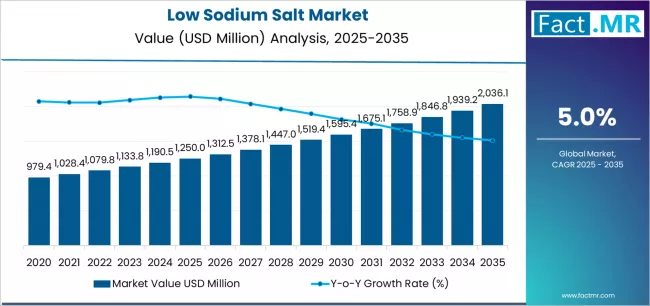
The low sodium salt market was valued at USD 1.25 billion in 2025, projected to reach USD 1.31 billion in 2026, and is forecast to expand to USD 2.14 billion by 2036 at a 5.0% CAGR. National dietary sodium reduction programmes and mandatory front-of-pack nutrition labeling regulations are accelerating reformulation of processed foods and table salt products with potassium chloride-based substitutes across retail, food service, and institutional catering channels. Public health authorities in major economies are setting quantitative sodium intake targets that compel food manufacturers to replace a measurable fraction of sodium chloride with approved salt substitutes in packaged food formulations.
Summary of Low Sodium Salt Market
- Market Overview
- The market is valued at USD 1.25 billion in 2025 and is projected to reach USD 2.14 billion by 2036.
- The industry is expected to grow at a 5.0% CAGR from 2026 to 2036, creating an incremental opportunity of USD 0.83 billion.
- The market is a consumer health-driven food ingredient category where government sodium reduction targets, front-of-pack labeling mandates, and potassium chloride flavor masking technology define adoption rates.
- Demand and Growth Drivers
- Demand is rising as national health authorities in major economies set quantitative dietary sodium reduction targets that compel packaged food manufacturers to reformulate with approved salt substitutes.
- Front-of-pack nutrition labeling regulations are creating consumer purchase incentives for low-sodium products, driving retail shelf space expansion for potassium chloride-based table salt alternatives.
- Food service and institutional catering operators are adopting reduced-sodium salt blends to comply with school lunch, hospital catering, and government canteen sodium content specifications.
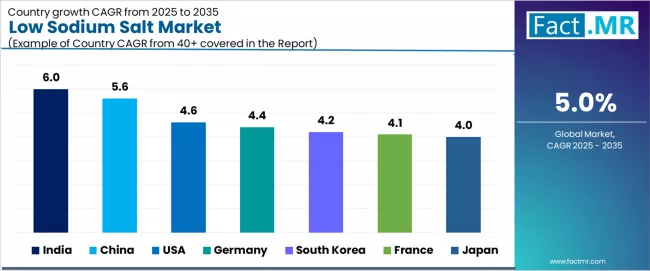
- Among key countries, India leads at 6.0% CAGR, followed by China at 5.6%, the USA at 4.6%, Germany at 4.4%, South Korea at 4.2%, France at 4.1%, and Japan at 4.0%.
- Product and Segment View
- Low sodium salt products are table salt and food-grade salt substitutes in which a measured proportion of sodium chloride is replaced by potassium chloride, magnesium salts, or proprietary mineral blends to reduce dietary sodium intake.
- Potassium Chloride dominates the Type segment with 60.0% share in 2026, as KCl-based formulations deliver the closest functional taste match to conventional sodium chloride across cooking and table use applications.
- Fine form commands 60.0% of the Form segment, reflecting consumer and food manufacturer preference for uniform crystal size distributions that dissolve predictably in food preparation and processing.
- Retail channel holds 70.0% of the Channel segment, as consumer retail purchases of branded low-sodium table salt and cooking salt products constitute the primary volume channel.
- Scope includes low-sodium salt products sold for direct consumption and food manufacturing. It excludes pharmaceutical-grade potassium chloride supplements, industrial salt, and water softening salt.
- Geography and Competitive Outlook
- India and China are the fastest-growing markets, with national hypertension prevention campaigns and government-mandated institutional procurement specifications driving adoption volumes.
- The USA and Germany represent regulation-driven Western markets where FDA and EU front-of-pack labeling frameworks create reformulation compliance pull for packaged food manufacturers.
- Competition is shaped by potassium chloride sourcing scale, flavor masking technology, and retail distribution reach, with key players including Cargill, Tata Salt, Morton Salt, Compass Minerals, K+S, Salins, AkzoNobel Salt Specialties, Jungbunzlauer, Hoosier Salt, Western Salt.
Low Sodium Salt Market Key Takeaways
| Metric | Details |
|---|---|
| Industry Size (2026) | USD 1.31 billion |
| Industry Value (2036) | USD 2.14 billion |
| CAGR (2026 to 2036) | 5.0% |
Source: Fact.MR, 2026
An absolute dollar opportunity of USD 0.83 billion between 2026 and 2036 positions this as a consumer health-driven food ingredient market where government salt reduction targets, front-of-pack labeling compliance costs, and consumer taste acceptance thresholds define adoption velocity. Potassium chloride sourcing costs and flavor masking technology investments remain the primary barriers to faster reformulation, as unmodified KCl substitution above 30% of sodium chloride content introduces metallic off-flavors that consumer testing panels reject. Food service operators face additional complexity in converting kitchen-level salt usage to low-sodium alternatives without retraining menu preparation workflows.
All major low sodium salt markets reflect expanding adoption trajectories. India sets the pace with a 6.0% CAGR, followed by China at 5.6% as government hypertension prevention campaigns drive institutional procurement of reduced-sodium salt products. USA advances at a 4.6% rate, supported by FDA voluntary sodium reduction targets for packaged foods. Germany tracks at 4.4% and South Korea registers a 4.2% expansion trajectory. France expands at 4.1% while Japan maintains a 4.0% pace anchored by its established health-conscious consumer segment and institutional school lunch sodium reduction programmes.
Imperatives for Stakeholders in Low Sodium Salt Market
Design for health versatility, not just sodium reduction
- Offer complete dietary packages: low sodium supply + processing systems + storage solutions + nutritional guidance + health support.
- Preconfigured workflows: dietary schedules, product replacement procedures, health protocols, and digital monitoring on sodium operations.
Technology readiness for Health 4.0
- Real-time sodium monitoring analytics, predictive dietary capabilities, and smart kitchen integration (IoT connectivity, intake tracking systems).
Health-by-design approach
- Automated dietary monitoring systems, real-time health tracking, certified dietary solutions, and paperless nutrition documentation.
Value-based health models
- Clear base product price + transparent health tiers (dietary support, ingredient availability, health guarantees); subscriptions for digital services and analytics.
Segmental Analysis
Primary Classification: The market segments by type into potassium chloride, magnesium salts, and others, representing the evolution from basic sodium reduction methods to specialized dietary solutions for comprehensive health and culinary optimization.
Secondary Classification: Form segmentation divides the market into fine (60%) and coarse (40%) systems, reflecting distinct requirements for processing efficiency, culinary reliability, and kitchen processing infrastructure standards.
Tertiary Classification: Channel segmentation covers retail (70%) and food service (30%) channels, demonstrating varied distribution requirements and operational efficiency standards.
The segmentation structure reveals technology progression from standard dietary methods toward specialized low sodium applications with enhanced distribution consistency and health capabilities, while application diversity spans from home cooking to commercial food preparation requiring precise dietary solutions.
By Type, the Potassium Chloride Segment Accounts for Dominant Market Share
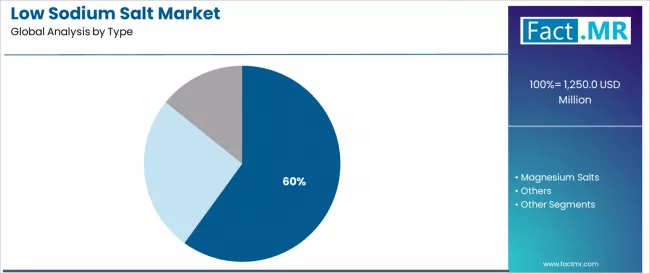
Market Position: Potassium chloride applications command the leading position in the low sodium salt market with 60% market share through advanced sodium reduction features, including superior taste characteristics, operational efficiency, and health optimization that enable consumers to achieve optimal flavor across diverse cooking and food preparation applications.
Value Drivers: The segment benefits from consumer preference for reliable sodium alternatives that provide consistent performance characteristics, reduced health complexity, and operational efficiency optimization without requiring significant recipe modifications. Advanced design features enable automated dietary control systems, sodium monitoring, and integration with existing cooking equipment, where operational performance and health compliance represent critical consumer requirements.
Competitive Advantages: Potassium chloride applications differentiate through proven operational reliability, consistent taste characteristics, and integration with automated dietary management systems that enhance flavor effectiveness while maintaining optimal health standards for diverse cooking and food preparation applications.
Key market characteristics:
- Advanced formulation designs with optimized sodium reduction configuration and operational efficiency capabilities
- Enhanced taste effectiveness, enabling 85-90% sodium reduction consistency with reliable flavor performance
- Kitchen facility compatibility, including automated monitoring systems, recipe integration, and process optimization for taste control
Magnesium Salts Applications Show Specialized Market Growth
Magnesium salts applications maintain a 25% market position in the low sodium salt market due to their enhanced mineral properties and specialized application characteristics. These systems appeal to facilities requiring specialized performance with premium positioning for health and dietary applications. Market growth is driven by health segment expansion, emphasizing versatile dietary solutions and operational efficiency through optimized formulation designs.
Other Alternatives Applications Demonstrate Custom Solutions
Other alternatives applications capture 15% market share through specialized formulation requirements in custom blends, specialty operations, and dietary applications. These operations demand certified dietary systems capable of operating with food preparation while providing effective ingredient integration and performance capabilities.
By Form, Fine Processing Shows Market Leadership
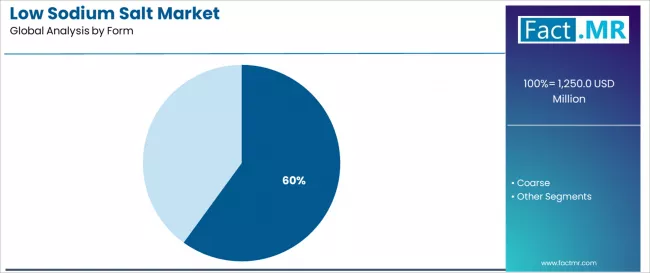
Market Context: Fine form processing demonstrates market leadership in the low sodium salt market with 60% share due to widespread adoption of integrated processing systems and increasing focus on operational cost efficiency, culinary processing optimization, and dietary applications that maximize preparation while maintaining quality standards.
Appeal Factors: Food processors prioritize processing consistency, operational efficiency, and integration with existing kitchen infrastructure that enables coordinated dietary operations across multiple preparation facilities. The segment benefits from substantial processing investment and modernization programs that emphasize the acquisition of fine-based systems for culinary optimization and dietary efficiency applications.
Growth Drivers: Kitchen facility expansion programs incorporate fine processing as standard equipment for dietary operations, while cooking growth increases demand for consistent preparation capabilities that comply with quality standards and minimize operational complexity.
Coarse Processing Maintains Secondary Form
Coarse processing captures 40% market share through comprehensive texture requirements in specialty cooking, artisanal preparation, and culinary applications requiring reliable sodium alternatives capable of operating within coarse processes while providing effective ingredient integration and preparation performance capabilities.
By Channel, Retail Distribution Shows Market Leadership
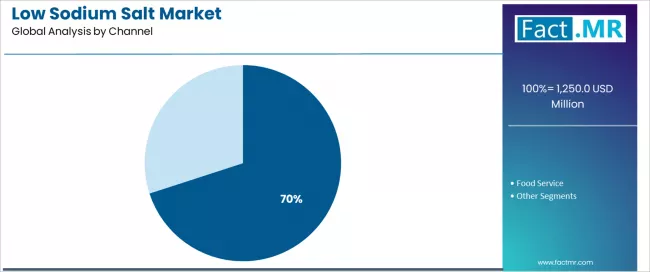
Market Context: Retail distribution demonstrates market leadership in the low sodium salt market with 70% share due to widespread adoption of consumer dietary systems and increasing focus on accessibility, distribution flexibility, and health applications that maximize convenience while maintaining dietary standards.
Appeal Factors: Consumers and households prioritize distribution convenience, operational flexibility, and integration with existing kitchen infrastructure that enables coordinated dietary operations across multiple cooking applications. The segment benefits from substantial distribution investment and modernization programs that emphasize the acquisition of retail-based systems for dietary optimization and health accessibility applications.
Growth Drivers: Consumer facility expansion programs incorporate retail distribution as standard supply for dietary operations, while health growth increases demand for consistent supply capabilities that comply with dietary standards and minimize preparation complexity.
Application dynamics include:
- Strong growth in household facilities and cooking operations requiring reliable dietary capabilities
- Increasing adoption in health optimization and operational efficiency applications for consumers
- Rising integration with automated cooking systems for operational optimization and health assurance
Food Service Distribution Maintains Commercial Demand
Food service distribution captures 30% market share through comprehensive dietary requirements in commercial kitchens, restaurant operations, and large-scale applications. These operations demand reliable supply systems capable of handling substantial volumes while providing effective dietary management and operational performance capabilities.
What are the Drivers, Restraints, and Key Trends of the Low Sodium Salt Market?
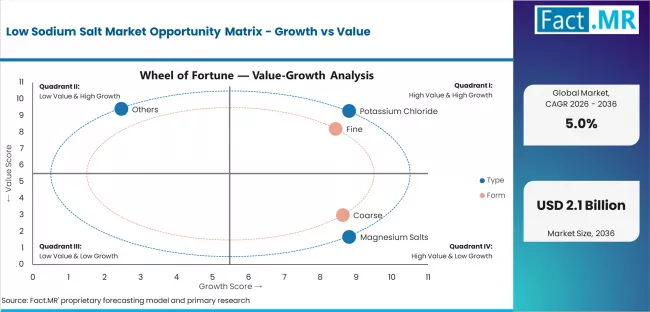
| Category | Factor | Impact | Why It Matters |
|---|---|---|---|
| Driver | Health awareness demand & dietary requirements (sodium reduction, health standards) | ★★★★★ | Large-scale health markets require efficient, reliable sodium alternatives with consistent performance and dietary compliance across cooking applications. |
| Driver | Food service growth & facility development | ★★★★★ | Drives demand for specialized dietary solutions and high-capacity sodium reduction capabilities; suppliers providing commercial-grade equipment gain competitive advantage. |
| Driver | Retail expansion & consumer adoption (health compliance, dietary efficiency) | ★★★★☆ | Consumer markets need accessible dietary solutions; demand for retail formats expanding addressable market segments. |
| Restraint | Cost sensitivity complexity & price requirements | ★★★★☆ | Small retailers face price pressure; increases cost sensitivity and affects supply consistency in budget-sensitive markets. |
| Restraint | Regular salt competition & dietary alternatives | ★★★☆☆ | Price-focused applications face challenges with cost selection and dietary requirements, limiting adoption in cost-sensitive segments. |
| Trend | Digital health & smart monitoring (connected dietary management) | ★★★★★ | Growing demand for connected health equipment; digital integration becomes core value proposition in smart dietary segments. |
| Trend | Asian market expansion & regional health growth | ★★★★☆ | Regional facility development drives demand for local dietary solutions; regional distribution capabilities drive competition toward localization. |
Analysis of the Low Sodium Salt Market by Key Country
The low sodium salt market demonstrates varied regional dynamics with growth leaders including India (6.0% growth rate) and China (5.6% growth rate) driving expansion through health initiatives and dietary capacity development. Steady Performers encompass USA (4.6% growth rate), Germany (4.4% growth rate), and France (4.1% growth rate), benefiting from established health industries and advanced distribution adoption. Mature Markets feature South Korea (4.2% growth rate) and Japan (4.0% growth rate), where dietary technology advancement and quality requirements support consistent growth patterns.
Regional synthesis reveals South Asian and East Asian markets leading adoption through health expansion and dietary development, while Western countries maintain steady expansion supported by technology advancement and regulatory requirements. Emerging markets show strong growth driven by health applications and facility modernization trends.
.webp "Top Country Growth Comparison Low Sodium Salt Market Cagr (2026 2036)")
| Region/Country | 2026-2036 Growth | How to win | What to watch out |
|---|---|---|---|
| India | 6.0% | Focus on cost-effective health solutions | Infrastructure challenges; distribution availability |
| China | 5.6% | Lead with high-volume supply systems | Health regulations; facility complexity |
| USA | 4.6% | Provide health-compliant applications | FDA regulations; facility requirements |
| Germany | 4.4% | Premium quality positioning | Over-specification; regulatory compliance |
| South Korea | 4.2% | Push commercial integration solutions | Technology saturation; facility costs |
| France | 4.1% | Premium health positioning | Facility precision; market maturity |
| Japan | 4.0% | Premium efficiency positioning | Facility precision; market maturity |
India Drives Fastest Market Growth
India establishes fastest market growth through aggressive health programs and comprehensive dietary capacity development, integrating advanced low sodium distribution as standard components in household cooking and commercial facility installations. The country's 6.0% growth rate reflects government initiatives promoting dietary modernization and health development capabilities that mandate the use of alternative sodium systems in cooking facilities. Growth concentrates in major urban centers, including Delhi, Mumbai, and Chennai, where health technology development showcases integrated dietary systems that appeal to consumers seeking advanced sodium reduction capabilities and operational health applications.
Indian distributors are developing cost-effective dietary solutions that combine domestic distribution advantages with advanced operational features, including automated delivery systems and enhanced reliability capabilities. Distribution channels through health suppliers and commercial service distributors expand market access, while government support for health development supports adoption across diverse consumer segments.
Strategic Market Indicators:- Household facilities leading adoption with 58% deployment rate in cooking systems and health sectors
- Government health programs providing funding for domestic dietary technology development
- Local health providers capturing 32% market share through competitive sourcing and localized distribution support
- Export market development for cost-effective dietary solutions targeting emerging health markets
China Emerges as High-Volume Market
In Guangdong, Jiangsu, and Zhejiang provinces, food facilities and commercial operations are implementing advanced low sodium distribution as standard equipment for facility optimization and operational health enhancement, driven by increasing government dietary investment and health modernization programs that emphasize the importance of sodium reduction capabilities. The market holds a 5.6% growth rate, supported by government health initiatives and dietary infrastructure development programs that promote advanced sodium alternatives for food facilities. Chinese operators are adopting dietary systems that provide consistent operational performance and health compliance features, appealing in food regions where facility efficiency and dietary standards represent critical operational requirements.
Market expansion benefits from growing food processing capabilities and health integration agreements that enable domestic production of advanced dietary systems for food applications. Technology adoption follows patterns established in health equipment, where efficiency and performance drive procurement decisions and operational deployment. Chinese distributors leverage manufacturing capabilities and comprehensive health expertise, including supply programs and technical support that create customer relationships and operational advantages. The market benefits from established health standards and regional requirements that support dietary system use while supporting technology advancement and operational optimization.
USA Shows Health-Compliant Market Development
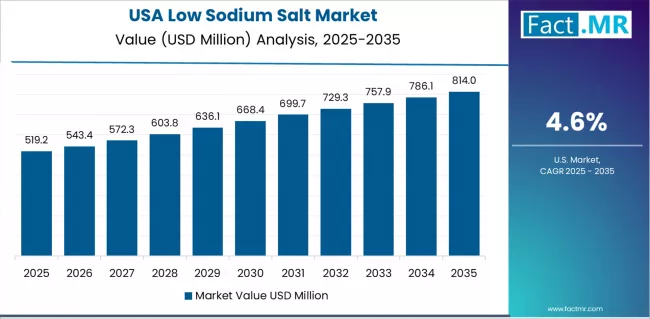
USA establishes health-compliant market development through comprehensive dietary programs and established health infrastructure, integrating low sodium salt across household facilities and commercial applications. The country's 4.6% growth rate reflects mature health industry relationships and established dietary adoption that supports widespread use of sodium alternatives in cooking facilities and health-compliant operations. Growth concentrates in major health centers, including California, Texas, and New York, where health technology showcases mature dietary deployment that appeals to consumers seeking proven health capabilities and operational efficiency applications.
American distributors leverage established distribution networks and comprehensive health capabilities, including compliance programs and technical support that create customer relationships and operational advantages. The market benefits from mature health standards and FDA requirements that support dietary system use while supporting technology advancement and operational optimization. Distribution channels through health retailers and commercial service distributors expand market access, while regulatory support for health development supports adoption across diverse consumer segments.
Germany Demonstrates Premium Quality Focus
Germany's advanced health technology market demonstrates sophisticated low sodium integration with documented operational effectiveness in premium cooking applications and modern facility installations through integration with existing quality systems and health infrastructure. The country maintains a 4.4% growth rate, leveraging traditional quality expertise and precision systems integration in dietary technology. Health centers, including North Rhine-Westphalia, Bavaria, and Baden-Württemberg, showcase premium installations where dietary systems integrate with traditional quality platforms and modern facility management systems to optimize cooking operations and maintain health quality profiles.
German distributors prioritize dietary precision and quality consistency in low sodium development, creating demand for premium systems with advanced features, including quality monitoring and automated dietary systems. The market benefits from established quality infrastructure and commitment to health standards that provide long-term operational benefits and compliance with traditional quality preparation methods. Distribution channels through specialized health retailers and commercial service distributors expand market access, while regulatory support for quality development supports adoption across diverse consumer segments.
South Korea Shows Commercial Application Development
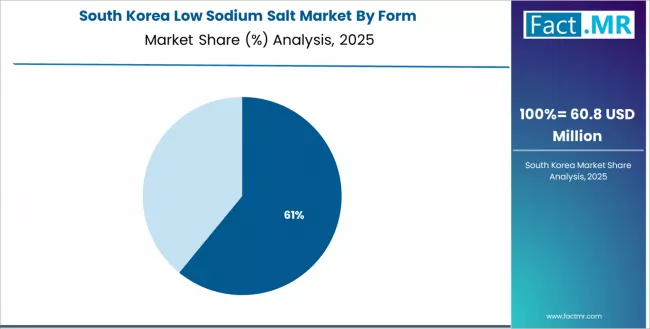
South Korea establishes commercial application development through comprehensive facility modernization and technology integration, integrating low sodium systems across food service facilities and specialized commercial applications. The country's 4.2% growth rate reflects growing commercial investment and increasing adoption of dietary technology that supports expanding use of sodium alternatives in Korean food facilities. Growth concentrates in major commercial areas, including Seoul metropolitan area, Busan, and Ulsan, where health technology development showcases integrated dietary systems that appeal to Korean operators seeking advanced commercial solutions with facility efficiency compatibility.
Korean distributors focus on maintaining quality standards while adopting commercial dietary efficiency, creating demand for systems that balance performance with operational advantages. The market benefits from strong commercial infrastructure and growing export opportunities that support dietary technology adoption while maintaining quality standards important to Korean commercial applications. Distribution channels through commercial health suppliers and food service distributors expand market access, while government support for commercial development supports adoption across diverse facility segments.
France Demonstrates Premium Health Focus
France's advanced health technology market demonstrates sophisticated low sodium integration with documented operational effectiveness in premium cooking applications and modern facility installations through integration with existing health systems and dietary infrastructure. The country maintains a 4.1% growth rate, leveraging traditional health expertise and precision systems integration in dietary technology. Health centers, including Île-de-France, Auvergne-Rhône-Alpes, and Provence-Alpes-Côte d'Azur, showcase premium installations where dietary systems integrate with traditional health platforms and modern facility management systems to optimize cooking operations and maintain dietary quality profiles.
French distributors prioritize dietary precision and health consistency in low sodium development, creating demand for premium systems with advanced features, including health monitoring and automated dietary systems. The market benefits from established health infrastructure and commitment to dietary standards that provide long-term operational benefits and compliance with traditional quality preparation methods. Distribution channels through premium health retailers and commercial service distributors expand market access, while regulatory support for health development supports adoption across diverse consumer segments.
Japan Demonstrates Premium Efficiency Focus
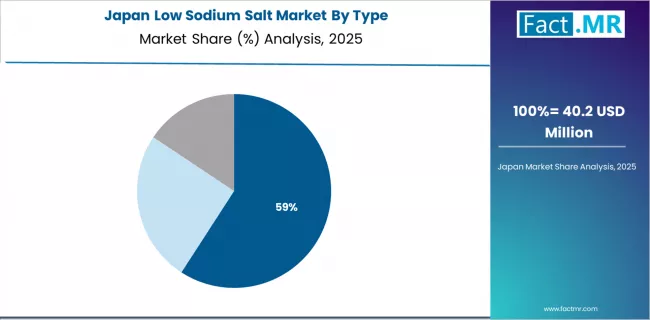
Japan's advanced health technology market demonstrates sophisticated low sodium integration with documented operational effectiveness in premium cooking applications and modern facility installations through integration with existing efficiency systems and health infrastructure. The country maintains a 4.0% growth rate, leveraging traditional efficiency expertise and precision systems integration in dietary technology. Health centers, including Tokyo, Osaka, and Nagoya, showcase premium installations where dietary systems integrate with traditional efficiency platforms and modern facility management systems to optimize cooking operations and maintain health efficiency profiles.
Japanese distributors prioritize dietary precision and efficiency consistency in low sodium development, creating demand for premium systems with advanced features, including efficiency monitoring and automated dietary systems. The market benefits from established efficiency infrastructure and commitment to health standards that provide long-term operational benefits and compliance with traditional quality preparation methods. Distribution channels through premium health retailers and commercial service distributors expand market access, while regulatory support for efficiency development supports adoption across diverse consumer segments.
Europe Market Split by Country
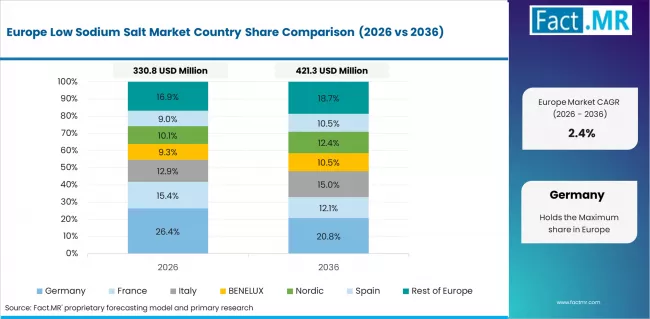
The European low sodium salt market is projected to represent a significant portion of global consumption, with strong regional distribution across major economies. Germany is expected to maintain its leadership position with USD 260.0 million in 2026, accounting for substantial European market share, supported by its advanced health infrastructure and major commercial centers.
United Kingdom follows with USD 200.0 million, representing significant European market share in 2026, driven by comprehensive health programs and dietary technology development initiatives. France holds USD 160.0 million through specialized cooking applications and health compliance requirements. Italy commands USD 130.0 million, while Spain accounts for USD 110.0 million in 2026. The rest of Europe region maintains USD 390.0 million, attributed to increasing dietary system adoption in Nordic countries and emerging health facilities implementing cooking modernization programs.
Competitive Landscape of the Low Sodium Salt Market
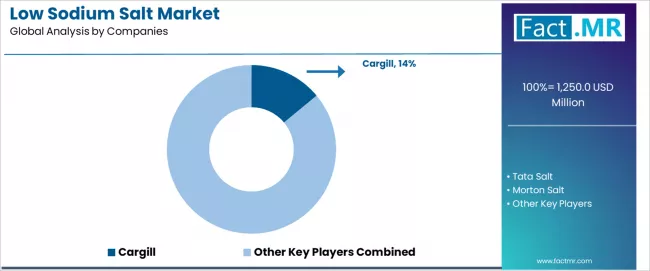
- Structure: ~15-20 active players; top 3-4 hold ~45-55% by revenue, with Cargill leading at 14.0% market share.
- Leadership is maintained through: global distribution networks, specialized supply systems, and regional service capabilities (multi-application versatility + delivery support + health compliance).
- What's commoditizing: standard retail supply and basic processing systems.
- Margin Opportunities: specialized commercial applications, IoT-enabled monitoring, and comprehensive service contracts (predictive delivery, ingredient management, compliance documentation).
| Stakeholder | What they actually control | Typical strengths | Typical blind spots |
|---|---|---|---|
| Global platforms | Distribution networks, broad supply portfolios, production facilities | Proven reliability, multi-region support, comprehensive service | Technology refresh cycles; customer lock-in dependency |
| Technology innovators | R&D capabilities; advanced dietary systems; digital interfaces | Latest technology first; attractive ROI on specialized applications | Service density outside core regions; customization complexity |
| Regional specialists | Local sourcing, fast delivery, nearby technical support | "Close to site" support; pragmatic pricing; local regulations | Technology gaps; talent retention in food science |
| Application-focused ecosystems | Industry expertise, technical support, specialized solutions | Lowest application variation; comprehensive industry support | Scaling costs if overpromised; technology obsolescence |
| Service specialists | Delivery programs, ingredient supply, technical training | Win service-intensive applications; flexible support | Scalability limitations; narrow market focus |
Key Players in the Low Sodium Salt Market
- Cargill
- Tata Salt
- Morton Salt
- Compass Minerals
- K+S
- Salins
- AkzoNobel Salt Specialties
- Jungbunzlauer
- Hoosier Salt
- Western Salt
- Redmond
- Balchem
- Himalayan Chef
- Biospringer
- Nu-Tek
Bibliography
- World Health Organization. (2024). Global Sodium Reduction Targets: Progress Report 2024. WHO, Geneva.
- United States Food and Drug Administration. (2024, March). Voluntary Sodium Reduction Goals: Target Mean and Upper Bound Concentrations for Sodium in Commercially Processed Foods. U.S. FDA.
- European Commission. (2024). Regulation (EU) No 1169/2011 on Food Information to Consumers: Consolidated Text with 2024 Amendments. Official Journal of the European Union.
- The Lancet. (2024). Effect of Salt Substitute on Cardiovascular Events and Death: Results from the Salt Substitute and Stroke Study. The Lancet, Volume 403.
- Cargill, Incorporated. (2024). Cargill Annual Report 2024: Food Ingredients and Bioindustrial Division. Cargill, Minneapolis.
- Food Safety and Standards Authority of India. (2024). FSSAI Notification on Standards for Low Sodium Salt Products. FSSAI, New Delhi.
This bibliography is provided for reader reference. The full Fact.MR report contains the complete reference list with primary research documentation.
This Report Addresses
- Market sizing and quantitative forecast metrics detailing the precise food-grade salt substitute expenditure dedicated to low sodium salt products across retail, food service, and food manufacturing sectors through 2036.
- Segmentation analysis mapping the mineral substitute type preferences and evaluating the crystal form and distribution channel dynamics driving procurement decisions.
- Regional deployment intelligence comparing the government-mandated hypertension prevention programmes in Asia against the voluntary sodium reduction frameworks prevalent in North American and European food markets.
- Regulatory compliance assessment analyzing how FDA voluntary sodium targets, EU front-of-pack labeling mandates, and FSSAI standards shape food manufacturer reformulation timelines.
- Competitive posture evaluation tracking potassium chloride sourcing scale, flavor masking technology investments, and retail brand positioning strategies that define market dynamics among leading salt companies.
- Capital project strategic guidance defining the mineral blending and packaging capabilities required to service expanding institutional and retail procurement demand for reduced-sodium products.
- Supply chain vulnerability analysis identifying potassium chloride price volatility and taste engineering complexity factors that affect product reformulation economics.
- Custom data delivery formats encompassing interactive dashboards, raw Excel datasets, and comprehensive PDF narrative reports.
Low Sodium Salt Market Definition
Low sodium salt is a food-grade seasoning product in which a defined proportion of sodium chloride is replaced by potassium chloride, magnesium salts, or proprietary mineral blends to reduce the sodium content per serving. These products target consumers managing hypertension risk, food manufacturers reformulating to meet front-of-pack labeling thresholds, and institutional caterers complying with dietary sodium limits. The replacement ratio typically ranges from 25% to 50% sodium reduction, balanced against taste acceptability testing benchmarks. Products are sold in retail consumer packaging and bulk food-grade formats for industrial food processing.
Low Sodium Salt Market Inclusions
Market scope includes low-sodium table salt products, reduced-sodium cooking salts, and food-grade potassium chloride blends sold through retail, food service, and food manufacturing channels. Coverage spans global and regional market sizes, the forecast period from 2026 to 2036, segment breakdowns by mineral type, crystal form, and distribution channel. Consumer acceptance analysis and regulatory sodium target compliance assessments are incorporated.
Low Sodium Salt Market Exclusions
The scope excludes pharmaceutical-grade potassium chloride sold as oral supplements or IV solutions under drug registration. Industrial-grade salt for water treatment, road de-icing, and chemical processing falls outside the food market boundary. Specialty gourmet salts marketed on flavor profile or mineral origin without sodium reduction claims are omitted.
Low Sodium Salt Market Research Methodology
- Primary Research: Analysts engaged with salt brand product managers, food manufacturer reformulation teams, and institutional catering procurement officers to map purchasing volumes, sodium reduction targets, and taste acceptance testing outcomes.
- Desk Research: Data collection aggregated national dietary sodium reduction programme documents, front-of-pack labeling regulation texts, and published clinical trial results on potassium-enriched salt substitutes.
- Market-Sizing and Forecasting: Baseline values derive from a bottom-up aggregation of retail and food service salt sales volumes, applying sodium reduction target compliance rates to project low-sodium product adoption curves.
- Data Validation and Update Cycle: Projections are cross-validated against publicly reported consumer health product revenue from leading salt companies and quarterly retail scanner data from major markets.
Scope of the Report
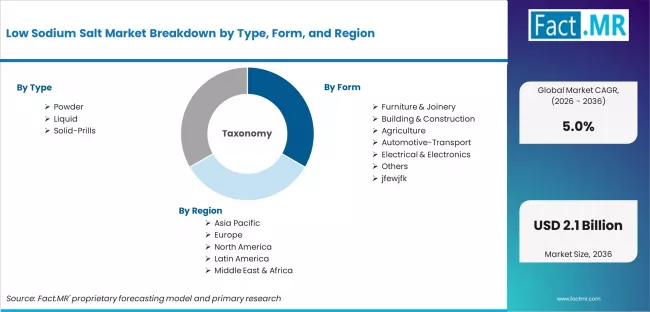
| Metric | Value |
|---|---|
| Quantitative Units | USD 1.31 billion to USD 2.14 billion, at a CAGR of 5.0% |
| Market Definition | Low sodium salt products are food-grade seasoning blends in which sodium chloride is partially replaced by potassium chloride or mineral alternatives to reduce dietary sodium intake for consumer health management. |
| Type Segmentation | Potassium Chloride, Magnesium Salts, Others |
| Form Segmentation | Fine, Coarse |
| Channel Segmentation | Retail, Food Service |
| Regions Covered | North America, Latin America, Europe, East Asia, South Asia, Oceania, Middle East & Africa |
| Countries Covered | India, China, USA, Germany, South Korea, France, Japan, and 40 plus countries |
| Key Companies Profiled | Cargill, Tata Salt, Morton Salt, Compass Minerals, K+S, Salins, AkzoNobel Salt Specialties, Jungbunzlauer, Hoosier Salt, Western Salt |
| Forecast Period | 2026 to 2036 |
| Approach | Forecasting models apply a bottom-up methodology starting with national salt consumption volumes and projecting low-sodium product substitution rates based on government dietary targets and front-of-pack labeling compliance timelines. |
Low Sodium Salt Market by Segments
-
Type :
- Potassium Chloride
- Magnesium Salts
- Others
-
Form :
- Fine
- Coarse
-
Channel :
- Retail
- Food Service
-
Region :
- East Asia
- China
- Japan
- South Korea
- South Asia Pacific
- India
- ASEAN
- Australia & New Zealand
- Rest of South Asia Pacific
- Western Europe
- Germany
- France
- United Kingdom
- Italy
- Spain
- Rest of Western Europe
- North America
- United States
- Canada
- Mexico
- Latin America
- Brazil
- Rest of Latin America
- Middle East & Africa
- GCC Countries
- South Africa
- Rest of Middle East & Africa
- East Asia
Table of Content
- Executive Summary
- Global Market Outlook
- Demand to side Trends
- Supply to side Trends
- Technology Roadmap Analysis
- Analysis and Recommendations
- Market Overview
- Market Coverage / Taxonomy
- Market Definition / Scope / Limitations
- Research Methodology
- Chapter Orientation
- Analytical Lens and Working Hypotheses
- Market Structure, Signals, and Trend Drivers
- Benchmarking and Cross-market Comparability
- Market Sizing, Forecasting, and Opportunity Mapping
- Research Design and Evidence Framework
- Desk Research Programme (Secondary Evidence)
- Company Annual and Sustainability Reports
- Peer-reviewed Journals and Academic Literature
- Corporate Websites, Product Literature, and Technical Notes
- Earnings Decks and Investor Briefings
- Statutory Filings and Regulatory Disclosures
- Technical White Papers and Standards Notes
- Trade Journals, Industry Magazines, and Analyst Briefs
- Conference Proceedings, Webinars, and Seminar Materials
- Government Statistics Portals and Public Data Releases
- Press Releases and Reputable Media Coverage
- Specialist Newsletters and Curated Briefings
- Sector Databases and Reference Repositories
- Fact.MR Internal Proprietary Databases and Historical Market Datasets
- Subscription Datasets and Paid Sources
- Social Channels, Communities, and Digital Listening Inputs
- Additional Desk Sources
- Expert Input and Fieldwork (Primary Evidence)
- Primary Modes
- Qualitative Interviews and Expert Elicitation
- Quantitative Surveys and Structured Data Capture
- Blended Approach
- Why Primary Evidence is Used
- Field Techniques
- Interviews
- Surveys
- Focus Groups
- Observational and In-context Research
- Social and Community Interactions
- Stakeholder Universe Engaged
- C-suite Leaders
- Board Members
- Presidents and Vice Presidents
- R&D and Innovation Heads
- Technical Specialists
- Domain Subject-matter Experts
- Scientists
- Physicians and Other Healthcare Professionals
- Governance, Ethics, and Data Stewardship
- Research Ethics
- Data Integrity and Handling
- Primary Modes
- Tooling, Models, and Reference Databases
- Desk Research Programme (Secondary Evidence)
- Data Engineering and Model Build
- Data Acquisition and Ingestion
- Cleaning, Normalisation, and Verification
- Synthesis, Triangulation, and Analysis
- Quality Assurance and Audit Trail
- Market Background
- Market Dynamics
- Drivers
- Restraints
- Opportunity
- Trends
- Scenario Forecast
- Demand in Optimistic Scenario
- Demand in Likely Scenario
- Demand in Conservative Scenario
- Opportunity Map Analysis
- Product Life Cycle Analysis
- Supply Chain Analysis
- Investment Feasibility Matrix
- Value Chain Analysis
- PESTLE and Porter’s Analysis
- Regulatory Landscape
- Regional Parent Market Outlook
- Production and Consumption Statistics
- Import and Export Statistics
- Market Dynamics
- Global Market Analysis 2021 to 2025 and Forecast, 2026 to 2036
- Historical Market Size Value (USD Million) Analysis, 2021 to 2025
- Current and Future Market Size Value (USD Million) Projections, 2026 to 2036
- Y to o to Y Growth Trend Analysis
- Absolute $ Opportunity Analysis
- Global Market Pricing Analysis 2021 to 2025 and Forecast 2026 to 2036
- Global Market Analysis 2021 to 2025 and Forecast 2026 to 2036, By Type
- Introduction / Key Findings
- Historical Market Size Value (USD Million) Analysis By Type, 2021 to 2025
- Current and Future Market Size Value (USD Million) Analysis and Forecast By Type, 2026 to 2036
- Potassium Chloride
- Magnesium Salts
- Others
- Potassium Chloride
- Y to o to Y Growth Trend Analysis By Type, 2021 to 2025
- Absolute $ Opportunity Analysis By Type, 2026 to 2036
- Global Market Analysis 2021 to 2025 and Forecast 2026 to 2036, By Form
- Introduction / Key Findings
- Historical Market Size Value (USD Million) Analysis By Form, 2021 to 2025
- Current and Future Market Size Value (USD Million) Analysis and Forecast By Form, 2026 to 2036
- Fine
- Coarse
- Fine
- Y to o to Y Growth Trend Analysis By Form, 2021 to 2025
- Absolute $ Opportunity Analysis By Form, 2026 to 2036
- Global Market Analysis 2021 to 2025 and Forecast 2026 to 2036, By Channel
- Introduction / Key Findings
- Historical Market Size Value (USD Million) Analysis By Channel, 2021 to 2025
- Current and Future Market Size Value (USD Million) Analysis and Forecast By Channel, 2026 to 2036
- Retail
- Food Service
- Retail
- Y to o to Y Growth Trend Analysis By Channel, 2021 to 2025
- Absolute $ Opportunity Analysis By Channel, 2026 to 2036
- Global Market Analysis 2021 to 2025 and Forecast 2026 to 2036, By Region
- Introduction
- Historical Market Size Value (USD Million) Analysis By Region, 2021 to 2025
- Current Market Size Value (USD Million) Analysis and Forecast By Region, 2026 to 2036
- North America
- Latin America
- Western Europe
- Eastern Europe
- East Asia
- South Asia and Pacific
- Middle East & Africa
- Market Attractiveness Analysis By Region
- North America Market Analysis 2021 to 2025 and Forecast 2026 to 2036, By Country
- Historical Market Size Value (USD Million) Trend Analysis By Market Taxonomy, 2021 to 2025
- Market Size Value (USD Million) Forecast By Market Taxonomy, 2026 to 2036
- By Country
- USA
- Canada
- Mexico
- By Type
- By Form
- By Channel
- By Country
- Market Attractiveness Analysis
- By Country
- By Type
- By Form
- By Channel
- Key Takeaways
- Latin America Market Analysis 2021 to 2025 and Forecast 2026 to 2036, By Country
- Historical Market Size Value (USD Million) Trend Analysis By Market Taxonomy, 2021 to 2025
- Market Size Value (USD Million) Forecast By Market Taxonomy, 2026 to 2036
- By Country
- Brazil
- Chile
- Rest of Latin America
- By Type
- By Form
- By Channel
- By Country
- Market Attractiveness Analysis
- By Country
- By Type
- By Form
- By Channel
- Key Takeaways
- Western Europe Market Analysis 2021 to 2025 and Forecast 2026 to 2036, By Country
- Historical Market Size Value (USD Million) Trend Analysis By Market Taxonomy, 2021 to 2025
- Market Size Value (USD Million) Forecast By Market Taxonomy, 2026 to 2036
- By Country
- Germany
- UK
- Italy
- Spain
- France
- Nordic
- BENELUX
- Rest of Western Europe
- By Type
- By Form
- By Channel
- By Country
- Market Attractiveness Analysis
- By Country
- By Type
- By Form
- By Channel
- Key Takeaways
- Eastern Europe Market Analysis 2021 to 2025 and Forecast 2026 to 2036, By Country
- Historical Market Size Value (USD Million) Trend Analysis By Market Taxonomy, 2021 to 2025
- Market Size Value (USD Million) Forecast By Market Taxonomy, 2026 to 2036
- By Country
- Russia
- Poland
- Hungary
- Balkan & Baltic
- Rest of Eastern Europe
- By Type
- By Form
- By Channel
- By Country
- Market Attractiveness Analysis
- By Country
- By Type
- By Form
- By Channel
- Key Takeaways
- East Asia Market Analysis 2021 to 2025 and Forecast 2026 to 2036, By Country
- Historical Market Size Value (USD Million) Trend Analysis By Market Taxonomy, 2021 to 2025
- Market Size Value (USD Million) Forecast By Market Taxonomy, 2026 to 2036
- By Country
- China
- Japan
- South Korea
- By Type
- By Form
- By Channel
- By Country
- Market Attractiveness Analysis
- By Country
- By Type
- By Form
- By Channel
- Key Takeaways
- South Asia and Pacific Market Analysis 2021 to 2025 and Forecast 2026 to 2036, By Country
- Historical Market Size Value (USD Million) Trend Analysis By Market Taxonomy, 2021 to 2025
- Market Size Value (USD Million) Forecast By Market Taxonomy, 2026 to 2036
- By Country
- India
- ASEAN
- Australia & New Zealand
- Rest of South Asia and Pacific
- By Type
- By Form
- By Channel
- By Country
- Market Attractiveness Analysis
- By Country
- By Type
- By Form
- By Channel
- Key Takeaways
- Middle East & Africa Market Analysis 2021 to 2025 and Forecast 2026 to 2036, By Country
- Historical Market Size Value (USD Million) Trend Analysis By Market Taxonomy, 2021 to 2025
- Market Size Value (USD Million) Forecast By Market Taxonomy, 2026 to 2036
- By Country
- Kingdom of Saudi Arabia
- Other GCC Countries
- Turkiye
- South Africa
- Other African Union
- Rest of Middle East & Africa
- By Type
- By Form
- By Channel
- By Country
- Market Attractiveness Analysis
- By Country
- By Type
- By Form
- By Channel
- Key Takeaways
- Key Countries Market Analysis
- USA
- Pricing Analysis
- Market Share Analysis, 2025
- By Type
- By Form
- By Channel
- Canada
- Pricing Analysis
- Market Share Analysis, 2025
- By Type
- By Form
- By Channel
- Mexico
- Pricing Analysis
- Market Share Analysis, 2025
- By Type
- By Form
- By Channel
- Brazil
- Pricing Analysis
- Market Share Analysis, 2025
- By Type
- By Form
- By Channel
- Chile
- Pricing Analysis
- Market Share Analysis, 2025
- By Type
- By Form
- By Channel
- Germany
- Pricing Analysis
- Market Share Analysis, 2025
- By Type
- By Form
- By Channel
- UK
- Pricing Analysis
- Market Share Analysis, 2025
- By Type
- By Form
- By Channel
- Italy
- Pricing Analysis
- Market Share Analysis, 2025
- By Type
- By Form
- By Channel
- Spain
- Pricing Analysis
- Market Share Analysis, 2025
- By Type
- By Form
- By Channel
- France
- Pricing Analysis
- Market Share Analysis, 2025
- By Type
- By Form
- By Channel
- India
- Pricing Analysis
- Market Share Analysis, 2025
- By Type
- By Form
- By Channel
- ASEAN
- Pricing Analysis
- Market Share Analysis, 2025
- By Type
- By Form
- By Channel
- Australia & New Zealand
- Pricing Analysis
- Market Share Analysis, 2025
- By Type
- By Form
- By Channel
- China
- Pricing Analysis
- Market Share Analysis, 2025
- By Type
- By Form
- By Channel
- Japan
- Pricing Analysis
- Market Share Analysis, 2025
- By Type
- By Form
- By Channel
- South Korea
- Pricing Analysis
- Market Share Analysis, 2025
- By Type
- By Form
- By Channel
- Russia
- Pricing Analysis
- Market Share Analysis, 2025
- By Type
- By Form
- By Channel
- Poland
- Pricing Analysis
- Market Share Analysis, 2025
- By Type
- By Form
- By Channel
- Hungary
- Pricing Analysis
- Market Share Analysis, 2025
- By Type
- By Form
- By Channel
- Kingdom of Saudi Arabia
- Pricing Analysis
- Market Share Analysis, 2025
- By Type
- By Form
- By Channel
- Turkiye
- Pricing Analysis
- Market Share Analysis, 2025
- By Type
- By Form
- By Channel
- South Africa
- Pricing Analysis
- Market Share Analysis, 2025
- By Type
- By Form
- By Channel
- USA
- Market Structure Analysis
- Competition Dashboard
- Competition Benchmarking
- Market Share Analysis of Top Players
- By Regional
- By Type
- By Form
- By Channel
- Competition Analysis
- Competition Deep Dive
- Cargill
- Overview
- Product Portfolio
- Profitability by Market Segments (Product/Age /Sales Channel/Region)
- Sales Footprint
- Strategy Overview
- Marketing Strategy
- Product Strategy
- Channel Strategy
- Tata Salt
- Morton Salt
- Compass Minerals
- K+S
- Salins
- AkzoNobel Salt Specialties
- Jungbunzlauer
- Hoosier Salt
- Western Salt
- Redmond
- Balchem
- Himalayan Chef
- Biospringer
- Nu-Tek
- Cargill
- Competition Deep Dive
- Assumptions & Acronyms Used
List Of Table
- Table 1: Global Market Value (USD Million) Forecast by Region, 2021 to 2036
- Table 2: Global Market Value (USD Million) Forecast by Type, 2021 to 2036
- Table 3: Global Market Value (USD Million) Forecast by Form, 2021 to 2036
- Table 4: Global Market Value (USD Million) Forecast by Channel, 2021 to 2036
- Table 5: North America Market Value (USD Million) Forecast by Country, 2021 to 2036
- Table 6: North America Market Value (USD Million) Forecast by Type, 2021 to 2036
- Table 7: North America Market Value (USD Million) Forecast by Form, 2021 to 2036
- Table 8: North America Market Value (USD Million) Forecast by Channel, 2021 to 2036
- Table 9: Latin America Market Value (USD Million) Forecast by Country, 2021 to 2036
- Table 10: Latin America Market Value (USD Million) Forecast by Type, 2021 to 2036
- Table 11: Latin America Market Value (USD Million) Forecast by Form, 2021 to 2036
- Table 12: Latin America Market Value (USD Million) Forecast by Channel, 2021 to 2036
- Table 13: Western Europe Market Value (USD Million) Forecast by Country, 2021 to 2036
- Table 14: Western Europe Market Value (USD Million) Forecast by Type, 2021 to 2036
- Table 15: Western Europe Market Value (USD Million) Forecast by Form, 2021 to 2036
- Table 16: Western Europe Market Value (USD Million) Forecast by Channel, 2021 to 2036
- Table 17: Eastern Europe Market Value (USD Million) Forecast by Country, 2021 to 2036
- Table 18: Eastern Europe Market Value (USD Million) Forecast by Type, 2021 to 2036
- Table 19: Eastern Europe Market Value (USD Million) Forecast by Form, 2021 to 2036
- Table 20: Eastern Europe Market Value (USD Million) Forecast by Channel, 2021 to 2036
- Table 21: East Asia Market Value (USD Million) Forecast by Country, 2021 to 2036
- Table 22: East Asia Market Value (USD Million) Forecast by Type, 2021 to 2036
- Table 23: East Asia Market Value (USD Million) Forecast by Form, 2021 to 2036
- Table 24: East Asia Market Value (USD Million) Forecast by Channel, 2021 to 2036
- Table 25: South Asia and Pacific Market Value (USD Million) Forecast by Country, 2021 to 2036
- Table 26: South Asia and Pacific Market Value (USD Million) Forecast by Type, 2021 to 2036
- Table 27: South Asia and Pacific Market Value (USD Million) Forecast by Form, 2021 to 2036
- Table 28: South Asia and Pacific Market Value (USD Million) Forecast by Channel, 2021 to 2036
- Table 29: Middle East & Africa Market Value (USD Million) Forecast by Country, 2021 to 2036
- Table 30: Middle East & Africa Market Value (USD Million) Forecast by Type, 2021 to 2036
- Table 31: Middle East & Africa Market Value (USD Million) Forecast by Form, 2021 to 2036
- Table 32: Middle East & Africa Market Value (USD Million) Forecast by Channel, 2021 to 2036
List Of Figures
- Figure 1: Global Market Pricing Analysis
- Figure 2: Global Market Value (USD Million) Forecast 2021 to 2036
- Figure 3: Global Market Value Share and BPS Analysis by Type, 2026 and 2036
- Figure 4: Global Market Y-o-Y Growth Comparison by Type, 2026 to 2036
- Figure 5: Global Market Attractiveness Analysis by Type
- Figure 6: Global Market Value Share and BPS Analysis by Form, 2026 and 2036
- Figure 7: Global Market Y-o-Y Growth Comparison by Form, 2026 to 2036
- Figure 8: Global Market Attractiveness Analysis by Form
- Figure 9: Global Market Value Share and BPS Analysis by Channel, 2026 and 2036
- Figure 10: Global Market Y-o-Y Growth Comparison by Channel, 2026 to 2036
- Figure 11: Global Market Attractiveness Analysis by Channel
- Figure 12: Global Market Value (USD Million) Share and BPS Analysis by Region, 2026 and 2036
- Figure 13: Global Market Y-o-Y Growth Comparison by Region, 2026 to 2036
- Figure 14: Global Market Attractiveness Analysis by Region
- Figure 15: North America Market Incremental Dollar Opportunity, 2026 to 2036
- Figure 16: Latin America Market Incremental Dollar Opportunity, 2026 to 2036
- Figure 17: Western Europe Market Incremental Dollar Opportunity, 2026 to 2036
- Figure 18: Eastern Europe Market Incremental Dollar Opportunity, 2026 to 2036
- Figure 19: East Asia Market Incremental Dollar Opportunity, 2026 to 2036
- Figure 20: South Asia and Pacific Market Incremental Dollar Opportunity, 2026 to 2036
- Figure 21: Middle East & Africa Market Incremental Dollar Opportunity, 2026 to 2036
- Figure 22: North America Market Value Share and BPS Analysis by Country, 2026 and 2036
- Figure 23: North America Market Value Share and BPS Analysis by Type, 2026 and 2036
- Figure 24: North America Market Y-o-Y Growth Comparison by Type, 2026 to 2036
- Figure 25: North America Market Attractiveness Analysis by Type
- Figure 26: North America Market Value Share and BPS Analysis by Form, 2026 and 2036
- Figure 27: North America Market Y-o-Y Growth Comparison by Form, 2026 to 2036
- Figure 28: North America Market Attractiveness Analysis by Form
- Figure 29: North America Market Value Share and BPS Analysis by Channel, 2026 and 2036
- Figure 30: North America Market Y-o-Y Growth Comparison by Channel, 2026 to 2036
- Figure 31: North America Market Attractiveness Analysis by Channel
- Figure 32: Latin America Market Value Share and BPS Analysis by Country, 2026 and 2036
- Figure 33: Latin America Market Value Share and BPS Analysis by Type, 2026 and 2036
- Figure 34: Latin America Market Y-o-Y Growth Comparison by Type, 2026 to 2036
- Figure 35: Latin America Market Attractiveness Analysis by Type
- Figure 36: Latin America Market Value Share and BPS Analysis by Form, 2026 and 2036
- Figure 37: Latin America Market Y-o-Y Growth Comparison by Form, 2026 to 2036
- Figure 38: Latin America Market Attractiveness Analysis by Form
- Figure 39: Latin America Market Value Share and BPS Analysis by Channel, 2026 and 2036
- Figure 40: Latin America Market Y-o-Y Growth Comparison by Channel, 2026 to 2036
- Figure 41: Latin America Market Attractiveness Analysis by Channel
- Figure 42: Western Europe Market Value Share and BPS Analysis by Country, 2026 and 2036
- Figure 43: Western Europe Market Value Share and BPS Analysis by Type, 2026 and 2036
- Figure 44: Western Europe Market Y-o-Y Growth Comparison by Type, 2026 to 2036
- Figure 45: Western Europe Market Attractiveness Analysis by Type
- Figure 46: Western Europe Market Value Share and BPS Analysis by Form, 2026 and 2036
- Figure 47: Western Europe Market Y-o-Y Growth Comparison by Form, 2026 to 2036
- Figure 48: Western Europe Market Attractiveness Analysis by Form
- Figure 49: Western Europe Market Value Share and BPS Analysis by Channel, 2026 and 2036
- Figure 50: Western Europe Market Y-o-Y Growth Comparison by Channel, 2026 to 2036
- Figure 51: Western Europe Market Attractiveness Analysis by Channel
- Figure 52: Eastern Europe Market Value Share and BPS Analysis by Country, 2026 and 2036
- Figure 53: Eastern Europe Market Value Share and BPS Analysis by Type, 2026 and 2036
- Figure 54: Eastern Europe Market Y-o-Y Growth Comparison by Type, 2026 to 2036
- Figure 55: Eastern Europe Market Attractiveness Analysis by Type
- Figure 56: Eastern Europe Market Value Share and BPS Analysis by Form, 2026 and 2036
- Figure 57: Eastern Europe Market Y-o-Y Growth Comparison by Form, 2026 to 2036
- Figure 58: Eastern Europe Market Attractiveness Analysis by Form
- Figure 59: Eastern Europe Market Value Share and BPS Analysis by Channel, 2026 and 2036
- Figure 60: Eastern Europe Market Y-o-Y Growth Comparison by Channel, 2026 to 2036
- Figure 61: Eastern Europe Market Attractiveness Analysis by Channel
- Figure 62: East Asia Market Value Share and BPS Analysis by Country, 2026 and 2036
- Figure 63: East Asia Market Value Share and BPS Analysis by Type, 2026 and 2036
- Figure 64: East Asia Market Y-o-Y Growth Comparison by Type, 2026 to 2036
- Figure 65: East Asia Market Attractiveness Analysis by Type
- Figure 66: East Asia Market Value Share and BPS Analysis by Form, 2026 and 2036
- Figure 67: East Asia Market Y-o-Y Growth Comparison by Form, 2026 to 2036
- Figure 68: East Asia Market Attractiveness Analysis by Form
- Figure 69: East Asia Market Value Share and BPS Analysis by Channel, 2026 and 2036
- Figure 70: East Asia Market Y-o-Y Growth Comparison by Channel, 2026 to 2036
- Figure 71: East Asia Market Attractiveness Analysis by Channel
- Figure 72: South Asia and Pacific Market Value Share and BPS Analysis by Country, 2026 and 2036
- Figure 73: South Asia and Pacific Market Value Share and BPS Analysis by Type, 2026 and 2036
- Figure 74: South Asia and Pacific Market Y-o-Y Growth Comparison by Type, 2026 to 2036
- Figure 75: South Asia and Pacific Market Attractiveness Analysis by Type
- Figure 76: South Asia and Pacific Market Value Share and BPS Analysis by Form, 2026 and 2036
- Figure 77: South Asia and Pacific Market Y-o-Y Growth Comparison by Form, 2026 to 2036
- Figure 78: South Asia and Pacific Market Attractiveness Analysis by Form
- Figure 79: South Asia and Pacific Market Value Share and BPS Analysis by Channel, 2026 and 2036
- Figure 80: South Asia and Pacific Market Y-o-Y Growth Comparison by Channel, 2026 to 2036
- Figure 81: South Asia and Pacific Market Attractiveness Analysis by Channel
- Figure 82: Middle East & Africa Market Value Share and BPS Analysis by Country, 2026 and 2036
- Figure 83: Middle East & Africa Market Value Share and BPS Analysis by Type, 2026 and 2036
- Figure 84: Middle East & Africa Market Y-o-Y Growth Comparison by Type, 2026 to 2036
- Figure 85: Middle East & Africa Market Attractiveness Analysis by Type
- Figure 86: Middle East & Africa Market Value Share and BPS Analysis by Form, 2026 and 2036
- Figure 87: Middle East & Africa Market Y-o-Y Growth Comparison by Form, 2026 to 2036
- Figure 88: Middle East & Africa Market Attractiveness Analysis by Form
- Figure 89: Middle East & Africa Market Value Share and BPS Analysis by Channel, 2026 and 2036
- Figure 90: Middle East & Africa Market Y-o-Y Growth Comparison by Channel, 2026 to 2036
- Figure 91: Middle East & Africa Market Attractiveness Analysis by Channel
- Figure 92: Global Market - Tier Structure Analysis
- Figure 93: Global Market - Company Share Analysis
- Frequently Asked Questions -
How large is the demand for low sodium salt in the global market in 2026?
Demand for low sodium salt in the global market is estimated to be valued at USD 1.31 billion in 2026.
What will be the market size of low sodium salt in the global market by 2036?
Market size for low sodium salt is projected to reach USD 2.14 billion by 2036.
What is the expected demand growth for low sodium salt in the global market between 2026 and 2036?
Demand for low sodium salt is expected to grow at a CAGR of 5.0% between 2026 and 2036.
Which Type segment is poised to lead global sales by 2026?
Potassium Chloride accounts for 60.0% in 2026 as KCl-based formulations deliver the closest functional and taste profile to conventional sodium chloride for cooking and table salt applications.
How significant is the Retail channel in driving low sodium salt adoption in 2026?
Retail holds 70.0% of channel share as branded consumer table salt products constitute the primary volume pathway for low-sodium salt market penetration.
What is driving demand in India?
India leads at 6.0% CAGR as government hypertension prevention campaigns and FSSAI product standards drive institutional and retail procurement of reduced-sodium salt blends.
What is the growth outlook for Japan in this report?
Japan is projected to grow at a CAGR of 4.0% during 2026 to 2036, supported by its health-conscious consumer base and institutional school lunch sodium reduction programmes.
What does Fact.MR use as the basis for its low sodium salt forecast?
Forecasting models apply a bottom-up methodology starting with national salt consumption volumes, projecting low-sodium substitution rates based on government dietary targets and retail scanner data from major consumer markets.

Related Reports

Low Sodium Salt Market