- Base Value(2025): 0.9 Bn
- Estimated Value(2025): 0.9 Bn
- Forecast Value (2035): 1.4 Bn
- CAGR (2025 - 2035): 4.7%
Molybdenum Disulfide Market Forecast and Outlook 2025 to 2035
The global molybdenum disulfide market is projected to reach USD 1.42 billion by 2035, recording an absolute increase of USD 0.52 billion over the forecast period. The market is valued at USD 0.9 billion in 2025 and is set to rise at a CAGR of 4.7% during the assessment period.
The market is expected to grow by 1.6 times during the same period, supported by increasing demand from lubricant manufacturing operations and expanding applications in catalyst production across both developed and emerging industrial markets. Additionally, growing application diversity in electronics manufacturing, semiconductor device fabrication, and specialty coating formulations creates expanding opportunities for molybdenum disulfide innovation and specialized product development.
Quick Stats for Molybdenum Disulfide Market
- Molybdenum Disulfide Market Value (2025): USD 0.9 billion
- Molybdenum Disulfide Market Forecast Value (2035): USD 1.42 billion
- Molybdenum Disulfide Market Forecast CAGR: 4.7%
- Leading Form in Molybdenum Disulfide Market: Powder (90.2%)
- Key Growth Regions in Molybdenum Disulfide Market: Asia Pacific, North America, and Europe
- Top Players in Molybdenum Disulfide Market: KANTO KAGAKU, 2D Semiconductors, ACS Material, Sisco Research Laboratories Pvt. Ltd., Luoyang Tongrun Nano Technology Co., Ltd., SUMICO LUBRICANT CO., LTD., Merck KGaA, Nanografi Advanced Materials, Songxian Exploiter Molybdenum Co., Structure Probe, Inc., VCI & LUBRICANTS LLC

Molybdenum Disulfide Market Market Value Analysis | Source: Fact.MR
Rising industrial output in Asia Pacific nations, coupled with expanding automotive manufacturing capacity through advanced production facilities and modern lubrication infrastructure, further accelerate market penetration across diverse industrial segments. The growing global demand for high-performance lubricants, particularly in aerospace and automotive applications, generates sustained requirements for solid lubricant materials and friction reduction additives.
Technical advancements in powder processing technologies demonstrating measurable improvements in particle size distribution, reduced impurity levels, and lubricity optimization reinforce manufacturer confidence in molybdenum disulfide application economics, while electric vehicle sector trends toward advanced battery material deployment expand addressable market opportunities beyond traditional lubrication applications into energy storage supply chains.
Automotive manufacturers and aerospace companies increasingly incorporate molybdenum disulfide materials into lubricant formulations, coating systems, and friction management programs, creating mainstream consumption channels that extend beyond specialty lubrication applications into conventional industrial environments.
However, fluctuating molybdenum ore prices for raw material supply and competition from graphene-based lubricant alternatives may pose challenges to market expansion. Environmental regulations for mining operations and processing facility emissions in certain regions also influence production capacity, requiring manufacturers to develop diversified sourcing strategies catering to specific quality requirements across different geographical markets.
Supply chain complexity during ore procurement and the technical requirements for purification processes and particle size control may limit accessibility among smaller specialty chemical producers in developing regions with limited infrastructure for advanced molybdenum disulfide processing and quality testing capabilities.
Molybdenum Disulfide Market Year-over-Year Forecast 2025 to 2035
Between 2025 and 2030, the molybdenum disulfide market is projected to expand from USD 0.9 billion to USD 1.12 billion, resulting in a value increase of USD 0.23 billion, which represents 43.7% of the total forecast growth for the decade. This phase of development will be shaped by rising demand for high-performance lubricant additives and catalytic material applications, product innovation in nano-scale powder formulations and surface-treated particle configurations, as well as expanding integration with electric vehicle manufacturing initiatives and renewable energy production platforms. Companies are establishing competitive positions through investment in purification technology development, particle engineering capabilities, and strategic market expansion across lubricant manufacturing facilities, petrochemical refining segments, and electronics production applications.
From 2030 to 2035, the market is forecast to grow from USD 1.12 billion to USD 1.42 billion, adding another USD 0.29 billion, which constitutes 56.3% of the overall ten-year expansion. This period is expected to be characterized by the expansion of specialized molybdenum disulfide derivatives, including targeted particle morphology formulations and customized surface treatment configurations tailored for specific industrial applications, strategic collaborations between molybdenum disulfide producers and end-use manufacturers, and an enhanced focus on sustainable mining practices and environmental compliance certifications. The growing emphasis on advanced materials development and nanotechnology applications will drive demand for high-performance molybdenum disulfide solutions across diverse industrial applications.
Molybdenum Disulfide Market Key Takeaways
| Metric | Value |
|---|---|
| Market Value (2025) | USD 0.9 billion |
| Market Forecast Value (2035) | USD 1.42 billion |
| Forecast CAGR (2025-2035) | 4.7% |
Source: Fact.MR analysis. Updated Dec 2, 2025
Why is the Molybdenum Disulfide Market Experiencing Steady Growth?
The molybdenum disulfide market grows by enabling lubricant manufacturers, catalyst producers, and electronics companies to access high-performance materials that support friction reduction while meeting industrial demand for consistent performance specifications.
Tribology engineers and materials scientists face mounting pressure to develop advanced lubrication systems with proven load-bearing capacity and extreme pressure characteristics, with molybdenum disulfide typically providing coefficient of friction values below 0.1 and temperature resistance up to 400°C essential for aerospace applications, automotive components, and industrial machinery lubrication, making this material essential for competitive positioning in lubricants, catalysts, and electronics categories.
The materials industry's need for reliable solid lubricant supply and consistent quality characteristics creates demand for diverse molybdenum disulfide grades that can provide superior friction reduction, maintain predictable performance across different operating conditions, and ensure quality compliance without compromising application economics or performance specifications.
Government initiatives promoting advanced manufacturing technologies and clean energy development drive adoption in lubricant production facilities, petroleum refining operations, and electronics manufacturing plants, where molybdenum disulfide selection has a direct impact on equipment performance outcomes and operational efficiency.
The industrial sector's growing focus on energy efficiency and equipment longevity further expands market opportunities, with engineering research demonstrating measurable performance advantages from molybdenum disulfide incorporation, including reduced wear rates and improved operational reliability.
Supply chain complexity during raw material sourcing and the technical requirements for particle processing and quality control protocols may limit accessibility among smaller specialty chemical producers and developing regions with limited infrastructure for advanced molybdenum disulfide manufacturing and application testing systems.
Segmental Analysis
The market is segmented by form, application, and region. By form, the market is divided into powder and crystals. By application, the market is divided into lubricants & greases, catalysts, electronics & semiconductors, coatings & additives, and others. Regionally, the market is divided into Asia Pacific, North America, Europe, Latin America, and Middle East & Africa.
Which Form of Molybdenum Disulfide is Most Preferred?
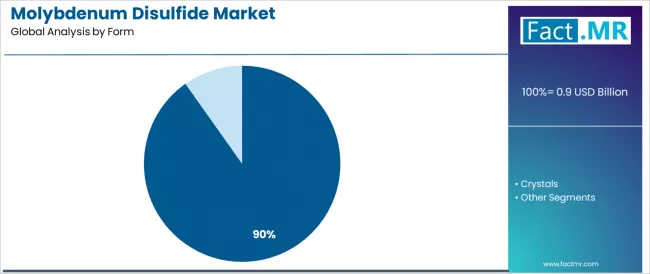
Molybdenum Disulfide Market Analysis By Form | Source: Fact.MR
Powdered molybdenum disulfide represents the dominant force, capturing 90.2% of the total market share in 2025. This established form category encompasses solutions featuring critical dispersion functionality for lubricant formulations, grease additives, and coating applications, including micron-sized powder grades, sub-micron powder specifications, and nano-scale powder products that enable uniform distribution, enhanced surface coverage, and proven lubrication performance across all industrial applications.
The powder segment's market leadership stems from its essential role in lubricant manufacturing operations, with powdered molybdenum disulfide capable of meeting diverse formulation requirements while maintaining cost-effective processing and operational reliability across all industrial lubrication environments. Within the powder segment, automotive lubricant applications account for the largest consumption share, driven by extensive vehicle production volumes and continuous friction reduction requirements across global automotive manufacturing operations.
The crystals segment maintains a 9.8% market share, serving research laboratories and specialized electronics manufacturers who require high-purity crystalline materials, layered structure characteristics, and specific physical properties across fundamental research, semiconductor device development, and advanced materials applications. These product forms offer distinctive structural advantages for scientific investigation and emerging technology development while providing sufficient material quality to meet research demands and experimental requirements.
Key advantages driving the powder segment include:
- Established application infrastructure with integrated lubricant blending facilities that reduce formulation complexity and ensure consistent product performance
- Critical dispersion functionality allowing uniform distribution across different base oils and grease matrices without significant processing penalties
- Proven lubrication effectiveness, delivering reliable friction reduction while maintaining competitiveness against alternative solid lubricant materials
- Broad industrial acceptance enabling straightforward formulation specification and quality standards across multiple manufacturing sectors
Which Application Category Dominates in the Global Molybdenum Disulfide Market?
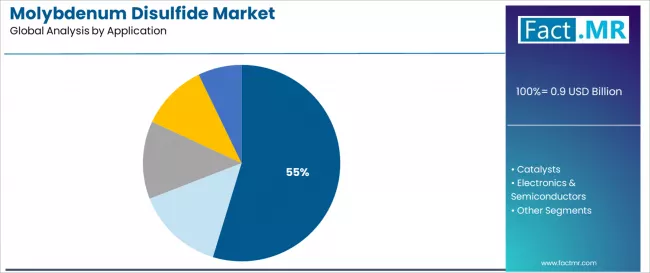
Molybdenum Disulfide Market Analysis By Application | Source: Fact.MR
The lubricants & greases segment captures approximately 54.7% of the molybdenum disulfide market in 2025, representing the most widely adopted application category across industrial lubrication operations. This application sector offers high-volume consumption patterns, established performance benefits, and comprehensive friction reduction requirements that align with industrial maintenance specifications.
The lubricants & greases segment's dominance reflects its widespread adoption in automotive engine oils, industrial gear lubricants, and specialty grease formulations where molybdenum disulfide provides essential extreme pressure protection and wear reduction capabilities.
The catalysts segment maintains an 18.0% market share, serving petroleum refineries and chemical processors requiring hydrodesulfurization catalysts, hydrotreating applications, and sulfur removal functionality across fuel production, petrochemical manufacturing, and emission control systems. These application categories provide critical refining capabilities for clean fuel production and environmental compliance.
The electronics & semiconductors segment accounts for 13.5% of the market, serving semiconductor manufacturers and electronics producers requiring thin-film materials, transistor applications, and electronic device components across next-generation technology development. The coatings & additives segment represents 8.1% market share, serving surface treatment operations and anti-friction coating applications, while others account for 5.8%, serving diverse specialized applications including battery materials and composite reinforcements.
What are the Drivers, Restraints, and Key Trends of the Molybdenum Disulfide Market?
The market is driven by three concrete demand factors tied to industrial growth and technology advancement. First, increasing automotive production and industrial machinery demand creates growing requirements for high-performance lubricant additives, with global automotive lubricant consumption expanding by 3-5% annually in major manufacturing regions worldwide, requiring comprehensive solid lubricant supply infrastructure. Second, expanding petroleum refining capacity and clean fuel regulations drive increased adoption of hydrodesulfurization catalysts, with many refineries implementing comprehensive catalyst upgrade programs for emission compliance by 2030. Third, technological advancements in two-dimensional materials and electronics applications enable more effective and efficient device performance that reduces energy consumption while improving semiconductor characteristics and transistor capabilities.
Market restraints include fluctuating molybdenum prices for raw material procurement that can deter manufacturers from maintaining competitive pricing strategies, particularly in regions where mining output and commodity markets face volatility pressures or supply constraints. Competition from alternative lubricant technologies and graphite-based materials poses another significant challenge, as competing solid lubricants offer performance advantages and cost benefits, potentially causing market share pressure and product substitution. Environmental concerns regarding mining operations and processing waste create additional market challenges for sustainable production, demanding ongoing investment in environmental management and regulatory compliance improvements.
Key trends indicate accelerated electric vehicle development in Asia Pacific markets, particularly China and India, where battery technology advancement and automotive electrification drive comprehensive molybdenum disulfide research implementation. Technology integration trends toward nano-scale powder production with controlled particle morphology, surface-functionalized materials with enhanced dispersion characteristics, and two-dimensional material exploration enable optimized application performance that improves lubrication efficiency and expands functionality. However, the market thesis could face disruption if significant advances in graphene-based lubricants or major shifts in lubrication technology strategies reduce reliance on traditional molybdenum disulfide solid lubricant approaches.
Analysis of the Molybdenum Disulfide Market by Key Countries
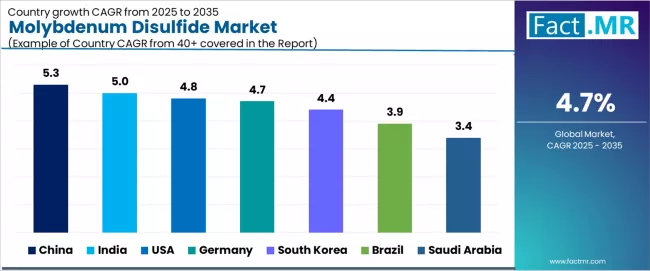
Molybdenum Disulfide Market Cagr Analysis By Country | Source: Fact.MR
| Country | CAGR (2025 to 2035) |
|---|---|
| China | 5.3% |
| India | 5.0% |
| USA | 4.8% |
| Germany | 4.7% |
| South Korea | 4.4% |
| Brazil | 3.9% |
| Saudi Arabia | 3.4% |
Source: Fact.MR analysis. Updated Dec 2, 2025
The molybdenum disulfide market is expanding steadily, with China leading at a 5.3% CAGR through 2035, driven by high molybdenum disulfide production capacity, expanding industrial consumption, and comprehensive manufacturing infrastructure development. India follows at 5.0%, supported by growing industrial lubrication demand, expanding automotive sector, and accelerated manufacturing development initiatives. USA records 4.8%, reflecting aerospace industry strength and increasing semiconductor technology capabilities.
Germany posts 4.7%, anchored by regulatory-driven performance lubrication and advanced automotive engineering operations. South Korea grows at 4.4%, with electronics innovation and battery materials research. Brazil advances at 3.9%, emphasizing mining equipment lubrication and agricultural machinery applications, while Saudi Arabia grows steadily at 3.4%, focusing on hydrodesulfurization catalyst usage through petroleum refining infrastructure and clean fuel production requirements.
China Leads Global Market Expansion
China demonstrates the strongest growth potential in the molybdenum disulfide market with a CAGR of 5.3% through 2035. The country's leadership position stems from substantial molybdenum mining operations, expanding industrial manufacturing capacity, and comprehensive chemical processing infrastructure enabling mainstream molybdenum disulfide production and consumption.
Growth is concentrated in major industrial regions, including Inner Mongolia, Shaanxi, Henan, and Liaoning, where mining operations and expanding manufacturing infrastructure are implementing molybdenum disulfide processing for lubricant production and catalyst manufacturing applications.
Distribution channels through chemical distributors, industrial supply networks, and direct manufacturing sales expand deployment across lubricant producers and petroleum refineries. The country's growing industrial sector provides production momentum for materials development, including domestic mining advantages supporting cost-competitive supply.
Key market factors:
- Industrial manufacturing demand concentrated in automotive production hubs and petrochemical refining centers with comprehensive chemical supply networks
- Infrastructure development through mining capacity expansion and processing facility improvements
- Comprehensive materials ecosystem, including established molybdenum mining with proven extraction capabilities
- Technology integration featuring advanced purification systems, particle processing equipment, and quality control technologies
India Emerges as Industrial Growth Driver
In major industrial states including Maharashtra, Gujarat, Tamil Nadu, and Karnataka, the adoption and consumption of molybdenum disulfide is accelerating across automotive manufacturing operations and industrial machinery segments, driven by expanding production base and comprehensive lubrication requirement programs.
The market demonstrates strong growth momentum with a CAGR of 5.0% through 2035, linked to industrial manufacturing expansion policies, growing automotive production infrastructure, and sustained machinery lubrication demand.
Indian manufacturers are implementing molybdenum disulfide lubricant additives and specialty grease formulations to enhance equipment performance while meeting growing demand in expanding automotive sectors and industrial machinery industries. The country's Make in India initiatives create persistent demand for performance materials, while increasing emphasis on equipment reliability drives adoption of advanced lubrication technologies.
Key development areas:
- Automotive and industrial machinery sectors leading molybdenum disulfide consumption with comprehensive lubrication programs
- Integrated supply chains providing efficient chemical distribution with extensive logistics infrastructure
- Technology partnerships between international material suppliers and domestic lubricant manufacturers are expanding market reach
- Integration of quality testing systems and comprehensive application development protocols
USA Shows Aerospace Leadership

Molybdenum Disulfide Market Country Value Analysis | Source: Fact.MR
The USA market expansion is driven by aerospace industry requirements, including high-performance lubrication programs in Washington and Texas, and expanding semiconductor manufacturing implementations across multiple technology regions. The country demonstrates solid growth potential with a CAGR of 4.8% through 2035, supported by established aerospace infrastructure, advanced semiconductor industry, and growing integration with defense technology applications across specialized sectors.
American manufacturers face implementation priorities related to performance specifications and reliability requirements, requiring investment in high-purity material sourcing and support from specialty chemical providers. However, growing technology demands and established industrial capacity create compelling business cases for molybdenum disulfide adoption, particularly in aerospace regions where extreme operating conditions have a direct impact on equipment performance and safety.
Key market characteristics:
- Aerospace and semiconductor segments showing sustained growth with continued investment in advanced material requirements
- Regional expansion trends focused on technology clusters in Pacific Northwest and Southwest states
- Future projections indicate the need for nano-scale material development and advanced application technology programs
- Growing emphasis on performance reliability and competitive technology positioning in USA industrial markets
Germany Demonstrates Engineering Excellence
The market in Germany leads in performance lubrication applications based on integration with automotive engineering excellence and regulatory-driven quality standards for enhanced operational efficiency. The country shows steady potential with a CAGR of 4.7% through 2035, driven by world-class automotive industry presence, stringent performance requirements, and the expansion of advanced lubricant facilities in major manufacturing centers, including Baden-Württemberg, Bavaria, North Rhine-Westphalia, and Lower Saxony.
German manufacturers are adopting advanced molybdenum disulfide formulations for automotive component lubrication and industrial equipment applications, particularly in regions with demanding engineering requirements and specialized performance demands requiring comprehensive quality standards. Technology deployment channels through established chemical suppliers and automotive OEM partnerships expand coverage across automotive manufacturers and industrial equipment producers.
Leading market segments:
- Automotive manufacturing and industrial machinery operations in major production centers implementing comprehensive lubrication strategies
- Strategic partnerships with specialty chemical suppliers, achieving stringent performance specifications and quality standards
- Collaborative research between technical institutes and automotive companies are expanding application capabilities
- Focus on energy efficiency initiatives and sustainable lubrication methodologies
South Korea Emphasizes Electronics Innovation
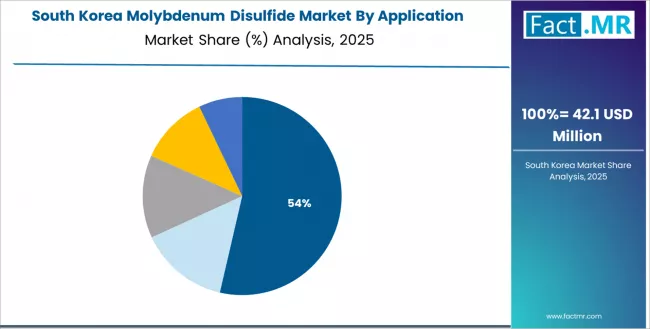
Molybdenum Disulfide Market South Korea Market Share Analysis By Application | Source: Fact.MR
In major industrial regions including Gyeonggi, Incheon, and Ulsan, electronics manufacturers and battery research facilities are implementing comprehensive molybdenum disulfide utilization strategies to optimize device performance and explore material applications, with documented research activities showing significant innovation focus through advanced materials development and semiconductor device integration techniques. The market shows moderate growth potential with a CAGR of 4.4% through 2035, linked to established electronics manufacturing infrastructure, advanced battery research capabilities, and ongoing technology development requirements in major industrial regions.
South Korean companies are adopting molybdenum disulfide materials for electronics applications and battery component research to enhance technology performance while exploring emerging applications in semiconductor sectors and energy storage industries. The country's technology innovation focus creates persistent demand for advanced materials supply and research-grade solutions that integrate with cutting-edge development programs.
Market development factors:
- Electronics manufacturers and battery research institutes leading molybdenum disulfide adoption across South Korea
- Technology innovation investment and materials research providing support for advanced application development
- Strategic relationships between Korean technology companies and international material suppliers are expanding capabilities
- Emphasis on two-dimensional materials exploration and semiconductor device optimization across research segments
Brazil Shows Mining Equipment Focus
Brazil's molybdenum disulfide market demonstrates competitive positioning focused on mining equipment lubrication and agricultural machinery integration, with documented adoption of specialty lubricant formulations, achieving enhanced equipment reliability through extreme pressure protection in Minas Gerais and Pará mining regions.
The country maintains moderate growth momentum with a CAGR of 3.9% through 2035, driven by substantial mining sector, growing agricultural mechanization, and strategic emphasis on industrial lubrication improvement.
Major industrial operations, including mining equipment maintenance facilities and agricultural machinery service centers, showcase expanding molybdenum disulfide implementations where lubrication performance supports operational reliability and comprehensive equipment protection programs.
Key market characteristics:
- Mining and agricultural machinery sectors driving molybdenum disulfide demand with emphasis on heavy-duty lubrication and equipment protection
- Industrial lubrication partnerships enabling specialty formulation access with comprehensive technical support programs
- Technology collaboration between international lubricant suppliers and Brazilian industrial operators is expanding market capabilities
- Emphasis on equipment reliability and maintenance cost optimization methodologies
Saudi Arabia Demonstrates Refining Catalyst Growth
Saudi Arabia's molybdenum disulfide market demonstrates focused landscape, characterized by integration of hydrodesulfurization catalysts with petroleum refining operations across fuel production, emission compliance, and clean energy applications. The country shows steady growth momentum with a CAGR of 3.4% through 2035, driven by substantial refining infrastructure and environmental regulation compliance in petrochemical facilities concentrated in industrial regions.
Saudi Arabia's emphasis on clean fuel production and emission standards creates requirements for catalytic materials that support comprehensive refining processes and stringent environmental requirements in petroleum operations. The market benefits from established relationships between international catalyst suppliers and domestic refineries, creating comprehensive catalyst supply ecosystems that prioritize performance reliability and regulatory compliance. Refining operations in major petrochemical complexes showcase established catalyst implementations where material performance achieves demanding processing standards through integrated catalyst management programs.
Key market characteristics:
- Petroleum refineries and petrochemical facilities driving hydrodesulfurization catalyst requirements with emphasis on clean fuel production and emission compliance
- Catalyst supply partnerships enabling proven material specifications with comprehensive technical support programs
- Regional collaboration between international catalyst manufacturers and Saudi refineries is expanding supply capabilities
- Emphasis on environmental compliance and fuel quality optimization methodologies
Europe Market Split by Country

Molybdenum Disulfide Market Europe Country Market Share Analysis, 2025 & 2035 | Source: Fact.MR
The molybdenum disulfide market in Europe is projected to grow from USD 186.4 million in 2025 to USD 274.3 million by 2035, registering a CAGR of 3.9% over the forecast period. Germany is expected to maintain its leadership position with a 34.2% market share in 2025, supported by its advanced automotive manufacturing infrastructure, comprehensive lubricant technology industry, and strong specialty chemical sector across major industrial centers.
France follows with a 22.6% share in 2025, driven by established aerospace industry operations and integrated automotive manufacturing sectors. UK holds a 17.8% share in 2025 through its specialty chemical capabilities and aerospace engineering presence. Italy commands a 14.3% share, while rest of Europe accounts for 11.1% in 2025.
By 2035, Germany is projected to hold 34.0% share, France 22.8%, UK 17.6%, Italy 14.4%, and Rest of Europe 11.2%, reflecting sustained growth momentum across all major European markets and increasing molybdenum disulfide adoption in diversified industrial applications implementing comprehensive performance lubrication programs.
Competitive Landscape of the Molybdenum Disulfide Market
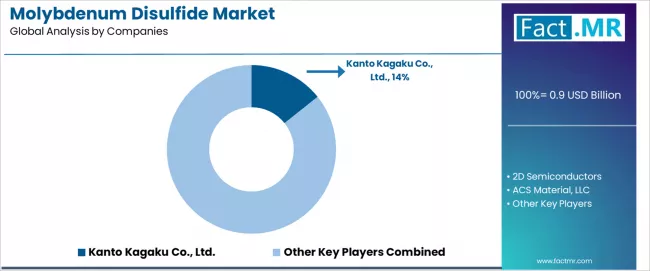
Molybdenum Disulfide Market Analysis By Company | Source: Fact.MR
The molybdenum disulfide market features approximately 20-30 meaningful players with moderate concentration, where the top three companies control roughly 30-40% of global production capacity through established processing operations and extensive customer relationships across lubricant and catalyst sectors.
Market leaders include Kanto Kagaku, Sumico Lubricant Co., Ltd., and Merck KGaA, which maintain competitive advantages through comprehensive molybdenum disulfide product portfolios, global distribution networks, and deep expertise in the specialty chemicals and materials processing sectors, creating strong customer relationships among lubricant manufacturers and catalyst producers.
These companies leverage established production facilities and ongoing quality improvement initiatives to defend market positions while expanding into adjacent nanomaterial applications and two-dimensional material markets. Kanto Kagaku commands a 14.3% market share through integrated molybdenum disulfide operations and strategic positioning in Asian industrial markets.
Challengers encompass 2D Semiconductors, ACS Material, and Luoyang Tongrun Nano Technology Co., Ltd., which compete through specialized product portfolios and strong regional presence in key industrial markets. Specialty providers, including Sisco Research Laboratories Pvt. Ltd., Nanografi Advanced Materials, Songxian Exploiter Molybdenum Co., Structure Probe, Inc., and VCI & LUBRICANTS LLC, focus on specific geographical regions or application segments, offering differentiated capabilities in custom particle specifications, research-grade materials, and technical application support.
Regional players and emerging materials companies create competitive pressure through processing innovation and strategic market positioning, particularly in high-growth markets including China and India, where local presence provides advantages in raw material access and customer proximity.
Market dynamics favor companies that combine production efficiency with comprehensive quality management that addresses the complete value chain from ore processing through particle engineering and application testing. Strategic investments in nano-scale production and two-dimensional material development enable product differentiation and market leadership across advanced materials applications.
Global Molybdenum Disulfide Market - Stakeholder Contribution Framework
Molybdenum disulfide products represent a critical industrial material that enables lubricant manufacturers, catalyst producers, and electronics companies to achieve superior friction reduction and catalytic performance without substantial formulation redesign, typically providing essential solid lubrication functionality and hydrodesulfurization capabilities while supporting diverse industrial applications.
With the market projected to grow from USD 0.9 billion in 2025 to USD 1.42 billion by 2035 at a 4.7% CAGR, these materials offer compelling advantages - exceptional lubricity, thermal stability, and catalytic activity - making them essential for powder formulations (largest segment), lubricant applications (dominant category), and diverse industrial applications seeking reliable performance enhancement technologies. Scaling production capacity and market development requires coordinated action across mining policy, industry standards, material producers, application developers, and research institutions.
How Governments Could Spur Local Production and Adoption?
- Mining & Materials Programs: Include molybdenum disulfide production capabilities in national materials strategies, providing targeted funding for processing facilities in regions with mineral resources and supporting local specialty chemical manufacturers through investment incentives and technology development support.
- Industrial Policy & Technology Support: Implement favorable frameworks for advanced materials development, provide incentives for specialty chemical innovation, and establish quality standards that support industrial material adoption.
- Trade Policy & Market Access: Create balanced import-export frameworks across specialty chemicals and industrial materials applications, establish fair trade practices for molybdenum disulfide products, and develop international cooperation protocols that facilitate material trade and specification harmonization.
- Skills Development & Training: Fund materials science education programs, chemical engineering training, and tribology specialization courses. Invest in technology transfer initiatives that bridge material producers with industrial application developers and manufacturing operations.
How Industry Bodies Could Support Market Development?
- Quality Standards & Certification: Define standardized performance specifications for molybdenum disulfide across lubricant, catalyst, and electronics applications, establish universal testing protocols and purity metrics, and create certification programs for material quality that manufacturers can implement.
- Market Education & Best Practices: Lead communication initiatives that demonstrate molybdenum disulfide performance benefits, emphasizing proven friction reduction, catalytic effectiveness, and application versatility compared to alternative materials and conventional approaches.
- Application Standards: Develop usage guideline recommendations for molybdenum disulfide incorporation, comprehensive formulation protocols, and performance optimization best practices, ensuring appropriate material utilization across different industrial applications and processing conditions.
How Manufacturers and Technology Players Could Strengthen the Ecosystem?
- Material Technology Development: Develop next-generation nano-scale powders with controlled morphology, surface-treated particles with enhanced dispersion characteristics, and application-specific features that improve performance while optimizing processing economics and material effectiveness.
- Technical Support Platforms: Provide comprehensive application engineering that integrates formulation assistance, performance testing services, troubleshooting guidance, and application optimization, enabling customers to maximize material performance and operational benefits.
- Supply Chain Integration: Offer flexible supply arrangements for lubricant manufacturers and industrial users, including long-term supply agreements, technical collaboration programs, and quality assurance services that keep molybdenum disulfide supply aligned with application requirements and quality standards.
Key Players in the Molybdenum Disulfide Market
- Kanto Kagaku Co., Ltd.
- 2D Semiconductors
- ACS Material, LLC
- Sisco Research Laboratories Pvt. Ltd.
- Luoyang Tongrun Nano Technology Co., Ltd.
- Sumico Lubricant Co., Ltd.
- Merck & Co. KGaA
- Nanografi Nanotechnology
- Songxian Exploiter Molybdenum Co., Ltd.
- Structure Probe, Inc.
- VCI & Lubricants LLC
Segmentation
Scope of the Report
| Items | Values |
|---|---|
| Quantitative Units | USD 0.9 billion |
| Form | Powder, Crystals |
| Application | Lubricants & Greases, Catalysts, Electronics & Semiconductors, Coatings & Additives, Others |
| Regions Covered | Asia Pacific, North America, Europe, Latin America, Middle East & Africa |
| Country Covered | China, India, USA, Germany, South Korea, Brazil, Saudi Arabia, and 40+ countries |
| Key Companies Profiled | KANTO KAGAKU, 2D Semiconductors, ACS Material, Sisco Research Laboratories Pvt. Ltd., Luoyang Tongrun Nano Technology Co., Ltd., SUMICO LUBRICANT CO., LTD., Merck KGaA, Nanografi Advanced Materials, Songxian Exploiter Molybdenum Co., Structure Probe, Inc., VCI & LUBRICANTS LLC |
| Additional Attributes | Dollar sales by form categories, regional consumption trends across Asia Pacific, North America, and Europe, competitive landscape with specialty chemical manufacturers and material suppliers, product specifications and performance requirements, integration with lubricant manufacturing facilities and catalyst production operations. |
Source: Fact.MR analysis. Updated Dec 2, 2025
Molybdenum Disulfide Market by Segments
-
Form :
- Powder
- Crystals
-
Application :
- Lubricants & Greases
- Catalysts
- Electronics & Semiconductors
- Coatings & Additives
- Others
-
Region :
- Asia Pacific
- China
- Japan
- South Korea
- India
- Australia & New Zealand
- ASEAN
- Rest of Asia Pacific
- North America
- USA
- Canada
- Mexico
- Europe
- Russia
- Germany
- Norway
- France
- Rest of Europe
- Latin America
- Brazil
- Rest of Latin America
- Middle East & Africa
- Kingdom of Saudi Arabia
- Other GCC Countries
- Turkey
- South Africa
- Rest of Middle East & Africa
- Asia Pacific
Frequently Asked Questions
How big is the molybdenum disulfide market in 2025?
What will be the size of molybdenum disulfide market in 2035?
How much will be the molybdenum disulfide market growth between 2025 and 2035?
What are the key product types in the molybdenum disulfide market?
Which application segment to contribute significant share in the molybdenum disulfide market in 2025?
Who worked on this report


Preview the report firsthand - request a free sample
Free SampleGet the brochure for pricing and purchase details
Download PDF