- Market Value (2025): USD 178.6 Mn
- Estimated Value (2026): USD 212.0 Mn
- Forecast Value (2036): USD 1180.0 Mn
- CAGR (2026-2036): 18.7%
What is the PCOS Digital Care Platforms Market forecast to be worth by 2036?
USD 212.0 million in 2026 to USD 1,180.0 million by 2036 at 18.7% CAGR.
- The PCOS digital care platforms market reached an estimated USD 178.6 million in 2025.
- Demand is projected to increase from USD 212.0 million in 2026 to USD 1,180.0 million by 2036.
- The market is forecast to record 18.7% CAGR from 2026 to 2036 as PCOS care moves toward structured digital support before clinician review.
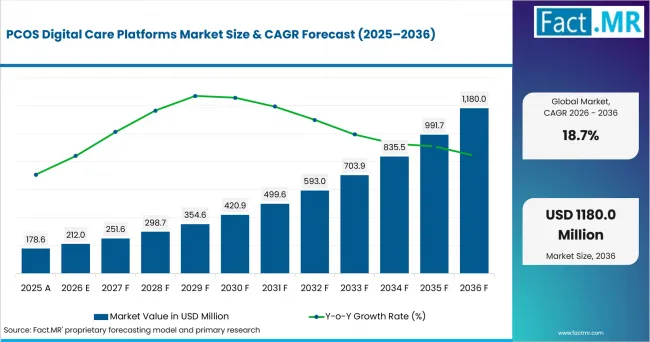
Pcos Digital Care Platforms Market Value Analysis | Source: Fact.MR
What are the defining numbers behind PCOS Digital Care Platforms Market growth?
USD 968.0 million absolute opportunity by 2036, led by symptom & cycle tracking and coach-supported platforms alongside insulin resistance and direct consumer access.
- Demand Drivers in the Market
- PCOS care involves cycle irregularity, metabolic risk and fertility goals. Platforms are expected to gain value when they organize symptom records before a medical visit.
- Long diagnostic journeys create demand for structured histories. A digital record is expected to reduce recall gaps and help clinicians review symptoms without treating the app as a diagnostic tool.
- Women’s health tools are moving beyond period dates. Condition-led content and guided routines are expected to support specialized services within mHealth apps.
- Employer and health-plan channels are expected to test broader hormonal health benefits. Telemedicine solutions give sponsors a familiar route for remote access and follow-up.
- Key Segments Analyzed
- By Care Component: Symptom & cycle tracking is expected to hold 35.2% share in 2026. Repeat records help users explain irregular periods with less guesswork. The segment also supports escalation when patterns need clinician review.
- By Platform Model: Coach-supported is projected to account for 35.2% share in 2026. Coaches help users turn education into routine changes. The model fits digital therapeutics where human accountability helps adherence.
- By Clinical Focus: Insulin resistance is anticipated to capture 32.6% share in 2026. Metabolic risk is central to PCOS care. Platform workflows are expected to guide screening and follow-up instead of one-time advice.
- By End User: Direct consumers are estimated to represent 39.2% share in 2026. Users can start with mobile applications before an employer or health plan becomes involved. This route remains practical after repeated symptoms or delayed diagnosis.
- Analyst Opinion at Fact.MR
- Shambhu Nath Jha, Sr. Consultant at Fact.MR, states, “PCOS digital care platforms are expected to be valued when they make symptom history and metabolic risk easier to manage. Services that respect diagnostic limits and user consent are expected to prove more durable than engagement-only applications.”
- Strategic Implications
- Metabolic-risk pathways must be built into the service before providers promote broad care coverage. Symptom records, screening prompts, and clinician referrals must function as one connected pathway.
- For sponsors, performance measurement extends beyond app engagement. Cycle irregularity, weight concerns, fertility goals, and the burden of multisystem care all belong in the outcome framework.
- Visible privacy safeguards are central to implementation. Plain-language consent and controlled data handling can protect sensitive reproductive-health records across telehealth and therapy services.
The World Health Organization reported in January 2026 that PCOS affects an estimated 10-13% of reproductive-aged women. This supports dedicated digital-care workflows. Medical assessment still remains necessary before diagnosis.
France is projected to record a 21.7% CAGR from 2026 to 2036. The USA is expected to record 17.3% CAGR. The UK is anticipated to record 17.0% CAGR. Australia is forecast to record 16.7% CAGR. Canada is estimated to record 16.2% CAGR. These rates should be read alongside national reimbursement, professional and digital-health pathways.
How does the PCOS Digital Care Platforms Market break down by segment?
Symptom & cycle tracking is expected to lead Care Component at 35.2% share in 2026. Direct consumers are estimated to lead End User at 39.2% share in 2026.
Which care component dominates?
Symptom & cycle tracking is projected to account for 35.2% share in 2026.
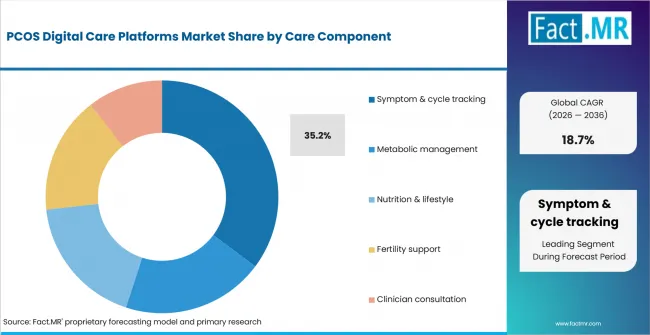
Pcos Digital Care Platforms Market Analysis By Care Component | Source: Fact.MR
Longitudinal records help users document irregular cycles, symptom changes and treatment responses before clinical review. This creates a clearer history for discussions about diagnosis, medication and fertility planning. Metabolic management remains important because PCOS care often includes screening for insulin resistance, weight-related risk and cardiovascular factors. Nutrition & lifestyle support adds practical guidance around food, sleep and activity, while fertility support becomes relevant when users require ovulation assessment, specialist referral or structured escalation beyond self-management and routine symptom monitoring.
What leads the Platform Model segment?
Coach-supported is expected to hold 35.2% share in 2026.
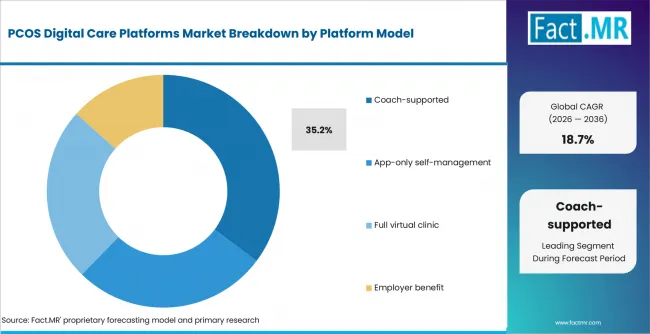
Pcos Digital Care Platforms Market Analysis By Platform Model | Source: Fact.MR
Coach-supported platforms bridge self-management and clinician-directed care by providing regular guidance without requiring a full virtual-clinic structure. Coaches can reinforce education, help users maintain routines and flag situations that may require medical review. App-only self-management remains suitable for lower-intensity use, while full virtual clinics serve users seeking integrated clinical services. Employer benefits platforms also remain relevant where access is sponsored. The segment leads because human involvement can improve continuity, accountability, confidence and adherence throughout longer PCOS management journeys.
How does Clinical Focus shape demand?
Insulin resistance is anticipated to lead with 32.6% share in 2026.
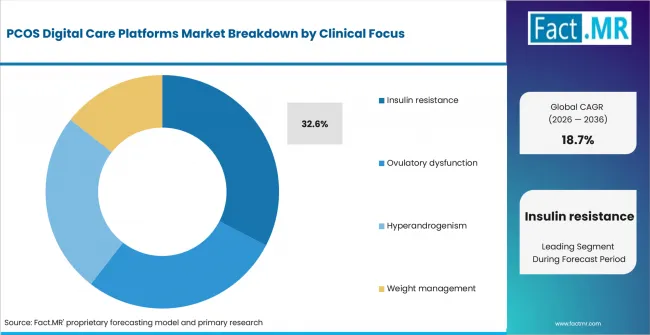
Pcos Digital Care Platforms Market Analysis By Clinical Focus | Source: Fact.MR
Insulin resistance holds the leading position because it links metabolic screening with nutrition, activity and weight-related interventions. It also gives platforms a measurable pathway for identifying risk and directing users toward qualified clinical care. Ovulatory dysfunction remains important where cycle regularity and fertility planning drive engagement. Hyperandrogenism supports demand for symptom tracking around acne, hair growth and hormonal change. Weight management stays relevant across the category, but the segment mix increasingly favors programs that connect metabolic indicators with reproductive and hormonal outcomes.
What supports Direct consumers within End User?
Direct consumers are estimated to hold 39.2% share in 2026.
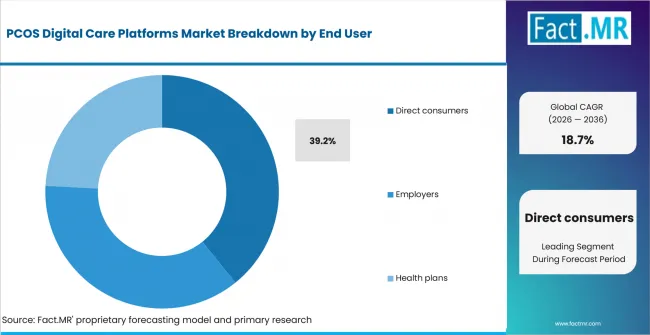
Pcos Digital Care Platforms Market Analysis By End User | Source: Fact.MR
Direct access allows users to begin support when irregular cycles, weight concerns or fertility questions become difficult to manage without guidance. Consumer-led entry also reduces dependence on employer eligibility or health-plan enrollment. Employer and health-plan channels remain important where benefits cover coaching, monitoring or specialist access. mHealth monitoring services provide an adjacent model for continuous tracking, but PCOS platforms require more focused pathways for hormonal, metabolic and reproductive issues. The segment leads because users often seek condition-specific support before entering formal clinical care.
What is accelerating PCOS Digital Care Platforms Market adoption, and what is holding it back?
Demand is expected to be driven by multisystem care burden and long diagnostic journeys. Adoption is expected to be held back by diagnostic complexity and sensitive-data risk.
Drivers Impact Analysis
| DRIVER | QUALITATIVE IMPACT | GEOGRAPHIC RELEVANCE | IMPACT TIMELINE |
|---|---|---|---|
| Multisystem care burden | High | Global | Short term (<= 2 years) |
| Long diagnostic journeys | High | Global | Short term (<= 2 years) |
| Consumer demand for women’s health tools | Medium | Global | Medium term (2-4 years) |
| Employer benefit expansion | Medium | France and enterprise markets | Medium term (2-4 years) |
Source: Fact.MR analysis. Updated Jul 27, 2026
- Multisystem care burden: PCOS users often need help with cycles and metabolic risk. Platforms are expected to create value when they organize these needs into a repeatable care workflow.
- Consumer demand for women’s health tools: Users increasingly expect condition-specific support instead of period-date predictions alone. Platforms that explain limits and escalation paths are expected to earn more confidence.
- Employer benefit expansion: Women’s health benefits are expected to broaden from fertility treatment toward long-term hormonal and metabolic care. Fertility preservation navigation creates an adjacent benefits pathway but PCOS services need dedicated clinical boundaries.
Opportunity Impact Analysis
| OPPORTUNITY | QUALITATIVE IMPACT | GEOGRAPHIC RELEVANCE | IMPACT TIMELINE |
|---|---|---|---|
| Metabolic-risk pathways | High | Global | Short term (<= 2 years) |
| Preconception transitions | Medium | France and USA | Medium term (2-4 years) |
| Validated symptom summaries | Medium | Global | Medium term (2-4 years) |
Source: Fact.MR analysis. Updated Jul 27, 2026
- Metabolic-risk pathways: Platforms are expected to connect cycle patterns with lifestyle support and screening reminders. The opportunity is clearest when clinicians receive a concise history before the visit.
- Preconception transitions: Programs are expected to carry PCOS history into fertility care without losing prior records. This pathway supports handoffs between self-management and specialist review.
- Validated symptom summaries: Consent-based reports are expected to improve clinical conversations without turning software into diagnosis. Digital transformation in healthcare supports records that travel across care settings.
Restraints Impact Analysis
| RESTRAINT | QUALITATIVE IMPACT | GEOGRAPHIC RELEVANCE | IMPACT TIMELINE |
|---|---|---|---|
| Diagnostic complexity | High | Global | Short term (<= 2 years) |
| Sensitive-data risk | High | Regulated and payer-funded markets | Medium term (2-4 years) |
| Variable evidence quality | Medium | Global | Medium term (2-4 years) |
Source: Fact.MR analysis. Updated Jul 27, 2026
- Diagnostic complexity: PCOS diagnosis requires clinical evaluation and exclusion of other causes. Apps that imply diagnosis from symptoms alone are expected to raise trust and compliance risk.
- Sensitive-data risk: Cycle, fertility and body-weight information need careful governance and user control. Wearable healthcare devices add another data source only when consent and clinical relevance are clear.
- Variable evidence quality: Commercial features can move faster than outcome validation across diverse populations. Customers are expected to ask for evidence that symptoms and escalation improve over time.
Which countries are scaling PCOS Digital Care Platforms Market fastest?
The country comparison is defined by reimbursement access and the path from self-management to clinical review. France holds the highest listed CAGR at 21.7%. The USA and UK follow the next tier. Australia and Canada complete the listed comparison. The pattern reflects benefit coverage and professional oversight more than consumer interest alone.
- France leads the comparison because reimbursement review and digital-health policy favor services with clear clinical boundaries. PCOS platforms are expected to gain confidence when they show local data practice and qualified escalation.
- The USA follows through employer and health-plan purchasing. Adoption is expected to depend on clinician coverage and professional rules that affect remote support.
- The UK is shaped by NHS pathway fit and evidence review. Digital services need to work beside non-digital routes so users with diagnostic complexity are not left without clinical access.
- Australia reflects an access case across dispersed populations. National digital-health infrastructure is expected to support remote care but service design still needs local professional oversight.
- Canada remains influenced by provincial delivery and benefit variation. Platforms are expected to localize privacy practice and clinical coverage before broad adoption.
- Comparable CAGRs can therefore create different commercial routes across these countries. Deployment timing depends on who pays for the service and how clearly the platform separates education from diagnosis. Local clinical support is expected to matter as much as product features.
The full report provides country-level CAGR analysis across North America and Europe. It also covers Latin America and East Asia. South Asia, Oceania and the Middle East and Africa complete the regional view.
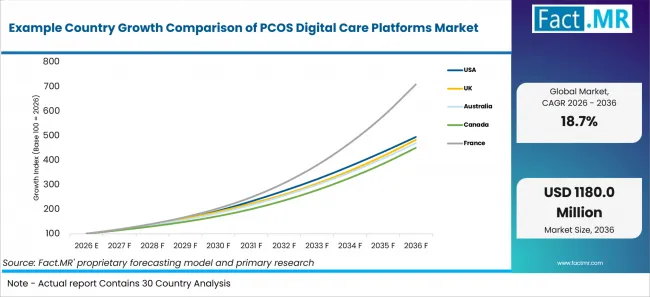
Example Country Growth Comparison Of Pcos Digital Care Platforms Market | Source: Fact.MR
| Country | CAGR (2026-2036) |
|---|---|
| France | 21.7% |
| USA | 17.3% |
| UK | 17.0% |
| Australia | 16.7% |
| Canada | 16.2% |
Source: Fact.MR analysis. Updated Jul 27, 2026
What supports France adoption?
21.7% CAGR, supported by reimbursement scrutiny and regulated digital-care pathways.
France offers a stronger route for platforms that can position PCOS support within a clinically supervised digital-health model. Market access is likely to depend on evidence quality, health-data governance and clear separation between symptom guidance and medical diagnosis. Services that produce structured histories for clinician review may fit the system better than engagement-led applications, particularly when metabolic risk, cycle irregularity and fertility concerns must be addressed through coordinated care.
How is USA scaling demand?
17.3% CAGR, driven by employer benefits and direct-to-consumer women’s health services.
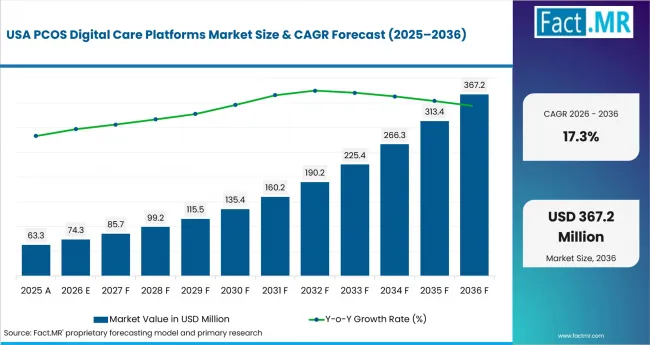
Pcos Digital Care Platforms Market Country Value Analysis | Source: Fact.MR
The USA market is developing through several payment routes rather than one national care pathway. Employers, health plans and consumers can each initiate access, allowing PCOS platforms to scale through coaching, telehealth and specialist referral models. Commercial success will depend on how well providers manage state-level clinical rules, insurance coverage and sensitive reproductive-health data while showing that the service contributes more than general period tracking or lifestyle content.
What is driving UK growth from 2026 to 2036?
17.0% CAGR, backed by pathway integration and demand for clinically credible digital support.
UK adoption is supported by whether a platform can complement established primary-care and specialist routes without presenting itself as a replacement for diagnosis. Long waits and fragmented symptom histories create room for digital tools that organize cycle, metabolic and fertility information before appointments. Providers are therefore likely to gain traction when they support clinician conversations, preserve non-digital access and demonstrate credible escalation for users whose symptoms require further investigation.
How is Australia developing demand?
16.7% CAGR, driven by remote-care access and digitally connected health services.
Australia presents a practical use case for PCOS platforms because specialist access can vary significantly across urban, regional and remote areas. Digital coaching and symptom documentation can reduce the burden of repeated travel while helping users prepare for medical consultations. The strongest services will combine remote convenience with locally appropriate clinician referral, rather than treating coaching as a complete care pathway for metabolic complications, fertility concerns or uncertain diagnoses.
How does Canada perform?
16.2% CAGR, led by provincial care variation and expanding virtual-health access.
Canada’s market is likely to advance through province-specific deployment rather than immediate nationwide standardization. Privacy requirements, reimbursement conditions and clinician availability differ across local health systems, making adaptable service design commercially important. PCOS platforms can create value by maintaining structured records across fragmented care encounters, but wider adoption will depend on whether providers establish credible provincial referral networks and align their data practices with local expectations for reproductive and hormonal health information.
Who leads the PCOS Digital Care Platforms Market?
Key players include Allara Health, Flo Health, Veera Health, and Oova.
Competition is expected to depend on PCOS-specific workflow depth and clinical escalation. Data governance is also expected to matter because users share sensitive reproductive-health information. The named companies should be compared by service scope and qualified human support.
From 2026 to 2036, providers are expected to compete on condition-specific design and trusted escalation. Services that connect cycle tracking with metabolic support and consent controls are expected to gain higher acceptance from consumers, employers and health plans.
Which companies are the key providers?
Key companies include Allara Health; Flo Health; Veera Health; Oova.
- Allara Health
- Flo Health
- Veera Health
- Oova
Bibliography
- World Health Organization. (2026, January 22). Polycystic ovary syndrome.
- World Health Organization. (2025, November 28). Guideline for the prevention, diagnosis and treatment of infertility.
- Australian Government Department of Health, Disability and Ageing. (2025, June). A stronger Medicare for Australian women.
- U.S. Food and Drug Administration. (2026, January). Clinical decision support software: Guidance for industry and Food and Drug Administration staff.
- Allara Health. (2025). Allara Health expands nationally and reports significant clinical outcomes in women’s hormonal and metabolic health.
This Report Answers
- The report provides strategic intelligence on the PCOS Digital Care Platforms Market across Care Component and Platform Model choices that shape digital care programs.
- Segment analysis covers Symptom & cycle tracking and Coach-supported models as the share leaders within the 2026 market.
- Country outlook evaluates France and the USA alongside the UK. Australia and Canada complete the growth comparison across the profiled markets.
- Competitive analysis profiles Allara Health alongside Flo Health and Veera Health. Oova completes the provider set.
- Care-pathway assessment covers symptom history, metabolic support and clinician escalation. Privacy practice and diagnostic boundaries complete the operating view.
What does the PCOS Digital Care Platforms Market cover?
PCOS digital care platforms help users track symptoms and cycles. They connect that information with metabolic care and nutrition support. Fertility goals and clinician access complete the care view.
The PCOS Digital Care Platforms Market covers self-management applications, coach-supported programs and virtual clinics built around PCOS-specific support. Coverage extends to symptom and cycle tracking. Metabolic management and nutrition support are included. Fertility support and clinician consultation are included where they remain tied to PCOS care.
The market differs from general menstrual tracking because commercial value comes from PCOS context and escalation rules. Calendar-only period tracking remains outside the boundary. General fertility applications and menopause care services are excluded unless the service directly supports PCOS users with relevant clinical boundaries.
What is included in the scope?
PCOS digital care services are included when they support condition-specific symptom records, metabolic care or qualified escalation.
The scope includes Care Component and Platform Model alongside Clinical Focus, End User and Region. Coverage spans symptom & cycle tracking and metabolic management. Nutrition & lifestyle, fertility support and clinician consultation complete the care component scope.
What is excluded from the scope?
General period trackers and unrelated wellness applications remain outside the scope of this market.
The scope excludes apps that only provide calendar-based period prediction without PCOS-specific support. General fertility applications are excluded unless they connect to PCOS care needs. Unrelated weight-loss programs are excluded when metabolic support is not tied to PCOS. Adjacent home healthcare services are considered only when remote care coordination directly supports PCOS care delivery.
How Was the Analysis Built?
The analysis draws on 120+ sources, 35+ company portfolios, 25+ countries, and more than 20 industry interviews.
- Primary Research: Primary research includes discussions with manufacturers, service providers, technology developers, distributors, end users, procurement teams, and subject-matter experts. These conversations examine purchasing priorities, product adoption, operational challenges, approval requirements, competitive positioning, and the factors that influence wider market acceptance.
- Desk Research: Desk research covers government statistics, regulatory publications, company filings, trade data, technical studies, industry associations, standards, public policy, and other authoritative sources. Every source used in the analysis is documented in the bibliography.
- Market Sizing and Forecasting: Market estimates combine historical performance, demand indicators, pricing and volume trends, segment shares, company participation, country-level growth, adoption patterns, investment activity, and barriers to market expansion.
- Data Validation and Update Cycle: Findings are validated by comparing primary interviews with public data, company activity, regulatory changes, trade patterns, and industry developments. Regular updates review new product launches, capacity changes, partnerships, approvals, procurement trends, and shifts in commercial adoption.
Segmentation
What is the report’s scope and coverage?
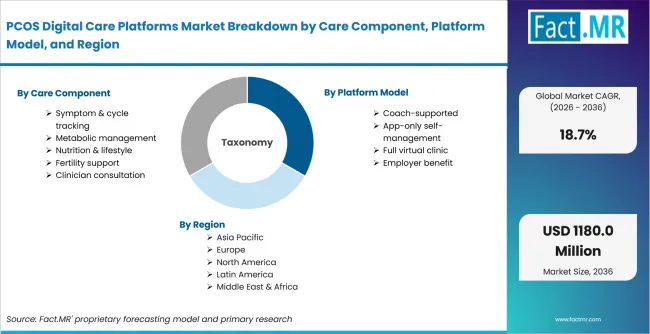
Pcos Digital Care Platforms Market Breakdown By Care Component, Platform Model, And Region | Source: Fact.MR
| Attribute | Details |
|---|---|
| Quantitative Units | USD 212.0 million in 2026 to USD 1,180.0 million by 2036 at 18.7% CAGR |
| Market Definition | Digital care services for polycystic ovary syndrome that combine symptom and cycle tracking with metabolic support, nutrition guidance, fertility support and clinician access |
| Care Component | Symptom & cycle tracking; Metabolic management; Nutrition & lifestyle; Fertility support; Clinician consultation |
| Platform Model | Coach-supported; App-only self-management; Full virtual clinic; Employer benefit |
| Clinical Focus | Insulin resistance; Ovulatory dysfunction; Hyperandrogenism; Weight management |
| End User | Direct consumers; Employers; Health plans |
| Regions Covered | North America; Latin America; Europe; East Asia; South Asia and Pacific; Middle East and Africa |
| Countries Covered | France; USA; UK; Australia; Canada |
| Key Companies Profiled | Allara Health; Flo Health; Veera Health; Oova |
| Forecast Period | 2026 to 2036 |
| Approach | Hybrid top-down and bottom-up approach using care component demand; platform model comparison; clinical focus; end-user channel analysis; country CAGR review; provider portfolio review; external clinical evidence and source verification |
Source: Fact.MR analysis. Updated Jul 27, 2026
How is the market segmented?
-
By Care Component:
- Symptom & cycle tracking
- Metabolic management
- Nutrition & lifestyle
- Fertility support
- Clinician consultation
-
By Platform Model:
- Coach-supported
- App-only self-management
- Full virtual clinic
- Employer benefit
-
By Clinical Focus:
- Insulin resistance
- Ovulatory dysfunction
- Hyperandrogenism
- Weight management
-
By End User:
- Direct consumers
- Employers
- Health plans
-
By Region:
- North America
- Europe
- South Asia & Oceania
- Latin America
- East Asia
- Middle East and Africa
Frequently Asked Questions
Which Care Component leads the market?
Which Platform Model leads the market?
Which Clinical Focus leads the market?
Which End User leads the market?
Which country records the highest listed CAGR?
What is the primary driver in this market?
What is the main restraint?
Why do direct consumers lead demand?
Who worked on this report


Preview the report firsthand - request a free sample
Free SampleGet the brochure for pricing and purchase details
Download PDF