- Market Value (2025): USD 0.38 Bn
- Estimated Value (2026): USD 0.45 Bn
- Forecast Value (2036): USD 2.25 Bn
- CAGR (2026-2036): 17.5%
What is the pickleball shoes market forecast to be worth by 2036?
USD 0.45 billion in 2026 to USD 2.25 billion by 2036, at 17.5% CAGR.
- The pickleball shoes market crossed a valuation of USD 0.38 billion in 2025.
- Demand is expected to increase from USD 0.45 billion in 2026 to USD 2.25 billion by 2036.
- The market is forecast to record 17.5% CAGR during 2026 to 2036 as dedicated court footwear replaces casual athletic shoes among repeat players and club participants.
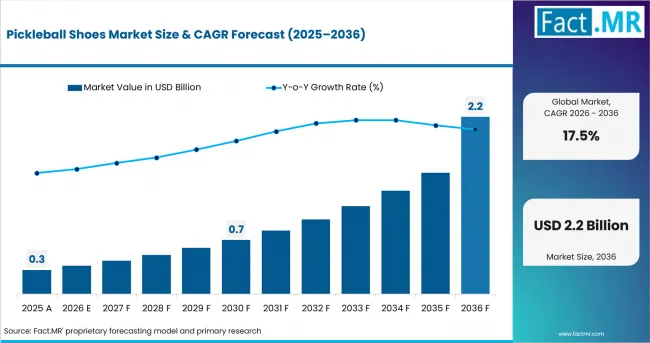
Pickleball Shoes Market Value Analysis | Source: Fact.MR
What are the defining numbers behind pickleball shoes growth?
USD 1.80 billion absolute opportunity by 2036. India, Australia and the United Kingdom lead the country view.
- Demand Drivers in the Market
- Court expansion is estimated to lift replacement spending as outdoor play wears outsole edges and toe guards faster than casual gym use.
- Dedicated pro tours are projected to raise product visibility when recreational players compare brand claims against court movement needs.
- Club programs are likely to create repeat footwear cycles because casual players move into weekly ladders and coached sessions.
- Retailers are expected to separate pickleball shoes from tennis footwear more often as buyers ask for lateral support and surface-specific grip.
- Key Segments Analyzed
- By Court Surface: Outdoor Hardcourt is estimated to account for 57.0% share in 2026. Converted tennis courts and community courts keep abrasion resistance central to replacement decisions.
- By Price Tier: Mid-Price is projected to capture 46.0% share in 2026. This band fits players replacing worn pairs before they consider pro signature footwear.
- By Gender Fit: Men are predicted to hold 46.0% share in 2026. Brand websites still list broader men’s size runs across performance court models.
- By User Type: Recreational Players are likely to represent 43.0% share in 2026. Open play and club sessions keep purchase decisions centered on comfort and durability.
- By Buyer Channel: Online Retail is forecast to secure 41.0% share in 2026. Product pages help buyers compare outsole type, width and cushioning before visiting a store.
- By Shoe Type: Performance Pickleball is anticipated to contribute 38.0% share in 2026. These models turn lateral support and toe protection into named purchase criteria.
- By Geography: North America is expected to hold 71.0% share in 2026. The United States provides the deepest player base and the widest dedicated product assortment.
- Analyst Opinion
- Shambhu Nath Jha, Principal Analyst at Fact.MR states, "Pickleball footwear has moved past a naming exercise. Buyers now ask whether the shoe grips a smaller court, protects the toe box and holds the foot during sideways stops. The brand that explains those three needs in plain language should win the next wave of recreational spending."
- Strategic Implications
- Footwear brands should keep pickleball models separate from tennis pages so buyers do not miss the use case.
- Retailers need simple filters for indoor court, outdoor hardcourt, wide fit and pro signature models.
- Clubs can improve pro-shop sales by linking shoe guidance to surface type and weekly play frequency.
- Manufacturers should use durable toe guards and outsole patterns as proof points instead of broad performance claims.
Court shoes designed for lateral movement and hard-court traction form the core of this market. The Sports & Fitness Industry Association reported 24.3 million U.S. pickleball participants in 2025. USA Pickleball reported that the Pickleheads database included 82,613 courts in January 2026. These participation and court signals support demand for dedicated lasts, outsole patterns and mid-price pickleball product lines.
India is projected to record 23.9% CAGR through 2036 as new clubs and federation activity expand the player base. Australia is likely to post 22.1% CAGR because club participation and outdoor court additions support specialist footwear demand. The United Kingdom is expected to register 20.8% CAGR as racquet-sport buyers shift from multi-court shoes to pickleball-specific models. Japan is forecast to advance at 19.6% CAGR as recreational clubs and senior fitness programs build participation. The United States is expected to record 16.1% CAGR as a larger installed player base shifts replacement demand toward durable hard-court shoes.
How does the pickleball shoes market break down by segment?
Outdoor Hardcourt leads at 57.0%. Mid-Price follows with 46.0% share in 2026.
Which court surface leads?
Outdoor Hardcourt holds 57.0% share in 2026.
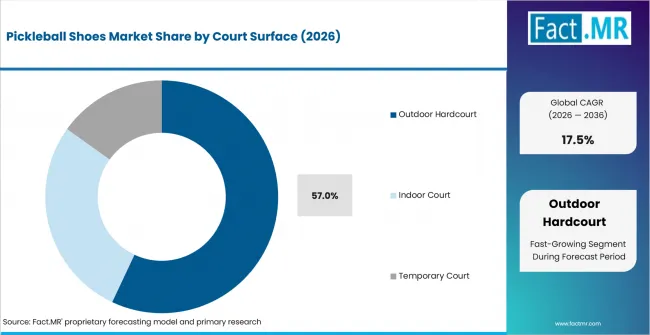
Pickleball Shoes Market Analysis By Court Surface | Source: Fact.MR
Outdoor Hardcourt is estimated to hold 57.0% share in 2026. Community courts and converted tennis courts expose shoes to abrasive surfaces, so players notice outsole wear quickly. This turns pickleball equipment spending into a wider replacement decision once weekly play becomes routine.
Which price tier leads?
Mid-Price holds 46.0% share in 2026.
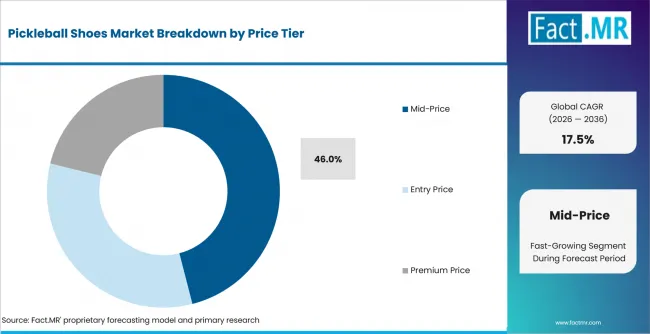
Pickleball Shoes Market Analysis By Price Tier | Source: Fact.MR
Mid-Price is projected to account for 46.0% share in 2026. New players usually avoid premium pro models, but frequent club players still need more support than basic court shoes provide. The middle band is therefore the conversion point where tennis-shoe users first move into dedicated pickleball footwear.
Which gender fit leads?
Men hold 46.0% share in 2026.
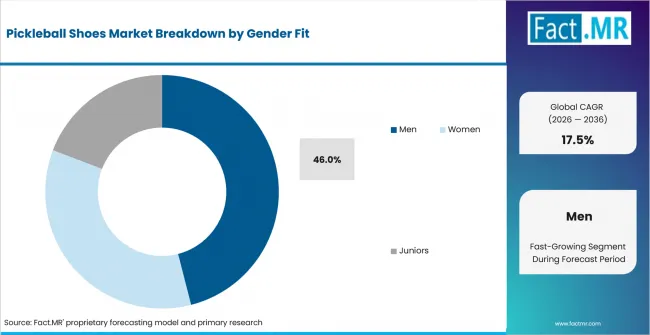
Pickleball Shoes Market Analysis By Gender Fit | Source: Fact.MR
Men are predicted to account for 46.0% share in 2026 as performance listings still show broader men’s size runs. Women’s shoes are expected to gain space as brands add width choices and club-friendly color lines. Junior and unisex models remain smaller because most youth spending still sits inside school or family recreation budgets.
Which user type leads?
Recreational Players hold 43.0% share in 2026.
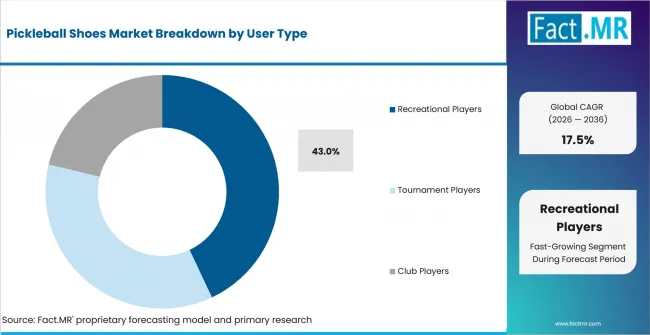
Pickleball Shoes Market Analysis By User Type | Source: Fact.MR
Recreational Players are likely to capture 43.0% share in 2026. Open play and club leagues shape this buyer group, so comfort and toe protection often matter before athlete endorsement. Retail placement inside broader sports footwear aisles means packaging and product-page language must explain the sport-specific use case.
Which buyer channel leads?
Online Retail holds 41.0% share in 2026.
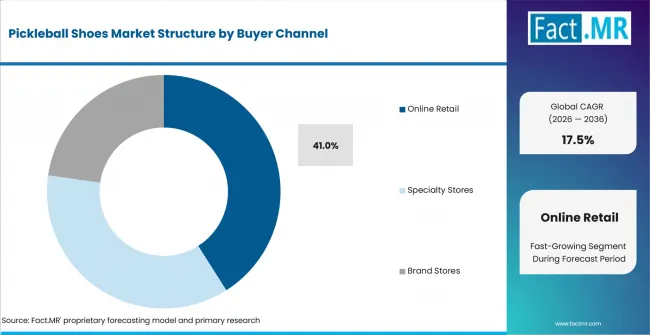
Pickleball Shoes Market Analysis By Buyer Channel | Source: Fact.MR
Online Retail is forecast to account for 41.0% share in 2026. Players can compare width, outsole design and cushioning before choosing a model, which makes brand pages part of the education process. Specialty stores retain influence when buyers need fit checks or advice from experienced club players.
Which shoe type leads?
Performance Pickleball holds 38.0% share in 2026.
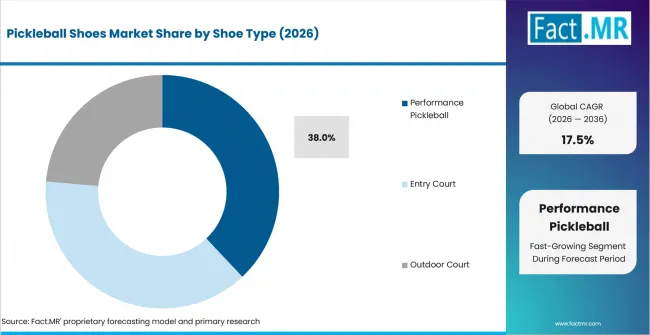
Pickleball Shoes Market Analysis By Shoe Type | Source: Fact.MR
Performance Pickleball is anticipated to hold 38.0% share in 2026. The segment answers a narrow job: support sideways stops, protect the toe box and grip smaller courts. That clear job moves the category into named athletic footwear territory rather than a relabeled tennis shelf.
Which region leads?
North America holds 71.0% share in 2026.
North America is projected to hold 71.0% share in 2026. The United States supplies the largest visible court and player base, while Canada adds organized membership through provincial clubs. Asia Pacific and Europe are expected to gain share as tour stops and federation programs bring dedicated footwear into local retail assortments.
What is accelerating pickleball shoes demand, and what is holding it back?
Court access and dedicated product lines support demand. Fit uncertainty and category confusion restrain wider conversion.
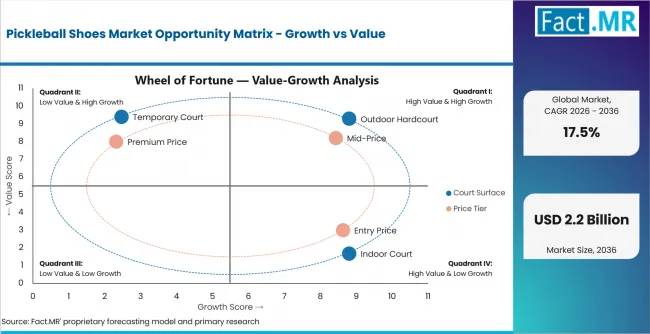
Pickleball Shoes Market Opportunity Matrix Growth Vs Value | Source: Fact.MR
Pickleball shoe demand is accelerating because the sport has moved into a weekly club routine for millions of players. Frequent play changes footwear from an optional accessory into a replacement purchase. The same logic supports pickleball machines at clubs that use training sessions to keep players engaged between matches.
Brand investment also supports the market. Skechers reported 2024 annual sales of USD 8.97 billion and continues to place pickleball inside its performance retail story. ASICS maintains a dedicated pickleball shoes and gear category on its U.S. site. These product pages show buyers that side support and grip are part of the shoe decision.
Growth is constrained by category overlap. Some players still use tennis shoes because both sports use court surfaces. Retailers must explain why pickleball creates more twisting and short lateral steps. The footwear value chain also faces material and freight cost pressure that can limit price flexibility in entry-level models.
Product development is expected to focus on lighter midsoles, wider fits and outsole durability. Some brands may test printed midsoles for small production runs or higher-priced models. This route should stay limited until costs fit the mid-price segment.
Where do the biggest pickleball shoes opportunities sit?
Outdoor hardcourt shoes, mid-price models and club-retail bundles are the clearest opportunities.
- Outdoor Hardcourt Shoes: Suppliers can win replacement sales by proving toe-drag resistance and grip on abrasive outdoor surfaces.
- Mid-Price Models: Brands can convert tennis-shoe users by offering visible support features below pro signature pricing.
- Club-Retail Bundles: Clubs can pair footwear guidance with lesson packages and open-play programs so buyers link shoes to surface type.
Durability messaging can borrow lessons from trail running shoes because both categories depend on outsole confidence. Pickleball brands still need simpler language because most buyers are recreational players rather than technical footwear shoppers. Longer term opportunity may come from sensor-enabled shoes for coaching or movement feedback. That use case should remain small until the price fits club players and the data helps with injury prevention or footwork training.
Which countries are scaling pickleball shoes fastest?
India 23.9% and Australia 22.1% lead the country view. The United Kingdom 20.8%, Japan 19.6% and Italy 19.1% follow. Canada 16.9% and the United States 16.1% complete the top seven.
Based on regional analysis, the pickleball shoes market is segmented into North America, Europe and Asia Pacific. Latin America and Middle East and Africa are included in the wider regional scope.
.webp "Top Country Growth Comparison Pickleball Shoes Market Cagr (2026 2036)")
Top Country Growth Comparison Pickleball Shoes Market Cagr (2026 2036) | Source: Fact.MR
| Country | CAGR |
|---|---|
| India | 23.9% |
| Australia | 22.1% |
| United Kingdom | 20.8% |
| Japan | 19.6% |
| Italy | 19.1% |
| Canada | 16.9% |
| United States | 16.1% |
Source: Fact.MR analysis. Updated Jun 22, 2026
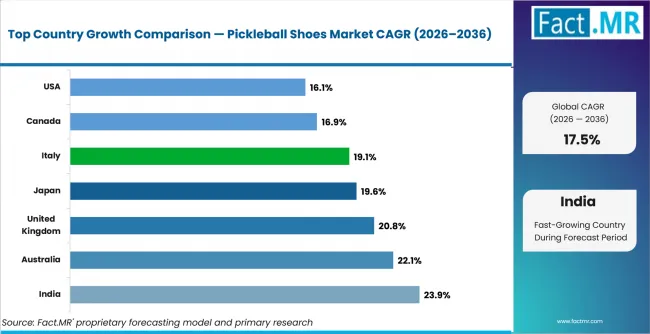
Pickleball Shoes Market Cagr Analysis By Country | Source: Fact.MR
What powers India’s lead?
23.9% CAGR, supported by PPA Tour India timing and franchise-led competition planning.
India is moving from informal recreation toward organized pickleball events in large cities. The United Pickleball Association and Global Sports announced PPA Tour India and Major League Pickleball India plans in April 2024. India is projected to record a 23.9% CAGR through 2036 because national events make dedicated shoes easier to justify for club players. Indoor-court habits also make badminton shoes a useful comparison when retailers explain lateral support to first-time buyers.
Why does Australia matter?
22.1% CAGR, supported by national participation tracking and international tour visibility.
Australia has a younger organized pickleball base than the United States. Pickleball Australia published its 2024 to 2025 annual report and the Australian Sports Commission added 2025 sport participation data tables to AusPlay in April 2026. Australia is expected to expand at 22.1% CAGR through 2036 because club formation and tour stops should move players from general court shoes into sport-specific pairs. Suppliers should work through clubs and specialty retailers because fit advice matters in a developing category.
What supports the United Kingdom outlook?
20.8% CAGR, led by club conversion and active-adult participation depth.
United Kingdom buyers enter pickleball through leisure centers, tennis clubs and community sessions. Sport England reported that 64.6% of adults in England met the active threshold in the November 2024 to November 2025 period. The United Kingdom is forecast to grow at 20.8% CAGR through 2036 because a large active-adult base can convert into repeat recreational play. Retailers should focus on comfort and grip rather than professional positioning.
Why is Japan relevant?
19.6% CAGR, supported by association unification and event standardization.
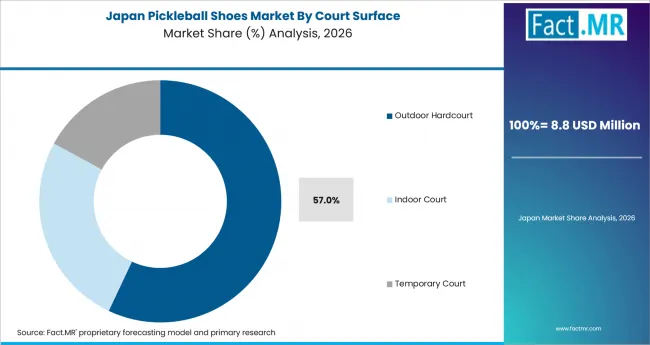
Pickleball Shoes Market Japan Market Share Analysis By Court Surface | Source: Fact.MR
Japan’s market is shaped by organized rollout rather than mass participation. The Japan Pickleball Association and Pickleball Japan Federation signed a merger agreement on March 13, 2026 and the merger took effect on April 14, 2026. Japan is expected to advance at 19.6% CAGR through 2036 because one governing body can make rules, events and coaching pathways clearer. Brands should adapt sizing and indoor-court traction claims for local buyers.
What makes Italy important?
19.1% CAGR, supported by federation infrastructure and European event hosting.
Italy brings pickleball into an existing tennis and padel federation structure. The Italian Tennis and Padel Federation reported 11,917 pickleball members in 2025 and 6,619 registered members at the end of March 2026. Italy is projected to rise at 19.1% CAGR through 2036 because clubs can add pickleball using existing racquet-sport infrastructure. The best route for suppliers is to link shoes with club events and coached sessions.
How does Canada scale footwear demand?
16.9% CAGR, supported by a sizeable player base and organized membership growth.
Canada has a visible recreational base and a national association structure. Pickleball Canada estimated 1.54 million players in January 2025 and reported 85,223 members at the end of 2024. Canada is forecast at 16.9% CAGR through 2036 because organized play can support replacement purchases without needing the same novelty effect seen in younger markets. Wider winter indoor play should keep indoor grip and wide-fit options important.
What supports the United States outlook?
16.1% CAGR, led by the largest player base and deeper court availability.
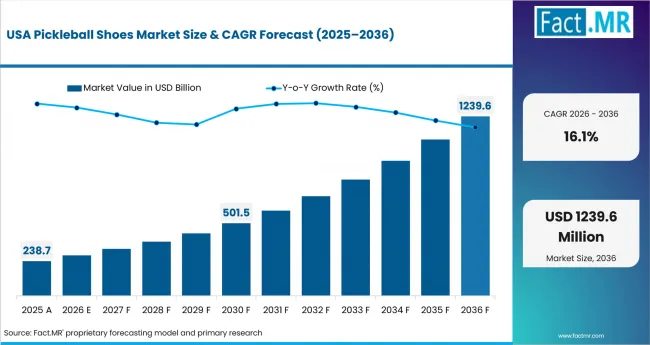
Pickleball Shoes Market Country Value Analysis | Source: Fact.MR
The United States is the anchor market for near-term revenue. The Sports & Fitness Industry Association reported 24.3 million U.S. pickleball players in 2025. USA Pickleball also reported 18,258 play locations and 82,613 known courts in its 2025 update. The United States is expected to post 16.1% CAGR through 2036 because the base is already large. Sales should shift toward replacement pairs and premium models rather than first-time trial purchases.
Who leads the pickleball shoes landscape?
Skechers, ASICS and K-Swiss lead through dedicated models and broad court-sport retail. New Balance, Wilson and FILA add depth through existing footwear channels.
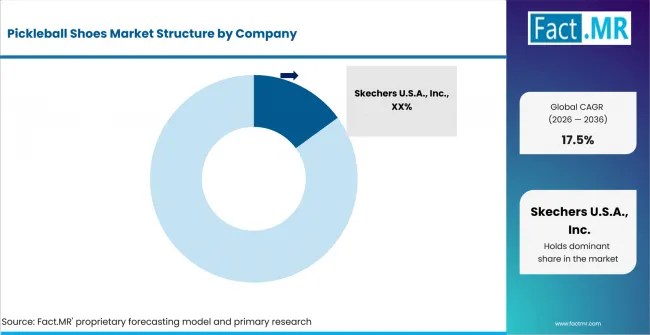
Pickleball Shoes Market Analysis By Company | Source: Fact.MR
Competition is based on fit, lateral support, outsole durability and brand visibility in pickleball channels. Skechers has the clearest dedicated performance story because it links pickleball with its broader performance retail and athlete roster. ASICS competes through technical court-shoe design and a dedicated pickleball listing. K-Swiss uses racquet-sport heritage and pickleball pages to target specialty buyers.
New Balance adds width options and familiar cushioning language through its pickleball listing. Wilson benefits from a broader racquet-sport retail footprint and can bundle shoes with paddles and apparel. FILA participates through pickleball-specific lines and athlete-led visibility. Acacia Sports remains relevant as a pickleball-first footwear specialist.
Retailers that also sell sport protection equipment can bundle ankle sleeves, insoles and footwear advice around injury prevention. This matters because players often understand pain points before they understand shoe technology. Providers that explain fit and surface use in plain language should be better placed through 2036.
The next competitive split is expected to sit between full-line footwear brands and pickleball-first specialists. Full-line brands can scale distribution faster. Specialist brands can speak more directly to club players and coaches. The best placed suppliers are those that pair credible court testing with clear price architecture.
Which companies are the key players?
Skechers, ASICS and K-Swiss are key players. FILA, New Balance, Wilson and Acacia Sports complete the company set.
- Skechers U.S.A., Inc.
- ASICS Corporation
- K-Swiss Inc.
- FILA Holdings Corp.
- New Balance Athletics, Inc.
- Wilson Sporting Goods Co.
- Acacia Sports Inc.
Bibliography
- Sports & Fitness Industry Association. (2026). U.S. pickleball participation statistics.
- USA Pickleball. (2026, January 30). Annual growth reports.
- Pickleball Canada. (2025, February 4). Pickleball in Canada: January 2025 survey.
- Pickleball Australia. (n.d.). Annual reports.
- Australian Sports Commission. (2026, April 30). AusPlay results.
- Sport England. (2026, April 23). England is getting more active but not everyone is benefiting.
- Watson, J. (2024, April 25). United Pickleball Association and Global Sports partner to bring PPA Tour and Major League Pickleball to India. Professional Pickleball Association.
- Major League Pickleball. (2024, July 18). United Pickleball Association announces further international expansion via five 2025 PPA Tour events in Australia, India, Canada, Asia and Europe.
- Watson, J. (2026, February 24). Carvana PPA Tour announces 2026-2027 schedule featuring marquee U.S. and international events. Professional Pickleball Association.
- Pickleball Japan. (2026, April 10). Official unification site.
- Federazione Italiana Tennis e Padel. (2026, April 1). Pickleball, la strategia FITP accelera la crescita: Numeri in forte aumento.
- Pickleball England. (n.d.). 2025 European Pickleball Championships.
- Skechers U.S.A., Inc. (2025, February 6). Skechers announces 2024 record annual sales of $8.97 billion.
- Skechers U.S.A., Inc. (2025, May 8). First European performance-focused Skechers store opens in Belgium.
- ASICS Corporation. (2024, August 15). A guide to pickleball shoes.
This Report Address
- Strategic intelligence on pickleball shoes across shoe type, user type, court surface and buyer channel.
- Segment analysis covering Outdoor Hardcourt, Mid-Price, Men, Recreational Players and Online Retail.
- Regional outlook covering India, Australia, United Kingdom, Japan, Italy, Canada and United States.
- Competitive analysis of Skechers, ASICS and K-Swiss, with FILA, New Balance, Wilson and Acacia Sports also profiled.
- Product assessment covering performance pickleball, entry court, outdoor court, indoor court and hybrid court shoes.
- Buyer assessment covering club players, recreational players, tournament players and online retail behavior.
- Source-led market sizing using player evidence, court evidence, brand portfolios and official company disclosures.
What does the pickleball shoes market cover?
Court footwear built or marketed for pickleball movement, including lateral support, outsole grip and toe-drag durability.
The market covers shoes sold as pickleball-specific footwear. It includes performance court shoes, entry court shoes, outdoor hardcourt shoes and indoor court shoes when the brand or retailer positions the model for pickleball play.
What is included in the scope?
Dedicated pickleball shoes and pickleball-positioned court shoes are included.
The scope includes shoes sold through brand websites, online retailers, specialty sports stores and club pro shops. It also includes pro signature models and wide-fit versions when they are marketed for pickleball. Replacement purchases by recreational players are included because sole wear is a recurring cost for frequent players.
What is excluded from the scope?
Generic running shoes, paddles, balls and court-construction spending are excluded.
The scope excludes tennis shoes that are not positioned for pickleball. It also excludes paddles, bags, apparel, court resurfacing, club fees and tournament registration revenue. Footwear for padel or badminton is excluded unless the product is explicitly sold for pickleball use.
How was the analysis built?
80+ sources and 25+ brand or association pages were reviewed. The model was checked through price bands, player counts and provider counts.
- Primary Research:
- Buyer-role checks covered club managers, specialty retailers and frequent recreational players. The checks focused on replacement timing and shoe-selection criteria.
- Desk Research:
- Desk research reviewed association releases, official tour announcements, brand product pages and national participation databases. Commercial market research figures were not used as source values.
- Market-Sizing and Forecasting:
- Forecasting used participation bases, dedicated-brand counts, average selling price bands and replacement-cycle assumptions.
- Data Validation and Update Cycle:
- Estimates were checked against USA Pickleball court data, Sports & Fitness Industry Association participation data and official brand activity. International expansion checks used PPA Tour, Major League Pickleball and national association releases.
Segmentation
What is the report’s scope and coverage?
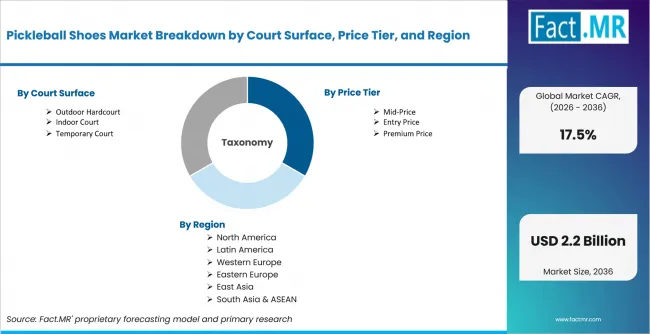
Pickleball Shoes Market Breakdown By Court Surface, Price Tier, And Region | Source: Fact.MR
| Attribute | Details |
|---|---|
| Quantitative Units | USD Billion in services in 2026 to USD Billion by 2036 |
| Market Definition | Court footwear built or marketed for pickleball movement and surface needs |
| Shoe Type | Performance Pickleball, Entry Court, Outdoor Court, Indoor Court, Hybrid Court |
| User Type | Recreational Players, Tournament Players, Club Players, Juniors, Seniors |
| Court Surface | Outdoor Hardcourt, Indoor Court, Temporary Court, Multi-Court, Community Court |
| Buyer Channel | Online Retail, Specialty Stores, Brand Stores, Club Shops, Mass Retail |
| Price Tier | Mid-Price, Entry Price, Premium Price, Pro Signature, Discounted |
| Gender Fit | Men, Women, Juniors, Wide Fit, Unisex |
| Regions Covered | North America, Europe, Asia Pacific, Latin America, Middle East and Africa |
| Countries Covered | India, Australia, United Kingdom, Japan, Italy, Canada and United States |
| Key Companies Profiled | Skechers, ASICS, K-Swiss, FILA, New Balance, Wilson and Acacia Sports |
| Forecast Period | 2026 to 2036 |
| Approach | Hybrid top-down and bottom-up approach using player evidence, court evidence, brand counts, price bands and replacement assumptions |
Source: Fact.MR analysis. Updated Jun 22, 2026
How is the market segmented?
-
By Shoe Type:
- Performance Pickleball
- Entry Court
- Outdoor Court
- Indoor Court
- Hybrid Court
-
By User Type:
- Recreational Players
- Tournament Players
- Club Players
- Juniors
- Seniors
-
By Court Surface:
- Outdoor Hardcourt
- Indoor Court
- Temporary Court
- Multi-Court
- Community Court
-
By Buyer Channel:
- Online Retail
- Specialty Stores
- Brand Stores
- Club Shops
- Mass Retail
-
By Price Tier:
- Mid-Price
- Entry Price
- Premium Price
- Pro Signature
- Discounted
-
By Gender Fit:
- Men
- Women
- Juniors
- Wide Fit
- Unisex
-
By Region:
- North America
- United States
- Canada
- Mexico
- Latin America
- Brazil
- Argentina
- Rest of Latin America
- Europe
- United Kingdom
- Italy
- Germany
- France
- Spain
- Rest of Europe
- Asia Pacific
- India
- Australia
- Japan
- China
- South Korea
- ASEAN
- Middle East & Africa
- GCC Countries
- South Africa
- UAE
- Rest of Middle East & Africa
- North America
Frequently Asked Questions
How is the Pickleball Shoes Market positioned?
What is the long-term outlook for the Pickleball Shoes Market?
Why is the Pickleball Shoes Market expected to grow?
Which court surface leads purchasing?
What price tier do buyers prefer?
Which country shows the fastest expansion?
How is the United Kingdom market developing?
How does the United States support market revenue?
What role does online retail play?
What is the main driver of market expansion?
Who worked on this report


Preview the report firsthand - request a free sample
Free SampleGet the brochure for pricing and purchase details
Download PDF