- Base Value(2025): 0.9 Bn
- Estimated Value(2026): 1.0 Bn
- Forecast Value (2036): 2.2 Bn
- CAGR (2026 - 2036): 8.2%
Session Border Controllers Market Forecast and Outlook By Fact.MR
In 2025, the session border controllers market was valued at USD 0.9 billion. Based on Fact.MR analysis, demand for session border controllers is estimated to grow to USD 1.0 billion in 2026 and USD 2.2 billion by 2036. FACT.MR projects a CAGR of 8.2% during the forecast period.
FACT.MR analysis indicates the session border controllers market is expected to generate an absolute dollar opportunity of USD 1.2 billion between 2026 and 2036. This steady expansion reflects cloud UC migration creating new SBC deployment demand at enterprise and carrier tiers, 5G voice interconnect security requirements expanding SBC use cases beyond traditional TDM replacement, and contact centre modernisation programmes requiring SBC-mediated SIP trunk security. Growth is moderated by virtualisation reducing hardware SBC unit values, open-source SBC alternatives constraining mid-market pricing, and enterprise cloud UC platform consolidation reducing the number of SBC-managed interconnects per organisation.
Country growth reflects telecom infrastructure investment, cloud UC adoption pace, and regulatory voice security mandates. India leads at 13.4% CAGR driven by TRAI VoIP regulatory framework expansion and telecom operator 4G/5G voice network SBC investment. China follows at 12.8% supported by operator core voice network modernisation and enterprise SIP trunk security mandates. Germany records 12.0% through VoIP quality standards and enterprise cloud UC migration. Japan advances at 11.5% via NTT and KDDI PSTN-to-IP migration and corporate SIP trunking deployment. The United States posts 11.0%, the largest market, with mature enterprise and carrier SBC installed base generating steady replacement and cloud virtualisation upgrade demand constrained by hardware-to-software migration revenue compression.
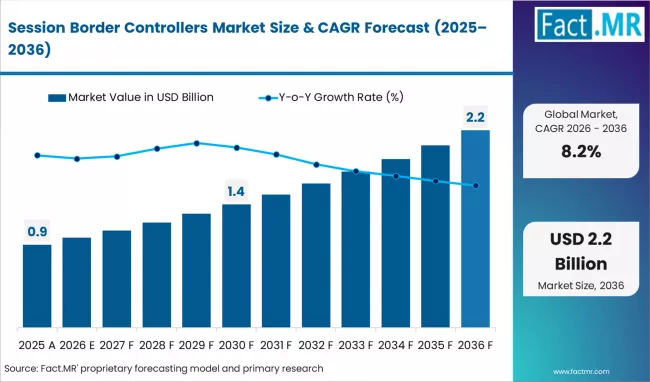
Session Border Controllers Market Market Value Analysis | Source: Fact.MR
| Metric | Value |
|---|---|
| Estimated Value in 2026 | USD 1.0 billion |
| Forecast Value in 2036 | USD 2.2 billion |
| Forecast CAGR (2026 to 2036) | 8.2% |
Session Border Controllers Market Definition
The session border controllers market includes hardware appliances, virtual machines, and cloud-native software platforms deployed at VoIP and unified communications network borders to secure and manage SIP communication sessions. SBCs provide toll fraud prevention, denial-of-service protection, SIP normalization, transcoding, lawful intercept compliance, and interoperability between VoIP systems.
Market Inclusions
Includes global and regional revenue forecasts from 2026 to 2036 by solution type, enterprise size, and end-user segment. Covers hardware SBC appliances, virtual SBC software, cloud-native SBC platforms, and related professional services such as deployment, integration, and maintenance across enterprise, carrier, data center, and contact center environments.
Market Exclusions
Excludes general-purpose firewalls without SIP session management, IP-PBX systems without SBC functionality, and SIP proxy servers lacking full security and interoperability capabilities. Also excludes unified communications platform licenses with embedded SBC functions that are not procured separately.
Research Methodology
- Primary Research: Interviews with telecom network architects, enterprise UC procurement managers, carrier voice engineers, contact center technology buyers, and SBC vendor product managers.
- Desk Research: Sources include ETSI SBC standards, TRAI VoIP regulation documents, Bundesnetzagentur telecom quality standards, OEM earnings reports, and enterprise UC migration procurement records.
- Market Sizing and Forecasting: A hybrid model combining SBC hardware and software shipment volumes, average selling prices by deployment tier, carrier SIP interconnect contract values, and enterprise UC migration investment benchmarks.
- Data Validation and Update Cycle: Forecasts validated using OEM revenue disclosures, ETSI deployment statistics, telecom operator capital expenditure reports, and interviews with enterprise voice network architects and carrier procurement teams.
Summary of Session Border Controllers Market
- Market Definition
- The SBC market includes hardware, virtual, and cloud-native platforms used to secure, normalize, and manage SIP communication sessions across enterprise, carrier, data center, and contact center networks.
- Demand Drivers
- Migration from legacy TDM PBX to cloud UC platforms such as Microsoft Teams Direct Routing, Zoom Phone, and Cisco Webex Calling is driving mandatory SBC deployment for PSTN connectivity.
- TRAI VoIP security regulations updated in October 2024 require commercial VoIP providers to deploy certified SBC platforms for compliance.
- Global 5G deployments are expanding SBC use cases to IMS voice security, 5G voice interconnect protection, and network slicing voice control.
- Key Segments Analyzed
- By Solution: SBC hardware and software platforms dominate because they represent the main capital investment in deployments.
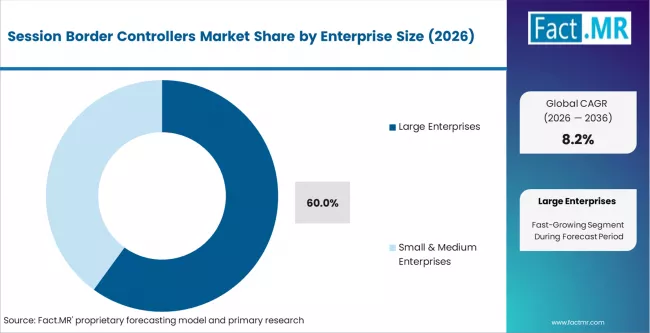
- By Enterprise Size: Large enterprises hold about 60 percent share in 2026 due to high-volume SIP trunk deployments and multi-site UC migrations.
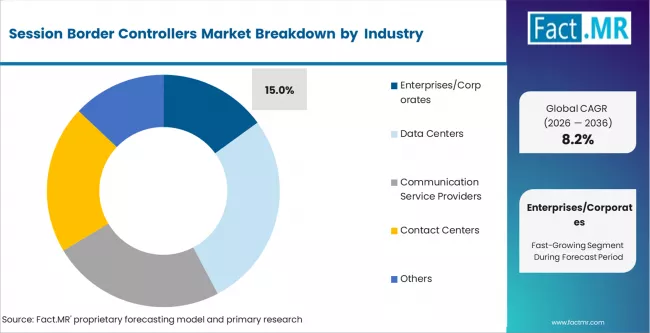
- By End User: Enterprises and communication service providers represent the largest segments, while CSPs deploy high-value carrier-grade SBC systems.
- Analyst Opinion at FACT.MR
- Shambhu Nath Jha, Principal Consultant at Fact.MR, notes that the strongest growth will come from cloud-native virtual SBC platforms certified for Microsoft Teams Direct Routing and Zoom Phone BYOC. Growth opportunities also include AI-driven SIP fraud detection, voice security analytics, and 5G IMS voice security applications.
- Strategic Implications
- Vendors should obtain certification for Microsoft Teams Direct Routing, Zoom Phone BYOC, and Cisco Webex Calling to participate in enterprise cloud UC migration projects.
- Companies should integrate AI-based SIP anomaly detection and toll fraud prevention analytics into SBC platforms.
- Vendors should develop TRAI-compliant VoIP documentation and ETSI TISPAN-certified SBC solutions to meet regulatory procurement requirements.
- Methodology
- Market sizing based on SBC shipment volumes and average selling prices validated through OEM revenue disclosures and telecom CAPEX data.
- Demand analysis supported by ETSI standards adoption, TRAI regulatory implementation, and enterprise UC migration investments.
- Forecasts incorporate cloud UC adoption timelines, 5G IMS voice deployment plans, contact center SIP modernization, and primary expert interviews.
Segmental Analysis
Session Border Controllers Market Analysis by Enterprise Size
Session Border Controllers Market Analysis By Enterprise Size | Source: Fact.MR
According to FACT.MR, Large Enterprises are expected to hold 60% market share in 2026. High SIP trunk volumes, multi-site UC deployments, and complex carrier interconnect requirements result in significantly higher SBC investment compared to SMEs.
- Cisco Large Enterprise Investment: In September 2024, Cisco launched Unified Border Element 17.14 with enhanced Teams Direct Routing support, WebRTC gateway capability, and AI-based anomaly detection for large enterprises migrating to hybrid cloud UC environments. [5]
- Oracle SME SBC Technology: In October 2024, Oracle introduced Session Border Controller 9.2 with simplified cloud deployment templates to help SMEs adopt SIP trunking without complex voice infrastructure management. [6]
- Contact Centre SBC Trend: Genesys reported in October 2024 that over 70% of its cloud contact centre deployments require SBC-based SIP trunk connectivity, highlighting contact centres as a key enterprise SBC adoption segment. [7]
Session Border Controllers Market Analysis by End User
Session Border Controllers Market Analysis By End Use | Source: Fact.MR
According to FACT.MR, Enterprises/Corporates represent about 15% of end-user revenue in 2026. Enterprise migration from legacy PBX systems to cloud UC platforms such as Teams, Zoom, and WebEx is driving consistent SBC procurement for PSTN connectivity.
- Nokia CSP End User Investment: In November 2024, Nokia expanded its Packet Core SBC portfolio for 5G IMS voice interconnect and signed contracts with three Tier-1 European telecom operators for VoNR interconnect management.
- Metaswitch Data Centre Technology: In September 2024, Metaswitch (Microsoft) updated its Perimeta virtual SBC to support deployment on Azure Kubernetes Service, enabling cloud-native SBC infrastructure for multi-tenant VoIP data centres.
- Contact Centre Modernisation Trend: NICE Systems reported in November 2024 that SBC-based SIP trunking is required for all contact centre cloud migrations, with over 400 enterprise contact centre migrations completed in North America during 2024.
Drivers, Restraints, and Opportunities
FACT.MR analysts note that the session border controllers market became essential as enterprises shifted from TDM voice to SIP-based VoIP, requiring security and interoperability at network borders. Market growth reflects the large installed base of hardware SBCs at enterprises and carriers and the ongoing shift toward virtual SBC platforms for cloud voice environments.
The market is transitioning from hardware-led deployments to software and cloud-based SBC platforms. Traditional hardware appliances are gradually being replaced by virtual SBC software and cloud-native SBC services as enterprises migrate voice infrastructure to Microsoft Teams, Zoom Phone, and AWS Connect. While hardware revenue per unit is declining, cloud SBC subscriptions and managed services are growing faster, supporting overall market expansion.
- Microsoft Teams Direct Routing: Microsoft’s Operator Connect and Direct Routing programs require certified SBCs for PSTN connectivity in Teams Phone environments. With over 320 million Microsoft 365 users globally, this requirement creates consistent SBC demand during enterprise cloud voice migrations. [2]
- India TRAI VoIP Security: India’s Telecom Cybersecurity Regulations 2024 mandate certified SBC deployment for commercial VoIP providers within 12 months. With over 50 million new VoIP users added annually and operators like Reliance Jio and Bharti Airtel expanding SIP trunking services, this regulation is driving large-scale SBC procurement. [3]
- 5G Voice IMS Expansion: Ericsson’s November 2024 Mobility Report reported 1.7 billion global 5G subscriptions in Q3 2024 with VoNR deployments rising across Asia. This growth is increasing carrier demand for SBC upgrades supporting IMS voice security and 5G network interconnect management. [4]
Regional Analysis
The session border controllers market is analysed across Asia Pacific, Europe, North America, Latin America, and Middle East and Africa, covering 40+ countries with distinct demand profiles shaped by cloud UC migration pace, telecom operator VoIP infrastructure investment, SIP security regulatory frameworks, and 5G voice deployment timelines. The full report offers market attractiveness analysis based on enterprise UC migration adoption benchmarks, government VoIP security mandates, and carrier SIP trunking infrastructure investment programmes.
.webp "Top Country Growth Comparison Session Border Controllers Market Cagr (2026 2036)")
Top Country Growth Comparison Session Border Controllers Market Cagr (2026 2036) | Source: Fact.MR
| Country | CAGR (2026-2036) |
|---|---|
| India | 13.4% |
| China | 12.8% |
| Germany | 12.0% |
| Japan | 11.5% |
| United States | 11.0% |
Source: Fact.MR (FACT.MR) analysis, based on proprietary forecasting model and primary research
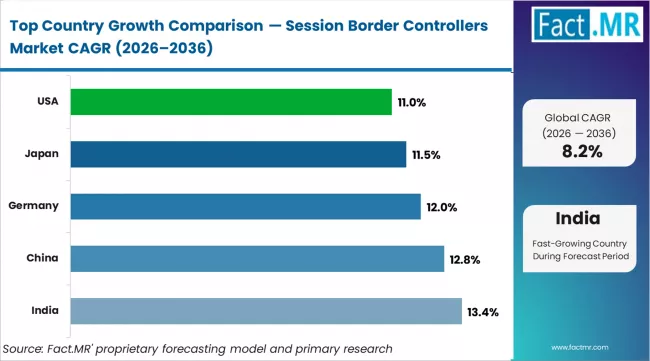
Session Border Controllers Market Cagr Analysis By Country | Source: Fact.MR
South Asia and Pacific Session Border Controllers Market Analysis
South Asia is the fastest growing SBC region due to India’s enterprise SIP trunking expansion, TRAI VoIP security regulations, and a large VoIP subscriber base. Vendors including Ribbon Communications, Cisco, AudioCodes, and Huawei compete for telecom and enterprise SBC contracts.
- India: India market growth is projected at 13.4% CAGR through 2036. TRAI Telecom Cybersecurity Regulations 2024 require certified SBC deployment for commercial VoIP providers within 12 months. Reliance Jio expanded JioMeet UCaaS with SBC based SIP trunking for enterprises. Bharti Airtel also expanded enterprise SIP trunk services using Cisco SBC infrastructure as corporate migration to IP voice increased.
- China: China SBC demand is expected to grow at 12.8% CAGR through 2036. China’s Ministry of Industry and Information Technology introduced IP Voice Network Security Technical Requirements mandating SBC functionality in IP voice networks. China Telecom reported 27% growth in enterprise SIP trunking revenue. Huawei’s CloudEngine SBC platform received MIIT certification enabling deployment with telecom operators and enterprises.
FACT.MR analysis of the Asia Pacific session border controllers market includes India, China, Japan, South Korea, ASEAN, Australia and New Zealand, and Rest of South Asia and Pacific. The report includes country level CAGR forecasts, SIP trunking investment data, regulatory tracking, and SBC deployment benchmarks.
Europe Session Border Controllers Market Analysis
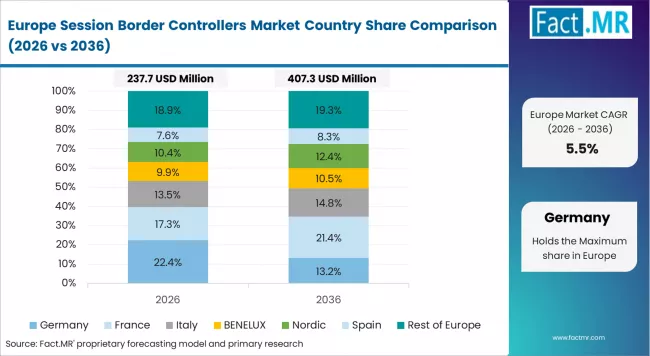
Session Border Controllers Market Europe Country Market Share Analysis, 2026 & 2036 | Source: Fact.MR
Europe represents a compliance driven SBC market shaped by ETSI TISPAN standards, VoIP regulations, and enterprise migration to cloud UC platforms such as Microsoft Teams. Vendors including Ribbon Communications, AudioCodes, Cisco, Nokia, and Ericsson compete across enterprise and carrier deployments.
- Germany: Germany’s SBC market demand is projected to grow at 12.0% CAGR through 2036. Bundesnetzagentur VoIP quality regulations require SBC deployment for VoIP providers and enterprise SIP trunk operators. Deutsche Telekom added 12,000 corporate SIP trunking clients through its MagentaBusiness IP Voice service. SAP migrated enterprise telephony to Microsoft Teams Direct Routing using AudioCodes SBC infrastructure.
- Japan: SBC demand is projected to grow at 11.5% CAGR through 2036. NTT Communications confirmed completion of Japan’s PSTN to IP migration by January 2025, increasing enterprise SBC adoption. KDDI signed 8,500 corporate SIP trunking contracts requiring certified SBC deployment. Fujitsu deployed Cisco SBC solutions for its Microsoft Teams Direct Routing communications platform.
FACT.MR analysis of the European session border controllers market includes Germany, France, the United Kingdom, Italy, Spain, Nordic countries, BENELUX, and Rest of Western Europe. The report includes ETSI compliance tracking, VoIP quality mandate data, enterprise Teams Direct Routing adoption benchmarks, and country level forecasts.
North America Session Border Controllers Market Analysis
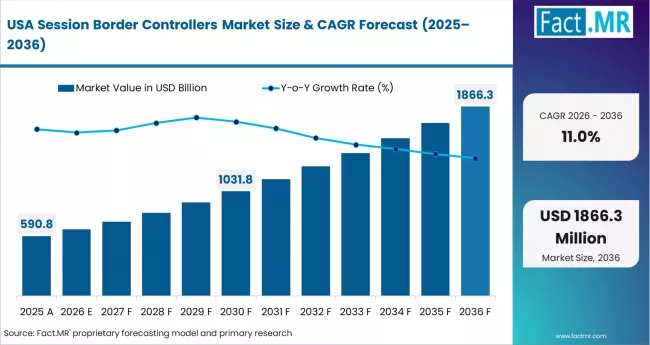
Session Border Controllers Market Country Value Analysis | Source: Fact.MR
North America is the largest SBC market due to rapid cloud UC migration and a large installed enterprise SBC base requiring upgrades or virtualization. Cisco, Ribbon Communications, and Oracle Communications dominate enterprise and carrier deployments.
- United States: United States SBC market demand is projected to grow at 11.0% CAGR through 2036. The FCC IP Transition programme requires carriers to replace legacy TDM services with IP voice alternatives, increasing enterprise SIP trunking and SBC deployment. Ribbon Communications reported 16% growth in its US enterprise cloud SBC segment driven by Teams Direct Routing adoption.
FACT.MR analysis of the North America session border controllers market includes the United States, Canada, and Mexico. The report provides insights on FCC IP transition programmes, SIP trunking infrastructure investments, Teams Direct Routing adoption trends, and country level forecasts by solution and enterprise size.
Competitive Aligners for Market Players
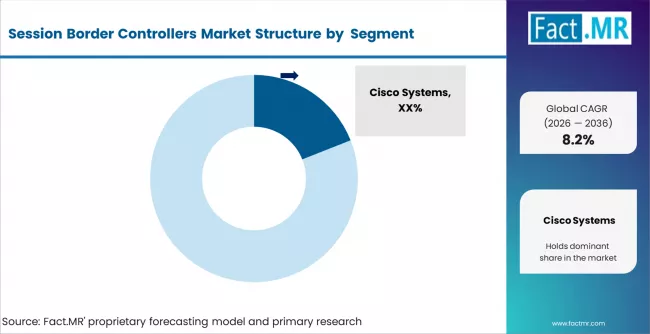
Session Border Controllers Market Analysis By Company | Source: Fact.MR
The global session border controllers (SBC) market is moderately concentrated, with a few major vendors dominating enterprise and carrier deployments. Companies such as Cisco, Ribbon Communications, Oracle Communications, and AudioCodes hold a large share of the enterprise SBC market, mainly because their platforms are certified for integration with leading cloud unified communications services like Microsoft Teams, Zoom Phone, and Cisco Webex. In the telecom carrier segment, Nokia and Ericsson maintain strong positions, particularly in deployments supporting 5G networks and large-scale PSTN migration projects.
Competition in the market is increasingly focused on cloud UC certification rather than basic SIP interoperability. Vendors that maintain up-to-date certifications with platforms such as Microsoft Teams Direct Routing or Zoom BYOC are more likely to be selected for enterprise voice migration projects.
Cisco benefits from a strong competitive advantage because its Unified Border Element SBC integrates directly with its broader voice and collaboration ecosystem, including Cisco Call Manager and Webex. Ribbon Communications has also strengthened its position with cloud-based SBC solutions following the GENBAND and SONUS merger. Meanwhile, AudioCodes remains competitive in the mid-market segment through cost-effective solutions and wide cloud UC compatibility.
Key Players
- Cisco Systems
- Oracle Communications
- Ribbon Communications
- AudioCodes
- Avaya
- Metaswitch (a Microsoft company)
- Nokia
- Huawei Technologies
- Ericsson
- Sangoma Technologies
Bibliography
- [1] Microsoft Corporation. (2024). Microsoft Teams Direct Routing Certified SBC Partner Programme Update: New Certified Partner Additions, Operator Connect Expansion, and Teams Phone PSTN Calling Architecture Requirements. October 2024. microsoft.com/en-us/microsoft-teams/direct-routing
- [2] Telecom Regulatory Authority of India. (2024). Telecom Cybersecurity Regulations 2024: Mandatory Session Border Control Requirements for Commercial VoIP Service Providers and Interconnected Voice Network Operators. November 2024. trai.gov.in
- [3] Ericsson AB. (2024). Ericsson Mobility Report November 2024: Global 5G Subscription Milestones, Voice over NR (VoNR) Deployment Status in South Korea, Japan, and China, and 5G IMS Voice Interconnect Architecture Trends. November 2024. ericsson.com/en/mobility-report
- [4] Cisco Systems Inc. (2024). Product Release: Cisco Unified Border Element 17.14 Virtual SBC Update Microsoft Teams Direct Routing Enhancement, WebRTC Gateway, and AI Anomaly Detection for Large Enterprise Cloud UC Migration. September 2024. cisco.com/c/en/us/products/unified-communications/unified-border-element
- [5] Oracle Corporation. (2024). Product Launch: Oracle Communications Session Border Controller 9.2 with SME Cloud Deployment Templates for Mid-Market SIP Trunking Adoption. October 2024. oracle.com/communications/session-border-controller
- [6] Genesys. (2024). Genesys Cloud CX Infrastructure Update: SBC-Mediated SIP Trunk Connectivity Requirement Rate in Cloud Contact Centre Deployments and Enterprise Migration Statistics. October 2024. genesys.com/resources
This Report Addresses
- Strategic intelligence on key regulations and programs influencing SBC demand including India TRAI Telecom Cybersecurity Regulations 2024, China MIIT IP voice security standards, Germany Bundesnetzagentur VoIP rules, Microsoft Teams Direct Routing certification, and Japan’s NTT PSTN decommissioning program.
- Market forecast from USD 1.0 billion in 2026 to USD 2.2 billion by 2036 at 8.2% CAGR, segmented by solution, enterprise size, and end user.
- Growth opportunities across India’s TRAI VoIP SBC compliance market, China’s MIIT IP voice security certification demand, Germany’s SIP trunking expansion, Japan’s PSTN migration cycle, and the US FCC IP transition programme.
- Country CAGR outlook including India 13.4%, China 12.8%, Germany 12.0%, Japan 11.5%, and the United States 11.0%, driven by VoIP security regulations, cloud UC migration, and 5G voice deployments.
- Competitive analysis of Cisco, Oracle Communications, Ribbon Communications, AudioCodes, Avaya, Metaswitch (Microsoft), Nokia, Huawei, Ericsson, and Sangoma covering certification portfolios and enterprise versus carrier positioning.
- Technology analysis covering Teams Direct Routing and Zoom Phone BYOC certified SBC platforms, virtual SBC software, AI based SIP fraud detection, 5G VoNR security, WebRTC gateways, and SBC as a service deployment models.
- Regulatory coverage including TRAI Telecom Cybersecurity Regulations 2024, China MIIT IP voice security standards, Germany Bundesnetzagentur VoIP QoS requirements, ETSI TISPAN SBC standards, and the FCC IP transition programme.
- Report delivered in PDF, Excel datasets, PowerPoint summary, and dashboards supported by OEM earnings data, telecom CAPEX disclosures, regulatory records, and primary interviews with enterprise voice network experts.
Scope of Report
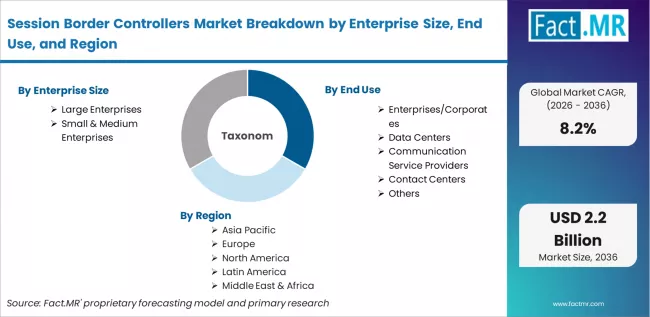
Session Border Controllers Market Breakdown By Enterprise Size, End Use, And Region | Source: Fact.MR
| Attribute | Details |
|---|---|
| Quantitative Units | USD 1.0 billion (2026) to USD 2.2 billion (2036), at a CAGR of 8.2% |
| Market Definition | Hardware and software appliances deployed at VoIP network borders to protect, control, and monitor real-time communications traffic between enterprise networks, contact centres, and carrier interconnects. |
| Solution Segmentation | Session Border Controllers, Services |
| Enterprise Size Segmentation | Small & Medium Enterprises, Large Enterprises |
| End User Segmentation | Data Centers, Communication Service Providers, Contact Centers, Enterprises/Corporates, Others |
| Application Coverage | VoIP trunk security and fraud prevention, SIP trunking interoperability, lawful intercept compliance, toll fraud mitigation, cloud UC migration support, and 5G voice interconnect security. |
| Regions Covered | Asia Pacific, Europe, North America, Latin America, Middle East and Africa |
| Countries Covered | China, Japan, South Korea, India, Australia and New Zealand, ASEAN, Germany, UK, France, Italy, Spain, Nordic, BENELUX, Rest of Western Europe, USA, Canada, Mexico, Brazil, Rest of Latin America, Saudi Arabia, GCC, Turkey, South Africa, Rest of MEA |
| Key Companies Profiled | Cisco Systems, Oracle Communications, Ribbon Communications, AudioCodes, Avaya, Metaswitch (Microsoft), Nokia, Huawei Technologies, Ericsson, Sangoma Technologies |
| Forecast Period | 2026 to 2036 |
| Approach | Hybrid top-down and bottom-up model using SBC unit shipment data, average selling price by deployment tier, carrier SIP interconnect programme values, and primary interviews with telecom network architects and enterprise UC procurement leads. |
Session Border Controllers Market by Segments
-
By Solution :
- Session Border Controllers
- Services
-
By Enterprise Size :
- Small & Medium Enterprises
- Large Enterprises
-
By End User :
- Data Centers
- Communication Service Providers
- Contact Centers
- Enterprises/Corporates
- Others
-
By Region :
- North America
- United States
- Canada
- Mexico
- Latin America
- Brazil
- Rest of Latin America
- Western Europe
- Germany
- United Kingdom
- France
- Italy
- Spain
- Nordic
- BENELUX
- Rest of Western Europe
- Eastern Europe
- Russia
- Poland
- Rest of Eastern Europe
- East Asia
- China
- Japan
- South Korea
- South Asia and Pacific
- India
- ASEAN
- Australia and New Zealand
- Rest of South Asia and Pacific
- Middle East and Africa
- Kingdom of Saudi Arabia
- Other GCC Countries
- Turkey
- South Africa
- Other African Union
- Rest of Middle East and Africa
- North America