- Market Value (2025): USD 2.9 Bn
- Estimated Value (2026): USD 3.2 Bn
- Forecast Value (2036):USD 7.0 Bn
- CAGR (2026-2036): 8.2%
What is the Shop-Floor CNC Tools Market forecast to be worth by 2036?
USD 3.2 billion in 2026 to USD 7.0 billion by 2036 at a 8.2% CAGR.
- The Shop-Floor CNC Tools Market at approximately USD 2.9 billion in 2025.
- Demand to increase from USD 3.2 billion in 2026 to USD 7.0 billion by 2036.
- The market is forecast to record 8.2% CAGR from 2026 to 2036, with setup reduction, controller-integrated workflows and tool-data management shaping the market outlook.
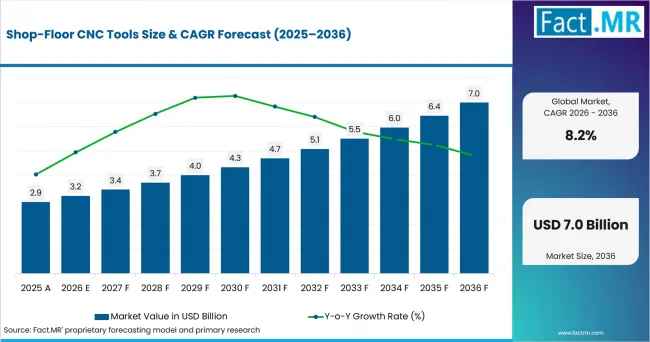
Shop Floor Cnc Tools Value Analysis | Source: Fact.MR
What are the defining numbers behind Shop-Floor CNC Tools Market growth?
USD 3.8 billion absolute opportunity between 2026 and 2036, with machine-side programming tools, machining centers and controller-integrated deployment identified as the leading modeled segments.
- Demand Drivers in the Market
- Production engineers need faster part setup as shorter job runs leave less room for trial cuts and offline program corrections.
- CNC operators need machine-side programming tools where last-minute edits happen after fixtures and cutters are selected.
- Manufacturing managers need tool presetting and management so cutter offsets, tool life and changeover records move with the job.
- Quality teams need in-process probing since dimensional checks inside the machine reduce movement between the CNC cell and inspection area.
- Key Segments Analyzed
- By Tool Category: Machine-side programming tools at 29.0% share in 2026, reflecting their use beside the operator and CNC controller.
- By Machine Type: Machining centers at 38.0% share in 2026, reflecting their broad use across milling and multi-axis jobs.
- By Deployment: Controller-integrated tools at 35.0% share in 2026, reflecting use within the normal CNC interface.
- By Use Case: Setup reduction at 28.0% share in 2026, reflecting the focus on shorter prove-out and faster first-part approval.
- Analyst Opinion at Fact.MR
- Shambhu Nath Jha, Principal Consultant at Fact.MR, states, “Shop-floor CNC tools are becoming part of everyday production control as manufacturers push programming, setup, probing and tool-data decisions closer to the machine. Operators value tools that shorten prove-out, reduce offset errors and fit naturally within controller workflows. Suppliers that combine intuitive interfaces with reliable program verification and measurement support are better positioned to improve spindle utilization and repeatable production.”
- Strategic Implications
- CNC software vendors should make controller workflows simple enough for operators to use during setup before calling a programming desk.
- Machine tool builders should bundle validated shop-floor apps with machining centers so customers shorten commissioning and operator training.
- Tooling companies should link cutter data with presetting records and machining recommendations to reduce offset errors at the machine.
- Plant managers should compare tools on setup time saved, scrap avoided and repeatability across different controllers before adding new licenses.
Germany to record a 10.0% CAGR through 2036, followed by the USA at 9.1%, Italy at 8.1%, Japan at 6.6% and the UK at 6.2%. The country sections below contextualize these forecasts using recent official manufacturing-order, labor-market, machine-tool-demand and digital-adoption indicators.
How does the Shop-Floor CNC Tools Market break down by segment?
Machine-side programming tools at 29.0% share and machining centers at 38.0% share in 2026.
Which Tool Category leads?
Machine-side programming tools hold 29.0% share in 2026.
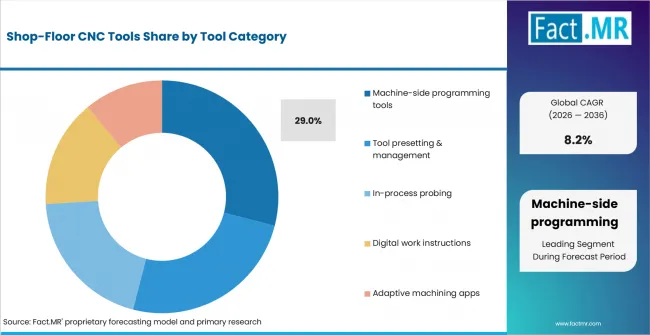
Shop Floor Cnc Tools Analysis By Tool Category | Source: Fact.MR
Machine-side programming tools lead since they solve a problem that appears directly at the CNC control. Operators often need to adjust geometry or confirm a toolpath after the part is loaded. Software placed near the machine reduces delay and gives the operator a clearer route from setup to first cut.
FANUC announced CNC Design Studio on December 16, 2025. The integrated platform centrally manages parameters, programs and customization data and uses digital-twin technology to strengthen coordination between virtual environments and actual machines. FANUC states that results validated in the virtual environment can be transferred directly to actual machines, while online adjustment supports pre-verification and shop-floor tuning.
What leads the Machine Type segment?
Machining centers account for 38.0% share in 2026.
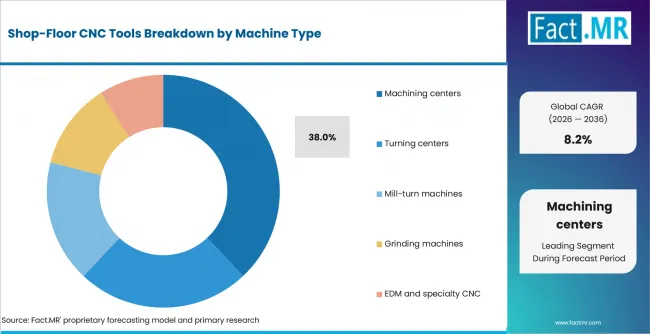
Shop Floor Cnc Tools Analysis By Machine Type | Source: Fact.MR
Machining centers lead because they support many shop-floor tool functions in one cell. Milling and multi-axis work need fixture setup, tool measurement and program checks before production can run smoothly. Production teams gain clear value when software and measurement tools improve the first-part process.
HEIDENHAIN expanded the TNC7 control family at EMO 2025 with additional machining and enhanced simulation functions and introduced the TNC7 go. HEIDENHAIN states that the enhanced simulation functions allow NC programs to be checked in detail before execution, while the TNC7 go is designed for vocational training, shop-floor use and legacy-machine upgrade projects.
How does Deployment shape demand?
Controller-integrated deployment leads with 35.0% share in 2026.
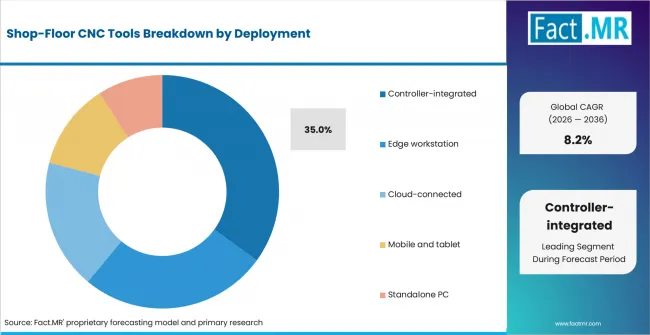
Shop Floor Cnc Tools Analysis By Deployment | Source: Fact.MR
Controller-integrated deployment leads because operators prefer tools inside the interface they already use. Separate desktop tools remain useful for planning teams. Integrated apps reduce training friction for plants that run mixed shifts and repeated part families across several machines.
Controller access also helps when a plant introduces connected inspection or tool-data records. Edge workstations and tablets extend visibility beyond the control. The center of use still remains near the CNC cell because setup teams make the final operating decisions there.
What supports Setup Reduction within Use Case?
Setup reduction holds 28.0% share in 2026.
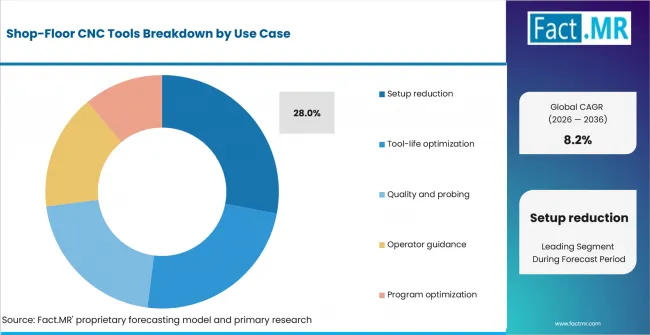
Shop Floor Cnc Tools Analysis By Use Case | Source: Fact.MR
Setup reduction leads because lost spindle time is easy for plant managers to measure. A setup tool gains attention when it lowers trial runs and tool offset mistakes. The use case suits small-batch work, where every extra setup hour reduces job margin.
Hexagon announced the latest NCSIMUL release on May 19, 2026, with Selective Simulation for NC program verification. The release gives programmers earlier visibility into stock conditions during long, complex machining programs. Hexagon states that NCSIMUL can reduce the need to prove out risky or time-consuming NC programs on valuable machine tools.
What is accelerating Shop-Floor CNC Tools Market adoption, and what is holding it back?
Demand is expected to rise through setup reduction, controller integration and tool-data discipline. Adoption is constrained by mixed controllers, skills gaps and capital cycles.
Drivers Impact Analysis
| DRIVER | (~) % IMPACT ON CAGR | GEOGRAPHIC RELEVANCE | IMPACT TIMELINE |
|---|---|---|---|
| Setup-time pressure at CNC cells | +1.4% | Global | Short term (<= 2 years) |
| Controller-based programming and proofing | +1.1% | Germany, USA, Japan | Medium term (2-4 years) |
| Tool presetting and in-process measurement | +0.8% | Europe, East Asia | Medium term (2-4 years) |
| Paperless operator guidance | +0.6% | Global | Long term (>= 4 years) |
Source: Fact.MR analysis. Updated Sep 7, 2026
- Setup-time pressure at CNC cells: Smaller batches increase the cost of every changeover. Software that shortens prove-out gives manufacturers a direct route to more usable spindle time.
- Controller-based programming and proofing: Operators need trusted edits at the machine when fixtures, cutters and stock conditions differ from the plan.
- Tool presetting and in-process measurement: Presetters, probes and tool data systems reduce errors that appear after a job enters production.
Opportunity Impact Analysis
| OPPORTUNITY | (~) % IMPACT ON CAGR | GEOGRAPHIC RELEVANCE | IMPACT TIMELINE |
|---|---|---|---|
| Controller-integrated shop-floor apps | +0.9% | Global | Short term (<= 2 years) |
| Cloud-connected tool data and job records | +0.7% | North America, Europe | Medium term (2-4 years) |
| Adaptive machining feedback loops | +0.6% | Japan, Germany, USA | Long term (>= 4 years) |
Source: Fact.MR analysis. Updated Sep 7, 2026
- Controller-integrated shop-floor apps: CNC makers can increase software pull-through when apps work inside the normal operator screen and require little retraining.
- Cloud-connected tool data and job records: Manufacturers with several cells can use shared tool libraries and inspection records to reduce repeated setup work.
- Adaptive machining feedback loops: Probing and machine data support closed-loop corrections when part geometry or tool wear changes during production.
Restraints Impact Analysis
| RESTRAINT | (~) % IMPACT ON CAGR | GEOGRAPHIC RELEVANCE | IMPACT TIMELINE |
|---|---|---|---|
| Mixed CNC controller installed base | -0.4% | Global | Short term (<= 2 years) |
| Limited programming and probing skills | -0.3% | USA, UK, Italy | Medium term (2-4 years) |
| Weak machine tool order cycles | -0.2% | Europe, Japan | Medium term (2-4 years) |
Source: Fact.MR analysis. Updated Sep 7, 2026
- Mixed CNC controller installed base: Older controls and varied machine brands increase integration work. Vendors maintain postprocessors, macros and operator-screen versions for several machine families.
- Limited programming and probing skills: Shop-floor tools still need trained users who understand offsets, fixtures and inspection routines.
- Weak machine tool order cycles: Delayed equipment investment can slow software upgrades when tools are bundled with new CNC machines or controller refreshes.
Which countries are scaling the Shop-Floor CNC Tools Market through 2036?
- The country comparison spans 3.72 percentage points and forms three practical growth bands across the forecast period.
- Germany remains 0.84 percentage point above the USA through machinery-order activity, controller-integrated workflows, and continued demand for shop-floor CNC productivity tools.
- The USA remains 1.04 percentage points above Italy as manufacturers address machine-worker availability and place greater emphasis on repeatable setup and operator-support workflows.
- Italy remains 1.51 percentage points above Japan through renewed domestic consumption of machine tools, robots, and automation equipment.
- Japan remains 0.33 percentage point above the UK as strong machine-tool ordering supports continued investment in CNC programming, simulation, and shop-floor production tools.
- The UK closes the displayed range as advanced-manufacturing support encourages adoption of robotics, automation, AI, digital twins, and related shop-floor technologies.
Comparable CAGRs can create different entry conditions due to CNC installed-base maturity, controller mix, workforce availability, machine-tool investment cycles, and digital-manufacturing adoption. Full report coverage includes North America, Latin America, Western Europe, Eastern Europe, East Asia, South Asia & Pacific, Middle East & Africa.
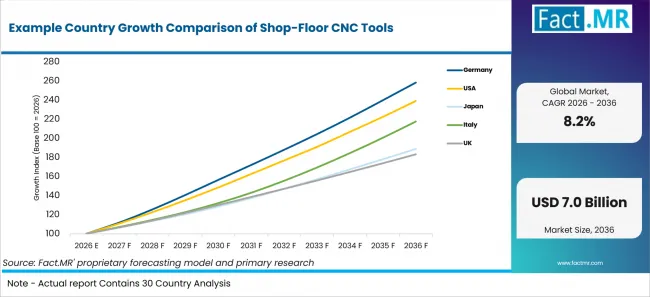
Example Country Growth Comparison Of Shop Floor Cnc Tools | Source: Fact.MR
| Country | Forecast CAGR |
|---|---|
| Germany | 10.0% |
| USA | 9.1% |
| Italy | 8.1% |
| Japan | 6.6% |
| UK | 6.2% |
Source: Fact.MR analysis. Updated Sep 7, 2026
What supports Germany adoption?
10.0% CAGR, supported by rising machinery orders and CNC equipment demand.
The Federal Statistical Office reported on February 5, 2026 that new orders in the manufacture of machinery and equipment increased 11.5% month on month in December 2025 after seasonal and calendar adjustment. The increase provides a recent official indicator of demand conditions in a manufacturing branch closely associated with CNC machinery and equipment.
How is the USA scaling demand?
9.1% CAGR, led by manufacturing workforce turnover and repeatable operator-support workflows.
The U.S. Bureau of Labor Statistics reported on August 27, 2026 that about 78,100 openings for metal and plastic machine workers are projected each year, on average, from 2025 to 2035. BLS expects all of these openings to result from workers transferring to other occupations or exiting the labor force, highlighting the value of repeatable setup and operator-support workflows for manufacturers.
What supports Italy adoption?
8.1% CAGR, backed by recovering machine-tool, robotics and automation demand.
UCIMU-SISTEMI PER PRODURRE reported on July 7, 2026 that Italian domestic consumption of machine tools, robots and automation increased 22.3% in 2025 to EUR 4.534 billion. The increase reflected a recovery in domestic demand across the sector’s equipment and automation market.
How does Japan perform?
6.6% CAGR, driven by strong machine-tool orders and sustained foreign demand.
The Japan Machine Tool Builders' Association reported on December 26, 2025 that total machine-tool orders were JPY 137.01 billion in November 2025. JMTBA also reported foreign orders of JPY 105.02 billion and described foreign orders as remaining strong.
What supports the UK outlook?
6.2% CAGR, shaped by advanced-manufacturing support and digital technology adoption.
The Department for Business and Trade stated in July 2026 that GBP 116 million is available through the Made Smarter Programme to support 5,500 SMEs with grants and expert support for adopting advanced technologies including robotics, AI, automation and digital twins. The programme provides a recent official indicator of government support for advanced-manufacturing technology adoption.
Who leads the Shop-Floor CNC Tools Market?
Notable providers with relevant controller, probing, tooling-data and CNC simulation capabilities include Siemens, FANUC, HEIDENHAIN, Renishaw, Sandvik Coromant and Hexagon.
Siemens participates through Sinumerik and shop-floor programming tools that connect operators with CNC control functions. FANUC adds CNC Design Studio and controller software that manage programs, parameters and digital twin data. HEIDENHAIN supports operator-led CNC work through TNC controls and programming functions used on the shop floor.
Renishaw strengthens the probing and machine-checking layer through on-machine apps, tool setters and measurement software. Sandvik Coromant links cutting data with tool libraries and toolpath support, giving production teams a route from cutter choice to NC output. Hexagon competes through NCSIMUL and related CNC simulation tools that verify programs before live machining.
Which companies are the key providers?
Key comapnies include Siemens, FANUC, HEIDENHAIN, Renishaw, Sandvik Coromant and Hexagon.
- Siemens
- FANUC
- HEIDENHAIN
- Renishaw
- Sandvik Coromant
- Hexagon
Bibliography
- Federal Statistical Office (Destatis). (2026, February 5). New orders in manufacturing in December 2025: +7.8% on the previous month.
- FANUC Corporation. (2025, December 16). FA new product: FANUC CNC Design Studio — Seamlessly connecting design and the shop floor with digital twin technology.
- HEIDENHAIN. (2025, September 16). HEIDENHAIN at EMO 2025: New functions of the TNC7 and introducing the TNC7 go.
- Hexagon. (2026, May 19). Hexagon helps manufacturers verify and optimise NC programs faster with NCSIMUL.
- Japan Machine Tool Builders' Association. (2025, December 26). The current condition of the Japanese machine tool industry: Monthly machine tool orders (November 2025).
- Siemens. (2025, July 29). Revolution in manufacturing: Optimize MyProgramming /3D Scanner transforms shop floor-oriented CNC programming.
- Department for Business and Trade. (2026, July 15). Advanced manufacturing.
- U.S. Bureau of Labor Statistics. (2026, August 27). Metal and plastic machine workers.
- UCIMU-SISTEMI PER PRODURRE. (2026, July 7). Assemblea UCIMU: Dopo un 2025 complessivamente debole, nel 2026 l’industria italiana costruttrice di macchine utensili, robot e automazione dovrebbe registrare una timida ripresa. Grandi aspettative per l’effetto dell’Iperammortamento.
This Report Answers
- The report explains where shop-floor CNC tools are used across tool category, machine type, deployment and use case.
- Segment analysis identifies the leading subsegments and the operating reasons machine shops prioritize them.
- Country analysis examines Germany, the USA, Italy, Japan and the UK with country-specific adoption conditions.
- Competitive analysis reviews controller suppliers, probing specialists, tooling-data providers and CNC simulation software companies.
- Application analysis assesses how setup time, tool life, probing and program optimization influence purchasing decisions.
What does the Shop-Floor CNC Tools Market cover?
The Shop-Floor CNC Tools Market covers digital tools used by operators, programmers and production engineers around CNC machines. It is positioned next to machine tools and supports machine-side decisions that affect setup, proofing and production release.
The assessment includes software and apps used with metal cutting machines. It gives special attention to controller-integrated tools used with multi-axis machining centers where setup and proofing tasks are frequent.
What is included in the scope?
The scope includes licensed or subscription tools for machine-side programming, presetting data, probing routines and operator guidance. It also includes workflow tools used around automated machine-tending cells when CNC setup data stays central.
The scope covers sensor-linked job records where smart CNC sensors feed setup and inspection decisions. It also includes software used with CNC retrofit kits when older equipment receives controller-adjacent workflow support.
What is excluded from the scope?
The scope excludes broad metal machinery categories when software is sold away from CNC setup or operator guidance. General plant software stays outside the boundary when it lacks a direct machine-side workflow.
Specialized micromachining equipment is covered only when the related software supports CNC setup, probing or program checks. General CAM suites used mainly for office programming remain outside this market boundary.
How Was the Analysis Built?
The analysis draws on 120+ sources, 35+ company portfolios, 25+ countries, and more than 20 industry interviews.
- Primary Research: Primary research includes discussions with manufacturers, service providers, technology developers, distributors, end users, and subject-matter experts. These conversations examine purchasing priorities, product adoption, operational challenges, approval requirements, competitive positioning, and the factors that influence wider market acceptance.
- Desk Research: Desk research covers government statistics, regulatory publications, company filings, trade data, technical studies, industry associations, standards, public policy, and other authoritative sources. Every source used in the analysis is documented in the bibliography.
- Market Sizing and Forecasting: Market estimates combine historical performance, demand indicators, pricing and volume trends, segment shares, company participation, country-level growth, adoption patterns, investment activity, and barriers to market expansion.
- Data Validation and Update Cycle: Findings are validated by comparing primary interviews with public data, company activity, regulatory changes, trade patterns, and industry developments. Regular updates review new product launches, capacity changes, partnerships, approvals, and shifts in commercial adoption.
Segmentation
What is the report’s scope and coverage?
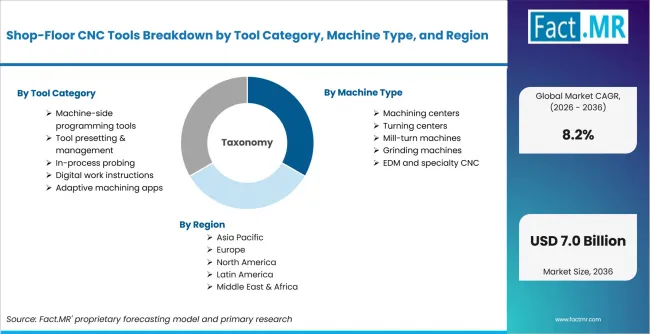
Shop Floor Cnc Tools Breakdown By Tool Category, Machine Type, And Region | Source: Fact.MR
| Attribute | Details |
|---|---|
| Quantitative Units | USD Billion |
| Market Definition | Digital and machine-side tools used on or near CNC machines to support programming, setup, probing, tool management, operator instructions and adaptive machining decisions. |
| Tool Category | Machine-side programming tools; Tool presetting & management; In-process probing; Digital work instructions; Adaptive machining apps |
| Machine Type | Machining centers; Turning centers; Mill-turn machines; Grinding machines; EDM and specialty CNC |
| Deployment | Controller-integrated; Edge workstation; Cloud-connected; Mobile and tablet; Standalone PC |
| Use Case | Setup reduction; Tool-life optimization; Quality and probing; Operator guidance; Program optimization |
| Regions Covered | North America; Latin America; Western Europe; Eastern Europe; East Asia; South Asia & Pacific; Middle East & Africa |
| Countries Covered | Germany; USA; Italy; Japan; UK |
| Companies Profiled | Siemens; FANUC; HEIDENHAIN; Renishaw; Sandvik Coromant; Hexagon |
| Forecast Period | 2026 to 2036 |
| Approach | Hybrid top-down and bottom-up approach using CNC installed base, machine type mix, shop-floor workflow adoption, country manufacturing data and provider portfolio review. |
Source: Fact.MR analysis. Updated Sep 7, 2026
How is the market segmented?
-
By Tool Category:
- Machine-side programming tools
- Tool presetting & management
- In-process probing
- Digital work instructions
- Adaptive machining apps
-
By Machine Type:
- Machining centers
- Turning centers
- Mill-turn machines
- Grinding machines
- EDM and specialty CNC
-
By Deployment:
- Controller-integrated
- Edge workstation
- Cloud-connected
- Mobile and tablet
- Standalone PC
-
By Use Case:
- Setup reduction
- Tool-life optimization
- Quality and probing
- Operator guidance
- Program optimization
-
By Region:
- North America
- Latin America
- Western Europe
- Eastern Europe
- East Asia
- South Asia & Pacific
- Middle East & Africa
Frequently Asked Questions
How big is the shop-floor CNC tools market in 2026?
What is the CAGR of the shop-floor CNC tools market from 2026 to 2036?
Which tool category leads the shop-floor CNC tools market?
Which machine type leads the shop-floor CNC tools market?
Who are the leading companies in the shop-floor CNC tools market?
Who worked on this report


Preview the report firsthand - request a free sample
Free SampleGet the brochure for pricing and purchase details
Download PDF