- Base Value(2025): 1.1 Bn
- Estimated Value(2026): 1.1 Bn
- Forecast Value (2036): 1.8 Bn
- CAGR (2026 - 2036): 4.9%
Mackerel Market Analysis and Forecast by Fact.MR
The mackerel market, valued at USD 1.09 billion in 2025, is expanding at a 4.9% CAGR to reach USD 1.845 billion by 2036. Mackerel (Scomber scombrus, Scomber japonicus, and related species) is a commercially harvested pelagic fish consumed globally in fresh, frozen, canned, and smoked forms. Growth is shaped by rising omega-3 fatty acid awareness driving oily fish consumption, expanding canned and processed mackerel distribution in emerging markets, sustainable fishery certification improving consumer confidence, and pet food industry demand for marine protein ingredients.
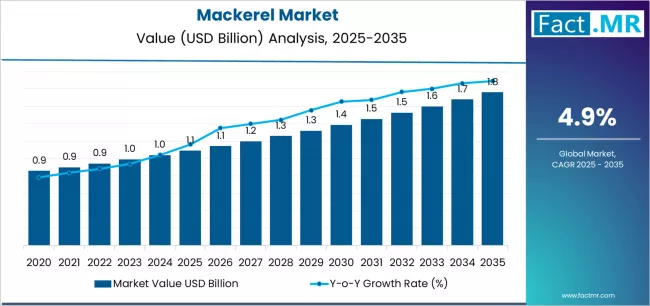
Mackerel Market Market Value Analysis | Source: Fact.MR
Summary of Mackerel Market
- Market Snapshot
- The mackerel market is valued at USD 1.09 billion in 2025.
- Estimated market value for 2026 is USD 1.143 billion, projected to reach USD 1.845 billion by 2036.
- A CAGR of 4.9% is forecast for the 2026 to 2036 assessment period.
- Incremental opportunity of USD 0.702 billion between 2026 and 2036.
- Frozen mackerel holds 38.9% of the product segment, with whole fish accounting for 34.7% of form demand.
- India and China are the fastest-growing markets for mackerel consumption.
- Demand and Growth Drivers
- Omega-3 fatty acid health awareness is driving oily fish consumption globally. Mackerel contains 2.5 to 3.0 grams of omega-3 per 100g serving, positioning it as one of the most omega-3-dense commercially available fish species at price points below salmon and tuna.
- Canned mackerel distribution is expanding in Sub-Saharan Africa, South Asia, and Southeast Asia, where shelf-stable protein products serve food security needs in markets with limited cold chain infrastructure.
- MSC (Marine Stewardship Council) certification of mackerel fisheries in the Northeast Atlantic and North Pacific is improving consumer confidence and enabling access to sustainability-conscious retail channels in Europe and North America.
- Pet food industry demand for marine protein ingredients is creating a secondary demand channel, with mackerel used in premium wet cat food, dog food, and aquaculture feed formulations.
- Product and Segment View
- Frozen mackerel holds 38.9% of the product segment, reflecting the dominance of frozen whole fish and fillet trade in international mackerel commerce.
- Food consumption captures 44.1% of application demand, driven by household and retail purchase for direct human consumption.
- Supermarkets and hypermarkets account for 36.8% of distribution channel share, reflecting the primary retail channel for fresh, frozen, and canned mackerel.
- Key segmentation includes:
- Product: Frozen Mackerel, Fresh Mackerel, Canned Mackerel, Smoked Mackerel, Processed Mackerel Products
- Application: Food Consumption, Food Service, Processed Food Industry, Pet Food Industry, Nutraceutical Applications
- End Use: Household Consumers, Food Service Operators, Seafood Processors, Pet Food Manufacturers, Nutraceutical Companies
- Distribution Channel: Supermarkets and Hypermarkets, Convenience Stores, Online Retail, Specialty Stores, Wholesale Distribution
- Form: Whole Fish, Fillet Form, Canned Form, Smoked Form
- Preservation Method: Frozen Preservation, Fresh Chilled, Canned Preservation, Smoked Preservation
- Pricing Tier: Mid Range, Economy, Premium, Ultra Premium
- Geography and Competitive Outlook
- North America accounts for significant revenue, with the USA generating USD 0.407 billion in 2025.
- East Asia is a major production and consumption centre, with Japan contributing USD 0.061 billion and South Korea contributing USD 0.036 billion in 2025.
- Thai Union Group Public Company Ltd. holds approximately 11.0% of global market share through its integrated seafood processing and canned mackerel operations.
- Maruha Nichiro Corporation, Mowi ASA, and Dongwon Industries compete on processing scale, species sourcing, and distribution reach.
- Analyst Opinion
- The mackerel market is a commodity seafood sector where growth depends on three interconnected factors: wild catch quota management by national fisheries authorities, consumer awareness of omega-3 health benefits relative to competing oily fish species (salmon, sardine), and processing infrastructure that enables value-added product development beyond whole frozen fish trade. Companies that invest in canned, smoked, and ready-to-eat mackerel product development will capture premiumisation value in a category that has historically been traded primarily as a frozen commodity.
Key Growth Drivers, Constraints, and Opportunities
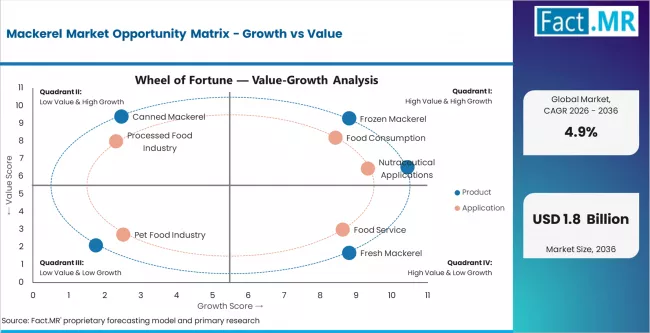
Mackerel Market Opportunity Matrix Growth Vs Value | Source: Fact.MR
Key Factors Driving Growth
- Global mackerel catch volumes exceeded 5 million tonnes annually in 2024, per FAO FishStat data, with the Northwest Pacific, Northeast Atlantic, and Eastern Pacific as primary fishing grounds. Mackerel is among the world's most abundant commercially fished pelagic species, with quota allocations that support sustained harvest levels in well-managed fisheries.
- Canned mackerel is one of the most price-accessible shelf-stable protein sources in developing markets. A 155g can of mackerel delivers 20 to 25 grams of protein at retail prices of USD 0.50 to USD 1.50, making it a critical food security product in Sub-Saharan Africa (Nigeria, Ghana, DR Congo), where canned mackerel imports exceed 500,000 tonnes annually.
- Smoked mackerel consumption in Northern Europe (UK, Germany, Scandinavia, Netherlands) is a stable premium segment where traditional cold-smoked and hot-smoked mackerel products command retail prices of EUR 15 to EUR 25 per kilogram, 3 to 5 times above frozen whole mackerel.
Key Market Constraints
- Quota allocation disputes among fishing nations, particularly the EU-Norway-UK-Iceland Northeast Atlantic mackerel quota negotiations, create supply uncertainty. Disagreements over total allowable catch (TAC) and national quota shares have periodically resulted in MSC certification suspension for Northeast Atlantic mackerel, affecting access to sustainability-conscious retail channels.
- Mercury and histamine content management in mackerel processing requires rigorous quality control. Mackerel, as a pelagic oily fish, accumulates methylmercury and is susceptible to histamine formation if temperature control during harvest and processing is inadequate. Regulatory maximum limits (EU: 0.5 mg/kg mercury; FDA: 50 ppm histamine) require continuous monitoring.
- Competition from farmed salmon, which offers comparable omega-3 content with more consistent supply and pricing, constrains mackerel market share growth in premium oily fish segments. Salmon's broader consumer appeal, milder flavour, and boneless fillet convenience position it as the preferred oily fish in many Western markets.
Key Opportunity Areas
- Ready-to-eat mackerel products (mackerel pate, mackerel in flavoured sauces, smoked mackerel salad preparations) are creating value-added sub-categories that increase revenue per unit by 50 to 150% over commodity frozen mackerel. These products target convenience-oriented consumers who want omega-3 benefits without fish preparation.
- Mackerel oil as a nutraceutical omega-3 source is a growing high-value application. Mackerel oil's naturally high EPA and DHA content makes it a cost-effective alternative to cod liver oil and krill oil in omega-3 supplement production.
- African market expansion for canned mackerel represents the largest volume growth opportunity. Per-capita fish consumption in Sub-Saharan Africa is 10 kg annually versus the global average of 20 kg, and canned mackerel is the primary format for increasing fish protein accessibility in the region.
Segment-wise Analysis of the Mackerel Market
- Frozen mackerel holds 38.9% of the product segment, reflecting the dominance of frozen formats in international mackerel trade.
- Food consumption captures 44.1% of application demand, driven by direct human consumption of mackerel products.
- Mid-range pricing accounts for 46.5% of pricing tier demand, reflecting the mainstream positioning of mackerel as an affordable oily fish.
Which product type dominates the Mackerel Market?
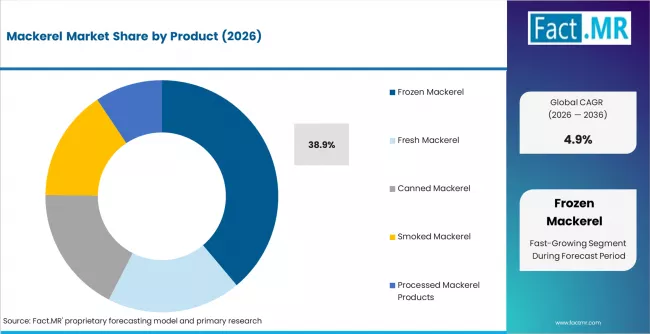
Mackerel Market Analysis By Product | Source: Fact.MR
Frozen mackerel controls 38.9% of the product segment. Frozen whole mackerel and frozen mackerel fillets dominate international trade, with China, Norway, and Japan as primary exporters. Frozen preservation maintains quality during long-distance transport and enables year-round availability despite seasonal fishing periods. Individual quick freezing (IQF) technology is the standard processing method for commercially traded frozen mackerel.
Canned mackerel holds the second-largest share, driven by shelf-stable protein demand in Africa and Asia. Fresh mackerel serves local coastal markets. Smoked mackerel is the fastest-growing product type in premium-positioned European markets.
Which application drives demand in the Mackerel Market?
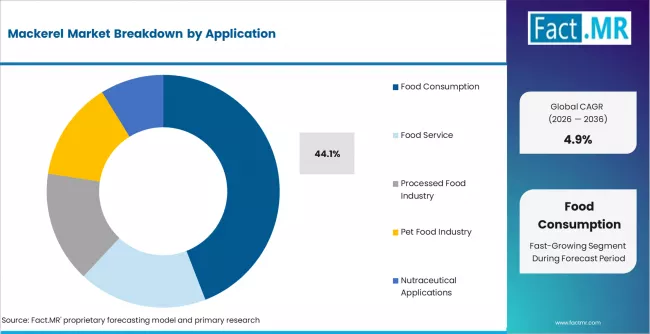
Mackerel Market Analysis By Application | Source: Fact.MR
Food consumption accounts for 44.1% of application demand. Direct human consumption through household cooking and retail purchase is the primary demand driver. Mackerel is consumed grilled, baked, fried, canned, smoked, and as sashimi (saba) in Japanese cuisine. Consumption patterns vary significantly by region, with smoked and canned formats dominant in Europe and whole fish dominant in Asia and Africa.
Food service holds the second-largest share, with restaurants and catering operations using mackerel in sushi, grilled fish menus, and prepared seafood dishes. Pet food industry demand is a growing secondary application.
Which preservation method captures the largest share in the Mackerel Market?
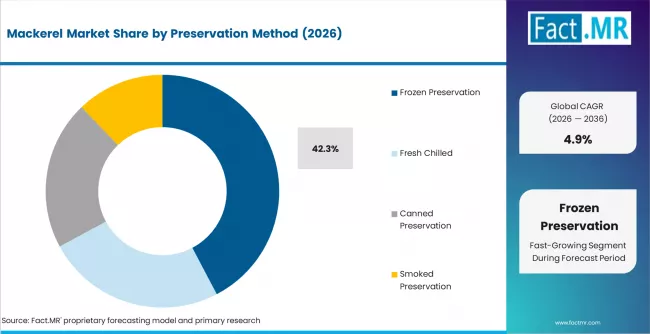
Mackerel Market Analysis By Preservation Method | Source: Fact.MR
Frozen preservation accounts for 42.3% of preservation method demand. Freezing at minus 18C or below within hours of harvest preserves omega-3 content, texture, and nutritional value for international distribution. Blast freezing and IQF technologies enable efficient processing of large catch volumes during seasonal fishing periods.
Canned preservation holds the second-largest share, providing 2 to 5 year shelf stability without refrigeration. Fresh chilled serves premium markets within 24 to 48 hours of harvest. Smoked preservation (hot and cold smoking) serves the premium European consumption occasion.
Which Product Trend is Shaping the Next Phase of Growth in the Mackerel Market?
The fastest-growing product trend in the mackerel market is the development of value-added, ready-to-eat mackerel products that address the convenience barrier limiting mackerel consumption growth in developed markets. Traditional mackerel consumption requires whole fish preparation (gutting, filleting, bone removal) or acceptance of canned products with limited flavour variety. The emerging product trend bridges this gap with mackerel pate, smoked mackerel flakes, mackerel in teriyaki or peri-peri sauce, and mackerel salad toppers that deliver omega-3 nutrition in convenient, no-preparation formats.
The commercial significance is that value-added mackerel products compete for the convenient protein occasion against canned tuna, smoked salmon, and deli meat products, expanding mackerel's competitive frame beyond the traditional fresh fish counter. These products command retail prices of USD 4 to USD 8 per serving versus USD 1 to USD 2 for commodity canned mackerel, delivering 2 to 4 times the revenue per unit of raw material. Companies that invest in flavour development, convenient packaging (peel-top cans, pouches), and retail placement outside the traditional canned fish aisle will capture this premiumisation opportunity.
Regional Outlook Across Key Markets
.webp "Top Country Growth Comparison Mackerel Market Cagr (2026 2036)")
Top Country Growth Comparison Mackerel Market Cagr (2026 2036) | Source: Fact.MR
- North America is a significant market, with the USA contributing USD 0.407 billion in 2025 revenue.
- East Asia is a major production and consumption centre, with Japan at USD 0.061 billion and South Korea at USD 0.036 billion.
- South Asia and Pacific is the fastest-growing region, driven by mackerel consumption expansion in India.
- Europe is a mature market with established smoked and canned mackerel consumption.
CAGR Table
| Country | CAGR (%) |
|---|---|
| India | 5.8% |
| China | 5.4% |
| Brazil | 4.9% |
| Japan | 4.6% |
| USA | 4.4% |
| Germany | 4.2% |
| UK | 4.1% |
Source: Fact.MR analysis. Updated Apr 30, 2026
Source: Fact.MR analysis, based on proprietary forecasting model and primary research.

Mackerel Market Cagr Analysis By Country | Source: Fact.MR
India: Affordable protein demand and canned fish distribution expansion drive growth
India leads country-level growth. Mackerel (bangda) is a traditional food fish in coastal Indian states (Maharashtra, Goa, Kerala, Karnataka), and consumption is expanding inland through canned and frozen distribution. India's domestic mackerel catch from the Arabian Sea and Bay of Bengal is supplemented by imports from Thailand and China.
- India's marine fish production exceeded 4 million tonnes in 2024, per CMFRI data, with mackerel among the top five species by catch volume.
China: Processing hub and domestic consumption expansion define positioning
China is both the world's largest mackerel processor and an expanding domestic consumption market. Chinese processing facilities in Shandong, Fujian, and Zhejiang provinces handle mackerel imported from Norway, Iceland, and the North Pacific, producing frozen fillets, canned products, and surimi for domestic and export markets.
- China's mackerel processing output exceeded 1.5 million tonnes in 2024, per China Fisheries Statistical Yearbook data.
Brazil: Affordable seafood demand and canned fish growth sustain adoption
Brazil's growth reflects expanding canned fish consumption driven by price-accessible protein demand. Canned mackerel and sardine products are staple shelf-stable proteins in Brazilian retail, and domestic consumption is growing as distribution reaches interior cities beyond traditional coastal markets.
- Brazil's canned fish market grew 6% in 2024, per ABIA data, with canned mackerel maintaining steady share alongside sardine products.
Japan: Saba cuisine tradition and premium consumption sustain demand
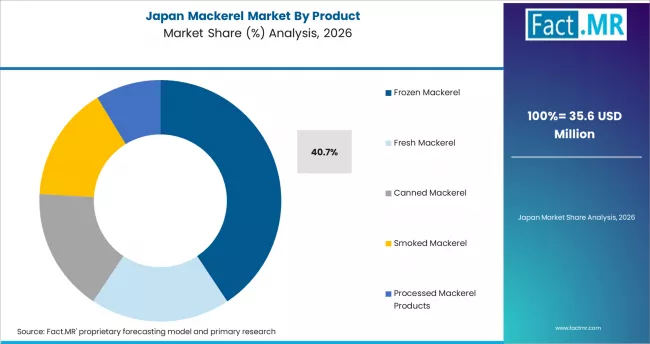
Mackerel Market Japan Market Share Analysis By Product | Source: Fact.MR
Japan contributes USD 0.061 billion in 2025. Japan has the world's deepest mackerel culinary tradition, consuming saba (mackerel) as sashimi, grilled (shioyake), simmered (misoni), and cured (shime saba). Japanese mackerel consumption is concentrated in premium domestic species (masaba) alongside imported frozen product.
- Japan's domestic mackerel catch exceeded 300,000 tonnes in 2024, per Ministry of Agriculture, Forestry, and Fisheries data.
USA: Omega-3 awareness and canned seafood growth drive consumption

Mackerel Market Country Value Analysis | Source: Fact.MR
The USA generates USD 0.407 billion in 2025 revenue. US mackerel demand is driven by omega-3 health awareness and expanding canned seafood consumption. King mackerel and Atlantic mackerel are the primary commercially available species in US retail. Smoked mackerel is gaining specialty retail shelf space.
- US canned seafood sales grew 5% in 2024, per NOAA Fisheries data, with mackerel products gaining share in the canned fish category.
Germany: Smoked mackerel tradition and sustainable sourcing drive demand
Germany's growth reflects strong traditional demand for smoked mackerel (Rauchermakrele) and growing consumer interest in sustainably sourced seafood. MSC-certified mackerel products command premium shelf positioning in German supermarket seafood counters.
- Germany's smoked fish market exceeded EUR 800 million in 2024, per BVL data, with mackerel maintaining its position as the second-most consumed smoked fish species after salmon.
UK: Canned and smoked mackerel consumption sustain steady demand
UK growth is driven by established smoked mackerel consumption and expanding canned mackerel usage. Smoked mackerel is a pantry staple in UK households, consumed in salads, pate, and as a standalone protein. The UK market benefits from proximity to Northeast Atlantic mackerel fishing grounds.
- UK mackerel consumption exceeded 40,000 tonnes in 2024, per Seafish industry data, with smoked formats accounting for the largest share of retail mackerel sales.
Competitive Benchmarking and Company Positioning

Mackerel Market Analysis By Company | Source: Fact.MR
Mackerel Market Analysis By Company
- Thai Union Group Public Company Ltd. holds approximately 11.0% of global revenue through its integrated seafood processing operations spanning canned mackerel, frozen mackerel, and value-added mackerel product lines.
- Maruha Nichiro Corporation and Dongwon Industries compete on processing scale, species diversification, and distribution in East Asian and global markets.
- Mowi ASA and Ocean Treasure World Foods serve specific regional markets and product niches within the mackerel competitive field.
The competitive structure is moderately fragmented, with Thai Union holding the largest share at 11.0%. Thai Union's position is built on integrated seafood processing capability spanning Thailand, Vietnam, and European operations, with canned mackerel production for African export markets as a significant revenue contributor. The company's brand portfolio (John West, Chicken of the Sea) provides retail distribution reach that commodity mackerel traders lack.
Competition varies by product form. In frozen mackerel trade, Chinese and Norwegian processors compete primarily on price and volume. In canned mackerel, Thai Union, Siam Canadian, and regional African brands compete on price accessibility and distribution reach. In smoked mackerel, UK and Northern European processors compete on product quality, origin specification, and sustainability certification.
Key Companies in the Mackerel Market
- The mackerel competitive field includes Thai Union Group Public Company Ltd., Siam Canadian Foods Co. Ltd., Ocean Treasure World Foods Limited, Pinetree Vietnam Company Limited, Subo International Holland, Viet Ocean Seafood Vietnam, Ocean More Foods Co. Limited, Mowi ASA, Maruha Nichiro Corporation, and Dongwon Industries Co. Ltd.
- Recent Industry Developments
- Thai Union: value-added mackerel product range (2025)
- Thai Union launched a new range of mackerel in flavoured sauces (teriyaki, tomato basil, lemon pepper) under its John West brand, targeting the convenience seafood occasion in UK and Australian retail.
- Maruha Nichiro: premium saba product line expansion (2025)
- Maruha Nichiro expanded its premium saba (mackerel) product line in Japan with new ready-to-eat grilled mackerel portions and mackerel rice bowl (saba don) products for convenience store distribution.
- Dongwon Industries: canned mackerel African distribution (2026)
- Dongwon Industries expanded canned mackerel distribution to West and East African markets, establishing supply partnerships with distributors in Nigeria, Ghana, and Kenya.
- Mowi ASA: mackerel pelagic fish processing expansion (2025)
- Mowi expanded its pelagic fish processing capacity at its Scottish facility, increasing mackerel processing throughput for smoked and value-added product lines.
Leading Companies Shaping the Mackerel Market
-
Global Players
- Thai Union Group Public Company Ltd.
- Maruha Nichiro Corporation
- Mowi ASA
- Dongwon Industries Co., Ltd.
-
Regional Players
- Siam Canadian Foods Co. Ltd.
- Ocean Treasure World Foods Limited
- Pinetree Vietnam Company Limited
- Subo International Holland
-
Emerging / Start-up Players
- Viet Ocean Seafood Vietnam
- Ocean More Foods Co., Limited
- Wild Planet Foods
Sources and Research References
- Company annual reports from Thai Union Group, Maruha Nichiro, and Mowi ASA.
- FAO FishStat global mackerel catch and trade statistics.
- MSC (Marine Stewardship Council) mackerel fishery certification data.
- CMFRI (Central Marine Fisheries Research Institute) India marine fish production data.
- NOAA Fisheries US seafood consumption and production statistics.
- Seafish UK seafood industry data and consumption reports.
All cited sources are first-party company filings, government fisheries agencies, international organisations, or industry associations. No syndicated market research reports were used.
Key Questions This Report Addresses
- What is the projected market value for mackerel by 2036?
- Which product type holds the largest share?
- What CAGR is forecast from 2026 to 2036?
- How is omega-3 awareness driving mackerel consumption?
- Which countries are growing fastest?
- What is the competitive structure?
- How are value-added mackerel products changing the category?
- What role does canned mackerel play in food security?
- How do quota negotiations affect mackerel supply?
Mackerel Market Definition
The mackerel market encompasses the harvest, processing, and trade of mackerel species for human consumption, pet food, and nutraceutical applications. Products include fresh, frozen, canned, and smoked mackerel in whole, fillet, and processed formats sold through retail, foodservice, wholesale, and industrial channels.
Mackerel Market Inclusions
- Fresh, frozen, canned, and smoked mackerel products for human consumption.
- Mackerel fillets, steaks, and ready-to-eat mackerel products.
- Mackerel used as a raw material in pet food and aquaculture feed manufacturing.
- Mackerel oil used in nutraceutical omega-3 supplement production.
Mackerel Market Exclusions
- Horse mackerel and jack mackerel species classified separately from true mackerel.
- Fish meal and fish oil produced from mackerel processing waste for industrial applications.
- Live mackerel used as bait in recreational and commercial fishing.
- Mackerel aquaculture (currently minimal commercial production volume).
Mackerel Market Research Methodology
- Primary research with mackerel processors, fishing fleet operators, seafood distributors, and retail buyers across 12 countries.
- Revenue modelling based on FAO catch statistics, trade flow data, and processor-reported sales.
- Pricing analysis using seafood exchange data, wholesale market records, and retail shelf pricing surveys.
- Competitive share estimation through company annual reports, seafood industry association data, and port landing records.
- Demand validation through FAO fish consumption statistics, dietary survey references, and pet food ingredient consumption data.
Segmentation
Scope of Analysis
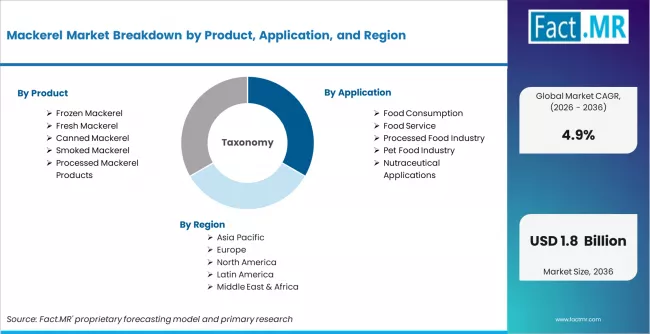
Mackerel Market Breakdown By Product, Application, And Region | Source: Fact.MR
| Parameter | Details |
|---|---|
| Report Currency | USD Billion |
| Market Value (2025) | USD 1.09 Billion |
| Forecast Value (2036) | USD 1.845 Billion |
| CAGR (2026 to 2036) | 4.9% |
| Product | Frozen Mackerel, Fresh Mackerel, Canned Mackerel, Smoked Mackerel, Processed Mackerel Products |
| Application | Food Consumption, Food Service, Processed Food Industry, Pet Food Industry, Nutraceutical Applications |
| End Use | Household Consumers, Food Service Operators, Seafood Processors, Pet Food Manufacturers, Nutraceutical Companies |
| Distribution Channel | Supermarkets and Hypermarkets, Convenience Stores, Online Retail, Specialty Stores, Wholesale Distribution |
| Form | Whole Fish, Fillet Form, Canned Form, Smoked Form |
| Preservation Method | Frozen Preservation, Fresh Chilled, Canned Preservation, Smoked Preservation |
| Pricing Tier | Mid Range, Economy, Premium, Ultra Premium |
| Regions | North America, Latin America, Europe, East Asia, South Asia and Pacific, Middle East and Africa |
| Countries | India, China, Brazil, Japan, USA, Germany, UK, and 40+ countries |
| Companies | Thai Union Group, Siam Canadian Foods, Ocean Treasure, Pinetree Vietnam, Subo International, Viet Ocean Seafood, Ocean More Foods, Mowi ASA, Maruha Nichiro, Dongwon Industries |
| Forecast Period | 2026 to 2036 |
| Approach | Top-down and bottom-up with primary and secondary research |
Source: Fact.MR analysis. Updated Apr 30, 2026
Market Segmentation Analysis
-
Mackerel Market Market Segmented by Product:
- Frozen Mackerel
- Whole Frozen Mackerel
- Fillet Frozen Mackerel
- Steak Cuts
- Fresh Mackerel
- Whole Fresh Mackerel
- Fillet Fresh Mackerel
- Canned Mackerel
- Oil Packed Mackerel
- Brine Packed Mackerel
- Tomato Sauce Packed Mackerel
- Smoked Mackerel
- Cold Smoked Mackerel
- Hot Smoked Mackerel
- Processed Mackerel Products
- Mackerel Paste
- Mackerel Spread
- Mackerel Mince
- Frozen Mackerel
-
Mackerel Market Market Segmented by Application:
- Food Consumption
- Home Cooking
- Retail Ready Meals
- Food Service
- Restaurants
- Hotels
- Catering Services
- Processed Food Industry
- Seafood Snacks
- Canned Food Manufacturing
- Surimi and Fish-Based Products
- Pet Food Industry
- Pet Food Formulations
- Aquatic Feed Ingredients
- Nutraceutical Applications
- Omega 3 Supplements
- Fish Oil Extraction
- Food Consumption
-
Mackerel Market Market Segmented by End Use:
- Household Consumers
- Health Conscious Consumers
- Budget Consumers
- Food Service Operators
- Horeca Sector
- Quick Service Restaurants
- Seafood Processors
- Canning Companies
- Frozen Food Manufacturers
- Pet Food Manufacturers
- Dry Pet Food Producers
- Wet Pet Food Producers
- Nutraceutical Companies
- Omega 3 Supplement Brands
- Functional Food Producers
- Household Consumers
-
Mackerel Market Market Segmented by Distribution Channel:
- Supermarkets and Hypermarkets
- Seafood Retail Chains
- Grocery Stores
- Convenience Stores
- Small Format Retail
- Online Retail
- E Commerce Grocery Platforms
- Quick Commerce Platforms
- Specialty Stores
- Seafood Markets
- Frozen Food Stores
- Wholesale Distribution
- Horeca Supply Chains
- Industrial Seafood Distributors
- Supermarkets and Hypermarkets
-
Mackerel Market Market Segmented by Form:
- Whole Fish
- Gutted Whole Fish
- Head On Whole Fish
- Fillet Form
- Skin On Fillets
- Skinless Fillets
- Canned Form
- Ready To Eat Cans
- Single Serve Packs
- Smoked Form
- Sliced Smoked Fish
- Vacuum Packed Smoked Fish
- Whole Fish
-
Mackerel Market Market Segmented by Preservation Method:
- Frozen Preservation
- Blast Frozen Fish
- IQF Individually Quick Frozen
- Fresh Chilled
- Ice Stored Fish
- Cold Chain Distribution
- Canned Preservation
- Thermally Sterilized Cans
- Retail Shelf Stable Packs
- Smoked Preservation
- Natural Smoke Preservation
- Salt Curing Methods
- Frozen Preservation
-
Mackerel Market Market Segmented by Pricing Tier:
- Mid Range
- Retail Frozen Fish
- Canned Branded Products
- Economy
- Bulk Frozen Mackerel
- Commodity Grade Fish
- Premium
- Fresh Wild Caught Mackerel
- Smoked Specialty Fish
- Ultra Premium
- Organic Certified Seafood
- Sustainable Wild Catch Premium
- Mid Range
-
Mackerel Market Market by Region:
- North America
- USA
- Canada
- Mexico
- Latin America
- Brazil
- Chile
- Rest of Latin America
- Western Europe
- Germany
- UK
- Italy
- Spain
- France
- Nordic
- BENELUX
- Rest of Western Europe
- Eastern Europe
- Russia
- Poland
- Hungary
- Balkan & Baltic
- Rest of Eastern Europe
- East Asia
- China
- Japan
- South Korea
- South Asia and Pacific
- India
- ASEAN
- Australia & New Zealand
- Rest of South Asia and Pacific
- Middle East & Africa
- Kingdom of Saudi Arabia
- Other GCC Countries
- Turkiye
- South Africa
- Other African Union
- Rest of Middle East & Africa
- North America
Frequently Asked Questions
What is the current market size?
What growth rate is expected?
Which product type leads?
Which application is largest?
Which country is growing fastest?
What is the incremental opportunity?
Which company holds the largest share?
Who worked on this report


Preview the report firsthand - request a free sample
Free SampleGet the brochure for pricing and purchase details
Download PDF