- Base Value(2025): 583 Mn
- Estimated Value(2026): 620 Mn
- Forecast Value (2036): 1142 Mn
- CAGR (2026 - 2036): 6.3%
Anti Carbonation Coatings Market Forecast and Outlook 2026 to 2036
In 2025, the anti-carbonation coatings market was valued at USD 583 million. Based on Fact.MR analysis, demand for anti-carbonation coatings is estimated to grow to USD 620 million in 2026 and USD 1,142 million by 2036. Fact.MR projects a CAGR of 6.3% during the forecast period. Growth reflects sustained specification of carbonation resistant systems across public infrastructure, transport assets, and exposed concrete structures.
The market adds approximately USD 559 million in value over the decade, reflecting steady compounding rather than step change expansion. Demand progression tracks inspection cycles, refurbishment funding, and compliance with EN 1504 performance requirements. Pricing trends are shaped by polymer system selection, application method, and certified durability thresholds, which limit substitution by decorative coatings and anchor repeat demand.
As Thomas Hasler, Chief Executive Officer of Sika, noted while discussing 2024 performance and refurbishment driven growth, “Despite a market environment that remains very challenging, we achieved new record sales and an over proportional increase in profits... Sika thus once again expanded its market share in the past fiscal year.” The statement aligns with Sika Strategy 2028, where refurbishment and concrete protection form a central revenue pillar, as per Fact.MR assessment of supplier disclosures. [1]
India records the fastest growth at 7.2% CAGR due to bridge and urban infrastructure rehabilitation programs. Vietnam follows at 6.9% on coastal and transport asset protection, while Indonesia grows at 6.8% through national infrastructure upkeep. China posts 6.1% supported by concrete durability codes, and the U.A.E. reaches 5.8% driven by climate related protection needs. Mature markets including the United States at 3.6% and Germany at 2.7% remain replacement led, constrained by long refurbishment intervals and strict approval frameworks.
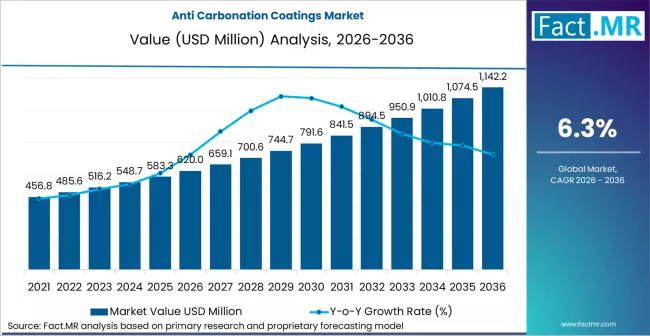
Anti Carbonation Coatings Market Market Value Analysis | Source: Fact.MR
Anti-Carbonation Coatings Market Definition
The anti-carbonation coatings market covers protective coating materials applied to concrete surfaces to slow the penetration of carbon dioxide from the atmosphere. Carbon dioxide reacts with concrete over time and lowers its alkalinity, which increases the risk of steel reinforcement corrosion. Anti-carbonation coatings form a barrier that reduces gas diffusion while allowing moisture vapor to escape, as defined under EN 1504-2 standards for concrete protection systems published by CEN [2]. These coatings are used on buildings, bridges, parking structures, and other reinforced concrete assets.
Anti-Carbonation Coatings Market Inclusions
The report covers global and regional market size estimates in volume and value terms with a forecast period from 2026 to 2036. It includes segmentation by resin type such as acrylic, elastomeric, and cementitious systems referenced in EN 1504-2 [3], application areas including buildings and civil infrastructure, and end use sectors such as construction and public infrastructure. The scope also includes regional demand patterns and pricing benchmarks linked to concrete repair activity.
Anti-Carbonation Coatings Market Exclusions
The scope excludes waterproofing membranes and protective coatings designed primarily for water ingress control rather than carbon dioxide diffusion, as regulated separately under construction product standards. Decorative architectural paints without certified carbonation resistance are not included. Downstream repair systems sold as complete refurbishment packages, consumer grade coatings, laboratory scale materials, and experimental surface treatments without documented use under EN 1504 frameworks are also excluded.
Anti-Carbonation Coatings Market Research Methodology
- Primary Research: Primary research involved interviews with concrete repair contractors, coating manufacturers, civil engineers, and asset owners managing reinforced concrete structures under public infrastructure programs.
- Desk Research: Desk research used EN 1504 series standards from CEN, technical guidance from the American Concrete Institute, government infrastructure maintenance manuals, and company annual reports and technical product datasheets filed with securities regulators.
- Market Sizing and Forecasting: Market sizing applied a hybrid model combining concrete repair area estimates from public infrastructure inventories with coating consumption rates specified in EN 1504-2 and national construction spending data.
- Data Validation and Update Cycle: Outputs were validated through cross checks against government construction statistics, procurement disclosures, and regulatory documentation, with updates applied when verified public sources release revisions.
Summary of anti-carbonation coatings market
- Market definition
- The anti-carbonation coatings market covers protective coatings applied to reinforced concrete surfaces to limit carbon dioxide diffusion, maintain alkalinity, and reduce corrosion risk of steel reinforcement, as defined under EN 1504-2 concrete protection standards published by CEN
- Demand drivers
- Public infrastructure owners specify anti carbonation coatings to meet service life extension requirements embedded in concrete durability and refurbishment standards rather than new construction volumes, based on Fact.MR analysis.
- Transport authorities and municipal asset managers procure anti carbonation coatings through inspection-led maintenance cycles for bridges, parking structures, and tunnels, aligned with EN 1504 performance compliance
- Urban pollution exposure, coastal environments, and climate stress accelerate carbonation risk in concrete, driving repeat demand for certified protective systems across Asia Pacific and the Middle East, as per Fact.MR.
- Key segments analyzed
- Technology: Acrylic elastomeric coatings lead with an estimated 39% share in 2026 due to crack-bridging capability and vapor permeability under EN 1504-2 requirements, based on Fact.MR
- Structure type: Building facades account for around 35% of demand, reflecting large refurbishment volumes and local code requirements for exterior concrete protection, according to Fact.MR.
- Geography: Asia Pacific records the fastest growth led by India, Vietnam, Indonesia, and China, while North America and Europe remain replacement-driven markets, based on Fact.MR analysis.
- Analyst opinion at Fact.MR
- Shambhu Nath Jha, Principal Consultant at Fact.MR, opines, ‘CXOs will find that demand for anti-carbonation coatings follows refurbishment intensity and compliance with concrete durability standards, rather than short-term construction activity.’
- Strategic implications and executive takeaways
- Fact.MR is of the opinion that suppliers should align capacity and sales planning with refurbishment funding cycles and inspection schedules.
- Fact.MR opines that product portfolios should prioritize EN 1504-compliant elastomeric and polymer-modified systems to secure specification-led projects.
- Fact.MR analysts recommend strengthening technical documentation and approval credentials to maintain eligibility across public infrastructure tenders.
- Methodology
- Based on Fact.MR’s report, estimates draw on primary interviews with coating manufacturers, concrete repair contractors, civil engineers, and asset owners.
- Fact.MR analysis integrates EN 1504 series standards, infrastructure maintenance manuals, and company technical disclosures
- Outputs were validated through cross-checks with government construction statistics and public procurement disclosures.
Segmental Analysis
Anti-carbonation coatings market analysis by technology
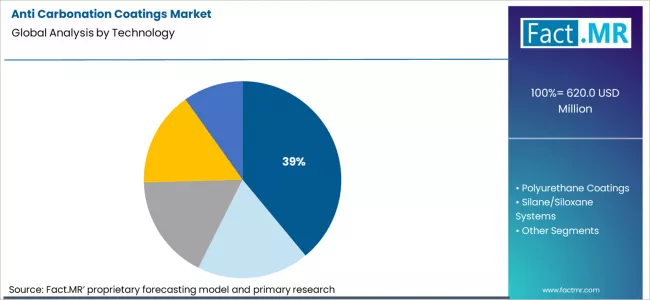
Anti Carbonation Coatings Market Analysis By Technology | Source: Fact.MR
Based on FACT.MR's anti carbonation coatings market report, consumption of acrylic elastomeric coatings is estimated to hold 39% share in 2026. FACT.MR analysts note acrylic elastomeric systems deliver high elongation and crack-bridging performance that limits CO₂ ingress on concrete substrates, allowing asset owners to extend repaint cycles. FACT.MR opines buyers select these products where surface movement and long outdoor exposure create a need for a flexible, breathable protective film.
- Capacity investment: PPG announced a multi-year investment program to expand waterborne and industrial coatings manufacturing capacity in North America, enabling higher supply of elastomeric and acrylic exterior coatings to meet growing refurbishment demand
- Product development: Sika publishes product data for Sikagard-550 W IN and Sikagard-5500 showing UV-cured acrylic dispersion formulations with specified crack-bridging and anti-carbonation performance in their technical data sheets
- Specification trend: Fact.MR analysis and public procurement specifications increasingly cite elastomeric acrylics for façade refurbishment projects because their permeability and elongation permit long inspection intervals, supporting large renovation programmes in urban areas.
Anti-carbonation coatings market analysis by structure type
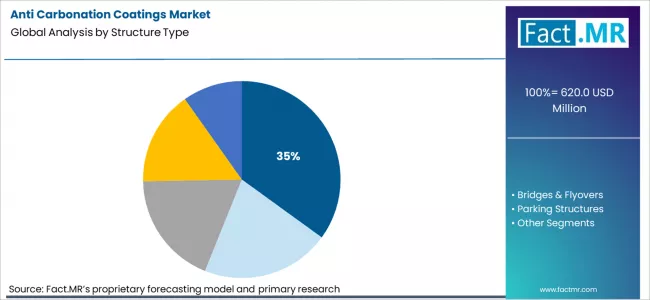
Anti Carbonation Coatings Market Analysis By Structure Type | Source: Fact.MR
Based on FACT.MR's anti-carbonation coatings market report, consumption for building facades is estimated to hold 35% share in 2026. As per FACT.MR, facades demand coatings that balance decorative finish with carbonation resistance and vapor permeability, which drives preference for elastomeric acrylic and polymer-modified systems. FACT.MR is of the opinion that refurbishment cycles and local building codes push owners toward systems that reduce lifecycle maintenance costs.
- Plant expansion: AkzoNobel opened a new multi-segment manufacturing site that includes capacity for protective and specialty exterior coatings to support regional façade and infrastructure refurbishment needs
- Product technical data: BASF documents MasterProtect 300 as an acrylic, elastomeric anti-carbonation coating with stated performance for concrete protection in its technical brochure
- Policy driver: The European Commission’s Renovation Wave targets large-scale building upgrades, creating sustained demand for façade repair and anti-carbonation systems that align with energy and durability retrofit specifications.
Anti-carbonation coatings market drivers, restraints, and opportunities
Fact.MR analysis indicates that the anti-carbonation coatings market exists as a protective solutions segment within the broader concrete coatings industry, driven by the need to prevent carbon dioxide penetration and rebar corrosion in reinforced concrete structures. As per FACT.MR, reinforced concrete carbonation reduces alkalinity around reinforcing steel, accelerating corrosion and structural degradation coatings with low CO₂ permeability are specified to slow that process and extend service life in bridges, parking structures, and marine-exposed infrastructure (anti-carbonation coatings prevent CO₂ ingress and moisture penetration). Anti-carbonation systems are benchmarked against European standard EN 1504 parts 2 and 9, which define requirements for surface protection and concrete repair principles for coatings intended to block carbonation and other aggressive agents.
FACT.MR is of the opinion that the market is shifting from basic decorative coatings toward performance-differentiated protective systems that meet formal test criteria for CO₂ diffusion resistance and field durability. Based on FACT.MR’s report, demand for generic paints declines where specifications call for measurable carbonation resistance and breathability, which often carry higher formulation costs. These advanced anti-carbonation products ship in lower volumes than decorative paints but command a premium price-per-unit because of additive complexity and compliance with EN 1504 performance characteristics, resulting in a net gain in market value despite slower tonnage growth (protective coatings must meet CO₂ resistance and water vapor diffusion criteria
- EN 1504 performance compliance: FACT.MR analysts note that specifications tied to EN 1504-2 and EN 1504-9 performance classes require anti carbonation coatings to demonstrate specific CO₂ permeability and adhesion criteria before acceptance in concrete protection projects, shaping product development and competitive dynamics [4].
- Infrastructure maintenance demand: Based on FACT.MR’s report, public infrastructure assets such as bridges, elevated highways, and exposed concrete facades in North America and Europe drive consistent demand for anti-carbonation coatings because prevention of carbonation-induced degradation is integrated into long-term asset management programs.
- Asia Pacific construction pressure: FACT.MR opines that rapid expansion of reinforced concrete construction in China, India, and Southeast Asia increases specification of anti-carbonation coatings to reduce lifecycle repair costs and align with global infrastructure standards increasingly referenced by local project owners seeking durable performance.
Regional Analysis
Based on regional assessment, the anti-carbonation coatings sector is analyzed across North America, Latin America, Europe, East Asia, South Asia, Oceania, and the Middle East & Africa, spanning more than 40 countries. Regional performance varies according to infrastructure investment, exposure to aggressive environments, and regulatory requirements for concrete protection. The report also presents a comparative market attractiveness evaluation grounded in region-specific demand trends.
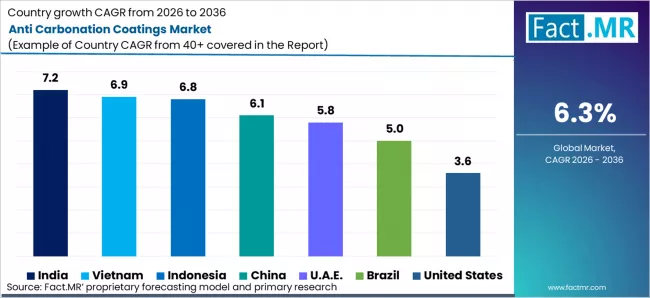
Anti Carbonation Coatings Market Cagr Analysis By Country | Source: Fact.MR
| Country | CAGR |
|---|---|
| India | 7.2% |
| Vietnam | 6.9% |
| Indonesia | 6.8% |
| China | 6.1% |
| U.A.E. | 5.8% |
| Brazil | 5.0% |
| United States | 3.6% |
| Germany | 2.7% |
Source: Fact.MR analysis. Updated Feb 14, 2026
Source: Fact.MR analysis, based on proprietary forecasting models and primary research.
Asia Pacific anti carbonation coatings market analysis
Asia Pacific functions as the primary growth engine for anti-carbonation coatings due to high exposure of reinforced concrete to humidity, urban pollution, and coastal conditions. Demand is tied to public infrastructure protection and high-rise construction. Regional suppliers such as Nippon Paint, Asian Paints, and Kansai Nerolac hold strong positions through project-driven concrete protection portfolios.
- India: Demand for anti-carbonation coatings in India is projected to rise at 7.2% CAGR through 2036. Growth is supported by concrete durability requirements under CPWD specifications updated in April 2021 and metro rail viaduct protection tenders issued by DMRC in August 2022, as per Fact.MR.
- Vietnam: Demand for anti-carbonation coatings in Vietnam is projected to rise at 6.9% CAGR through 2036. Usage is driven by durability standards under the Ministry of Construction issued in June 2020 and coastal bridge rehabilitation programs approved in September 2022, according to Fact.MR.
- Indonesia: Demand for anti-carbonation coatings in Indonesia is projected to rise at 6.8% CAGR through 2036. Uptake is linked to concrete protection norms under National Strategic Projects released in July 2021 and port structure rehabilitation specifications issued in March 2023, based on Fact.MR.
- China: Demand for anti-carbonation coatings in China is projected to rise at 6.1% CAGR through 2036. Consumption is supported by concrete durability codes under GB standards revised in October 2020 and urban infrastructure maintenance programs launched by local governments in May 2022, as per Fact.MR.
Fact.MR’s analysis of the anti-carbonation coatings market in Asia Pacific consists of country-wise assessment that includes India, Vietnam, Indonesia, and China. Readers can find public procurement activity, durability standards adoption, and application-level demand patterns.
Middle East anti carbonation coatings market analysis
The Middle East operates as a climate-driven protection market where carbonation resistance is required to extend concrete service life in hot and saline conditions. Demand is tied to infrastructure preservation rather than new capacity. Regional supply is shaped by project specifications and public sector maintenance programs.
- U.A.E.: Demand for anti-carbonation coatings in the U.A.E. is projected to rise at 5.8% CAGR through 2036. Growth is supported by concrete protection requirements under Dubai Municipality specifications updated in February 2021 and bridge refurbishment contracts issued by Abu Dhabi DOT in November 2022, according to Fact.MR.
Fact.MR’s analysis of the anti-carbonation coatings market in the Middle East consists of country-wise assessment that includes the U.A.E. Readers can find municipal standards, infrastructure maintenance trends, and coating specification data.
Latin America anti carbonation coatings market analysis
Latin America functions as a rehabilitation-led market for anti-carbonation coatings, supported by aging urban infrastructure and increased focus on concrete durability. Demand is shaped by public works refurbishment and transport asset protection. Regional suppliers operate through contractor-led project channels.
- Brazil: Demand for anti-carbonation coatings in Brazil is projected to rise at 5.0% CAGR through 2036. Consumption is supported by bridge maintenance guidelines issued by DNIT in May 2020 and metro infrastructure rehabilitation programs approved in São Paulo in August 2022, as per Fact.MR.
Fact.MR’s analysis of the anti-carbonation coatings market in Latin America consists of country-wise assessment that includes Brazil. Readers can find infrastructure refurbishment activity and application-level demand insights.
North America anti carbonation coatings market analysis
North America operates as a standards-led refurbishment market where anti carbonation coatings are specified to extend reinforced concrete service life. Demand is linked to public infrastructure rehabilitation and lifecycle cost management. Procurement follows federal and state-level durability guidelines.
- United States: Demand for anti-carbonation coatings in the United States is projected to rise at 3.6% CAGR through 2036. Growth is supported by bridge rehabilitation funding under the Infrastructure Investment and Jobs Act enacted in November 2021 and concrete durability guidance issued by FHWA in March 2022, based on Fact.MR.
Fact.MR’s analysis of the anti-carbonation coatings market in North America consists of country-wise assessment that includes the United States. Readers can find federal funding trends, standards adoption, and demand by application.
Europe anti carbonation coatings market analysis
Europe functions as a regulation-driven concrete protection market where carbonation resistance is tied to service-life compliance. Demand centers on refurbishment of transport and public assets. Suppliers operate within harmonized standards frameworks.
- Germany: Demand for anti-carbonation coatings in Germany is projected to rise at 2.7% CAGR through 2036. Uptake is supported by concrete durability requirements under DIN standards revised in June 2020 and rail infrastructure refurbishment programs reaffirmed by Deutsche Bahn in February 2022, according to Fact.MR.
Fact.MR’s analysis of the anti-carbonation coatings market in Europe consists of country-wise assessment that includes Germany. Readers can find regulatory standards, refurbishment cycles, and application-based demand analysis.
Competitive Aligners for Market Players
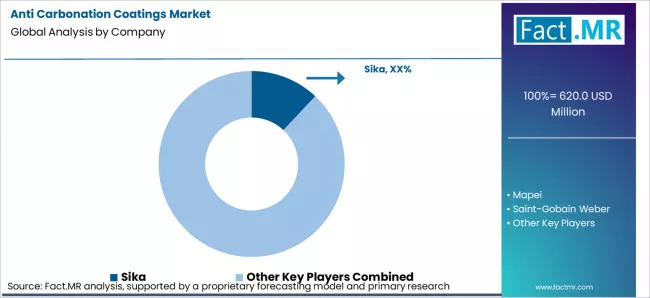
Anti Carbonation Coatings Market Analysis By Company | Source: Fact.MR
The anti-carbonation coatings market shows moderate concentration among suppliers serving infrastructure and concrete protection demand. Producers with established technical specifications and approved status with construction integrators secure larger contract share. Competitive differentiation arises from proven durability performance and compliance with concrete cover standards rather than formulation claims alone.
Companies with global manufacturing, testing capabilities, and technical service networks hold structural advantages. Entities with multiple polymer chemistries and captive formulation labs manage raw material fluctuations better and support onsite specification trials. Smaller regional players depend on distribution partners and local certification, limiting access to large infrastructure frameworks.
Buyer leverage is reinforced through multi-vendor sourcing and tender frameworks. Large contractors and asset owners maintain approved supplier lists to limit dependency and require performance validation data. Price negotiation centers on long term maintenance cost outcomes and application reliability across climatic ranges.
Recent developments
- Sika’s Manufacturing Expansion (Feb 2026): Sika inaugurated a new massive R&D and manufacturing center in Gujarat, India. This facility is specifically focused on high-performance mortars and Sikagard® anti-carbonation coatings to feed the "booming" infrastructure refurbishment market in Asia. [5]
Key Players in the Anti-Carbonation Coatings Market
- Sika
- Mapei
- Saint-Gobain Weber
- Fosroc
- Master Builders Solutions
- RPM International (Tremco CPG)
- Pidilite Industries
- Drizoro
- Kryton International
- Bostik (Arkema)
References
- [1] Sika AG. (2025). Sika with record results and jump in net profit. Sika AG.
- [2] European Committee for Standardization. (2018). EN 1504-2: Products and systems for the protection and repair of concrete structures - Surface protection systems for concrete. CEN.
- [3] European Committee for Standardization. (2018). EN 1504-2: Products and systems for the protection and repair of concrete structures - Definitions, requirements, quality control and evaluation of conformity. CEN.
- [4] European Federation of Corrosion. (2024). EN 1504-2 requirements for surface protection systems. European Coatings Institute.
- [5] Coatings World. (2026). Sika opens new manufacturing facility and R&D center in India. Rodman Media.
Segmentation
Scope of the Report
| Metric | Value |
|---|---|
| Quantitative Units | USD 620 million (2026) to USD 1,142 million (2036), at a CAGR of 6.3% |
| Market Definition | The anti-carbonation coatings market covers protective coatings applied to concrete surfaces to slow CO₂ penetration, maintaining alkalinity and protecting steel reinforcement from corrosion. Coatings are used on buildings, bridges, tunnels, parking structures, and water retaining infrastructure, aligned with EN 1504-2 standards for concrete protection (CEN). |
| Technology Segmentation | Acrylic Elastomeric Coatings, Polyurethane Coatings, Silane/Siloxane Systems, Polymer-Modified Cementitious, Other |
| Structure Type Segmentation | Building Facades, Bridges & Flyovers, Parking Structures, Tunnels & Underground, Water Retaining Structures |
| Application Method Segmentation | Spray Applied, Roller/Brush Applied, Self-Leveling/Fluid, Pre-blended Mortar System, Other |
| Regions Covered | Asia Pacific, Europe, North America, Latin America, Middle East & Africa |
| Countries Covered | India, Vietnam, Indonesia, China, U.A.E., Brazil, United States, Germany, Japan, South Korea, Australia & New Zealand, ASEAN, Rest of Asia Pacific, Italy, France, United Kingdom, Spain, Benelux, Nordics, Central & Eastern Europe, Rest of Europe, Canada, Mexico, Argentina, Chile, Rest of Latin America, South Africa, Turkey, Rest of Middle East & Africa |
| Key Companies Profiled | Sika, Mapei, Saint-Gobain Weber, Fosroc, Master Builders Solutions, RPM International (Tremco CPG), Pidilite Industries, Drizoro, Kryton International, Bostik (Arkema) |
| Forecast Period | 2026 to 2036 |
| Approach | Hybrid top-down and bottom-up modeling validated through primary interviews with coating manufacturers, concrete repair contractors, civil engineers, and asset owners, supported by EN 1504 concrete protection standards, national infrastructure spending, and company disclosures. |
Source: Fact.MR analysis. Updated Feb 14, 2026
Anti-Carbonation Coatings Market Analysis by segments
-
Technology :
- Acrylic Elastomeric Coatings
- Polyurethane Coatings
- Silane/Siloxane Systems
- Polymer-Modified Cementitious
- Other
-
Structure Type :
- Building Facades
- Bridges & Flyovers
- Parking Structures
- Tunnels & Underground
- Water Retaining Structures
-
Application Method :
- Spray Applied
- Roller/Brush Applied
- Self-Leveling/Fluid
- Pre-blended Mortar System
- Other
-
Region :
- Asia Pacific
- India
- China
- Japan
- South Korea
- Indonesia
- Australia & New Zealand
- ASEAN
- Rest of Asia Pacific
- Europe
- Germany
- Italy
- France
- United Kingdom
- Spain
- Benelux
- Nordics
- Central & Eastern Europe
- Rest of Europe
- North America
- United States
- Canada
- Mexico
- Latin America
- Brazil
- Argentina
- Chile
- Rest of Latin America
- Middle East & Africa
- Kingdom of Saudi Arabia
- United Arab Emirates
- South Africa
- Turkey
- Rest of Middle East & Africa
- Asia Pacific
Frequently Asked Questions
How large is the anti-carbonation coatings market in 2026?
What will the market size be for anti-carbonation coatings by 2036?
What is the expected CAGR of the anti-carbonation coatings market during the forecast period?
How much value is the anti-carbonation coatings market expected to add over the decade?
What was the valuation of the anti-carbonation coatings market in 2025?
Which technology segment is expected to lead the market in 2026?
How significant are building facades in overall market demand?
Which country is projected to record the fastest growth in anti-carbonation coatings?
What is the growth outlook for Vietnam in this market?
How fast is the anti-carbonation coatings market growing in Indonesia?
What is the projected CAGR for China’s anti-carbonation coatings market?
How strong is demand growth for anti-carbonation coatings in the U.A.E.?
What is the growth outlook for Brazil in anti-carbonation coatings?
How does the U.S. anti-carbonation coatings market compare in growth terms?
What is the expected growth rate of the market in Germany?
Which region functions as the primary growth engine for anti-carbonation coatings?
How does growth differ between emerging and mature markets?
Is market expansion driven by new construction or refurbishment activity?
Does the market experience abrupt growth cycles?
How important are standards-based specifications to long-term market growth?
Who worked on this report


Preview the report firsthand - request a free sample
Free SampleGet the brochure for pricing and purchase details
Download PDF