Arsenic Removal Media and Chemicals Market
Arsenic Removal Media and Chemicals Market Size and Share Forecast Outlook 2026 to 2036
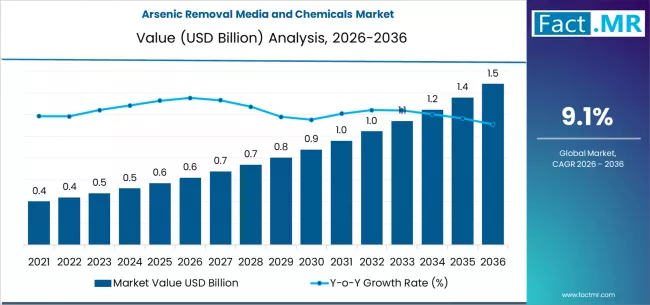
Arsenic removal media and chemicals market is projected to grow from USD 0.6 billion in 2026 to USD 1.5 billion by 2036, at a CAGR of 9.1%. Iron Oxide/Ferric-Based Adsorbents will dominate with a 34.0% market share, while municipal drinking water purification will lead the treatment application segment with a 38.0% share.
Arsenic Removal Media and Chemicals Market Forecast and Outlook 2026 to 2036
The global market for arsenic removal media and chemicals is projected to reach USD 1.48 billion by 2036. The market is valued at USD 0.62 billion in 2026 and is set to rise at a CAGR of 9.1% during the assessment period.
By chemical type, iron oxide/ferric-based adsorbents hold a leading 34% share. The treatment application for municipal drinking water purification represents the dominant segment at 38%.
Key Takeaways from the Arsenic Removal Media and Chemicals Market
- Market Value for 2026: USD 0.62 Billion
- Market Value for 2036: USD 1.48 Billion
- Forecast CAGR (2026-2036): 9.1%
- Leading Chemical Type Share (2026): Iron Oxide/Ferric-Based Adsorbents (34%)
- Leading Treatment Application Share (2026): Municipal Drinking Water Purification (38%)
- Leading End-Use Sector Share (2026): Water Utilities & Municipal Bodies (40%)
- Key Players in the Market: AdEdge Water Technologies, Evoqua Water Technologies, Kemira Oyj., Kurita Water Industries, Veolia Environnement S.A.
Water utilities and municipal bodies constitute the foremost end-use sector, accounting for a 40% share. This growth is propelled by the recognition of arsenic as a severe global public health threat and the consequent enforcement of stricter drinking water standards worldwide. The need to treat contaminated groundwater sources, which serve billions, drives continuous investment in reliable, cost-effective removal technologies.
Specialized media and chemicals are essential for reducing arsenic concentrations to safe levels, often below 10 µg/L. Their performance is critical in preventing long-term health issues such as skin lesions, cancer, and cardiovascular diseases, making them a non-negotiable component of water security in affected regions.
Arsenic Removal Media and Chemicals Market
| Metric | Value |
|---|---|
| Market Value (2026) | USD 0.62 Billion |
| Market Forecast Value (2036) | USD 1.48 Billion |
| Forecast CAGR (2026-2036) | 9.1% |
Category
| Category | Segments |
|---|---|
| Chemical Type | Iron Oxide/Ferric-Based Adsorbents, Activated Alumina & Alumina Blends, Ion Exchange Resins (Selective), Modified Zeolites, Biochar & Hybrid Media, Other Arsenic Removal Chemicals |
| Treatment Application | Municipal Drinking Water Purification, Groundwater & Well Water Treatment, Industrial Wastewater & Effluents, Residential & Small Community Systems, Other Environmental Remediation |
| End-Use Sector | Water Utilities & Municipal Bodies, Industrial & Mining, Environmental Remediation Firms, Residential/Commercial, Other Public Sector Projects |
| Region | North America, Latin America, Western Europe, Eastern Europe, East Asia, South Asia & Pacific, MEA |
Segmental Analysis
By Chemical Type, Which Segment is the Most Widely Adopted for Arsenic Removal?
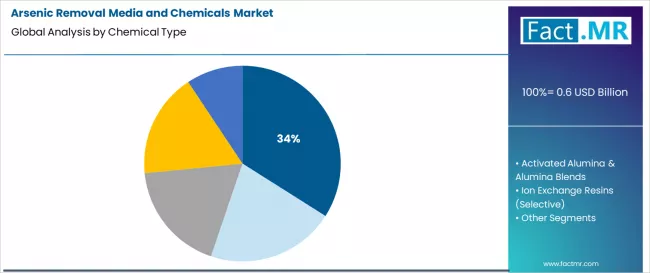
Iron oxide/ferric-based adsorbents lead the segment with a 34% share. Their dominance is due to high affinity for both arsenate (As V) and arsenite (As III), relative cost-effectiveness, and ease of use in various system configurations.
These media, often in granular or hybrid forms, operate effectively across a range of pH levels and water compositions commonly found in contaminated groundwater. Their proven track record in large-scale municipal deployments and resilience to competing ions solidify their position as the primary technological choice.
By Treatment Application, where is the Demand for Arsenic Removal Most Critical?
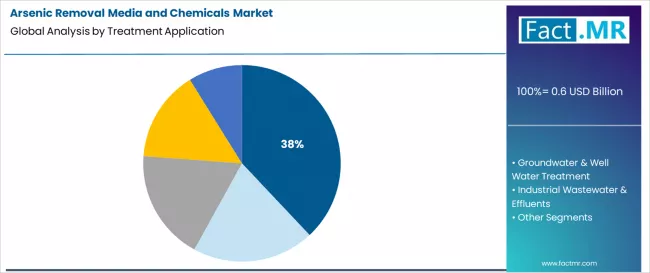
Municipal drinking water purification represents the largest application segment at 38%. The scale of the public health challenge mandates centralized treatment solutions. Municipalities are responsible for delivering safe water to large populations, creating sustained, high-volume demand for robust and reliable removal systems. This application drives the bulk of capital expenditure and operational spending on both media replenishment and supporting chemicals.
By End-Use Sector, who bears the Primary Responsibility for Deployment?
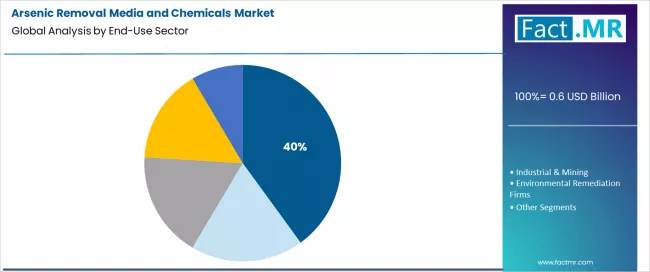
Water utilities and municipal bodies lead the end-use sector with a 40% share. As the legally accountable entities for public water supply safety, these organizations are the principal investors in arsenic treatment infrastructure.
Their procurement decisions, driven by regulatory compliance and public health mandates, set the technological standards and create the most significant and stable demand channel for manufacturers and service providers.
What are the Drivers, Restraints, and Key Trends of the Arsenic Removal Media and Chemicals Market?
The fundamental market driver is the increasing enforcement of stringent global and national drinking water standards for arsenic, primarily the WHO guideline of 10 µg/L. Growing epidemiological evidence of arsenic's health risks at low exposures and rising public awareness are compelling governments to act. Significant funding from international development agencies for remediation in endemic regions also provides a substantial demand catalyst.
A primary restraint is the operational complexity and waste management challenge associated with spent media. The disposal of arsenic-laden adsorbents or sludges is regulated as hazardous waste, adding significant lifecycle costs and logistical burdens. System performance can also be hindered by high concentrations of competing ions like phosphate, silica, or sulfate in source water, necessitating pre-treatment and increasing overall project complexity and cost.
Key trends include the development of regenerable media to reduce hazardous waste generation and lower long-term costs. There is strong innovation in low-cost, locally sourced materials like modified laterite or biochar for use in decentralized, community-level systems. The market is moving toward integrated treatment systems that combine oxidation, adsorption, and filtration in compact units, and seeing increased remote monitoring and data analytics for optimizing media change-out cycles and ensuring consistent water quality.
Analysis of the Arsenic Removal Media and Chemicals Market by Key Countries
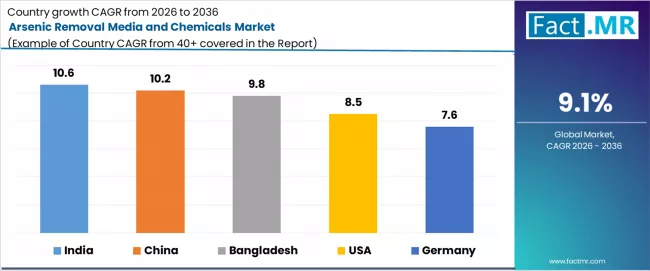
| Country | CAGR (2026-2036) |
|---|---|
| India | 10.60% |
| China | 10.20% |
| Bangladesh | 9.80% |
| USA | 8.50% |
| Germany | 7.60% |
How is India's National Mission for Safe Water Driving Market Growth?
India's leading CAGR of 10.60% is directly fueled by the Jal Jeevan Mission, which aims to provide Functional Household Tap Connections (FHTC) with safe water to all rural households. With arsenic contamination affecting numerous states, the mission's massive implementation budget is channeled into deploying community and household-level arsenic removal technologies, creating an unprecedented scale of demand for effective media and chemicals.
What is the Impact of China's Groundwater Remediation Plans on the Market?
China's 10.20% growth is supported by its national action plans to address soil and groundwater pollution. While surface water treatment is advancing, chronic arsenic contamination in specific aquifers drives targeted remediation projects. China’s focus on technological solutions and its manufacturing capacity for treatment media position it as both a major market and a key production hub.
Why is Bangladesh a Critical and Enduring Market for Arsenic Removal Solutions?
Bangladesh's 9.80% CAGR stems from its status as home to one of the world's most severe mass poisoning events due to arsenic in well water. Decades of international and government-led interventions continue, focusing on identifying safe wells, installing community filters, and developing new point-of-use solutions. This creates a persistent, large-scale market for robust, low-maintenance removal technologies suitable for rural settings.
How do Evolving Regulations and Legacy Sites Influence Demand for Arsenic Removal Media and Chemicals in USA?
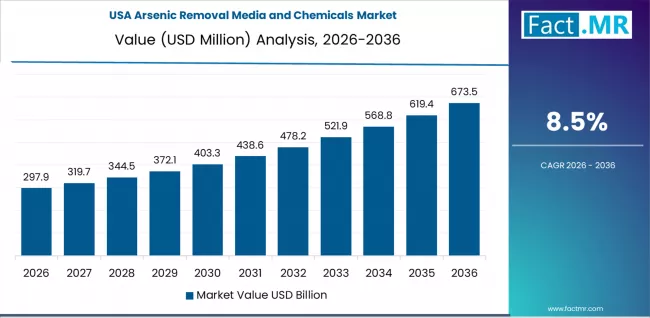
The USA's 8.50% growth is underpinned by the EPA's enforcement of the 10 µg/L arsenic standard for public water systems, particularly affecting smaller utilities in the West and Midwest relying on groundwater. Additionally, the remediation of legacy mining and industrial sites contaminated with arsenic generates significant demand for specialized media and chemicals used in ex-situ and in-situ treatment systems.
What role does Germany's Engineering and Export Focus Play?
Germany's 7.60% growth reflects its strength as a developer and exporter of high-end water treatment technologies, including advanced adsorption and ion exchange systems. German engineering firms cater to global markets requiring precise, reliable arsenic removal, especially in municipal and industrial applications where performance guarantees and technical sophistication are paramount.
Competitive Landscape of the Arsenic Removal Media and Chemicals Market
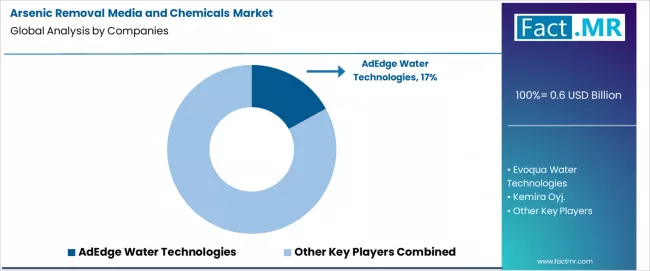
The competitive landscape includes specialized water technology companies, global chemical suppliers, and large water treatment service corporations. Specialists like AdEdge and Evoqua compete through proprietary media formulations and integrated packaged systems tailored for varying arsenic concentrations and water chemistries.
Larger players like Veolia and Kemira leverage their broad water treatment portfolios and service networks to offer comprehensive arsenic management solutions. Competition centers on media performance (capacity, kinetics), system reliability, total cost of ownership, and the ability to provide complete solutions from design to waste handling.
Key Players in the Arsenic Removal Media and Chemicals Market
- AdEdge Water Technologies
- Evoqua Water Technologies
- Kemira Oyj.
- Kurita Water Industries
- Veolia Environnement S.A.
Scope of Report
| Items | Values |
|---|---|
| Quantitative Units | USD Billion |
| Chemical Type | Iron-Based Adsorbents, Activated Alumina, Ion Exchange Resins, Modified Media, Others |
| Treatment Application | Municipal Drinking Water, Groundwater, Industrial Wastewater, Residential Systems, Other |
| End-Use Sector | Water Utilities, Industrial/Mining, Environmental Remediation, Residential/Commercial, Other |
| Key Countries | India, China, Bangladesh, USA, Germany |
| Key Companies | AdEdge Water Technologies, Evoqua Water Technologies, Kemira Oyj., Kurita Water Industries, Veolia Environnement S.A. |
| Additional Analysis | Analysis of oxidation requirements for As(III) to As(V); media capacity and regeneration studies; management and stabilization of arsenic-laden waste; comparative cost analysis of adsorption vs. coagulation-filtration; regulatory frameworks and testing protocols for arsenic in water. |
Market by Segments
-
Chemical Type :
- Iron Oxide/Ferric-Based Adsorbents
- Activated Alumina & Alumina Blends
- Ion Exchange Resins (Selective)
- Modified Zeolites, Biochar & Hybrid Media
- Other Arsenic Removal Chemicals
-
Treatment Application :
- Municipal Drinking Water Purification
- Groundwater & Well Water Treatment
- Industrial Wastewater & Effluents
- Residential & Small Community Systems
- Other Environmental Remediation
-
End-Use Sector :
- Water Utilities & Municipal Bodies
- Industrial & Mining
- Environmental Remediation Firms
- Residential/Commercial
- Other Public Sector Projects
-
Region :
-
North America
- USA
- Canada
-
Latin America
- Brazil
- Mexico
- Argentina
- Rest of Latin America
-
Western Europe
- Germany
- UK
- France
- Spain
- Italy
- BENELUX
- Rest of Western Europe
-
Eastern Europe
- Russia
- Poland
- Czech Republic
- Rest of Eastern Europe
-
East Asia
- China
- Japan
- South Korea
- Rest of East Asia
-
South Asia & Pacific
- India
- Bangladesh
- ASEAN
- Australia
- Rest of South Asia & Pacific
-
MEA
- Saudi Arabia
- UAE
- Turkiye
- Rest of MEA
-
Table of Content
- Executive Summary
- Global Market Outlook
- Demand to side Trends
- Supply to side Trends
- Technology Roadmap Analysis
- Analysis and Recommendations
- Market Overview
- Market Coverage / Taxonomy
- Market Definition / Scope / Limitations
- Market Background
- Market Dynamics
- Drivers
- Restraints
- Opportunity
- Trends
- Scenario Forecast
- Demand in Optimistic Scenario
- Demand in Likely Scenario
- Demand in Conservative Scenario
- Opportunity Map Analysis
- Product Life Cycle Analysis
- Supply Chain Analysis
- Investment Feasibility Matrix
- Value Chain Analysis
- PESTLE and Porter’s Analysis
- Regulatory Landscape
- Regional Parent Market Outlook
- Production and Consumption Statistics
- Import and Export Statistics
- Market Dynamics
- Global Market Analysis 2021 to 2025 and Forecast, 2026 to 2036
- Historical Market Size Value (USD Million) Analysis, 2021 to 2025
- Current and Future Market Size Value (USD Million) Projections, 2026 to 2036
- Y to o to Y Growth Trend Analysis
- Absolute $ Opportunity Analysis
- Global Market Pricing Analysis 2021 to 2025 and Forecast 2026 to 2036
- Global Market Analysis 2021 to 2025 and Forecast 2026 to 2036, By Chemical Type
- Introduction / Key Findings
- Historical Market Size Value (USD Million) Analysis By Chemical Type, 2021 to 2025
- Current and Future Market Size Value (USD Million) Analysis and Forecast By Chemical Type, 2026 to 2036
- Iron Oxide/Ferric-Based Adsorbents
- Activated Alumina & Alumina Blends
- Ion Exchange Resins (Selective)
- Modified Zeolites, Biochar & Hybrid Media
- Other Arsenic Removal Chemicals
- Iron Oxide/Ferric-Based Adsorbents
- Y to o to Y Growth Trend Analysis By Chemical Type, 2021 to 2025
- Absolute $ Opportunity Analysis By Chemical Type, 2026 to 2036
- Global Market Analysis 2021 to 2025 and Forecast 2026 to 2036, By Treatment Application
- Introduction / Key Findings
- Historical Market Size Value (USD Million) Analysis By Treatment Application, 2021 to 2025
- Current and Future Market Size Value (USD Million) Analysis and Forecast By Treatment Application, 2026 to 2036
- Municipal Drinking Water Purification
- Groundwater & Well Water Treatment
- Industrial Wastewater & Effluents
- Residential & Small Community Systems
- Other Environmental Remediation
- Municipal Drinking Water Purification
- Y to o to Y Growth Trend Analysis By Treatment Application, 2021 to 2025
- Absolute $ Opportunity Analysis By Treatment Application, 2026 to 2036
- Global Market Analysis 2021 to 2025 and Forecast 2026 to 2036, By End-Use Sector
- Introduction / Key Findings
- Historical Market Size Value (USD Million) Analysis By End-Use Sector, 2021 to 2025
- Current and Future Market Size Value (USD Million) Analysis and Forecast By End-Use Sector, 2026 to 2036
- Water Utilities & Municipal Bodies
- Industrial & Mining
- Environmental Remediation Firms
- Residential / Commercial
- Other Public Sector Projects
- Water Utilities & Municipal Bodies
- Y to o to Y Growth Trend Analysis By End-Use Sector, 2021 to 2025
- Absolute $ Opportunity Analysis By End-Use Sector, 2026 to 2036
- Global Market Analysis 2021 to 2025 and Forecast 2026 to 2036, By Region
- Introduction
- Historical Market Size Value (USD Million) Analysis By Region, 2021 to 2025
- Current Market Size Value (USD Million) Analysis and Forecast By Region, 2026 to 2036
- North America
- Latin America
- Western Europe
- Eastern Europe
- East Asia
- South Asia and Pacific
- Middle East & Africa
- Market Attractiveness Analysis By Region
- North America Market Analysis 2021 to 2025 and Forecast 2026 to 2036, By Country
- Historical Market Size Value (USD Million) Trend Analysis By Market Taxonomy, 2021 to 2025
- Market Size Value (USD Million) Forecast By Market Taxonomy, 2026 to 2036
- By Country
- USA
- Canada
- Mexico
- By Chemical Type
- By Treatment Application
- By End-Use Sector
- By Country
- Market Attractiveness Analysis
- By Country
- By Chemical Type
- By Treatment Application
- By End-Use Sector
- Key Takeaways
- Latin America Market Analysis 2021 to 2025 and Forecast 2026 to 2036, By Country
- Historical Market Size Value (USD Million) Trend Analysis By Market Taxonomy, 2021 to 2025
- Market Size Value (USD Million) Forecast By Market Taxonomy, 2026 to 2036
- By Country
- Brazil
- Chile
- Rest of Latin America
- By Chemical Type
- By Treatment Application
- By End-Use Sector
- By Country
- Market Attractiveness Analysis
- By Country
- By Chemical Type
- By Treatment Application
- By End-Use Sector
- Key Takeaways
- Western Europe Market Analysis 2021 to 2025 and Forecast 2026 to 2036, By Country
- Historical Market Size Value (USD Million) Trend Analysis By Market Taxonomy, 2021 to 2025
- Market Size Value (USD Million) Forecast By Market Taxonomy, 2026 to 2036
- By Country
- Germany
- UK
- Italy
- Spain
- France
- Nordic
- BENELUX
- Rest of Western Europe
- By Chemical Type
- By Treatment Application
- By End-Use Sector
- By Country
- Market Attractiveness Analysis
- By Country
- By Chemical Type
- By Treatment Application
- By End-Use Sector
- Key Takeaways
- Eastern Europe Market Analysis 2021 to 2025 and Forecast 2026 to 2036, By Country
- Historical Market Size Value (USD Million) Trend Analysis By Market Taxonomy, 2021 to 2025
- Market Size Value (USD Million) Forecast By Market Taxonomy, 2026 to 2036
- By Country
- Russia
- Poland
- Hungary
- Balkan & Baltic
- Rest of Eastern Europe
- By Chemical Type
- By Treatment Application
- By End-Use Sector
- By Country
- Market Attractiveness Analysis
- By Country
- By Chemical Type
- By Treatment Application
- By End-Use Sector
- Key Takeaways
- East Asia Market Analysis 2021 to 2025 and Forecast 2026 to 2036, By Country
- Historical Market Size Value (USD Million) Trend Analysis By Market Taxonomy, 2021 to 2025
- Market Size Value (USD Million) Forecast By Market Taxonomy, 2026 to 2036
- By Country
- China
- Japan
- South Korea
- By Chemical Type
- By Treatment Application
- By End-Use Sector
- By Country
- Market Attractiveness Analysis
- By Country
- By Chemical Type
- By Treatment Application
- By End-Use Sector
- Key Takeaways
- South Asia and Pacific Market Analysis 2021 to 2025 and Forecast 2026 to 2036, By Country
- Historical Market Size Value (USD Million) Trend Analysis By Market Taxonomy, 2021 to 2025
- Market Size Value (USD Million) Forecast By Market Taxonomy, 2026 to 2036
- By Country
- India
- ASEAN
- Australia & New Zealand
- Rest of South Asia and Pacific
- By Chemical Type
- By Treatment Application
- By End-Use Sector
- By Country
- Market Attractiveness Analysis
- By Country
- By Chemical Type
- By Treatment Application
- By End-Use Sector
- Key Takeaways
- Middle East & Africa Market Analysis 2021 to 2025 and Forecast 2026 to 2036, By Country
- Historical Market Size Value (USD Million) Trend Analysis By Market Taxonomy, 2021 to 2025
- Market Size Value (USD Million) Forecast By Market Taxonomy, 2026 to 2036
- By Country
- Kingdom of Saudi Arabia
- Other GCC Countries
- Turkiye
- South Africa
- Other African Union
- Rest of Middle East & Africa
- By Chemical Type
- By Treatment Application
- By End-Use Sector
- By Country
- Market Attractiveness Analysis
- By Country
- By Chemical Type
- By Treatment Application
- By End-Use Sector
- Key Takeaways
- Key Countries Market Analysis
- USA
- Pricing Analysis
- Market Share Analysis, 2025
- By Chemical Type
- By Treatment Application
- By End-Use Sector
- Canada
- Pricing Analysis
- Market Share Analysis, 2025
- By Chemical Type
- By Treatment Application
- By End-Use Sector
- Mexico
- Pricing Analysis
- Market Share Analysis, 2025
- By Chemical Type
- By Treatment Application
- By End-Use Sector
- Brazil
- Pricing Analysis
- Market Share Analysis, 2025
- By Chemical Type
- By Treatment Application
- By End-Use Sector
- Chile
- Pricing Analysis
- Market Share Analysis, 2025
- By Chemical Type
- By Treatment Application
- By End-Use Sector
- Germany
- Pricing Analysis
- Market Share Analysis, 2025
- By Chemical Type
- By Treatment Application
- By End-Use Sector
- UK
- Pricing Analysis
- Market Share Analysis, 2025
- By Chemical Type
- By Treatment Application
- By End-Use Sector
- Italy
- Pricing Analysis
- Market Share Analysis, 2025
- By Chemical Type
- By Treatment Application
- By End-Use Sector
- Spain
- Pricing Analysis
- Market Share Analysis, 2025
- By Chemical Type
- By Treatment Application
- By End-Use Sector
- France
- Pricing Analysis
- Market Share Analysis, 2025
- By Chemical Type
- By Treatment Application
- By End-Use Sector
- India
- Pricing Analysis
- Market Share Analysis, 2025
- By Chemical Type
- By Treatment Application
- By End-Use Sector
- ASEAN
- Pricing Analysis
- Market Share Analysis, 2025
- By Chemical Type
- By Treatment Application
- By End-Use Sector
- Australia & New Zealand
- Pricing Analysis
- Market Share Analysis, 2025
- By Chemical Type
- By Treatment Application
- By End-Use Sector
- China
- Pricing Analysis
- Market Share Analysis, 2025
- By Chemical Type
- By Treatment Application
- By End-Use Sector
- Japan
- Pricing Analysis
- Market Share Analysis, 2025
- By Chemical Type
- By Treatment Application
- By End-Use Sector
- South Korea
- Pricing Analysis
- Market Share Analysis, 2025
- By Chemical Type
- By Treatment Application
- By End-Use Sector
- Russia
- Pricing Analysis
- Market Share Analysis, 2025
- By Chemical Type
- By Treatment Application
- By End-Use Sector
- Poland
- Pricing Analysis
- Market Share Analysis, 2025
- By Chemical Type
- By Treatment Application
- By End-Use Sector
- Hungary
- Pricing Analysis
- Market Share Analysis, 2025
- By Chemical Type
- By Treatment Application
- By End-Use Sector
- Kingdom of Saudi Arabia
- Pricing Analysis
- Market Share Analysis, 2025
- By Chemical Type
- By Treatment Application
- By End-Use Sector
- Turkiye
- Pricing Analysis
- Market Share Analysis, 2025
- By Chemical Type
- By Treatment Application
- By End-Use Sector
- South Africa
- Pricing Analysis
- Market Share Analysis, 2025
- By Chemical Type
- By Treatment Application
- By End-Use Sector
- USA
- Market Structure Analysis
- Competition Dashboard
- Competition Benchmarking
- Market Share Analysis of Top Players
- By Regional
- By Chemical Type
- By Treatment Application
- By End-Use Sector
- Competition Analysis
- Competition Deep Dive
- AdEdge Water Technologies
- Overview
- Product Portfolio
- Profitability by Market Segments (Product/Age /Sales Channel/Region)
- Sales Footprint
- Strategy Overview
- Marketing Strategy
- Product Strategy
- Channel Strategy
- Evoqua Water Technologies
- Kemira Oyj.
- Kurita Water Industries
- Veolia Environnement S.A.
- AdEdge Water Technologies
- Competition Deep Dive
- Assumptions & Acronyms Used
- Research Methodology
List Of Table
- Table 1: Global Market Value (USD Million) Forecast by Region, 2021 to 2036
- Table 2: Global Market Value (USD Million) Forecast by Chemical Type, 2021 to 2036
- Table 3: Global Market Value (USD Million) Forecast by Treatment Application, 2021 to 2036
- Table 4: Global Market Value (USD Million) Forecast by End-Use Sector, 2021 to 2036
- Table 5: North America Market Value (USD Million) Forecast by Country, 2021 to 2036
- Table 6: North America Market Value (USD Million) Forecast by Chemical Type, 2021 to 2036
- Table 7: North America Market Value (USD Million) Forecast by Treatment Application, 2021 to 2036
- Table 8: North America Market Value (USD Million) Forecast by End-Use Sector, 2021 to 2036
- Table 9: Latin America Market Value (USD Million) Forecast by Country, 2021 to 2036
- Table 10: Latin America Market Value (USD Million) Forecast by Chemical Type, 2021 to 2036
- Table 11: Latin America Market Value (USD Million) Forecast by Treatment Application, 2021 to 2036
- Table 12: Latin America Market Value (USD Million) Forecast by End-Use Sector, 2021 to 2036
- Table 13: Western Europe Market Value (USD Million) Forecast by Country, 2021 to 2036
- Table 14: Western Europe Market Value (USD Million) Forecast by Chemical Type, 2021 to 2036
- Table 15: Western Europe Market Value (USD Million) Forecast by Treatment Application, 2021 to 2036
- Table 16: Western Europe Market Value (USD Million) Forecast by End-Use Sector, 2021 to 2036
- Table 17: Eastern Europe Market Value (USD Million) Forecast by Country, 2021 to 2036
- Table 18: Eastern Europe Market Value (USD Million) Forecast by Chemical Type, 2021 to 2036
- Table 19: Eastern Europe Market Value (USD Million) Forecast by Treatment Application, 2021 to 2036
- Table 20: Eastern Europe Market Value (USD Million) Forecast by End-Use Sector, 2021 to 2036
- Table 21: East Asia Market Value (USD Million) Forecast by Country, 2021 to 2036
- Table 22: East Asia Market Value (USD Million) Forecast by Chemical Type, 2021 to 2036
- Table 23: East Asia Market Value (USD Million) Forecast by Treatment Application, 2021 to 2036
- Table 24: East Asia Market Value (USD Million) Forecast by End-Use Sector, 2021 to 2036
- Table 25: South Asia and Pacific Market Value (USD Million) Forecast by Country, 2021 to 2036
- Table 26: South Asia and Pacific Market Value (USD Million) Forecast by Chemical Type, 2021 to 2036
- Table 27: South Asia and Pacific Market Value (USD Million) Forecast by Treatment Application, 2021 to 2036
- Table 28: South Asia and Pacific Market Value (USD Million) Forecast by End-Use Sector, 2021 to 2036
- Table 29: Middle East & Africa Market Value (USD Million) Forecast by Country, 2021 to 2036
- Table 30: Middle East & Africa Market Value (USD Million) Forecast by Chemical Type, 2021 to 2036
- Table 31: Middle East & Africa Market Value (USD Million) Forecast by Treatment Application, 2021 to 2036
- Table 32: Middle East & Africa Market Value (USD Million) Forecast by End-Use Sector, 2021 to 2036
List Of Figures
- Figure 1: Global Market Pricing Analysis
- Figure 2: Global Market Value (USD Million) Forecast 2021 to 2036
- Figure 3: Global Market Value Share and BPS Analysis by Chemical Type, 2026 and 2036
- Figure 4: Global Market Y to o to Y Growth Comparison by Chemical Type, 2026 to 2036
- Figure 5: Global Market Attractiveness Analysis by Chemical Type
- Figure 6: Global Market Value Share and BPS Analysis by Treatment Application, 2026 and 2036
- Figure 7: Global Market Y to o to Y Growth Comparison by Treatment Application, 2026 to 2036
- Figure 8: Global Market Attractiveness Analysis by Treatment Application
- Figure 9: Global Market Value Share and BPS Analysis by End-Use Sector, 2026 and 2036
- Figure 10: Global Market Y to o to Y Growth Comparison by End-Use Sector, 2026 to 2036
- Figure 11: Global Market Attractiveness Analysis by End-Use Sector
- Figure 12: Global Market Value (USD Million) Share and BPS Analysis by Region, 2026 and 2036
- Figure 13: Global Market Y to o to Y Growth Comparison by Region, 2026 to 2036
- Figure 14: Global Market Attractiveness Analysis by Region
- Figure 15: North America Market Incremental Dollar Opportunity, 2026 to 2036
- Figure 16: Latin America Market Incremental Dollar Opportunity, 2026 to 2036
- Figure 17: Western Europe Market Incremental Dollar Opportunity, 2026 to 2036
- Figure 18: Eastern Europe Market Incremental Dollar Opportunity, 2026 to 2036
- Figure 19: East Asia Market Incremental Dollar Opportunity, 2026 to 2036
- Figure 20: South Asia and Pacific Market Incremental Dollar Opportunity, 2026 to 2036
- Figure 21: Middle East & Africa Market Incremental Dollar Opportunity, 2026 to 2036
- Figure 22: North America Market Value Share and BPS Analysis by Country, 2026 and 2036
- Figure 23: North America Market Value Share and BPS Analysis by Chemical Type, 2026 and 2036
- Figure 24: North America Market Y to o to Y Growth Comparison by Chemical Type, 2026 to 2036
- Figure 25: North America Market Attractiveness Analysis by Chemical Type
- Figure 26: North America Market Value Share and BPS Analysis by Treatment Application, 2026 and 2036
- Figure 27: North America Market Y to o to Y Growth Comparison by Treatment Application, 2026 to 2036
- Figure 28: North America Market Attractiveness Analysis by Treatment Application
- Figure 29: North America Market Value Share and BPS Analysis by End-Use Sector, 2026 and 2036
- Figure 30: North America Market Y to o to Y Growth Comparison by End-Use Sector, 2026 to 2036
- Figure 31: North America Market Attractiveness Analysis by End-Use Sector
- Figure 32: Latin America Market Value Share and BPS Analysis by Country, 2026 and 2036
- Figure 33: Latin America Market Value Share and BPS Analysis by Chemical Type, 2026 and 2036
- Figure 34: Latin America Market Y to o to Y Growth Comparison by Chemical Type, 2026 to 2036
- Figure 35: Latin America Market Attractiveness Analysis by Chemical Type
- Figure 36: Latin America Market Value Share and BPS Analysis by Treatment Application, 2026 and 2036
- Figure 37: Latin America Market Y to o to Y Growth Comparison by Treatment Application, 2026 to 2036
- Figure 38: Latin America Market Attractiveness Analysis by Treatment Application
- Figure 39: Latin America Market Value Share and BPS Analysis by End-Use Sector, 2026 and 2036
- Figure 40: Latin America Market Y to o to Y Growth Comparison by End-Use Sector, 2026 to 2036
- Figure 41: Latin America Market Attractiveness Analysis by End-Use Sector
- Figure 42: Western Europe Market Value Share and BPS Analysis by Country, 2026 and 2036
- Figure 43: Western Europe Market Value Share and BPS Analysis by Chemical Type, 2026 and 2036
- Figure 44: Western Europe Market Y to o to Y Growth Comparison by Chemical Type, 2026 to 2036
- Figure 45: Western Europe Market Attractiveness Analysis by Chemical Type
- Figure 46: Western Europe Market Value Share and BPS Analysis by Treatment Application, 2026 and 2036
- Figure 47: Western Europe Market Y to o to Y Growth Comparison by Treatment Application, 2026 to 2036
- Figure 48: Western Europe Market Attractiveness Analysis by Treatment Application
- Figure 49: Western Europe Market Value Share and BPS Analysis by End-Use Sector, 2026 and 2036
- Figure 50: Western Europe Market Y to o to Y Growth Comparison by End-Use Sector, 2026 to 2036
- Figure 51: Western Europe Market Attractiveness Analysis by End-Use Sector
- Figure 52: Eastern Europe Market Value Share and BPS Analysis by Country, 2026 and 2036
- Figure 53: Eastern Europe Market Value Share and BPS Analysis by Chemical Type, 2026 and 2036
- Figure 54: Eastern Europe Market Y to o to Y Growth Comparison by Chemical Type, 2026 to 2036
- Figure 55: Eastern Europe Market Attractiveness Analysis by Chemical Type
- Figure 56: Eastern Europe Market Value Share and BPS Analysis by Treatment Application, 2026 and 2036
- Figure 57: Eastern Europe Market Y to o to Y Growth Comparison by Treatment Application, 2026 to 2036
- Figure 58: Eastern Europe Market Attractiveness Analysis by Treatment Application
- Figure 59: Eastern Europe Market Value Share and BPS Analysis by End-Use Sector, 2026 and 2036
- Figure 60: Eastern Europe Market Y to o to Y Growth Comparison by End-Use Sector, 2026 to 2036
- Figure 61: Eastern Europe Market Attractiveness Analysis by End-Use Sector
- Figure 62: East Asia Market Value Share and BPS Analysis by Country, 2026 and 2036
- Figure 63: East Asia Market Value Share and BPS Analysis by Chemical Type, 2026 and 2036
- Figure 64: East Asia Market Y to o to Y Growth Comparison by Chemical Type, 2026 to 2036
- Figure 65: East Asia Market Attractiveness Analysis by Chemical Type
- Figure 66: East Asia Market Value Share and BPS Analysis by Treatment Application, 2026 and 2036
- Figure 67: East Asia Market Y to o to Y Growth Comparison by Treatment Application, 2026 to 2036
- Figure 68: East Asia Market Attractiveness Analysis by Treatment Application
- Figure 69: East Asia Market Value Share and BPS Analysis by End-Use Sector, 2026 and 2036
- Figure 70: East Asia Market Y to o to Y Growth Comparison by End-Use Sector, 2026 to 2036
- Figure 71: East Asia Market Attractiveness Analysis by End-Use Sector
- Figure 72: South Asia and Pacific Market Value Share and BPS Analysis by Country, 2026 and 2036
- Figure 73: South Asia and Pacific Market Value Share and BPS Analysis by Chemical Type, 2026 and 2036
- Figure 74: South Asia and Pacific Market Y to o to Y Growth Comparison by Chemical Type, 2026 to 2036
- Figure 75: South Asia and Pacific Market Attractiveness Analysis by Chemical Type
- Figure 76: South Asia and Pacific Market Value Share and BPS Analysis by Treatment Application, 2026 and 2036
- Figure 77: South Asia and Pacific Market Y to o to Y Growth Comparison by Treatment Application, 2026 to 2036
- Figure 78: South Asia and Pacific Market Attractiveness Analysis by Treatment Application
- Figure 79: South Asia and Pacific Market Value Share and BPS Analysis by End-Use Sector, 2026 and 2036
- Figure 80: South Asia and Pacific Market Y to o to Y Growth Comparison by End-Use Sector, 2026 to 2036
- Figure 81: South Asia and Pacific Market Attractiveness Analysis by End-Use Sector
- Figure 82: Middle East & Africa Market Value Share and BPS Analysis by Country, 2026 and 2036
- Figure 83: Middle East & Africa Market Value Share and BPS Analysis by Chemical Type, 2026 and 2036
- Figure 84: Middle East & Africa Market Y to o to Y Growth Comparison by Chemical Type, 2026 to 2036
- Figure 85: Middle East & Africa Market Attractiveness Analysis by Chemical Type
- Figure 86: Middle East & Africa Market Value Share and BPS Analysis by Treatment Application, 2026 and 2036
- Figure 87: Middle East & Africa Market Y to o to Y Growth Comparison by Treatment Application, 2026 to 2036
- Figure 88: Middle East & Africa Market Attractiveness Analysis by Treatment Application
- Figure 89: Middle East & Africa Market Value Share and BPS Analysis by End-Use Sector, 2026 and 2036
- Figure 90: Middle East & Africa Market Y to o to Y Growth Comparison by End-Use Sector, 2026 to 2036
- Figure 91: Middle East & Africa Market Attractiveness Analysis by End-Use Sector
- Figure 92: Global Market - Tier Structure Analysis
- Figure 93: Global Market - Company Share Analysis
- FAQs -
How big is the arsenic removal media and chemicals market in 2026?
The global arsenic removal media and chemicals market is estimated to be valued at USD 0.6 billion in 2026.
What will be the size of arsenic removal media and chemicals market in 2036?
The market size for the arsenic removal media and chemicals market is projected to reach USD 1.5 billion by 2036.
How much will be the arsenic removal media and chemicals market growth between 2026 and 2036?
The arsenic removal media and chemicals market is expected to grow at a 9.1% CAGR between 2026 and 2036.
What are the key product types in the arsenic removal media and chemicals market?
The key product types in arsenic removal media and chemicals market are iron oxide/ferric-based adsorbents, activated alumina & alumina blends, ion exchange resins (selective), modified zeolites, biochar & hybrid media and other arsenic removal chemicals.
Which treatment application segment to contribute significant share in the arsenic removal media and chemicals market in 2026?
In terms of treatment application, municipal drinking water purification segment to command 38.0% share in the arsenic removal media and chemicals market in 2026.