- Market Value (2025): USD 0.3 Bn
- Estimated Value (2026): USD 0.4 Bn
- Forecast Value (2036): USD 15.0 Bn
- CAGR (2026-2036): 43.7%
What is the carbon removal MRV services market forecast to be worth by 2036?
USD 0.4 billion in 2026 to USD 15.0 billion by 2036, at 43.7% CAGR.
- The carbon removal MRV services market crossed a valuation of USD 0.3 billion in 2025.
- Demand is expected to increase from USD 0.4 billion in 2026 to USD 15.0 billion by 2036.
- The market is forecast to record 43.7% CAGR during 2026 to 2036 as CDR suppliers and corporate credit purchasers need verifiable proof before carbon removal credits can scale.
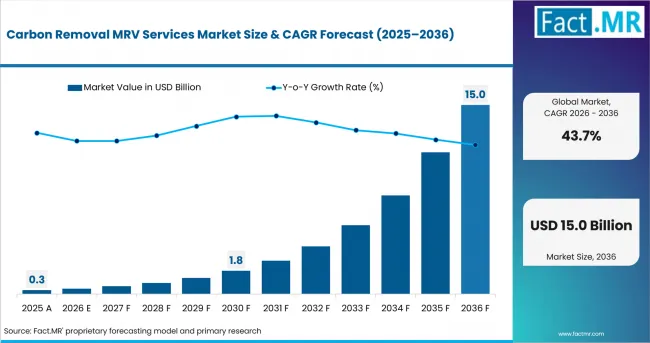
Carbon Removal Mrv Services Market Value Analysis | Source: Fact.MR
What are the defining numbers behind carbon removal MRV services growth?
USD 14.6 billion absolute opportunity by 2036, led by the United States and Germany.
- Demand Drivers in the Market
- Carbon removal suppliers need verified evidence before credits can be issued or sold.
- Corporate credit purchasers need proof that removals are real and traceable.
- Registries need pathway-specific protocols that can support consistent issuance.
- Regulators need transparent certification data before removals can enter trusted frameworks.
- Key Segments Analyzed
- By Service Type: Project measurement and verification is expected to hold 37.0% share in 2026 because credit issuance starts with verified removal data.
- By Removal Pathway: Biochar carbon removal leads because it has more commercial credit activity than most early CDR pathways. The share is projected at 34.0% in 2026.
- By Customer Type: Carbon removal suppliers are likely to account for 44.0% share in 2026 because suppliers must pay for verification before revenue.
- By Delivery Model: Registry-linked certification programs lead as credit issuance needs accepted methods. The model is projected to hold 41.0% share in 2026.
- By End Use: Credit Issuance is expected to hold 38.0% share in 2026 because verified tonnes must become tradable certificates.
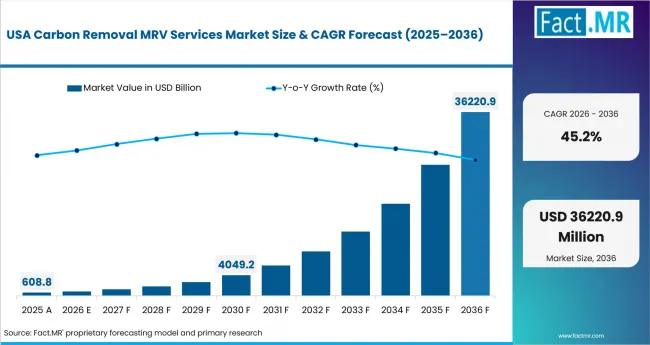
- By Geography: The United States is projected to record 45.2% CAGR through 2036 as Frontier-style offtakes and CDR supplier activity expand.
- Analyst Opinion at Fact.MR
- Shambhu Nath Jha, Senior Analyst at Fact.MR, states, “Carbon removal MRV is becoming the trust layer of the CDR market. We see suppliers asking how to prove tonnes and corporate clients asking how to compare durability across pathways. Providers that combine scientific protocols with auditable data systems will gain stronger access to future removal credit flows.”
- Strategic Implications
- CDR suppliers should select MRV methods before signing large offtake contracts.
- Registries need pathway-specific protocols that can evolve with field evidence.
- Corporate clients should require audit-ready data before purchasing removal credits.
- MRV providers need digital systems that reduce verification cost as project volumes rise.
| Metric | Details |
|---|---|
| Industry Size 2026 | USD 0.4 billion |
| Industry Value 2036 | USD 15.0 billion |
| CAGR 2026 to 2036 | 43.7% |
Source: Fact.MR analysis. Updated Jun 18, 2026
Carbon removal MRV services are becoming the trust layer for carbon credit markets. These services check whether engineered and nature-based removals such as direct air capture and enhanced rock weathering are measured and reported correctly. The European Commission states that the CRCF Regulation requires third-party verification of carbon removals and publication of certification information in an EU-wide registry. [1] This supports demand for audit and certification services that help carbon removal credits reach the market with stronger credibility.
The United States is projected to record 45.2% CAGR by 2036 as Frontier-style offtakes and CDR supplier activity expand. Germany is likely to post 44.0% CAGR because EU CRCF rules and industrial removal projects need verification support. The United Kingdom is expected to register 43.3% CAGR as carbon removal registries and rating providers scale. Canada is forecast to advance at 41.7% CAGR from 2026 to 2036 as biomass and direct air capture projects need MRV. Finland is set to record 40.6% CAGR as Puro.earth and Nordic CDR infrastructure support certification demand.
How does the carbon removal MRV services market break down by segment?
Project Measurement and Verification leads at 37.0%; Biochar Carbon Removal leads at 34.0%.
Which service type dominates?
Project Measurement and Verification holds 37.0% share in 2026.
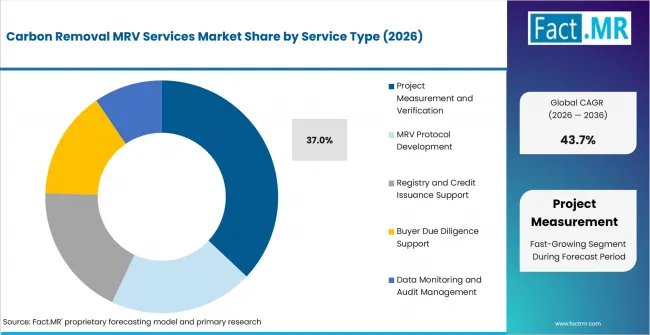
Carbon Removal Mrv Services Market Analysis By Service Type | Source: Fact.MR
Project Measurement and Verification is expected to dominate with 37.0% share in 2026. The segment leads because carbon removal credits cannot be issued without verified removal data. Providers support baseline setting and audit-ready documentation. This creates a strong service base for firms that can verify removals against accepted methods.
Which removal pathway dominates?
Biochar Carbon Removal leads because it has earlier commercial credit activity.
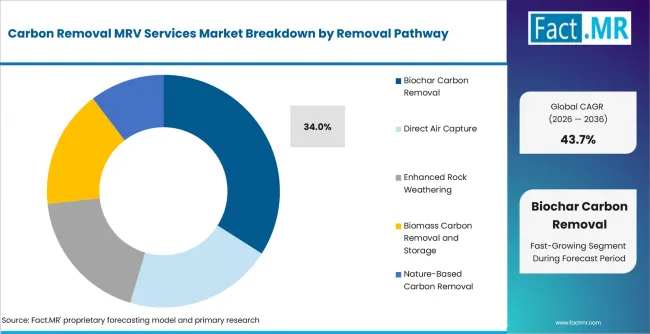
Carbon Removal Mrv Services Market Analysis By Removal Pathway | Source: Fact.MR
Biochar Carbon Removal leads because it has more operational projects and shorter verification cycles than many engineered pathways. The removal pathway is projected to capture 34.0% share in 2026 as suppliers seek certificates for durable carbon storage. Verra’s 2025 VM0044 methodology quantifies carbon dioxide removals from converting waste biomass into biochar, supporting verification demand around feedstock evidence and production data [2]. Biochar projects need durability calculations before certificates can be issued.
Which customer type dominates?
Carbon Removal Suppliers hold 44.0% share in 2026.
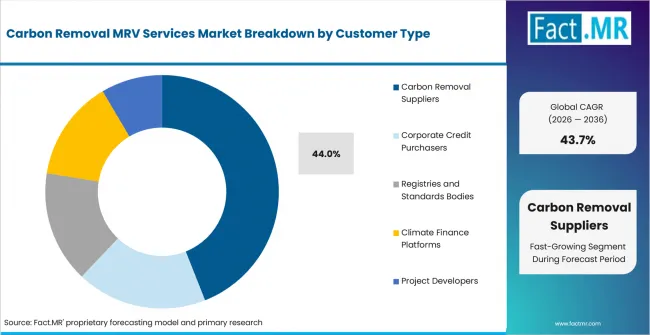
Carbon Removal Mrv Services Market Analysis By Customer Type | Source: Fact.MR
Carbon Removal Suppliers are likely to account for 44.0% share in 2026 because they must prove tonnes before credits can generate revenue. The European Commission states that the CRCF Regulation mandates third-party verification of carbon removals and publication of certification-related information in an EU-wide registry, supporting demand for MRV plans and registry support [3]. Suppliers need MRV plans before scaling DAC or enhanced rock weathering projects.
Which delivery model dominates?
Registry-Linked Certification Programs lead because credit issuance needs accepted methods.
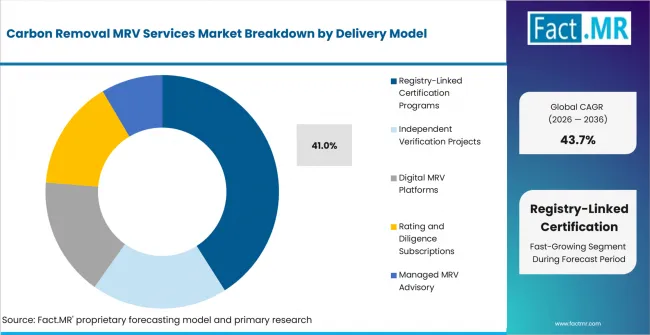
Carbon Removal Mrv Services Market Analysis By Delivery Model | Source: Fact.MR
Registry-Linked Certification Programs lead because suppliers need recognized protocols before credits can be sold. The model is projected to hold 41.0% share in 2026 as registries set rules for quantification and verification. Isometric states that protocols set how CDR must be monitored, reported and verified. [4] Registry-linked delivery also helps corporate clients compare credits across pathways.
Which end use dominates?
Credit Issuance holds 38.0% share in 2026.
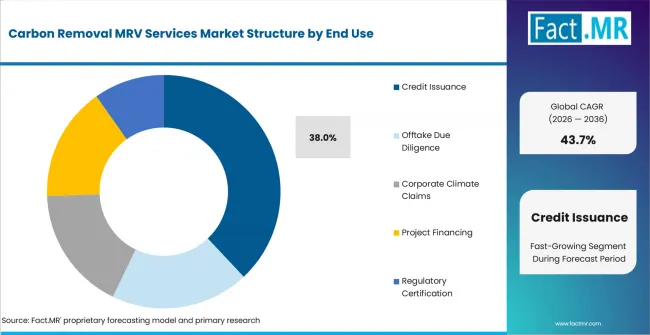
Carbon Removal Mrv Services Market Analysis By End Use | Source: Fact.MR
Credit Issuance leads because verified tonnes must become tradable certificates before supplier revenue is realized. The end use is expected to hold 38.0% share in 2026 as CDR projects move from pilots into contracted delivery. MRV services support the evidence chain from project activity to marketable credit.
What is accelerating carbon removal MRV demand, and what is holding it back?
CRCF rules, net-zero targets and offtake demand drive MRV; pathway uncertainty restrains scale.
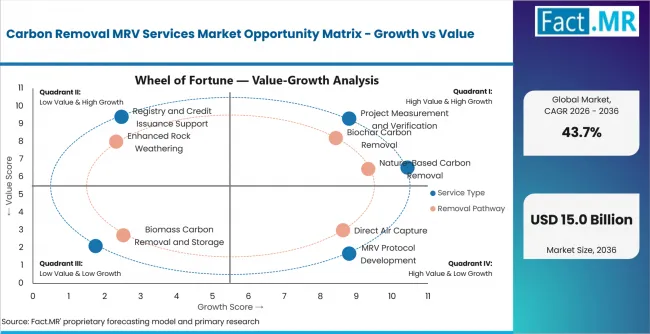
Carbon Removal Mrv Services Market Opportunity Matrix Growth Vs Value | Source: Fact.MR
CRCF is the main regulatory driver. Regulation (EU) 2024/3012 establishes a Union certification framework for permanent carbon removals and carbon storage in products, while setting monitoring and reporting requirements that support stronger transparency and help address greenwashing [5].
The main restraint is pathway uncertainty. DAC and enhanced rock weathering use different measurement methods. Field conditions can create uncertainty around permanence and leakage. MRV providers must balance scientific rigor with practical project economics before verification can scale across many suppliers.
Where do the biggest carbon removal MRV opportunities sit?
Registry-linked verification, biochar MRV and enhanced rock weathering evidence.
- Registry-Linked Verification: Providers can support suppliers from protocol selection through credit issuance.
- Biochar MRV: MRV firms can verify feedstock and durable storage claims.
- Enhanced Rock Weathering Evidence: Specialists can support field measurement and uncertainty analysis.
Which countries are scaling carbon removal MRV services fastest?
United States 45.2%, Germany 44.0%, United Kingdom 43.3%, Canada 41.7%, Finland 40.6%.
Based on regional analysis, the carbon removal MRV services market is segmented into North America, Western Europe, Northern Europe, East Asia, South Asia and Pacific, Latin America, and Middle East and Africa.
.webp "Top Country Growth Comparison Carbon Removal Mrv Services Market Cagr (2026 2036)")
Top Country Growth Comparison Carbon Removal Mrv Services Market Cagr (2026 2036) | Source: Fact.MR
| Country | CAGR |
|---|---|
| United States | 45.2% |
| Germany | 44.0% |
| United Kingdom | 43.3% |
| Canada | 41.7% |
| Finland | 40.6% |
Source: Fact.MR analysis. Updated Jun 18, 2026
Source: Fact.MR analysis, based on proprietary forecasting model and primary research.
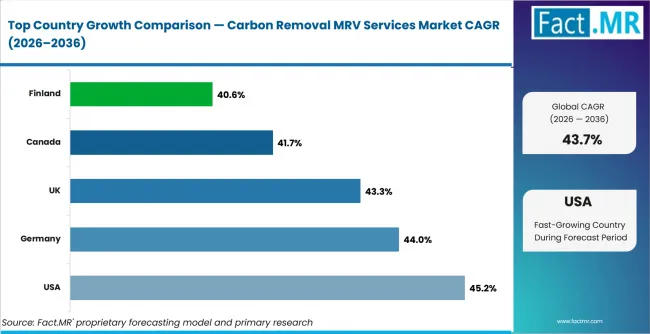
Carbon Removal Mrv Services Market Cagr Analysis By Country | Source: Fact.MR
What is powering the United States lead?
Carbon Removal Mrv Services Market Country Value Analysis | Source: Fact.MR
The United States is projected to record 45.2% CAGR through 2036 as Frontier-style offtakes and CDR supplier activity expand. U.S. suppliers need MRV support before credits can be contracted and delivered. Corporate credit purchasers need diligence around durability and reversal risk. Service demand will favor providers that support data-room preparation and registry issuance. Growth will be strongest around DAC and biomass carbon removal hubs.
How is Germany scaling carbon removal MRV demand?
Germany is likely to post 44.0% CAGR by 2036 because EU CRCF rules and industrial removal projects need verification support. German companies will need removal certificates that can withstand EU scrutiny. Industrial carbon management projects also require monitoring and audit evidence before crediting. CRCF creates a stronger quality bar for EU activity. MRV service providers can gain by supporting certification schemes and registry publication. Demand will favor firms that understand EU methods and can work with industrial project developers.
What underpins the United Kingdom outlook?
The United Kingdom is expected to register 43.3% CAGR over the forecast period as carbon removal registries and rating providers scale. UK-based credit rating and registry talent supports the market. Corporate clients will need diligence before purchasing credits across new pathways. Service demand will focus on protocol review and credit-quality scoring. The country will favor providers with scientific depth and strong links to climate finance clients.
Why is Canada an important MRV market?
Canada is forecast to advance at 41.7% CAGR through 2036 as biomass and direct air capture projects need MRV. Canada has strong potential for geologic storage and industrial carbon management. Suppliers need verification support before large credit agreements can be delivered. MRV providers can gain through project monitoring and lifecycle accounting. Demand will favor firms that can support cold-climate projects and cross-border corporate credit sales.
How is Finland scaling carbon removal MRV services?
Finland is set to record 40.6% CAGR through 2036 as Nordic CDR infrastructure and Puro.earth certification demand expand. Nordic carbon removal activity benefits from strong sustainability governance and buyer interest in durable credits. Finland’s role is important because registry infrastructure can serve suppliers outside its domestic market. Service demand will favor methods and independent verification tied to engineered carbon removal certificates.
Who leads the carbon removal MRV services landscape?
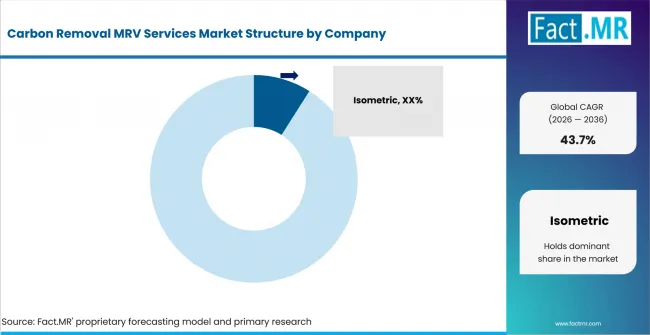
Isometric and Carbonfuture lead through protocols and digital MRV.
Carbon Removal Mrv Services Market Analysis By Company | Source: Fact.MR
Carbon removal MRV services are used by suppliers and corporate credit purchasers that need trusted evidence before credits are issued. Isometric provides certification infrastructure and pathway-specific protocols. Puro.earth provides the Puro Standard and a Nasdaq-powered registry. Sylvera supports carbon credit ratings and due diligence for corporate clients.
BeZero provides carbon credit ratings and risk analysis for removal and avoidance credits. Carbonfuture provides digital MRV and project tracking infrastructure for durable carbon removal. Competition through 2036 will depend on scientific credibility and acceptance by corporate credit purchasers.
Providers that combine protocol design with digital monitoring will be better placed. Registry-led platforms can win issuance-linked work. Rating providers can win purchaser diligence. Digital MRV firms can gain by reducing verification cost for high-volume biochar and enhanced rock weathering projects.
Which companies are the key players?
Isometric, Puro.earth, Sylvera, BeZero and Carbonfuture.
- Isometric
- Puro.earth (Nasdaq)
- Sylvera
- BeZero
- Carbonfuture
Bibliography
- [1] European Commission. (n.d.). Carbon removals and carbon farming. Directorate-General for Climate Action.
- [2] Verra. (2025, June 27). Verra publishes minor revision to biochar methodology.
- [3] European Commission. (2026, February 3). EU sets world’s first voluntary standard for permanent carbon removals. Directorate-General for Climate Action.
- [4] Isometric. (2025, September 11). Building trust in carbon removal—protocols and scientific rigor.
- [5] European Parliament and Council of the European Union. (2024, November 27). Regulation (EU) 2024/3012 establishing a Union certification framework for permanent carbon removals, carbon farming and carbon storage in products. Official Journal of the European Union.
This Report Addresses
- Strategic intelligence on carbon removal MRV services across service type, removal pathway and customer type.
- Forecast mapping from USD 0.4 billion in 2026 to USD 15.0 billion by 2036.
- Segment analysis covering Project Measurement and Verification, Biochar Carbon Removal, Carbon Removal Suppliers, Registry-Linked Certification Programs and Credit Issuance.
- Regional outlook covering the United States, Germany, United Kingdom, Canada and Finland.
- Competitive analysis of Isometric, Puro.earth, Sylvera, BeZero and Carbonfuture.
- Service assessment covering MRV protocols, verification, registry support and buyer diligence.
- Pathway assessment covering DAC, biochar, enhanced rock weathering, biomass removal and nature-based removal.
- Primary interviews, provider checks, official source review and CDR project validation support the forecast.
What does the carbon removal MRV services market cover?
Measurement and verification services for engineered and nature-based carbon removal.
The carbon removal MRV services market covers services that measure and certify carbon dioxide removal outcomes. It includes protocol design and credit-quality evidence. The market differs from the broad carbon credit market because the service focus is removal-specific proof before credits are issued or purchased.
What is included in the scope?
MRV protocol support and credit issuance services.
The scope includes measurement planning and removal quantification. It covers monitoring systems and registry documentation. It includes services for DAC and nature-based removals. It also includes credit purchaser diligence and data-room support for offtake deals.
What is excluded from the scope?
Carbon credit trading without removal verification.
The scope excludes carbon credit brokerage unless MRV diligence or verification support is included. It excludes emissions reduction offsets with no carbon removal claim. It also excludes corporate sustainability reporting tools that do not validate carbon removal outcomes.
How was the analysis built?
100+ sources, 45+ company portfolios, 25+ countries, 20+ interviews.
- Primary Research:
- Primary research includes interviews with carbon removal suppliers and registry teams. It includes input from corporate sustainability leads and verification specialists.
- Desk Research:
- Desk research reviews CRCF rules and registry disclosures. It covers MRV provider pages and carbon removal purchase programs.
- Market-Sizing and Forecasting:
- Forecasting uses CDR supplier counts and credit issuance activity. Corporate climate targets and offtake growth support the market assessment.
- Data Validation and Update Cycle:
- Forecasts are validated through provider checks and CDR project tracking. CRCF methodology updates and registry issuance activity help confirm market direction.
Segmentation
What is the report’s scope and coverage?
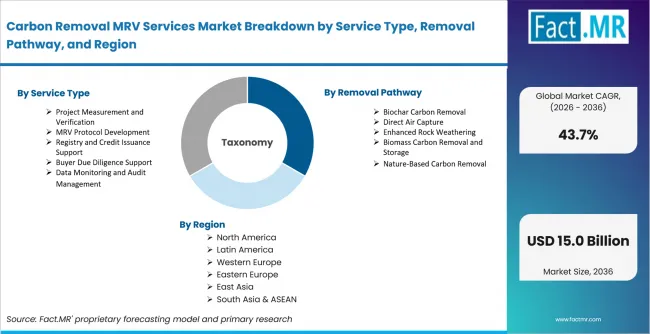
USD 0.4 billion to USD 15.0 billion at 43.7% CAGR across key services and regions.
Carbon Removal Mrv Services Market Breakdown By Service Type, Removal Pathway, And Region | Source: Fact.MR
| Attribute | Details |
|---|---|
| Quantitative Units | USD 0.4 billion in 2026 to USD 15.0 billion by 2036 at 43.7% CAGR |
| Market Definition | Measurement, reporting and verification services that certify engineered and nature-based carbon removal |
| Service Type | Project Measurement and Verification, MRV Protocol Development, Registry and Credit Issuance Support, Buyer Due Diligence Support, Data Monitoring and Audit Management |
| Removal Pathway | Biochar Carbon Removal, Direct Air Capture, Enhanced Rock Weathering, Biomass Carbon Removal and Storage, Nature-Based Carbon Removal |
| Customer Type | Carbon Removal Suppliers, Corporate Credit Purchasers, Registries and Standards Bodies, Climate Finance Platforms, Project Developers |
| Delivery Model | Registry-Linked Certification Programs, Independent Verification Projects, Digital MRV Platforms, Rating and Diligence Subscriptions, Managed MRV Advisory |
| End Use | Credit Issuance, Offtake Due Diligence, Corporate Climate Claims, Project Financing, Regulatory Certification |
| Regions Covered | North America, Western Europe, Northern Europe, East Asia, South Asia and Pacific, Latin America, Middle East and Africa |
| Countries Covered | United States, Germany, United Kingdom, Canada, Finland |
| Key Companies Profiled | Isometric, Puro.earth, Sylvera, BeZero and Carbonfuture |
| Forecast Period | 2026 to 2036 |
| Approach | Hybrid top-down and bottom-up approach using CDR supplier counts, verification intensity, registry activity, offtake growth and provider validation |
Source: Fact.MR analysis. Updated Jun 18, 2026
How is the market segmented?
-
By Service Type:
- Project Measurement and Verification
- MRV Protocol Development
- Registry and Credit Issuance Support
- Buyer Due Diligence Support
- Data Monitoring and Audit Management
-
By Removal Pathway:
- Biochar Carbon Removal
- Direct Air Capture
- Enhanced Rock Weathering
- Biomass Carbon Removal and Storage
- Nature-Based Carbon Removal
-
By Customer Type:
- Carbon Removal Suppliers
- Corporate Credit Purchasers
- Registries and Standards Bodies
- Climate Finance Platforms
- Project Developers
-
By Delivery Model:
- Registry-Linked Certification Programs
- Independent Verification Projects
- Digital MRV Platforms
- Rating and Diligence Subscriptions
- Managed MRV Advisory
-
By End Use:
- Credit Issuance
- Offtake Due Diligence
- Corporate Climate Claims
- Project Financing
- Regulatory Certification
-
By Region:
- North America
- United States
- Canada
- Europe
- Germany
- United Kingdom
- Finland
- France
- Netherlands
- Asia Pacific
- Japan
- Australia
- Singapore
- South Korea
- India
- Latin America
- Brazil
- Chile
- Mexico
- Middle East & Africa
- GCC Countries
- South Africa
- Israel
- North America
Frequently Asked Questions
What is the Carbon Removal MRV Services Market size in 2026?
What will the Carbon Removal MRV Services Market be worth by 2036?
What CAGR is projected for the Carbon Removal MRV Services Market?
Which service type leads the Carbon Removal MRV Services Market?
Which country expands faster in the Carbon Removal MRV Services Market?
How does Germany perform in the Carbon Removal MRV Services Market?
How does the United Kingdom perform in the Carbon Removal MRV Services Market?
How does Canada perform in the Carbon Removal MRV Services Market?
How does Finland perform in the Carbon Removal MRV Services Market?
What is the primary driver in the Carbon Removal MRV Services Market?
What is the main restraint in the Carbon Removal MRV Services Market?
Why is biochar important in this market?
Who worked on this report


Preview the report firsthand - request a free sample
Free SampleGet the brochure for pricing and purchase details
Download PDF