- Market Value (2025): USD 298.2 Mn
- Estimated Value (2026): USD 340.0 Mn
- Forecast Value (2036): USD 1260.0 Mn
- CAGR (2026-2036): 14.0%
What is the Hygienic Dewpoint Sensors Market forecast to be worth by 2036?
USD 340.0 million in 2026 to USD 1260.0 million by 2036 at a 14.0% CAGR.
- The Hygienic Dewpoint Sensors Market reached USD 298.2 million in 2025.
- Demand is projected to increase from USD 340.0 million in 2026 to USD 1260.0 million by 2036.
- The market is forecast to record 14.0% CAGR from 2026 to 2036 as plant operators tighten water-vapor control in compressed-air utilities.
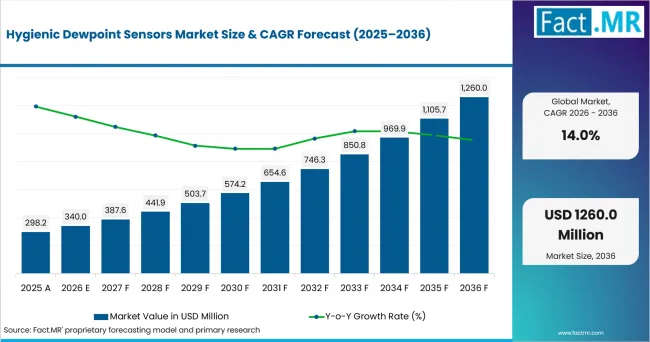
Hygienic Dewpoint Sensors Market Value Analysis | Source: Fact.MR
What are the defining numbers behind Hygienic Dewpoint Sensors Market growth?
USD 920.0 million absolute opportunity between 2026 and 2036.
- Demand Drivers in the Market
- Ultra-dry dewpoint measurement is used in applications including pharmaceutical manufacturing and high-end compressed-air systems. The Federal Reserve reported on August 18, 2026 that U.S. manufacturing production grew 0.2% in July 2026.
- Automation teams need Ethernet-ready moisture data so alarms, historian records, and service tickets feed into existing industrial automation control systems.
- Battery and semiconductor dry-room managers need low-dewpoint readings to protect moisture-sensitive materials during coating, assembly, and storage.
- Maintenance teams need early warning from machine condition monitoring systems so dryer failure is visible before moisture reaches pneumatic tools or instruments.
- Key Segments Analyzed
- By Sensor Type: Optical is expected to hold 44.0% share in 2026 due to stable low-moisture measurement and fast response in dry-gas service.
- By Connectivity: Industrial Ethernet is projected to account for 42.0% share in 2026 as plants connect dewpoint readings to supervisory controls and asset records.
- By Function: Condition monitoring is anticipated to capture 46.0% share in 2026 because moisture alarms reduce unplanned dryer checks and product-risk investigations.
- By End Use: Automotive is estimated to represent 32.0% share in 2026 owing to paint, compressed-air, and electronics lines that require reliable dry utilities.
- By Installation: Inline is forecast to hold 45.0% share in 2026 as operators prefer continuous measurement at dryer outlets and critical branch lines.
- Analyst Opinion at Fact.MR
- Shambhu Nath Jha, Principal Consultant at Fact.MR, states, “Dewpoint sensing is now a serious reliability decision when water vapor can stop a dry room, spoil a coating run, or damage a clean gas line. The market is expected to reward suppliers that combine accurate low-moisture probes with plant-network connectivity and practical calibration support. Buyers are asking for proof that readings stay dependable after installation, beyond a sensor specification on paper.”
- Strategic Implications
- Sensor makers should publish response-time and drift data for low dewpoint ranges used in dry rooms and compressed-air networks.
- Calibration service providers should offer traceable field checks that reduce downtime for regulated or quality-sensitive factories.
- Automation integrators should map dewpoint alarms to historian systems so moisture events become actionable maintenance records. UKRI lists a GBP 52 million Robotics Adoption Programme running from April 2026 to March 2030 to help organisations understand, trial, and integrate robotics.
- Plant owners should place sensors at dryer exits and high-risk branches alongside occasional manual checks.
The USA is estimated to record 17.0% CAGR through 2036 supported by electronics orders and dry utility monitoring. South Korea is projected to advance at 15.5% CAGR as semiconductor and electronics production increases moisture-control needs. Germany is anticipated to post 14.8% CAGR through machinery orders and optical-product manufacturing. The UK is forecast to reach 11.5% CAGR as manufacturers add selected robotics and monitoring upgrades. Japan is expected to record 10.2% CAGR with machinery orders and precision manufacturing supporting steady replacement demand.
How does the Hygienic Dewpoint Sensors Market break down by segment?
Optical leads Sensor Type at 44.0%; Condition monitoring leads Function at 46.0%.
Which Sensor Type dominates?
Optical is expected to hold 44.0% share in 2026.
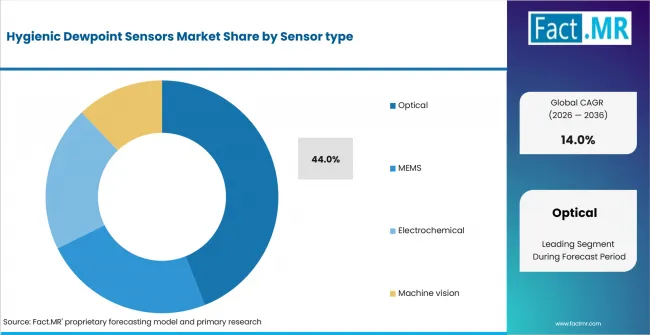
Hygienic Dewpoint Sensors Market Analysis By Sensor Type | Source: Fact.MR
Optical sensing leads because low-moisture applications need stable measurement near dryer outlets and clean gas lines. Battery rooms and electronics plants need repeatable readings before water vapor affects production.
Optical probes fit ultra-dry service when low dewpoint ranges require fast response and traceable checks. That role explains why optical devices are concentrated in dry rooms and specialty gas systems.
What leads the Connectivity segment?
Industrial Ethernet is projected to account for 42.0% share in 2026.
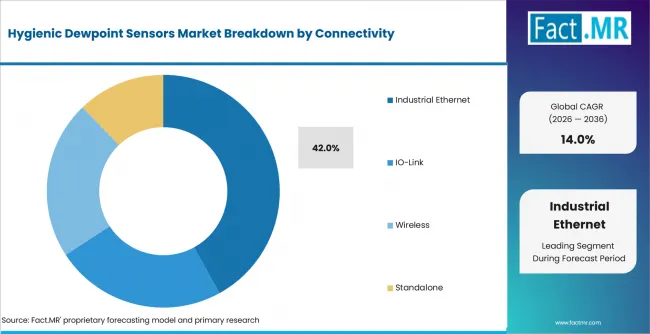
Hygienic Dewpoint Sensors Market Analysis By Connectivity | Source: Fact.MR
Industrial Ethernet leads because plants want dewpoint values inside control rooms and maintenance dashboards. It gives engineers live alarms that connect moisture readings with IoT-enabled equipment maintenance solutions.
Ethernet also supports multi-point monitoring across compressed-air headers and gas branches. Operators can compare dryer performance with downstream alarms during audits.
How does Function shape demand?
Condition monitoring is anticipated to lead with 46.0% share in 2026.
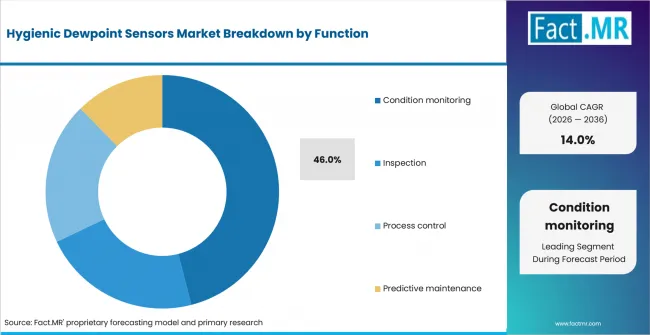
Hygienic Dewpoint Sensors Market Analysis By Function | Source: Fact.MR
Condition monitoring leads because dewpoint drift often appears before air-system failures affect product quality. Alarms help teams find dryer saturation or sample-line leaks early.
Continuous records help factories move away from manual checks. They are valuable in regulated plants because they show whether a dry-air utility stayed within the approved range during production.
What supports Automotive within End Use?
Automotive is estimated to represent 32.0% share in 2026.
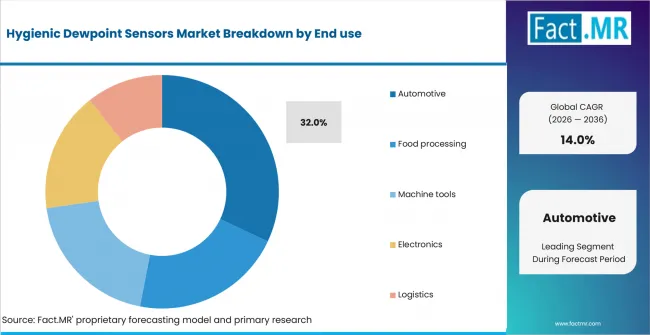
Hygienic Dewpoint Sensors Market Analysis By End Use | Source: Fact.MR
Automotive leads among end uses because paint booths, pneumatic tools, and electronics assembly depend on dry utilities. Dewpoint monitoring helps prevent condensation and coating defects.
Vehicle plants also use more automated inspection and handling equipment. The same movement toward robotic sensors increases the value of stable utility monitoring because moisture-related downtime can interrupt tightly sequenced production cells.
What supports Inline within Installation?
Inline is forecast to hold 45.0% share in 2026.
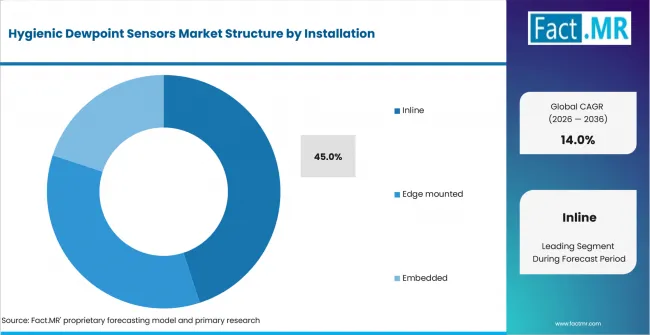
Hygienic Dewpoint Sensors Market Analysis By Installation | Source: Fact.MR
Inline installation leads because dewpoint control works best when measurement is placed close to the process. Sensors at dryer outlets or critical branch lines give a faster signal than cabinet meters checked by hand.
Inline placement is practical in compressed-air networks served by refrigerant compressed air dryers and adsorption air dryers. Live readings keep dryer performance tied to maintenance budgets.
What is accelerating Hygienic Dewpoint Sensors Market adoption, and what is holding it back?
Demand rises through compressed-air quality control and low-moisture production; adoption is constrained by calibration cost and installation complexity.
| DRIVER | (~) % IMPACT ON CAGR | GEOGRAPHIC RELEVANCE | IMPACT TIMELINE |
|---|---|---|---|
| Low-moisture compressed-air and dry-gas quality control | +1.7% | Global | Short term (<= 2 years) |
| Industrial Ethernet and IO-Link integration | +1.2% | North America, Europe, East Asia | Medium term (2-4 years) |
| Battery, semiconductor and precision manufacturing moisture limits | +1.4% | USA, South Korea, Japan | Medium term (2-4 years) |
| Automotive paint, pneumatic and electronics uptime needs | +0.9% | USA, Germany, South Korea | Long term (>= 4 years) |
Source: Fact.MR analysis. Updated Aug 26, 2026
- Low-moisture compressed-air and dry-gas quality control: Plants use dewpoint readings to protect sensitive materials, pneumatic systems, and clean gas utilities from water-vapor excursions.
- Industrial Ethernet and IO-Link integration: Networked sensors shorten the route from a moisture alarm to maintenance action and production records.
- Battery, semiconductor and precision manufacturing moisture limits: Dry-room and cleanroom operators require readings that remain stable at low dewpoint levels.
| OPPORTUNITY | (~) % IMPACT ON CAGR | GEOGRAPHIC RELEVANCE | IMPACT TIMELINE |
|---|---|---|---|
| Lifecycle calibration and exchange services | +0.8% | Global | Short term (<= 2 years) |
| Inline sensors for clean dry rooms | +1.0% | USA, South Korea, Japan | Medium term (2-4 years) |
| Digital plant retrofits for hygienic utility lines | +0.7% | Europe, North America | Medium term (2-4 years) |
Source: Fact.MR analysis. Updated Aug 26, 2026
- Lifecycle calibration and exchange services: Suppliers can reduce buyer hesitation by bundling traceable checks, replacement probes, and practical service intervals.
- Inline sensors for clean dry rooms: Low-dewpoint manufacturing creates openings for probes that combine fast response with stable readings after installation.
- Digital plant retrofits for hygienic utility lines: Older facilities are expected to add sensor points where compressed air from industrial air compressors reaches sensitive operations.
| RESTRAINT | (~) % IMPACT ON CAGR | GEOGRAPHIC RELEVANCE | IMPACT TIMELINE |
|---|---|---|---|
| Calibration and traceability cost | -0.5% | Global | Short term (<= 2 years) |
| Sample-line contamination and response lag | -0.4% | Industrial plants | Medium term (2-4 years) |
| Delayed automation budgets during weak production cycles | -0.3% | Europe, Japan | Short term (<= 2 years) |
Source: Fact.MR analysis. Updated Aug 26, 2026
- Calibration and traceability cost: Quality-critical plants must document sensor accuracy, which raises lifecycle spending beyond the purchase price.
- Sample-line contamination and response lag: Poor installation can make a good sensor look unreliable when sample tubing carries leaks, oil, or residual moisture.
- Delayed automation budgets during weak production cycles: Plants may keep older transmitters longer when production utilization or machinery orders soften.
Which countries are scaling the Hygienic Dewpoint Sensors Market through 2036?
- The country comparison spans 6.8 percentage points between the USA and Japan.
- The USA remains 1.5 percentage points above South Korea because electronics orders and dry-air monitoring support early sensor upgrades.
- South Korea remains 0.7 percentage point above Germany as semiconductor and ICT production increases the need for low-moisture process control.
- Germany remains 3.3 percentage points above the UK through machinery orders and optical-product manufacturing activity.
- The UK remains 1.3 percentage points above Japan as robotics support and selective manufacturing gains sustain sensor retrofits.
- Japan closes the displayed range while machinery orders and precision factory upgrades continue to support replacement demand.
Comparable CAGRs create different entry conditions because automation depth, dry-room exposure, and calibration expectations vary by country. Full report coverage includes North America, Latin America, Western Europe, Eastern Europe, East Asia, South Asia & Pacific, Middle East & Africa.
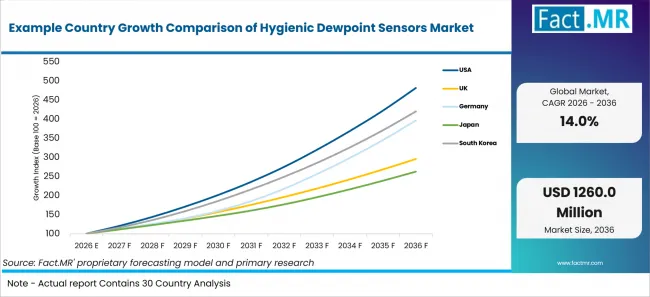
Example Country Growth Comparison Of Hygienic Dewpoint Sensors Market | Source: Fact.MR
| Country | CAGR (2026-2036) |
|---|---|
| USA | 17.0% |
| South Korea | 15.5% |
| Germany | 14.8% |
| UK | 11.5% |
| Japan | 10.2% |
Source: Fact.MR analysis. Updated Aug 26, 2026
What supports USA adoption?
17.0% CAGR, supported by electronics orders and compressed-air monitoring.
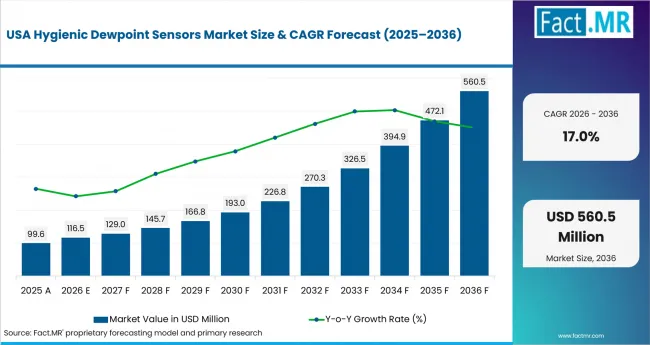
Hygienic Dewpoint Sensors Market Country Value Analysis | Source: Fact.MR
The U.S. Census Bureau reported on July 27, 2026 that new orders for manufactured durable goods increased to USD 334.8 billion in June 2026. Computers and electronic products led the increase, rising USD 0.9 billion, or 3.1%, to USD 31.1 billion.
How is South Korea developing demand?
15.5% CAGR, backed by semiconductor exports and manufacturing intensity.
MOTIR and MSIT announced on July 14, 2026 that Korea's ICT exports reached USD 253.9 billion in the first half of 2026, with semiconductors and solid-state drives accounting for 83.7% of ICT exports.
What supports Germany adoption?
14.8% CAGR, led by machinery orders and optical-product manufacturing activity.
Destatis reported on August 6, 2026 that real new orders in German manufacturing rose 3.1% in June 2026 from the previous month, with increases of 12.7% in machinery and equipment and 22.7% in computer, electronic and optical products.
What supports the United Kingdom’s growth?
11.5% CAGR, backed by selective manufacturing upgrades and utility monitoring.
The Office for National Statistics reported on August 13, 2026 that UK manufacturing output grew 1.0% in Quarter 2 2026, with computer, electronic and optical products up 3.0%.
How does Japan perform?
10.2% CAGR, led by machinery orders and precision manufacturing upgrades.
The Cabinet Office reported on August 19, 2026 that the total value of machinery orders received by 280 manufacturers increased 0.4% in June from the previous month on a seasonally adjusted basis; in the April-June period, total machinery orders increased 11.3% from the previous quarter.
Who leads the Hygienic Dewpoint Sensors Market?
Vaisala Oyj, Michell Instruments, Endress+Hauser Group, Endress+Hauser, AMETEK, and CS Instruments GmbH & Co. KG as relevant dewpoint and moisture-measurement providers.
Vaisala Oyj is active through dew-point transmitters designed for low-moisture industrial processes. Its DMT153 is designed for ultra-dry applications including battery dry rooms, semiconductor cleanrooms, specialty gas lines and high-end compressed-air systems, with fast response, long-term stability and field-verification capabilities.
Michell Instruments, part of Process Sensing Technologies, supports trace-moisture measurement and chilled-mirror hygrometry. In October 2025, Process Sensing Technologies introduced the Michell S8000 HT for high-temperature dew-point measurement from −30 °Cdp to +95 °Cdp with ±0.1 °C accuracy, adding a high-temperature reference instrument for calibration laboratories.
Endress+Hauser Group offers low-dew-point probes for compressed-air systems and refrigeration and adsorption dryers. CS Instruments GmbH & Co. KG supplies FA 510/515 dew-point sensors for compressed-air dryers and industrial gases. Endress+Hauser offers natural-gas moisture analyzers such as the SS500, which measures moisture concentration and reports dew point, while AMETEK Process Instruments supplies trace-moisture analyzers and chilled-mirror dew-point instruments for industrial gas and process applications. Low-dew-point capability, instrument integration and calibration and service support are relevant competitive considerations across these product portfolios.
Which companies are the key providers?
Key companies include Vaisala Oyj, Michell Instruments, Endress+Hauser Group, Endress+Hauser, AMETEK, and CS Instruments GmbH & Co. KG.
- Vaisala Oyj
- Michell Instruments
- Endress+Hauser Group
- Endress+Hauser
- AMETEK
- CS Instruments GmbH & Co. KG
Bibliography
- Board of Governors of the Federal Reserve System. (2026, August 18). Industrial production and capacity utilization—G.17.
- U.S. Census Bureau. (2026, July 27). Monthly advance report on durable goods manufacturers' shipments, inventories and orders.
- Ministry of Trade, Industry and Resources, & Ministry of Science and ICT. (2026, July 14). Korea’s ICT exports reach record $253.9 billion in first half of 2026.
- Federal Statistical Office. (2026, August 6). New orders in manufacturing in June 2026: +3.1% on the previous month.
- Office for National Statistics. (2026, August 13). Index of Production, UK: June 2026.
- UK Research and Innovation. (2026, August 11). Area of investment and support: Robotics adoption programme.
- Cabinet Office, Economic and Social Research Institute. (2026, August 19). Machinery orders in June, 2026 and forecast for Jul.-Sep. 2026.
- Vaisala. (2026, March 5). Vaisala launches DMT153 dew point transmitter for ultra-dry processes.
- Process Sensing Technologies. (2025, October 16). Introducing the S8000 HT: High-Temperature Chilled Mirror.
This Report Answers
- The report explains where hygienic dewpoint sensors are used across sensor type, connectivity, function, end use, and installation.
- Segment analysis identifies the leading subsegments and the operational reasons plant teams prioritize them.
- Country analysis examines the listed markets and the production, automation, and policy mechanisms supporting dewpoint sensor deployment.
- Competitive analysis reviews current providers across dewpoint transmitters, chilled mirror systems, compressed-air sensors, and hygienic instrumentation.
- Application analysis assesses how low-moisture control, calibration needs, and plant connectivity influence purchase decisions.
What does the Hygienic Dewpoint Sensors Market cover?
The Hygienic Dewpoint Sensors Market covers instruments that measure water vapor in compressed air, process gases, dry-room systems, and clean utilities. It includes optical, MEMS, and electrochemical sensor types used when operators need continuous dewpoint records and alarms. Adjacent gas detection equipment shows a similar move toward fixed monitoring.
The assessment covers industrial Ethernet, IO-Link, wireless, and standalone connectivity. It also reviews condition monitoring, inspection, process control, and predictive maintenance across automotive, food processing, machine tools, electronics, and logistics. Related self-powered sensors illustrate how plant teams are also evaluating lower-maintenance sensing options for distributed equipment.
What is included in the scope?
The scope includes dewpoint transmitters, probes, inline measurement points, sensor modules, sampling assemblies, and related software functions when dewpoint measurement is the core purpose. It includes products used in hygienic air and gas lines where low moisture directly affects product quality or process reliability.
The scope also includes dewpoint sensing attached to dryer monitoring, clean gas distribution, battery dry rooms, and electronics assembly. It considers supplier activity where moisture measurement connects with industrial automation control systems and utility maintenance workflows.
What is excluded from the scope?
The scope excludes general humidity sensors used only for building comfort, weather monitoring, consumer devices, or HVAC room control. It excludes laboratory instruments outside hygienic industrial moisture-control duty.
Gas analyzers, flowmeters, temperature probes, and pressure sensors are excluded without dewpoint or water-vapor measurement. Compressed-air dryers and air compressors are excluded as equipment categories when the sensor is sold only as part of the machine.
How Was the Analysis Built?
The analysis draws on 120+ sources, 35+ portfolios, 25+ countries, and 20+ interviews.
- Primary Research: Discussions with manufacturers, sensor suppliers, distributors, end users, procurement teams, and subject-matter experts examine purchasing priorities, approval requirements, and adoption barriers.
- Desk Research: Government statistics, regulatory publications, company filings, trade data, standards, public policy, and authoritative technical sources support the analysis.
- Market Sizing and Forecasting: Estimates combine historical performance, segment shares, country growth, adoption patterns, investment activity, and barriers to expansion.
- Data Validation and Update Cycle: Findings are validated against public data, company activity, regulation, trade patterns, launches, approvals, procurement trends, and commercial adoption.
Segmentation
What is the report’s scope and coverage?
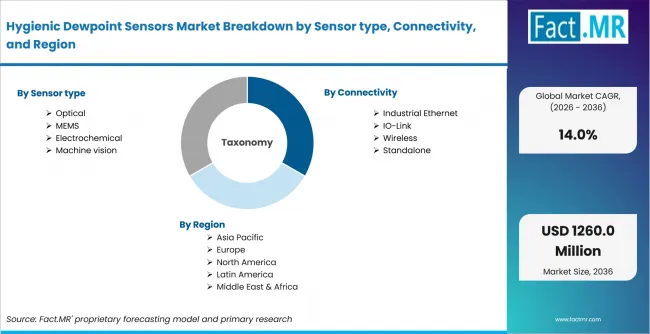
Hygienic Dewpoint Sensors Market Breakdown By Sensor Type, Connectivity, And Region | Source: Fact.MR
| Attribute | Details |
|---|---|
| Quantitative Units | USD million |
| Market Definition | Sensors and transmitters used to measure dewpoint or water vapor in hygienic compressed air, process gas, dry-room, and clean manufacturing applications. |
| Sensor Type | Optical; MEMS; Electrochemical |
| Connectivity | Industrial Ethernet; IO-Link; Wireless; Standalone |
| Function | Condition monitoring; Inspection; Process control; Predictive maintenance |
| End Use | Automotive; Food processing; Machine tools; Electronics; Logistics |
| Installation | Inline; Edge mounted; Embedded |
| Regions Covered | North America; Latin America; Western Europe; Eastern Europe; East Asia; South Asia & Pacific; Middle East & Africa |
| Countries Covered | USA; UK; Germany; Japan; South Korea |
| Key Companies Profiled | Vaisala Oyj; Michell Instruments; Endress+Hauser Group; Endress+Hauser; AMETEK; CS Instruments GmbH & Co. KG |
| Forecast Period | 2026 to 2036 |
| Approach | Hybrid top-down and bottom-up approach using industrial moisture-control needs, sensor portfolios, country production indicators, segment shares, and provider activity review. |
Source: Fact.MR analysis. Updated Aug 26, 2026
How is the market segmented?
-
By Sensor Type:
- Optical
- MEMS
- Electrochemical
-
By Connectivity:
- Industrial Ethernet
- IO-Link
- Wireless
- Standalone
-
By Function:
- Condition monitoring
- Inspection
- Process control
- Predictive maintenance
-
By End Use:
- Automotive
- Food processing
- Machine tools
- Electronics
- Logistics
-
By Installation:
- Inline
- Edge mounted
- Embedded
-
By Region:
- North America
- Latin America
- Western Europe
- Eastern Europe
- East Asia
- South Asia & Pacific
- Middle East & Africa
Frequently Asked Questions
How big is the hygienic dewpoint sensors market in 2026?
What is the CAGR of the hygienic dewpoint sensors market from 2026 to 2036?
Which sensor type leads the hygienic dewpoint sensors market?
Which connectivity segment leads the hygienic dewpoint sensors market?
Who are the leading companies in the hygienic dewpoint sensors market?
Who worked on this report


Preview the report firsthand - request a free sample
Free SampleGet the brochure for pricing and purchase details
Download PDF