- Market Value (2025): USD 1,174.6 Mn
- Estimated Value (2026): USD 1460.0 Mn
- Forecast Value (2036): USD 12854.8 Mn
- CAGR (2026-2036): 24.3%
What is the Megawatt Charging Dispensers Market forecast to be worth by 2036?
USD 1,460.0 million in 2026 to USD 12,854.8 million by 2036 at a 24.3% CAGR.
- The Megawatt Charging Dispensers Market reached USD 1,174.6 million in 2025.
- Demand is projected to increase from USD 1,460.0 million in 2026 to USD 12,854.8 million by 2036.
- The market is forecast to record 24.3% CAGR from 2026 to 2036.
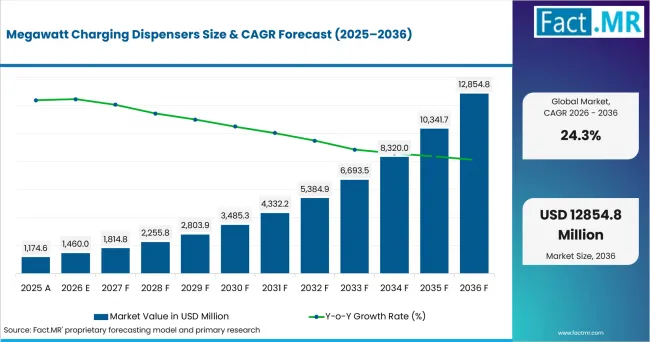
Megawatt Charging Dispensers Value Analysis | Source: Fact.MR
What are the defining numbers behind Megawatt Charging Dispensers Market growth?
An absolute opportunity of USD 11,394.8 million is expected between 2026 and 2036.
- Demand Drivers in the Market
- Electric truck deployment is moving megawatt dispensers from demonstration sites into fleet planning. The International Energy Agency reported in May 2026 that global electric truck sales exceeded 400,000 in 2025 and reached 9% of truck sales worldwide. Charging equipment must now serve larger batteries within driver-rest windows.
- High-current charging creates heat at the connector and cable. Liquid-cooled cable dispensers are projected to benefit as fleet operators look for safer hand contact, stable current delivery and lower strain on drivers during repeated charging sessions.
- Highway charging hubs need dispenser layouts that fit tractor-trailer movement. Operators prefer clear bay access, serviceable connector assemblies and commercial-fleet payment systems.
- Ports and logistics yards are anticipated to add application volume where trucks return to fixed routes. These sites can schedule charging windows around loading activity and reduce the risk of idle dispensers.
- Key Segments Analyzed
- By Dispenser Architecture: Liquid-cooled cable dispensers are expected to hold 46.0% share in 2026 driven by heat control and practical cable handling in high-current truck charging.
- By Power Class: 1-1.5 MW is projected to account for 33.0% share in 2026 since early MCS sites balance charging speed with manageable grid and hardware cost.
- By Vehicle: Heavy-duty trucks are anticipated to capture 58.0% share in 2026 owing to long-haul and regional freight fleets needing faster charging stops.
- By Deployment: Highway charging hubs are estimated to represent 34.0% share in 2026 supported by corridor charging needs for en-route heavy goods movement.
- Analyst Opinion at Fact.MR
- Shambhu Nath Jha, Principal Consultant at Fact.MR, states, “Megawatt charging dispensers are becoming a site-productivity decision. The market is expected to reward suppliers that can combine cooled cable handling, service response and standards alignment in one dispenser platform. Fleet operators want charging that fits truck routes and driver breaks, so reliability is as material as peak power.”
- Strategic Implications
- Manufacturers should qualify liquid-cooled connector systems across repeated high-current cycles so fleet operators can evaluate thermal performance before multi-site rollout.
- Charging-site developers should model truck access and trailer turning paths before selecting dispenser posts for highway hubs and logistics yards.
- Standards teams should track interoperability testing closely. CharIN reported in June 2025 that its MCS Testival in Saint-Genis-Pouilly brought four heavy-duty vehicles into fully integrated MCS testing, enabling real-vehicle power-transfer, interoperability and secure communication testing.
- Service networks should train technicians on cooled cable assemblies, power modules and communication faults because downtime becomes costly when one dispenser serves a full heavy-vehicle bay.
Sweden is forecast to post 25.4% CAGR through 2036 driven by heavy-vehicle charging grants and Nordic freight pilots. The Netherlands is projected to record 25.0% CAGR as logistics hubs test public truck charging under high-use conditions. The USA is anticipated to advance at 24.7% CAGR supported by freight-corridor funding. The UK is estimated to reach 24.3% CAGR through ZEHID locations and depot charging support. Germany is expected to register 24.0% CAGR owing to motorway tenders and MCS corridor planning.
How does the Megawatt Charging Dispensers Market break down by segment?
Liquid-cooled cable dispensers lead Dispenser Architecture at 46.0%; Heavy-duty trucks lead Vehicle at 58.0%.
Which Dispenser Architecture dominates?
Liquid-cooled cable dispensers are expected to hold 46.0% share in 2026.
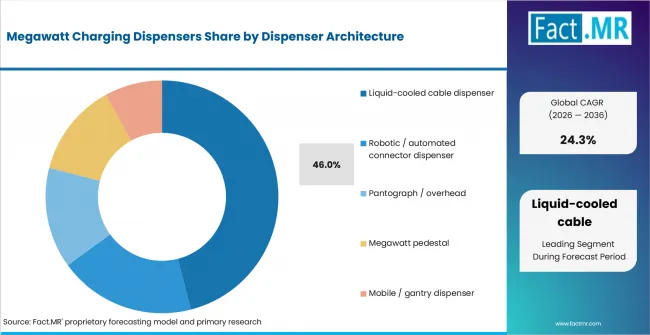
Megawatt Charging Dispensers Analysis By Dispenser Architecture | Source: Fact.MR
Liquid-cooled cable dispensers lead because MCS charging pushes more current through the connector than conventional public fast chargers. Cooling helps control cable temperature and allows the dispenser to stay usable for drivers who must connect and disconnect large truck inlets several times per shift.
Fleet operators are likely to favor designs that reduce cable weight and torque at the inlet. That preference gives liquid-cooled cable dispensers a practical advantage in highway hubs and larger depots.
What leads the Power Class segment?
1-1.5 MW is projected to account for 33.0% share in 2026.
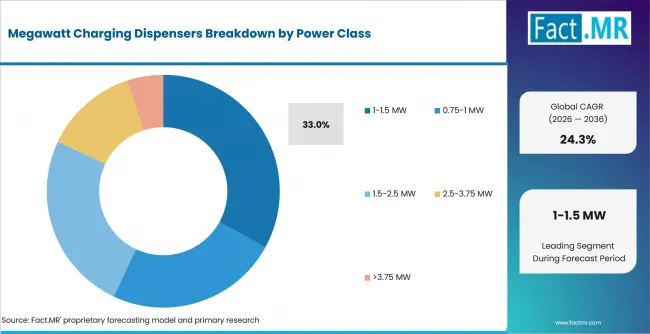
Megawatt Charging Dispensers Analysis By Power Class | Source: Fact.MR
The 1-1.5 MW class leads because it gives early truck-charging sites a workable balance between charging speed and installed power cost. Many fleet operators need faster charging than current high-power CCS systems, yet they still need a power level that utilities and site owners can integrate in phases.
Power above 1 MW is expected to become more common as truck battery capacity rises. The near-term revenue pool remains concentrated in equipment that can be deployed first, upgraded later and supported by trained service teams.
How does Vehicle shape demand?
Heavy-duty trucks are anticipated to lead with 58.0% share in 2026.
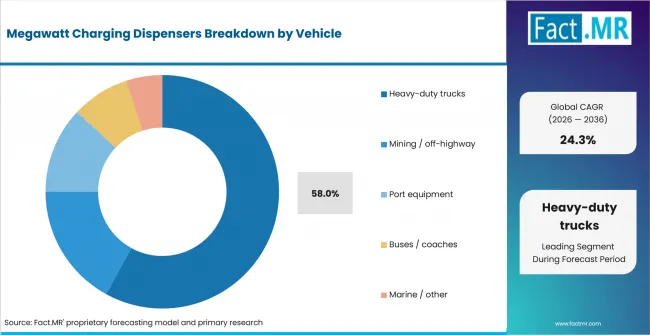
Megawatt Charging Dispensers Analysis By Vehicle | Source: Fact.MR
Heavy-duty trucks lead because long-haul and regional freight vehicles need short charging stops to protect daily asset use. The U.S. Department of Energy selected SuperTruck Charge projects in January 2025, including a publicly accessible 10+ MW medium- and heavy-duty EV charging station in Barstow, California. Such projects show why dispenser output must scale beyond passenger-car fast charging.
Mining vehicles and port equipment create valuable side applications, especially where routes are fixed. Heavy-duty trucks remain the main use case because highway and depot charging both require dedicated dispenser placement and driver-safe connector handling.
What supports Highway charging hubs within Deployment?
Highway charging hubs are estimated to represent 34.0% share in 2026.
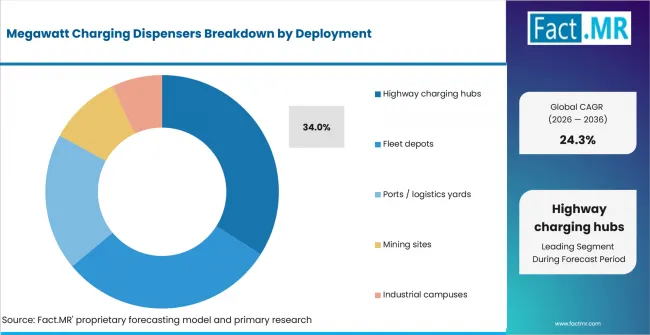
Megawatt Charging Dispensers Analysis By Deployment | Source: Fact.MR
Highway charging hubs lead deployment because electric truck routes need visible stopping points between depots. A hub format can combine several dispensers, waiting space and service access in one location, which is harder to achieve with isolated chargers at smaller roadside sites.
Fleet depots remain essential for overnight and shift-based charging. Highway hubs add a different requirement: the dispenser must serve drivers who arrive with uncertain state of charge and need dependable connector availability within a defined break period.
What is accelerating Megawatt Charging Dispensers Market adoption, and what is holding it back?
Demand is expected to rise through truck electrification, MCS standardization and corridor charging programs. Growth is constrained by grid upgrades, site economics and early fleet utilization.
Drivers Impact Analysis
| DRIVER | (~) % IMPACT ON CAGR | GEOGRAPHIC RELEVANCE | IMPACT TIMELINE |
|---|---|---|---|
| Electric truck charging beyond passenger-car fast charging | +2.8% | Global | Short term (<= 2 years) |
| Liquid-cooled connector and cable handling needs | +2.1% | North America, Western Europe | Medium term (2-4 years) |
| Highway hub and depot charging buildout | +1.8% | USA, Germany, Netherlands | Medium term (2-4 years) |
| MCS interoperability testing and standard alignment | +1.2% | Global | Long term (>= 4 years) |
Source: Fact.MR analysis. Updated Sep 10, 2026
Opportunity Impact Analysis
| OPPORTUNITY | (~) % IMPACT ON CAGR | GEOGRAPHIC RELEVANCE | IMPACT TIMELINE |
|---|---|---|---|
| Upgradeable dispenser platforms for mixed CCS and MCS sites | +1.5% | Global | Short term (<= 2 years) |
| Truck-focused service packages for highway charging hubs | +1.1% | Western Europe, North America | Medium term (2-4 years) |
| Automated and robotic connector concepts for controlled yards | +0.8% | Ports, mining, logistics hubs | Long term (>= 4 years) |
Source: Fact.MR analysis. Updated Sep 10, 2026
Restraints Impact Analysis
| RESTRAINT | (~) % IMPACT ON CAGR | GEOGRAPHIC RELEVANCE | IMPACT TIMELINE |
|---|---|---|---|
| Grid connection lead times for multi-MW sites | -0.9% | North America, Western Europe | Short term (<= 2 years) |
| Low early utilization at public truck hubs | -0.6% | Global | Medium term (2-4 years) |
| Service skill gaps for cooled cable and MCS systems | -0.4% | Global | Long term (>= 4 years) |
Source: Fact.MR analysis. Updated Sep 10, 2026
Which countries are scaling the Megawatt Charging Dispensers Market through 2036?
- The country comparison spans 1.4 percentage points and forms two practical growth bands across the forecast period.
- Sweden remains 0.4 percentage point above the Netherlands through heavy-vehicle charging grants and Nordic freight electrification pilots.
- The Netherlands remains 0.3 percentage point above the USA as logistics hubs test public truck charging at dense freight locations.
- The USA remains 0.4 percentage point above the UK through federal corridor funding and large freight-route charging projects.
- The UK remains 0.3 percentage point above Germany as ZEHID locations and depot charging funds move heavy goods fleets toward charging readiness.
- Germany closes the displayed range through motorway truck-charging awards and MCS point planning along federal highways.
Comparable CAGRs create different entry conditions due to freight density, grid availability, route patterns and policy timing. Full coverage includes North America, Latin America, Western Europe, Eastern Europe, East Asia, South Asia & Pacific, Middle East & Africa.
Megawatt Charging Dispensers Value Analysis | Source: Fact.MR
| Country | CAGR (2026-2036) |
|---|---|
| Sweden | 25.4% |
| Netherlands | 25.0% |
| United States | 24.7% |
| United Kingdom | 24.3% |
| Germany | 24.0% |
Source: Fact.MR analysis. Updated Sep 10, 2026
What supports Sweden adoption?
25.4% CAGR, supported by heavy-vehicle charging grants and Nordic freight pilots.
Sweden is building a national heavy-vehicle charging base around grant-backed locations and cold-weather freight needs. The Swedish Energy Agency reported in December 2025 that the goal is to have 250 charging stations for heavy vehicles in place by the end of 2025. That target supports demand for rugged dispensers that can serve regional freight routes and depot-linked public stops.
How is the Netherlands scaling demand?
25.0% CAGR, driven by logistics-hub trials and dense freight locations.
The Netherlands is testing truck charging in a dense logistics network where ports, distribution yards and highway access overlap. Rijkswaterstaat reported in September 2025 that the Living Lab Heavy-Duty Charging Hubs study analysed detailed data from six operational charging hubs. Practical hub data helps operators select dispensers that match parking geometry, charging time and energy-management needs.
What supports USA adoption?
24.7% CAGR, backed by freight-corridor funding and public charging awards.
The USA is scaling around corridor funding and early high-power truck-charging sites. The Federal Highway Administration announced in January 2025 that 49 projects would deploy more than 11,500 EV charging ports and alternative-fueling infrastructure across 27 states, four federally recognized Tribes and the District of Columbia. Such funding expands the addressable base for high-output dispensers on commercial routes.
What supports the United Kingdom’s growth?
24.3% CAGR, supported by ZEHID locations and depot charging funds.
The United Kingdom is pairing road-freight trials with charging locations for zero-emission HGVs. UK Parliament stated in November 2025 that ZEHID had funded 73 planned infrastructure locations representing more than 360 chargers. That program supports dispenser demand at sites where truck operators need charging equipment aligned with depot access and public heavy-vehicle routes.
How does Germany perform?
24.0% CAGR, led by motorway tenders and MCS corridor planning.
Germany is moving truck charging from planning into motorway allocation. The Federal Ministry of Transport said in July 2026 that unstaffed rest areas would include 447 MCS charging points for road freight. Motorway awards create a route for dispenser suppliers that can deliver high-current hardware, service coverage and installation support for heavy commercial traffic.
Who leads the Megawatt Charging Dispensers Market?
ABB E-mobility participates in heavy-duty megawatt charging through its MCS1200. Launched in April 2025, the system delivers 1.2 MW of power and 1,500 A of continuous output and incorporates a purpose-built connector holder designed to align the connector with the truck inlet and reduce cable torque.
Alpitronic addresses high-power and megawatt charging through its HYC1000 platform. The system combines power cabinets rated at up to 1,000 kW with an MCS dispenser supporting charging currents of up to 1,500 A.
Kempower competes through its Megawatt Charging System and Mega Satellite platform for electric trucks and other heavy-duty vehicles. The system provides up to 1.2 MW of charging power and supports dynamic power sharing between MCS and CCS charging outputs.
Siemens eMobility, which acquired Heliox, supplies charging hardware, software and services for electric bus and truck fleets. Its SICHARGE FLEX distributed charging system supports CCS and MCS charging, with system power of up to 1.68 MW and MCS charging current of up to 1,500 A.
Delta Electronics participates through high-power EV charging and its MW Charging Solution. Delta has also introduced a Megawatt Charging System for heavy-duty commercial vehicles and offers charging-management technology that can integrate EV charging with energy-storage systems.
Which companies are the key providers?
Key companies include ABB E-mobility; Alpitronic; Kempower; Siemens eMobility, including Heliox; and Delta Electronics.
- ABB E-mobility
- Alpitronic
- Kempower
- Siemens eMobility, including Heliox
- Delta Electronics
Bibliography
- International Energy Agency. (2026, May 20). Trends in other EV modes. In Global EV Outlook 2026.
- Federal Highway Administration. (2025, January 10). INVESTING IN AMERICA: Biden-Harris Administration announces $635 million in awards to continue expanding zero-emission EV charging and refueling infrastructure.
- U.S. Department of Energy. (2025, January 15). DOE invests $68 million in innovative heavy-duty electric vehicle charging solutions.
- ABB E-mobility. (2025, April 24). Unified architecture meets segment-specific needs as ABB E-mobility launches trio of new EV chargers.
- CharIN. (2025, June 10). Accelerating the future of heavy-duty charging with Megawatt Charging System.
- Swedish Energy Agency. (2025, December 17). Charging infrastructure in Sweden.
- Rijkswaterstaat. (2025, September 19). Charging hubs for electric trucks prove their potential, but scaling-up demands collaboration.
- UK Parliament. (2025, November 10). Large Goods Vehicles: Charging Points [Written answer, UIN 87135].
- Bundesministerium für Verkehr. (2026, July 2). Autobahn GmbH vergibt Aufträge für Aufbau des E-Lkw-Schnellladenetzes auf unbewirtschafteten Rastanlagen.
- Kempower. (2025, June 17). Kempower starts delivering the MORE Power charging solution, becoming the first EV charging manufacturer ready to ship 1.2 MW of dynamically shared charging power.
- Siemens. (2025, October 4). SICHARGE FLEX: Siemens unveils Next-Gen EV Charging System for the Megawatt era.
- Delta Electronics, Inc. (2025, April 23). Delta presents total solutions for smart mobility with Megawatt-scale EV charging & Energy Storage Systems at E-Mobility Taiwan 2025.
- IONITY. (2025, April 24). IONITY first to procure Megawatt Charging System Alpitronic HYC1000.
This Report Answers
- The report explains where megawatt charging dispensers are used across dispenser architecture and power class. It also covers vehicle type, deployment setting and regional demand.
- Segment analysis identifies the leading subsegments and the operating reasons fleet operators prioritize them.
- Country analysis examines the listed markets and the funding, corridor and hub mechanisms supporting heavy-vehicle charging deployment.
- Competitive analysis reviews current providers across liquid-cooled dispensing, modular DC charging and distributed charging systems.
- Application analysis assesses how cable cooling, connector ergonomics and site uptime influence supplier selection.
What does the Megawatt Charging Dispensers Market cover?
The Megawatt Charging Dispensers Market covers charging-dispenser hardware used where high-power EV charging systems must deliver megawatt-class DC output to commercial vehicles. It includes dispenser posts, cooled cable assemblies, connector interfaces and cabinet-to-dispenser layouts used at truck-ready sites.
The assessment covers liquid-cooled cable dispensers and automated connector formats across highway hubs and controlled fleet locations. EV charging cables helps frame connector and cable exposure without counting standalone cable sales inside this market.
What is included in the scope?
The scope includes MCS-ready dispensers, high-current cable assemblies and hardware designed for electric commercial vehicles. It covers new installations, modular upgrades and dispenser packages that connect power cabinets with truck charging bays.
It includes equipment used with electric trucks at public corridors and fleet sites. Related charging needs for electric commercial vehicle battery packs are considered only where they shape dispenser power requirements.
Applications linked with heavy-duty truck megapack battery systems are included when the charging equipment is sold as a dispenser asset. Power architecture overlap with DC power distribution is treated as supporting infrastructure.
What is excluded from the scope?
The scope excludes standalone batteries, in-vehicle charging hardware, grid transformers and energy-management software sold separately from dispensers. It also excludes V2X bidirectional EV chargers when the product is positioned for two-way vehicle-grid services instead of megawatt truck charging.
Standalone EV charging cable management accessories are excluded when sold as safety or storage items. Passenger-car electric car battery chargers are excluded unless the site hardware is upgraded for heavy-vehicle megawatt dispensing.
How Was the Analysis Built?
The analysis draws on 120+ references, 35+ company portfolios, 25+ countries, and more than 20 industry interviews.
- Primary Research: Primary research includes discussions with charging equipment manufacturers, fleet operators, site developers, logistics companies, utilities and subject-matter experts. These conversations examine product selection, operational limits, approval requirements and service expectations.
- Desk Research: Desk research covers government statistics, regulatory publications, company filings, technical studies, industry associations, standards and public policy. The bibliography lists the evidence used in the analysis.
- Market Sizing and Forecasting: Market estimates combine charging-equipment activity, electric truck rollout indicators, power-class assumptions, segment shares, country-level growth and deployment patterns.
- Data Validation and Update Cycle: Findings are checked against public data, company activity, policy changes, charging tenders and technology developments. Regular updates review launches, capacity changes, awards and adoption shifts.
Segmentation
What is the report’s scope and coverage?
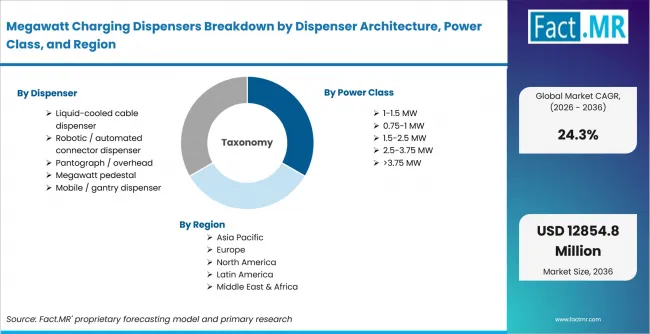
Megawatt Charging Dispensers Breakdown By Dispenser Architecture, Power Class, And Region | Source: Fact.MR
| Attribute | Details |
|---|---|
| Quantitative Units | USD million |
| Market Definition | Dispenser hardware and associated connector assemblies used to deliver megawatt-class DC charging to heavy-duty electric vehicles and other high-power mobile equipment. |
| Dispenser Architecture | Liquid-cooled cable dispenser; Robotic or automated connector dispenser; Pantograph or overhead; Megawatt pedestal; Mobile or gantry dispenser |
| Power Class | 0.75-1 MW; 1-1.5 MW; 1.5-2.5 MW; 2.5-3.75 MW; Above 3.75 MW |
| Vehicle | Heavy-duty trucks; Mining or off-highway; Port equipment; Buses or coaches; Marine or other |
| Deployment | Highway charging hubs; Fleet depots; Ports or logistics yards; Mining sites; Industrial campuses |
| Regions Covered | North America; Latin America; Western Europe; Eastern Europe; East Asia; South Asia & Pacific; Middle East & Africa |
| Countries Covered | United States; Germany; Netherlands; Sweden; United Kingdom |
| Key Companies Profiled | ABB E-mobility; Alpitronic; Kempower; Siemens eMobility, including Heliox; Delta Electronics |
| Forecast Period | 2026 to 2036 |
| Approach | Hybrid top-down and bottom-up approach using electric truck rollout, corridor charging programs, dispenser architecture mix, power-class adoption, deployment settings and provider portfolio review. |
Source: Fact.MR analysis. Updated Sep 10, 2026
How is the market segmented?
-
By Dispenser Architecture
- Liquid-cooled cable dispenser
- Robotic or automated connector dispenser
- Pantograph or overhead
- Megawatt pedestal
- Mobile or gantry dispenser
-
By Power Class
- 0.75-1 MW
- 1-1.5 MW
- 1.5-2.5 MW
- 2.5-3.75 MW
- Above 3.75 MW
-
By Vehicle
- Heavy-duty trucks
- Mining or off-highway
- Port equipment
- Buses or coaches
- Marine or other
-
By Deployment
- Highway charging hubs
- Fleet depots
- Ports or logistics yards
- Mining sites
- Industrial campuses
-
By Region
- North America
- Latin America
- Western Europe
- Eastern Europe
- East Asia
- South Asia & Pacific
- Middle East & Africa
Frequently Asked Questions
How big is the megawatt charging dispensers market in 2026?
What is the CAGR of the megawatt charging dispensers market from 2026 to 2036?
Which dispenser architecture leads the megawatt charging dispensers market?
Which deployment type leads the megawatt charging dispensers market?
Who are the leading companies in the megawatt charging dispensers market?
Who worked on this report


Preview the report firsthand - request a free sample
Free SampleGet the brochure for pricing and purchase details
Download PDF