- Market Value (2025): USD 1.3 Bn
- Estimated Value (2026): USD 1.6 Bn
- Forecast Value (2036): USD 15.2 Bn
- CAGR (2026-2036): 25.1%
What is the MCS Charge Points Market forecast to be worth by 2036?
USD 1.6 billion in 2026 to USD 15.2 billion by 2036, at a 25.1% CAGR.
- The MCS Charge Points Market reached USD 1.3 billion in 2025.
- Demand is projected to increase from USD 1.6 billion in 2026 to USD 15.2 billion by 2036.
- The market is forecast to record 25.1% CAGR from 2026 to 2036 as fleet depots and highway charging operators align chargers with heavy-duty vehicle duty cycles.
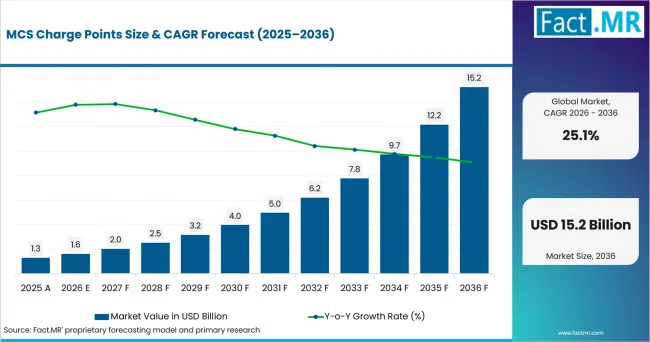
Mcs Charge Points Value Analysis | Source: Fact.MR
What are the defining numbers behind MCS Charge Points Market growth?
USD 13.6 billion absolute opportunity by 2036, led by highway megawatt hubs, liquid-cooled cable systems and direct medium-voltage connection.
- Demand Drivers in the Market
- Fleet operators need charging sessions that fit rest periods and dispatch windows, so site selection is expected to focus on usable energy delivered per stop.
- SAE International issued SAE J3271 in March 2025 for the SAE Megawatt Charging System for Electric Vehicles, providing a framework that includes electromechanical coupler specifications and interoperability requirements for megawatt-scale EV charging.
- Charging-site developers need high utilization from each bay. The International Energy Agency reported in May 2026 that electric truck sales exceeded 400,000 in 2025 and reached 9% of truck sales worldwide.
- Utilities need clearer load visibility as megawatt equipment moves depots and highway sites toward industrial power profiles.
- Logistics landlords need charging layouts that keep trailers moving through yards while cables, cooling units and parking geometry remain safe for drivers.
- Key Segments Analyzed
- By Site Type: Highway megawatt hubs are expected to hold 37.0% share in 2026 due to long-haul charging needs on scheduled freight routes.
- By Power Rating: 1-1.5 MW systems are projected to account for 34.0% share in 2026 as fleets balance charging speed with connection cost.
- By Cooling System: Liquid-cooled cable systems are anticipated to capture 68.0% share in 2026 owing to high current flow and driver handling needs.
- By Grid Integration: Direct medium-voltage connection is estimated to represent 31.0% share in 2026 because large sites need dependable power access.
- Analyst Opinion at Fact.MR
- Shambhu Nath Jha, Principal Consultant at Fact.MR, states, “Megawatt charging is a site-engineering problem before it becomes a charger purchase. Operators compare cable handling, grid access and dwell time in one decision. Suppliers are expected to win by combining high-current hardware with service coverage and interoperability evidence.”
- Strategic Implications
- Charging-equipment vendors should document connector temperature behavior, cable handling and 1 MW-class duty cycles under realistic truck-stop conditions.
- Fleet operators should model charging windows by vehicle route, payload and driver rest period before choosing between depot and corridor sites.
- Site developers should coordinate utility connection studies early and align switchgear design with truck-arrival profiles.
- Energy-management providers should link chargers with behind-the-meter energy storage where connection limits raise the value of staged power delivery.
The United Kingdom leads the country group at 29.3% CAGR through strategic-road charging funds. The Netherlands follows at 26.4% as zero-emission zones push depot charging. The USA reaches 26.1% through corridor grants. Germany records 25.5% through Autobahn truck-charging plans. Sweden posts 24.6% as logistics support expands.
How does the MCS Charge Points Market break down by segment?
Highway megawatt hubs lead Site Type at 37.0%; Liquid-cooled cable systems lead Cooling System at 68.0%.
Which Site Type dominates?
Highway megawatt hubs are expected to hold 37.0% share in 2026.
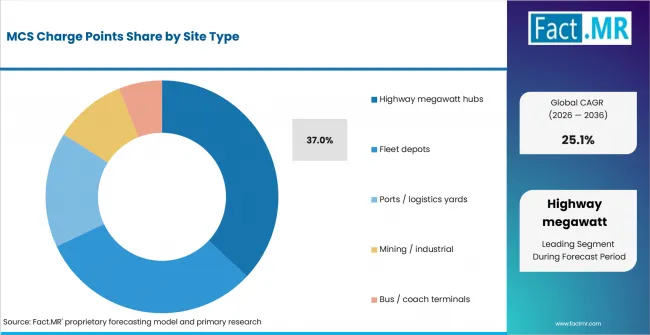
Mcs Charge Points Analysis By Site Type | Source: Fact.MR
Highway megawatt hubs are expected to lead because long-haul freight needs rapid energy transfer near rest areas and route breaks. These sites align charging time with driver schedules. They also support electric truck operations that rely on corridor availability beyond home depots.
The European Alternative Fuels Observatory released its first public HDV recharging infrastructure dataset in October 2025, identifying 1,512 publicly accessible HDV recharging stations across the EU27. EAFO also planned to integrate the locations into the TEN-Tec Interactive Map Viewer, improving visibility of HDV charging infrastructure along European transport corridors.
What leads the Power Rating segment?
1-1.5 MW systems are projected to account for 34.0% share in 2026.
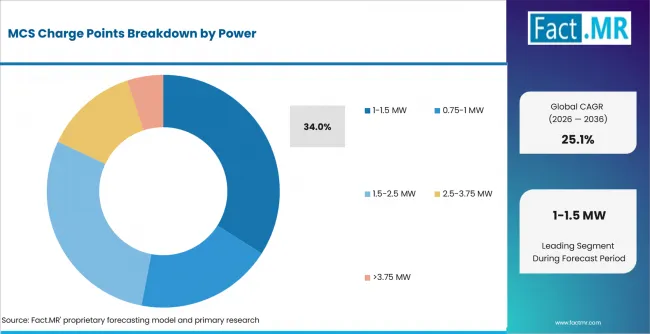
Mcs Charge Points Analysis By Power | Source: Fact.MR
The 1-1.5 MW band is projected to lead early deployments because it bridges high-power DC charging and higher MCS ratings. Fleet depots can trial truck charging without sizing every site for maximum output.
How does Cooling System shape demand?
Liquid-cooled cable systems are anticipated to capture 68.0% share in 2026.
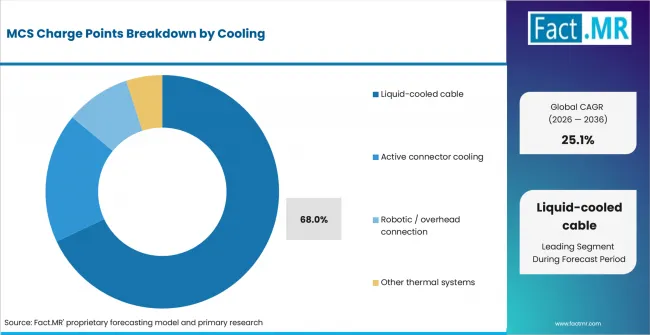
Mcs Charge Points Analysis By Cooling | Source: Fact.MR
Liquid-cooled cable systems are anticipated to lead because high-current charging raises heat and handling demands. A cable that stays manageable for drivers has direct value at highway hubs and depot bays. The need links MCS hardware with adjacent EV charging cable design work.
ABB E-mobility and MAN reported in September 2025 that an MCS test charged a MAN truck from 2% to 90% state of charge in 36 minutes at nearly 750 kW. The testing also assessed interoperability, high-current thermal performance, reliability and safety, including connector-pin temperatures during extended charging sessions.
What leads Grid Integration?
Direct medium-voltage connection is estimated to represent 31.0% share in 2026.
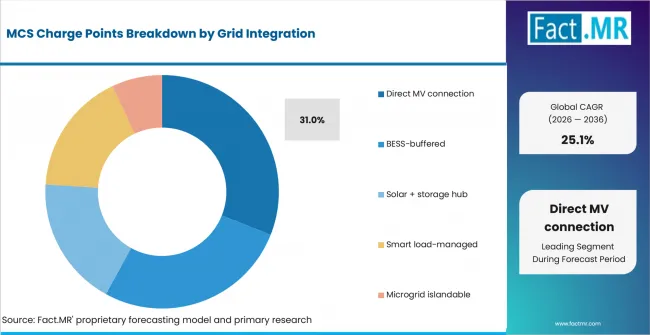
Mcs Charge Points Analysis By Grid Integration | Source: Fact.MR
Direct medium-voltage connection is estimated to lead grid integration because MCS hubs can resemble industrial loads. Sites serving multiple trucks need power architecture that reduces bottlenecks at peak charging hours. Battery-buffered designs remain relevant where connection upgrades require longer planning.
Delta Electronics announced in April 2025 a scalable MW-level fast charging system for large EV fleets. The system offers up to 3 MW across 16 outputs and supports storage-linked site designs, connecting MCS hardware with broader energy storage systems.
What is accelerating MCS Charge Points Market adoption, and what is holding it back?
Demand is expected to rise through truck electrification, corridor funding and standards alignment. Growth is moderated by grid access, site design and interoperability validation.
Drivers Impact Analysis
| DRIVER | (~) % IMPACT ON CAGR | GEOGRAPHIC RELEVANCE | IMPACT TIMELINE |
|---|---|---|---|
| Long-haul electric truck charging windows | +3.1% | North America, Europe | Short term (<= 2 years) |
| MCS standardization and OEM interoperability | +2.4% | Global | Medium term (2-4 years) |
| Public corridor funding for heavy-duty vehicles | +1.9% | USA, Europe | Medium term (2-4 years) |
| Depot electrification for return-to-base fleets | +1.5% | Global | Long term (>= 4 years) |
Source: Fact.MR analysis. Updated Sep 10, 2026
Opportunity Impact Analysis
| OPPORTUNITY | (~) % IMPACT ON CAGR | GEOGRAPHIC RELEVANCE | IMPACT TIMELINE |
|---|---|---|---|
| BESS-buffered charging for constrained sites | +1.6% | USA, Western Europe | Short term (<= 2 years) |
| Port and logistics yard charging | +1.2% | Netherlands, Sweden, Germany | Medium term (2-4 years) |
| Overhead and robotic connection formats | +0.8% | Europe, North America | Long term (>= 4 years) |
Source: Fact.MR analysis. Updated Sep 10, 2026
Restraints Impact Analysis
| RESTRAINT | (~) % IMPACT ON CAGR | GEOGRAPHIC RELEVANCE | IMPACT TIMELINE |
|---|---|---|---|
| Grid connection lead times for high-load sites | -1.0% | North America, Europe | Short term (<= 2 years) |
| Truck-to-charger interoperability testing | -0.7% | Global | Medium term (2-4 years) |
| Site geometry and driver handling needs | -0.5% | Highway corridors, ports | Long term (>= 4 years) |
Source: Fact.MR analysis. Updated Sep 10, 2026
Which countries are scaling the MCS Charge Points Market through 2036?
- The country comparison spans 4.7 percentage points and forms two practical growth bands across the forecast period.
- The United Kingdom remains 2.9 percentage points above the Netherlands through strategic-road charging support and HGV corridor focus.
- The Netherlands remains 0.3 percentage point above the USA as zero-emission zones accelerate depot and urban freight charging.
- The USA remains 0.6 percentage point above Germany through SuperTruck projects and national corridor grants.
- Germany remains 0.9 percentage point above Sweden through Autobahn rest-area charging plans for heavy commercial vehicles.
Comparable CAGRs create different entry conditions due to grid access, site ownership, vehicle readiness and corridor policy. Full report coverage includes North America, Latin America, Western Europe, Eastern Europe, East Asia, South Asia & Pacific, Middle East & Africa.
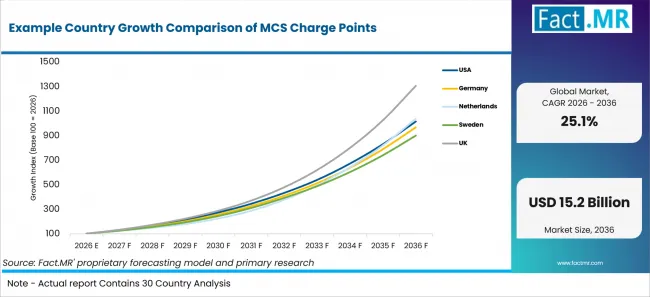
Example Country Growth Comparison Of Mcs Charge Points | Source: Fact.MR
| Country | CAGR |
|---|---|
| United Kingdom | 29.3% |
| Netherlands | 26.4% |
| United States | 26.1% |
| Germany | 25.5% |
| Sweden | 24.6% |
Source: Fact.MR analysis. Updated Sep 10, 2026
What supports United Kingdom adoption?
29.3% CAGR, supported by road-network charging funds and heavy goods vehicle corridor needs.
The United Kingdom is expected to move quickly where motorway service areas and strategic-road sites prepare for heavier electric vehicles. GOV.UK stated in July 2025 that GBP 400 million had been announced for charging infrastructure, including England’s strategic road network. The same publication recorded more than 5,500 rapid and ultra-rapid chargepoints within one mile of that network in April 2025. MCS hubs fit the next step because heavy goods vehicles need wider bays, safer cable handling and higher energy per stop.
How is the Netherlands scaling demand?
26.4% CAGR, driven by zero-emission zones and freight-vehicle transition pressure.
The Netherlands is anticipated to scale around depots, logistics parks and city-freight routes. The Ministry of Infrastructure and Water Management reported in March 2025 that 14 municipalities had introduced zero-emission zones from 1 January 2025. CBS reported in June 2026 that 2.2%, or approximately 3,800, of Dutch freight vehicles had a Euro Z powertrain at the start of 2026. Depot charging and BESS-buffered designs are expected to fit Dutch sites where grid space and delivery windows guide charger sizing.
What supports USA adoption?
26.1% CAGR, backed by corridor grants and truck-focused charging demonstrations.
The USA is forecast to gain from public funding that links chargers with freight corridors and fleet depots. The Federal Highway Administration announced USD 635 million in January 2025 for EV charging and alternative-fueling grants. The agency directed USD 268 million to seven corridor fast-charging projects. Heavy-duty sites are expected to prioritize pull-through bays, utility coordination and software that manages several trucks arriving within short time windows.
What is supporting Germany’s adoption?
25.5% CAGR, supported by Autobahn charging plans and heavy commercial vehicle infrastructure.
Germany is estimated to develop around Autobahn charging and fleet electrification programs. The European Commission approved a German support scheme of up to EUR 1.6 billion in December 2025 for public fast-charging stations for heavy electric commercial vehicles. The scheme covers up to 1,410 charge points at more than 120 non-serviced rest areas. MCS suppliers gain a route into sites where grid work, operator contracts and truck availability need to move together.
How does Sweden perform?
24.6% CAGR, led by logistics charging, port sites and national support programs.
Sweden is expected to build demand through logistics hubs and heavy-vehicle charging grants. The Swedish Energy Agency said in January 2026 that support had been approved for another 60 public charging stations and 35 loading-station charging sites. Sweden’s route geography keeps public heavy-vehicle charging relevant beyond depots. MCS charge points are therefore expected to serve ports, industrial yards and long-distance freight nodes.
Who leads the MCS Charge Points Market?
ABB E-mobility participates through its MCS1200 megawatt charging system and joint validation with truck manufacturers. In September 2025, ABB E-mobility and MAN reported that, ahead of their MCS test campaign, they had validated a long-duration charging session at continuous 1.2 MW output. During the test week, a MAN truck charged from 2% to 90% state of charge in 36 minutes at nearly 750 kW.
Kempower supports truck depots through distributed high-power charging systems. In September 2025, Kempower reported a Swedish charging session in which CCS and MCS were used simultaneously to charge two trucks, reaching 864 kW of combined output and a 728 kW peak at the MCS charging point.
Siemens eMobility participates through SICHARGE FLEX and its expanded Heliox charging portfolio for eBus, eTruck, depot and fleet applications. Siemens introduced SICHARGE FLEX in October 2025 with an MCS/CCS2 liquid-cooled dispenser configuration supporting up to 1,500 A of charging current.
Delta Electronics provides scalable megawatt-level charging solutions for large EV fleets. Its portfolio combines high-power charging hardware with energy-management capabilities, energy-storage integration and site-management systems for fleet and charging-hub applications.
Alpitronic participates through the HYC1000 platform. In April 2025, IONITY announced plans to deploy HYC1000 systems across its European network. The architecture uses a central power cabinet serving up to four dispensers and supports simultaneous charging of multiple vehicles with dynamic power allocation.
Across these suppliers, product portfolios emphasize MCS and CCS interoperability, high-current charging performance, connector and cable usability, scalable power distribution, energy management and integration with site-level energy infrastructure.
Which companies are the key providers?
Key providers include ABB E-mobility; Kempower; Alpitronic; Siemens eMobility, including Heliox; and Delta Electronics.
- ABB E-mobility
- Kempower
- Alpitronic
- Siemens eMobility, including Heliox
- Delta Electronics
Bibliography
- SAE International. (2025, March 5). SAE Megawatt Charging System for Electric Vehicles (SAE J3271_202503) [Information report].
- International Energy Agency. (2026, May 20). Trends in other EV modes. In Global EV Outlook 2026.
- U.S. Department of Energy. (2025, January 15). DOE invests $68 million in innovative heavy-duty electric vehicle charging solutions.
- Federal Highway Administration. (2025, January 10). INVESTING IN AMERICA: Biden-Harris Administration announces $635 million in awards to continue expanding zero-emission EV charging and refueling infrastructure.
- Office for Zero Emission Vehicles. (2025, July 11). Electric vehicle charging infrastructure on the strategic road network.
- Ministry of Infrastructure and Water Management. (2025, March 14). Gemeenten, brancheorganisaties en ministerie maken afspraken over zero-emissiezones [Municipalities, industry organizations and ministry make agreements on zero-emission zones].
- Statistics Netherlands. (2026, June 29). Aantal vrachtvoertuigen met Euro 6-motor in vijf jaar 45 procent gestegen [Number of freight vehicles with Euro 6 engine up 45% in five years].
- European Commission Representation in Germany. (2025, December 18). Schnellladestationen für Elektro-Lastwagen an Autobahnen: Kommission genehmigt deutsche Milliarden-Beihilfe [Fast-charging stations for electric trucks on motorways: Commission approves German billion-euro aid].
- Swedish Energy Agency. (2026, January 29). Sveriges laddnätverk för tunga fordon växer [Sweden’s charging network for heavy vehicles is growing].
- European Alternative Fuels Observatory. (2025, October 20). New public HDV recharging infrastructure data now live on EAFO.
- ABB E-mobility. (2025, April 24). Unified architecture meets segment-specific needs as ABB E-mobility launches trio of new EV chargers.
- ABB E-mobility. (2025, September 23). MAN and ABB E-mobility conduct landmark MCS test week.
- Siemens. (2025, October 4). SICHARGE FLEX: Siemens unveils Next-Gen EV Charging System for the Megawatt era.
- Delta Electronics (Americas). (2025, April 16). Delta unveils scalable MW-level charging solution for large EV fleets and a new ultra-slim 50kW DC EV charger at ACT Expo 2025.
- Kempower. (2025, September 5). Kempower charges with MCS standard at the state-of-the-art Alfredsson Transport truck depot in Sweden.
- IONITY. (2025, April 24). IONITY first to procure Megawatt Charging System Alpitronic HYC1000.
This Report Answers
- The report explains where MCS charge points are used across highway hubs, fleet depots, ports, industrial yards and bus terminals.
- Segment analysis identifies the site, power, cooling, connection and grid-integration choices that influence fleet charging decisions.
- Country analysis examines the listed markets and the road, depot and policy mechanisms supporting megawatt charging.
- Competitive analysis reviews current providers across charger hardware, cable cooling, service coverage and truck-to-charger validation.
- Application analysis assesses how charging time, bay layout and grid access influence investment in electric commercial vehicle battery packs and related charging infrastructure.
What does the MCS Charge Points Market cover?
The MCS Charge Points Market covers charger hardware and related site equipment used to deliver megawatt-class power to heavy-duty electric vehicles. It includes systems serving trucks, buses, coach fleets, port equipment and industrial vehicles where charging time and high energy transfer shape site economics.
The assessment covers highway hubs, fleet depots, logistics yards, industrial sites and terminals. It also considers connections with public charging queue hardware, grid controls and battery-buffered designs where site use requires higher throughput.
What is included in the scope?
The scope includes MCS dispensers, power cabinets, cooled cables, connectors, site controls, load-management software sold with charging hardware and grid-integration equipment for high-power fleet charging.
Covered applications include highway megawatt hubs, fleet depots, ports, logistics yards, mines, industrial sites, bus terminals and coach terminals. Related demand from electric commercial vehicles is considered when it directly influences MCS charging equipment.
What is excluded from the scope?
Outside scope are passenger-car-only AC chargers, low-power DC chargers, vehicle battery packs, battery-swapping equipment and general depot construction services sold separately from charging hardware.
Vehicle manufacturing, electricity retailing and standalone solar plants remain outside scope unless the activity is bundled with MCS charging hardware or site controls. The assessment treats heavy-duty truck battery systems as adjacent demand, since battery size influences charging power needs.
How Was the Analysis Built?
The analysis draws on 120+ sources, 35+ company portfolios, 25+ countries, and more than 20 industry interviews.
- Primary Research: Primary research includes discussions with manufacturers, service providers, technology developers, distributors, end users, and subject-matter experts. These conversations examine purchasing priorities, product adoption, operational challenges, approval requirements, competitive positioning, and the factors that influence wider market acceptance.
- Desk Research: Desk research covers government statistics, regulatory publications, company filings, trade data, technical studies, industry associations, standards, public policy, and other authoritative sources. Every source used in the analysis is documented in the bibliography.
- Market Sizing and Forecasting: Market estimates combine historical performance, demand indicators, pricing and volume trends, segment shares, company participation, country-level growth, adoption patterns, investment activity, and barriers to market expansion.
- Data Validation and Update Cycle: Findings are validated by comparing primary interviews with public data, company activity, regulatory changes, trade patterns, and industry developments. Regular updates review new product launches, capacity changes, partnerships, approvals, and shifts in commercial adoption.
Segmentation
What is the report’s scope and coverage?
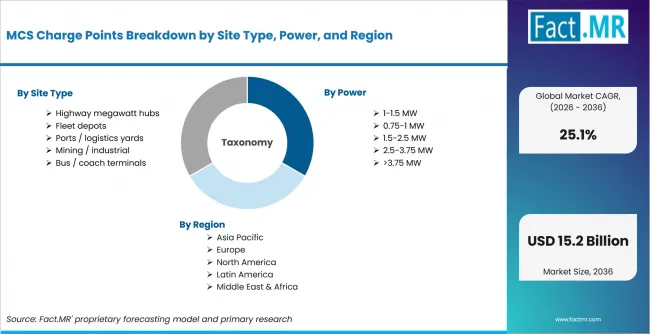
Mcs Charge Points Breakdown By Site Type, Power, And Region | Source: Fact.MR
| Attribute | Details |
|---|---|
| Quantitative Units | USD billion |
| Market Definition | Charging points designed for megawatt-class electric vehicle charging, including high-current dispensers, liquid-cooled cables, power cabinets, connector systems, site controls and grid-integration hardware used for heavy-duty electric vehicles and high-throughput fleet sites. |
| Site Type | Highway megawatt hubs; Fleet depots; Ports/logistics yards; Mining/industrial; Bus/coach terminals |
| Power Rating | 0.75-1 MW; 1-1.5 MW; 1.5-2.5 MW; 2.5-3.75 MW; >3.75 MW |
| Cooling System | Liquid-cooled cable; Active connector cooling; Other thermal systems |
| Grid Integration | Direct medium-voltage connection; BESS-buffered; Solar and storage hub; Smart load-managed; Microgrid islandable |
| Regions Covered | North America; Latin America; Western Europe; Eastern Europe; East Asia; South Asia & Pacific; Middle East & Africa |
| Countries Covered | United Kingdom; Netherlands; United States; Germany; Sweden |
| Key Companies Profiled | ABB E-mobility; Kempower; Alpitronic; Siemens eMobility, including Heliox; Delta Electronics |
| Forecast Period | 2026 to 2036 |
| Approach | Hybrid top-down and bottom-up approach using heavy-duty electric vehicle adoption, charging-site power ratings, corridor programs, depot use cases, country-level policy support and provider portfolio review. |
Source: Fact.MR analysis. Updated Sep 10, 2026
How is the market segmented?
-
By Site Type
- Highway megawatt hubs
- Fleet depots
- Ports/logistics yards
- Mining/industrial
- Bus/coach terminals
-
By Power Rating
- 0.75-1 MW
- 1-1.5 MW
- 1.5-2.5 MW
- 2.5-3.75 MW
- >3.75 MW
-
By Cooling System
- Liquid-cooled cable
- Active connector cooling
- Other thermal systems
-
By Grid Integration
- Direct medium-voltage connection
- BESS-buffered
- Solar and storage hub
- Smart load-managed
- Microgrid islandable
-
By Region
- North America
- Latin America
- Western Europe
- Eastern Europe
- East Asia
- South Asia & Pacific
- Middle East & Africa
Frequently Asked Questions
How big is the MCS charge points market in 2026?
What is the CAGR of the MCS charge points market from 2026 to 2036?
Which site type leads the MCS charge points market?
Which cooling system leads the MCS charge points market?
Who are the leading companies in the MCS charge points market?
Who worked on this report


Preview the report firsthand - request a free sample
Free SampleGet the brochure for pricing and purchase details
Download PDF