- Base Value(2025): 14.5 Bn
- Estimated Value(2026): 15.4 Bn
- Forecast Value (2036): 29.6 Bn
- CAGR (2026 - 2036): 6.7%
Packaged Salad Market Forecast and Outlook By Fact.MR
In 2025, the packaged salad market was valued at USD 14.5 billion. Based on Fact.MR analysis, demand for packaged salad is estimated to grow to USD 15.4 billion in 2026 and USD 29.6 billion by 2036. FACT.MR projects a CAGR of 6.7% during the forecast period.
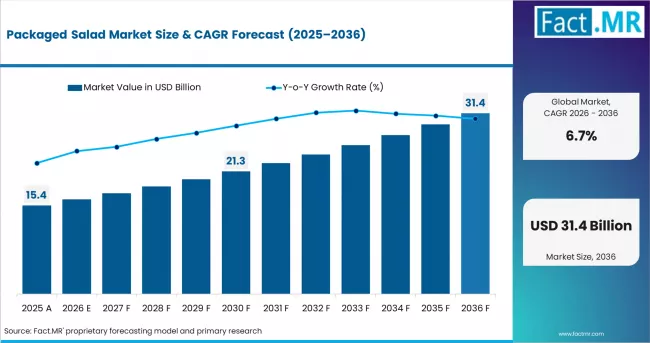
Packaged Salad Market Market Value Analysis | Source: Fact.MR
| Metric | Value |
|---|---|
| Estimated Value in 2026 | USD 15.4 billion |
| Forecast Value in 2036 | USD 29.6 billion |
| Forecast CAGR (2026 to 2036) | 6.7% |
Source: Fact.MR analysis. Updated May 6, 2026
Summary of the Packaged Salad Market
- Market Definition
- Market covers ready-to-eat packaged salads across vegetable, fruit, grain, and protein formats in conventional and organic variants.
- Demand Drivers
- The United States is expanding ready-to-eat salad consumption across retail and foodservice. Driven by health trends and salad kit growth.
- China is increasing adoption through urbanisation and modern retail expansion.
- EU and U.S. food safety regulations are tightening. This drives investment in cold-chain and traceability systems.
- Key Segments Analyzed
- By Product Type: Packaged greens lead with 55% share in 2026. Driven by high consumption of leafy vegetables.
- By Nature: Conventional leads with 75% share in 2026. Supported by price and availability.
- By Processing Type: Vegetarian leads with 80% share in 2026. Driven by broad consumer preference.
- Analyst Opinion at FACT.MR
- Shambhu Nath Jha states that organic and protein-based formats are gaining share. Conventional formats face margin pressure. Clean-label and traceability provide a competitive edge.
- Strategic Implications
- Invest in organic and protein-based salad formats to capture premium demand.
- Develop extended shelf-life packaging to support foodservice expansion.
- Expand private-label partnerships in the U.S. and UK retail markets.
- Methodology
- Market sizing uses manufacturer revenues and shipment volumes.
- Analysis includes USDA data, EU certification, and FDA compliance frameworks.
- Forecasts consider cold-chain trends, health preferences, and retail expansion.
Between 2026 and 2036, the packaged salad market is expected to generate an absolute opportunity of USD 14.2 billion. Growth remains strong and structurally supported. Demand is rising due to increased adoption of ready-to-eat meals and health-focused retail formats. Direct-to-consumer salad subscriptions are also gaining traction. However, growth is partly constrained by short shelf life and high cold-chain logistics costs in emerging markets.
Procurement across retail and foodservice is evolving. Buyers are prioritising clean-label ingredients, modified atmosphere packaging, and traceability. Large grocery retailers and institutional buyers are consolidating supplier bases. Preference is shifting toward brands with strong food safety documentation, organic certifications, and reliable cold-chain compliance. Lower-cost private-label products without differentiation are facing pressure.
China leads growth with a projected CAGR of 9.2% through 2036. Expansion is driven by urbanization, Western dietary adoption, and modern retail growth. The United States follows at 8.5%, supported by strong ready-to-eat demand and online grocery expansion. Germany records 8.0%, driven by health-conscious consumers and strong retail networks. France grows at 7.3%, supported by demand for premium and organic salads. The United Kingdom records 7.0%, led by high retail penetration and private-label dominance.
Segmental Analysis
Packaged Salad Market Analysis by Product Type
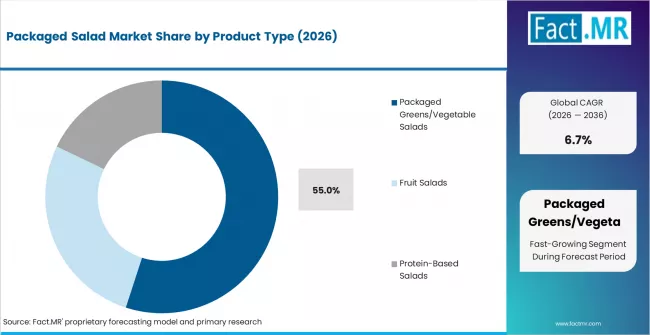
Packaged Salad Market Analysis By Product Type | Source: Fact.MR
Based on FACT.MR's packaged salad market report, consumption of packaged greens and vegetable salads is estimated to hold 55% share in 2026. This segment leads due to strong and consistent demand for ready-to-eat lettuce, spinach, and mixed green products.
- Dole Organic Expansion: Dole Food Company expanded its organic packaged salad portfolio in 2024. It introduced certified organic baby spinach and spring mix SKUs in U.S. retail. This supports premium positioning and organic segment growth. [1]
- Taylor Farms Product Development: Taylor Farms launched a new line of protein-enriched salad kits in 2025. These combine packaged greens with plant-based protein toppings. This targets health-focused consumers in major U.S. grocery chains. [2]
- Retail Salad Kit Shelf Trend: The USDA reported continued expansion of packaged salad kit facings in U.S. grocery retail in 2024. Multi-component salad kit formats with dressings and toppings gained significant shelf space. This drives incremental category revenue beyond single-ingredient bag salads. [3]
Packaged Salad Market Analysis by Nature
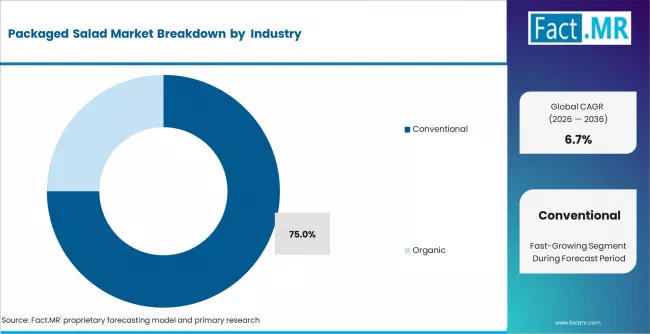
Packaged Salad Market Analysis By Nature | Source: Fact.MR
Based on FACT.MR's packaged salad market report, conventional packaged salads are estimated to hold 75% share in 2026. This segment leads due to broader retail distribution, lower price points, and established consumer purchasing habits. Conventional formats dominate mass grocery and discount retail channels where price accessibility drives volume.
- Bonduelle Organic Programme: Bonduelle expanded its certified organic salad range across European retail in 2025. It added organic lamb's lettuce and mixed leaf blends to its portfolio. This targets growing organic produce demand in French and German supermarkets. [4]
- Fresh Express Conventional Innovation: Fresh Express introduced new resealable conventional salad bag formats in 2024. These include portion-controlled pack sizes for single-serve retail. This supports impulse purchase growth in convenience and pharmacy retail channels. [5]
- Organic Produce Growth Trend: The Organic Trade Association reported a 9% year-on-year increase in organic packaged salad retail sales in the United States in 2024. Consumer demand for pesticide-free, certified produce drove the growth. This is accelerating organic shelf space allocation in major grocery chains. [6]
Drivers, Restraints, and Opportunities
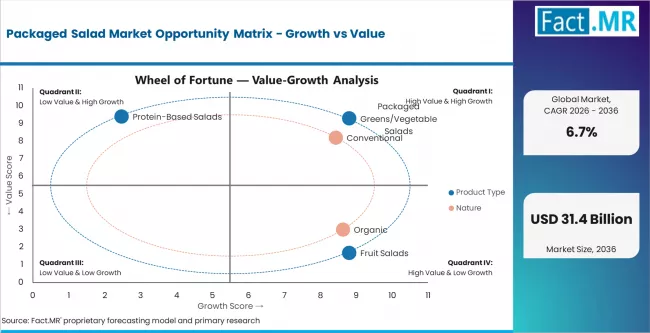
Packaged Salad Market Opportunity Matrix Growth Vs Value | Source: Fact.MR
FACT.MR analysis identifies the packaged salad market as health-driven and retail-focused, valued at USD 14.5 billion in 2025. Demand is supported by rising adoption of ready-to-eat meals across grocery and foodservice channels.
The market shows a clear product divide. Conventional bagged salads face margin pressure from private-label competition. Differentiation is declining in standard formats. Organic, protein-enriched, and premium salad kits are gaining share. Advanced packaging and shelf-life extension technologies support pricing power.
- Health and Wellness Consumer Shift: Demand for nutrient-rich and minimally processed foods is rising. The U.S. FDA Dietary Guidelines 2024 update supports higher vegetable intake. Taylor Farms and Dole Food Company expanded health-focused product lines in 2024. [1]
- EU Organic Regulation and Retailer Commitment: The EU Farm-to-Fork Strategy targets 25% organic farmland by 2030. This is increasing organic salad sourcing by retailers. Bonduelle expanded its organic portfolio in 2025. Regulatory support is creating stable demand for certified products. [2]
- Asia Pacific Urbanisation and Retail Expansion: China is expanding modern grocery retail in tier-2 and tier-3 cities. Urban consumption policies support fresh produce demand. This creates new growth opportunities for packaged salad brands. [3]
Regional Analysis
The packaged salad market is assessed across North America, Europe, Asia Pacific, Latin America, and Middle East and Africa, covering 40+ key countries with distinct demand profiles shaped by retail format maturity, health trend adoption, and cold-chain infrastructure. The full report offers market attractiveness analysis by region and country.
.webp "Top Country Growth Comparison Packaged Salad Market Cagr (2026 2036)")
Top Country Growth Comparison Packaged Salad Market Cagr (2026 2036) | Source: Fact.MR
| Country | CAGR (2026 to 2036) |
|---|---|
| China | 9.2% |
| United States | 8.5% |
| Germany | 8.0% |
| France | 7.3% |
| United Kingdom | 7.0% |
Source: Fact.MR analysis. Updated May 6, 2026
Source: Fact.MR (FACT.MR) analysis, based on proprietary forecasting model and primary research
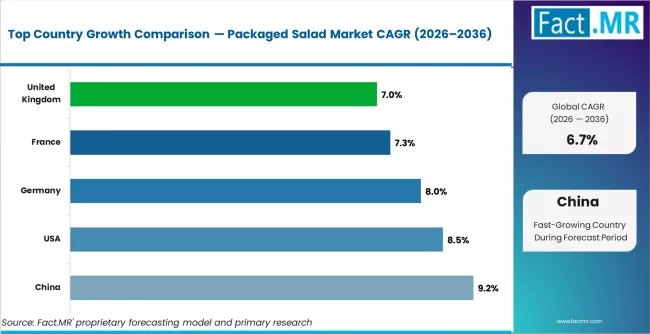
Packaged Salad Market Cagr Analysis By Country | Source: Fact.MR
Asia Pacific Packaged Salad Market Analysis
Asia Pacific is the fastest-growing region, supported by rapid urbanisation and expansion of organised retail. China accounts for the majority of incremental volume, driven by changing consumption habits and improved cold-chain infrastructure. Market dynamics vary across countries, with China reflecting lifestyle-driven uptake, while Japan and Australia exhibit maturity-led replacement cycles. Dole Food Company and private-label suppliers are strengthening their presence through region-specific product formats.
- China: The market is projected to expand at 9.2% CAGR through 2036. Urban middle-class consumers are increasingly incorporating ready-to-eat salads into daily diets. Government-backed retail modernisation is supporting category expansion. Leading chains such as Hema Fresh and Sam’s Club increased shelf space allocation in 2024, improving product visibility and accessibility across tier-1 and tier-2 cities.
Fact.MR covers China, Japan, South Korea, India, ASEAN, and Australia & New Zealand. The analysis includes urban consumption patterns, retail penetration, and cold-chain investment trends.
North America Packaged Salad Market Analysis
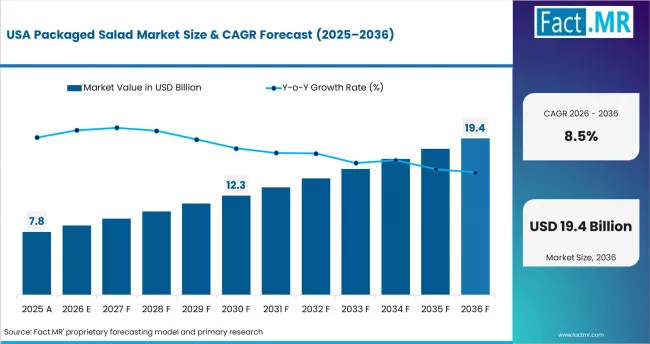
Packaged Salad Market Country Value Analysis | Source: Fact.MR
North America represents the largest and most developed market, supported by deep retail penetration and strong health-oriented consumption patterns. Foodservice integration of ready-to-eat salad components continues to expand alongside retail sales. Dole Food Company, Taylor Farms, Fresh Express, and Ready Pac Foods maintain leading positions through scale and product innovation.
- United States: The market is expected to grow at 8.5% CAGR through 2036, supported by widespread adoption of salad kits across retail formats. Online grocery and club-store channels are expanding access to packaged salads. Updated FDA Produce Safety Rule requirements are strengthening traceability and cold-chain compliance. Taylor Farms expanded its California production base in 2025 to support rising retail and e-commerce channel volumes.
Fact.MR covers the United States, Canada, and Mexico. The analysis includes regulatory compliance trends, retail category expansion, and foodservice procurement patterns.
Europe Packaged Salad Market Analysis
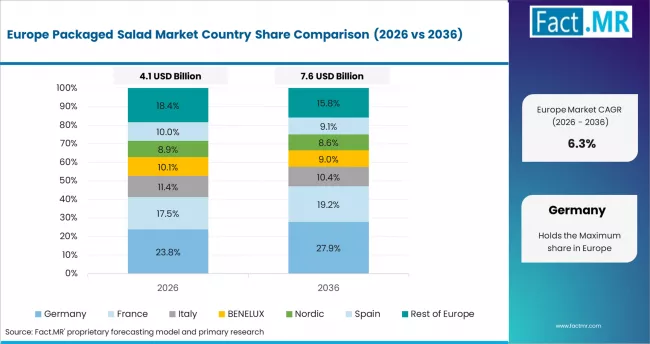
Packaged Salad Market Europe Country Market Share Analysis, 2026 & 2036 | Source: Fact.MR
Europe is characterised by strict regulatory frameworks and strong private-label dominance. Organic certification requirements and sustainability targets are reshaping sourcing strategies. Bonduelle, Bakkavor, and Dole Food Company lead supply across major markets, focusing on premium and compliant product offerings.
- Germany: Demand is projected to grow at 8.0% CAGR through 2036, supported by high consumer preference for organic and locally sourced produce. Updated labelling regulations introduced in 2024 are accelerating investments in certified production. Bonduelle expanded its organic packaged salad portfolio to strengthen presence in leading retail chains.
- France: The market is expected to grow at 7.3% CAGR through 2036, with expansion led by premium and organic salad kits. Institutional procurement is increasing under updated food sourcing regulations. Retailers such as Carrefour and Leclerc are expanding premium assortments to capture higher-value consumer segments.
- United Kingdom: Growth is forecast to grow at 7.0% CAGR through 2036, driven by strong private-label penetration across major grocery chains. Own-brand product expansion is supporting category growth. Bakkavor increased manufacturing capacity in 2025 to support retailer partnerships. Updated food safety standards are reinforcing supplier consolidation.
Fact.MR covers Germany, France, the United Kingdom, Italy, Spain, and the rest of Europe. The analysis includes regulatory impact, private-label trends, and organic product adoption across key markets.
Competitive Aligners for Market Players
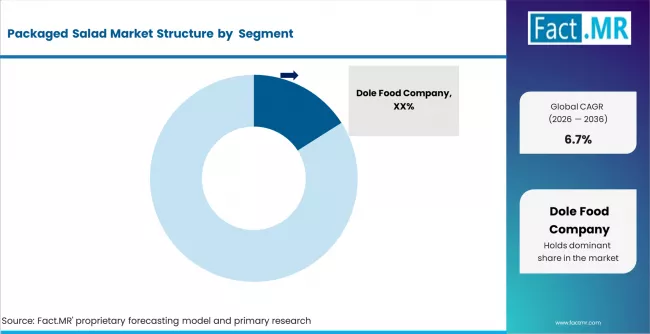
Packaged Salad Market Analysis By Company | Source: Fact.MR
The packaged salad market is moderately consolidated, with competition centred on scale, supply chain control, product differentiation, and compliance capabilities. Leading players such as Dole Food Company, Taylor Farms, and Fresh Express maintain strong positions through vertically integrated sourcing, advanced processing infrastructure, and established relationships with large retail chains. Their ability to ensure consistent quality, cold-chain reliability, and nationwide distribution provides a structural advantage in high-volume categories.
Competition is increasingly shifting toward premium and value-added formats. Companies such as Bonduelle and Bakkavor are strengthening their presence through organic product lines, private-label manufacturing, and customised salad kits. These players are aligning portfolios with evolving consumer preferences for clean-label, protein-enriched, and convenience-oriented offerings, enabling margin expansion beyond commoditised segments.
Strategic investments in automation, packaging innovation, and shelf-life extension technologies are becoming key differentiators. Large producers are expanding processing capacity and enhancing modified atmosphere packaging capabilities to support premium positioning and reduce spoilage risks. At the same time, private-label partnerships with major retailers are intensifying competition, particularly in developed markets where shelf space is highly contested. Smaller regional producers continue to operate in niche and localised segments, especially in organic and specialty salads. However, they face increasing pressure from larger players with stronger certification credentials, regulatory compliance, and distribution scale. Rising food safety standards and cold-chain requirements are elevating entry barriers, reinforcing the competitive advantage of established, fully integrated suppliers.
Key Players
- Dole Food Company
- Taylor Farms
- Fresh Express
- Bonduelle
- Bakkavor
- Gotham Greens
- Ready Pac Foods
Bibliography
- [1] Dole Food Company. Organic Packaged Salad Portfolio Expansion and U.S. Retail Distribution Update. March 2024. dole.com/investor-relations
- [2] Taylor Farms. Product Innovation Announcement: Protein-Enriched Salad Kit Range Launch for U.S. Grocery Retail. 2025. taylorfarms.com
- [3] United States Department of Agriculture Agricultural Marketing Service. Fresh-Cut Packaged Salad Category Retail Performance and Shelf Expansion Data. 2024. ams.usda.gov
- [4] Bonduelle Group. Organic Farming Partnership and European Retail Organic Salad Range Expansion. September 2024. bonduelle.com/finance
- [5] Fresh Express. Resealable Conventional Salad Bag Format Innovation and Single-Serve Retail Launch. 2024. freshexpress.com
- [6] Organic Trade Association. U.S. Organic Packaged Salad Retail Sales Annual Performance Report. 2024. ota.com
- [7] Gotham Greens. Greenhouse Facility Expansion Announcement: U.S. Midwest Leafy Green Production Capacity Addition. 2024. gothamgreens.com
- [8] Bakkavor Group. Protein Salad Kit Foodservice Range Launch for UK Quick-Service Restaurant and Catering Channels. January 2025. bakkavor.com/investors
- [9] Ready Pac Foods. Protein Salad Bowl Range Expansion for U.S. Foodservice and Institutional Catering Accounts. 2024. readypac.com
This Report Addresses
- Strategic intelligence on packaged salad demand across vegetable greens, fruit, grain-based, and protein salad formats in retail and foodservice channels globally.
- Market forecast from USD 15.4 billion in 2026 to USD 29.6 billion by 2036 at a CAGR of 6.7%.
- Growth opportunities across China modern retail expansion, U.S. salad kit category growth, Germany organic demand, France premium positioning, and UK private-label penetration.
- Segment analysis by product type (vegetable greens, fruit, grain, protein), nature (conventional, organic), and processing type (vegetarian, non-vegetarian).
- Regional outlook covering Asia Pacific modern retail growth, North America health-driven salad kit adoption, and Europe organic-regulation-led category expansion.
- Competitive landscape of Dole Food Company, Taylor Farms, Fresh Express, Bonduelle, Bakkavor, Gotham Greens, and Ready Pac Foods, focused on certification, cold-chain capability, and retail positioning.
- Regulatory analysis covering EU Farm-to-Fork Strategy, U.S. FDA Produce Safety Rule, EU organic certification standards, and French EGAlim institutional sourcing mandates.
- Report delivered in PDF, Excel, and presentation formats, supported by primary interviews, company data, regulatory records, and retail category benchmarks.
Packaged Salad Market Definition
The packaged salad market includes pre-washed, pre-cut, and ready-to-eat salads sold in sealed packaging. Key formats include mixed greens, salad kits, fruit salads, grain-based salads, and protein-enriched combinations. These are supplied through retail and foodservice channels globally.
Packaged Salad Market Inclusions
Includes global and regional forecasts from 2026 to 2036 by product type, nature, and processing type. Covers vegetable greens, fruit salads, grain-based, and protein-based salads. Includes both conventional and organic formats across retail and foodservice sectors.
Packaged Salad Market Exclusions
Excludes loose bulk salad ingredients and unpackaged fresh produce. Omits salad dressings, condiments, and standalone meal kits. Focus remains on ready-to-eat packaged salads in sealed formats.
Packaged Salad Market Research Methodology
- Primary Research: Interviews with brand managers, retail buyers, logistics operators, and food safety experts across key markets.
- Desk Research: Analysis of Dole Food Company, Taylor Farms, Fresh Express, and Bonduelle reports. Includes USDA data, EU certification records, and retail statistics (2024–2025).
- Market-Sizing and Forecasting: Hybrid model combining top-down revenue estimates and bottom-up volume forecasts by segment.
- Data Validation and Update Cycle: Validated using shipment data, retail sell-through, and foodservice procurement benchmarks. Updated through expert interviews.
Segmentation
Scope of Report
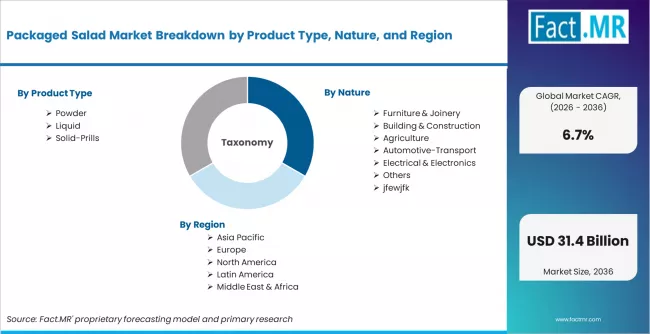
Packaged Salad Market Breakdown By Product Type, Nature, And Region | Source: Fact.MR
| Attribute | Details |
|---|---|
| Quantitative Units | USD 15.4 billion (2026) to USD 29.6 billion (2036), at a CAGR of 6.7% |
| Market Definition | Pre-washed, ready-to-eat packaged salad products including vegetable greens, fruit salads, grain-based salads, and protein-enriched formats in conventional and organic variants for retail and foodservice channels globally. |
| Product Segmentation | Packaged Greens/Vegetable Salads, Fruit Salads, Grain-Based Salads, Protein-Based Salads |
| Nature Segmentation | Conventional, Organic |
| Processing Type Segmentation | Vegetarian, Non-Vegetarian |
| Application Coverage | Retail fresh produce supply, foodservice salad component procurement, organic certified produce distribution, and direct-to-consumer packaged salad subscription fulfilment. |
| Regions Covered | North America, Europe, Asia Pacific, Latin America, Middle East and Africa |
| Countries Covered | USA, Canada, Mexico, Germany, UK, France, Italy, Spain, Nordic, BENELUX, China, Japan, South Korea, India, ASEAN, Australia and New Zealand, Brazil, Argentina, Chile, Saudi Arabia, GCC, Turkey, South Africa, Rest of MEA |
| Key Companies Profiled | Dole Food Company, Taylor Farms, Fresh Express, Bonduelle, Bakkavor, Gotham Greens, Ready Pac Foods |
| Forecast Period | 2026 to 2036 |
| Approach | Hybrid top-down and bottom-up model using packaged salad manufacturer revenues, unit shipment volumes by product type, average selling prices by nature and processing segment, retail category sell-through benchmarks, and primary interviews with grocery retail buyers and cold-chain procurement specialists. |
Source: Fact.MR analysis. Updated May 6, 2026
Packaged Salad Market by Segments
-
By Product Type:
- Packaged Greens / Vegetable Salads
- Fruit Salads
- Grain-Based Salads
- Protein-Based Salads
-
By Nature:
- Conventional
- Organic
-
By Processing Type:
- Vegetarian
- Non-Vegetarian
-
By Region:
- North America
- United States
- Canada
- Mexico
- Latin America
- Brazil
- Mexico
- Argentina
- Chile
- Rest of Latin America
- Western Europe
- Germany
- United Kingdom
- France
- Italy
- Spain
- Nordic Countries
- BENELUX
- Rest of Western Europe
- Eastern Europe
- Russia
- Poland
- Hungary
- Balkan and Baltic
- Rest of Eastern Europe
- East Asia
- China
- Japan
- South Korea
- South Asia and Pacific
- India
- ASEAN
- Australia and New Zealand
- Rest of South Asia and Pacific
- Middle East and Africa
- Kingdom of Saudi Arabia
- Other GCC Countries
- Turkey
- South Africa
- Rest of Middle East and Africa
- North America
Frequently Asked Questions
How large is the global packaged salad market in 2025?
What will the market size be in 2026?
What is the projected market size by 2036?
What is the expected CAGR from 2026 to 2036?
Which product type is poised to lead the packaged salad market?
Which nature segment holds the largest share?
Which country shows the fastest growth in the packaged salad market?
What are packaged salads used for?
What drives demand in this market?
Who are the key players in the market?
What are the major restraints?
Who worked on this report


Preview the report firsthand - request a free sample
Free SampleGet the brochure for pricing and purchase details
Download PDF