- Market Value (2025): USD 1537.7 Mn
- Estimated Value (2026): USD 1653.0 Mn
- Forecast Value (2036): USD 3406.9 Mn
- CAGR (2026-2036): 7.5%
What is the Rammed Earth Construction Materials Market forecast to be worth by 2036?
USD 1,653.0 million in 2026 to USD 3,406.9 million by 2036, at 7.5% CAGR.
- The rammed earth construction materials market crossed a valuation of USD 1,537.7 million in 2025 as engineered wall systems reached wider project specifications.
- Demand is projected to increase from USD 1,653.0 million in 2026 to USD 3,406.9 million by 2036.
- The market is forecast to record a 7.5% CAGR from 2026 to 2036 as architects and contractors seek lower-emission wall assemblies with local material options.
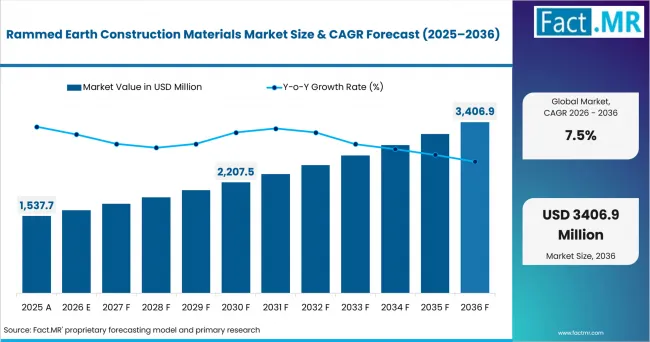
Rammed Earth Construction Materials Market Market Value Analysis | Source: Fact.MR
What are the defining numbers behind Rammed Earth Construction Materials Market growth?
USD 1,753.9 million absolute opportunity by 2036, led by Cementitious materials and Residential applications alongside Contractor procurement.
- Demand Drivers in the Market
- Architects need verified earth mixes supported by compressive testing and wall details that fit structural approval pathways before construction documents are issued.
- Contractors require repeatable batching and compaction procedures because wall appearance and strength depend on moisture control during every lift.
- Developers need schedule certainty supported by prefabricated elements and better equipment planning for projects where on-site labor intensity affects delivery risk.
- Public agencies need documented material impacts shaped by embodied-carbon targets and procurement rules that increasingly compare construction material choices.
- Key Segments Analyzed
- By Material Type: Cementitious is expected to account for 41.4% share in 2026, supported by familiar structural approval routes and controlled stabilized mixes.
- By Application: Residential is projected to garner 34.3% share in 2026, shaped by custom homes where wall finish and thermal mass influence specification.
- By Construction Type: New Build is anticipated to capture 41.4% share in 2026, attributable to early structural integration before foundations and roof interfaces are fixed.
- By Buyer: Contractor is estimated to hold 42.2% share in 2026, due to direct responsibility for batching and formwork alongside compaction quality.
- By Performance: Structural is forecast to record 38.1% share in 2026, owing to load-bearing wall specifications and engineered reinforced assemblies.
- Analyst Opinion at Fact.MR
- Shambhu Nath Jha, Senior Analyst at Fact.MR, states, “Rammed earth commercialization depends less on soil availability than on project-specific mix qualification and repeatable detailing. Demand is expected to favor providers that translate local material testing into approved wall assemblies and predictable site methods. Suppliers should combine soil characterization and construction training with structural documentation that remains usable before tendering.”
- Strategic Implications
- Material formulators should build regional soil testing protocols that define acceptable grading and moisture windows before commercial mixes reach project sites.
- Specialist contractors should standardize mock-up approvals and compaction records so architects compare finish outcomes before full wall production begins.
- Developers should evaluate prefabrication where wall area and site logistics support factory production without creating excessive transport distance or lifting complexity.
- Engineering teams should coordinate moisture protection and seismic details early so rammed earth remains integrated with foundations and roofs during design development.
Lehm Ton Erde detailed new rammed-earth production machinery in March 2025, including automated layer compaction and field-factory production for prefabricated elements across larger wall packages and demanding site conditions. The company states that its mobile compaction system performs work equivalent to four employees, reflecting repeatable production methods that reduce heavy manual work across larger prefabricated wall packages.
India is expected to record a 9.3% CAGR during the forecast period, supported by urban housing programs and rising attention to lower-emission material choices. China is projected to post an 8.6% CAGR by 2036, shaped by construction scale and public housing activity. Australia is anticipated to advance at a 7.3% CAGR over the assessment period, owing to specialist contractor depth and climate-responsive residential design. The United Kingdom is estimated to record a 7.0% CAGR between 2026 and 2036, attributable to material-carbon scrutiny and design-led demonstration projects. The United States is forecast to post a 6.8% CAGR across the forecast period, supported by custom residential work and specialist wall-system consulting.
How does the Rammed Earth Construction Materials Market break down by segment?
Cementitious account for 41.4% share in 2026, while Structural holds with 38.1% share.
Which Material Type dominates?
Cementitious is expected to secure 41.4% share in 2026, supported by predictable approval routes across rammed-earth material specifications.
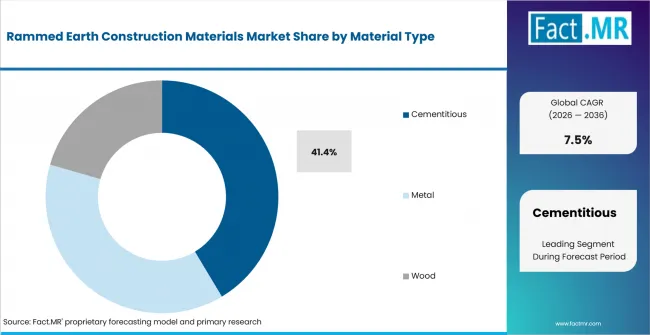
Rammed Earth Construction Materials Market Analysis By Material Type | Source: Fact.MR
Cementitious is projected to represent 41.4% share in 2026, supported by predictable compressive strength and familiar structural approval routes for stabilized earth walls. Metal inputs remain relevant for reinforcement and formwork systems where seismic loads or tall wall lifts require engineered restraint. Wood supports reusable formwork and hybrid assemblies that connect heavy earth walls with lighter roof systems. UNEP reported in March 2025 that cement and steel were responsible for 18% of global emissions. That pressure gives low-binder earth formulations a clearer procurement role when project teams document performance and binder content.
Why Residential segment lead in 2026?
Residential is projected to account for 34.3% share in 2026, shaped by custom housing specifications across rammed-earth applications..
Residential is projected to account for 34.3% share in 2026, shaped by custom homes where material expression and indoor thermal stability influence wall selection. Commercial projects use rammed earth for lobbies and public-facing walls where finish consistency must align with broader construction schedules. Industrial and infrastructure applications remain selective because repeated details and procurement scale require stronger standardization. In October 2025, India’s Ministry of Housing and Urban Affairs reported that more than 10 lakh homes had been sanctioned under PMAY-U 2.0. Large housing programs expand the testing ground for regionally sourced wall materials when local approvals and contractor skills are available.
How does Construction Type shape demand?
New Build is anticipated to capture 41.4% share in 2026, attributable to early coordination of wall thickness and structural interfaces.
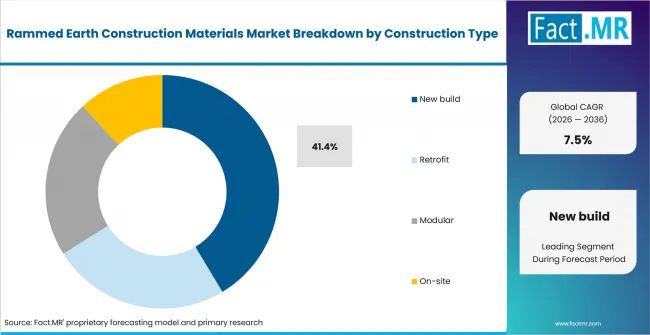
Rammed Earth Construction Materials Market Analysis By Construction Type | Source: Fact.MR
New Build is anticipated to capture 41.4% share in 2026, attributable to early coordination between wall thickness and structural interfaces during design. Retrofit work is narrower because existing foundations and roof geometry often limit heavy wall insertion without major structural changes. Modular methods are expanding the route for prefabricated panels while on-site construction remains useful where local soil and formwork access align. In May 2026, UNEP reported that global building floor area expanded by 1.7% during 2024 to reach 273 billion square metres. Continued floor-space addition supports opportunities for earth-wall systems that enter specifications before structural packages are locked.
What supports Contractor demand?
Contractor is estimated to represent 42.2% share in 2026, due to direct control over batching and compaction quality.
Contractor is estimated to represent 42.2% share in 2026, due to direct control over batching and formwork alongside lift-by-lift compaction quality. Developers influence early material selection but usually depend on specialist execution teams to translate design intent into site-ready wall methods. Public agencies shape demand through demonstration buildings and procurement standards that require documented performance before material substitution. In July 2026, the U.S. Census Bureau reported residential construction spending at a USD 930.2 billion annual rate for May 2026. That project base gives specialist contractors room to pursue custom wall packages where local permitting and engineering support align.
What share does Structural performance represent?
Structural is forecast to account for 38.1% share in 2026, owing to load-bearing requirements and engineered reinforcement strategies.
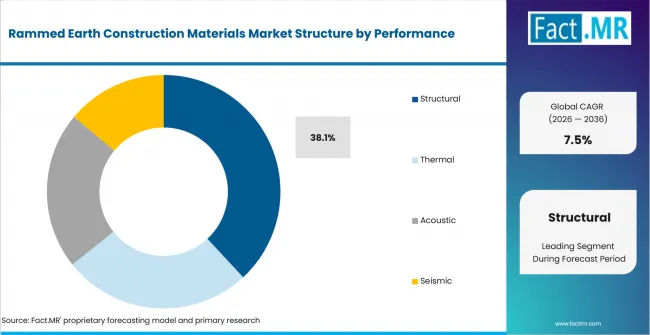
Rammed Earth Construction Materials Market Analysis By Performance | Source: Fact.MR
Structural is forecast to account for 38.1% share in 2026, owing to load-bearing wall specifications and reinforced systems used in seismic regions. Thermal performance supports interest in high-mass envelopes when architects coordinate insulation strategy with local climate requirements. Acoustic applications fit institutional and hospitality interiors while seismic performance depends on reinforcement and connection details. In February 2026, NITI Aayog reported that key construction materials accounted for 48% of total building lifecycle emissions in India during 2025. Performance-led substitution gains credibility when structural evidence and material-impact documentation are presented together during specification review.
What is accelerating Rammed Earth Construction Materials Market adoption, and what is holding it back?
Embodied-carbon scrutiny drives material selection; project-specific mix qualification and approval requirements restrain wider project adoption across regions.
Drivers Impact Analysis
| DRIVER | (~) % IMPACT ON CAGR | GEOGRAPHIC RELEVANCE | IMPACT TIMELINE |
|---|---|---|---|
| Embodied-carbon scrutiny in material procurement | +0.9% | Europe and Asia Pacific | Medium term (2-4 years) |
| Project interest in local mineral material streams | +0.7% | India and Australia | Long term (>= 4 years) |
| Prefabrication and mechanized compaction methods | +0.6% | Europe and North America | Medium term (2-4 years) |
| Residential construction and custom-home demand | +0.5% | India and United States | Medium term (2-4 years) |
| Thermal-mass design in climate-responsive envelopes | +0.4% | Australia and United States | Long term (>= 4 years) |
Source: Fact.MR analysis. Updated Jul 8, 2026
- Embodied-carbon scrutiny: Building teams are comparing material impacts earlier in design as embodied emissions receive more attention from public agencies and institutional clients. In May 2026, Australia’s environment and energy department reported a projected 247 Mt CO2e of upfront embodied carbon from construction across the five years to 2026–27. Procurement is expected to favor earth-wall options where suppliers document binder content and transport distance alongside structural performance.
- Local mineral material streams: Rammed earth creates a route for screened local mineral material when site soil grading and moisture characteristics meet project requirements. In March 2025, the European Environment Agency reported 54 million tonnes of excavated and quarried material in Switzerland’s 2020 mineral waste stream. Adoption is projected to expand where testing partners convert local soil variability into repeatable recipes.
- Mechanized production methods: Equipment development is reducing the gap between craft production and repeatable element manufacturing for larger wall packages. Stationary compaction systems and field factories help teams manage layer consistency while shifting difficult manual work toward controlled machinery. Demand is anticipated to strengthen where prefabrication economics suit larger wall areas and planned lifting operations across repeatable project packages.
- Residential construction activity: Custom residential projects give architects more control over wall thickness and visible finishes than many short-cycle commercial projects. In April 2026, the Australian Bureau of Statistics reported 53,567 dwelling commencements for the December 2025 quarter. Supplier activity is estimated to deepen where specialist builders combine design support with site execution.
- Thermal-mass design: High-mass wall assemblies are attractive in projects that manage solar exposure and insulation as one envelope strategy. Rammed earth specifications still require climate-specific detailing because thermal mass alone does not replace insulation in every region. Uptake is forecast to rise where performance modelling starts before wall thickness and roof junctions are fixed.
Opportunity Impact Analysis
| OPPORTUNITY | (~) % IMPACT ON CAGR | GEOGRAPHIC RELEVANCE | IMPACT TIMELINE |
|---|---|---|---|
| Regional soil testing and mix-design services | +0.6% | Global specialist projects | Short term (<= 2 years) |
| Prefabricated panels for schedule-sensitive projects | +0.5% | Europe and United States | Medium term (2-4 years) |
| Public housing and demonstration procurement | +0.4% | India and China | Medium term (2-4 years) |
| Material declarations and specification support | +0.3% | Europe and North America | Long term (>= 4 years) |
Source: Fact.MR analysis. Updated Jul 8, 2026
- Regional mix-design services: Earth-wall projects need local grading analysis and test compaction before final recipes move into production. Providers that package soil characterization with mock-up work reduce uncertainty for architects and contractors during tender review. Service revenue is expected to expand where local mineral sourcing is attractive but in-house earth expertise is limited.
- Prefabricated earth elements: Off-site production separates wall compaction from weather exposure and congested construction sites. The approach suits projects with repeated wall geometry and lifting plans suited to heavy elements. Opportunity is projected to widen where suppliers connect factory quality records with installation details suitable for structural approval.
- Public housing procurement: Large housing programs create opportunities for wall systems that demonstrate regional material sourcing and predictable delivery methods. In February 2026, China’s National Bureau of Statistics reported that 1.21 million government-subsidized housing units had been started or made available during 2025. Adoption is anticipated to progress where local code pathways and trained contractors support repeated delivery across housing packages.
- Specification documentation: Architects need concise evidence packages covering mix composition and structural tests alongside moisture details before unfamiliar wall systems reach tender. Standard submittal formats reduce repeated engineering work across projects and help building officials review unfamiliar wall systems more consistently. Service demand is estimated to increase where specialist providers make approval information usable by general contractors and building officials.
Restraints Impact Analysis
| RESTRAINT | (~) % IMPACT ON CAGR | GEOGRAPHIC RELEVANCE | IMPACT TIMELINE |
|---|---|---|---|
| Project-specific mix qualification and approvals | -0.6% | Global | Short term (<= 2 years) |
| Labor and formwork intensity on smaller projects | -0.5% | North America and Australia | Medium term (2-4 years) |
| Moisture detailing and weather exposure risk | -0.4% | United Kingdom and humid regions | Medium term (2-4 years) |
| Weight and logistics limits for prefabricated elements | -0.3% | Global urban projects | Long term (>= 4 years) |
Source: Fact.MR analysis. Updated Jul 8, 2026
- Project-specific qualification: Soil sources vary by mineral composition and grading so one approved recipe does not transfer automatically across sites. Test ramming and compressive checks extend preconstruction work before procurement teams lock material supply and final wall schedules. Adoption is forecast to remain selective where local testing capacity and structural review are not available early.
- Labor and formwork intensity: On-site wall production requires stable formwork and controlled material placement across repeated lifts. Smaller projects often lack enough wall area to justify specialized machinery or a temporary production setup. Demand is expected to remain concentrated around experienced crews that maintain quality without extended learning periods.
- Moisture and weather exposure: Poor cap details and ground interfaces expose earth walls to repeated wetting that damages finishes or weakens confidence in the system. In February 2026, the Office for National Statistics reported private new housing output fell 3.6% during the fourth quarter of 2025. Procurement is projected to stay cautious when project budgets tighten and unfamiliar detailing adds review time.
- Prefabricated element logistics: Factory production improves consistency but earth panels remain heavy and require lifting coordination before delivery routes are fixed. Long transport distances reduce part of the local-material advantage that initially attracts project teams to rammed earth. Adoption is anticipated to favor regional production networks and field factories located close to sizable wall packages.
Which countries are scaling Rammed Earth Construction Materials Market fastest?
India 9.3%; China 8.6%; Australia 7.3%; United Kingdom 7.0%; United States 6.8%; Germany 6.5%; Japan 6.2%.
Rammed Earth Construction Materials Market is segmented into North America, Europe, Asia Pacific, Latin America, and the Middle East & Africa.
| COUNTRY | CAGR |
|---|---|
| India | 9.3% |
| China | 8.6% |
| Australia | 7.3% |
| United Kingdom | 7.0% |
| United States | 6.8% |
| Germany | 6.5% |
| Japan | 6.2% |
Source: Fact.MR analysis. Updated Jul 8, 2026
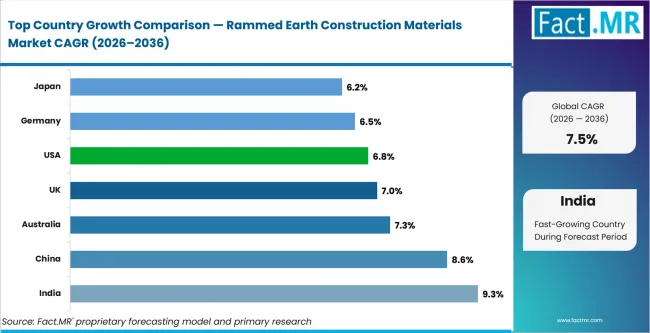
Rammed Earth Construction Materials Market Cagr Analysis By Country | Source: Fact.MR
What is powering India’s market outlook?
9.3% CAGR, supported by urban housing programs and material-carbon scrutiny during the forecast period.
India’s housing pipeline creates a broad testing ground for regionally sourced wall systems where local contractors meet structural approval requirements. The market is expected to record a 9.3% CAGR during the forecast period, supported by public housing activity and interest in lower-emission construction materials. In January 2026, the Ministry of Statistics and Programme Implementation estimated 7.0% growth for manufacturing and construction during FY 2025–26 while broader project activity supports trained earth-wall crews.
How is China scaling rammed earth construction materials demand?
8.6% CAGR, shaped by construction scale and large urban renewal programs by 2036.
Urban renewal gives China a broad project base for testing local mineral materials where construction teams can standardize wall methods across repeated residential work. In January 2026, the State Council website reported that 26,000 old urban residential community renovations had been initiated during the previous year. Demand is projected to post an 8.6% CAGR over the assessment period, as material documentation and contractor training make repeatable earth-wall packages easier to approve.
What supports the Australia outlook?
7.3% CAGR, owing to specialist contractor depth and climate-responsive custom housing design over the assessment period.
Australia combines specialist-builder depth with residential design practices that value thermal mass and visible earth finishes across custom housing. The market is anticipated to advance at a 7.3% CAGR between 2026 and 2036, owing to experienced execution channels and climate-responsive design. Australia’s environment and energy department reported in February 2026 that residential buildings used around 24% of electricity and caused more than 10% of national carbon emissions.
What underpins United Kingdom growth?
7.0% CAGR, attributable to embodied-carbon review and design-led demonstration projects between 2026 and 2036.
United Kingdom project teams face growing pressure to compare material impacts and specification evidence within institutional and design-led construction. In June 2025, the Department for Energy Security and Net Zero reported that cement emitted 6 MtCO2e during 2022 and accounted for 9% of UK industrial emissions. The market is estimated to record a 7.0% CAGR by 2036, as selected projects seek documented lower-emission wall materials and verifiable structural performance.
How is the United States developing rammed earth construction materials demand?
6.8% CAGR, supported by custom residential work and specialist consulting networks during the forecast period.
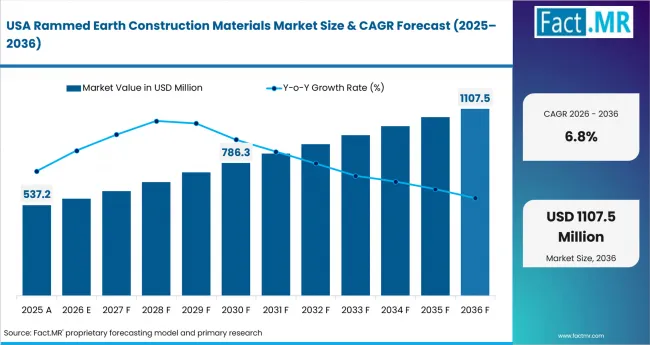
Rammed Earth Construction Materials Market Country Value Analysis | Source: Fact.MR
United States demand is concentrated in custom homes and cultural projects where architects coordinate wall systems early with engineering teams. The market is forecast to post a 6.8% CAGR across the forecast period, supported by specialist consulting and prefabricated wall options. In August 2025, NAHB reported 54,000 custom-home starts during the second quarter and an approximate 19% share of single-family starts that supports a defined niche for specialist wall systems.
Who leads the Rammed Earth Construction Materials Market?
SIREWALL and Rammed Earth Works lead direct rammed-earth system coverage, while Lehm Ton Erde and ClayTec strengthen prefabrication and ready-mix capability.
SIREWALL competes through a structural insulated rammed-earth system that combines earth walls with insulation and moisture-control technology. Rammed Earth Works adds U.S. panel manufacturing and project execution across residential and institutional applications. Lehm Ton Erde brings unstabilized earth systems and mechanized prefabrication methods while ClayTec supplies rammed-earth ready mix for walls and floor base layers.
Rammed Earth Constructions and Rammed Earth Australia provide direct wall construction across Australian residential and commercial projects. The Rammed Earth Co. combines soil testing and engineering coordination with stabilized wall construction and prefabricated cladding in the United States. Competition over the assessment period is expected to be shaped by mix testing and code documentation alongside trained field execution.
Which companies are the key providers?
SIREWALL, Rammed Earth Works, Lehm Ton Erde, ClayTec, Rammed Earth Constructions, Rammed Earth Australia, The Rammed Earth Co.
- SIREWALL
- Rammed Earth Works
- Lehm Ton Erde
- ClayTec
- Rammed Earth Constructions
- Rammed Earth Australia
- The Rammed Earth Co.
Bibliography
- Australian Bureau of Statistics. (2026, April 8). Building Activity, Australia, December 2025. Australian Bureau of Statistics.
- Department of Climate Change, Energy, the Environment and Water. (2026, February 23). Residential buildings. Australian Government.
- Department of Climate Change, Energy, the Environment and Water. (2026, May 19). Commercial buildings. Australian Government.
- Department for Energy Security and Net Zero. (2025, June 23). A policy framework to grow the market for low carbon industrial products: Consultation document. UK Government.
- European Environment Agency. (2025, March). Waste management country profile with a focus on municipal and packaging waste: Switzerland. European Environment Agency.
- Lehm Ton Erde. (2025, March 26). New machines and tools in rammed earth construction. ERDEN.
- Ministry of Housing and Urban Affairs. (2025, October 16). Secretary, MoHUA chairs 5th meeting of Central Sanctioning and Monitoring Committee under PMAY-U 2.0. Press Information Bureau, Government of India.
- Ministry of Statistics and Programme Implementation. (2026, January 7). First advance estimates of gross domestic product, 2025–26. Press Information Bureau, Government of India.
- National Association of Home Builders. (2025, August 20). Custom home building grows as broader housing market struggles. National Association of Home Builders.
- National Bureau of Statistics of China. (2026, February 28). Statistical communiqué of the People’s Republic of China on the 2025 national economic and social development. National Bureau of Statistics of China.
- NITI Aayog. (2026, February 10). Scenarios towards Viksit Bharat and net zero: Sectoral insights: Buildings (Vol. 5). Government of India.
- Office for National Statistics. (2026, February 12). Construction output in Great Britain: December 2025, new orders and construction output price indices, October to December 2025. Office for National Statistics.
- State Council of the People’s Republic of China. (2026, January 23). China to intensify efforts in quest for high-quality housing, urban-rural development: Minister. State Council of the People’s Republic of China.
- United Nations Environment Programme. (2025, March 17). Global Status Report for Buildings and Construction 2024/2025. United Nations Environment Programme.
- United Nations Environment Programme. (2026, May 19). Climate action key to affordable housing, but buildings decarbonisation stalls. United Nations Environment Programme.
- U.S. Census Bureau. (2026, July 1). Monthly construction spending, May 2026. U.S. Department of Commerce.
This Report Addresses
- The report provides strategic intelligence on Rammed Earth Construction Materials across Material Type and Application choices that shape project specifications.
- Segment analysis identifies Cementitious materials and Residential applications as the leading segments within the 2026 structure.
- Regional outlook evaluates India and China alongside Australia while the United Kingdom and United States complete the country comparison.
- Competitive analysis profiles SIREWALL and Rammed Earth Works alongside Lehm Ton Erde and ClayTec followed by three specialist construction providers.
- Material assessment covers Cementitious and Metal inputs alongside Wood components used across stabilized earth systems and hybrid assemblies.
- Use-case assessment covers Residential and Commercial projects alongside Industrial and Infrastructure applications where earth walls meet project requirements.
- Construction assessment covers New Build and Retrofit work alongside Modular and On-Site delivery paths that shape labor and logistics planning.
What does the Rammed Earth Construction Materials Market cover?
Cementitious, metal and wood inputs support structural rammed-earth walls and prefabricated earth elements across included construction applications.
The Rammed Earth Construction Materials Market covers material inputs and systems used to create compacted earth walls or prefabricated earth elements. Coverage includes stabilized and unstabilized approaches where earth composition and reinforcement strategy are specified for a defined construction application.
The market differs from the broader low-carbon construction materials category because commercial value is tied directly to rammed-earth wall production and supporting materials. General concrete and timber products remain outside the boundary unless they are specified as part of a rammed-earth assembly.
What is included in the scope?
Rammed-earth material systems used in buildings and infrastructure projects across site-built and prefabricated construction environments.
The scope includes Cementitious and Metal inputs alongside Wood components used in rammed-earth wall assemblies. Coverage spans Residential and Commercial applications while Industrial and Infrastructure projects are included when compacted earth forms a defined wall or element. New Build and Retrofit work are covered alongside Modular and On-Site delivery paths that affect scheduling and material handling. Contractor and Developer procurement is assessed together with Public Agency purchasing across design approvals and site delivery decisions. Structural and Thermal performance requirements are included alongside Acoustic and Seismic needs that influence engineering review and detailing. Adjacent procurement context includes low-carbon cement systems where binder selection affects stabilized earth specifications and project documentation requirements during approval. Related material strategy also considers zero-waste construction materials when site excavation or mineral reuse changes sourcing economics across local material programs. Upstream conditioning context includes soil stabilization materials where additives or soil treatment affect performance requirements before final rammed-earth mix qualification and production.
What is excluded from the scope?
General concrete products and standalone soil stabilization chemicals remain outside the rammed-earth construction materials scope defined for this analysis.
The scope excludes conventional concrete walls and masonry systems sold without a direct rammed-earth construction function. Standalone excavated soil disposal services and general geotechnical stabilization are excluded unless the purchased material or service directly supports a rammed-earth wall system.
How was the analysis built?
120+ reviewed sources, 35+ company portfolios, 25+ country markets and 20+ industry interviews underpin the analysis.
- Primary Research:
- Primary research includes interviews with earth-building contractors and architects alongside structural engineers and material testing specialists. It also incorporates input from project developers and public procurement teams involved in specification review or project delivery.
- Desk Research:
- Desk research reviews official construction statistics and housing programs alongside building-sector emissions reports and current company portfolios. Product pages and technical articles are evaluated together with project evidence and supplier announcements that confirm current market participation and system boundaries.
- Market-Sizing and Forecasting:
- Forecasting uses construction activity and residential project pipelines alongside specialist contractor capacity and material attachment rates. Models also consider mix-design services and prefabrication uptake together with regional pricing and project qualification cycles.
- Data Validation and Update Cycle:
- Forecasts are validated through provider checks and technical interviews that test assumptions on project access and execution constraints. Portfolio mapping and country-level construction indicators are reviewed regularly to confirm market direction and company activity.
Segmentation
What is the report’s scope and coverage?
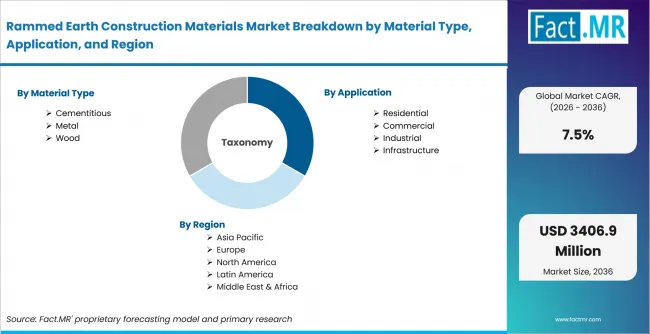
Rammed Earth Construction Materials Market Breakdown By Material Type, Application, And Region | Source: Fact.MR
| Attribute | Details |
|---|---|
| Quantitative Units | USD million |
| Market Definition | Materials and system inputs used to produce compacted earth walls and prefabricated rammed-earth elements across building and infrastructure projects |
| Material Type | Cementitious; Metal; Wood |
| Application | Residential; Commercial; Industrial; Infrastructure |
| Construction Type | New Build; Retrofit; Modular; On-Site |
| Buyer | Contractor; Developer; Public Agency |
| Performance | Structural; Thermal; Acoustic; Seismic |
| Regions Covered | North America; Europe; Asia Pacific; Latin America; Middle East & Africa |
| Countries Covered | India; China; Australia; United Kingdom; United States |
| Key Companies Profiled | SIREWALL; Rammed Earth Works; Lehm Ton Erde; ClayTec; Rammed Earth Constructions; Rammed Earth Australia; The Rammed Earth Co. |
| Forecast Period | 2026 to 2036 |
| Approach | Hybrid top-down and bottom-up approach using construction activity; residential project pipelines; specialist contractor capacity; material attachment rates; mix-design services; prefabrication uptake; regional pricing and supplier validation |
Source: Fact.MR analysis. Updated Jul 8, 2026
How is the market segmented?
-
By Material Type:
- Cementitious
- Metal
- Wood
-
By Application:
- Residential
- Commercial
- Industrial
- Infrastructure
-
By Construction Type:
- New Build
- Retrofit
- Modular
- On-Site
-
By Buyer:
- Contractor
- Developer
- Public Agency
-
By Performance:
- Structural
- Thermal
- Acoustic
- Seismic
-
By Region:
- North America
- United States
- Canada
- Europe
- Germany
- United Kingdom
- France
- Italy
- Spain
- Asia Pacific
- India
- China
- Japan
- South Korea
- Australia
- Latin America
- Brazil
- Argentina
- Mexico
- Chile
- Middle East & Africa
- UAE
- Saudi Arabia
- South Africa
- North America
Frequently Asked Questions
What share is estimated for Cementitious materials?
How much Application demand is projected for Residential?
What share is forecast for New Build projects?
How much Buyer demand is anticipated from Contractors?
What share is expected for Structural performance?
Which country is estimated to grow fastest?
What CAGR is projected for China?
What growth rate is forecast for Australia?
What CAGR is anticipated for the United Kingdom?
How fast is the United States market expected to grow?
What primarily drives market adoption?
What most limits wider market adoption?
Why are Cementitious materials preferred?
Why is Contractor procurement significant?
Who worked on this report


Preview the report firsthand - request a free sample
Free SampleGet the brochure for pricing and purchase details
Download PDF