- Market Value (2025): USD 561.1 Mn
- Estimated Value (2026): USD 620 Mn
- Forecast Value (2036): USD 1682.7 Mn
- CAGR (2026-2036): 10.5%
What is the remote aircraft tugs market forecast to be worth by 2036?
USD 620 million in 2026 to USD 1,682.7 million by 2036, at 10.5% CAGR.
- The remote aircraft tugs market crossed a valuation of USD 561.1 million in 2025. Demand is expected to increase from USD 620 million in 2026 to USD 1,682.7 million by 2036.
- The market is forecast to record 10.5% CAGR from 2026 to 2036 because airports and hangars need safer aircraft movement in crowded aprons.
- Airports Council International reported 100.6 million aircraft movements globally in 2024. International Air Transport Association reported global air passenger traffic rose 5.7% in 2025.
- That traffic keeps towing equipment close to daily flight reliability. Remote tugs reduce crew exposure near wings and jet blast, while electric drive helps operators meet airside emission rules.
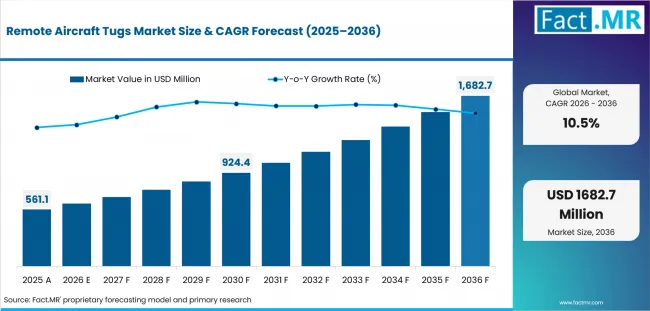
Remote Aircraft Tugs Market Market Value Analysis | Source: Fact.MR
What are the defining numbers behind remote aircraft tug growth?
USD 1,062.7 million absolute opportunity by 2036, led by India and China.
- Demand Drivers in the Market
- Airport operators need quieter towing systems before they extend electric ground equipment programs.
- Fixed-base operators need compact tugs that move aircraft safely inside dense hangars.
- Maintenance facilities need one-person positioning support when aircraft move between bays.
- Military air bases need remote-control tugs that reduce tow-team size during unmanned aircraft movement.
- Key Segments Analyzed
- By Tug Type: Towbarless tugs are expected to hold 34.0% share in 2026 because buyers want less nose-gear handling risk.
- By Aircraft Class: Business jets lead with 29.0% share in 2026 because fixed-base operators need tight hangar movement.
- By Use Case: Hangar movement is projected to capture 31.0% share in 2026 due to ramp congestion and bay scheduling pressure.
- By Powertrain: Lithium-ion battery units are likely to account for 38.0% share in 2026 as operators move away from lead-acid limitations.
- By Buyer Type: Fixed-base operators are projected to hold 30.0% share in 2026 because business aviation hangars need fast aircraft positioning.
- By Geography: India is projected to record 12.8% CAGR through 2036 as airport expansion increases local towing needs.
- Analyst Opinion at Fact.MR
- Shambhu Nath Jha, Senior Analyst at Fact.MR, states, “Remote aircraft tugs are becoming a hangar productivity purchase rather than only a ramp vehicle purchase. Buyers now ask whether a tug can protect nose gear, cut towing crew exposure and fit charging limits. Suppliers that prove aircraft compatibility and service uptime are placed better for repeat orders.”
- Strategic Implications
- Remote tug suppliers should publish aircraft compatibility charts for every rated model.
- Fixed-base operators should map tug choice to hangar door clearance and aircraft class mix.
- Airport buyers should connect charging plans with wider electric ground equipment procurement.
- Distributors should carry service parts because downtime directly delays aircraft repositioning.
India is projected to record 12.8% CAGR through 2036 as airport expansion and fixed-base operator demand widen. China is expected to expand at 12.1% CAGR as transport airports and domestic fleets increase. The United States is forecast to grow at 10.9% CAGR as business aviation and maintenance hangars replace older towing assets. France is expected to advance at 10.4% CAGR as electric ground support equipment procurement reaches larger hubs. Germany is projected to rise at 10.2% CAGR because apron electrification and precision towing needs remain active. The United Kingdom is forecast at 9.8% CAGR due to fixed-base operator activity and constrained hub operations. Japan is expected to post 9.2% CAGR as space-constrained airports favor compact towing systems.
How does the remote aircraft tugs market break down by segment?
Towbarless tugs lead at 34.0%; lithium-ion battery units lead at 38.0%.
Which tug type leads?
Towbarless tugs account for 34.0% share in 2026.
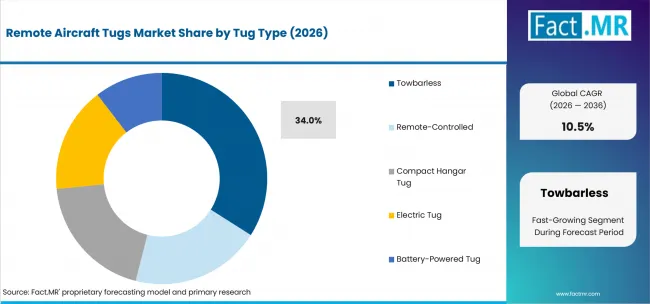
Remote Aircraft Tugs Market Analysis By Tug Type | Source: Fact.MR
Towbarless tugs lead because buyers want lower nose-gear stress and faster connection. The related aircraft tow tractors category shows why tractor design still anchors broader ground handling purchases. Remote control gives the operator a clearer view of the aircraft path. It also helps small crews reposition aircraft in dense hangars.
Which aircraft class leads?
Business jets hold 29.0% share in 2026.
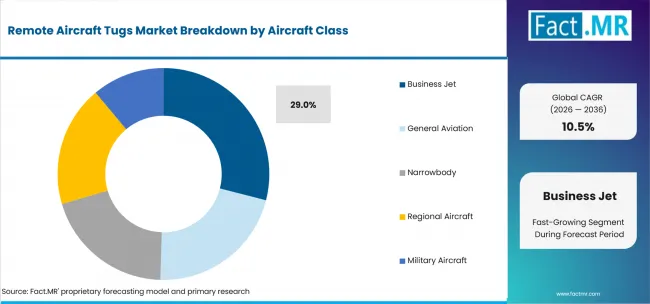
Remote Aircraft Tugs Market Analysis By Aircraft Class | Source: Fact.MR
Business jets lead because fixed-base operators move mixed aircraft inside tight hangar layouts. The Federal Aviation Administration expects the active general aviation fleet to increase by 10.6%. This keeps light jet and turboprop owners focused on compact electric tugs. The segment also benefits from premium hangar services where safe repositioning supports customer experience.
Which use case leads?
Hangar movement leads with 31.0% share in 2026.
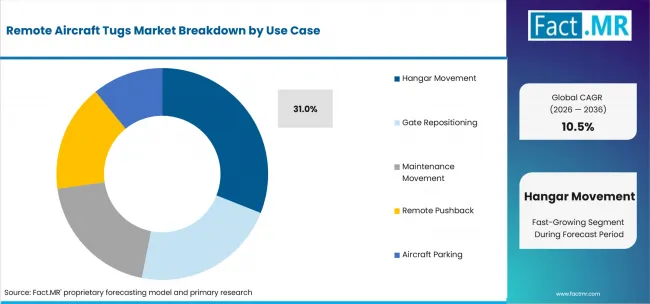
Remote Aircraft Tugs Market Analysis By Use Case | Source: Fact.MR
Hangar movement leads because aircraft storage layouts leave little room for error. Operators still use aircraft towbars for legacy fleets, but remote towbarless units reduce setup time when compatibility is proven. Demand is concentrated in business aviation hangars and maintenance shops. Buyers compare turning radius, battery run time and nose-wheel adapters before procurement.
Which powertrain leads?
Lithium-ion battery units hold 38.0% share in 2026.
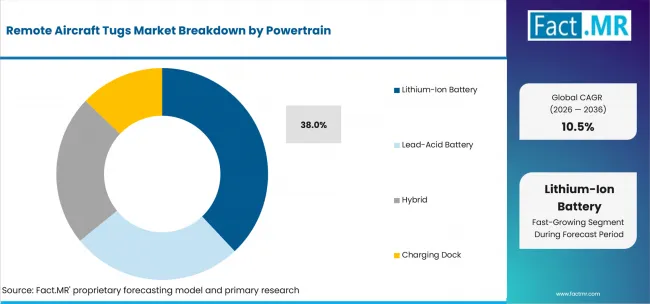
Remote Aircraft Tugs Market Analysis By Powertrain | Source: Fact.MR
Lithium-ion battery units lead because users want faster charging and more consistent duty cycles. Oshkosh AeroTech stated that its LEKTRO 88i is available with a lithium-ion battery option. Lead-acid units remain relevant for price-sensitive users. Battery choice depends on daily tow counts, charger access and service capability.
Which buyer type leads?
Fixed-base operators account for 30.0% share in 2026.
Fixed-base operators lead because they handle aircraft parking, customer handoffs and hangar rearrangement. They need equipment that a trained operator can use without waiting for a full tow team. Airlines and airports remain important buyers for larger pushback tasks. Military air bases add demand where remote tugs improve safety around unmanned aircraft.
What is accelerating remote aircraft tug adoption, and what is holding it back?
Hangar congestion and electric ground equipment procurement drive it, while high purchase price and aircraft compatibility limits restrain it.
Drivers Impact Analysis
| DRIVER | (~) % IMPACT ON CAGR |
GEOGRAPHIC RELEVANCE | IMPACT TIMELINE |
|---|---|---|---|
| Hangar congestion at fixed-base operators | +2.0% | United States, Europe and Japan | Short term (≤ 2 years) |
| Electric ground equipment procurement | +1.8% | Europe, China and India | Short term (≤ 2 years) |
| Business aviation repositioning needs | +1.5% | United States and Middle East | Medium term (2–4 years) |
| Maintenance bay scheduling pressure | +1.3% | Maintenance hubs | Medium term (2–4 years) |
| Military unmanned aircraft movement | +1.1% | United States and NATO air bases | Long term (≥ 4 years) |
Source: Fact.MR analysis. Updated Jul 6, 2026
Hangar congestion drives compact towing
Fixed-base operators are using remote tugs to move aircraft in tighter hangar stacks. The broader aircraft tugs segment remains tied to how safely operators can reposition parked aircraft. The need is largest where hangar space costs more than equipment downtime. Compact towbarless units help crews avoid repeated towbar changes.
Electric GSE procurement changes tug specifications
Airport electrification is moving beyond baggage tractors and support carts. Purchases for ground support equipment tires also show how electric duty cycles affect supporting components. The European Commission states that the Alternative Fuels Infrastructure Regulation applies to stationary aircraft at trans-European network airports.
Business aviation rewards fast repositioning
Business aviation operators value hangar flow because aircraft handoffs are time-sensitive. Remote tugs help one operator watch the aircraft path and adjust movement before contact risk increases.
Opportunity Impact Analysis
| OPPORTUNITY | (~) % IMPACT ON CAGR |
GEOGRAPHIC RELEVANCE | IMPACT TIMELINE |
|---|---|---|---|
| Charging docks bundled with tug sales | +1.6% | Europe and North America | Short term (≤ 2 years) |
| Military remote tug programs | +1.4% | United States and allied bases | Medium term (2–4 years) |
| Rental fleets for seasonal ramps | +1.2% | Europe and Asia Pacific | Medium term (2–4 years) |
| Lithium-ion retrofit packages | +1.0% | Fixed-base operators | Long term (≥ 4 years) |
| Dealer service contracts | +0.9% | India and China | Short term (≤ 2 years) |
Source: Fact.MR analysis. Updated Jul 6, 2026
Charging packages can widen orders
Remote tug suppliers can sell charging docks with the tug instead of treating power supply as a separate site issue. Similar electrification planning also affects airport catering trucks in airport service fleets. The opportunity is larger where buyers already plan electric apron assets. The same purchasing logic reaches belt loaders when fleet managers consolidate charging points.
Military towing programs create a service opening
The United States Air Force tested an electric remote-controlled tug with Light Detection and Ranging based collision detection at Holloman Air Force Base. Military buyers need training, field service and aircraft-specific adapters. Suppliers that document this support can move beyond one-off demonstrations.
Dealer contracts can reduce downtime risk
Dealers can package spare batteries, adapters and operator training with the equipment sale. This mirrors service planning used around lavatory service vehicles in airport fleets. The largest opportunity is not only unit sales. It is recurring service revenue after the first aircraft compatibility approval.
Restraints Impact Analysis
| RESTRAINT | (~) % IMPACT ON CAGR |
GEOGRAPHIC RELEVANCE | IMPACT TIMELINE |
|---|---|---|---|
| High purchase price versus manual towing | -1.4% | India and smaller airports | Short term (≤ 2 years) |
| Aircraft compatibility limits | -1.2% | Mixed fleets | Short term (≤ 2 years) |
| Battery service uncertainty | -1.0% | Hot climates and high-use ramps | Medium term (2–4 years) |
| Training and liability concerns | -0.8% | Military and airline users | Medium term (2–4 years) |
| Charging infrastructure gaps | -0.7% | Older airports | Long term (≥ 4 years) |
Source: Fact.MR analysis. Updated Jul 6, 2026
Purchase price slows smaller buyers
Remote aircraft tugs cost more than manual towbar setups. Smaller operators may continue with legacy tools until labor savings or safety requirements justify the purchase. The replacement decision also depends on whether existing towing hardware remains adequate. This keeps adjacent assets such as air start units in the same capital planning cycle.
Aircraft compatibility narrows model choice
Not every tug matches every nose-wheel layout. Mototok lists six model series to cover different aircraft groups, which shows why buyers need compatibility proof before purchase. This can slow procurement at hangars with mixed fleets. Suppliers with clear adapter libraries can reduce buyer hesitation.
Battery and charging gaps remain practical limits
Battery service can be a restraint when chargers are not placed near parking areas. Operators may also hesitate if local service teams cannot replace battery modules quickly. This issue sits within a wider airport equipment power transition. Procurement teams compare tugs with hydrant dispensers and other critical vehicles before assigning charger capacity.
Which countries are scaling remote aircraft tugs fastest?
India 12.8%, China 12.1%, United States 10.9%, France 10.4%, Germany 10.2%, United Kingdom 9.8%, Japan 9.2%.
Based on regional analysis, the remote aircraft tugs market covers North America and Latin America. It also covers Europe and East Asia. South Asia and Pacific and Middle East and Africa complete the regional view.
| Country | CAGR |
|---|---|
| India | 12.8% |
| China | 12.1% |
| United States | 10.9% |
| France | 10.4% |
| Germany | 10.2% |
| United Kingdom | 9.8% |
| Japan | 9.2% |
Source: Fact.MR analysis. Updated Jul 6, 2026
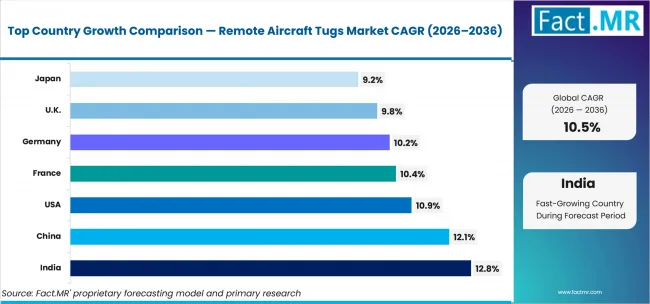
Remote Aircraft Tugs Market Cagr Analysis By Country | Source: Fact.MR
What is powering India’s lead?
12.8% CAGR, supported by airport expansion and fixed-base operator demand.
Airport expansion is changing the size of India’s ground equipment base. The Ministry of Civil Aviation reported that India had 163 airports in 2025. India is projected to record 12.8% CAGR through 2036 as new airport and regional connectivity programs raise tug requirements. Fixed-base operators and maintenance providers need compact systems as traffic spreads beyond metro hubs. Suppliers with dealer service and training programs should see better access.
How is China scaling remote tug demand?
12.1% CAGR, driven by airport network expansion and equipment replacement.
Chinese airport growth is spread across major hubs and inland airport networks. Civil Aviation Administration of China reported 270 domestic commercial airports at the end of 2025. China is expected to expand at 12.1% CAGR from 2026 to 2036 as aircraft movement and airport count support equipment replacement. Domestic suppliers may compete on price and service proximity. Imported systems can retain space where high-capacity towbarless performance is required.
What supports the United States outlook?
10.9% CAGR, supported by business aviation and maintenance hangar replacement.
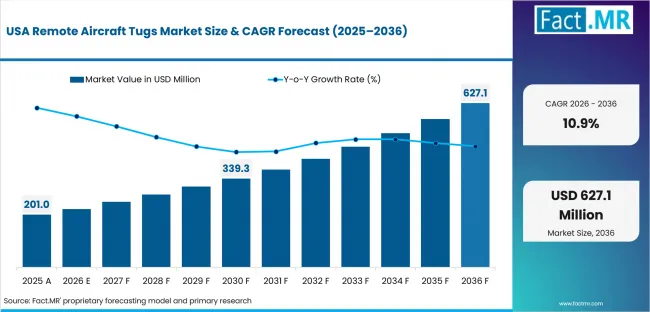
Remote Aircraft Tugs Market Country Value Analysis | Source: Fact.MR
United States demand is anchored in business aviation and maintenance hangars. The United States is forecast to grow at 10.9% CAGR by 2036 because fixed-base operators replace older tugs to improve hangar flow. Military programs add a second route for remote-control systems. The buyer focus is proof of aircraft compatibility and field service depth.
Why is France important for electric tug suppliers?
10.4% CAGR, backed by electric ground support equipment procurement.
French demand is tied to European airport electrification and a domestic ground support equipment supplier base. Airports Council International Europe recorded 3.6% passenger growth for French airports in the first half of 2025. France is expected to advance at 10.4% CAGR through 2036 as lower-emission ground equipment procurement reaches larger hubs. TLD adds local supplier relevance through aircraft tractor portfolios and hydrogen tow tractor work. Buyers are likely to compare total operating support before placing fleet orders.
What underpins Germany’s growth?
10.2% CAGR, supported by apron electrification and precision towing needs.
Germany has a large supplier base in airport handling equipment and a large business aviation hangar network. Germany is projected to rise at 10.2% CAGR from 2026 to 2036 because operators need compact electric tugs for hangar and maintenance movement. Goldhofer gives the country an important product reference in heavy aircraft towing. Supplier advantage depends on proving charging reliability and service response.
How does the United Kingdom perform?
9.8% CAGR, driven by fixed-base operator activity and constrained hub operations.
The United Kingdom is a replacement-led market because major airport capacity is constrained. The United Kingdom is forecast at 9.8% CAGR by 2036 as operators prioritize safe ramp and hangar repositioning. Demand is concentrated in fixed-base operator sites and premium aircraft handling. Dealers that combine training with quick parts support can outperform pure equipment sellers.
Why is Japan a compact tug market?
9.2% CAGR, supported by space-constrained airport operations and compact equipment needs.
Japan’s airport operations reward precise ground movement because aprons and maintenance areas face space limits. The country is expected to post 9.2% CAGR through 2036 as operators renew aircraft positioning systems. Business jet growth and airport technology discipline support premium tug specifications. Suppliers should focus on low-noise operation, adapter fit and after-sales reliability.
Who leads the remote aircraft tugs landscape?
Mototok, Goldhofer and Oshkosh AeroTech lead through electric towbarless capability and aircraft compatibility depth.
Remote aircraft tugs are bought by fixed-base operators and maintenance hangars. Airports, airlines and military air bases also remain important buyers. Goldhofer is visible in airline electric tow tractor deployment through KLM’s use of Phoenix AST2E units at Schiphol Airport.
Competition through 2036 depends on aircraft compatibility, battery service and dealer response. Suppliers that also cover aircraft refuelers can approach airport buyers with a broader ground support equipment package.
Specialist tug companies can still win when they prove precise movement in tight hangars. Larger ground support equipment firms can win fleet tenders through service networks and financing support.
Which companies are the key players?
Mototok and Goldhofer are key players. TowFLEXX and TLD are also covered. Oshkosh AeroTech, Best Tugs and AC Air Technology complete the list.
- Mototok
- Goldhofer
- TowFLEXX
- TLD
- Oshkosh AeroTech
- Best Tugs
- AC Air Technology
Bibliography
- Airports Council International. (2025, July 8). World’s busiest airports revealed in final global rankings. ACI World.
- International Air Transport Association. (2026). Annual review 2026. International Air Transport Association.
- Federal Aviation Administration. (2025, May). FAA aerospace forecast: Fiscal years 2025–2045 forecast highlights. Federal Aviation Administration.
- European Union. (2024, February 1). Deployment of alternative fuels infrastructure. EUR-Lex.
- ACI Europe. (2025, August 5). Passenger traffic up +4.5% in first half of 2025. ACI Europe.
- Press Information Bureau, Government of India. (2025, October 23). India’s aviation: Soaring towards inclusive growth. Government of India.
- Civil Aviation Administration of China. (2026, April 22). CAAC releases statistical bulletin of civil aviation industry development in 2025. Civil Aviation Administration of China.
- Oshkosh AeroTech. (2026, January 14). Oshkosh AeroTech celebrates 7,000th LEKTRO electric towbarless aircraft tractor as Atlantic Aviation takes delivery of milestone unit. Oshkosh AeroTech.
- Koninklijke Luchtvaart Maatschappij. (2025, December 17). First new electric aircraft tow tractors commissioned by KLM. KLM.
- TLD. (2026). Hydrogen towbarless tractor. TLD.
- Mototok International GmbH. (2026, April 9). What Mototok tugs are compatible with what aircraft? Mototok.
- Ferrari, M. (2025, March 4). Holloman AFB looks to revolutionize aircraft towing operations. Air Force Research Laboratory.
- Goldhofer. (2026). PHOENIX E: Towbarless aircraft tractor. Goldhofer.
- Best Tugs. (2026). Romeo series: Remote control tugs. Best Tugs.
- AC Air Technology. (2026). Remote control aircraft tugs. AC Air Technology.
This Report Addresses
- Strategic intelligence on remote aircraft tugs across tug type, aircraft class and buyer type.
- Segment analysis covers towbarless tugs and business jets. Hangar movement and lithium-ion battery units are also reviewed.
- Regional outlook covers India and China. The United States, France and Germany are also reviewed. The United Kingdom and Japan complete the country view.
- Competitive analysis covers Mototok, Goldhofer, TowFLEXX, TLD, Oshkosh AeroTech, Best Tugs and AC Air Technology.
- Powertrain assessment covers lead-acid battery and lithium-ion battery units. Hybrid units and charging docks are also reviewed.
- Buyer assessment covers airports and fixed-base operators. Maintenance providers, airlines and military air bases are also reviewed.
- Primary interviews, official source review and supplier validation support the forecast.
What does the remote aircraft tugs market cover?
Remote-controlled aircraft movement systems used for hangar positioning and gate repositioning.
The remote aircraft tugs market covers electric, battery-powered and hybrid tow tractors that can be operated at a distance. It includes towbarless equipment and compact hangar tugs used for general aviation aircraft and business jets. Regional aircraft, narrowbody aircraft and military aircraft are also covered.
What is included in the scope?
Remote-controlled and operator-assisted tug systems for aircraft movement.
The scope includes compact hangar tugs and towbarless remote tugs. It also includes electric pushback units and battery-powered movement systems. Selected hybrid towing units are covered when they support aircraft movement. It covers aftermarket service, charging docks and airport support packages when sold with aircraft tug programs.
What is excluded from the scope?
Manual towing bars and non-remote baggage tractors without aircraft towing specification.
The scope excludes conventional baggage tractors that are not rated for aircraft movement. It also excludes manual tow bars, aircraft recovery equipment and autonomous towing software sold without a tug platform.
How was the analysis built?
100+ sources, 40+ company portfolios, 25+ countries, 20+ interviews.
- Primary Research: Primary research includes interviews with fixed-base operators, maintenance hangar managers and airport ground handlers. It also includes input from distributors and airport equipment buyers.
- Desk Research: Desk research reviews airport traffic and aircraft movement. It also covers aviation policy and supplier portfolio sources. Official aviation bodies and active company product lines supported the review.
- Market-Sizing and Forecasting: Forecasting uses airport movements and aircraft class mix. Fixed-base operator density and replacement cycles were added to the model. Pricing was benchmarked against supplier quotes and published equipment specifications.
- Data Validation and Update Cycle: Forecasts were validated through supplier checks and buyer-side procurement signals. Source updates after January 2024 were prioritized for market direction.
Segmentation
What is the report’s scope and coverage?
| Attribute | Details |
|---|---|
| Quantitative Units | USD Million in 2026 to USD Million by 2036 at CAGR |
| Market Definition | Remote-controlled aircraft towing and positioning systems used on airport ramps and inside hangars |
| Tug Type | Towbarless, Remote-Controlled, Compact Hangar Tug, Electric Tug, Battery-Powered Tug |
| Aircraft Class | General Aviation, Business Jet, Narrowbody, Regional Aircraft, Military Aircraft |
| Use Case | Hangar Movement, Gate Repositioning, Maintenance Movement, Remote Pushback, Aircraft Parking |
| Powertrain | Lead-Acid Battery, Lithium-Ion Battery, Hybrid, Charging Dock |
| Buyer Type | Airports, Fixed-Base Operators, Maintenance Providers, Airlines, Military Air Bases |
| Regions Covered | North America, Latin America, Europe, East Asia, South Asia and Pacific, Middle East and Africa |
| Countries Covered | India, China, United States, France, Germany, United Kingdom, Japan |
| Key Companies Profiled | Mototok, Goldhofer, TowFLEXX, TLD, Oshkosh AeroTech, Best Tugs, AC Air Technology |
| Forecast Period | 2026 to 2036 |
| Approach | Hybrid top-down and bottom-up approach using aircraft movements, airport counts, fleet mix and supplier validation |
Source: Fact.MR analysis. Updated Jul 6, 2026
How is the market segmented?
-
By Tug Type:
- Towbarless
- Remote-Controlled
- Compact Hangar Tug
- Electric Tug
- Battery-Powered Tug
-
By Aircraft Class:
- General Aviation
- Business Jet
- Narrowbody
- Regional Aircraft
- Military Aircraft
-
By Use Case:
- Hangar Movement
- Gate Repositioning
- Maintenance Movement
- Remote Pushback
- Aircraft Parking
-
By Powertrain:
- Lead-Acid Battery
- Lithium-Ion Battery
- Hybrid
- Charging Dock
-
By Buyer Type:
- Airports
- Fixed-Base Operators
- Maintenance Providers
- Airlines
- Military Air Bases
-
By Region
- North America
- United States
- Canada
- Latin America
- Brazil
- Argentina
- Mexico
- Rest of Latin America
- Europe
- Germany
- United Kingdom
- France
- Italy
- Spain
- Rest of Europe
- Asia Pacific
- China
- India
- Japan
- South Korea
- ASEAN
- Middle East & Africa
- GCC Countries
- South Africa
- UAE
- Rest of Middle East & Africa
- North America
Frequently Asked Questions
Which tug type leads the Remote Aircraft Tugs Market?
Which country expands faster in the Remote Aircraft Tugs Market?
How does China perform in the Remote Aircraft Tugs Market?
How does the United States perform in the Remote Aircraft Tugs Market?
How does Germany perform in the Remote Aircraft Tugs Market?
What is the primary driver in the Remote Aircraft Tugs Market?
What is the main restraint in the Remote Aircraft Tugs Market?
Why are lithium-ion battery tugs important in this market?
Who are the leading companies in this market?
Who worked on this report


Preview the report firsthand - request a free sample
Free SampleGet the brochure for pricing and purchase details
Download PDF