- Market Value (2025): USD 285.7 Mn
- Estimated Value (2026): USD 340 Mn
- Forecast Value (2036): USD 1936 Mn
- CAGR (2026-2036): 19.0%
What is the Self-Healing Seals Market forecast to be worth by 2036?
USD 340 million in 2026 to USD 1936 million by 2036 at a 19.0% CAGR.
- The self-healing seals market reached USD 285.7 million in 2025.
- Demand is projected to increase from USD 340 million in 2026 to USD 1936 million by 2036.
- The market is forecast to record 19.0% CAGR from 2026 to 2036 as automotive engineers, oilfield operators and chemical plants qualify repair-capable seals for compact equipment.
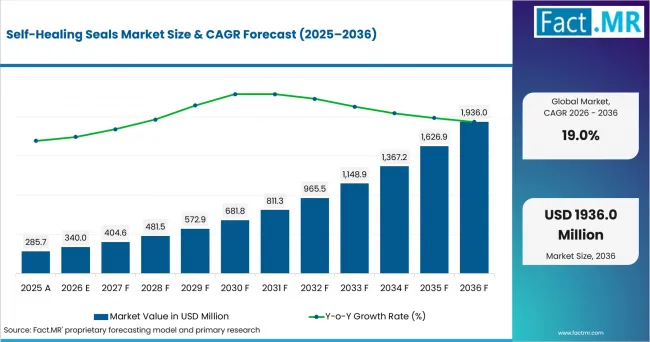
Self Healing Seals Market Value Analysis | Source: Fact.MR
What are the defining numbers behind Self-Healing Seals Market growth?
USD 1,596 million absolute opportunity is expected between 2026 and 2036.
- Demand Drivers in the Market
- Automotive engineers need compact O-rings that recover after minor damage because battery packs and thermal circuits leave little room for easy seal replacement.
- Oilfield maintenance teams need hydrocarbon-compatible gaskets supported by field evidence. The NSTA recorded 398 well interventions in 2025 across the UK Continental Shelf.
- Chemical plant operators need repair mechanisms matched to process media since swelling response varies by solvent, temperature and pressure cycle.
- Key Segments Analyzed
- By Product: O-rings are expected to hold 26.0% share in 2026 driven by their use in compact grooves and repeatable assembly formats.
- By Mechanism: Reversible covalent networks are projected to account for 36.0% share in 2026 supported by repeatable bond repair under controlled service conditions.
- By Fluid: Hydrocarbons are anticipated to capture 48.0% share in 2026 owing to seal wear around pumps, valves and oilfield equipment.
- By End Use: Automotive is estimated to represent 46.0% share in 2026 because electrified vehicles add sealing points across coolant loops and power electronics.
- Analyst Opinion at Fact.MR
- Shambhu Nath Jha, Principal Consultant at Fact.MR, states, “Self-healing seals are drawing attention where downtime cost exceeds compound premiums. Demand is expected to move first into controlled O-ring and gasket formats where failure modes are documented. Suppliers should combine chemistry proof, compression data and fluid-specific qualification packages.”
- Strategic Implications
- Seal compounders should publish fluid-by-fluid recovery data so engineers compare repair behavior across hydrocarbons, water-steam service and process chemicals.
- Automotive suppliers should match repair-capable materials to coolant and battery enclosure designs before platform drawings lock groove geometry.
- Oilfield service teams should test bonded seals around valves and pumps because reinstated wells increase the value of lower-intervention components.
The UK is projected to post 23.4% CAGR through 2036 driven by zero-emission vehicles and North Sea maintenance. The USA is expected to record 22.0% CAGR on the back of crude production and vehicle use. Germany is forecast to advance at 15.5% CAGR reflecting electric-drive production. South Korea is anticipated to hold 14.9% CAGR supported by vehicle exports. Japan is estimated to reach 13.4% CAGR due to aerospace traffic.
How does the Self-Healing Seals Market break down by segment?
Hydrocarbons lead at 48.0%; Automotive leads at 46.0%.
Which Product dominates?
O-rings hold 26.0% share in 2026.
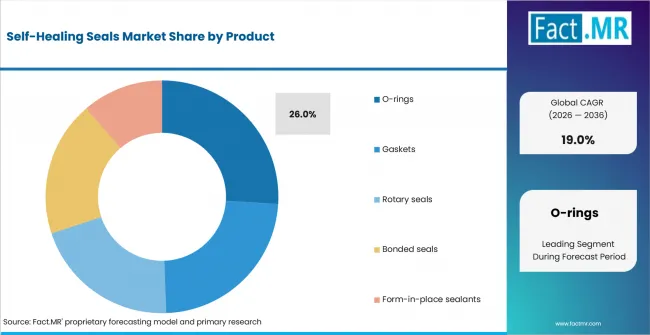
Self Healing Seals Market Analysis By Product | Source: Fact.MR
O-rings are expected to hold 26.0% share in 2026 because they are easy to specify in compact grooves. Their circular form allows repair-capable materials to be tested against compression, swelling and assembly damage. Gaskets follow where larger flange surfaces need controlled sealing recovery. Rotary seals and bonded seals serve rotating or mounted applications with tighter qualification requirements.
What leads the Mechanism segment?
Reversible covalent networks lead with 36.0% share in 2026.
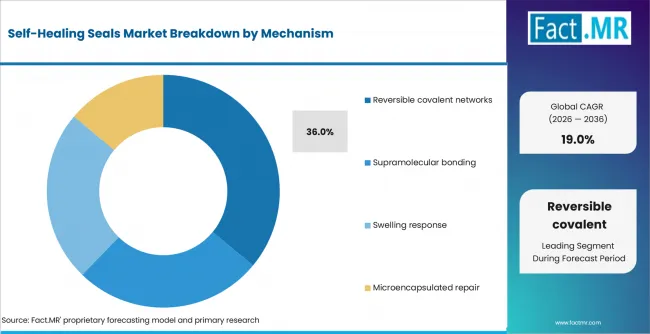
Self Healing Seals Market Analysis By Mechanism | Source: Fact.MR
Reversible covalent networks are projected to account for 36.0% share in 2026 since repeatable bond repair gives engineers a clearer testing route. Supramolecular bonding appeals where lower-temperature recovery is required. Swelling response suits select fluid environments where controlled expansion closes small leakage paths. Microencapsulated repair remains more specialized since capsules must survive mixing and service stress.
How does Fluid shape demand?
Hydrocarbons lead with 48.0% share in 2026.
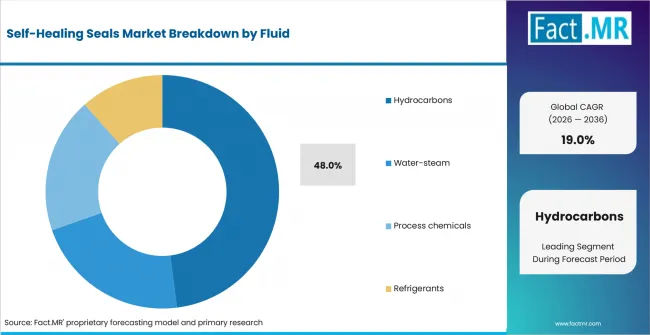
Self Healing Seals Market Analysis By Fluid | Source: Fact.MR
Hydrocarbons are anticipated to capture 48.0% share in 2026 owing to valve, pump and flange exposure in oil and gas service. Water-steam applications require heat and compression stability before broader use. Process chemicals need careful compatibility screening because one compound rarely performs across all media. Refrigerants remain attractive where leak prevention carries regulatory and service-cost value.
What supports Automotive within End Use?
Automotive accounts for 46.0% share in 2026.
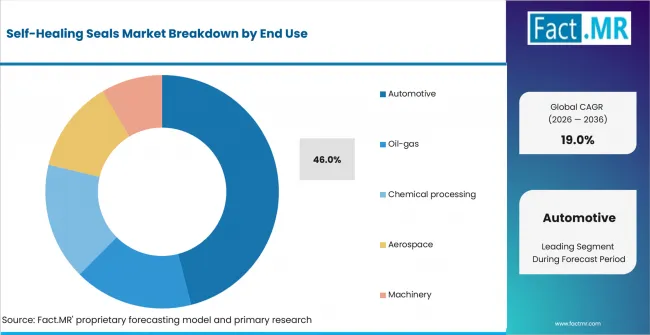
Self Healing Seals Market Analysis By End Use | Source: Fact.MR
Automotive is estimated to represent 46.0% share in 2026 driven by electrified vehicle sealing. Battery packs and coolant manifolds use small seals that are hard to access. DfT reported that zero-emission vehicles accounted for 4.8% of all licensed UK vehicles at the end of 2025.
What is accelerating Self-Healing Seals Market adoption, and what is holding it back?
Downtime avoidance drives it; qualification workload restrains it.
Drivers Impact Analysis
| DRIVER | (~) % IMPACT ON CAGR | GEOGRAPHIC RELEVANCE | IMPACT TIMELINE |
|---|---|---|---|
| Automotive thermal-management sealing | +2.1% | North America, Europe, East Asia | Short term (<= 2 years) |
| Oilfield valve and pump maintenance | +1.8% | USA, UK, Middle East | Medium term (2-4 years) |
| Chemical media compatibility needs | +1.2% | Germany, Japan, South Korea | Medium term (2-4 years) |
| Aerospace and machinery service cycles | +0.9% | USA, Japan, Germany | Long term (>= 4 years) |
Source: Fact.MR analysis. Updated Aug 25, 2026
- Automotive thermal-management sealing: Compact electric-drive platforms are expected to increase seal density in coolant loops and enclosures. Design teams favor O-rings and bonded seals that protect assemblies after heat cycling.
- Oilfield valve and pump maintenance: Hydrocarbon equipment is projected to remain a practical entry point for repair-capable gaskets. Operators evaluate materials around valves, pumps and flanges where intervention cost is high.
- Chemical media compatibility needs: Process plants are anticipated to test self-healing seals where leakage risk affects uptime and safety procedures. Materials must show recovery behavior within defined media groups.
- Aerospace and machinery service cycles: Aerospace and precision machinery users are forecast to adopt repair-capable seals after repeated validation. Vibration and compression exposure require proof beyond short lab cycles.
Opportunity Impact Analysis
| OPPORTUNITY | (~) % IMPACT ON CAGR | GEOGRAPHIC RELEVANCE | IMPACT TIMELINE |
|---|---|---|---|
| Battery coolant and e-axle seals | +1.6% | UK, Germany, Japan | Short term (<= 2 years) |
| Hydrogen-compatible repair materials | +1.1% | Europe, USA, South Korea | Medium term (2-4 years) |
| Retrofit gaskets for hard-access equipment | +0.8% | Oil and gas regions | Medium term (2-4 years) |
| Custom compound validation services | +0.6% | Global | Long term (>= 4 years) |
Source: Fact.MR analysis. Updated Aug 25, 2026
- Battery coolant and e-axle seals: Electric vehicle programs are expected to open premium positions for compact self-healing O-rings.
- Hydrogen-compatible repair materials: Hydrogen service is anticipated to create demand for materials with documented pressure, temperature and permeation behavior.
- Retrofit gaskets for hard-access equipment: Retrofit demand is projected to favor gaskets used where shutdowns are costly.
- Custom compound validation services: Application engineering is expected to become a commercial differentiator.
Restraints Impact Analysis
| RESTRAINT | (~) % IMPACT ON CAGR | GEOGRAPHIC RELEVANCE | IMPACT TIMELINE |
|---|---|---|---|
| Long qualification cycles | -0.8% | Global | Short term (<= 2 years) |
| Fluid-specific repair limits | -0.6% | Chemical processing regions | Medium term (2-4 years) |
| Higher compound cost | -0.4% | SME equipment users | Medium term (2-4 years) |
| Limited field history | -0.3% | Safety-critical uses | Long term (>= 4 years) |
Source: Fact.MR analysis. Updated Aug 25, 2026
- Long qualification cycles: Seal approval is expected to remain lengthy in automotive, aerospace and oilfield equipment. Engineering teams ask for compression-set results, aging data and fluid compatibility proof before drawing approval.
- Fluid-specific repair limits: Repair behavior is likely to vary across hydrocarbons, steam and refrigerants. A mechanism proven in one medium requires fresh validation in another.
- Higher compound cost: Premium elastomers are expected to face procurement scrutiny where standard FKM, EPDM or nitrile parts already perform adequately. Facility teams need a clear uptime saving before accepting higher unit prices. Smaller plants often test repair-capable seals in a few high-failure locations before wider specification.
- Limited field history: Field history is anticipated to weigh heavily in safety-linked equipment. Buyers prefer proven seal grades where leakage affects aircraft systems, high-pressure fluids or chemical containment. New self-healing materials need repeated installation evidence. Suppliers therefore need pilot programs that record failure mode, media exposure and replacement interval.
Which countries are scaling the Self-Healing Seals Market through 2036?
- The country comparison spans 10.0 percentage points and forms three practical growth bands across the forecast period.
- The UK remains 1.4 percentage points above the USA through zero-emission vehicle registrations and North Sea maintenance.
- The USA remains 6.5 percentage points above Germany through crude production and vehicle-use exposure.
- Germany remains 0.6 percentage point above South Korea through electric-drive activity and aviation recovery.
- South Korea remains 1.5 percentage points above Japan through vehicle exports and port-linked equipment maintenance.
- Japan closes the displayed range through aerospace traffic and machinery qualification demand.
Comparable CAGRs create different entry conditions due to vehicle platforms, oilfield activity, chemical processing, aerospace service and maintenance access. Coverage includes North America, Latin America, Western Europe, Eastern Europe, East Asia, South Asia & Pacific, Middle East & Africa.
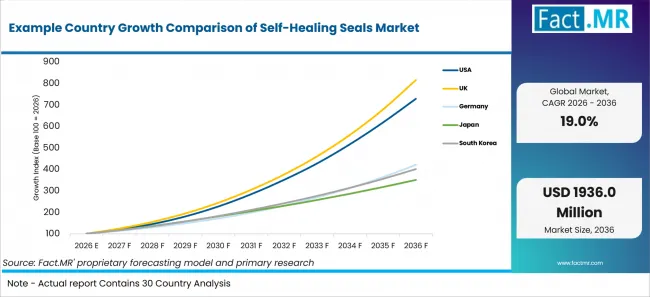
Example Country Growth Comparison Of Self Healing Seals Market | Source: Fact.MR
| Country | CAGR (2026-2036) |
|---|---|
| UK | 23.4% |
| USA | 22.0% |
| Germany | 15.5% |
| South Korea | 14.9% |
| Japan | 13.4% |
Source: Fact.MR analysis. Updated Aug 25, 2026
What supports UK growth?
23.4% CAGR through 2036, supported by zero-emission vehicles and North Sea maintenance.
The UK sealing base is expected to expand where electric vehicles and offshore equipment create hard-access sealing points. DfT reported that 528,000 zero-emission vehicles were registered for the first time in the UK in 2025, while the NSTA reported that 56 reinstated wells produced an additional 16 million barrels of oil equivalent during 2025. Self-healing O-rings and gaskets fit applications where replacement labor carries a higher cost than compound premiums.
How is the USA scaling demand?
22.0% CAGR through 2036, driven by oil production and vehicle use.
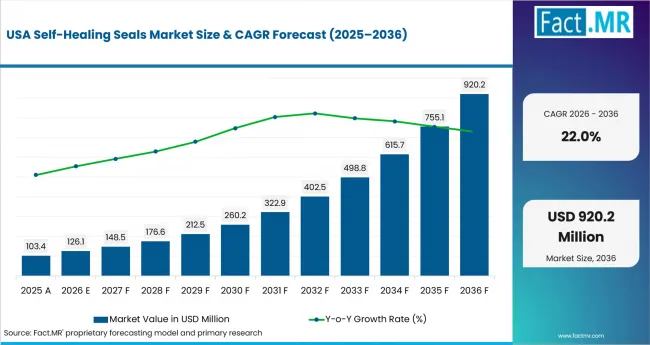
Self Healing Seals Market Country Value Analysis | Source: Fact.MR
U.S. oilfield and vehicle platforms are anticipated to keep severe-duty seal qualification active. EIA reported that U.S. crude oil production averaged a record 13.6 million barrels per day in 2025, while NHTSA reported preliminary FHWA data showing that vehicle miles traveled increased by about 29.8 billion miles, or 0.9%, during the year. The country offers broad trial routes for hydrocarbon seals, automotive O-rings and bonded seal formats.
What supports Germany adoption?
15.5% CAGR through 2036, led by electric-drive production and aviation recovery.
German manufacturers are projected to qualify self-healing seals where electric mobility and precision machinery require long validation. BMWE stated in January 2026 that roughly two million fully electric cars were registered on German roads at the end of 2025. Destatis reported in January 2026 that passenger traffic at Germany’s main commercial airports increased 3.9% year over year in 2025. Detailed testing favors suppliers with fluid data, compression data and local engineering support.
How is South Korea developing demand?
14.9% CAGR through 2036, supported by vehicle exports and port-linked equipment.
South Korea is expected to benefit from export-oriented vehicle production and heavy port equipment maintenance. MOTIR recorded automobile exports of USD 72.0 billion in 2025, while the Ministry of Oceans and Fisheries recorded 1.57101 billion tonnes of port cargo in 2025. Those activity bases support demand for hydrocarbon-compatible gaskets, O-rings and bonded seals.
How does Japan perform?
13.4% CAGR through 2036, shaped by aerospace traffic and machinery orders.
Japan is forecast to scale through careful qualification in aerospace, machinery and automotive systems. MLIT recorded 112.50 million domestic scheduled air passengers in fiscal 2025, and the Cabinet Office reported that private-sector machinery orders excluding volatile orders for ships and electric power rose 19.1% month on month in December 2025. Suppliers gain when repair behavior is documented through heat aging, swelling tests and compression-set work.
Who leads the Self-Healing Seals Market?
Dow Inc. and Gelest, Inc. show the materials-platform relevance to self-healing sealing systems, while SKF strengthens the competitive landscape through engineered sealing expertise. Arkema S.A., Reliance Industries Limited and Hydril USA Distribution LLC broaden the field through specialty polymers, elastomers and industrial sealing applications.
Dow Inc. contributes silicone and specialty polymer technologies suited to flexible, durable sealing formulations. Gelest, Inc. supports the market through specialty silicones, silanes and surface-modification materials that can enhance seal performance. SKF adds established sealing-system and rotating-equipment expertise. Arkema S.A. contributes high-performance polymers and elastomer technologies, while Reliance Industries Limited provides large-scale polymer capabilities. Hydril USA Distribution LLC extends the competitive field through sealing solutions for demanding energy and industrial environments. Competition is expected to focus on autonomous damage recovery, sealing retention, chemical resistance, temperature stability, fatigue life and compatibility with existing equipment.
Which companies are the key providers?
Key companies include Gelest, Inc., Hydril USA Distribution LLC, Dow Inc., SKF, Arkema S.A., Reliance Industries Limited.
- Gelest, Inc.
- Hydril USA Distribution LLC
- Dow Inc.
- SKF
- Arkema S.A.
- Reliance Industries Limited
Bibliography
- Department for Transport. (2026, April 29). Vehicle licensing statistics, United Kingdom: 2025. GOV.UK.
- North Sea Transition Authority. (2026, August 11). Reinstated wells produced 16 million boe in 2025.
- U.S. Energy Information Administration. (2026, August 11). Short-Term Energy Outlook.
- National Highway Traffic Safety Administration. (2026, April 1). Trump’s Transportation Department announces record-low traffic deaths & fatality rates in 2025.
- Federal Ministry for Economic Affairs and Energy. (2026, January 27). Great prospects for electric mobility. Energiewende direkt.
- Statistisches Bundesamt. (2026, January 29). 3,9 % mehr Fluggäste im Jahr 2025 als im Vorjahr [3.9% more air passengers in 2025 than in the previous year].
- Ministry of Trade, Industry and Resources. (2026, January 15). Automobile exports hit record high of $72 billion in 2025.
- Cabinet Office, Economic and Social Research Institute. (2026, February 19). Machinery orders in December, 2025 and forecast for Jan.-Mar. 2026.
This Report Answers
- The report explains where self-healing seals are used across product and mechanism. It covers fluid exposure and end use.
- Segment analysis identifies the leading subsegments and the operational reasons engineers prioritize them.
- Country analysis examines the USA, UK, Germany, South Korea and Japan with activity data tied to sealing demand.
- Competitive analysis reviews Gelest, Inc., Hydril USA Distribution LLC, Dow Inc., SKF, Arkema S.A. and Reliance Industries Limited.
- Application analysis reviews automotive, oil-gas, chemical processing, aerospace and machinery adoption routes.
What does the Self-Healing Seals Market cover?
O-rings, gaskets, rotary seals and bonded seals used for repair-capable sealing.
The Self-Healing Seals Market covers elastomeric seals designed to restore sealing function after small physical damage or controlled swelling changes. It includes O-rings, gaskets, rotary seals, bonded seals and form-in-place sealants where repair behavior is part of the performance claim.
The assessment is narrower than the broader gaskets and seals category. It focuses on repair-capable products and includes adjacent polymer seals only when the material offers a defined self-healing or damage-recovery mechanism.
What is included in the scope?
Self-healing sealing products used in automotive, oil-gas, chemical, aerospace and machinery applications.
The scope includes repair-capable O-rings and gaskets for high pressure seals service. It covers hydrocarbon applications linked to oil and gas gaskets and thermal applications connected with high temperature gaskets. Material coverage includes elastomer systems near circular elastomers, hydrogenated nitrile rubber and fluoroelastomers when repair function is part of the product claim. Form-in-place sealants are included where the sealing bead is used as a damage-recovery barrier.
What is excluded from the scope?
Standard elastomer seals and general adhesive systems are outside the scope.
The scope excludes ordinary FKM, EPDM, nitrile and silicone seals sold with standard compression or chemical-resistance claims. Broad adhesives and sealants and automotive adhesives are outside coverage unless the product is sold as a self-healing seal or as a form-in-place sealing material with defined repair behavior.
How Was the Analysis Built?
The analysis draws on 120+ sources, 35+ company portfolios, 25+ countries, and more than 20 industry interviews.
- Primary Research: Primary research includes discussions with manufacturers, service providers, technology developers, distributors, end users, procurement teams, and subject-matter experts. These conversations examine purchasing priorities, product adoption, operational challenges, approval requirements, competitive positioning, and the factors that influence wider market acceptance.
- Desk Research: Desk research covers government statistics, regulatory publications, company filings, trade data, technical studies, industry associations, standards, public policy, and other authoritative sources. Every source used in the analysis is documented in the bibliography.
- Market Sizing and Forecasting: Market estimates combine historical performance, demand indicators, pricing and volume trends, segment shares, company participation, country-level growth, adoption patterns, investment activity, and barriers to market expansion.
- Data Validation and Update Cycle: Findings are validated by comparing primary interviews with public data, company activity, regulatory changes, trade patterns, and industry developments. Regular updates review new product launches, capacity changes, partnerships, approvals, procurement trends, and shifts in commercial adoption.
Segmentation
What is the report's scope and coverage?
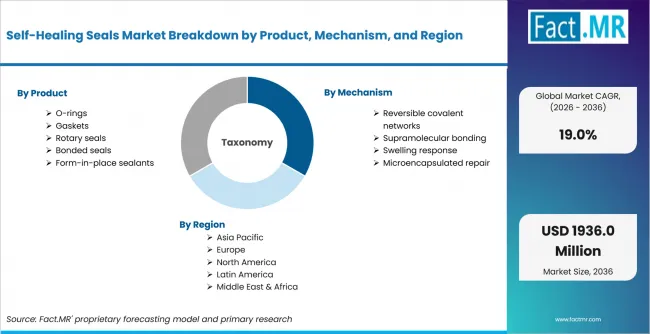
Self Healing Seals Market Breakdown By Product, Mechanism, And Region | Source: Fact.MR
| Attribute | Details |
|---|---|
| Quantitative Units | USD million in 2026 to USD million by 2036 at a CAGR |
| Market Definition | Repair-capable elastomer and sealing products that recover sealing function after minor cuts, microcracks, swelling shifts or compression damage in defined service conditions. |
| Product | O-rings; Gaskets; Rotary seals; Bonded seals; Form-in-place sealants |
| Mechanism | Reversible covalent networks; Supramolecular bonding; Swelling response; Microencapsulated repair |
| Fluid | Hydrocarbons; Water-steam; Process chemicals; Refrigerants |
| End Use | Automotive; Oil-gas; Chemical processing; Aerospace; Machinery |
| Regions Covered | North America; Latin America; Western Europe; Eastern Europe; East Asia; South Asia & Pacific; Middle East & Africa |
| Countries Covered | USA; UK; Germany; South Korea; Japan |
| Key Companies Profiled | Gelest, Inc., Hydril USA Distribution LLC, Dow Inc., SKF, Arkema S.A., Reliance Industries Limited |
| Forecast Period | 2026 to 2036 |
| Approach | Hybrid top-down and bottom-up approach using sealing applications, fluid exposure, product formats, country adoption and provider portfolio review. |
Source: Fact.MR analysis. Updated Aug 25, 2026
How is the market segmented?
-
By Product:
- O-rings
- Gaskets
- Rotary seals
- Bonded seals
- Form-in-place sealants
-
By Mechanism:
- Reversible covalent networks
- Supramolecular bonding
- Swelling response
- Microencapsulated repair
-
By Fluid:
- Hydrocarbons
- Water-steam
- Process chemicals
- Refrigerants
-
By End Use:
- Automotive
- Oil-gas
- Chemical processing
- Aerospace
- Machinery
-
By Region:
- North America
- Latin America
- Western Europe
- Eastern Europe
- East Asia
- South Asia & Pacific
- Middle East & Africa
Frequently Asked Questions
How big is the self-healing seals market in 2026?
What is the CAGR of the self-healing seals market from 2026 to 2036?
Which product leads the self-healing seals market?
Which mechanism leads the self-healing seals market?
Who are the leading companies in the self-healing seals market?
Who worked on this report


Preview the report firsthand - request a free sample
Free SampleGet the brochure for pricing and purchase details
Download PDF