- Market Value (2025): USD 336.9 Mn
- Estimated Value (2026): USD 380 Mn
- Forecast Value (2036): USD 1267 Mn
- CAGR (2026-2036): 12.8%
What is the Single-Serve Wellness Concentrates Market forecast to be worth by 2036?
USD 380 million in 2026 to USD 1267 million by 2036 at 12.8% CAGR.
- The single-serve wellness concentrates market reached USD 336.9 million in 2025 as hydration sticks and vitamin sachets moved deeper into repeat-use routines.
- Demand is projected to increase from USD 380 million in 2026 to USD 1267 million by 2036.
- The market is forecast to record 12.8% CAGR from 2026 to 2036 owing to portable wellness use and online replenishment.
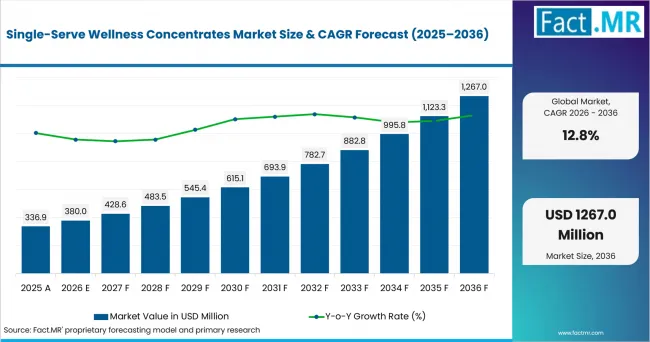
Single Serve Wellness Concentrates Market Value Analysis | Source: Fact.MR
What are the defining numbers behind Single-Serve Wellness Concentrates Market growth?
USD 887 million absolute opportunity by 2036, led by Hydration & electrolytes and Liquid drops/sticks alongside Online/DTC channels.
Demand Drivers in the Market
- Active consumers need portable electrolyte servings because gym bags and office drawers favor sachets over bottles.
- Health retail teams need clear dosage language since supplement-like concentrates are placed beside vitamins and oral rehydration products.
- Convenience stores need compact wellness products where single-use sticks fit water coolers, travel aisles and checkout placement.
Key Segments Analyzed
- By Benefit: Hydration & electrolytes are expected to hold 34.0% share in 2026 because sodium, potassium and magnesium claims are easy to explain.
- By Format: Liquid drops/sticks are projected to account for 44.0% share in 2026 as shoppers prefer fast mixing and small packs.
- By Distribution: Online/DTC is anticipated to capture 47.0% share in 2026 due to subscriptions, variety bundles and influencer-led trial.
Analyst Opinion at Fact.MR
- Shambhu Nath Jha, Senior Consultant at Fact.MR, states, “The commercial test is not whether a concentrate has many ingredients. It is whether one serving gives a clear use moment. Repeat purchasing is expected to depend on clean taste, precise dosage and claims that retailers can defend.”
Strategic Implications
- Brand teams should build flavor ladders around hydration first, then add energy and immunity variants only where claims remain clear.
- Retailers should place sachets near bottled water and vitamins so shoppers understand the product as an add-to-water serving.
- DTC teams should test subscription bundles because online sales already carry a large share of U.S. retail activity.
- Compliance teams should review caffeine and vitamin wording before launches since regulators are focusing on supplement-like products.
Australia is projected to record 14.7% CAGR through 2036 driven by active lifestyles and pharmacy-led hydration. Canada follows at 13.5% owing to e-commerce replenishment. The United States is anticipated to post 13.4% supported by supplement familiarity. The United Kingdom is estimated at 13.0%, Germany at 12.8% and Japan at 11.9%.
How does the Single-Serve Wellness Concentrates Market break down by segment?
Hydration & electrolytes lead Benefit at 34.0%; Liquid drops/sticks lead Format at 44.0%.
Which benefit dominates?
Hydration & electrolytes are projected to account for 34.0% share in 2026.
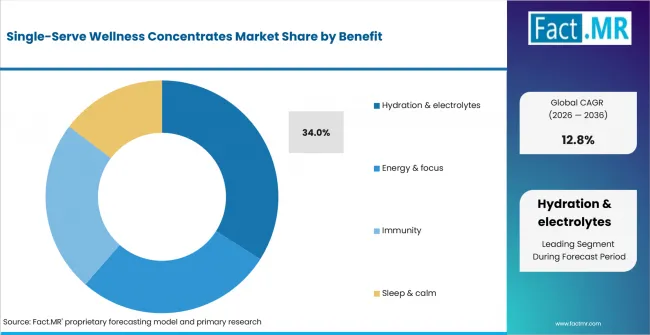
Single Serve Wellness Concentrates Market Analysis By Benefit | Source: Fact.MR
Hydration & electrolytes are expected to lead Benefit with 34.0% share in 2026 because the use case is immediate and easy to understand. Pedialyte Sport Powder Packs feature five key electrolytes and 3× the electrolytes of the leading sports drink, reinforcing the product’s hydration-focused positioning for athletes.
What leads the Format segment?
Liquid drops/sticks are expected to hold 44.0% share in 2026.
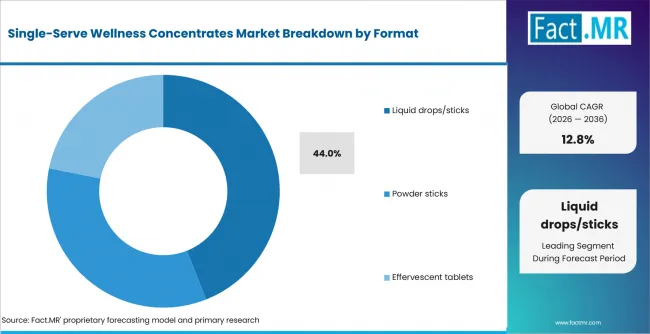
Single Serve Wellness Concentrates Market Analysis By Format | Source: Fact.MR
Liquid drops/sticks are projected to lead Format with 44.0% share in 2026 because they dissolve quickly and travel easily. Liquid I.V. states that its Energy Multiplier® Sugar-Free stick uses 93% less packaging than a canned ready-to-drink energy drink, based on a Carbon Impact Study comparing its sticks with a hypothetical liquid ready-to-drink format.
How does Distribution shape demand?
Online/DTC is anticipated to lead with 47.0% share in 2026.
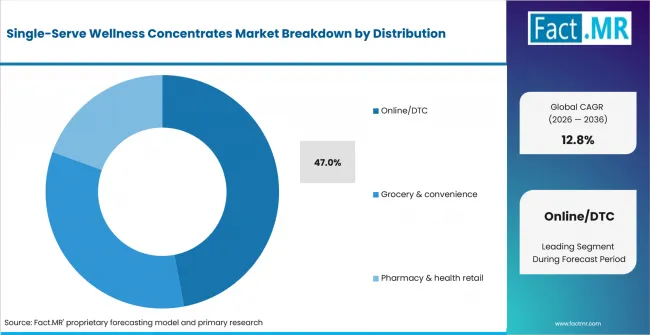
Single Serve Wellness Concentrates Market Analysis By Distribution | Source: Fact.MR
Online/DTC is forecast to lead Distribution with 47.0% share in 2026 because variety packs, subscriptions and direct product education can reduce trial friction. Nestlé Health Science states that Nuun products are sold in more than 5,000 U.S. outlets and are available in over 30 countries, indicating broad retail and international distribution.
What is accelerating Single-Serve Wellness Concentrates Market adoption, and what is holding it back?
Portable hydration drives it; claim and dosing scrutiny restrains it.
Drivers Impact Analysis
| DRIVER | (~) % IMPACT ON CAGR | GEOGRAPHIC RELEVANCE | IMPACT TIMELINE |
|---|---|---|---|
| Hydration use occasions | +3.1% | USA, Australia, Canada | Short term (<= 2 years) |
| Online replenishment | +2.6% | USA, UK, Germany | Short term (<= 2 years) |
| Low-sugar wellness positioning | +2.2% | USA, UK, Japan | Medium term (2-4 years) |
| Travel and commute use | +1.7% | Japan, Germany, Canada | Medium term (2-4 years) |
| Retail shelf education | +1.1% | Pharmacy and convenience channels | Long term (>= 4 years) |
Source: Fact.MR analysis. Updated Aug 19, 2026
- Hydration use occasions: Sports, heat and travel are expected to raise repeat use. ABS reported in March 2026 that adult accelerometer volunteers averaged 4 hours 26 minutes of activity per day in 2023.
- Online replenishment: DTC channels are projected to support bundles and subscriptions. ONS reported in July 2026 that online sales accounted for 29.4% of total retail sales in Great Britain in June 2026, providing a substantial digital channel for brands to distribute and rotate product variants.
- Travel and commute use: Compact formats are expected to gain where bottles are inconvenient. METI reported in August 2025 that Japan’s B2C e-commerce market for food, drinks, and liquor reached JPY 3.1163 trillion in 2024, providing a substantial online sales base for compact and easy-to-ship product formats.
Opportunity Impact Analysis
| OPPORTUNITY | (~) % IMPACT ON CAGR | GEOGRAPHIC RELEVANCE | IMPACT TIMELINE |
|---|---|---|---|
| Energy hydration blends | +1.5% | USA and UK | Medium term (2-4 years) |
| Pharmacy wellness sachets | +1.2% | Germany and Canada | Medium term (2-4 years) |
| Convenience trial packs | +0.9% | Japan and Australia | Long term (>= 4 years) |
| Corporate wellness refills | +0.6% | USA and Canada | Long term (>= 4 years) |
Source: Fact.MR analysis. Updated Aug 19, 2026
- Energy hydration blends: Caffeine formats are expected to expand beyond cans when dosage stays clear. Liquid I.V. lists 100 mg of natural caffeine in Energy Multiplier Sugar-Free. That creates an afternoon use case without shipping water.
- Pharmacy wellness sachets: Pharmacies are anticipated to favor precise servings. Haleon reported in February 2026 that its ₹10 Centrum Recharge launch in India had sold 13 million sachets with strong early repeat rates, supporting the role of low-price sachet formats in reaching lower-income consumers.
- Convenience trial packs: Convenience stores are expected to use trial packs for bottled-water shoppers. Japan’s Family Income and Expenditure Survey reported average monthly consumption expenditure of JPY 320,345 for households of two or more persons in May 2026, indicating a consumer-spending environment in which lower-priced trial formats may help reduce purchase barriers.
Restraints Impact Analysis
| RESTRAINT | (~) % IMPACT ON CAGR | GEOGRAPHIC RELEVANCE | IMPACT TIMELINE |
|---|---|---|---|
| Caffeine and vitamin scrutiny | -1.3% | USA, UK, Australia | Short term (<= 2 years) |
| Ingredient-dose confusion | -1.0% | Germany and Canada | Short term (<= 2 years) |
| Per-serving price pressure | -0.8% | Grocery channels | Medium term (2-4 years) |
| Taste and solubility limits | -0.6% | Global | Long term (>= 4 years) |
Source: Fact.MR analysis. Updated Aug 19, 2026
- Caffeine and vitamin scrutiny: Energy concentrates are expected to face more label review. The FSA's 2024/25 Retail Surveillance Sampling Programme found 33 of 40 caffeine food supplement samples non-compliant overall, equivalent to an 18% compliance rate. Brands need clean dosage instructions.
- Ingredient-dose confusion: Supplement-like concentrates are projected to slow where boundaries are unclear. BfR reported in July 2025 that a quarter of German respondents believed supplements were freely available medical drugs. Claim discipline remains necessary.
- Per-serving price pressure: Premium sticks are anticipated to face comparisons with tablets and large powder tubs. Grocery buyers test velocity before expanding shelf space. Brands must justify price through taste and portability.
- Taste and solubility limits: High-mineral formulas are expected to meet texture limits. waterdrop states that Microlyte may not dissolve completely because of its high magnesium concentration and that some residue can remain. Clear use guidance reduces complaints.
Which countries are scaling Single-Serve Wellness Concentrates Market fastest?
- The country comparison spans 2.80 percentage points across three growth bands.
- Australia remains 1.20 percentage points above Canada through active lifestyles.
- Canada remains 0.04 percentage point above the United States through online retail.
- The United States remains 0.45 percentage point above the United Kingdom through DTC hydration.
- The United Kingdom remains 0.13 percentage point above Germany through online retail.
- Germany remains 0.98 percentage point above Japan through pharmacy guidance.
- Japan closes the displayed range with compact homes and convenience retail.
Comparable CAGRs create different entry conditions because claim rules and retail channels vary by country. Full report coverage includes North America, Latin America, Europe, East Asia, South Asia and Pacific, Middle East and Africa.
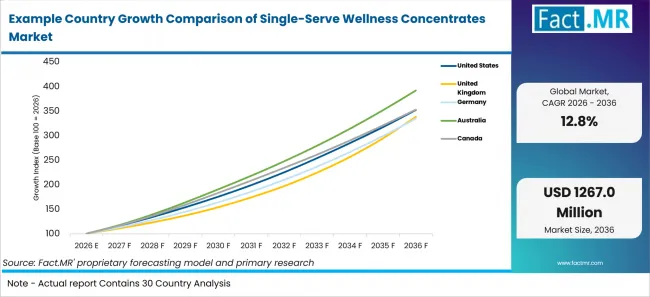
Example Country Growth Comparison Of Single Serve Wellness Concentrates Market | Source: Fact.MR
| Country | CAGR |
|---|---|
| Australia | 14.7% |
| Canada | 13.5% |
| United States | 13.4% |
| United Kingdom | 13.0% |
| Germany | 12.8% |
| Japan | 11.9% |
Source: Fact.MR analysis. Updated Aug 19, 2026
What supports Australia growth?
14.7% CAGR, supported by active lifestyles and portable hydration routines.
Australia’s growth reflects active lifestyles and strong demand for portable hydration formats. ABS reported adults wearing accelerometers averaged 4 hours 26 minutes of activity per day in 2023, while food spending rose 1.1% in May 2026. Vitamin B6 safety concerns, combined-use instructions and premium sachet pricing may temper adoption.
How is Canada scaling demand?
13.5% CAGR, driven by e-commerce reach and health retail replenishment.
Canada’s growth is supported by strong digital retail activity and established health-product channels. Statistics Canada reported CAD 5.0 billion in e-commerce sales and CAD 73.7 billion in total retail sales in May 2026. Label documentation, unauthorized-product enforcement and per-serving price comparisons may constrain premium hydration and wellness concentrates.
What underpins United States growth?
13.4% CAGR, backed by supplement use and DTC hydration brands.
United States growth is supported by widespread supplement use and strong digital commerce. CDC/NCHS reported 60.2% of adults aged 20 and older used a dietary supplement, while Q1 2026 e-commerce sales reached USD 326.7 billion. Caffeine-label scrutiny, advertising costs and intense DTC competition may limit smaller-brand expansion.
How does the United Kingdom perform?
13.0% CAGR, shaped by online retail and active-lifestyle consumers.
United Kingdom growth reflects high physical-activity participation and substantial online shopping. Sport England reported 64.6% of adults met weekly activity guidance, while ONS recorded online sales at 29.4% of retail sales. Caffeine compliance concerns, careful supplement-like positioning and value comparisons with lower-cost alternatives may restrain adoption.
What supports Germany outlook?
12.8% CAGR, supported by supplement familiarity and pharmacy-led guidance.
Germany’s growth is supported by widespread supplement use and expanding online retail. Destatis reported that internet and mail-order retail turnover increased 3.4% in real terms month over month in May 2026, while BfR reported that more than two thirds of respondents had consumed a food supplement within the previous 12 months. Medicine-food confusion, regulatory boundary scrutiny and competition from familiar effervescent tablets may limit faster uptake.
How is Japan developing demand?
11.9% CAGR, led by compact wellness formats and mature e-commerce channels.
Japan’s growth is supported by compact consumption formats and established e-commerce channels. METI reported that Japan’s B2C e-commerce market for food, drinks, and liquor reached JPY 3.1163 trillion in 2024, while the Statistics Bureau reported average monthly consumption expenditure of JPY 320,345 for households of two or more persons in May 2026. Food-drug boundary checks and preference for familiar tablet formats may constrain stick adoption.
Who leads the Single-Serve Wellness Concentrates Market?
Unilever and Nestle Health Science show direct hydration coverage, while Abbott and Haleon strengthen pharmacy-oriented wellness formats.
Unilever participates through Liquid I.V. powdered hydration multipliers and a sugar-free energy line. Nestle Health Science participates through Nuun sport, energy, immunity and vitamin products. Glanbia adds sports nutrition reach through Optimum Nutrition.
Abbott supports the field with Pedialyte Sport powder packs and rehydration credibility. Haleon participates through vitamin and sachet formats. waterdrop adds Microlyte cubes between tablets and powder sticks.
Which companies are the key providers?
Key companies include Unilever; Nestle Health Science; Glanbia; Abbott; Haleon; and waterdrop.
- Unilever
- Nestle Health Science
- Glanbia
- Abbott
- Haleon
- waterdrop
Bibliography
- Australian Bureau of Statistics. (2026, June 25). Household spending up 1.3% in May.
- Australian Bureau of Statistics. (2026, March 24). Measured physical activity and sleep, 2023.
- Therapeutic Goods Administration. (2026, February 19). Medicines containing vitamin B6 (pyridoxine, pyridoxal or pyridoxamine).
- U.S. Census Bureau. (2026, May 18). Quarterly retail e-commerce sales, 1st quarter 2026.
- U.S. Food and Drug Administration. (2026, February 10). Human Foods Program 2026 priority deliverables.
- Statistics Canada. (2026, July 23). Retail trade, May 2026.
- Health Canada. (2026, May 7). Stay safe when buying health products online.
- Office for National Statistics. (2026, July 24). Retail sales, Great Britain: June 2026.
- Sport England. (2026, April). Active Lives Adult Survey – November 2024–25 report.
- Food Standards Agency. (2025, July 9). FSA publishes results of latest Retail Surveillance Survey and revised industry guidance on caffeine supplements.
- Statistisches Bundesamt. (2026, June 30). Einzelhandelsumsatz im Mai 2026 real um 1,1 % höher als im Vormonat.
- German Federal Institute for Risk Assessment. (2025, July 18). Between hype and misconception: Common misunderstandings about food supplements.
- Federal Office of Consumer Protection and Food Safety. (2025, March 11). Im Grenzbereich zwischen Arznei- und Lebensmitteln.
- Ministry of Economy, Trade and Industry. (2025, August 26). Results of FY2024 E-Commerce Market Survey Compiled.
- Statistics Bureau of Japan. (2026, July 7). Summary of the latest month on Family Income and Expenditure Survey: May 2026.
This Report Answers
- The report provides strategic intelligence on the Single-Serve Wellness Concentrates Market across Benefit and Format choices that shape add-to-water wellness routines.
- Segment analysis covers Hydration & electrolytes and Liquid drops/sticks as the 2026 share leaders within the market.
- Country outlook evaluates Australia and Canada alongside the United States, United Kingdom, Germany and Japan.
- Competitive analysis profiles Unilever and Nestle Health Science alongside Glanbia, Abbott, Haleon and waterdrop.
- Benefit assessment covers Hydration & electrolytes and Energy & focus alongside Immunity and Sleep & calm.
- Format assessment links liquid drops, powder sticks and effervescent tablets to the wider functional beverages and functional drinks base.
What does the Single-Serve Wellness Concentrates Market cover?
Liquid drops, powder sticks and effervescent tablets used for measured wellness servings.
The Single-Serve Wellness Concentrates Market covers add-to-water products that deliver a defined benefit in one measured serving. It includes hydration minerals, caffeine blends, vitamin sachets and calm-positioned formats where the product is sold as a concentrate instead of a finished drink.
Coverage differs from broader dietary supplements because the product is designed for beverage preparation at the point of use. The market overlaps with natural health supplements when vitamin or mineral claims shape purchase decisions.
What is included in the scope?
Single-serve concentrate products used in consumer hydration and wellness routines.
The scope includes liquid dietary supplements and powder dietary supplements when they are portioned for beverage mixing. Coverage spans hydration sticks, energy sachets, immunity powders, sleep or calm blends and dissolvable cubes. It includes formats connected to soft drink concentrates only when the product carries a wellness benefit. Online/DTC, grocery, convenience, pharmacy and health retail channels are included where the product is sold for consumer self-use.
What is excluded from the scope?
Ready-to-drink beverages and prescription therapies are outside the scope.
Ready-to-drink sports drinks, bottled juices and standard non-alcoholic beverages are excluded unless the product is sold as a concentrate serving. Bulk tubs are excluded when they are not portioned for single use. Prescription oral rehydration therapy, drug products, meal replacements and alcohol mixers are excluded even when they use flavors or minerals.
OTC vitamin supplements are included only when the product is a single-serve beverage concentrate. Tablets, capsules and gummies without a drink-preparation role are outside the market boundary.
How Was the Analysis Built?
The analysis draws on 120+ sources, 35+ company portfolios, 25+ countries, and more than 20 industry interviews.
- Primary Research: Primary research includes discussions with manufacturers, service providers, technology developers, distributors, end users, procurement teams, and subject-matter experts. These conversations examine purchasing priorities, product adoption, operational challenges, approval requirements, competitive positioning, and the factors that influence wider market acceptance.
- Desk Research: Desk research covers government statistics, regulatory publications, company filings, trade data, technical studies, industry associations, standards, public policy, and other authoritative sources. Every source used in the analysis is documented in the bibliography.
- Market Sizing and Forecasting: Market estimates combine historical performance, demand indicators, pricing and volume trends, segment shares, company participation, country-level growth, adoption patterns, investment activity, and barriers to market expansion.
- Data Validation and Update Cycle: Findings are validated by comparing primary interviews with public data, company activity, regulatory changes, trade patterns, and industry developments. Regular updates review new product launches, capacity changes, partnerships, approvals, procurement trends, and shifts in commercial adoption.
Segmentation
What is the report’s scope and coverage?
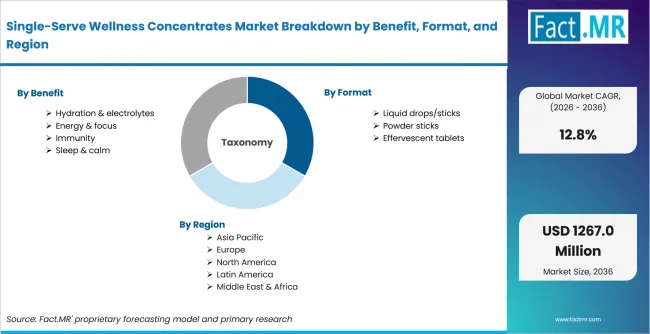
Single Serve Wellness Concentrates Market Breakdown By Benefit, Format, And Region | Source: Fact.MR
| Attribute | Details |
|---|---|
| Quantitative Units | USD million in 2026 to USD million by 2036 at CAGR |
| Market Definition | Single-serve concentrated wellness formats added to water or drinks for hydration, energy, immunity, sleep or calm benefits. |
| Benefit | Hydration & electrolytes; Energy & focus; Immunity; Sleep & calm |
| Format | Liquid drops/sticks; Powder sticks; Effervescent tablets |
| Distribution | Online/DTC; Grocery & convenience; Pharmacy & health retail |
| Regions Covered | North America; Latin America; Europe; East Asia; South Asia and Pacific; Middle East and Africa |
| Countries Covered | Australia; Canada; United States; United Kingdom; Germany; Japan |
| Key Companies Profiled | Unilever; Nestle Health Science; Glanbia; Abbott; Haleon; waterdrop |
| Forecast Period | 2026 to 2036 |
| Approach | Hybrid top-down and bottom-up approach using wellness concentrate demand; hydration use occasions; supplement adoption; retail e-commerce; grocery and pharmacy placement; ingredient claim review; country adoption patterns and company portfolio review |
Source: Fact.MR analysis. Updated Aug 19, 2026
How is the market segmented?
-
By Benefit:
- Hydration & electrolytes
- Energy & focus
- Immunity
- Sleep & calm
-
By Format:
- Liquid drops/sticks
- Powder sticks
- Effervescent tablets
-
By Distribution:
- Online/DTC
- Grocery & convenience
- Pharmacy & health retail
-
By Region:
- North America
- Latin America
- Europe
- East Asia
- South Asia and Oceania
- Middle East and Africa
Frequently Asked Questions
How big is the single-serve wellness concentrates market in 2026?
What is the CAGR of the single-serve wellness concentrates market from 2026 to 2036?
Which benefit leads the single-serve wellness concentrates market?
Which format leads the single-serve wellness concentrates market?
Who are the leading companies in the single-serve wellness concentrates market?
Who worked on this report


Preview the report firsthand - request a free sample
Free SampleGet the brochure for pricing and purchase details
Download PDF