- Market Value (2025): USD 0.36 Bn
- Estimated Value (2026): USD 0.45 Bn
- Forecast Value (2036): USD 4.50 Bn
- CAGR (2026-2036): 25.9%
What is the racket sports booking apps market forecast to be worth by 2036?
USD 0.45 billion in 2026 to USD 4.50 billion by 2036, at 25.9% CAGR.
- The racket sports booking apps market crossed a valuation of USD 0.36 billion in 2025.
- Demand is expected to increase from USD 0.45 billion in 2026 to USD 4.50 billion by 2036.
- The market is forecast to record 25.9% CAGR during 2026 to 2036 as club subscriptions, transaction fees and player discovery tools lift software revenue.
- Court-booking and player-matching platforms form the core of this market. The International Tennis Federation reported nearly 106 million tennis players in November 2024.
- The International Padel Federation reported 77,300 padel courts in December 2025.
- The Sports & Fitness Industry Association reported 24.3 million United States pickleball players in June 2026.
- These participation and court signals support demand for apps that manage bookings, payments and open-match discovery.
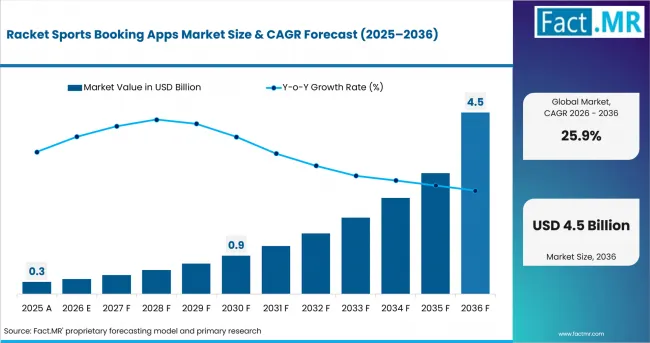
Racket Sports Booking Apps Market Value Analysis | Source: Fact.MR
What are the defining numbers behind racket sports booking apps growth?
USD 4.05 billion absolute opportunity by 2036. Spain, United States and United Kingdom lead the country view.
- Demand Drivers in the Market
- Peak-hour court shortages are moving clubs away from phone booking because live inventory reduces missed cancellations.
- Open-match tools add revenue because one player can join a paid slot without arranging a full group.
- Integrated payments support cash control because deposits and refunds can be handled before play starts.
- Rating systems improve repeat use because players can avoid level mismatches that damage the match experience.
- Key Segments Analyzed
- By Platform Function: Court Booking is expected to account for 46.0% share in 2026 because the reservation layer starts nearly every paid venue interaction.
- By Sport Type: Padel is projected to capture 42.0% share in 2026 because club-led play and open matches fit platform-led scheduling.
- By Customer Type: Private Clubs are estimated to hold 39.0% share in 2026 as member rules and guest access need structured booking controls.
- By Revenue Model: Software-as-a-service Subscriptions are anticipated to contribute 37.0% share in 2026 because venues prefer predictable monthly software costs.
- By Deployment Model: Cloud Apps are forecast to secure 34.0% share in 2026 since smaller clubs need quick setup and remote support.
- By Court Network Type: Multi-Court Venues are likely to represent 33.0% share in 2026 because larger sites have more slot conflicts to manage.
- By User Interface: Player Apps are predicted to hold 32.0% share in 2026 because consumer discovery helps fill open-match and off-peak inventory.
- By Geography: Spain is projected to record 30.8% CAGR through 2036 due to padel density and Playtomic’s domestic operating base.
- Analyst Opinion
- Shambhu Nath Jha, Principal Analyst at Fact.MR states, "Racket venues are not buying a booking screen alone. They are buying a way to fill idle courts, collect payment earlier and match players who would not have found each other without the platform."
- Strategic Implications
- Club operators should treat booking software as revenue control because the app decides how peak-hour slots are priced and released.
- Platform providers need stronger migration support because smaller venues resist switching when member records are messy.
- Payment partners can win accounts by reducing refund delays and making split payments simple for open-match formats.
- Player marketplaces should protect rating quality because poor matching can damage retention even when court supply is available.
Playtomic and PwC Strategy& counted 58,300 courts in the Global Padel Report 2026. Playtomic Manager also shows club-scale adoption on its provider page. These signals explain why booking apps are becoming a venue operating layer, not a narrow consumer calendar.
Spain is projected to record 30.8% CAGR through 2036 as padel density and Playtomic’s domestic platform base support app monetization. The United States is likely to post 29.7% CAGR because pickleball participation and tennis-center upgrades widen the software base. The United Kingdom is expected to register 28.4% CAGR as padel strategy and high-value urban court use support booking control. France is forecast to advance at 27.8% CAGR as federation-linked clubs add padel and player-matching tools. Germany is anticipated to record 27.1% CAGR as new padel venues choose cloud booking systems at launch.
How does the racket sports booking apps market break down by segment?
Court Booking leads at 46.0%. Padel follows with 42.0% share in 2026.
Which platform function dominates?
Court Booking holds 46.0% share in 2026.
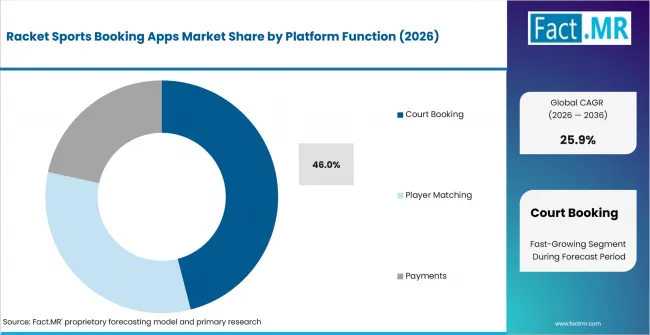
Racket Sports Booking Apps Market Analysis By Platform Function | Source: Fact.MR
Court Booking is expected to hold 46.0% share in 2026 because every paid venue needs a reservation layer before it can sell coaching, leagues or events. This is where club operations meet sports analytics because usage history gives owners evidence on busy hours and empty slots. Payment and cancellation rules become easier to manage once the booking layer is reliable.
Which sport type dominates?
Padel holds 42.0% share in 2026.
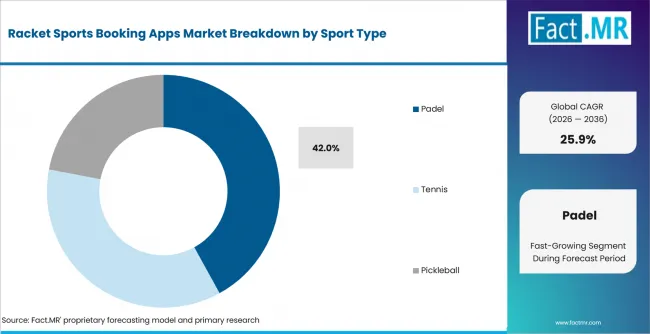
Racket Sports Booking Apps Market Analysis By Sport Type | Source: Fact.MR
Padel is projected to account for 42.0% share in 2026 because the sport is usually played at commercial clubs with paid hourly access. The same player may book several times a week, which gives a mobile application more repeat transactions than a casual public-court model. Tennis and pickleball is important but their venue mix is more varied.
Which customer type dominates?
Private Clubs hold 39.0% share in 2026.
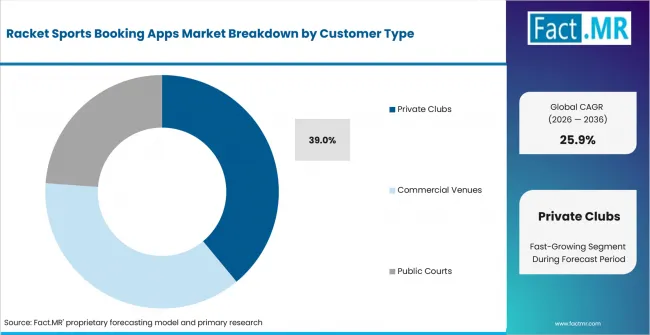
Racket Sports Booking Apps Market Analysis By Customer Type | Source: Fact.MR
Private Clubs are estimated to hold 39.0% share in 2026 because memberships create rules that software must enforce. Clubs need limits for guest access, prime-time booking windows and lesson calendars. Public courts are expected to add share later when municipalities require online booking and payment records.
Which revenue model dominates?
Software-as-a-service Subscriptions hold 37.0% share in 2026.
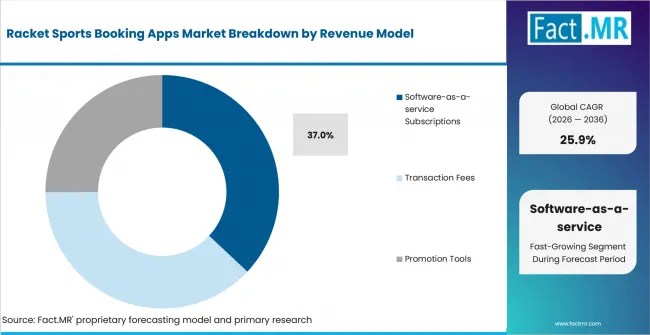
Racket Sports Booking Apps Market Analysis By Revenue Model | Source: Fact.MR
Software-as-a-service subscriptions are anticipated to contribute 37.0% share in 2026 because venues prefer monthly costs that scale with court count. Transaction fees are still important because open matches and online deposits connect the category with mobile payment behavior. Hybrid pricing should stay common as suppliers balance club budgets with player-side revenue.
Which deployment model dominates?
Cloud Apps hold 34.0% share in 2026.
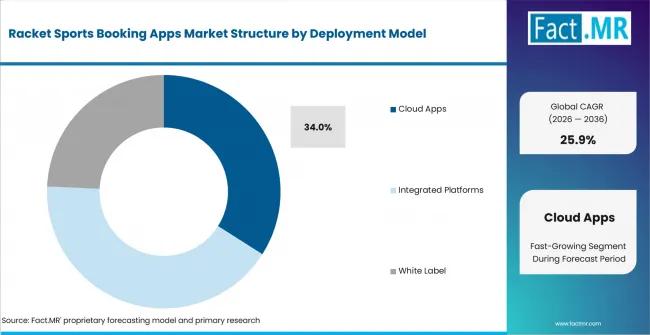
Racket Sports Booking Apps Market Analysis By Deployment Model | Source: Fact.MR
Cloud Apps are forecast to secure 34.0% share in 2026 because most venues do not want local software maintenance. Smaller clubs value quick setup, remote support and automatic updates. Larger chains may still request deeper integrations when central teams manage several sites and coach programs together.
Which user interface dominates?
Player Apps hold 32.0% share in 2026.
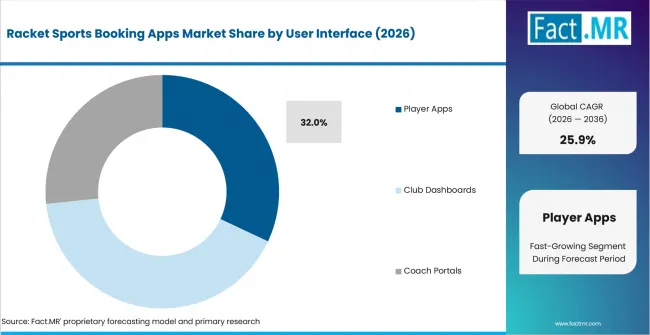
Racket Sports Booking Apps Market Analysis By User Interface | Source: Fact.MR
Player Apps are predicted to hold 32.0% share in 2026 because consumers start the transaction when they search for a court or open match. Club Dashboards stay essential for managers, but the player interface controls discovery and repeat use. Coach portals and admin consoles add value once the club has enough traffic to manage programs and events.
Which court network type dominates?
Multi-Court Venues hold 33.0% share in 2026.
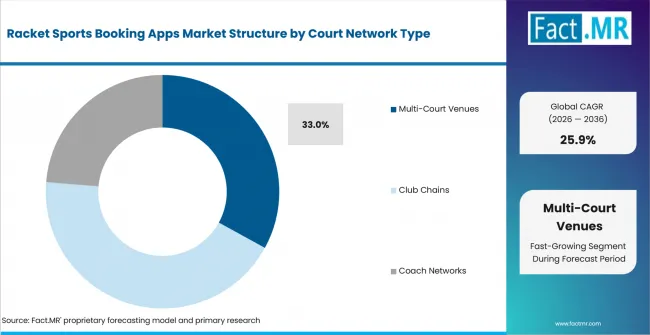
Racket Sports Booking Apps Market Analysis By Court Network Type | Source: Fact.MR
Multi-Court Venues are likely to represent 33.0% share in 2026 because more courts create more booking conflicts and cancellation exposure. Single-court facilities can rely on lighter tools for longer. Club chains add another layer because managers compare utilization, lessons and event fill rates across locations.
What is accelerating racket sports booking apps demand, and what is holding it back?
Padel club density and pickleball participation support demand. Migration effort and payment dependency restrain smaller venues.
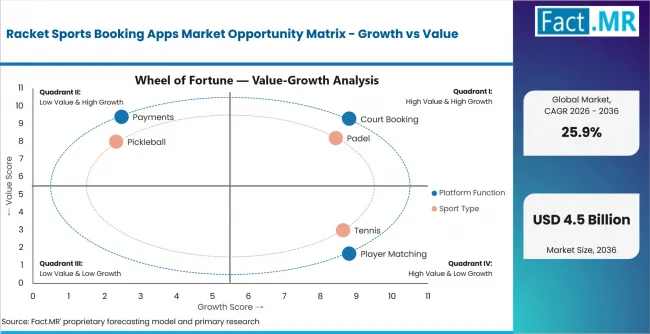
Racket Sports Booking Apps Market Opportunity Matrix Growth Vs Value | Source: Fact.MR
Racket venues are moving from manual calendars to cloud-based control because court inventory now changes by the hour. Large tennis and pickleball participation bases create demand for booking systems that behave more like fitness applications than static venue directories. This player base creates demand for booking systems that behave more like fitness applications than static venue directories.
Expansion is constrained when clubs lack clean customer records or staff time to move member data. Payment dependency can also slow decisions because refunds, card fees and payout timing affect venue cash flow. Suppliers that combine onboarding support with transparent pricing should face less resistance from smaller clubs and local chains.
Where do the biggest racket sports booking apps opportunities sit?
Open-match monetization, integrated payments and multi-site club dashboards.
- Open-Match Monetization: Platforms can sell empty slots to individual players when a full group is not ready, which extends the logic of a home fitness app into live club attendance.
- Integrated Payments: Suppliers can help clubs collect deposits and reduce no-shows when the booking step includes card payment and refund rules.
- Multi-Site Dashboards: Club chains can compare court use and coaching calendars across locations, which brings venue operations closer to smart fitness tracking without turning the club into a gym platform.
Which countries are scaling racket sports booking apps fastest?
Spain 30.8% and United States 29.7% lead the country view. United Kingdom 28.4%, France 27.8% and Germany 27.1% follow. Italy 26.6% and Sweden 24.9% complete the top seven.
Based on regional analysis, the racket sports booking apps market is segmented into North America and Western Europe. Asia Pacific and Latin America are also covered. Middle East and Africa completes the regional scope.
.webp "Top Country Growth Comparison Racket Sports Booking Apps Market Cagr (2026 2036)")
Top Country Growth Comparison Racket Sports Booking Apps Market Cagr (2026 2036) | Source: Fact.MR
| Country | CAGR |
|---|---|
| Spain | 30.8% |
| United States | 29.7% |
| United Kingdom | 28.4% |
| France | 27.8% |
| Germany | 27.1% |
| Italy | 26.6% |
| Sweden | 24.9% |
Source: Fact.MR analysis. Updated Jun 23, 2026
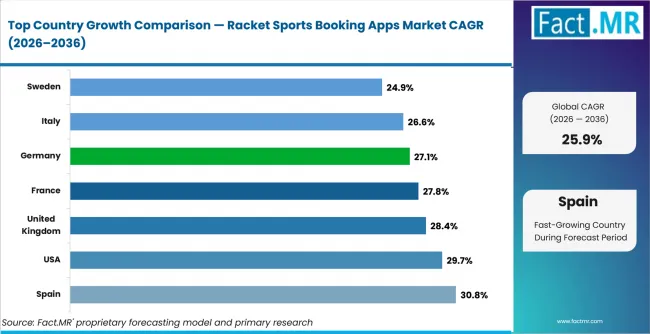
Racket Sports Booking Apps Market Cagr Analysis By Country | Source: Fact.MR
What powers Spain’s lead?
30.8% CAGR, supported by padel density and a local platform base.
Spain starts from the strongest padel booking culture because commercial clubs and player marketplaces developed together. Playtomic’s domestic origin gives Spanish venues a familiar platform for booking, open matches and payments. Suppliers that connect court inventory with coaching and events can attach revenue beyond the first booking. The country also influences related sports equipment spending because frequent play drives replacement purchases.
What supports the United States outlook?
29.7% CAGR, led by pickleball participation and tennis-center software upgrades.
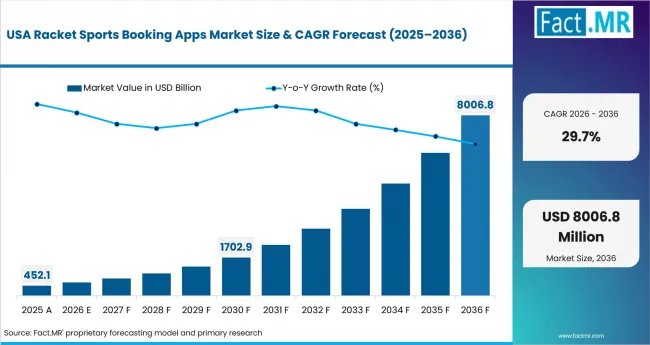
Racket Sports Booking Apps Market Country Value Analysis | Source: Fact.MR
The United States has the broadest near-term player pool because pickleball and tennis both support app-based reservations. United States Tennis Association data placed tennis participation at 27.3 million players in 2025. CourtReserve’s provider page lists 2,300+ clubs and 105 million+ bookings, which shows that club software is already part of venue operations. This creates a wider route into sport accessories retail tie-ins when clubs sell lessons, events and gear near the booking flow.
Why does the United Kingdom matter?
28.4% CAGR, supported by padel strategy and high-value urban court use.
The United Kingdom matters because organized padel expansion is arriving through tennis clubs, private venues and local operators. The Lawn Tennis Association announced a strategy in September 2024 that targeted 1,000 padel courts by 2026. Higher urban court prices make online booking and payment control more important for venue yield. Suppliers that can handle mixed tennis and padel calendars should see stronger buyer pull.
How is France scaling booking app demand?
27.8% CAGR, supported by federation-linked tennis clubs and expanding padel play.
France has a club network that can support racket software without every venue starting from scratch. Padel growth adds a second booking layer alongside tennis and lessons. Buyers are likely to prefer tools that can manage memberships, guest access and tournaments in French-language workflows. The market should favor platforms that integrate player discovery with club administration.
What makes Germany important?
27.1% CAGR, supported by early-stage padel supply and structured club operations.
Germany is developing from a lower padel base than Spain and Italy, which leaves more room for new venues to choose booking software at launch. Club buyers are expected to compare data control, privacy handling and payment workflows before switching systems. The near-term opportunity sits with multi-sport clubs that add padel beside tennis. Suppliers that document data hosting and support terms should have an advantage.
Why is Italy a relevant commercial market?
26.6% CAGR, supported by court density and frequent club-led padel use.
Italy offers one of Europe’s clearest padel software routes because clubs already handle high booking volume. The International Padel Federation reported 10,017 Italian padel courts in June 2025. That level of supply creates a practical need for slot rules, open matches and payments. Platforms that serve both clubs and players should gain value where venue choice is dense.
How does Sweden create a cautionary but useful market?
24.9% CAGR, supported by player depth but moderated by facility-cycle discipline.
Sweden shows why booking apps need more than rapid court expansion. The International Padel Federation highlighted 600,000 players and more than 4,000 courts in February 2024. After a fast buildout phase, venue operators need better utilization data and pricing rules to protect occupancy. This makes Sweden a useful market for analytics, retention and targeted player matching.
Who leads the racket sports booking apps landscape?
Playtomic, CourtReserve and MATCHi lead through player reach and venue workflow depth. ClubSpark, Playbypoint and SportyHQ add operating depth.
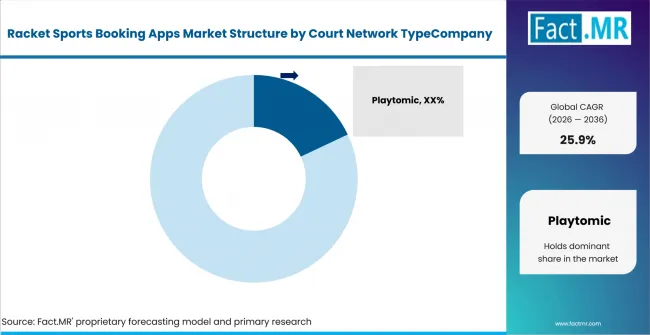
Racket Sports Booking Apps Market Analysis By Company | Source: Fact.MR
Competition is split between player marketplaces and club management systems. Marketplaces such as Playtomic and MATCHi compete on player discovery, open matches and rating depth. Club operating platforms such as CourtReserve and Playbypoint compete on member rules, billing and daily staff workflows.
Playtomic has the clearest network effect because it serves clubs and players in the same loop. CourtReserve has a strong United States club-management position because it links reservations, memberships and payments for tennis and pickleball venues. The connection with smart sports equipment is indirect but useful because frequent players create more data-rich retail and training opportunities.
ClubSpark is relevant because national bodies and tennis clubs use booking modules to manage structured access. SportyHQ brings court booking and league tools into multi-sport venue operations. Playo shows how a multi-sport booking model can work in dense urban markets where racket sports share wallet space with other activities and mobile point-of-sale systems.
Providers that control both venue inventory and player discovery should be better placed through 2036. Smaller software suppliers can still win when they provide clean migration, local support and simpler monthly pricing. Buyer decisions should be shaped by rating quality, payment reliability and how quickly staff can recover from cancellations.
Which companies are the key players?
Playtomic, CourtReserve and MATCHi are key players. ClubSpark, Playbypoint and SportyHQ are also profiled. Playo completes the company set.
- Playtomic
- CourtReserve
- MATCHi
- ClubSpark
- Playbypoint
- SportyHQ
- Playo
Bibliography
- [1] Bowers, C. (2024, November 28). ITF Global Tennis Report: Participation hits 106 million in five years. International Tennis Federation.
- [2] International Padel Federation. (2025, December 2). Online the FIP World Padel Report 2025, a comprehensive analysis of a sport in constant growth.
- [3] International Padel Federation. (2025, June 11). The padel boom shows no signs of stopping: Italy surpasses 10,000 courts second only to Spain.
- [4] International Padel Federation. (2024, February 21). Focus on Sweden: 600,000 players, over 4,000 courts. And the Next Gen faces the world’s best young players.
- [5] Sports & Fitness Industry Association. (2026, June 4). SFIA releases 2026 pickleball single sport report; team sports to follow.
- [6] Sellmeyer, J. (2026, April 16). U.S. tennis participation reaches record high; USTA Missouri Valley drives regional impact. United States Tennis Association.
- [7] Lawn Tennis Association. (2024, September 11). LTA announces new padel strategy.
- [8] Lawn Tennis Association. (2025, April 29). Finance and governance report 2024.
- [9] Playtomic. (2026). Global Padel Report 2026.
- [10] Playtomic. (2026). Playtomic Manager: Racket sports club management platform.
- [11] Tennis Australia. (2025, May). Clubspark court booking upgrade: Feature overview—Club admins.
This Report Addresses
- Strategic intelligence on racket sports booking apps across platform function, sport type, customer type and revenue model.
- Segment analysis covering Court Booking, Padel, Private Clubs, Software-as-a-service Subscriptions and Cloud Apps.
- Regional outlook covering Spain, United States, United Kingdom, France, Germany, Italy and Sweden.
- Competitive analysis of Playtomic, CourtReserve and MATCHi. ClubSpark, Playbypoint and SportyHQ are also profiled. Playo completes the company set.
- Service assessment covering court reservations, open matches, rating systems, payments and club dashboards.
- Source-led market sizing using federation data, provider pages, app listings and official participation evidence.
What does the racket sports booking apps market cover?
Court-booking, player matching, ratings and payment tools for racket sports venues and players.
The racket sports booking apps market covers paid software and player platforms that help people reserve courts and join matches. It includes club dashboards, player-facing apps, payment modules, open-match discovery and rating systems. The scope covers padel, tennis, pickleball and adjacent racket sports when booking or player matching is the paid software function.
What is included in the scope?
Player apps and venue dashboards. Payment tools, ratings and club-management modules are also included.
The scope includes court reservations for commercial clubs, private racket centers and public venue operators. It includes subscription software and transaction-fee models. It also covers open-match tools, coach booking, tournament scheduling and venue analytics when they are sold as part of a racket sports booking platform.
What is excluded from the scope?
Rackets, court construction, shoes and ordinary fitness apps that do not manage racket court inventory.
The scope excludes racket equipment, balls, apparel and court-surface revenue. It excludes general gym management software unless the product includes racket court reservations. It also excludes social sports communities that do not control venue booking, payment or player-match workflows.
How was the analysis built?
80+ sources and 35+ provider or federation pages. 20+ countries were checked with 15+ interviews.
- Primary Research:
- Interviews covered racket club owners, software buyers and platform operators. Tennis center managers, padel club chains and pickleball venue operators were also included.
- Desk Research:
- Desk research reviewed official sport federation pages and participation reports. Provider pages, app listings and venue software documentation were checked for live capabilities.
- Market-Sizing and Forecasting:
- Forecasting used provider counts, active venue evidence, estimated software revenue per club and transaction-fee attach rates. Estimates were reconciled against sport participation and court-count evidence.
- Data Validation and Update Cycle:
- Estimates were checked against Playtomic, CourtReserve, MATCHi and ClubSpark service evidence. International Tennis Federation, International Padel Federation and Sports & Fitness Industry Association data were used to validate the addressable base.
Segmentation
What is the report’s scope and coverage?
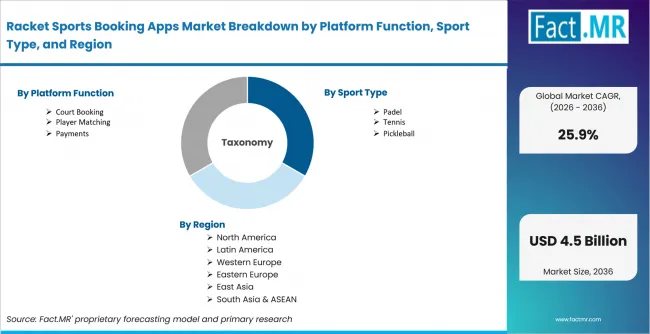
Racket Sports Booking Apps Market Breakdown By Platform Function, Sport Type, And Region | Source: Fact.MR
| Attribute | Details |
|---|---|
| Quantitative Units | USD Billion in 2026 to USD Billion& by 2036 at CAGR |
| Market Definition | Court-booking, matchmaking, rating and payment platforms for racket sports venues and players |
| Platform Function | Court Booking, Player Matching, Rating Systems, Payments, Club Tools |
| Sport Type | Padel, Tennis, Pickleball, Squash, Badminton |
| Customer Type | Private Clubs, Commercial Venues, Public Courts, Coaches, Federations |
| Revenue Model | Software-as-a-service Subscriptions, Transaction Fees, Promotion Tools, League Fees, Hardware Links |
| Deployment Model | Cloud Apps, Integrated Platforms, White Label, Marketplace, Integration Links |
| Court Network Type | Multi-Court Venues, Club Chains, Municipal Courts, Coach Networks, Federation Venues |
| User Interface | Player Apps, Club Dashboards, Coach Portals, Admin Consoles |
| Regions Covered | North America, Western Europe, Asia Pacific, Latin America, Middle East and Africa |
| Countries Covered | Spain, United States, United Kingdom, France, Germany, Italy and Sweden |
| Key Companies Profiled | Playtomic, CourtReserve, MATCHi, ClubSpark, Playbypoint, SportyHQ and Playo |
| Forecast Period | 2026 to 2036 |
| Approach | Hybrid top-down and bottom-up approach using court counts, player evidence, provider counts, transaction assumptions and company validation |
Source: Fact.MR analysis. Updated Jun 23, 2026
How is the market segmented?
-
By Sport Type:
- Padel
- Tennis
- Pickleball
- Squash
- Badminton
-
By Platform Function:
- Court Booking
- Player Matching
- Rating Systems
- Payments
- Club Tools
-
By Customer Type:
- Private Clubs
- Commercial Venues
- Public Courts
- Coaches
- Federations
-
By Revenue Model:
- Software-as-a-service Subscriptions
- Transaction Fees
- Promotion Tools
- League Fees
- Hardware Links
-
By Deployment Model:
- Cloud Apps
- Integrated Platforms
- White Label
- Marketplace
- Integration Links
-
By Court Network Type:
- Multi-Court Venues
- Club Chains
- Municipal Courts
- Coach Networks
- Federation Venues
-
By User Interface:
- Player Apps
- Club Dashboards
- Coach Portals
- Admin Consoles
-
By Region:
- North America
- United States
- Canada
- Mexico
- Latin America
- Brazil
- Argentina
- Rest of Latin America
- Europe
- Spain
- United Kingdom
- France
- Germany
- Italy
- Sweden
- Rest of Europe
- Asia Pacific
- China
- India
- Japan
- South Korea
- Australia
- ASEAN
- Middle East & Africa
- GCC Countries
- South Africa
- Rest of Middle East & Africa
- North America
Frequently Asked Questions
How is the Racket Sports Booking Apps Market positioned today?
What is the long-term outlook for the Racket Sports Booking Apps Market?
Why is the Racket Sports Booking Apps Market expected to grow?
Which platform function is expected to lead the market?
Which sport type supports the leading software use case?
Which country shows the strongest expansion path?
How do booking apps earn revenue?
How do apps help clubs improve payback?
How does player matching work in practical terms?
What is the main adoption challenge for smaller clubs?
Who worked on this report


Preview the report firsthand - request a free sample
Free SampleGet the brochure for pricing and purchase details
Download PDF