- Base Value(2025): 79.5 Mn
- Forecast Value (2035): 123.5 Mn
- CAGR (2035): 44.2%
Scented Sampling Tags Market Outlook 2025 to 2035
The global scented sampling tags market is expected to reach USD 123.5 million by 2035, up from USD 79.5 million in 2025. During the forecast period 2025 to 2035, the industry is projected to expand at a CAGR of 4.5%.
The scented sampling tags market is majorly influenced by the factors such as increased demand for personalized fragrance experiences, higher investments in perfume and cosmetic marketing, and more luxury and niche fragrance launches. The increased gesture of using scent-based promotional tools in retail, direct mail, and e-commerce packaging, along with the progress in micro-encapsulation and long-lasting scent-release technologies, are resulting in more people adopting these products. The trend towards sustainability and the use of biodegradable scented materials is also helping the market to expand in the beauty, lifestyle, and consumer goods sectors.
Quick Stats for Scented Sampling Tags Market
- Industry Value (2025): USD 79.5 million
- Projected Value (2035): USD 123.5 million
- Forecast CAGR (2025 to 2035): 4.5%
- Leading Segment (2025): Paper-Based Tags (44.2% Market Share)
- Fastest Growing Country (2025-2035): China (6.4% CAGR)
- Top Key Players: Orlandi, Sixth Scents, Scentisphere, Adhespack, Maxi-mise, Sampling Innovations / Scent Green®, and Qosmedix
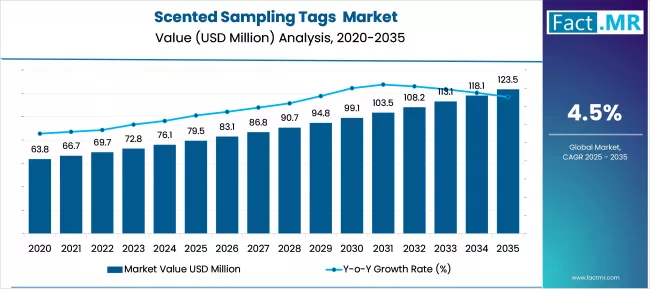
Scented Sampling Tags Market Market Value Analysis | Source: Fact.MR
What are the drivers of the Scented Sampling Tags Market?
One of the main contributors to the robust expansion of the scented sampling tags market is the increasing inclination of brands to incorporate sensory marketing to make product discovery more appealing and to generate a higher level of customer engagement.
A large part of the global demand for premium and niche fragrances has been responsible for the development of the beauty retail networks and also for the surge in online perfume shopping which, in turn, has raised the need for convenient, hygienic, and portable fragrance trial solutions. The developments in micro-encapsulation and eco-friendly scented paper technologies have been largely indispensable in ensuring the durability and sustainability of the formats of the sampling.
There is a great influence on the consumption of recyclable materials and the implementation of immersive scent-based promotional strategies due to the collaboration between fragrance houses, packaging innovators, and luxury brands that is enabling design customization to become the main driver of adoption in the cosmetics, personal care, and consumer goods industries worldwide.
What are the regional trends of the Scented Sampling Tags Market?
The scented sampling tags market is a consequence of regional changes that are quite different from each other. These changes resulted from the culture of fragrance, the development of luxury retail, and the innovation of marketing. Europe is at the forefront, which is kept up by its strong perfume heritage, hubs of luxury branding, and high uptake of premium sampling formats.
North America is the next one with the widespread use of these in beauty retail, direct mail campaigns, and experiential marketing.
The main contributors to this growth in East Asia are China, Japan, and South Korea. They are becoming a significant force because of increasing perfume consumption, e-commerce sampling, and tech-driven packaging trends.
South Asia & Pacific are getting more and more popular with the rise in disposable income and the expanding cosmetics markets.
Latin America and Middle East & Africa are the places from where the scented sampling tags market can seize new opportunities as the demand for fragrances and brand promotions are increasing gradually.
What are the challenges and restraining factors of the Scented Sampling Tags Market?
The scented sampling tags market is riddled with various stumbling blocks that prevent a wide adoption of such product. One of the reasons is that the production costs of such materials can be quite high, since premium scented paper, micro-encapsulation and customization are used, which makes the campaign expensive if it is done on a large scale.
Besides that, it is quite challenging to ensure scent longevity, controlled fragrance release and durability during distribution at the same time. Environmental concerns related to coated papers, adhesives, and limited recyclability are some of the factors that restrict the sector in terms of sustainability and thus put pressure on manufacturers to come up with eco-friendly alternatives.
Limited consumer exposure to emerging markets and brand hesitation to invest in sampling during economic slowdowns also have an impact on the market. Apart from that, the competition with digital fragrance sampling technologies and regulations concerning chemical safety and allergen disclosures are some of the additional obstacles faced by the market.
Country-Wise Insights
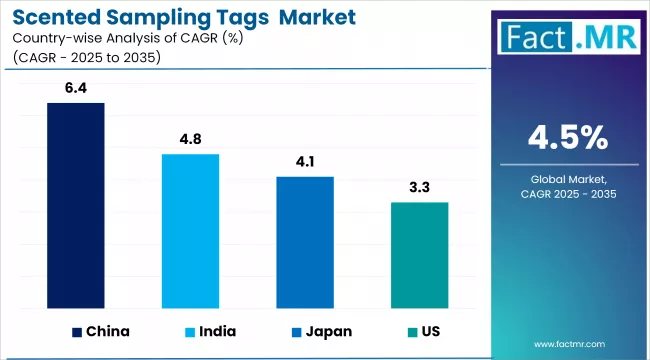
Scented Sampling Tags Market Cagr Analysis By Country | Source: Fact.MR
U.S. leads with strong fragrance culture and advanced sampling innovation
Due to a well-established luxury fragrance industry, a strong brand marketing culture, and the high willingness of consumers to try out new fragrances, the United States is the leader in the market. Major perfume brands, beauty retailers, and direct-to-consumer brands intensely utilize scent-sampling tags for marketing, store testing, and subscription boxes. High-end scent formats are made possible by advanced printing and micro-encapsulation technologies.
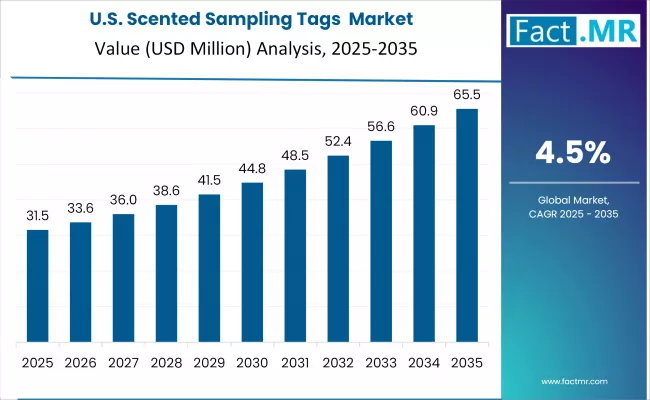
Scented Sampling Tags Market Country Value Analysis | Source: Fact.MR
The U.S. e-commerce boom and the trend of experiential marketing are the main reasons for the rapid adoption of fragrance discovery tools which in turn are playing a key role in purchase decisions. The increasing demand for sustainable products leads to the production of biodegradable scented tags and recyclable paper, which not only supports local production but also brand partnerships across the cosmetics, lifestyle, and personal care sectors.
China’s rising perfume demand and e-commerce drive sampling expansion
China is one of the most rapidly expanding markets for scented sampling tags, mainly due to the increasing demand for perfumes by young urban consumers and the fast growth of the premium beauty retail sector. The development of strong e-commerce ecosystems like Tmall, JD, and Douyin has made sample-based marketing indispensable for online fragrance testing. To gain more visibility, brands are turning to scented tags to run influencer-led campaigns, as packaging inserts, and at luxury pop-ups. The rise in popularity of niche and international perfumes is leading to more samples being given out as a way of letting buyers try before they buy.
However, the preference of consumers for lighter fragrances and the cultural sensitivity towards the scent intensity do affect formulation. Efforts towards sustainability and regulatory focus on the safety of chemicals are some of the factors that are resulting in the production of greener, low-VOC, and allergen-compliant sampling solutions.
India’s growing fragrance adoption fuels rapid scented tag usage
India’s scented sampling tags market is expanding rapidly along with rising perfume usage, middle-class purchasing power, and interest in premium personal-care experiences. As most consumers are first-time fragrance buyers, sampling formats such as scented cards and tags are indispensable in gaining trust and encouraging scent trial.
Beauty retail chains, malls, and niche fragrance brands use tags to attract shoppers, whereas e-commerce platforms utilize sample inserts to conversion. The presence of international perfume brands, influencer marketing, and subscription beauty boxes also help in the usage. While sustainability, affordability, and scalable distribution solutions are still the main factors, they are facilitating locally produced eco-friendly, cost-efficient scented tag.
Category-Wise Analysis
Paper-based tags lead due to affordability, customization, and sustainability strengths

Scented Sampling Tags Market Analysis By Material Type | Source: Fact.MR
Paper-based tags have been the most popular choice among scented sampling tags, mainly because they are affordable, adaptable, and can be easily micro-encapsulated for a gradual and long-lasting fragrance release. Their applications cover retail sampling, direct mail inserts, magazine promotions, and in-store touchpoints. Brands like paper substrate as they facilitate quality printing, customization, and branding and, at the same time, give a tactile experience.
The emphasis on sustainability is the reason behind the increasing consumption of biodegradable, FSC-certified, and recyclable paper. The effectiveness of these tags is being improved by developments in scent technology such as slow-release coatings and multi-note layering. Paper-based tags are still the most widely used and environmentally friendly option for large-scale fragrance marketing campaigns in both premium and mass-market segments.
Perfume and personal care drive sampling needs for fragrance trial
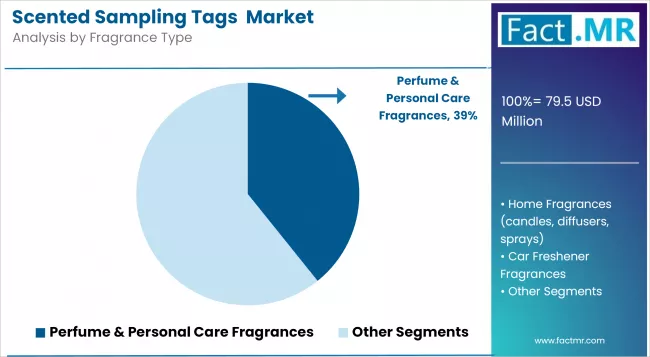
Scented Sampling Tags Market Analysis By Fragrance Type | Source: Fact.MR
Scented sampling tags are the main focus of the perfume and personal care division, which is the leading application sector for these environmentally friendly sampling tags, and it is the main factor for the growing worldwide fragrance usage and the increased consumer willingness to try new scents. Most of the beauty brands of luxury and premium use tag massively to make customers try their products, to eliminate the hesitation of purchasing and to create brand recall.
Brands of personal care such as deodorants, body mists, hair perfumes, and lotions also use scented labels to give the smell of the products to consumers without the need to open them. The increase of niche perfumery, clean beauty, and gender-neutral fragrances has turned sampling into an absolutely necessary tool for consumer knowledge and brand distinction. Consequently, the purchase conversion rates become higher due to enhanced sensory engagement.
B2B campaigns boost brand engagement through targeted scent sampling
The B2B segment is the main source of demand for the scented sampling tags market, as brands, marketing agencies, and retailers use fragrance-infused tags to promote and launch products through campaigns. Such tags are a means to create brand experiences that appeal to the senses and are present in mailers, store displays, influencer kits, event handouts, and packaging inserts.
The corporate partnerships, travel retail, hospitality, and automotive sectors are the most prominent ones to integrate fragrance sampling for customer engagement. B2B clients are most interested in the formats being customizable, the printing being of a high quality, and the scent retention being long-lasting.
Due to the increased use of experiential marketing and omnichannel retail strategies, companies are dependent on scented sampling tags to tell their brand story in a more captivating way, to convert more trial users into buyers, and to target new customers effectively.
Competitive Analysis
Key players in the scented sampling tags market include Orlandi, Sixth Scents, Scentisphere, Adhespack, Maxi-mise, Sampling Innovations / Scent Green®,Qosmedix
The scented sampling tags market exhibits a moderate level of competition, where the major players mainly concentrate on three areas, which are: scent-infusion technology, the manufacturing of premium paper, and the provision of marketing solutions employing fragrances. Best-performing companies, by one measure, are the companies which manufacture fragrances, the producers of specialty paper, and the suppliers of promotional materials that mainly concentrate on such aspects as quality of the scent retention, customization, and environmentally-friendly formats.
By another measure, the innovations are revolving around micro-encapsulation, recyclable substrates, and improved printing aesthetics for brand differentiation. Consequently, the strategic collaborations between beauty brands, packaging innovators, and marketing agencies are enabling the growth of both the international presence and the personalization possibilities.
Besides, competition also refers to efforts in delivering production that is cost-efficient and scalable while at the same time ensuring sustainability as well as long-lasting fragrance performance. Moreover, as the experiential marketing gets more popular, the players strive to be more creative, to have more authentic scents, and to be more efficient in their supply chain.
Recent Development
- In April 2025, Orlandi presented EcoPro™, a new paper-based fragrance sampling label that is free of plastic and aluminium foil, thus giving the full fragrance release through its "Reveal®" technology in a completely recyclable substrate.
- In March 2025, Arcade Beauty has introduced an eco-designed next-generation version of its ScentSeal press-sampling solution, which was achieved by the removal of almost all aluminium and the replacement of the barrier film with a paper-rich structure (48% paper outer label, total 70-90% paper content). This resulted in the reduction of the CO₂ footprint by about 37%.
Fact.MR has provided detailed information about the price points of key manufacturers of Scented Sampling Tags Market positioned across regions, sales growth, production capacity, and speculative technological expansion, in the recently published report.
Methodology and Industry Tracking Approach
A worldwide industry assessment comprising a market study of scented sampling tags and a survey of more than 3200 respondents from 15 different countries was conducted in 2025. Consumer of scented goods, executives in marketing, retail brand managers, and packaging specialists were the respondents of a survey. About 65% of the respondents were people from the end-user and retail environments, and the rest 35% were product designers, brand strategists, and procurement experts. The research gave primary importance to product usability, fragrance retention, sensory appeal, printing compatibility, and sustainability preference. Also, more than 90 secondary sources like patent reviews, packaging innovation reports, regulatory guidelines, and fragrance industry filings, were scrutinized between September 2024 and August 2025 for technology trend mapping, market adoption rates, and regional growth potential.
With Fact.MR monitoring consumer behavior, product efficacy, industry trends, and market opportunities since 2018, this report is becoming an authoritative source of information that stakeholders can rely on.
Segmentation
Segmentation of Scented Sampling Tags Market
-
By Material Type :
- Paper-Based Tags
- Plastic/Polymer Tags
- Fabric/Textile Tags
- Composite/Bio-based Materials
-
By Fragrance Type :
- Perfume & Personal Care Fragrances
- Home Fragrances (candles, diffusers, sprays)
- Car Freshener Fragrances
- Cosmetic & Skincare Product Fragrances
- Food & Beverage Aromas (for experiential marketing)
-
By Distribution Channel :
- B2B (Brand and Product Sampling Campaigns)
- Retail Distribution (Store Displays, Counters)
- Online Sampling & E-commerce Campaigns
- Event & Trade Show Promotions
-
By Application :
- Perfume & Cosmetic Sampling
- Household Cleaning Product Promotions
- Air Care Product Marketing
- Automotive Industry (car fragrances)
- Retail and In-Store Promotions
- Direct Mail & Magazine Inserts
-
By Region :
- North America
- Latin America
- Western Europe
- Eastern Europe
- East Asia
- South Asia & Pacific
- Middle East & Africa
Frequently Asked Questions
What was the global Scented Sampling Tags Market size reported by Fact.MR for 2025?
Who are the major players operating in the Scented Sampling Tags Market?
What is the estimated valuation of the Scented Sampling Tags Market in 2035?
What Value CAGR did the Scented Sampling Tags Market exhibit over the last five years?
Who worked on this report


Preview the report firsthand - request a free sample
Free SampleGet the brochure for pricing and purchase details
Download PDF