- Base Value(2025): 1.9 Bn
- Forecast Value (2035): 3.9 Bn
- CAGR (2035): 8.5%
Sugar Peels Market Outlook 2025 to 2035
The global sugar peels market is expected to reach USD 3.9 Billion by 2035, up from USD 1.8 Billion in 2025. During the forecast period 2025 to 2035, the industry is projected to expand at a CAGR of 7.6%.
Sugar peels market is propelled by a rising consumer requirement to use natural, gentle, and effective skin care solutions. Growing interest in glycolic, lactic and other sugar-based acids in chemical exfoliation is driving adoption in professional dermatology and in-home cosmetic items. The rising consciousness of anti-aging and skin rejuvenation, clean-label formulations and a high level of innovation in personalized beauty makes sugar peels a fundamental growth factor in the global cosmetics industry.
Quick Stats for Sugar Peels Market
- Industry Value (2025): USD 1.8 Billion
- Projected Value (2035): USD 3.9 Billion
- Forecast CAGR (2025 to 2035): 7.6%
- Leading Segment (2025): Anti-aging & Wrinkle Treatment (30.1% Market Share)
- Fastest Growing Country (2025-2035): China (9.1% CAGR)
- Top Key Players: The Ordinary, Paula’s Choice, Drunk Elephant, Neutrogena, Exuviance, Jan Marini, Tatcha, Clinique, and Bioderma
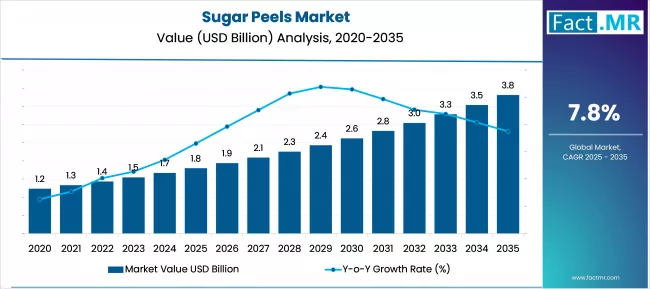
Sugar Peels Market Market Value Analysis | Source: Fact.MR
What are the drivers of the Sugar Peels market?
The market for sugar peels is booming with increasing customer preference on the use of natural based, skin friendly exfoliation solutions instead of synthetic ones. Glycolic, lactic and malic, which are all based on sugar, are also being used in professional dermatology and at home in skincare because of their customization and the fact that they are science supported. There is growing demand with an increasing interest in anti-aging, hyperpigmentation, and skin rejuvenation benefits and clean-label and eco-friendly positioning can only grow consumer acceptance.
Current trends in development technologies of formulations, as well as strategic partnerships between skincare lines and dermatology experts, are making a wider range of innovations and more affordable, which strengthens Sugar Peels as a fundamental force in the developing skincare market.
What are the regional trends of the Sugar Peels market?
The regional dynamics of the sugar peels market reflect diverse consumer behaviors, regulatory landscapes, and innovation ecosystems. North America is the leading location with high levels of uptake of glycolic and lactic acid peels, which has been encouraged by its strong network of professional dermatology and the need to use anti-aging products.
Europe focuses on clean-label and dermatologically tested products that fit with rigid cosmetic safety standards, and the innovation in green formulations is pushed in France and Germany.
Japan, South Korea and China are experiencing a swift adoption of the product in Asia-Pacific, with beauty-tech integration and K-beauty trends driving rapid growth in the demand of sugar peels.
Latin America and Middle East & Africa have increasing interest due to the increasing skincare awareness and increasing retail infrastructure on beauty.
What are the challenges and restraining factors of the Sugar Peels market?
A major issue that arises in the sugar peels market is the ability to maintain the same effectiveness and safety in various types and sensitivities of the skin. Glycolic, lactic or malic acid peels may induce biological reactions that are not consistent across age, ethnic and underlying skin conditions, resulting in cautious use. Lack of consumer awareness and professional experience in the new markets that have less developed dermatological infrastructure is another constraint.
Government regulation of the acid levels and allegations of natural formulations make things even more complicated, and brands have to find the balance between the new regulation and the new innovations. Moreover, small cosmetic brands fragment the market, thereby providing obstacles to standardization, scalability and consumer confidence.
Country-Wise Insights
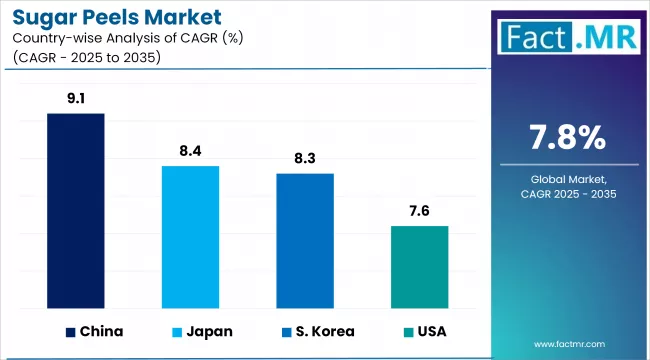
Sugar Peels Market Cagr Analysis By Country | Source: Fact.MR
U.S. sugar peels market thrives on anti-aging skincare demand
U.S. sugar peels market is defined by high demand of anti-aging and resurfacing products in professional dermatology clinics and at home product companies. The high interest of consumers in glycolic and lactic acid-based peels is justified by the developed ecosystem of aesthetic services in the country. Large cosmetic companies are entering into the market with multi-acid blends that focus on safety and visible outcomes, which follow FDA-regulated concentration limits.
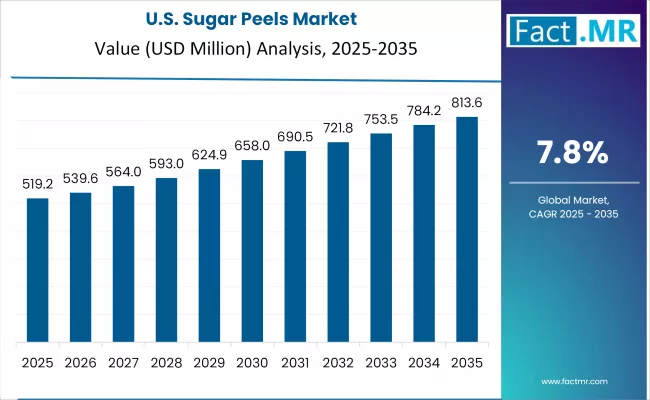
Sugar Peels Market Country Value Analysis | Source: Fact.MR
Millennials and Gen Z are growing in embracing peels as a preventive skincare measure in particular. Moreover, accessibility is being driven by the growth of e-commerce and subscription-based skincare products, whereas dermatologists are also prescribing sugar peels to mild acne and hyperpigmentation.
South Korea leads sugar peels innovation through K-beauty dominance
The sugar peels market in South Korea is fuelled by its internationally impactful K-beauty market, with exfoliation being the main component of multi-step skincare regimens. The increased demand by consumers on mild acids such as gluconolactone and malic acid of natural origin increases the pace of innovation of the gentle sugar peel formulation.
Domestic brands are entering into hybrid products, which have a combination of peeling, hydration, and brightening properties, attracting consumers who want to use multifunctional skincare. The focus of safety and low irritability regulations is research-based, dermatologically tested solutions.
South Korea is establishing global trends with high-tech retail platforms, AR try-ons, and robust online communities of skincare enthusiasts, and thus sugar peel is becoming a mainstream beauty category in local and international markets.
Japan’s sugar peels market emphasizes precision, safety, and science
The sugar peels market in Japan is supported by the consumer demand on precision skincare with special emphasis on safe exfoliation to sensitive and aging skin. Local firms focus on science-based formulations based on lactic and malic acids, and making sure they are effective without affecting the health of skin barrier.
The culture of beauty in the country that places importance on translucency and long-term skin health is encouraging people to adopt the use of mild sugar peels in their daily or weekly routine. Integration of peels into high-tech skincare devices and apps that can be found in retail shops facilitates growth. Moreover, the safety of products and the research and development investment of the Japanese mega companies such as Shiseido are enhancing consumers confidence and competitiveness.
Category-Wise Analysis
Anti-aging peels drive market with collagen-boosting, youth-preserving solutions
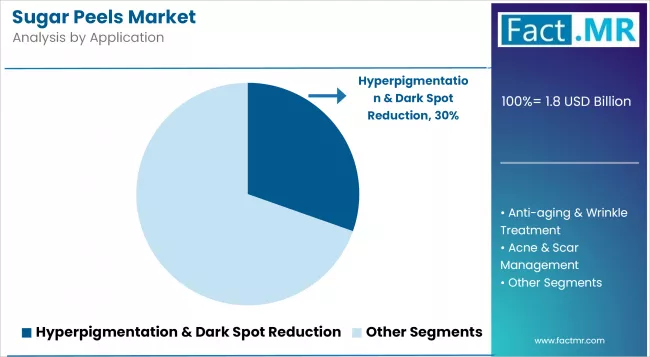
Sugar Peels Market Analysis By Application | Source: Fact.MR
The antiaging and wrinkle treatment market is the largest in terms of the Sugar Peels market with increasing awareness among the consumers on the need to have antiaging skin products to counter early aging regardless of age. More products are being developed based on sugar-derived glycolic and lactic acids to stimulate collagen production, collagen to boost elasticity and fine lines.
A surge in demand for preventive skincare among younger demographics complements curative adoption among mature consumers. Dermatological approval and clinical validation have been used to support anti-aging promises that are driving clinics, salons, and at-home brands to the core of marketing efforts. This segment is therefore the most valuable and the most important growth driver in the Sugar Peels environment.
Liquid peels dominate due to versatility, precision, and quick results
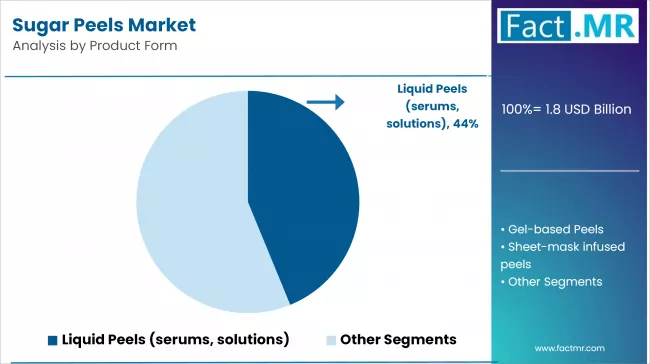
Sugar Peels Market Analysis By Product Form | Source: Fact.MR
The liquid peels are still ruling the market due to their flexibility, simplicity in use and quicker outcome than the rest. Dermatologists favour sugar-based serums and solution peels because of their ability to provide controlled exfoliation in clinical practices as well as consumer-friendly at-home systems.
The fact that they can provide specific penetration of active acids whilst ensuring a convenient user base puts them at the forefront of product development. Enhancing R&D in stabilizing formulations, PH balancing and safety testing have added strength to their use in professional and consumer markets. This bilateral presence will guarantee a long term lead of liquid peels in the international Sugar Peels market.
At-home peel users surge with DIY skincare and D2C brands
At-home consumer is a rapidly growing momentum segment with skincare routines becoming more customized and home-made. D2C brands are increasing the availability of sugar peels via online platforms, which provide cheap, but effective, exfoliation options to salons. This adoption is being fuelled by convenience, affordability, and trends established by social media in the beauty sector, especially amongst the millennial and Gen Z generations, and innovations like single-use sachets, subscription services, and OTC formulations recommended by a dermatologist are boosting consumer trust in self-administered peels. As safety, mild formulas, and regulatory compliance become more of a concern, at-home consumers are the most democratized and rapidly expanding end-user segment in the Sugar Peels market.
Competitive Analysis
Key players in the Sugar Peels market include The Ordinary, Paula’s Choice, Drunk Elephant, Neutrogena, SkinCeuticals, Glytone, Murad, Peter Thomas Roth, Obagi, Pixi Beauty, Exuviance, Jan Marini, Tatcha, Clinique, Bioderma.
Sugar Peels market is getting more competitive with the brands focusing on more sophisticated ingredients, several-in-one effects, and clean-labeling. Firms are also working on glycolic and lactic acid derivatives with natural and skin friendly profiles to attract both the dermatology practitioners and home actors. The increasing demand of anti-aging, brightening, and acne solutions has driven liquid and gel-based peels and players have incorporated botanical extracts and hydration enhancers. Direct-to-consumer (D2C) marketing and engagement of dermatologists and aesthetic clinics reinvent competitive dynamics and add credibility, respectively. Both global and regional brands are becoming more aggressive with customizable, safe and outcome-based peel solutions.
Recent Development
- In August 2024, The Inkey List has released two new body-care products which contain chemical exfoliants, such as a Glycolic Acid Exfoliating Body Formula and PHA Exfoliating & Hydrating Water Cream. Signals sugar-AHA peel technology is now expansive into body care- expanding the market beyond facial skincare.
- In February 2024, L’Oréal Paris introduced the Glycolic Bright Dark Circle Eye Serum on the Indian market. Extends the use of glycolic acid to small, specific, and sensitive zones such as the skin under the eyes- past the old face exfoliation.
Fact.MR has provided detailed information about the price points of key manufacturers of Sugar Peels Market positioned across regions, sales growth, production capacity, and speculative technological expansion, in the recently published report.
Methodology and Industry Tracking Approach
The 2025 Global Sugar Peels Market report was created as a result of extensive survey of 10,000 stakeholders in 30 countries, whereby 300 or more stakeholders within a region were surveyed. Almost 65 percent of respondents were end users or producers (cosmetic manufacturers, dermatology clinics, spa and at-home consumers), with the rest being distributors, formulation scientists, and supply chain managers. Information was collected in May 2024-April 2025, which includes trends, driving forces of demand, innovations, and regulatory risks. More than 250 secondary sources such as scientific journals, patents, regulatory guidelines and company reports were reviewed. The high level of statistical tools like regression modeling provided strong, dependable and weighted information of the regions.
With Fact.MR monitoring consumer behavior, product efficacy, industry trends, and market opportunities since 2018, this report is becoming an authoritative source of information that stakeholders can rely on.
Segmentation
Segmentation of Sugar Peels Market
-
By Source Type :
- Glycolic Acid Peels
- Lactic Acid Peels
- Malic & Tartaric Acid Peels
- Combination Sugar Acid Peels
-
By Product Form :
- Liquid Peels (serums, solutions)
- Gel-based Peels
- Sheet-mask infused peels
- Cream/Lotion Peels
-
By Application :
- Hyperpigmentation & Dark Spot Reduction
- Anti-aging & Wrinkle Treatment
- Acne & Scar Management
- Skin Brightening & Glow Enhancement
- Hydration & Texture Improvement
-
By End-Use Industry :
- Dermatology Clinics & Medical Aesthetic Centers
- Spas & Salons
- At-home Consumers (OTC products, D2C brands)
-
By Region :
- North America
- Latin America
- Western Europe
- Eastern Europe
- East Asia
- South Asia & Pacific
- Middle East & Africa
Frequently Asked Questions
What was the Global Sugar Peels Market Size Reported by Fact.MR for 2025?
Who are the Major Players Operating in the Sugar Peels Market?
What is the Estimated Valuation of the Sugar Peels Market in 2035?
What Value CAGR did the Sugar Peels Market Exhibit Over the Last Five Years?
Who worked on this report


Preview the report firsthand - request a free sample
Free SampleGet the brochure for pricing and purchase details
Download PDF