Catechin Market Size, Share, Growth and Forecast (2026 - 2036)
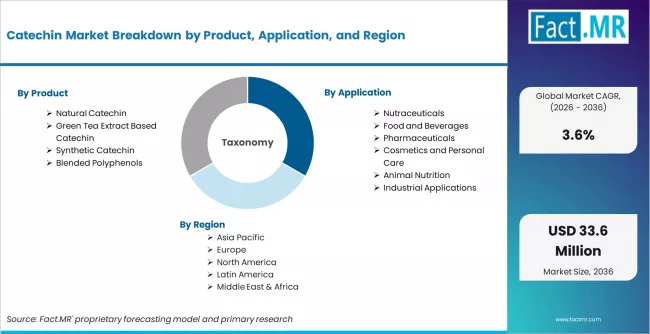
Catechin Market is segmented by Product (Natural Catechin, Green Tea Extract Based Catechin, Synthetic Catechin, Blended Polyphenols), Application (Nutraceuticals, Food and Beverages, Pharmaceuticals, Cosmetics and Personal Care, Animal Nutrition, Industrial Applications), End Use (Nutraceutical Companies, Food Industry Manufacturers, Pharmaceutical Companies, Cosmetic Manufacturers, Animal Health Industry), and Region, with forecasts covering the period from 2026 to 2036.
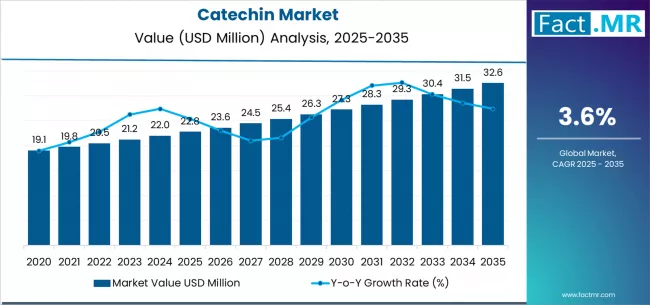
According to Fact.MR estimates, the global catechin market market was valued at USD 22.8 million in 2025. The market is projected to reach USD 23.6 million in 2026 and is expected to grow to USD 33.6 million by 2036, expanding at a CAGR of 3.6%. Natural Catechin is anticipated to account for 42.6% of the product segment in 2026, while Nutraceuticals is expected to remain the leading application with around 37.9% share.
Catechin Market Analysis and Forecast by Fact.MR
The catechin market, valued at USD 22.8 million in 2025, is expanding at a 3.6% CAGR to reach USD 33.643 million by 2036. Catechins are polyphenolic flavonoid compounds, primarily extracted from green tea (Camellia sinensis), with epigallocatechin gallate (EGCG) as the most bioactive form. Applications span nutraceutical supplements, functional food and beverages, pharmaceutical formulations, cosmetic ingredients, and animal nutrition. Growth is shaped by clinical evidence supporting antioxidant and anti-inflammatory properties, functional beverage formulation demand, and cosmetic industry adoption of plant-derived bioactive ingredients.
Summary of Catechin Market
- Market Snapshot
- The catechin market is valued at USD 22.8 million in 2025.
- Estimated market value for 2026 is USD 23.621 million, projected to reach USD 33.643 million by 2036.
- A CAGR of 3.6% is forecast for the 2026 to 2036 assessment period.
- Incremental opportunity of USD 10.022 million between 2026 and 2036.
- Natural catechin holds 42.6% of the product segment, with nutraceuticals at 37.9% of application demand.
- India and South Korea are the fastest-growing markets for catechin adoption.
- Demand and Growth Drivers
- Clinical research documenting catechin's antioxidant, anti-inflammatory, and cardioprotective properties is supporting nutraceutical supplement formulation demand, with over 5,000 peer-reviewed studies on EGCG published in biomedical databases.
- Functional beverage formulation is driving catechin ingredient demand, as beverage manufacturers incorporate green tea extracts into ready-to-drink teas, energy drinks, and wellness shots targeting health-conscious consumers.
- Cosmetic industry adoption of catechin as an anti-ageing and photoprotective ingredient is expanding personal care applications, with catechin's UV-protective and antioxidant properties validated in dermatological research.
- Animal nutrition applications are emerging, with catechin extracts used as natural antioxidants and gut health modulators in poultry and swine feed formulations.
- Product and Segment View
- Natural catechin holds 42.6% of the product segment, reflecting consumer and formulator preference for plant-derived, minimally processed catechin extracts.
- Nutraceuticals capture 37.9% of application demand, driven by dietary supplement formulation for antioxidant, weight management, and cardiovascular health positioning.
- Direct sales account for 63.1% of distribution channel demand, reflecting the B2B nature of catechin ingredient trade.
- Key segmentation includes:
- Product: Natural Catechin, Green Tea Extract Based Catechin, Synthetic Catechin, Blended Polyphenols
- Application: Nutraceuticals, Food and Beverages, Pharmaceuticals, Cosmetics and Personal Care, Animal Nutrition, Industrial Applications
- Source: Green Tea Leaves, Black Tea Leaves, Other Plant Sources
- Form: Powder Form, Liquid Form, Encapsulated Form
- Purity Level: High Purity, Medium Purity, Low Purity, Ultra High Purity
- Geography and Competitive Outlook
- North America accounts for significant revenue, with the USA generating USD 8.971 million in 2025.
- East Asia is the production centre, with Japan contributing USD 1.076 million and South Korea contributing USD 0.611 million in 2025.
- Hunan Sunfull Bio-tech Co. Ltd. holds approximately 14.0% of global market share through large-scale green tea extract production in China.
- Taiyo Green Power, Botaniex, and Novanat Bioresource compete on extraction purity, EGCG standardisation, and regulatory documentation.
- Analyst Opinion
- The catechin market is a niche bioactive ingredient sector where growth depends on three factors: clinical evidence generation that supports regulatory health claims, extraction technology that delivers cost-effective high-purity EGCG, and formulation science that overcomes catechin's stability and bioavailability limitations. Companies that invest in encapsulation technology to improve catechin bioavailability and stability in food and cosmetic matrices will differentiate from commodity extract suppliers and capture premium pricing.
Key Growth Drivers, Constraints, and Opportunities
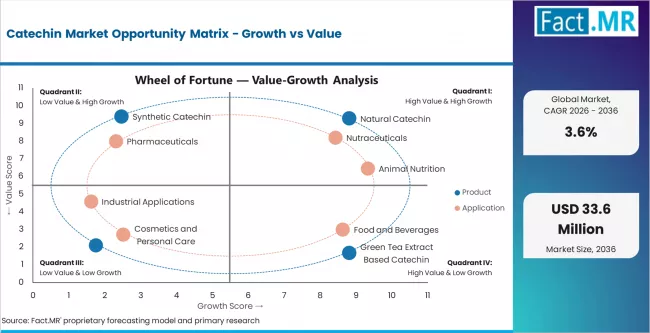
Key Factors Driving Growth
- EGCG is one of the most extensively researched bioactive compounds in nutritional science. Meta-analyses published in the American Journal of Clinical Nutrition and the European Journal of Clinical Nutrition report statistically significant effects of catechin supplementation on body weight management, LDL cholesterol reduction, and blood pressure modulation at daily doses of 200 to 800 mg. This evidence base supports regulatory health claim applications in the EU, Japan, and South Korea.
- Japan's Food for Specified Health Uses (FOSHU) regulatory framework has approved multiple catechin-containing functional food and beverage products, with Kao Corporation's Healthya green tea demonstrating that catechin-standardised beverages can achieve mainstream consumer adoption when supported by approved health claims.
- The global anti-ageing cosmetic market is growing at 7 to 9% annually, creating demand for bioactive ingredients with photoprotective and antioxidant properties. Catechin's ability to neutralise reactive oxygen species and protect against UV-induced collagen degradation positions it as a functional ingredient in anti-ageing serum, cream, and sunscreen formulations. Catechin is gaining formulator preference among cosmetic companies seeking plant-derived bioactive ingredients with clinical evidence supporting both topical and ingestible application efficacy.
Key Market Constraints
- Catechin bioavailability is inherently low, with oral absorption rates of 1 to 5% for EGCG in unformulated supplements. This bioavailability limitation reduces the clinical efficacy of catechin supplementation and requires either high doses or advanced delivery systems (liposomal encapsulation, nano-formulation) to achieve therapeutic tissue concentrations.
- Green tea extract quality varies significantly depending on tea cultivar, harvest season, growing region, and extraction parameters. Batch-to-batch variability in EGCG content (20 to 98% depending on product specification) creates supply chain quality management challenges for formulators requiring consistent active ingredient concentrations.
- Hepatotoxicity concerns associated with high-dose concentrated green tea extract supplements have led to regulatory warnings in some markets. EFSA issued a scientific opinion in 2018 recommending daily EGCG intake from food supplements not exceed 800 mg, and several national regulators have implemented labelling requirements.
Key Opportunity Areas
- Encapsulated catechin technology (liposomal, nanoparticle, cyclodextrin complexation) is improving bioavailability 3 to 10-fold compared to unformulated EGCG, per published pharmacokinetic studies. Companies with proprietary encapsulation platforms can command 2 to 5 times the price of commodity catechin extracts.
- Cosmetic-grade catechin for topical application bypasses the oral bioavailability limitation, delivering catechin directly to skin tissue. Cosmetic-grade specifications (purity, colour, stability in emulsion systems) command 3 to 8 times the price of supplement-grade catechin extracts.
- Matcha-derived catechin extracts are a premium niche, with matcha's shade-grown cultivation producing tea leaves with 2 to 3 times higher catechin content than standard green tea. Matcha-origin catechin commands premiums reflecting both the functional advantage and the consumer brand recognition of matcha as a premium ingredient.
Segment-wise Analysis of the Catechin Market
- Natural catechin holds 42.6% of the product segment, reflecting preference for plant-derived extracts.
- Nutraceuticals capture 37.9% of application demand, driven by antioxidant supplement formulation.
- High purity accounts for 39.7% of purity level demand, reflecting nutraceutical and pharmaceutical specification requirements.
Which product type dominates the Catechin Market?
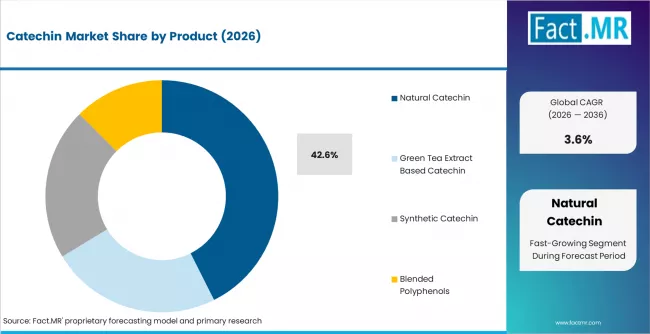
Natural catechin controls 42.6% of the product segment. Natural catechin extracts from green tea leaves are the preferred form for nutraceutical and food applications, where plant-derived origin and clean-label positioning are consumer purchase drivers. Natural catechin products are standardised for total catechin content (typically 40 to 98%) and EGCG content (typically 20 to 70%) depending on extraction and purification parameters.
Green tea extract-based catechin holds the second-largest share, serving as an intermediate product form between crude tea extract and purified catechin isolate. Synthetic catechin serves pharmaceutical applications requiring ultra-high purity.
Which application drives demand in the Catechin Market?
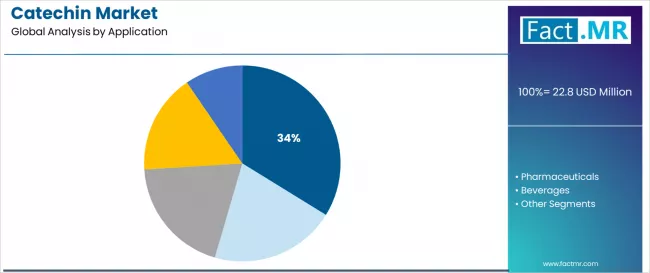
Nutraceuticals account for 37.9% of application demand. Dietary supplements containing green tea catechin extracts are marketed for antioxidant protection, weight management support, cardiovascular health, and cognitive function. Catechin supplements are available in capsule, tablet, and powder formats across health food retail and online supplement channels.
Food and beverages hold the second-largest share, with functional beverage formulation as the primary food application. Pharmaceuticals and cosmetics are growing as high-value application niches.
Which source leads the Catechin Market?
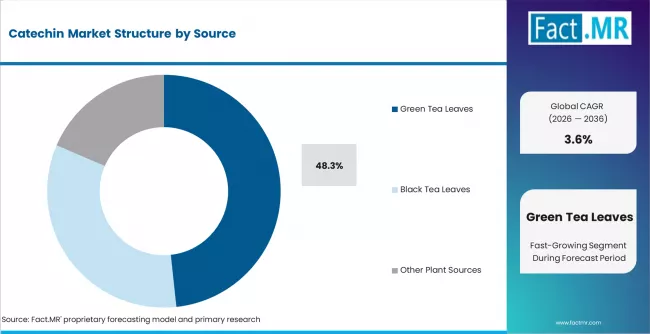
Green tea leaves account for 48.3% of source demand. Camellia sinensis leaves, particularly Japanese (Sencha, Gyokuro, Matcha) and Chinese (Longjing, Biluochun) green tea varieties, are the primary commercial catechin source. Green tea processing (steaming or pan-firing to prevent oxidation) preserves catechin content that is degraded during black tea fermentation.
Black tea leaves hold the second-largest source share, with theaflavin and thearubigin catechin derivatives extracted from oxidised tea leaves. Other plant sources (grape seed, apple, cocoa) serve niche catechin applications.
Which Product Trend is Shaping the Next Phase of Growth in the Catechin Market?
The fastest-growing product trend in the catechin market is the development of bioavailability-enhanced catechin formulations using advanced delivery technologies. Standard catechin supplement products deliver only 1 to 5% oral bioavailability, limiting the clinical translation of in-vitro research findings to human health outcomes. Liposomal catechin, phytosome complexation (catechin bound to phosphatidylcholine), and nano-emulsion delivery systems are demonstrating 3 to 10-fold bioavailability improvements in human pharmacokinetic studies.
The commercial significance is that bioavailability-enhanced catechin products can deliver equivalent biological activity at lower doses, addressing both the efficacy limitation and the hepatotoxicity concern associated with high-dose supplementation. These formulations command retail prices 3 to 5 times above standard catechin supplements, creating a premium segment within the nutraceutical channel. Companies such as Taiyo Green Power (Sunphenon BG), Indena (GreenSelect Phytosome), and proprietary encapsulation specialists are building IP-protected positions in the enhanced-bioavailability segment.
Regional Outlook Across Key Markets
.webp)
- North America is a major market, with the USA contributing USD 8.971 million in 2025.
- East Asia is the production and consumption centre, with Japan at USD 1.076 million and South Korea at USD 0.611 million.
- South Asia and Pacific is the fastest-growing region, driven by India's nutraceutical industry expansion.
- Europe is a mature market with established regulatory frameworks for catechin health claims.
CAGR Table
| Country | CAGR (%) |
|---|---|
| India | 4.4% |
| South Korea | 4.2% |
| China | 4.1% |
| Brazil | 3.9% |
| Japan | 3.7% |
| USA | 3.5% |
| Germany | 3.3% |
Source: Fact.MR analysis, based on proprietary forecasting model and primary research.
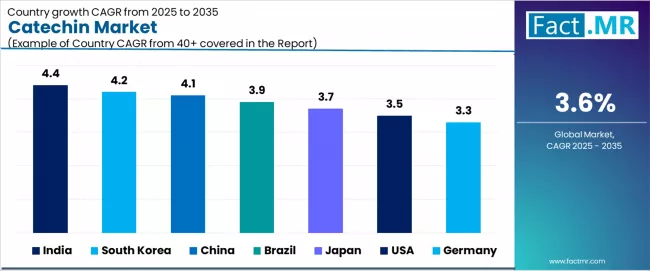
India: nutraceutical industry expansion and herbal extract manufacturing drive growth
India leads country-level growth. India's nutraceutical industry, growing at 15 to 20% annually per ASSOCHAM data, is creating demand for green tea catechin extracts as supplement and functional food ingredients. Indian herbal extract manufacturers in Himachal Pradesh and Assam are expanding catechin production capacity, with tea estates in Darjeeling and Nilgiri regions providing premium green tea raw material for high-purity extract production.
- India's nutraceutical market exceeded USD 10 billion in 2024, per FSSAI data, with green tea-based supplements among the fastest-growing product categories.
South Korea: K-beauty cosmetic demand and functional food innovation drive adoption
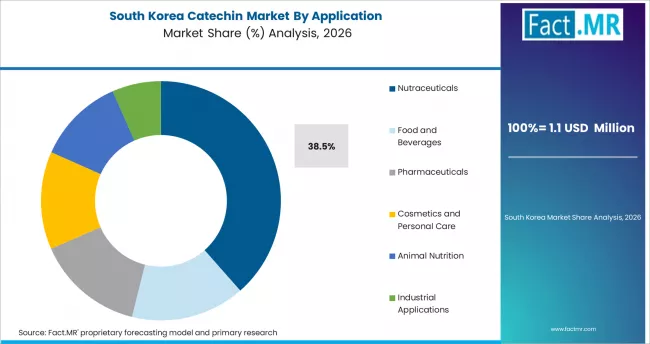
South Korea records the second-highest growth rate. Korean cosmetic manufacturers are incorporating catechin into anti-ageing and brightening formulations for both domestic consumption and K-beauty export markets. South Korea's functional food regulatory framework enables catechin health claims that support consumer product positioning.
- South Korea's functional food market grew 8% in 2024, per MFDS data, with green tea catechin-based products maintaining strong consumer acceptance.
China: green tea production base and extract manufacturing scale define positioning
China is the world's largest green tea producer and catechin extract manufacturer. Chinese extract companies in Hunan, Zhejiang, and Fujian provinces dominate global catechin supply through scale advantages and proximity to tea cultivation areas. Domestic demand is growing as Chinese consumers adopt supplement culture.
- China's green tea production exceeded 2 million tonnes in 2024, per China Tea Marketing Association data, providing abundant raw material for catechin extraction.
Brazil: herbal supplement growth and cosmetic industry demand support expansion
Brazil's growth reflects expanding herbal supplement consumption and demand from Brazil's large cosmetic industry. Brazilian consumers are adopting green tea extract supplements for weight management and antioxidant positioning.
- Brazil's herbal supplement market grew 12% in 2024, per ANVISA data, with green tea-based products among the most purchased herbal supplement categories.
Japan: functional food leadership and FOSHU framework create premium demand
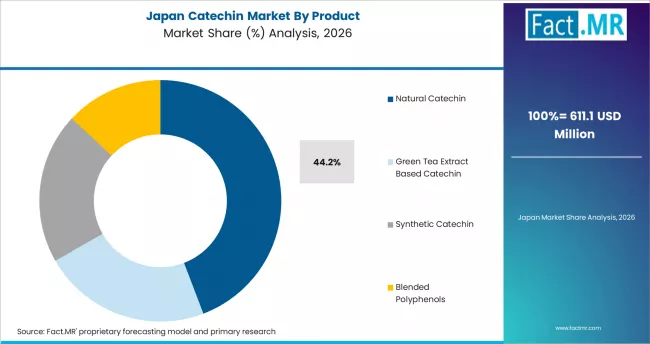
Japan contributes USD 1.076 million in 2025. Japan is the most mature catechin market globally, with FOSHU-approved catechin beverages (Kao Healthya, Ito En) achieving mainstream retail distribution. Japanese consumer acceptance of functional food health claims creates a premium pricing environment for catechin-standardised products.
- Japan's FOSHU product market exceeded JPY 600 billion in 2024, per Consumer Affairs Agency data, with catechin-containing products maintaining established market positions.
USA: supplement market scale and functional beverage innovation drive consumption
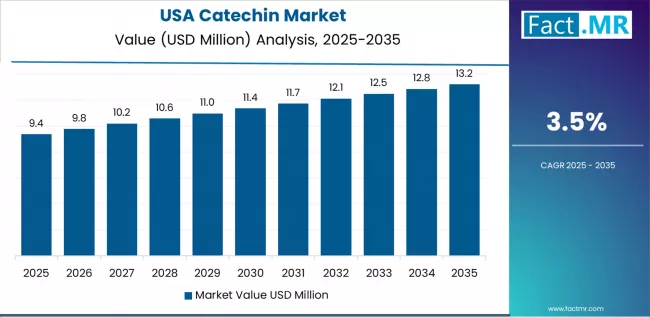
The USA generates USD 8.971 million in 2025. US demand is driven by the dietary supplement market, the world's largest by value, and functional beverage innovation incorporating green tea catechin extracts. FDA GRAS determination for green tea catechin extracts enables broad food and beverage application.
- US dietary supplement sales exceeded USD 60 billion in 2024, per CRN data, with green tea extracts among the top-selling herbal supplement ingredients.
Germany: pharmaceutical-grade catechin demand and regulatory framework support growth
Germany's growth is driven by pharmaceutical-grade catechin demand for clinical research applications and the European regulatory framework that enables catechin health claims under EFSA-authorised conditions. German pharmaceutical and nutraceutical companies source high-purity catechin for clinical-grade supplement formulations.
- Germany's herbal supplement market grew 6% in 2024, per BAH data, with standardised plant extract products driving premium segment growth.
Competitive Benchmarking and Company Positioning
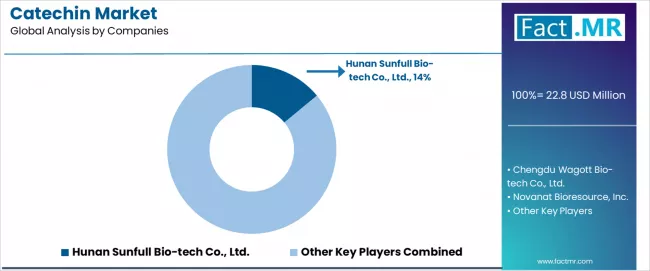
Catechin Market Analysis By Company
- Hunan Sunfull Bio-tech Co. Ltd. holds approximately 14.0% of global revenue through large-scale green tea polyphenol and catechin extract production in Hunan Province, China.
- Taiyo Green Power and Botaniex compete on extraction technology, purity standardisation, and regulatory documentation for international markets.
- Chinese extract manufacturers including Chengdu Wagott, Hangzhou Qinyuan, and Shaanxi Dongyu serve global B2B markets through competitive pricing and production scale.
The competitive structure is moderately concentrated, with Hunan Sunfull holding the largest share at 14.0%. Sunfull's position is built on production scale, cost-competitive extraction from Chinese green tea sourcing, and established export distribution to nutraceutical and food ingredient customers in North America, Europe, and Japan.
Competition is divided between large-scale Chinese manufacturers competing on price and production volume, and specialty producers competing on purity, bioavailability enhancement, and regulatory documentation. Japanese companies (Taiyo Green Power) and European companies compete on product quality, clinical data packages, and proprietary formulation technologies that command premium pricing in the nutraceutical and cosmetic channels.
Key Companies in the Catechin Market
The catechin competitive field includes Hunan Sunfull Bio-tech Co. Ltd., Chengdu Wagott Bio-tech Co. Ltd., Novanat Bioresource Inc., Hangzhou Qinyuan Natural Plant High-tech Co. Ltd., Taiyo Green Power, Botaniex Inc., Shaanxi Dongyu Bio-Tech Co. Ltd., Hunan Huacheng Biotech Inc., Tianjin Jianfeng Natural Product Research Co. Ltd., and Xian Lyphar Biotech Co. Ltd.
Recent Industry Developments
- Hunan Sunfull: ultra-high purity EGCG production line (2025)
- Hunan Sunfull commissioned a new production line delivering 98%+ EGCG purity for pharmaceutical and cosmetic-grade applications, expanding its premium product portfolio beyond standard extract grades.
- Taiyo Green Power: bioavailability-enhanced catechin product (2025)
- Taiyo launched its Sunphenon BG product with clinically demonstrated enhanced bioavailability through proprietary complexation technology, targeting the premium nutraceutical segment.
- Botaniex: organic catechin extract certification (2026)
- Botaniex achieved USDA Organic and EU Organic dual certification for its green tea catechin extract range, targeting the growing organic supplement and natural cosmetic ingredient markets.
- Novanat Bioresource: cosmetic-grade catechin launch (2025)
- Novanat launched a cosmetic-grade catechin extract product with colour stability and emulsion compatibility specifications designed for anti-ageing serum and cream formulations.
Leading Companies Shaping the Catechin Market
-
Global Players
- Hunan Sunfull Bio-tech Co., Ltd.
- Taiyo Green Power
- Botaniex, Inc.
-
Regional Players
- Chengdu Wagott Bio-tech Co., Ltd.
- Hangzhou Qinyuan Natural Plant High-tech Co., Ltd.
- Novanat Bioresource, Inc.
- Shaanxi Dongyu Bio-Tech Co., Ltd.
-
Emerging / Start-up Players
- Hunan Huacheng Biotech, Inc.
- Tianjin Jianfeng Natural Product Research Co., Ltd.
- Xian Lyphar Biotech Co., Ltd.
Sources and Research References
- Company production data from Hunan Sunfull, Taiyo Green Power, and Botaniex.
- EFSA scientific opinions on green tea catechin safety and health claims.
- FOSHU (Food for Specified Health Uses) product approval database, Japan.
- American Journal of Clinical Nutrition and European Journal of Clinical Nutrition meta-analyses on catechin supplementation.
- CRN (Council for Responsible Nutrition) US dietary supplement market data.
- China Tea Marketing Association green tea production statistics.
All cited sources are first-party company data, regulatory databases, peer-reviewed journals, or industry associations. No syndicated market research reports were used.
Key Questions This Report Addresses
- What is the projected market value for catechin by 2036?
- Which product type holds the largest share?
- What CAGR is forecast from 2026 to 2036?
- How is bioavailability enhancement changing catechin product positioning?
- Which countries are growing fastest?
- What is the competitive structure?
- How do cosmetic applications create premium catechin demand?
- What regulatory frameworks support catechin health claims?
- How does EGCG standardisation affect catechin pricing?
Catechin Market Definition
The catechin market encompasses the extraction, purification, and sale of catechin compounds, primarily from green tea leaves, for nutraceutical, food, pharmaceutical, cosmetic, and animal nutrition applications. Products include natural catechin extracts, standardised EGCG preparations, synthetic catechin, and blended polyphenol formulations in powder, liquid, and encapsulated forms.
Catechin Market Inclusions
- Natural catechin extracts from green tea, black tea, and other plant sources.
- Standardised EGCG preparations for nutraceutical and pharmaceutical applications.
- Catechin-containing polyphenol blends for food, beverage, and cosmetic formulation.
- Encapsulated catechin products designed for improved bioavailability and stability.
Catechin Market Exclusions
- Green tea leaf products sold as whole tea or tea bags for brewing.
- Green tea flavouring agents without standardised catechin content.
- Pharmaceutical drugs containing catechin as an active pharmaceutical ingredient under drug regulation.
- Polyphenol supplements not standardised for catechin content.
Catechin Market Research Methodology
- Primary research with green tea extract manufacturers, nutraceutical formulators, cosmetic ingredient suppliers, and pharmaceutical companies across 8 countries.
- Revenue modelling based on catechin extract production volumes, trade data, and manufacturer-reported sales.
- Pricing analysis using B2B ingredient supplier catalogues, nutraceutical procurement records, and cosmetic ingredient price lists.
- Competitive share estimation through company production capacity data, patent filings, and trade show participation records.
- Demand validation through nutraceutical industry consumption data, functional beverage market analysis, and cosmetic ingredient trade statistics.
Scope of Analysis

| Parameter | Details |
|---|---|
| Report Currency | USD Million |
| Market Value (2025) | USD 22.8 Million |
| Forecast Value (2036) | USD 33.643 Million |
| CAGR (2026 to 2036) | 3.6% |
| Product | Natural Catechin, Green Tea Extract Based Catechin, Synthetic Catechin, Blended Polyphenols |
| Application | Nutraceuticals, Food and Beverages, Pharmaceuticals, Cosmetics and Personal Care, Animal Nutrition, Industrial Applications |
| Source | Green Tea Leaves, Black Tea Leaves, Other Plant Sources |
| Form | Powder Form, Liquid Form, Encapsulated Form |
| Purity Level | High Purity, Medium Purity, Low Purity, Ultra High Purity |
| Regions | North America, Latin America, Europe, East Asia, South Asia and Pacific, Middle East and Africa |
| Countries | India, South Korea, China, Brazil, Japan, USA, Germany, and 40+ countries |
| Companies | Hunan Sunfull, Chengdu Wagott, Novanat Bioresource, Hangzhou Qinyuan, Taiyo Green Power, Botaniex, Shaanxi Dongyu, Hunan Huacheng, Tianjin Jianfeng, Xian Lyphar |
| Forecast Period | 2026 to 2036 |
| Approach | Top-down and bottom-up with primary and secondary research |
Market Segmentation Analysis
-
Catechin Market Market Segmented by Product:
- Natural Catechin
- Epigallocatechin Gallate
- Epigallocatechin
- Epicatechin
- Epicatechin Gallate
- Catechin Monomers
- Green Tea Extract Based Catechin
- Standardized Green Tea Extract
- Decaffeinated Catechin Extract
- Synthetic Catechin
- Laboratory Synthesized Catechin
- High Purity Synthetic Variants
- Blended Polyphenols
- Catechin Rich Polyphenol Blends
- Functional Antioxidant Blends
- Natural Catechin
-
Catechin Market Market Segmented by Application:
- Nutraceuticals
- Dietary Supplements
- Capsules and Tablets
- Functional Powders
- Food and Beverages
- Functional Beverages
- Health Drinks
- Dietary Foods
- Pharmaceuticals
- Antioxidant Formulations
- Cardiovascular Health Drugs
- Weight Management Drugs
- Cosmetics and Personal Care
- Skin Care Products
- Hair Care Products
- UV Protection Formulations
- Animal Nutrition
- Pet Supplements
- Livestock Feed Additives
- Industrial Applications
- Natural Antioxidants
- Food Preservation Systems
- Nutraceuticals
-
Catechin Market Market Segmented by End Use:
- Nutraceutical Companies
- Supplement Manufacturers
- Functional Nutrition Brands
- Food Industry Manufacturers
- Beverage Producers
- Processed Food Companies
- Pharmaceutical Companies
- Drug Formulators
- Clinical Nutrition Providers
- Cosmetic Manufacturers
- Skincare Brands
- Personal Care Companies
- Animal Health Industry
- Feed Manufacturers
- Pet Care Companies
- Nutraceutical Companies
-
Catechin Market Market Segmented by Distribution Channel:
- Direct Sales
- Bulk Ingredient Supply Contracts
- Manufacturer Agreements
- Distributors
- Health Ingredient Distributors
- Food Ingredient Distributors
- Online B2B Platforms
- Specialty Chemical Marketplaces
- Ingredient E Commerce Platforms
- Retail Channels
- Health Stores
- Organic Retail Chains
- Export Channels
- Global Bulk Trade
- Contract Manufacturing Supply Chains
- Direct Sales
-
Catechin Market Market Segmented by Source:
- Green Tea Leaves
- Camellia Sinensis Plant
- Organic Tea Cultivation
- Black Tea Leaves
- Fermented Tea Sources
- Processed Tea Extracts
- Other Plant Sources
- Grape Seed Extract
- Cocoa Extract
- Synthetic Laboratory Production
- Green Tea Leaves
-
Catechin Market Market Segmented by Form:
- Powder Form
- Fine Powder Catechin
- Encapsulated Powder
- Liquid Form
- Concentrated Extracts
- Solution Based Catechin
- Encapsulated Form
- Softgel Capsules
- Microencapsulation Systems
- Powder Form
-
Catechin Market Market Segmented by Purity Level:
- High Purity
- 95 Percent Plus Catechin
- Analytical Grade Compounds
- Medium Purity
- Refined Extracts
- Functional Grade Catechin
- Low Purity
- Crude Plant Extracts
- Standardized Blends
- Ultra High Purity
- Pharmaceutical Grade Catechin
- Research Grade Isolates
- High Purity
-
Catechin Market Market by Region:
- North America
- USA
- Canada
- Mexico
- Latin America
- Brazil
- Chile
- Rest of Latin America
- Western Europe
- Germany
- UK
- Italy
- Spain
- France
- Nordic
- BENELUX
- Rest of Western Europe
- Eastern Europe
- Russia
- Poland
- Hungary
- Balkan & Baltic
- Rest of Eastern Europe
- East Asia
- China
- Japan
- South Korea
- South Asia and Pacific
- India
- ASEAN
- Australia & New Zealand
- Rest of South Asia and Pacific
- Middle East & Africa
- Kingdom of Saudi Arabia
- Other GCC Countries
- Turkiye
- South Africa
- Other African Union
- Rest of Middle East & Africa
- North America
- Frequently Asked Questions -
What is the current market size?
The market is valued at USD 22.8 million in 2025.
What growth rate is expected?
A 3.6% CAGR from 2026 to 2036.
Which product type leads?
Natural catechin holds 42.6% of the product segment.
Which application is largest?
Nutraceuticals capture 37.9% of application demand.
Which country is growing fastest?
India leads at the highest CAGR.
What is the incremental opportunity?
USD 10.022 million between 2026 and 2036.
Which company holds the largest share?
Hunan Sunfull Bio-tech holds approximately 14.0%.
Table of Content
- Executive Summary
- Global Market Outlook
- Demand to side Trends
- Supply to side Trends
- Technology Roadmap Analysis
- Analysis and Recommendations
- Market Overview
- Market Coverage / Taxonomy
- Market Definition / Scope / Limitations
- Research Methodology
- Chapter Orientation
- Analytical Lens and Working Hypotheses
- Market Structure, Signals, and Trend Drivers
- Benchmarking and Cross-market Comparability
- Market Sizing, Forecasting, and Opportunity Mapping
- Research Design and Evidence Framework
- Desk Research Programme (Secondary Evidence)
- Company Annual and Sustainability Reports
- Peer-reviewed Journals and Academic Literature
- Corporate Websites, Product Literature, and Technical Notes
- Earnings Decks and Investor Briefings
- Statutory Filings and Regulatory Disclosures
- Technical White Papers and Standards Notes
- Trade Journals, Industry Magazines, and Analyst Briefs
- Conference Proceedings, Webinars, and Seminar Materials
- Government Statistics Portals and Public Data Releases
- Press Releases and Reputable Media Coverage
- Specialist Newsletters and Curated Briefings
- Sector Databases and Reference Repositories
- Fact.MR Internal Proprietary Databases and Historical Market Datasets
- Subscription Datasets and Paid Sources
- Social Channels, Communities, and Digital Listening Inputs
- Additional Desk Sources
- Expert Input and Fieldwork (Primary Evidence)
- Primary Modes
- Qualitative Interviews and Expert Elicitation
- Quantitative Surveys and Structured Data Capture
- Blended Approach
- Why Primary Evidence is Used
- Field Techniques
- Interviews
- Surveys
- Focus Groups
- Observational and In-context Research
- Social and Community Interactions
- Stakeholder Universe Engaged
- C-suite Leaders
- Board Members
- Presidents and Vice Presidents
- R&D and Innovation Heads
- Technical Specialists
- Domain Subject-matter Experts
- Scientists
- Physicians and Other Healthcare Professionals
- Governance, Ethics, and Data Stewardship
- Research Ethics
- Data Integrity and Handling
- Primary Modes
- Tooling, Models, and Reference Databases
- Desk Research Programme (Secondary Evidence)
- Data Engineering and Model Build
- Data Acquisition and Ingestion
- Cleaning, Normalisation, and Verification
- Synthesis, Triangulation, and Analysis
- Quality Assurance and Audit Trail
- Market Background
- Market Dynamics
- Drivers
- Restraints
- Opportunity
- Trends
- Scenario Forecast
- Demand in Optimistic Scenario
- Demand in Likely Scenario
- Demand in Conservative Scenario
- Opportunity Map Analysis
- Product Life Cycle Analysis
- Supply Chain Analysis
- Investment Feasibility Matrix
- Value Chain Analysis
- PESTLE and Porter’s Analysis
- Regulatory Landscape
- Regional Parent Market Outlook
- Production and Consumption Statistics
- Import and Export Statistics
- Market Dynamics
- Global Market Analysis 2021 to 2025 and Forecast, 2026 to 2036
- Historical Market Size Value (USD Million) Analysis, 2021 to 2025
- Current and Future Market Size Value (USD Million) Projections, 2026 to 2036
- Y to o to Y Growth Trend Analysis
- Absolute $ Opportunity Analysis
- Global Market Pricing Analysis 2021 to 2025 and Forecast 2026 to 2036
- Global Market Analysis 2021 to 2025 and Forecast 2026 to 2036, By Product
- Introduction / Key Findings
- Historical Market Size Value (USD Million) Analysis By Product , 2021 to 2025
- Current and Future Market Size Value (USD Million) Analysis and Forecast By Product , 2026 to 2036
- Natural Catechin
- Epigallocatechin Gallate
- Epigallocatechin
- Epicatechin
- Epicatechin Gallate
- Catechin Monomers
- Green Tea Extract Based Catechin
- Standardized Green Tea Extract
- Decaffeinated Catechin Extract
- Synthetic Catechin
- Laboratory Synthesized Catechin
- High Purity Synthetic Variants
- Blended Polyphenols
- Catechin Rich Polyphenol Blends
- Functional Antioxidant Blends
- Natural Catechin
- Y to o to Y Growth Trend Analysis By Product , 2021 to 2025
- Absolute $ Opportunity Analysis By Product , 2026 to 2036
- Global Market Analysis 2021 to 2025 and Forecast 2026 to 2036, By Application
- Introduction / Key Findings
- Historical Market Size Value (USD Million) Analysis By Application, 2021 to 2025
- Current and Future Market Size Value (USD Million) Analysis and Forecast By Application, 2026 to 2036
- Nutraceuticals
- Dietary Supplements
- Capsules and Tablets
- Functional Powders
- Food and Beverages
- Functional Beverages
- Health Drinks
- Dietary Foods
- Pharmaceuticals
- Antioxidant Formulations
- Cardiovascular Health Drugs
- Weight Management Drugs
- Cosmetics and Personal Care
- Skin Care Products
- Hair Care Products
- UV Protection Formulations
- Animal Nutrition
- Pet Supplements
- Livestock Feed Additives
- Industrial Applications
- Natural Antioxidants
- Food Preservation Systems
- Nutraceuticals
- Y to o to Y Growth Trend Analysis By Application, 2021 to 2025
- Absolute $ Opportunity Analysis By Application, 2026 to 2036
- Global Market Analysis 2021 to 2025 and Forecast 2026 to 2036, By End Use
- Introduction / Key Findings
- Historical Market Size Value (USD Million) Analysis By End Use, 2021 to 2025
- Current and Future Market Size Value (USD Million) Analysis and Forecast By End Use, 2026 to 2036
- Nutraceutical Companies
- Supplement Manufacturers
- Functional Nutrition Brands
- Food Industry Manufacturers
- Beverage Producers
- Processed Food Companies
- Pharmaceutical Companies
- Drug Formulators
- Clinical Nutrition Providers
- Cosmetic Manufacturers
- Skincare Brands
- Personal Care Companies
- Animal Health Industry
- Feed Manufacturers
- Pet Care Companies
- Nutraceutical Companies
- Y to o to Y Growth Trend Analysis By End Use, 2021 to 2025
- Absolute $ Opportunity Analysis By End Use, 2026 to 2036
- Global Market Analysis 2021 to 2025 and Forecast 2026 to 2036, By Distribution Channel
- Introduction / Key Findings
- Historical Market Size Value (USD Million) Analysis By Distribution Channel, 2021 to 2025
- Current and Future Market Size Value (USD Million) Analysis and Forecast By Distribution Channel, 2026 to 2036
- Direct Sales
- Bulk Ingredient Supply Contracts
- Manufacturer Agreements
- Distributors
- Health Ingredient Distributors
- Food Ingredient Distributors
- Online B2B Platforms
- Specialty Chemical Marketplaces
- Ingredient E Commerce Platforms
- Retail Channels
- Health Stores
- Organic Retail Chains
- Export Channels
- Global Bulk Trade
- Contract Manufacturing Supply Chains
- Direct Sales
- Y to o to Y Growth Trend Analysis By Distribution Channel, 2021 to 2025
- Absolute $ Opportunity Analysis By Distribution Channel, 2026 to 2036
- Global Market Analysis 2021 to 2025 and Forecast 2026 to 2036, By Source
- Introduction / Key Findings
- Historical Market Size Value (USD Million) Analysis By Source, 2021 to 2025
- Current and Future Market Size Value (USD Million) Analysis and Forecast By Source, 2026 to 2036
- Green Tea Leaves
- Camellia Sinensis Plant
- Organic Tea Cultivation
- Black Tea Leaves
- Fermented Tea Sources
- Processed Tea Extracts
- Other Plant Sources
- Grape Seed Extract
- Cocoa Extract
- Synthetic Laboratory Production
- Green Tea Leaves
- Y to o to Y Growth Trend Analysis By Source, 2021 to 2025
- Absolute $ Opportunity Analysis By Source, 2026 to 2036
- Global Market Analysis 2021 to 2025 and Forecast 2026 to 2036, By Form
- Introduction / Key Findings
- Historical Market Size Value (USD Million) Analysis By Form, 2021 to 2025
- Current and Future Market Size Value (USD Million) Analysis and Forecast By Form, 2026 to 2036
- Powder Form
- Fine Powder Catechin
- Encapsulated Powder
- Liquid Form
- Concentrated Extracts
- Solution Based Catechin
- Encapsulated Form
- Softgel Capsules
- Microencapsulation Systems
- Powder Form
- Y to o to Y Growth Trend Analysis By Form, 2021 to 2025
- Absolute $ Opportunity Analysis By Form, 2026 to 2036
- Global Market Analysis 2021 to 2025 and Forecast 2026 to 2036, By Purity Level
- Introduction / Key Findings
- Historical Market Size Value (USD Million) Analysis By Purity Level, 2021 to 2025
- Current and Future Market Size Value (USD Million) Analysis and Forecast By Purity Level, 2026 to 2036
- High Purity
- 95 Percent Plus Catechin
- Analytical Grade Compounds
- Medium Purity
- Refined Extracts
- Functional Grade Catechin
- Low Purity
- Crude Plant Extracts
- Standardized Blends
- Ultra High Purity
- Pharmaceutical Grade Catechin
- Research Grade Isolates
- High Purity
- Y to o to Y Growth Trend Analysis By Purity Level, 2021 to 2025
- Absolute $ Opportunity Analysis By Purity Level, 2026 to 2036
- Global Market Analysis 2021 to 2025 and Forecast 2026 to 2036, By Region
- Introduction
- Historical Market Size Value (USD Million) Analysis By Region, 2021 to 2025
- Current Market Size Value (USD Million) Analysis and Forecast By Region, 2026 to 2036
- North America
- Latin America
- Western Europe
- Eastern Europe
- East Asia
- South Asia and Pacific
- Middle East & Africa
- Market Attractiveness Analysis By Region
- North America Market Analysis 2021 to 2025 and Forecast 2026 to 2036, By Country
- Historical Market Size Value (USD Million) Trend Analysis By Market Taxonomy, 2021 to 2025
- Market Size Value (USD Million) Forecast By Market Taxonomy, 2026 to 2036
- By Country
- USA
- Canada
- Mexico
- By Product
- By Application
- By End Use
- By Distribution Channel
- By Source
- By Form
- By Purity Level
- By Country
- Market Attractiveness Analysis
- By Country
- By Product
- By Application
- By End Use
- By Distribution Channel
- By Source
- By Form
- By Purity Level
- Key Takeaways
- Latin America Market Analysis 2021 to 2025 and Forecast 2026 to 2036, By Country
- Historical Market Size Value (USD Million) Trend Analysis By Market Taxonomy, 2021 to 2025
- Market Size Value (USD Million) Forecast By Market Taxonomy, 2026 to 2036
- By Country
- Brazil
- Chile
- Rest of Latin America
- By Product
- By Application
- By End Use
- By Distribution Channel
- By Source
- By Form
- By Purity Level
- By Country
- Market Attractiveness Analysis
- By Country
- By Product
- By Application
- By End Use
- By Distribution Channel
- By Source
- By Form
- By Purity Level
- Key Takeaways
- Western Europe Market Analysis 2021 to 2025 and Forecast 2026 to 2036, By Country
- Historical Market Size Value (USD Million) Trend Analysis By Market Taxonomy, 2021 to 2025
- Market Size Value (USD Million) Forecast By Market Taxonomy, 2026 to 2036
- By Country
- Germany
- UK
- Italy
- Spain
- France
- Nordic
- BENELUX
- Rest of Western Europe
- By Product
- By Application
- By End Use
- By Distribution Channel
- By Source
- By Form
- By Purity Level
- By Country
- Market Attractiveness Analysis
- By Country
- By Product
- By Application
- By End Use
- By Distribution Channel
- By Source
- By Form
- By Purity Level
- Key Takeaways
- Eastern Europe Market Analysis 2021 to 2025 and Forecast 2026 to 2036, By Country
- Historical Market Size Value (USD Million) Trend Analysis By Market Taxonomy, 2021 to 2025
- Market Size Value (USD Million) Forecast By Market Taxonomy, 2026 to 2036
- By Country
- Russia
- Poland
- Hungary
- Balkan & Baltic
- Rest of Eastern Europe
- By Product
- By Application
- By End Use
- By Distribution Channel
- By Source
- By Form
- By Purity Level
- By Country
- Market Attractiveness Analysis
- By Country
- By Product
- By Application
- By End Use
- By Distribution Channel
- By Source
- By Form
- By Purity Level
- Key Takeaways
- East Asia Market Analysis 2021 to 2025 and Forecast 2026 to 2036, By Country
- Historical Market Size Value (USD Million) Trend Analysis By Market Taxonomy, 2021 to 2025
- Market Size Value (USD Million) Forecast By Market Taxonomy, 2026 to 2036
- By Country
- China
- Japan
- South Korea
- By Product
- By Application
- By End Use
- By Distribution Channel
- By Source
- By Form
- By Purity Level
- By Country
- Market Attractiveness Analysis
- By Country
- By Product
- By Application
- By End Use
- By Distribution Channel
- By Source
- By Form
- By Purity Level
- Key Takeaways
- South Asia and Pacific Market Analysis 2021 to 2025 and Forecast 2026 to 2036, By Country
- Historical Market Size Value (USD Million) Trend Analysis By Market Taxonomy, 2021 to 2025
- Market Size Value (USD Million) Forecast By Market Taxonomy, 2026 to 2036
- By Country
- India
- ASEAN
- Australia & New Zealand
- Rest of South Asia and Pacific
- By Product
- By Application
- By End Use
- By Distribution Channel
- By Source
- By Form
- By Purity Level
- By Country
- Market Attractiveness Analysis
- By Country
- By Product
- By Application
- By End Use
- By Distribution Channel
- By Source
- By Form
- By Purity Level
- Key Takeaways
- Middle East & Africa Market Analysis 2021 to 2025 and Forecast 2026 to 2036, By Country
- Historical Market Size Value (USD Million) Trend Analysis By Market Taxonomy, 2021 to 2025
- Market Size Value (USD Million) Forecast By Market Taxonomy, 2026 to 2036
- By Country
- Kingdom of Saudi Arabia
- Other GCC Countries
- Turkiye
- South Africa
- Other African Union
- Rest of Middle East & Africa
- By Product
- By Application
- By End Use
- By Distribution Channel
- By Source
- By Form
- By Purity Level
- By Country
- Market Attractiveness Analysis
- By Country
- By Product
- By Application
- By End Use
- By Distribution Channel
- By Source
- By Form
- By Purity Level
- Key Takeaways
- Key Countries Market Analysis
- USA
- Pricing Analysis
- Market Share Analysis, 2025
- By Product
- By Application
- By End Use
- By Distribution Channel
- By Source
- By Form
- By Purity Level
- Canada
- Pricing Analysis
- Market Share Analysis, 2025
- By Product
- By Application
- By End Use
- By Distribution Channel
- By Source
- By Form
- By Purity Level
- Mexico
- Pricing Analysis
- Market Share Analysis, 2025
- By Product
- By Application
- By End Use
- By Distribution Channel
- By Source
- By Form
- By Purity Level
- Brazil
- Pricing Analysis
- Market Share Analysis, 2025
- By Product
- By Application
- By End Use
- By Distribution Channel
- By Source
- By Form
- By Purity Level
- Chile
- Pricing Analysis
- Market Share Analysis, 2025
- By Product
- By Application
- By End Use
- By Distribution Channel
- By Source
- By Form
- By Purity Level
- Germany
- Pricing Analysis
- Market Share Analysis, 2025
- By Product
- By Application
- By End Use
- By Distribution Channel
- By Source
- By Form
- By Purity Level
- UK
- Pricing Analysis
- Market Share Analysis, 2025
- By Product
- By Application
- By End Use
- By Distribution Channel
- By Source
- By Form
- By Purity Level
- Italy
- Pricing Analysis
- Market Share Analysis, 2025
- By Product
- By Application
- By End Use
- By Distribution Channel
- By Source
- By Form
- By Purity Level
- Spain
- Pricing Analysis
- Market Share Analysis, 2025
- By Product
- By Application
- By End Use
- By Distribution Channel
- By Source
- By Form
- By Purity Level
- France
- Pricing Analysis
- Market Share Analysis, 2025
- By Product
- By Application
- By End Use
- By Distribution Channel
- By Source
- By Form
- By Purity Level
- India
- Pricing Analysis
- Market Share Analysis, 2025
- By Product
- By Application
- By End Use
- By Distribution Channel
- By Source
- By Form
- By Purity Level
- ASEAN
- Pricing Analysis
- Market Share Analysis, 2025
- By Product
- By Application
- By End Use
- By Distribution Channel
- By Source
- By Form
- By Purity Level
- Australia & New Zealand
- Pricing Analysis
- Market Share Analysis, 2025
- By Product
- By Application
- By End Use
- By Distribution Channel
- By Source
- By Form
- By Purity Level
- China
- Pricing Analysis
- Market Share Analysis, 2025
- By Product
- By Application
- By End Use
- By Distribution Channel
- By Source
- By Form
- By Purity Level
- Japan
- Pricing Analysis
- Market Share Analysis, 2025
- By Product
- By Application
- By End Use
- By Distribution Channel
- By Source
- By Form
- By Purity Level
- South Korea
- Pricing Analysis
- Market Share Analysis, 2025
- By Product
- By Application
- By End Use
- By Distribution Channel
- By Source
- By Form
- By Purity Level
- Russia
- Pricing Analysis
- Market Share Analysis, 2025
- By Product
- By Application
- By End Use
- By Distribution Channel
- By Source
- By Form
- By Purity Level
- Poland
- Pricing Analysis
- Market Share Analysis, 2025
- By Product
- By Application
- By End Use
- By Distribution Channel
- By Source
- By Form
- By Purity Level
- Hungary
- Pricing Analysis
- Market Share Analysis, 2025
- By Product
- By Application
- By End Use
- By Distribution Channel
- By Source
- By Form
- By Purity Level
- Kingdom of Saudi Arabia
- Pricing Analysis
- Market Share Analysis, 2025
- By Product
- By Application
- By End Use
- By Distribution Channel
- By Source
- By Form
- By Purity Level
- Turkiye
- Pricing Analysis
- Market Share Analysis, 2025
- By Product
- By Application
- By End Use
- By Distribution Channel
- By Source
- By Form
- By Purity Level
- South Africa
- Pricing Analysis
- Market Share Analysis, 2025
- By Product
- By Application
- By End Use
- By Distribution Channel
- By Source
- By Form
- By Purity Level
- USA
- Market Structure Analysis
- Competition Dashboard
- Competition Benchmarking
- Market Share Analysis of Top Players
- By Regional
- By Product
- By Application
- By End Use
- By Distribution Channel
- By Source
- By Form
- By Purity Level
- Competition Analysis
- Competition Deep Dive
- Hunan Sunfull Bio-tech Co., Ltd.
- Overview
- Product Portfolio
- Profitability by Market Segments (Product/Age /Sales Channel/Region)
- Sales Footprint
- Strategy Overview
- Marketing Strategy
- Product Strategy
- Channel Strategy
- Chengdu Wagott Bio-tech Co., Ltd.
- Novanat Bioresource, Inc.
- Hangzhou Qinyuan Natural Plant High-tech Co., Ltd.
- Taiyo Green Power
- Botaniex, Inc.
- Shaanxi Dongyu Bio-Tech Co., Ltd.
- Hunan Huacheng Biotech, Inc.
- Tianjin Jianfeng Natural Product Research Co., Ltd.
- Xian Lyphar Biotech Co., Ltd.
- Hunan Sunfull Bio-tech Co., Ltd.
- Competition Deep Dive
- Assumptions & Acronyms Used
List Of Table
- Table 1: Global Market Value (USD Million) Forecast by Region, 2021 to 2036
- Table 2: Global Market Value (USD Million) Forecast by Product , 2021 to 2036
- Table 3: Global Market Value (USD Million) Forecast by Application, 2021 to 2036
- Table 4: Global Market Value (USD Million) Forecast by End Use, 2021 to 2036
- Table 5: Global Market Value (USD Million) Forecast by Distribution Channel, 2021 to 2036
- Table 6: Global Market Value (USD Million) Forecast by Source, 2021 to 2036
- Table 7: Global Market Value (USD Million) Forecast by Form, 2021 to 2036
- Table 8: Global Market Value (USD Million) Forecast by Purity Level, 2021 to 2036
- Table 9: North America Market Value (USD Million) Forecast by Country, 2021 to 2036
- Table 10: North America Market Value (USD Million) Forecast by Product , 2021 to 2036
- Table 11: North America Market Value (USD Million) Forecast by Application, 2021 to 2036
- Table 12: North America Market Value (USD Million) Forecast by End Use, 2021 to 2036
- Table 13: North America Market Value (USD Million) Forecast by Distribution Channel, 2021 to 2036
- Table 14: North America Market Value (USD Million) Forecast by Source, 2021 to 2036
- Table 15: North America Market Value (USD Million) Forecast by Form, 2021 to 2036
- Table 16: North America Market Value (USD Million) Forecast by Purity Level, 2021 to 2036
- Table 17: Latin America Market Value (USD Million) Forecast by Country, 2021 to 2036
- Table 18: Latin America Market Value (USD Million) Forecast by Product , 2021 to 2036
- Table 19: Latin America Market Value (USD Million) Forecast by Application, 2021 to 2036
- Table 20: Latin America Market Value (USD Million) Forecast by End Use, 2021 to 2036
- Table 21: Latin America Market Value (USD Million) Forecast by Distribution Channel, 2021 to 2036
- Table 22: Latin America Market Value (USD Million) Forecast by Source, 2021 to 2036
- Table 23: Latin America Market Value (USD Million) Forecast by Form, 2021 to 2036
- Table 24: Latin America Market Value (USD Million) Forecast by Purity Level, 2021 to 2036
- Table 25: Western Europe Market Value (USD Million) Forecast by Country, 2021 to 2036
- Table 26: Western Europe Market Value (USD Million) Forecast by Product , 2021 to 2036
- Table 27: Western Europe Market Value (USD Million) Forecast by Application, 2021 to 2036
- Table 28: Western Europe Market Value (USD Million) Forecast by End Use, 2021 to 2036
- Table 29: Western Europe Market Value (USD Million) Forecast by Distribution Channel, 2021 to 2036
- Table 30: Western Europe Market Value (USD Million) Forecast by Source, 2021 to 2036
- Table 31: Western Europe Market Value (USD Million) Forecast by Form, 2021 to 2036
- Table 32: Western Europe Market Value (USD Million) Forecast by Purity Level, 2021 to 2036
- Table 33: Eastern Europe Market Value (USD Million) Forecast by Country, 2021 to 2036
- Table 34: Eastern Europe Market Value (USD Million) Forecast by Product , 2021 to 2036
- Table 35: Eastern Europe Market Value (USD Million) Forecast by Application, 2021 to 2036
- Table 36: Eastern Europe Market Value (USD Million) Forecast by End Use, 2021 to 2036
- Table 37: Eastern Europe Market Value (USD Million) Forecast by Distribution Channel, 2021 to 2036
- Table 38: Eastern Europe Market Value (USD Million) Forecast by Source, 2021 to 2036
- Table 39: Eastern Europe Market Value (USD Million) Forecast by Form, 2021 to 2036
- Table 40: Eastern Europe Market Value (USD Million) Forecast by Purity Level, 2021 to 2036
- Table 41: East Asia Market Value (USD Million) Forecast by Country, 2021 to 2036
- Table 42: East Asia Market Value (USD Million) Forecast by Product , 2021 to 2036
- Table 43: East Asia Market Value (USD Million) Forecast by Application, 2021 to 2036
- Table 44: East Asia Market Value (USD Million) Forecast by End Use, 2021 to 2036
- Table 45: East Asia Market Value (USD Million) Forecast by Distribution Channel, 2021 to 2036
- Table 46: East Asia Market Value (USD Million) Forecast by Source, 2021 to 2036
- Table 47: East Asia Market Value (USD Million) Forecast by Form, 2021 to 2036
- Table 48: East Asia Market Value (USD Million) Forecast by Purity Level, 2021 to 2036
- Table 49: South Asia and Pacific Market Value (USD Million) Forecast by Country, 2021 to 2036
- Table 50: South Asia and Pacific Market Value (USD Million) Forecast by Product , 2021 to 2036
- Table 51: South Asia and Pacific Market Value (USD Million) Forecast by Application, 2021 to 2036
- Table 52: South Asia and Pacific Market Value (USD Million) Forecast by End Use, 2021 to 2036
- Table 53: South Asia and Pacific Market Value (USD Million) Forecast by Distribution Channel, 2021 to 2036
- Table 54: South Asia and Pacific Market Value (USD Million) Forecast by Source, 2021 to 2036
- Table 55: South Asia and Pacific Market Value (USD Million) Forecast by Form, 2021 to 2036
- Table 56: South Asia and Pacific Market Value (USD Million) Forecast by Purity Level, 2021 to 2036
- Table 57: Middle East & Africa Market Value (USD Million) Forecast by Country, 2021 to 2036
- Table 58: Middle East & Africa Market Value (USD Million) Forecast by Product , 2021 to 2036
- Table 59: Middle East & Africa Market Value (USD Million) Forecast by Application, 2021 to 2036
- Table 60: Middle East & Africa Market Value (USD Million) Forecast by End Use, 2021 to 2036
- Table 61: Middle East & Africa Market Value (USD Million) Forecast by Distribution Channel, 2021 to 2036
- Table 62: Middle East & Africa Market Value (USD Million) Forecast by Source, 2021 to 2036
- Table 63: Middle East & Africa Market Value (USD Million) Forecast by Form, 2021 to 2036
- Table 64: Middle East & Africa Market Value (USD Million) Forecast by Purity Level, 2021 to 2036
List Of Figures
- Figure 1: Global Market Pricing Analysis
- Figure 2: Global Market Value (USD Million) Forecast 2021-2036
- Figure 3: Global Market Value Share and BPS Analysis by Product, 2026 and 2036
- Figure 4: Global Market Y-o-Y Growth Comparison by Product, 2026 to 2036
- Figure 5: Global Market Attractiveness Analysis by Product
- Figure 6: Global Market Value Share and BPS Analysis by Application, 2026 and 2036
- Figure 7: Global Market Y-o-Y Growth Comparison by Application, 2026 to 2036
- Figure 8: Global Market Attractiveness Analysis by Application
- Figure 9: Global Market Value Share and BPS Analysis by End Use, 2026 and 2036
- Figure 10: Global Market Y-o-Y Growth Comparison by End Use, 2026 to 2036
- Figure 11: Global Market Attractiveness Analysis by End Use
- Figure 12: Global Market Value Share and BPS Analysis by Distribution Channel, 2026 and 2036
- Figure 13: Global Market Y-o-Y Growth Comparison by Distribution Channel, 2026 to 2036
- Figure 14: Global Market Attractiveness Analysis by Distribution Channel
- Figure 15: Global Market Value Share and BPS Analysis by Source, 2026 and 2036
- Figure 16: Global Market Y-o-Y Growth Comparison by Source, 2026 to 2036
- Figure 17: Global Market Attractiveness Analysis by Source
- Figure 18: Global Market Value Share and BPS Analysis by Form, 2026 and 2036
- Figure 19: Global Market Y-o-Y Growth Comparison by Form, 2026 to 2036
- Figure 20: Global Market Attractiveness Analysis by Form
- Figure 21: Global Market Value Share and BPS Analysis by Purity Level, 2026 and 2036
- Figure 22: Global Market Y-o-Y Growth Comparison by Purity Level, 2026 to 2036
- Figure 23: Global Market Attractiveness Analysis by Purity Level
- Figure 24: Global Market Value (USD Million) Share and BPS Analysis by Region, 2026 and 2036
- Figure 25: Global Market Y-o-Y Growth Comparison by Region, 2026 to 2036
- Figure 26: Global Market Attractiveness Analysis by Region
- Figure 27: North America Market Incremental Dollar Opportunity, 2026 to 2036
- Figure 28: Latin America Market Incremental Dollar Opportunity, 2026 to 2036
- Figure 29: Western Europe Market Incremental Dollar Opportunity, 2026 to 2036
- Figure 30: Eastern Europe Market Incremental Dollar Opportunity, 2026 to 2036
- Figure 31: East Asia Market Incremental Dollar Opportunity, 2026 to 2036
- Figure 32: South Asia and Pacific Market Incremental Dollar Opportunity, 2026 to 2036
- Figure 33: Middle East & Africa Market Incremental Dollar Opportunity, 2026 to 2036
- Figure 34: North America Market Value Share and BPS Analysis by Country, 2026 and 2036
- Figure 35: North America Market Value Share and BPS Analysis by Product, 2026 and 2036
- Figure 36: North America Market Y-o-Y Growth Comparison by Product, 2026 to 2036
- Figure 37: North America Market Attractiveness Analysis by Product
- Figure 38: North America Market Value Share and BPS Analysis by Application, 2026 and 2036
- Figure 39: North America Market Y-o-Y Growth Comparison by Application, 2026 to 2036
- Figure 40: North America Market Attractiveness Analysis by Application
- Figure 41: North America Market Value Share and BPS Analysis by End Use, 2026 and 2036
- Figure 42: North America Market Y-o-Y Growth Comparison by End Use, 2026 to 2036
- Figure 43: North America Market Attractiveness Analysis by End Use
- Figure 44: North America Market Value Share and BPS Analysis by Distribution Channel, 2026 and 2036
- Figure 45: North America Market Y-o-Y Growth Comparison by Distribution Channel, 2026 to 2036
- Figure 46: North America Market Attractiveness Analysis by Distribution Channel
- Figure 47: North America Market Value Share and BPS Analysis by Source, 2026 and 2036
- Figure 48: North America Market Y-o-Y Growth Comparison by Source, 2026 to 2036
- Figure 49: North America Market Attractiveness Analysis by Source
- Figure 50: North America Market Value Share and BPS Analysis by Form, 2026 and 2036
- Figure 51: North America Market Y-o-Y Growth Comparison by Form, 2026 to 2036
- Figure 52: North America Market Attractiveness Analysis by Form
- Figure 53: North America Market Value Share and BPS Analysis by Purity Level, 2026 and 2036
- Figure 54: North America Market Y-o-Y Growth Comparison by Purity Level, 2026 to 2036
- Figure 55: North America Market Attractiveness Analysis by Purity Level
- Figure 56: Latin America Market Value Share and BPS Analysis by Country, 2026 and 2036
- Figure 57: Latin America Market Value Share and BPS Analysis by Product, 2026 and 2036
- Figure 58: Latin America Market Y-o-Y Growth Comparison by Product, 2026 to 2036
- Figure 59: Latin America Market Attractiveness Analysis by Product
- Figure 60: Latin America Market Value Share and BPS Analysis by Application, 2026 and 2036
- Figure 61: Latin America Market Y-o-Y Growth Comparison by Application, 2026 to 2036
- Figure 62: Latin America Market Attractiveness Analysis by Application
- Figure 63: Latin America Market Value Share and BPS Analysis by End Use, 2026 and 2036
- Figure 64: Latin America Market Y-o-Y Growth Comparison by End Use, 2026 to 2036
- Figure 65: Latin America Market Attractiveness Analysis by End Use
- Figure 66: Latin America Market Value Share and BPS Analysis by Distribution Channel, 2026 and 2036
- Figure 67: Latin America Market Y-o-Y Growth Comparison by Distribution Channel, 2026 to 2036
- Figure 68: Latin America Market Attractiveness Analysis by Distribution Channel
- Figure 69: Latin America Market Value Share and BPS Analysis by Source, 2026 and 2036
- Figure 70: Latin America Market Y-o-Y Growth Comparison by Source, 2026 to 2036
- Figure 71: Latin America Market Attractiveness Analysis by Source
- Figure 72: Latin America Market Value Share and BPS Analysis by Form, 2026 and 2036
- Figure 73: Latin America Market Y-o-Y Growth Comparison by Form, 2026 to 2036
- Figure 74: Latin America Market Attractiveness Analysis by Form
- Figure 75: Latin America Market Value Share and BPS Analysis by Purity Level, 2026 and 2036
- Figure 76: Latin America Market Y-o-Y Growth Comparison by Purity Level, 2026 to 2036
- Figure 77: Latin America Market Attractiveness Analysis by Purity Level
- Figure 78: Western Europe Market Value Share and BPS Analysis by Country, 2026 and 2036
- Figure 79: Western Europe Market Value Share and BPS Analysis by Product, 2026 and 2036
- Figure 80: Western Europe Market Y-o-Y Growth Comparison by Product, 2026 to 2036
- Figure 81: Western Europe Market Attractiveness Analysis by Product
- Figure 82: Western Europe Market Value Share and BPS Analysis by Application, 2026 and 2036
- Figure 83: Western Europe Market Y-o-Y Growth Comparison by Application, 2026 to 2036
- Figure 84: Western Europe Market Attractiveness Analysis by Application
- Figure 85: Western Europe Market Value Share and BPS Analysis by End Use, 2026 and 2036
- Figure 86: Western Europe Market Y-o-Y Growth Comparison by End Use, 2026 to 2036
- Figure 87: Western Europe Market Attractiveness Analysis by End Use
- Figure 88: Western Europe Market Value Share and BPS Analysis by Distribution Channel, 2026 and 2036
- Figure 89: Western Europe Market Y-o-Y Growth Comparison by Distribution Channel, 2026 to 2036
- Figure 90: Western Europe Market Attractiveness Analysis by Distribution Channel
- Figure 91: Western Europe Market Value Share and BPS Analysis by Source, 2026 and 2036
- Figure 92: Western Europe Market Y-o-Y Growth Comparison by Source, 2026 to 2036
- Figure 93: Western Europe Market Attractiveness Analysis by Source
- Figure 94: Western Europe Market Value Share and BPS Analysis by Form, 2026 and 2036
- Figure 95: Western Europe Market Y-o-Y Growth Comparison by Form, 2026 to 2036
- Figure 96: Western Europe Market Attractiveness Analysis by Form
- Figure 97: Western Europe Market Value Share and BPS Analysis by Purity Level, 2026 and 2036
- Figure 98: Western Europe Market Y-o-Y Growth Comparison by Purity Level, 2026 to 2036
- Figure 99: Western Europe Market Attractiveness Analysis by Purity Level
- Figure 100: Eastern Europe Market Value Share and BPS Analysis by Country, 2026 and 2036
- Figure 101: Eastern Europe Market Value Share and BPS Analysis by Product, 2026 and 2036
- Figure 102: Eastern Europe Market Y-o-Y Growth Comparison by Product, 2026 to 2036
- Figure 103: Eastern Europe Market Attractiveness Analysis by Product
- Figure 104: Eastern Europe Market Value Share and BPS Analysis by Application, 2026 and 2036
- Figure 105: Eastern Europe Market Y-o-Y Growth Comparison by Application, 2026 to 2036
- Figure 106: Eastern Europe Market Attractiveness Analysis by Application
- Figure 107: Eastern Europe Market Value Share and BPS Analysis by End Use, 2026 and 2036
- Figure 108: Eastern Europe Market Y-o-Y Growth Comparison by End Use, 2026 to 2036
- Figure 109: Eastern Europe Market Attractiveness Analysis by End Use
- Figure 110: Eastern Europe Market Value Share and BPS Analysis by Distribution Channel, 2026 and 2036
- Figure 111: Eastern Europe Market Y-o-Y Growth Comparison by Distribution Channel, 2026 to 2036
- Figure 112: Eastern Europe Market Attractiveness Analysis by Distribution Channel
- Figure 113: Eastern Europe Market Value Share and BPS Analysis by Source, 2026 and 2036
- Figure 114: Eastern Europe Market Y-o-Y Growth Comparison by Source, 2026 to 2036
- Figure 115: Eastern Europe Market Attractiveness Analysis by Source
- Figure 116: Eastern Europe Market Value Share and BPS Analysis by Form, 2026 and 2036
- Figure 117: Eastern Europe Market Y-o-Y Growth Comparison by Form, 2026 to 2036
- Figure 118: Eastern Europe Market Attractiveness Analysis by Form
- Figure 119: Eastern Europe Market Value Share and BPS Analysis by Purity Level, 2026 and 2036
- Figure 120: Eastern Europe Market Y-o-Y Growth Comparison by Purity Level, 2026 to 2036
- Figure 121: Eastern Europe Market Attractiveness Analysis by Purity Level
- Figure 122: East Asia Market Value Share and BPS Analysis by Country, 2026 and 2036
- Figure 123: East Asia Market Value Share and BPS Analysis by Product, 2026 and 2036
- Figure 124: East Asia Market Y-o-Y Growth Comparison by Product, 2026 to 2036
- Figure 125: East Asia Market Attractiveness Analysis by Product
- Figure 126: East Asia Market Value Share and BPS Analysis by Application, 2026 and 2036
- Figure 127: East Asia Market Y-o-Y Growth Comparison by Application, 2026 to 2036
- Figure 128: East Asia Market Attractiveness Analysis by Application
- Figure 129: East Asia Market Value Share and BPS Analysis by End Use, 2026 and 2036
- Figure 130: East Asia Market Y-o-Y Growth Comparison by End Use, 2026 to 2036
- Figure 131: East Asia Market Attractiveness Analysis by End Use
- Figure 132: East Asia Market Value Share and BPS Analysis by Distribution Channel, 2026 and 2036
- Figure 133: East Asia Market Y-o-Y Growth Comparison by Distribution Channel, 2026 to 2036
- Figure 134: East Asia Market Attractiveness Analysis by Distribution Channel
- Figure 135: East Asia Market Value Share and BPS Analysis by Source, 2026 and 2036
- Figure 136: East Asia Market Y-o-Y Growth Comparison by Source, 2026 to 2036
- Figure 137: East Asia Market Attractiveness Analysis by Source
- Figure 138: East Asia Market Value Share and BPS Analysis by Form, 2026 and 2036
- Figure 139: East Asia Market Y-o-Y Growth Comparison by Form, 2026 to 2036
- Figure 140: East Asia Market Attractiveness Analysis by Form
- Figure 141: East Asia Market Value Share and BPS Analysis by Purity Level, 2026 and 2036
- Figure 142: East Asia Market Y-o-Y Growth Comparison by Purity Level, 2026 to 2036
- Figure 143: East Asia Market Attractiveness Analysis by Purity Level
- Figure 144: South Asia and Pacific Market Value Share and BPS Analysis by Country, 2026 and 2036
- Figure 145: South Asia and Pacific Market Value Share and BPS Analysis by Product, 2026 and 2036
- Figure 146: South Asia and Pacific Market Y-o-Y Growth Comparison by Product, 2026 to 2036
- Figure 147: South Asia and Pacific Market Attractiveness Analysis by Product
- Figure 148: South Asia and Pacific Market Value Share and BPS Analysis by Application, 2026 and 2036
- Figure 149: South Asia and Pacific Market Y-o-Y Growth Comparison by Application, 2026 to 2036
- Figure 150: South Asia and Pacific Market Attractiveness Analysis by Application
- Figure 151: South Asia and Pacific Market Value Share and BPS Analysis by End Use, 2026 and 2036
- Figure 152: South Asia and Pacific Market Y-o-Y Growth Comparison by End Use, 2026 to 2036
- Figure 153: South Asia and Pacific Market Attractiveness Analysis by End Use
- Figure 154: South Asia and Pacific Market Value Share and BPS Analysis by Distribution Channel, 2026 and 2036
- Figure 155: South Asia and Pacific Market Y-o-Y Growth Comparison by Distribution Channel, 2026 to 2036
- Figure 156: South Asia and Pacific Market Attractiveness Analysis by Distribution Channel
- Figure 157: South Asia and Pacific Market Value Share and BPS Analysis by Source, 2026 and 2036
- Figure 158: South Asia and Pacific Market Y-o-Y Growth Comparison by Source, 2026 to 2036
- Figure 159: South Asia and Pacific Market Attractiveness Analysis by Source
- Figure 160: South Asia and Pacific Market Value Share and BPS Analysis by Form, 2026 and 2036
- Figure 161: South Asia and Pacific Market Y-o-Y Growth Comparison by Form, 2026 to 2036
- Figure 162: South Asia and Pacific Market Attractiveness Analysis by Form
- Figure 163: South Asia and Pacific Market Value Share and BPS Analysis by Purity Level, 2026 and 2036
- Figure 164: South Asia and Pacific Market Y-o-Y Growth Comparison by Purity Level, 2026 to 2036
- Figure 165: South Asia and Pacific Market Attractiveness Analysis by Purity Level
- Figure 166: Middle East & Africa Market Value Share and BPS Analysis by Country, 2026 and 2036
- Figure 167: Middle East & Africa Market Value Share and BPS Analysis by Product, 2026 and 2036
- Figure 168: Middle East & Africa Market Y-o-Y Growth Comparison by Product, 2026 to 2036
- Figure 169: Middle East & Africa Market Attractiveness Analysis by Product
- Figure 170: Middle East & Africa Market Value Share and BPS Analysis by Application, 2026 and 2036
- Figure 171: Middle East & Africa Market Y-o-Y Growth Comparison by Application, 2026 to 2036
- Figure 172: Middle East & Africa Market Attractiveness Analysis by Application
- Figure 173: Middle East & Africa Market Value Share and BPS Analysis by End Use, 2026 and 2036
- Figure 174: Middle East & Africa Market Y-o-Y Growth Comparison by End Use, 2026 to 2036
- Figure 175: Middle East & Africa Market Attractiveness Analysis by End Use
- Figure 176: Middle East & Africa Market Value Share and BPS Analysis by Distribution Channel, 2026 and 2036
- Figure 177: Middle East & Africa Market Y-o-Y Growth Comparison by Distribution Channel, 2026 to 2036
- Figure 178: Middle East & Africa Market Attractiveness Analysis by Distribution Channel
- Figure 179: Middle East & Africa Market Value Share and BPS Analysis by Source, 2026 and 2036
- Figure 180: Middle East & Africa Market Y-o-Y Growth Comparison by Source, 2026 to 2036
- Figure 181: Middle East & Africa Market Attractiveness Analysis by Source
- Figure 182: Middle East & Africa Market Value Share and BPS Analysis by Form, 2026 and 2036
- Figure 183: Middle East & Africa Market Y-o-Y Growth Comparison by Form, 2026 to 2036
- Figure 184: Middle East & Africa Market Attractiveness Analysis by Form
- Figure 185: Middle East & Africa Market Value Share and BPS Analysis by Purity Level, 2026 and 2036
- Figure 186: Middle East & Africa Market Y-o-Y Growth Comparison by Purity Level, 2026 to 2036
- Figure 187: Middle East & Africa Market Attractiveness Analysis by Purity Level
- Figure 188: Global Market - Tier Structure Analysis
- Figure 189: Global Market - Company Share Analysis